1 Chronicles 6:77

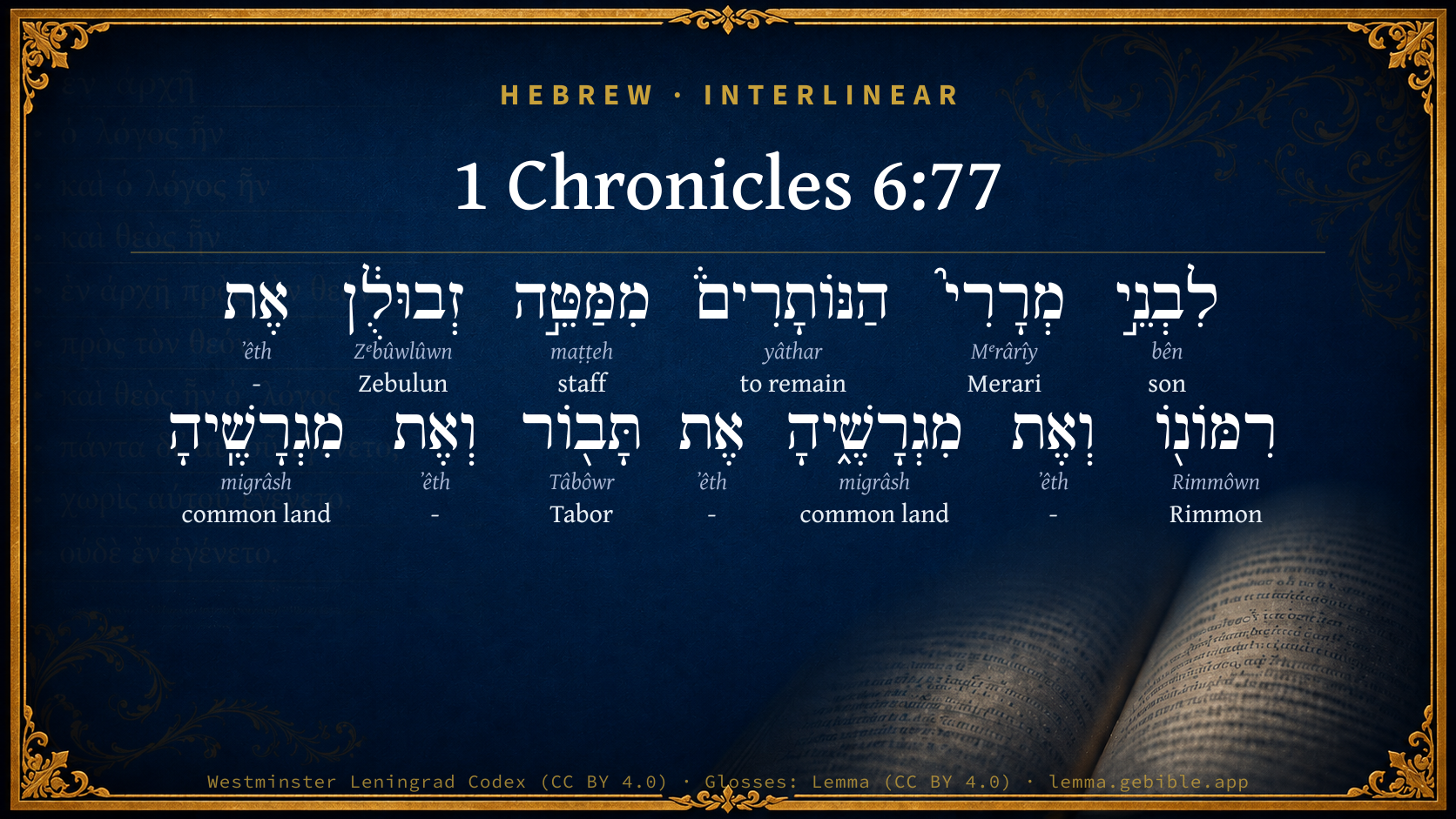
Hebrew (Westminster Leningrad Codex) 1 Chronicles 6:77 appears in the Hebrew Old Testament. The text above is from the Westminster Leningrad Codex. Each word links to its Strong’s number, a concise gloss, and parsing drawn from the Open Scriptures Hebrew Bible morphology. Click any word for its full Brown-Driver-Briggs (BDB) entry.
Download image
Cite this verse

1 Chronicles 6:77 (World English Bible). Public Domain. Lemma interlinear Bible study tool, https://lemma.gebible.app/v/1-chronicles/6/77.

Show BibTeX & RIS
BibTeX
RIS
English Translation
To the rest of [the Levites], the sons of Merari, [were given], out of the tribe of Zebulun, Rimmono with its suburbs, Tabor with its suburbs;
World English Bible · Public Domain
Download a study sheet

One document with this verse’s original text, its word-by-word gloss line, the meaning frame, cross-references with their text, attributed commentary, and full source and license credits — printable, and it pastes into notes with its structure intact.

This verse Autodidact and up

Study sheet (.html) Plain text (.txt)

A passage Seminary Student

Up to 50 verses in one chapter. A passage sheet keeps up to 6 commentary sources and 12 cross-references per verse, in the order this page ranks them, and says so on the sheet whenever that leaves anything out. Ask for a single verse and you get the Autodidact verse sheet above.

Everything on this page stays free to read, with no account — the sheet is a download of what is already on screen, not access to it.

Want to remove ads? Support Godless Engineer
Compare translations 3

The same verse in 3 English versions, stacked beneath the original-language interlinear above. Click any original word for its lexicon entry.

Each is an independent rendering of the whole verse — the interlinear is not word-aligned to these translations.

Highlighted words mark where these versions differ — a whole-verse word diff, not a word-by-word alignment.

  • World English Bible Public Domain
    To the rest of [the Levites], the sons of Merari, [were given], out of the tribe of Zebulun, Rimmono with its suburbs, Tabor with its suburbs;
  • King James Version Public Domain
    Unto the rest of the children of Merari were given out of the tribe of Zebulun, Rimmon with her suburbs, Tabor with her suburbs:
  • unfoldingWord Literal Text CC BY-SA 4.0
    To the remaining sons of Merari, from the tribe of Zebulun: Rimmono and its pasturelands, Tabor and its pasturelands,

unfoldingWord Literal Text — © unfoldingWord, licensed CC BY-SA 4.0. Word-aligned USFM3 via Door43 (git.door43.org/unfoldingWord/en_ult).

Versions to compare (up to 4)

3 of 4 selected

Show all 18 translations

Every available English version of this verse, each an independent rendering of the whole verse.

  • World English Bible Public Domain
    To the rest of [the Levites], the sons of Merari, [were given], out of the tribe of Zebulun, Rimmono with its suburbs, Tabor with its suburbs;
  • Berean Standard Bible Public Domain
    The Merarites (the rest of the Levites) received the following: From the tribe of Zebulun they were given Rimmono and Tabor, together with their pasturelands.
  • Majority Standard Bible Public Domain
    The Merarites (the rest of the Levites) received the following: From the tribe of Zebulun they were given Rimmono and Tabor, together with their pasturelands.
  • King James Version Public Domain
    Unto the rest of the children of Merari were given out of the tribe of Zebulun, Rimmon with her suburbs, Tabor with her suburbs:
  • American Standard Version (1901) Public Domain
    Unto the rest of `the Levites', the sons of Merari, `were given', out of the tribe of Zebulun, Rimmono with its suburbs, Tabor with its suburbs;
  • Revised Version (1885) Public Domain
    Unto the rest of the Levites, the sons of Merari, were given, out of the tribe of Zebulun, Rimmono with her suburbs, Tabor with her suburbs:
  • Geneva Bible (1599) Public Domain
    Vnto the rest of the children of Merari were giuen out of ye tribe of Zebulun Rimmon and her suburbes, Tabor and her suburbes,
  • Douay-Rheims (1899) Public Domain
    And to the sons of Merari that remained: out of the tribe of Zabulon, Remmono and its suburbs, and Thabor with its suburbs.
  • Young's Literal Translation Public Domain
    To the sons of Merari who are left, from the tribe of Zebulun, `are' Rimmon and its suburbs, Tabor and its suburbs;
  • Literal Standard Version CC BY-SA 4.0
    To the sons of Merari who are left, from the tribe of Zebulun: Rimmon and its outskirts, Tabor and its outskirts;
  • Unlocked Literal Bible CC BY-SA 4.0
    The rest of Merari's descendants received from the tribe of Zebulun: Jokneam, Kartah, and Rimmono with its pasturelands and Tabor with its pasturelands;
  • unfoldingWord Literal Text CC BY-SA 4.0
    To the remaining sons of Merari, from the tribe of Zebulun: Rimmono and its pasturelands, Tabor and its pasturelands,
  • Darby Bible Public Domain
    To the children of Merari that remained [were given] out of the tribe of Zebulun, Rimmono and its suburbs, [and] Tabor and its suburbs;
  • World Messianic Bible Public Domain
    To the rest of the Levites, the sons of Merari, were given, out of the tribe of Zebulun, Rimmono with its pasture lands, and Tabor with its pasture lands;
  • Webster's Bible Public Domain
    To the rest of the children of Merari were given out of the tribe of Zebulun, Rimmon with its suburbs, Tabor with its suburbs:
  • Free Bible Version CC BY-SA 4.0
    The rest of the descendants of Merari received the following. From the tribe of Zebulun: Jokneam, Kartah, Rimmono, and Tabor, together with their pasturelands;
  • Bible in Basic English Public Domain
    To the rest of the Levites, the sons of Merari, were given, out of the tribe of Zebulun, Rimmono with its outskirts, Tabor with its outskirts;
  • JPS Tanakh (1917) Public Domain
    (6-62) Unto the rest of the Levites, the sons of Merari, were given, out of the tribe of Zebulun, Rimmono with the open land about it, Tabor with the open land about it;

Literal Standard Version (2020), Covenant Press — licensed CC BY-SA 4.0. Text via the HelloAO Bible API (eBible.org). Unlocked Literal Bible (unfoldingWord) — licensed CC BY-SA 4.0. Text via the HelloAO Bible API (eBible.org). unfoldingWord Literal Text — © unfoldingWord, licensed CC BY-SA 4.0. Word-aligned USFM3 via Door43 (git.door43.org/unfoldingWord/en_ult). Free Bible Version, Dr. Jonathan Gallagher — licensed CC BY-SA 4.0. Text via the HelloAO Bible API (eBible.org).

Word by word

More ways to search: Search by grammar → Find every occurrence → Compare this word →

Practice this passage: Drill this verse → Learn its vocabulary →

תָּב֖וֹר
Tâbôwr
H8396
“Tabor”
Noun, Proper
Part of Speech
Noun
Type
Proper
Full BDB Definition

Origin: from a root corresponding to H8406

TWOT: None

Tabor = "mound" - a mountain in the plain of Esdraelon rising abruptly and insulated except for a narrow ridge on the west connecting it to the hills of Nazareth (noun proper mountain) - a town around the summit of Mount Tabor (1) (noun proper locative) - a city of the Merarite Levites located in the territory of Zebulun (noun proper locative) - the place of an oak tree which was on the homeward journey of Saul after he had been anointed by Samuel (noun proper arbour)
  1. לִבְנֵ֣י bên H1121 “to/for · sons of” Preposition + Noun, Common, Masculine, Plural, Construct
  2. מְרָרִי֮ Mᵉrârîy H4847 “Merari” Noun, Proper
  3. הַנּוֹתָרִים֒ yâthar H3498 “the · remaining” Particle, Definite Article + Verb, Niphal, Participle Active, Masculine, Plural, Absolute
  4. מִמַּטֵּ֣ה maṭṭeh H4294 “from · staff of” Preposition + Noun, Common, Masculine, Singular, Construct
  5. זְבוּלֻ֔ן Zᵉbûwlûwn H2074 “Zebulun” Noun, Proper
  6. אֶת ʼêth H853 “-” Particle, Direct Object
  7. רִמּוֹנ֖וֹ Rimmôwn H7417 “Rimmon” Noun, Proper
  8. וְאֶת ʼêth H853 “and · -” Conjunction + Particle, Direct Object
  9. מִגְרָשֶׁ֑יהָ migrâsh H4054 “common lands · her” Noun, Common, Masculine, Plural, Construct + Suffix, Personal, 3rd Person, Feminine, Singular
  10. אֶת ʼêth H853 “-” Particle, Direct Object
  11. וְאֶת ʼêth H853 “and · -” Conjunction + Particle, Direct Object
  12. מִגְרָשֶֽׁיהָ migrâsh H4054 “common lands · her” Noun, Common, Masculine, Plural, Construct + Suffix, Personal, 3rd Person, Feminine, Singular

About this verse

These counts appear in no published source. They are computed here, from the morphology-tagged text and Lemma’s own curated glosses. What Lemma adds →

13
words
9
distinct lemmas
Historical
section

Notable vocabulary

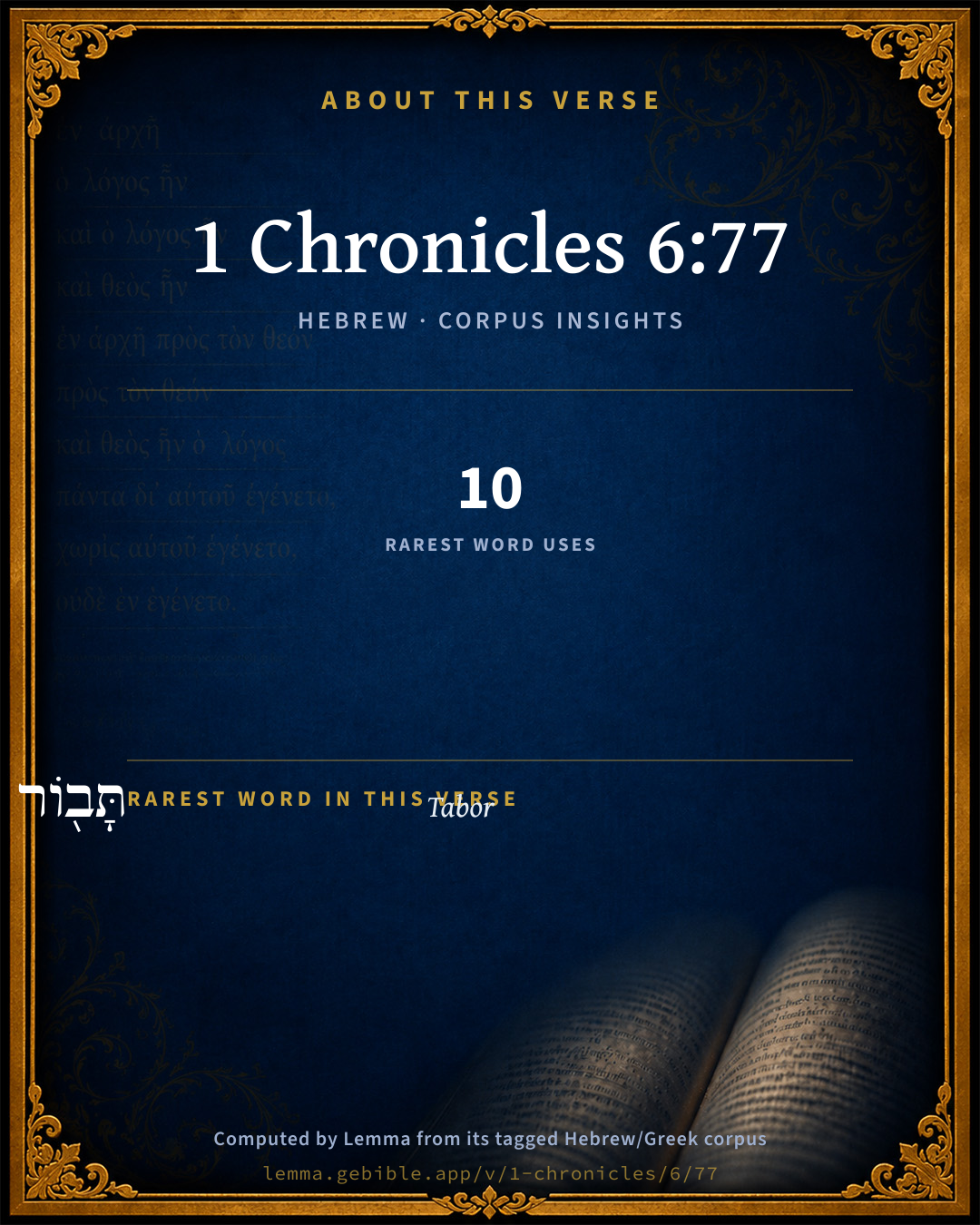
The rarest word here is תָּב֖וֹר Tabor H8396 — appearing just 10 times in the whole Hebrew Bible.

Shared distinctive vocabulary

תָּב֖וֹר Tabor H8396 occurs in 10 verses of the Hebrew Bible. Also found in:

Grammatical profile

  • 1 verb
  • 8 nouns
  • 4 particles

Verb forms

  • הַנּוֹתָרִים֒ Niphal · Participle Active

Repetition

A word recurs within this verse — often emphatic in Hebrew:

  • מִגְרָשֶׁ֑יהָ common land H4054 ×2

Hebrew & Septuagint length

In English translation the verse runs 26 words from the Hebrew and 25 from the Septuagint (LXX English) — closely comparable.

A rough comparison of the two English renderings, which tokenize alike — not a word-level alignment.

Word counts can differ between the Hebrew and the Greek without any difference in meaning — e.g. the Hebrew direct-object marker אֵת has no separate Greek word, and Greek often adds the article ὁ.

Cross-references

1

Topical passages linked to 1 Chronicles 6:77 in the Treasury of Scripture Knowledge — connected by theme and wording, ordered by reader-vote popularity; previews shown in the World English Bible.

  • Joshua 21:34–35 To the families of the children of Merari, the rest of the Levites, out of the tribe of Zebulun, Jokneam with its suburbs, and Kartah with its suburbs,

Cross-references courtesy of OpenBible.info (CC BY 4.0).

Hebrew and Greek witnesses Masoretic Hebrew ↔ Greek Septuagint

The same verse in the two great witnesses to the Old Testament, shown verse-for-verse.

These are two independent witnesses, not word-aligned to each other, and the Septuagint is shown in lemma (dictionary) form.

Hebrew 1 Chronicles 6:77 Masoretic · Westminster Leningrad Codex

לִבְנֵ֣י מְרָרִי֮ הַנּוֹתָרִים֒ מִמַּטֵּ֣ה זְבוּלֻ֔ן אֶת רִמּוֹנ֖וֹ וְאֶת מִגְרָשֶׁ֑יהָ אֶת תָּב֖וֹר וְאֶת מִגְרָשֶֽׁיהָ

To the rest of [the Levites], the sons of Merari, [were given], out of the tribe of Zebulun, Rimmono with its suburbs, Tabor with its suburbs;

World English Bible · Public Domain

Greek LXX 1 Chronicles 6:77 Septuagint · lemma form
To the sons of Merari that were left, they gave out of the tribe of Zabulon Remmon and her suburbs, and Thabor and her suburbs:

LXX2012 (modern English Septuagint) · Public Domain

Hebrew: Westminster Leningrad Codex (CC BY 4.0). Greek: Septuagint (public domain); English from LXX2012 (modern English Septuagint) (Public Domain). How the Septuagint differs from the Hebrew →

Commentary

Notes on 1 Chronicles 6:77 from classic Christian and Jewish commentators (each source and its license shown beneath its notes). The classic Christian expositions comment on the surrounding passage and are grouped to its opening verse, so a note may address several verses; the Jewish commentaries on the Tanakh (Rashi and others) are per-verse, so they appear only where the commentator wrote on this verse.

Lemma curates 59 commentaries, every one of them public domain or Creative Commons licensed, each selected and text-cleaned for this edition rather than reprinted as found. About our sources →

Ellicott's Commentary for English Readers

THE CITIES OF THE MERARITES.

(Comp. Jos_21:34-38.) 1Ch_6:77-81.

(77) Unto the rest of the children of Merari.—Rather, Unto the sons of Merari, the remaining Levites, as at Jos_21:34. The cities of the Kohathites and Gershonites having been rehearsed, it was natural to speak of the Merarites as “those who were left.”

Were given.—They gave, as before (1Ch_6:71).

Rimmon . . . Tabor.—Heb. Rimmônô. The reading of Jos_21:34-35 is quite different. We there find mention of Jokneam, Kartah, Dimnah, and Nahalal, “four cities.” The first pair of names may be accidentally omitted from our text. Dimnah, in Joshua, should probably be Rimmonah, answering to the present Rimmono or Rimmon (Jos_19:13). Rimmon, the Assyrian Rammânu. (See Note on 2Ki_5:18.) Nahalal is mentioned again (Jos_19:15) as a city-of Zebulun; while Tabor is only known as the name of the mountain which rises north-east of the plain of Esdraelon, and is famous as the traditional scene of the Transfiguration (Jdg_8:18; Psa_89:12). Nahalal means “pasture,” or “sheep-walk” = Nahalôl (Isa_7:19); and the original reading of our text may have been, Nahalal-tabôr (pasturage of Tabor)—a compound proper name like Hamm-thôdôr, and many-others.

(78, 79) Bezer in the wilderness.—A city of refuge (Deu_4:43). The phrase “on the east or Jordan” fixes the meaning of the indefinite expression “on the other side Jordan.”

Jahzah is a form of Jahaz, originally meaning, “to Jahaz.” (Comp. the modern names Stamboul = ἐς τὰν πόλιν, Stanchio = ἐς τὰν χίω) Jahaz was assigned to Reuben at the partition of Canaan (Jos_13:18), along with Kedemoth and Mephaath. Mesha, king of Moab, recovered it from Israel (see Note on 2Ki_1:1). Mephaath belonged to Moab temp. Jeremiah (Jer_48:21). It was, according to Jerome, a garrison town in the Roman age. (See also Jos_13:18; Jos_21:37; Deu_2:26.)

(80) Ramoth in Gilead.—A city of refuge (Jos_21:36). Jazer, Heshbon, Mahanaim, were given by Moses to the Gadites (Jos_13:25-26). Ramoth Gilead (see 1 Kings 22; 2 Chronicles 18, and 2Ki_8:28). Its position is unknown.

Mahanaim, now Maneh, lay on the north border of Gad.

(81) Heshbon, now Hesbân, on the south border of Gad. (See also Isa_15:4; Jer_48:2.)

Jazer belonged to Moab in the eighth century (Isa_16:8-9; Jer_48:32).

In regard to this entire list of the Levitical cities, it has been asserted that it is based upon a theory which is historically false; the theory, namely, that certain towns with their pasture-grounds were assigned by lot to the Levites for their exclusive possession. The objection is irrelevant, for the sacred records neither affirm nor imply that none but Levitical families dwelt in the forty-eight Levitical cities. It is à priori probable that the bulk of their population would be ordinary Israelites of the tribes in which they were situated. (Comp. Lev_25:32-34, and 1Ch_6:55-57 supra, and Num_35:1-5.)

Variations in local names, such as we have noted in comparing this list with those in Joshua, are not at all surprising, when it is remembered that centuries elapsed between the composition of the two books; and that names of places, like other names, are liable to phonetic change in the course of time. Something also must be allowed for errors of transcription.

A Bible Commentary for English Readers, edited by Charles John Ellicott (1878–1897) — public domain. Text from a community e-Sword module.

Geneva Bible (1599)

Geneva Bible translators

Or, Kartah, Josh. 21:34.

Or, Jokneam.

Geneva Bible (1599) marginal notes — public domain. Text via Bolls.life.

Adam Clarke's Commentary

Verse 77. 1Ch 6:71.

Adam Clarke's Commentary on the Bible (1810–1826) — public domain. Text from a community e-Sword/MySword module.

The Cambridge Bible for Schools and Colleges

gen. ed. J. J. S. Perowne

77–81 (= Jos_21:34-39). The [twelve] cities of the sons of Merari

77. Rimmon … Tabor] Against these two names there are four in Jos_21:34-35; Jokneam, Kartah, Dimnah and Nahalal. As regards the number of the cities the text of Joshua is certainly right. See Critical Note on 1Ch_6:54-81.

Tabor] No city, but only a mountain named Tabor is known to us, as having certainly existed in Old Testament times. A city however named Tabor existed on the Mountain as early as 218 b.c., and it may have been as old as the times of the Chronicler. Mount Tabor was in Zebulun. Cp. Bädeker, p. 248.

The Cambridge Bible for Schools and Colleges (gen. ed. J. J. S. Perowne; Cambridge University Press, 1878–1918) — public domain. Text from a community e-Sword module.

Haydock's Catholic Bible Commentary

Remmono and Thabor, or, Jecham and Cartha. (Haydock) --- Damna and Naalol are here omitted, Josue xxi. 35. There was formerly a town on Thabor, perhaps called Ceselet Thabor, Josue xix. 12., and Judges iv. 6. (Calmet)

George Leo Haydock (1774–1849), Haydock's Catholic Family Bible and Commentary, 1859 edition — public domain. Excludes Psalms (Douay-Rheims chapter numbering differs from Protestant) and Deuterocanonical books (Catholic canon only).

The Pulpit Commentary

Unto the rest of the children of Merari. Since none have yet been spoken of as having received their cities, we find the explanation of these words in their order in Jos_21:34, "Unto the families of the children of Merari, the rest of the Levites." To our list here, Jokneam and Kartah (Jos_21:34) need to be supplied, and Rimmon and Tabor here appear, (Jos_21:35) there as Dimnah and Nahalai.

The Pulpit Commentary (1880–1919), ed. H.D.M. Spence-Jones & Joseph S. Exell — public domain. Text from a community e-Sword module.

unfoldingWord translationNotes

Door43 World Missions Community

General Information:

See: How to Translate Names

The rest ... descendants received from the tribe of Zebulun

This can be translated in active form. AT: "The tribe of Zebulun gave the rest ... descendants" (See: Active or Passive)

Merari's

Translate "Merari" as in 1 Chronicles 6:1.

Rimmono ... and Tabor ... Bezer ... Jahzah ... Kedemoth ... Mephaath

These are all names of towns. (See: How to Translate Names)

its pasturelands

the land with grass for animals to eat. See how you translated this in 1 Chronicles 5:16.

and from the tribe of Reuben

The information in 1 Chronicles 6:78-79 has been rearranged so its meaning can be more easily understood. (See: Verse Bridges)

from the tribe of Reuben

This can be translated in active form. AT: "the tribe of Reuben gave these" or "they also received these from the tribe of Reuben" (See: Active or Passive)

translationWords

Levi

Zebulun

Jordan River

Jericho

desert

Reuben

unfoldingWord translationNotes — © Distant Shores Media and the Door43 World Missions Community, licensed CC BY-SA 4.0. Source: git.door43.org/Door43/en_tn.

Lesson kit

Teaching starters — assembled from the data on this page, not authored interpretation. Every prompt links to the verse data it draws on. Edit before teaching.

1 Chronicles, in the Historical, opens this verse with 13 words (9 distinct Hebrew lemmas). Its most distinctive word is Tâbôwr (“Tabor”). A historical commentator’s framing appears above. Read the whole chapter for the surrounding context.

Discussion questions

  1. The word Tâbôwr carries the sense “Tabor.” How does it shape the verse?
  2. How does Joshua 19:22, which shares the word «Tabor», read alongside this verse?
  3. What does the repetition of “common land” (2× in this one verse) do in this verse?
  4. These translations render this verse differently. What is at stake in choosing one wording over another?
  5. «הַנּוֹתָרִים֒» is a Niphal Participle Active verb. How does that grammatical form shape the action described?
  6. Compare how Ellicott's Commentary for English Readers and Geneva Bible (1599) read this verse. Where do they agree or differ?

Things to notice

  • These translations choose different wording for 11 words in this verse.
  • “common land” occurs 2× in this single verse.
  • 9 distinct Hebrew lemmas span 13 words in this verse.

Reading settings

Reading text

Shown beneath each verse's original-language words.

Old Testament
Old Testament edition

Read the OT as the Masoretic Hebrew (MT) or the Greek Septuagint (LXX).

English shown for the Greek Septuagint (in the Hebrew ↔ Greek comparison).

Comparing translations? Open the Compare panel on any verse page to stack up to four side by side.