
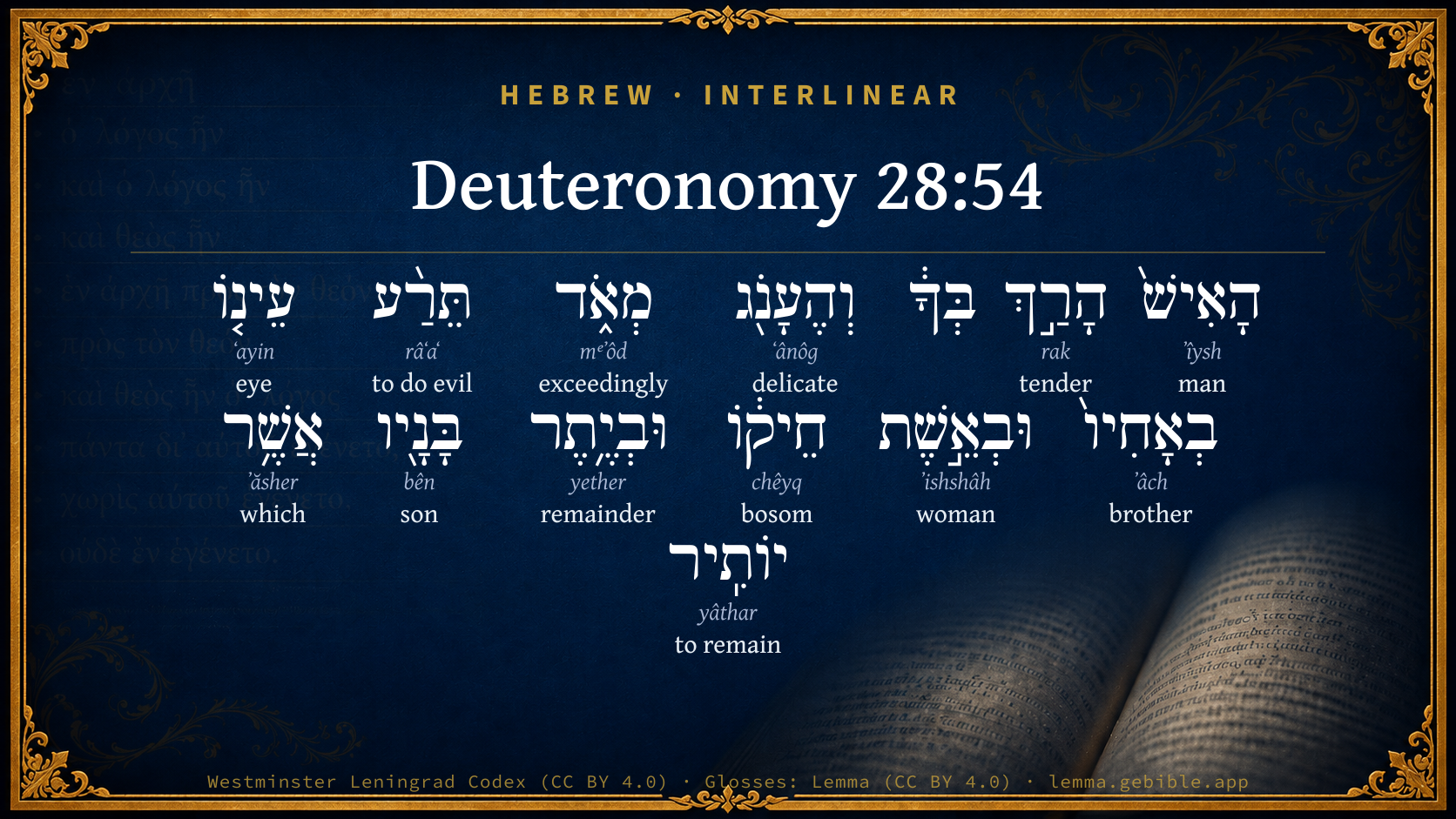
Deuteronomy 28:54

Hebrew (Westminster Leningrad Codex) Deuteronomy 28:54 appears in the Hebrew Old Testament. The text above is from the Westminster Leningrad Codex. Each word links to its Strong’s number, a concise gloss, and parsing drawn from the Open Scriptures Hebrew Bible morphology. Click any word for its full Brown-Driver-Briggs (BDB) entry.
Download image
Cite this verse

Deuteronomy 28:54 (World English Bible). Public Domain. Lemma interlinear Bible study tool, https://lemma.gebible.app/v/deuteronomy/28/54.

Show BibTeX & RIS
BibTeX
RIS
English Translation
The man who is tender among you, and very delicate, his eye shall be evil toward his brother, and toward the wife of his bosom, and toward the remnant of his children whom he has remaining;
World English Bible · Public Domain
Highlights
  • 1 first appearance in the Hebrew Bible
Full analysis ↓
Download a study sheet

One document with this verse’s original text, its word-by-word gloss line, the meaning frame, cross-references with their text, attributed commentary, and full source and license credits — printable, and it pastes into notes with its structure intact.

This verse Autodidact and up

Study sheet (.html) Plain text (.txt)

A passage Seminary Student

Up to 50 verses in one chapter. A passage sheet keeps up to 6 commentary sources and 12 cross-references per verse, in the order this page ranks them, and says so on the sheet whenever that leaves anything out. Ask for a single verse and you get the Autodidact verse sheet above.

Everything on this page stays free to read, with no account — the sheet is a download of what is already on screen, not access to it.

Want to remove ads? Support Godless Engineer
Compare translations 3

The same verse in 3 English versions, stacked beneath the original-language interlinear above. Click any original word for its lexicon entry.

Each is an independent rendering of the whole verse — the interlinear is not word-aligned to these translations.

Highlighted words mark where these versions differ — a whole-verse word diff, not a word-by-word alignment.

  • World English Bible Public Domain
    The man who is tender among you, and very delicate, his eye shall be evil toward his brother, and toward the wife of his bosom, and toward the remnant of his children whom he has remaining;
  • King James Version Public Domain
    So that the man that is tender among you, and very delicate, his eye shall be evil toward his brother, and toward the wife of his bosom, and toward the remnant of his children which he shall leave:
  • unfoldingWord Literal Text CC BY-SA 4.0
    The tender man among you and the very delicate, his eye will do wrong against his brother and against the wife of his bosom and against the remainder of his children who remain,

unfoldingWord Literal Text — © unfoldingWord, licensed CC BY-SA 4.0. Word-aligned USFM3 via Door43 (git.door43.org/unfoldingWord/en_ult).

Versions to compare (up to 4)

3 of 4 selected

Show all 18 translations

Every available English version of this verse, each an independent rendering of the whole verse.

  • World English Bible Public Domain
    The man who is tender among you, and very delicate, his eye shall be evil toward his brother, and toward the wife of his bosom, and toward the remnant of his children whom he has remaining;
  • Berean Standard Bible Public Domain
    The most gentle and refined man among you will begrudge his brother, the wife he embraces, and the rest of his children who have survived,
  • Majority Standard Bible Public Domain
    The most gentle and refined man among you will begrudge his brother, the wife he embraces, and the rest of his children who have survived,
  • King James Version Public Domain
    So that the man that is tender among you, and very delicate, his eye shall be evil toward his brother, and toward the wife of his bosom, and toward the remnant of his children which he shall leave:
  • American Standard Version (1901) Public Domain
    The man that is tender among you, and very delicate, his eye shall be evil toward his brother, and toward the wife of his bosom, and toward the remnant of his children whom he hath remaining;
  • Revised Version (1885) Public Domain
    The man that is tender among you, and very delicate, his eye shall be evil toward his brother, and toward the wife of his bosom, and toward the remnant of his children which he hath remaining:
  • Geneva Bible (1599) Public Domain
    So that the man (that is tender and exceeding deintie among you) shalbe grieued at his brother, and at his wife, that lieth in his bosome, and at the remnant of his children, which hee hath yet left,
  • Douay-Rheims (1899) Public Domain
    The man that is nice among you, and very delicate, shall envy his own brother, and his wife, that lieth in his bosom,
  • Young's Literal Translation Public Domain
    `The man who is tender in thee, and who `is' very delicate -- his eye is evil against his brother, and against the wife of his bosom, and against the remnant of his sons whom he leaveth,
  • Literal Standard Version CC BY-SA 4.0
    The man who is tender in you, and who [is] very delicate—his eye is evil against his brother, and against the wife of his bosom, and against the remnant of his sons whom he leaves,
  • Unlocked Literal Bible CC BY-SA 4.0
    The man who is tender and very delicate among you—he will be envious of his brother and his own dear wife, and of whatever children he has left.
  • unfoldingWord Literal Text CC BY-SA 4.0
    The tender man among you and the very delicate, his eye will do wrong against his brother and against the wife of his bosom and against the remainder of his children who remain,
  • Darby Bible Public Domain
    The eye of the man in thy midst that is tender and very luxurious shall be evil towards his brother, and the wife of his bosom, and the residue of his children which he hath left;
  • World Messianic Bible Public Domain
    The man who is tender among you, and very delicate, his eye will be evil toward his brother, toward the wife whom he loves, and toward the remnant of his children whom he has remaining,
  • Webster's Bible Public Domain
    So that the man that is tender among you, and very delicate, his eye shall be evil towards his brother, and towards the wife of his bosom, and towards the remnant of his children whom he shall leave:
  • Free Bible Version CC BY-SA 4.0
    The kindest and most sensitive man among you will refuse to share his food with his brother, the wife he loves, and those of his own children who are left.
  • Bible in Basic English Public Domain
    That man among you who is soft and used to comfort will be hard and cruel to his brother, and to his dear wife, and to of those his children who are still living;
  • JPS Tanakh (1917) Public Domain
    The man that is tender among you, and very delicate, his eye shall be evil against his brother, and against the wife of his bosom, and against the remnant of his children whom he hath remaining;

Literal Standard Version (2020), Covenant Press — licensed CC BY-SA 4.0. Text via the HelloAO Bible API (eBible.org). Unlocked Literal Bible (unfoldingWord) — licensed CC BY-SA 4.0. Text via the HelloAO Bible API (eBible.org). unfoldingWord Literal Text — © unfoldingWord, licensed CC BY-SA 4.0. Word-aligned USFM3 via Door43 (git.door43.org/unfoldingWord/en_ult). Free Bible Version, Dr. Jonathan Gallagher — licensed CC BY-SA 4.0. Text via the HelloAO Bible API (eBible.org).

Word by word

More ways to search: Search by grammar → Find every occurrence → Compare this word →

Practice this passage: Drill this verse → Learn its vocabulary →

וְהֶעָנֹ֖ג
ʻânôg
H6028
“and · the · delicate”
Conjunction + Particle, Definite Article + Adjective, Adjective, Masculine, Singular, Absolute
Part of Speech
Conjunction + Particle + Adjective
Type
Adjective
Gender
Masculine
Number
Singular
State
Absolute
Full BDB Definition

Origin: from H6026

TWOT: 1648b

dainty, delicate
  1. הָאִישׁ֙ ʼîysh H376 “the · man” Particle, Definite Article + Noun, Common, Masculine, Singular, Absolute
  2. הָרַ֣ךְ rak H7390 “the · tender” Particle, Definite Article + Adjective, Adjective, Masculine, Singular, Absolute
  3. מְאֹ֑ד mᵉʼôd H3966 “exceedingly” Adverb
  4. תֵּרַ֨ע râʻaʻ H7489 “to do evil” Verb, Qal, Imperfect, 3rd Person, Feminine, Singular
  5. עֵינ֤וֹ ʻayin H5869 “eye · his” Noun, Common, Both, Singular, Construct + Suffix, Personal, 3rd Person, Masculine, Singular
  6. בְאָחִיו֙ ʼâch H251 “in/at · brother · his” Preposition + Noun, Common, Masculine, Singular, Construct + Suffix, Personal, 3rd Person, Masculine, Singular
  7. וּבְאֵ֣שֶׁת ʼishshâh H802 “and · in/at · woman of” Conjunction + Preposition + Noun, Common, Feminine, Singular, Construct
  8. חֵיק֔וֹ chêyq H2436 “bosom · his” Noun, Common, Masculine, Singular, Construct + Suffix, Personal, 3rd Person, Masculine, Singular
  9. וּבְיֶ֥תֶר yether H3499 “and · in/at · remainder of” Conjunction + Preposition + Noun, Common, Masculine, Singular, Construct
  10. בָּנָ֖יו bên H1121 “sons · his” Noun, Common, Masculine, Plural, Construct + Suffix, Personal, 3rd Person, Masculine, Singular
  11. אֲשֶׁ֥ר ʼăsher H834 “which” Particle, Relative
  12. יוֹתִֽיר yâthar H3498 “to remain” Verb, Hiphil, Imperfect, 3rd Person, Masculine, Singular

About this verse

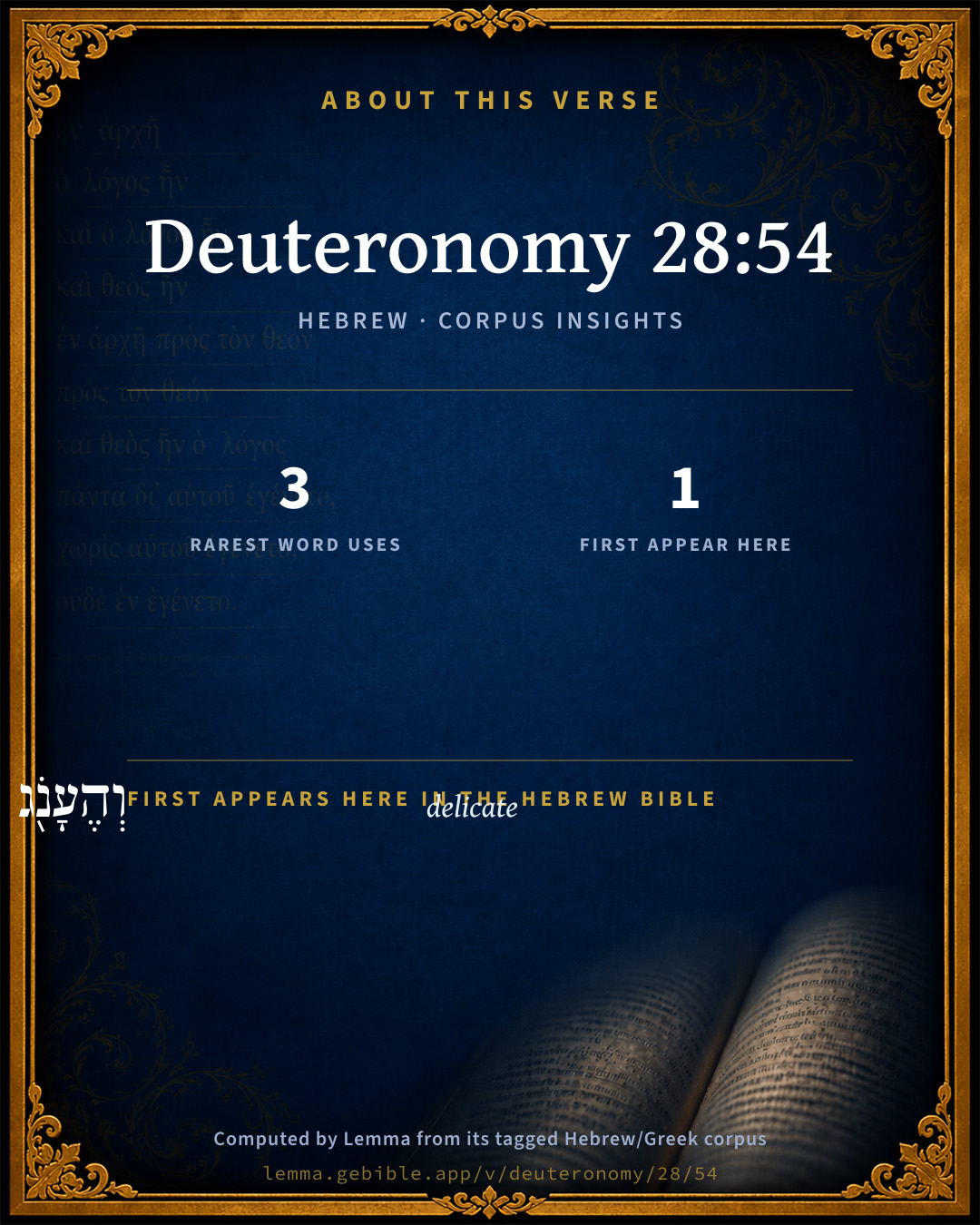
These counts appear in no published source. They are computed here, from the morphology-tagged text and Lemma’s own curated glosses. What Lemma adds →

14
words
13
distinct lemmas
Pentateuch
section

Notable vocabulary

The rarest word here is וְהֶעָנֹ֖ג delicate H6028 — appearing just 3 times in the whole Hebrew Bible.

First appearance in Scripture

This word makes its first canonical appearance in the Hebrew Bible here:

  • וְהֶעָנֹ֖ג delicate H6028

Shared distinctive vocabulary

וְהֶעָנֹ֖ג delicate H6028 occurs in 3 verses of the Hebrew Bible. Also found in:

Grammatical profile

  • 2 verbs
  • 7 nouns
  • 2 adjectives
  • 1 preposition
  • 1 adverb
  • 1 particle

Verb forms

  • תֵּרַ֨ע Qal · Imperfect
  • יוֹתִֽיר Hiphil · Imperfect

Hebrew & Septuagint length

In English translation the verse runs 36 words from the Hebrew and 37 from the Septuagint (LXX English) — closely comparable.

A rough comparison of the two English renderings, which tokenize alike — not a word-level alignment.

Word counts can differ between the Hebrew and the Greek without any difference in meaning — e.g. the Hebrew direct-object marker אֵת has no separate Greek word, and Greek often adds the article ὁ.

Cross-references

11

Topical passages linked to Deuteronomy 28:54 in the Treasury of Scripture Knowledge — connected by theme and wording, ordered by reader-vote popularity; previews shown in the World English Bible.

  • Deuteronomy 15:9 Beware that there not be a base thought in your heart, saying, The seventh year, the year of release, is at hand; and your eye be evil against your poor brother, and you give him nothing; and he cry to Yahweh against you, and it be sin to you.
  • Deuteronomy 13:6 If your brother, the son of your mother, or your son, or your daughter, or the wife of your bosom, or your friend, who is as your own soul, entice you secretly, saying, Let us go and serve other gods, which you have not known, you, nor your fathers;
  • Matthew 20:15 Isn't it lawful for me to do what I want to with what I own? Or is your eye evil, because I am good?'
  • 2 Samuel 12:3 but the poor man had nothing, except one little ewe lamb, which he had bought and raised. It grew up together with him, and with his children. It ate of his own food, drank of his own cup, and lay in his bosom, and was to him like a daughter.
  • Psalms 103:13 Like a father has compassion on his children, So Yahweh has compassion on those who fear him.
  • Proverbs 23:6 Don't eat the food of him who has a stingy eye, And don't crave his delicacies:
  • Proverbs 28:22 A stingy man hurries after riches, And doesn't know that poverty waits for him.
  • Isaiah 49:15 Can a woman forget her sucking child, that she should not have compassion on the son of her womb? yes, these may forget, yet I will not forget you.
  • Micah 7:5 Don't trust in a neighbor. Don't put confidence in a friend. With the woman lying in your embrace, Be careful of the words of your mouth!
  • Matthew 7:9–11 Or who is there among you, who, if his son asks him for bread, will give him a stone?
  • Luke 11:11–13 "Which of you fathers, if your son asks for bread, will give him a stone? Or if he asks for a fish, he won't give him a snake instead of a fish, will he?

Cross-references courtesy of OpenBible.info (CC BY 4.0).

Hebrew and Greek witnesses Masoretic Hebrew ↔ Greek Septuagint

The same verse in the two great witnesses to the Old Testament, shown verse-for-verse.

These are two independent witnesses, not word-aligned to each other, and the Septuagint is shown in lemma (dictionary) form.

Hebrew Deuteronomy 28:54 Masoretic · Westminster Leningrad Codex

הָאִישׁ֙ הָרַ֣ךְ בְּךָ֔ וְהֶעָנֹ֖ג מְאֹ֑ד תֵּרַ֨ע עֵינ֤וֹ בְאָחִיו֙ וּבְאֵ֣שֶׁת חֵיק֔וֹ וּבְיֶ֥תֶר בָּנָ֖יו אֲשֶׁ֥ר יוֹתִֽיר

The man who is tender among you, and very delicate, his eye shall be evil toward his brother, and toward the wife of his bosom, and toward the remnant of his children whom he has remaining;

World English Bible · Public Domain

Greek LXX Deuteronomy 28:54 Septuagint · lemma form

ὁ ἁπαλός ἐν σύ καί ὁ τρυφερός σφόδρα βασκαίνω ὁ ὀφθαλμός ὁ ἀδελφός καί ὁ γυνή ὁ ἐν ὁ κόλπος αὐτός καί ὁ καταλείπω τέκνον ὅς ἄν καταλείπω

He that is tender and very delicate within you shall look with an evil eye upon his brother, and the wife in his bosom, and the children that are left, which may have been left to him;

LXX2012 (modern English Septuagint) · Public Domain

Hebrew: Westminster Leningrad Codex (CC BY 4.0). Greek: Septuagint (public domain); English from LXX2012 (modern English Septuagint) (Public Domain). How the Septuagint differs from the Hebrew →

Targum (Aramaic paraphrase)

2

The Targum is the ancient Jewish Aramaic paraphrase of the Hebrew Scriptures — an interpretive translation, not the Hebrew text itself. Onkelos (literal) and Pseudo-Jonathan (expansive) render the Torah, and Jonathan the Prophets. Coverage is partial: where no permissively-licensed English translation exists for a verse, only the Aramaic is shown. This is verse-level text, not a word-by-word alignment to the Hebrew.

  1. Targum Onkelos Torah (Genesis–Deuteronomy)
    גַבְרָא דְרַכִּיךְ בָּךְ וְדִמְפַנַק לַחֲדָא תַּבְאֵשׁ עֵינֵהּ בְּאָחוּהִי וּבְאִתַּת קְיָמֵהּ וּבִשְׁאָר בְּנוֹהִי דִי יַשְׁאַר

    (no public-domain English translation for this verse)

    Targum Onkelos — Aramaic: “Onkelos Genesis” (public domain); “Onkelos Exodus” (public domain); “Onkelos Leviticus” (public domain); “Onkelos Numbers” (public domain); “Onkelos Deuteronomy” (public domain). English: “Sefaria Community Translation” (CC0 1.0 (public-domain dedication)); “J.W. Etheridge. The Targums of Onkelos and Jonathan Ben Uzziel on the Pentateuch. London: Longmans, Green, 1862” (public domain). Text via Sefaria.

  2. Targum Pseudo-Jonathan Torah (Genesis–Deuteronomy)
    גַבְרָא דְמֶחְטֵי בְּכוֹן וְדִימְפַרְנֵק לַחֲדָא תַּבְאֵשׁ עַיְינֵיהּ בְּאָחוֹי וּבְאִתְּתָא דְדָמְכָה בְּעוֹבֵיהּ וּבְשָׁיֵיר בְּנוֹי דִישַׁיֵיר

    The man who is gentle and refined among you will look with evil eyes upon his brother, and the wife who reposeth on his bosom, and upon the rest of his children who remain.

    Targum Pseudo-Jonathan — Aramaic: “Targum Jonathan on Genesis” (public domain); “Targum Jonathan on Exodus” (public domain); “Targum Jonathan on Leviticus” (public domain); “Targum Jonathan on Numbers” (public domain); “Targum Jonathan on Deuteronomy” (public domain). English: “The Targum of Jonathan ben Uzziel, trans. J. W. Etheridge, London, 1862” (public domain). Text via Sefaria.

Commentary

Notes on Deuteronomy 28:54 from classic Christian and Jewish commentators (each source and its license shown beneath its notes). The classic Christian expositions comment on the surrounding passage and are grouped to its opening verse, so a note may address several verses; the Jewish commentaries on the Tanakh (Rashi and others) are per-verse, so they appear only where the commentator wrote on this verse.

Lemma curates 59 commentaries, every one of them public domain or Creative Commons licensed, each selected and text-cleaned for this edition rather than reprinted as found. About our sources →

Trapp's Complete Commentary

John Trapp

Deu 28:54 [So that] the man [that is] tender among you, and very delicate, his eye shall be evil toward his brother, and toward the wife of his bosom, and toward the remnant of his children which he shall leave:

Ver. 54. His eye shall be evil,] i.e., Envious and grutchful.

John Trapp, A Commentary or Exposition upon All the Books of the Old and New Testament (1647–1656) — public domain. Text from a community e-Sword module.

Joseph Benson's Commentary

Deu 28:54-55. His eye shall be evil toward his brother — His wants will make him throw off all distinction of, and compassion for, his nearest and dearest relations. Hunger will make him snatch the meat out of the mouths of his own children, and grudge every morsel that they eat. Accordingly Josephus informs us that wives forced away the meat out of the very mouths of their husbands, children of their parents, and, what was yet more unnatural, mothers of their infants, taking away from them, as they lay languishing in their arms, the very last support of life. Nay, he tells us that “in every house, if there appeared any semblance of food, a battle ensued, and the dearest friends and relations fought with one another, snatching away the miserable provisions of life.” So, literally, were the words of Moses fulfilled! — Bel. Jud., lib. 5. cap. 10, sect. 3; and lib. 6. cap. 3, sect. 3.

Joseph Benson's Commentary on the Old and New Testaments (1811–1818) — public domain. Text from a community e-Sword module.

Tyndale Open Study Notes

Tyndale Open Resources

28:54 A tenderhearted man was sheltered from the dark and disgusting side of life. He had never experienced the horrors that would befall him.

Tyndale Open Study Notes — © Tyndale Open Resources, licensed CC BY-SA 4.0. Text via the HelloAO Bible API.

The Cambridge Bible for Schools and Colleges

gen. ed. J. J. S. Perowne

54. The man that is the most tender among you, and the very most delicate] or dainty. The same adjs. in Isa_47:1.

his eye shall be evil] See on Deu_15:9.

The Cambridge Bible for Schools and Colleges (gen. ed. J. J. S. Perowne; Cambridge University Press, 1878–1918) — public domain. Text from a community e-Sword module.

John Gill's Exposition

If thou wilt not observe to do all the words this law, that are written in this book,.... Of Deuteronomy, in which there is a repetition of the laws before delivered, and an addition of some new ones; all which were to be so observed as to be done, to this end:

that thou mayest fear this glorious and fearful name of the Lord thy God; or that it might appear that the fear of God was before their eyes, and in their hearts, by their obedience to his law; that they had a proper awe and reverence of him, who is glorious in his titles and attributes, and whose name Jehovah is holy and reverend; and who, as the covenant God of his people, is to, be feared for his goodness sake.

John Gill's Exposition of the Whole Bible (1746–1763) — public domain (CC PDM 1.0). Text via the HelloAO Bible API.

Haydock's Catholic Bible Commentary

Delicate, (luxuriosis,) abandoned to his pleasures. Josephus (Jewish Wars vi. 11,) seems to have had this passage in view, when he informs us, that parents and children snatched from each other’s mouths the wretched food, with which they endeavoured to support themselves. (Calmet)

George Leo Haydock (1774–1849), Haydock's Catholic Family Bible and Commentary, 1859 edition — public domain. Excludes Psalms (Douay-Rheims chapter numbering differs from Protestant) and Deuterocanonical books (Catholic canon only).

Matthew Poole's English Annotations

Evil, i.e. unkind, envious, covetous, to monopolize these dainty bits to themselves, and grudging that their dearest relations should have any part of them.

Matthew Poole's English Annotations on the Holy Bible (1683–1685) — public domain. Text from a community e-Sword/MySword module.

John Wesley's Explanatory Notes

Evil - Unkind, envious, covetous to monopolize these dainty bits to themselves, and grudging that their dearest relations should have any part of them.

John Wesley, Explanatory Notes Upon the Whole Bible (1754–1765) — public domain. Text via the GEBible commentary corpus.

unfoldingWord translationNotes

Door43 World Missions Community

General Information:

Moses speaks to the Israelites as if they were one man, so the words "you" and "your" here are singular. (See: Forms of You)

who is tender and very delicate among you—he

"who is tender and very delicate among you—even he." Moses is saying that not only those one would expect to eat their children, but even the last person one would expect to eat his own children will eat his children.

all your city gates

Here "city gates" represents the cities themselves. AT: "all your cities" (See: Synecdoche)

translationWords

envy

siege

adversary

gate

unfoldingWord translationNotes — © Distant Shores Media and the Door43 World Missions Community, licensed CC BY-SA 4.0. Source: git.door43.org/Door43/en_tn.

Rashi

Rabbi Shlomo Yitzchaki (Rashi)

הרך בך והענג THE MOST TENDER AMONG YOU AND THE DELICATE — רך and ענג are one and the same person; the words denote delicate living. The expressions in v. 56 ומהתענג ומרך prove regarding them that both of them (the two descriptive terms) refer to one person. The meaning of the verse is: Although he may be fastidious and his nature sickens at anything nauseous, yet the flesh of his sons and daughters will be so pleasant to him on account of his hunger, that תרע עינו HIS EYE WILL BE EVIL towards his remaining children, מתת לאחד מהם מבשר בניו THAT HE WILL NOT GIVE TO ANY OF THEM THE FLESH OF HIS CHILDREN — their brothers, אשר יאכל WHOM HE WILL EAT. — Another explanation of הרך בך is: the merciful and tender-hearted will become cruel because of the great hunger and will not give of the flesh of their children who have been killed to their remaining children.

Rashi on the Tanakh — English translations: “The Judaica Press complete Tanach with Rashi, translated by A. J. Rosenberg” (CC BY 4.0); “Pentateuch with Rashi's commentary by M. Rosenbaum and A.M. Silbermann, 1929-1934” (public domain); “The Metsudah Tanach series, Lakewood, N.J” (CC BY 4.0); and “The Book of Joshua, Metsudah Publications, 1997” (CC BY 4.0). Text via Sefaria.

Lesson kit

Teaching starters — assembled from the data on this page, not authored interpretation. Every prompt links to the verse data it draws on. Edit before teaching.

Deuteronomy, in the Pentateuch, opens this verse with 14 words (13 distinct Hebrew lemmas). Its most distinctive word is ʻânôg (“delicate”). A historical commentator’s framing appears above. Read the whole chapter for the surrounding context.

Discussion questions

  1. What does “delicate” (ʻânôg) contribute to the verse as a whole?
  2. The word “delicate” first appears here in Scripture. What is being introduced at this debut?
  3. Deuteronomy 28:56 shares the word «delicate» with this verse. How do the two illuminate each other?
  4. The translations on this page render this verse differently — a whole-verse word diff, not a word-by-word alignment. What might account for the different wordings?
  5. The verb «תֵּרַ֨ע» is Qal Imperfect. How does its form color the action?
  6. Reading how Trapp's Complete Commentary and Joseph Benson's Commentary read this verse, where do the two commentators agree and where do they part?

Things to notice

Reading settings

Reading text

Shown beneath each verse's original-language words.

Old Testament
Old Testament edition

Read the OT as the Masoretic Hebrew (MT) or the Greek Septuagint (LXX).

English shown for the Greek Septuagint (in the Hebrew ↔ Greek comparison).

Comparing translations? Open the Compare panel on any verse page to stack up to four side by side.