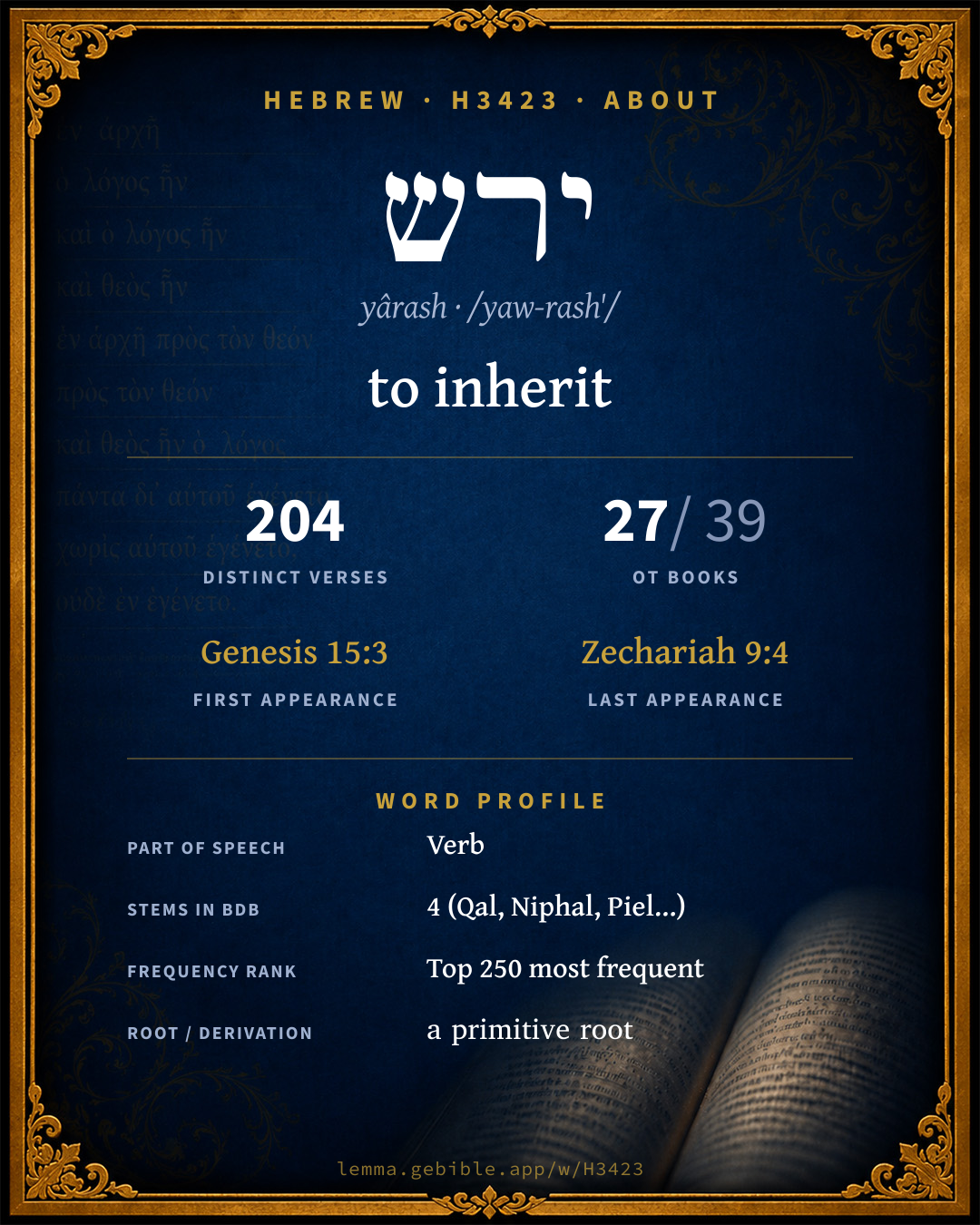
יָרַשׁ
to inherit
‘to inherit’ is one of 3 main senses fuller range ↓
Full lexicon entry — Brown-Driver-Briggs (BDB)
From Brown-Driver-Briggs (BDB)
Where this word appears
See every Qal verb in the Hebrew Bible →
Grammar key — what these labels mean
Part of speech
- Verb
- An action or state-of-being word.
Stem
- Qal
- The basic, simple active stem — the plain form of the verb (“he wrote”). Here: ‘take possession of’
- Hiphil
- The causative active stem (“he caused / brought about”). Here: ‘cause to possess’
- Niphal
- Usually the simple passive or reflexive of the Qal (“he was written”).
- Piel
- An intensive or resultative active stem.
Form
- Infinitive Construct
- A bound verbal noun, frequently with prepositions (“to write / in writing”).
- Perfect
- A completed action or state — Hebrew marks aspect (completeness) more than strict tense (“he wrote”).
- Sequential Imperfect
- An imperfect with prefixed waw — the standard past-narrative form (waw-consecutive imperfect).
- Imperfect
- An incomplete, ongoing, or future action (“he will / would write”).
- Sequential Perfect
- A perfect with prefixed waw continuing a preceding imperfect or command (waw-consecutive perfect).
- Participle Active
- A verbal adjective expressing ongoing or characteristic action (“writing / one who writes”).
- Imperative
- A direct command (“write!”).
- Infinitive Absolute
- An unbound verbal noun, often intensifying or standing in for a finite verb.
- Jussive
- A third- or second-person volitional form expressing wish or command (“let him write”).
- Cohortative
- A first-person volitional form expressing wish or resolve (“let me / let us write”).
State
- Absolute
- The independent form of a noun, not bound to a following word.
- Construct
- A noun bound to a following noun in a possessive / “of” relationship (the construct chain).
Person
- 3rd Person
- The one spoken about (“he / she / it / they”).
- 2nd Person
- The one addressed (“you”).
- 1st Person
- The speaker (“I / we”).
Gender
- Masculine
- Grammatically masculine.
- Common
- Either gender — not distinguished for this form.
- Feminine
- Grammatically feminine.
Number
- Singular
- One.
- Plural
- More than one (in Hebrew, generally three or more).
61 distinct verses where H3423 appears in the Hiphil stem, across 13 books. Filtered view — show all forms. Click any verse to open its interlinear word-by-word view. Verse text shown in the World English Bible for context — . Each verse’s Hebrew form is shown with its reference; the English is not keyword-highlighted, since the data carries no word-level English alignment. Use “Compare translations” on any verse to read it across multiple English versions. This concordance covers the Hebrew Bible; Septuagint (Greek Old Testament) occurrences are not indexed here.
Exodus 2 verses
- Exodus 15:9 תּוֹרִישֵׁ֖/מוֹ Hiphil impf 3fs + sfx pers 3mp The enemy said, 'I will pursue, I will overtake, I will divide the spoil. My desire shall be satisfied on them. I will draw my sword, my hand shall destroy them.'
- Exodus 34:24 אוֹרִ֤ישׁ Hiphil impf 1cs For I will drive out nations before you and enlarge your borders; neither shall any man desire your land when you go up to appear before Yahweh, your God, three times in the year.
Numbers 8 verses
- Numbers 14:12 וְ/אוֹרִשֶׁ֑/נּוּ conj + Hiphil impf 1cs + sfx pers 3ms I will strike them with the pestilence, and disinherit them, and will make of you a nation greater and mightier than they.
- Numbers 14:24 יוֹרִשֶֽׁ/נָּה Hiphil impf 3ms + sfx pers 3fs but my servant Caleb, because he had another spirit with him, and has followed me fully, him will I bring into the land into which he went; and his seed shall possess it.
- Numbers 21:32 ו/יירש וַ/יּ֖וֹרֶשׁ conj + Qal wimpf 3ms conj + Hiphil wimpf 3ms Moses sent to spy out Jazer; and they took the towns of it, and drove out the Amorites who were there.
- Numbers 32:21 הוֹרִישׁ֛/וֹ Hiphil inf.cs + sfx pers 3ms and every armed man of you will pass over the Jordan before Yahweh, until he has driven out his enemies from before him,
- Numbers 32:39 וַ/יּ֖וֹרֶשׁ conj + Hiphil wimpf 3ms The children of Machir the son of Manasseh went to Gilead, and took it, and dispossessed the Amorites who were therein.
- Numbers 33:52 וְ/ה֨וֹרַשְׁתֶּ֜ם conj + Hiphil wpf 2mp then you shall drive out all the inhabitants of the land from before you, and destroy all their figured [stones], and destroy all their molten images, and demolish all their high places:
- Numbers 33:53 וְ/הוֹרַשְׁתֶּ֥ם לָ/רֶ֥שֶׁת conj + Hiphil wpf 2mp prep + Qal inf.cs and you shall take possession of the land, and dwell therein; for to you have I given the land to possess it.
- Numbers 33:55 תוֹרִ֜ישׁוּ Hiphil impf 2mp But if you will not drive out the inhabitants of the land from before you, then shall those who you let remain of them be as pricks in your eyes, and as thorns in your sides, and they shall vex you in the land in which you dwell.
Deuteronomy 7 verses
- Deuteronomy 4:38 לְ/הוֹרִ֗ישׁ prep + Hiphil inf.cs to drive out nations from before you greater and mightier than you, to bring you in, to give you their land for an inheritance, as at this day.
- Deuteronomy 7:17 לְ/הוֹרִישָֽׁ/ם prep + Hiphil inf.cs + sfx pers 3mp If you shall say in your heart, These nations are more than I; how can I dispossess them?
- Deuteronomy 9:3 וְ/הֽוֹרַשְׁתָּ֤/ם conj + Hiphil wpf 2ms + sfx pers 3mp Know therefore this day, that Yahweh your God is he who goes over before you as a devouring fire; he will destroy them, and he will bring them down before you: so shall you drive them out, and make them to perish quickly, as Yahweh has spoken to you.
- Deuteronomy 9:4 לָ/רֶ֖שֶׁת מוֹרִישָׁ֥/ם prep + Qal inf.cs Hiphil ptcp.act ms cs + sfx pers 3mp Don't speak in your heart, after that Yahweh your God has thrust them out from before you, saying, For my righteousness Yahweh has brought me in to possess this land; whereas for the wickedness of these nations Yahweh does drive them out from before you.
- Deuteronomy 9:5 לָ/רֶ֣שֶׁת מוֹרִישָׁ֣/ם prep + Qal inf.cs Hiphil ptcp.act ms cs + sfx pers 3mp Not for your righteousness, or for the uprightness of your heart, do you go in to possess their land; but for the wickedness of these nations Yahweh your God does drive them out from before you, and that he may establish the word which Yahweh swore to your fathers, to Abraham, to Isaac, and to Jacob.
- Deuteronomy 11:23 וְ/הוֹרִ֧ישׁ וִֽ/ירִשְׁתֶּ֣ם conj + Hiphil wpf 3ms conj + Qal wpf 2mp then will Yahweh drive out all these nations from before you, and you shall dispossess nations greater and mightier than yourselves.
- Deuteronomy 18:12 מוֹרִ֥ישׁ Hiphil ptcp.act ms For whoever does these things is an abomination to Yahweh: and because of these abominations Yahweh your God does drive them out from before you.
Joshua 15 verses
- Joshua 3:10 וְ/הוֹרֵ֣שׁ יוֹרִ֣ישׁ conj + Hiphil inf.abs Hiphil impf 3ms Joshua said, Hereby you shall know that the living God is among you, and that he will without fail drive out from before you the Canaanite, and the Hittite, and the Hivite, and the Perizzite, and the Girgashite, and the Amorite, and the Jebusite.
- Joshua 8:7 וְ/הוֹרַשְׁתֶּ֖ם conj + Hiphil wpf 2mp and you shall rise up from the ambush, and take possession of the city: for Yahweh your God will deliver it into your hand.
- Joshua 13:6 אוֹרִישֵׁ֔/ם Hiphil impf 1cs + sfx pers 3mp all the inhabitants of the hill-country from Lebanon to Misrephoth Maim, even all the Sidonians; them will I drive out from before the children of Israel: only allot you it to Israel for an inheritance, as I have commanded you.
- Joshua 13:12 וַ/יֹּרִשֵֽׁ/ם conj + Hiphil wimpf 3ms + sfx pers 3mp all the kingdom of Og in Bashan, who reigned in Ashtaroth and in Edrei (the same was left of the remnant of the Rephaim); for these did Moses strike, and drove them out.
- Joshua 13:13 הוֹרִ֨ישׁוּ֙ Hiphil pf 3cp Nevertheless the children of Israel didn't drive out the Geshurites, nor the Maacathites: but Geshur and Maacath dwell in the midst of Israel to this day.
- Joshua 14:12 וְ/ה֣וֹרַשְׁתִּ֔י/ם conj + Hiphil wpf 1cs + sfx pers 3mp Now therefore give me this hill-country, of which Yahweh spoke in that day; for you heard in that day how the Anakim were there, and cities great and fortified: it may be that Yahweh will be with me, and I shall drive them out, as Yahweh spoke.
- Joshua 15:14 וַ/יֹּ֤רֶשׁ conj + Hiphil wimpf 3ms Caleb drove out there the three sons of Anak: Sheshai, and Ahiman, and Talmai, the children of Anak.
- Joshua 15:63 לְ/הֽוֹרִישָׁ֑/ם prep + Hiphil inf.cs + sfx pers 3mp As for the Jebusites, the inhabitants of Jerusalem, the children of Judah couldn't drive them out: but the Jebusites dwell with the children of Judah at Jerusalem to this day.
- Joshua 16:10 הוֹרִ֔ישׁוּ Hiphil pf 3cp They didn't drive out the Canaanites who lived in Gezer: but the Canaanites dwell in the midst of Ephraim to this day, and are become servants to do forced labor.
- Joshua 17:12 לְ/הוֹרִ֖ישׁ prep + Hiphil inf.cs Yet the children of Manasseh couldn't drive out [the inhabitants of] those cities; but the Canaanites would dwell in that land.
- Joshua 17:13 וְ/הוֹרֵ֖שׁ הוֹרִישֽׁ/וֹ conj + Hiphil inf.abs Hiphil pf 3ms + sfx pers 3ms It happened, when the children of Israel had grown strong, that they put the Canaanites to forced labor, and didn't utterly drive them out.
- Joshua 17:18 תוֹרִ֣ישׁ Hiphil impf 2ms but the hill-country shall be yours; for though it is a forest, you shall cut it down, and the goings out of it shall be yours; for you shall drive out the Canaanites, though they have chariots of iron, and though they are strong.
- Joshua 23:5 וְ/הוֹרִ֥ישׁ וִֽ/ירִשְׁתֶּם֙ conj + Hiphil wpf 3ms conj + Qal wpf 2mp Yahweh your God, he will thrust them out from before you, and drive them from out of your sight; and you shall possess their land, as Yahweh your God spoke to you.
- Joshua 23:9 וַ/יּ֤וֹרֶשׁ conj + Hiphil wimpf 3ms For Yahweh has driven out from before you great nations and strong: but as for you, no man has stood before you to this day.
- Joshua 23:13 לְ/הוֹרִ֛ישׁ prep + Hiphil inf.cs know for a certainty that Yahweh your God will no more drive these nations from out of your sight; but they shall be a snare and a trap to you, and a scourge in your sides, and thorns in your eyes, until you perish from off this good land which Yahweh your God has given you.
Judges 14 verses
- Judges 1:19 וַ/יֹּ֖רֶשׁ לְ/הוֹרִישׁ֙ conj + Hiphil wimpf 3ms prep + Hiphil inf.cs Yahweh was with Judah; and drove out [the inhabitants of] the hill-country; for he could not drive out the inhabitants of the valley, because they had chariots of iron.
- Judges 1:20 וַ/יּ֣וֹרֶשׁ conj + Hiphil wimpf 3ms They gave Hebron to Caleb, as Moses had spoken: and he drove out there the three sons of Anak.
- Judges 1:21 הוֹרִ֖ישׁוּ Hiphil pf 3cp The children of Benjamin did not drive out the Jebusites who inhabited Jerusalem; but the Jebusites dwell with the children of Benjamin in Jerusalem to this day.
- Judges 1:27 הוֹרִ֣ישׁ Hiphil pf 3ms Manasseh did not drive out [the inhabitants of] Beth-shean and its towns, nor [of] Taanach and its towns, nor the inhabitants of Dor and its towns, nor the inhabitants of Ibleam and its towns, nor the inhabitants of Megiddo and its towns; but the Canaanites would dwell in that land.
- Judges 1:28 וְ/הוֹרֵ֖ישׁ הוֹרִישֽׁ/וֹ conj + Hiphil inf.abs Hiphil pf 3ms + sfx pers 3ms It happened, when Israel had grown strong, that they put the Canaanites to forced labor, and did not utterly drive them out.
- Judges 1:29 הוֹרִ֔ישׁ Hiphil pf 3ms Ephraim didn't drive out the Canaanites who lived in Gezer; but the Canaanites lived in Gezer among them.
- Judges 1:30 הוֹרִישׁ֙ Hiphil pf 3ms Zebulun didn't drive out the inhabitants of Kitron, nor the inhabitants of Nahalol; but the Canaanites lived among them, and became subject to forced labor.
- Judges 1:31 הוֹרִישׁ֙ Hiphil pf 3ms Asher didn't drive out the inhabitants of Acco, nor the inhabitants of Sidon, nor of Ahlab, nor of Achzib, nor of Helbah, nor of Aphik, nor of Rehob;
- Judges 1:32 הוֹרִישֽׁ/וֹ Hiphil pf 3ms + sfx pers 3ms but the Asherites lived among the Canaanites, the inhabitants of the land; for they did not drive them out.
- Judges 1:33 הוֹרִ֞ישׁ Hiphil pf 3ms Naphtali didn't drive out the inhabitants of Beth-shemesh, nor the inhabitants of Beth Anath; but he lived among the Canaanites, the inhabitants of the land: nevertheless the inhabitants of Beth-shemesh and of Beth Anath became subject to forced labor.
- Judges 2:21 לְ/הוֹרִ֥ישׁ prep + Hiphil inf.cs I also will not henceforth drive out any from before them of the nations that Joshua left when he died;
- Judges 2:23 הוֹרִישָׁ֖/ם Hiphil inf.cs + sfx pers 3mp So Yahweh left those nations, without driving them out hastily; neither delivered he them into the hand of Joshua.
- Judges 11:23 הוֹרִישׁ֙ תִּירָשֶֽׁ/נּוּ Hiphil pf 3ms Qal impf 2ms + sfx pers 3ms So now Yahweh, the God of Israel, has dispossessed the Amorites from before his people Israel, and should you possess them?
- Judges 11:24 יוֹרִֽישְׁ/ךָ֛ תִירָ֑שׁ הוֹרִ֜ישׁ נִירָֽשׁ Hiphil impf 3ms + sfx pers 2ms Qal impf 2ms Hiphil pf 3ms Qal impf 1cp Won't you possess that which Chemosh your god gives you to possess? So whoever Yahweh our God has dispossessed from before us, them will we possess.
1 Samuel 1 verse
1 Kings 2 verses
- 1 Kings 14:24 הוֹרִ֣ישׁ Hiphil pf 3ms and there were also sodomites in the land: they did according to all the abominations of the nations which Yahweh drove out before the children of Israel.
- 1 Kings 21:26 הוֹרִ֣ישׁ Hiphil pf 3ms He did very abominably in following idols, according to all that the Amorites did, whom Yahweh cast out before the children of Israel.)
2 Kings 3 verses
- 2 Kings 16:3 הוֹרִ֤ישׁ Hiphil pf 3ms But he walked in the way of the kings of Israel, yes, and made his son to pass through the fire, according to the abominations of the nations, whom Yahweh cast out from before the children of Israel.
- 2 Kings 17:8 הוֹרִ֣ישׁ Hiphil pf 3ms and walked in the statutes of the nations, whom Yahweh cast out from before the children of Israel, and of the kings of Israel, which they made.
- 2 Kings 21:2 הוֹרִ֣ישׁ Hiphil pf 3ms He did that which was evil in the sight of Yahweh, after the abominations of the nations whom Yahweh cast out before the children of Israel.
2 Chronicles 4 verses
- 2 Chronicles 20:7 הוֹרַ֨שְׁתָּ֙ Hiphil pf 2ms Did not you, our God, drive out the inhabitants of this land before your people Israel, and give it to the seed of Abraham your friend forever?
- 2 Chronicles 20:11 הֽוֹרַשְׁתָּֽ/נוּ Hiphil pf 2ms + sfx pers 1cp behold, how they reward us, to come to cast us out of your possession, which you have given us to inherit.
- 2 Chronicles 28:3 הֹרִ֣ישׁ Hiphil pf 3ms Moreover he burnt incense in the valley of the son of Hinnom, and burnt his children in the fire, according to the abominations of the nations whom Yahweh cast out before the children of Israel.
- 2 Chronicles 33:2 הוֹרִ֣ישׁ Hiphil pf 3ms He did that which was evil in the sight of Yahweh, after the abominations of the nations whom Yahweh cast out before the children of Israel.
Ezra 1 verse
Job 2 verses
- Job 13:26 וְ֝/תוֹרִישֵׁ֗/נִי conj + Hiphil impf 2ms + sfx pers 1cs For you write bitter things against me, And make me inherit the iniquities of my youth:
- Job 20:15 יוֹרִשֶׁ֥/נּוּ Hiphil impf 3ms + sfx pers 3ms He has swallowed down riches, and he shall vomit them up again. God will cast them out of his belly.
Psalms 1 verse
Zechariah 1 verse
About this entry
At a glance — auto-summarized from this page’s data, not written by a person. Every figure links to its source below. This summary describes the numbers; it doesn’t interpret them.
The Hebrew verb ירש centers on the idea of “to inherit.” Different stems carry different senses — BDB groups them under 4 stems, among them Qal and Niphal. The Hebrew Bible uses it across 204 verses — common. Deuteronomy dominates its distribution — 63 of 204 verses. First canonically at Genesis 15:3, it enters the text early. For the data behind this summary, explore the sense tree and the renderings breakdown below.
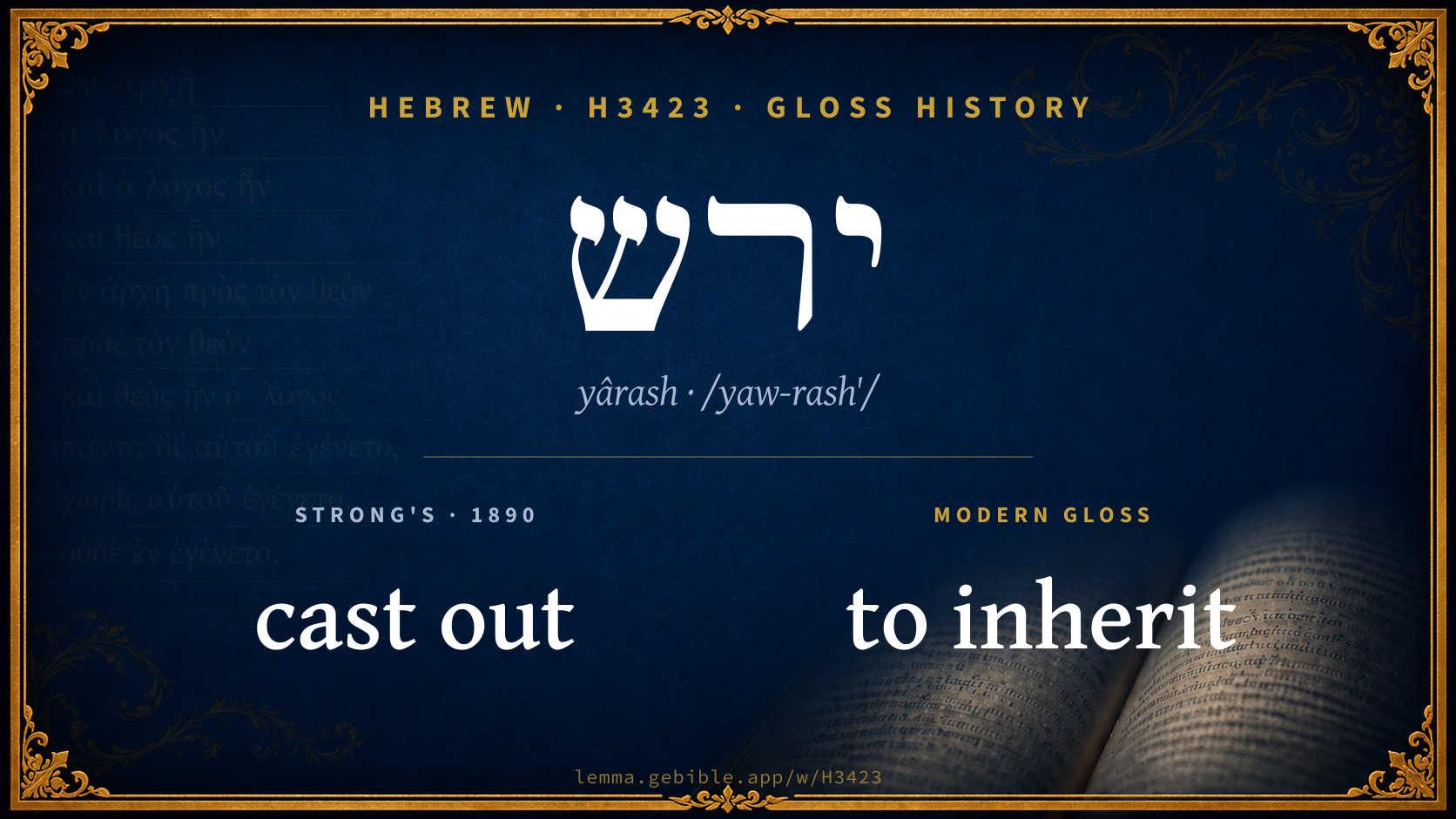
Gloss history
Strong's 1890 vs modern scholarship
About this word
Strong's H3423 catalogs a Hebrew word from the Hebrew Old Testament.
These counts are not copied from any lexicon or concordance. They are computed here, from the morphology-tagged Hebrew Old Testament. What Lemma adds →
- 204
- distinct verses
- The word appears in 204 distinct verses.
- 27 / 39
- OT books
- The word appears in 27 of 39 Old Testament books.
- #205
- by frequency
- Top 250 most frequent Hebrew words (rank 205 of 8,640 Hebrew words by occurrence).
View all 204 occurrences in the concordance →
Most concentrated in
- Deuteronomy 63 verses 31%
- Joshua 24 verses 12%
- Judges 21 verses 10%
By section of the Old Testament
By traditional corpus
Conventional, traditional groupings — biblical authorship is debated, so this is a traditional corpus grouping, not an authorship claim. Each share is this word’s portion of its verses in that division of the Hebrew canon. Each figure is a share of the word’s 204 distinct verses.
- Torah (Pentateuch) 89 verses · 44%
- Prophets (Nevi'im) 86 verses · 42%
- Writings (Ketuvim) 29 verses · 14%
How translations render this word
Counts come from each version’s own published word-to-Strong’s tagging or interlinear alignment — an approximate guide to how each version renders this word, not a word-level alignment the data otherwise carries. Because each total is that version’s own tagged count, the per-version totals vary from one another and need not match the appearance or distinct-verse counts above. These counts may also differ from a printed concordance because Lemma counts each distinctly tagged rendering and does not collapse phrase taggings into a single head-word total. This is a fixed set of word-tagged versions (KJV, ASV, BSB, ULT) and does not change with the reading translation you choose elsewhere. Each version’s license is shown beside its name below (and on Sources).
- King James Version: Possess 53×, Drive out 12×, Possessed 9×
- American Standard Version: Possess 32×, Possess it 13×, Possessed 8×
- Berean Standard Bible: Possess 47×, Drive out 15×, Take possession of 9×
- unfoldingWord Literal Text: Possess 33×, Possess it 29×, Dispossess 15×
King James Version Public Domain
Renders H3423 across 232 tagged occurrences — most commonly:
Plus other, less common renderings. Plus 87 renderings that appear only once — usually multi-word phrases or single function words the recovered tagging swept in, not distinct renderings. Not rendered by a distinct English word in 1 further occurrence.
American Standard Version Public Domain
Renders H3423 across 231 tagged occurrences — most commonly:
Plus other, less common renderings. Plus 89 renderings that appear only once — usually multi-word phrases or single function words the recovered tagging swept in, not distinct renderings.
Berean Standard Bible Public Domain
Renders H3423 across 230 tagged occurrences — most commonly:
Plus other, less common renderings. Plus 85 renderings that appear only once — usually multi-word phrases or single function words the recovered tagging swept in, not distinct renderings. Not rendered by a distinct English word in 1 further occurrence.
unfoldingWord Literal Text CC BY-SA 4.0
Renders H3423 across 265 tagged occurrences — most commonly:
Plus other, less common renderings. Plus 77 renderings that appear only once — usually multi-word phrases or single function words the recovered tagging swept in, not distinct renderings.
16 senses and sub-senses in the full BDB
Hebrew verbs can shift meaning by stem (binyan): Qal is the basic action, Niphal is often passive or reflexive, Piel often intensifies or makes it factitive, and Hiphil is typically causative. The senses below are grouped under the stem BDB assigns to each.
What do BDB’s symbols mean?
BDB uses these scholarly abbreviations:
| Symbol | Meaning |
|---|---|
| 𝔊 | the Septuagint (the ancient Greek translation, LXX) |
| 𝔙 | the Vulgate (the Latin translation) |
| 𝔖 | the Syriac version (the Peshitta) |
| 𝔗 | the Targum (the Aramaic translation) |
| ψ | the Psalms |
| √ | root (the underlying root or stem) |
| ‖ | parallel passage (a synonymous or contrasted parallel) |
| † | the dagger: every passage where the word occurs is cited |
The 16 senses and sub-senses the full Brown-Driver-Briggs lexicon distinguishes for this word, in lexicon order (not ranked by frequency), with BDB’s own verbatim wording and sub-sense lettering. Shown in Hebrew script with BDB’s own scholarly abbreviations. The condensed entry is in the Lexicon Entry tab. See also the Forms in the corpus table below.
Qal
- Pf. 3 ms. יָרַשׁ Je 49:1; וְיָרַשׁ consec. Je 49:2 Nu 27:11; 2 ms. יָרָ֑שְׁתָּ 1 K 21:19; וְיָרַשְׁתָּ֫ Dt 6:18 + 2 times; sf. וִירִשְׁתָּהּ consec. Dt 17:14 + 2 times (on this and kindred forms v. Köi. 406, 411); וִירִשְׁתָּם consec. Dt 19:1; 31:3; 3 pl. יָֽרְשׁוּ Dt 3:20 +; sf. וִירֵשׁוּךָ consec. Ez 36:12 (Köl.c.); וִירֵשׁוּהָ consec. Is 34:11 + 3 times; 2 mpl. וִירִשְׁתֶּם consec. Dt 4:1 + 7 times; 1 pl. יָרַשְׁנוּ Dt 3:12, etc.; Impf. 3 ms. יִירַשׁ Gn 21:10 ψ 25:13; 2 mpl. תִּירְשׁוּ Lv 20:24 1 Ch 28:8; תִּירָ֑שׁוּ Ez 33:25, 26; תִּירָשׁ֑וּן Dt 5:30, etc.; Imv. ms. יְרָ֑שָׁה Dt 33:23; רֵשׁ Dt 1:21 1 K 21:15; רָ֑שׁ Dt 2:24, 31; mpl. וּרְשׁוּ Dt 1:8; 9:23; Inf. cstr. לָרֶ֫שֶׁת Dt 2:31 + 17 times; לָרָ֑שֶׁת Ne 9:23; sf. לְרִשְׁתְּךָ Gn 28:4; לְרִשְׁתּוֹ 1 K 21:16, 18; לְרִשְׁתָּהּ Gn 15:7 + 28 times; Pt. יוֹרֵשׁ Gn 15:3 + 6 times; pl. י(וֹ)רְשִׁים Dt 12:2 Je 8:10; sf. יֹרְשָׁיו Je 49:2;— e.g. Jeremiah 49:1
- 1. take possession of, especially by force, have as a possession, often with collat. idea of taking in place of others, succeeding to, inheriting (cf. 2:
- a. land, sq. acc. Gn 15:7, 8 Nu 13:30; 21:24, 35 Jos 18:3 (all JE), 24:4, 8 (E), Ju 2:6; 11:21, 22, 23, 24(×2); 18:9 Dt 1:8, 21, 39 + 25 times Dt, + †Dt 11:31; 17:14; 26:1 (all possess land and dwell therein), similarly Is 65:9(×2) ψ 69:36; בְּאַרְצָם מִשְׁנֶה יִירָ֑שׁוּ Is 61:7 in their land they shall possess the double; הָחֵל רָשׁ Dt 2:24; הָחֵל רָשׁ לָרֶשֶׁת אֶת־אַרְצוֹ v 31; especially phr. (הארץ) שָׁמָּה לְרִשְׁתָּהּ (etc. עֹבְרִים) אֲשֶׁר אַתֶּם בָּאִים Dt 4:5, 14, 26 + 12 times Dt, also Ezr 9:10; v. Dt 30:18 Jos 1:11(×2), 15(×2); 12:1; 13:1; 21:41; 23:5 (all D); Am 2:10 Ob 19, 19 Hb 1:6 Ez 33:24, 25, 26 Lv 20:24(×2) (H), Gn 28:4 Nu 33:53 (both P), 1 Ch 28:8 Ne 9:15, 22, 23, 24; ψ 25:13; 37:9, 11, 22, 29, 34; + ב instr. 44:4; also וַעֲמַל לְאֻמִּים יִירָ֑שׁוּ 105:44 (‖ (וִיִּתֵּן לָהֶם אַרְצוֹת גּוֹיִם); †take possession of fields Je 8:10 (obj. not expr.), 1 K 21:15, 16, 18, 19 ψ 83:13; inheritance (in land) Nu 27:11; 36:8(×2) (all P); city (cities), Jos 19:47 (JE), Ju 3:13 Ob 20; so הַר־קָדְשִׁי Is 57:13 (‖ נחל ארץ), 63:18 where read prob. הַר־קָדְשֶׁ֑ךָ (for MT עַם־ק׳, see 𝔊 VB and ‖ cl.); possess city and dwell therein 2 K 17:24 Is 34:17; Is 34:11 yea the pelican and bittern shall possess it; so of nettles Ho 9:6; וְיִרַשׁ זַרְעֲךָ אֵת שַׁעַר אֹיְבָיו Gn 22:17, cf. 24:60 (both J); possess houses Ez 7:24 (del. Co), Ne 9:25; יוֹרֵשׁ עֶצֶר Ju 18:7 possessing wealth (? see VB)†. e.g. Genesis 15:7
- b. a people (with collat. idea of being their heir (2), and so dispossessing them), so especially in Dt 2:12, 21, 22; 9:1 (+ cities), 11:23; 12:2, 29(×2); 18:14; 19:1; 31:3; Nu 21:32 (Kt וַיִּירַשׁ; JE), Am 9:12; מַדּוּעַ יָרַשׁ מִלְכֹּם אֶת־גָּ֑ד Je 49:1 (on text see VB), v 2, 2 (in these 3 perhaps play on meaning inherit, cf. v 1 a); Ez 36:12 Ob 17 Is 54:3; nations + countries Ez 35:10. e.g. Deuteronomy 2:12
- 2. inherit, sq. acc. pers. = be one’s heir Gn 15:3, 4(×2) (JE); שִׁפְחָה כִּי־תִירַשׁ גְּבִרְתָּהּ Pr 30:23 (or, dispossess?); abs. be heir, sq. עִם pers. = jointly with 21:10 (E); (הַ)יּוֹרֵשׁ (the) heir 2 S 14:7 Je 49:1 (‖ בָּנִים); Mi 1:15 (= possessor, captor), where paronom. with n.pr.loc. מָרֵשָׁה; inherit persons, as slaves לָרֶשֶׁת אֲחֻזָּה Lv 25:46 (H). e.g. Genesis 15:3
- 3. = impoverish, הַלְיָרְשֵׁנוּ קְרָאתֶם (var. Pi. הַלְיָֽרְ׳ Ju 14:15 (v. Ges§ 69 m)) to impoverish us did ye call (us)? e.g. Judges 14:15
Niphal
- Impf. יִוָּרֵשׁ Pr 23:21; 2 ms. תִּוָּרֵשׁ Gn 45:11 Pr 20:13; אִוָּרֵשׁ Pr 30:9;—be (dispossessed =) impoverished, come to poverty Gn 45:11 (E), Pr 20:13; 23:21; 30:9 (opp. אֶשְׂבַּע). e.g. Proverbs 23:21
Piel
- Impf. פְּרִי אַדְמָתֶ֑ךָ יְיָרֵשׁ הַצְּלָצַֽל Dt 28:42 the fruit of thy ground shall the cricket get full possession of (cf. Qal Ho 9:6 Is 34:11), i.e. devour. e.g. Deuteronomy 28:42
Hiphil
- Pf. 3 ms. הוֹרִישׁ Ju 1:27 +; 2 ms. הוֹרַשְׁתָּ 2 Ch 20:7 ψ 44:3, etc.; Impf. 3 ms. יוֹרִישׁ Jos 3:10; וַיּ֫(וֹ)רֶשׁ Ju 1:19 +; 3 fs. sf. 3 mpl. תּוֹרִישֵׁמוּ Ex 15:9, etc.; Inf. abs. הוֹרֵשׁ Jos 3:10; 17:13; הוֹרֵישׁ Ju 1:28; cstr. לְהוֹרִישׁ Dt 4:38 +, etc.; Pt. מוֹרִישׁ 1 S 2:7 Dt 18:12; sf. מוֹרִישָׁם Dt 9:4, 5;— e.g. Judges 1:27
- 1. cause to possess, or inherit Ju 11:24; מִיְּרֻשָֽׁתְךָ אֲשֶׁר הוֹרַשְׁתָּנוּ 2 Ch 20:11; sq. ל pers., וְהוֹרַשְׁתֶּם לִבְנֵיכֶם Ezr 9:12 and cause your sons to inherit (it); fig. תּוֹרִישֵׁנִי עֲוֹנוֹת נְעוּרָ֑י Jb 13:26 thou makest me to inherit (the consequences of) the iniquities of my youth. e.g. Judges 11:24
- 2. cause (others) to possess or inherit, then gen. dispossess:
- a. sq. acc. gent. vel pers., Jos 13:13; 16:10 (both JE), Ju 1:29, 30, 31, 32, 33 (all opp. ישׁב בְּקֶרֶב), Jos 14:12 (JE), 17:13 (JE; הוֹרֵשׁ לֹא הוֹרִישׁוֹ), Ju 1:28 (id.); opp. ישׁב אֵת Jos 15:63; opp. ישׁב בְּ Ju 1:21, 27; also Nu 21:32 Qr, 32:39 Jos 17:18 (all JE), 13:12 (D), Ju 1:19b; 2:23; also וַיֹּרֶשׁ אֶת־הָהָר 1:19a (= את־יושׁבי ההר see v b), Dt 7:17 ψ 44:3; וְהוֹרַשְׁתָּם וְהַאֲבַדְתָּם Dt 9:3; sq. acc. + מִפְּנֵי Ex 34:24 Nu 32:21 Jos 3:10 (הוֹרֵשׁ יוֹרִישׁ; all these JE), Dt 4:38; 9:4, 5; 18:12 Jos 13:6; 23:9 (both D), Nu 33:52, 55 (both P), Ju 2:21; 11:23, 24 1 K 14:24; 21:26 2 K 16:3; 17:8; 21:2 (all D), 2 Ch 28:3; 33:2; acc. + מִלִּפְנֵי Dt 11:23 Jos 23:5, 13 (D; ‖ הָדַף), 2 Ch 20:7; acc. + מִשָּׁם Jos 15:14 (JE) = Ju 1:20; of cities (i.e. their inhabitants) Jos 8:7; 17:12; so of a land = Nu 33:53 (P), see v 52, 55 [𝔊 + יושׁבי] e.g. Joshua 13:13
- b. sq. acc. rei, מִבִּטְנוֹ יֹרִשֶׁנּוּ אֵל Jb 20:15 God shall cast them out of his belly, i.e. riches (‖ חַיִל בָּלַע וַיְקִאֶנּוּ). e.g. Job 20:15
- 3. = impoverish, יהוה מוֹרִישׁ וּמַעֲשׁיר 1 S 2:7 (song) י׳ impoverisheth and maketh rich; sq. acc. (of Tyre) אֲדֹנָי יוֹרִשֶׁנָּה Zc 9:4 (see v 3). e.g. 1 Samuel 2:7
- 4. nearly = bring to ruin, destroy, sq. acc. gent. אָרִיק חַרְבִּי תּוֹרִישֵׁמוֹ יָדִי Ex 15:9 (poem in E); so perhaps also Nu 14:12 (JE; AV disinherit; ‖ אַכֶּנּוּ בַדֶּבֶר). e.g. Exodus 15:9
- 5. = Qal take possession of a land Nu 14:24 (JE), but read prob. יִרָשֶׁנָּה. e.g. Numbers 14:24
Senses from the full Brown-Driver-Briggs lexicon (Brown, Driver, Briggs; Oxford 1906 — public domain), digitized via Sefaria, supplemented by the OpenScriptures HebrewLexicon (CC BY 4.0). Full attribution on Sources.
Word origin
vb. take possession of, inherit, dispossess (MI7 וירש take possession of; Aramaic יְרֵית, ܝܺܪܶܬ take possession of, and be heir to, inherit; so Ethiopic ወረሰ Arabic وَرِثَ inherit; v. also Sab. ורתֿ, inherit, CISiv, 37, 3), especially D (62 times Qal, 1 times Pi, 7 times Hiph. in Dt + 13 times D in Jos);—
— Brown-Driver-Briggs (Oxford 1906, public domain), digitized via Sefaria, supplemented by the OpenScriptures HebrewLexicon (CC BY 4.0). See Sources.
Origin: a primitive root
Jastrow Dictionary
A second Hebrew/Aramaic lexicon for comparison, covering Aramaic and post-biblical (Talmudic, Targumic, Midrashic) usage that the biblical-Hebrew BDB does not. Matched by lemma rather than by Strong’s number, so a lemma may carry more than one Jastrow headword (shown separately below), and the entries cover usage well beyond the Bible.
יָרַשׁ
- (b. h.) [to enter into, take the place of,] to conquer; to take possession, to succeed, inherit. Gen. R. s. 11, end י׳ את העולם במדה had his worldly share assigned to him with limitation. Gen. R. s. 44 ליוֹרְשֵׁנִי to be my heir. B. Bath. VIII, 5 איש … לא יִירַשׁ וכ׳ this man, my son, shall not be an heir with the rest of his brothers. Ib. בתי תִירָֹשֵנִי my daughter shall be my heiress. Ib. ראוי ליוֹרְשׁוֹ entitled to succeed him. Ib. IX, 1 (139ᵇ) הבנים יִירְשׁוּ (Bab. ed. יֵרְשׁוּ) the sons take possession of the estate; a. fr.—V. יוֹרֵשׁ.
- 1. to cause to inherit, to leave by will or by the law of succession; to transmit. Ib. 119ᵇ מוֹרִישִׁין ואינן יורשין they shall leave (the Holy Land to their children) but shall not take possession themselves. Shebu. 47ᵃ אין אדם מוֹרִישׁ שבועה לבניו a man cannot transmit an oath to his sons, i.e. property to be obtained only by the claimant’s oath cannot be claimed by his heirs. Keth. 43ᵃ; Kidd. 16ᵇ אין אדם מוריש זכות בתו וכ׳ a man cannot bequeathe his daughter’s privileges to his sons. B. Bath. IX, 8 if the house fell עליו ועל מוֹרִישָׁיו over himself (the heir) and his ancestors; a. fr.
- 2. to drive out, dispossess. Sifré Deut. 51 סמוך … לא הוֹרַשְׁתָּ (the Jebusite) who is near thy palace thou hast not driven out; a. e.
A Dictionary of the Targumim, the Talmud Babli and Yerushalmi, and the Midrashic Literature (Marcus Jastrow; London, Luzac, 1903) — Public Domain. Digitized via Sefaria. Digitized via Sefaria. Full attribution on Sources.
Forms in the corpus
The 163 distinct written forms H3423 takes in the Hebrew Bible, most frequent first — each parse links to that stem’s occurrences in the concordance. Hebrew forms include their vowel points and cantillation, so a single lemma takes many written forms.
The 60 most common forms are shown; 103 rarer forms follow in the full concordance.
Same root — word family
Other BDB entries built from the same root as H3423, grouped by Strong’s listed origin. These share a root / origin per the lexicon — not necessarily a shared meaning. Each links to that word’s own entry.
Derived from this word
- ירשה yᵉrêshâh H3424 possession
- ירשה yᵉrushshâh H3425 inheritance
- מורש môwrâsh H4180 possession
- רשת resheth H7568 net
- תירוש tîyrôwsh H8492 wine
Proper names from this root
People and places named from this root — a name, not an additional meaning of the word.
Compare all same-root words → Showing 4 of 8 — not the complete family. 2 of the same-root words are proper names (people or places). They share a root, not necessarily a meaning.
Septuagint verse parallels
This word appears in 193 verses that also exist in the Greek Old Testament (Septuagint), out of the 204 Hebrew verses it occurs in. You can read those verses in Greek by switching the Old Testament edition to the Septuagint.
Read these verses in the Septuagint
- Genesis 15:3
- Exodus 15:9
- Leviticus 20:24
- Numbers 13:30
- Deuteronomy 1:8
- Joshua 1:11
- Judges 1:19
- 1 Samuel 2:7
- 2 Samuel 14:7
- 1 Kings 21:15
- 2 Kings 16:3
- 1 Chronicles 28:8
This is a verse-level parallel only — the same verses exist in both the Hebrew and Greek Old Testaments. No word-level Hebrew↔Greek correspondence is claimed: the data carries no such alignment, so no Greek word is shown as this Hebrew word’s translation. Coverage is not total — the Septuagint omits the deuterocanon and renumbers the Psalms, so some Hebrew verses have no direct Greek parallel.