
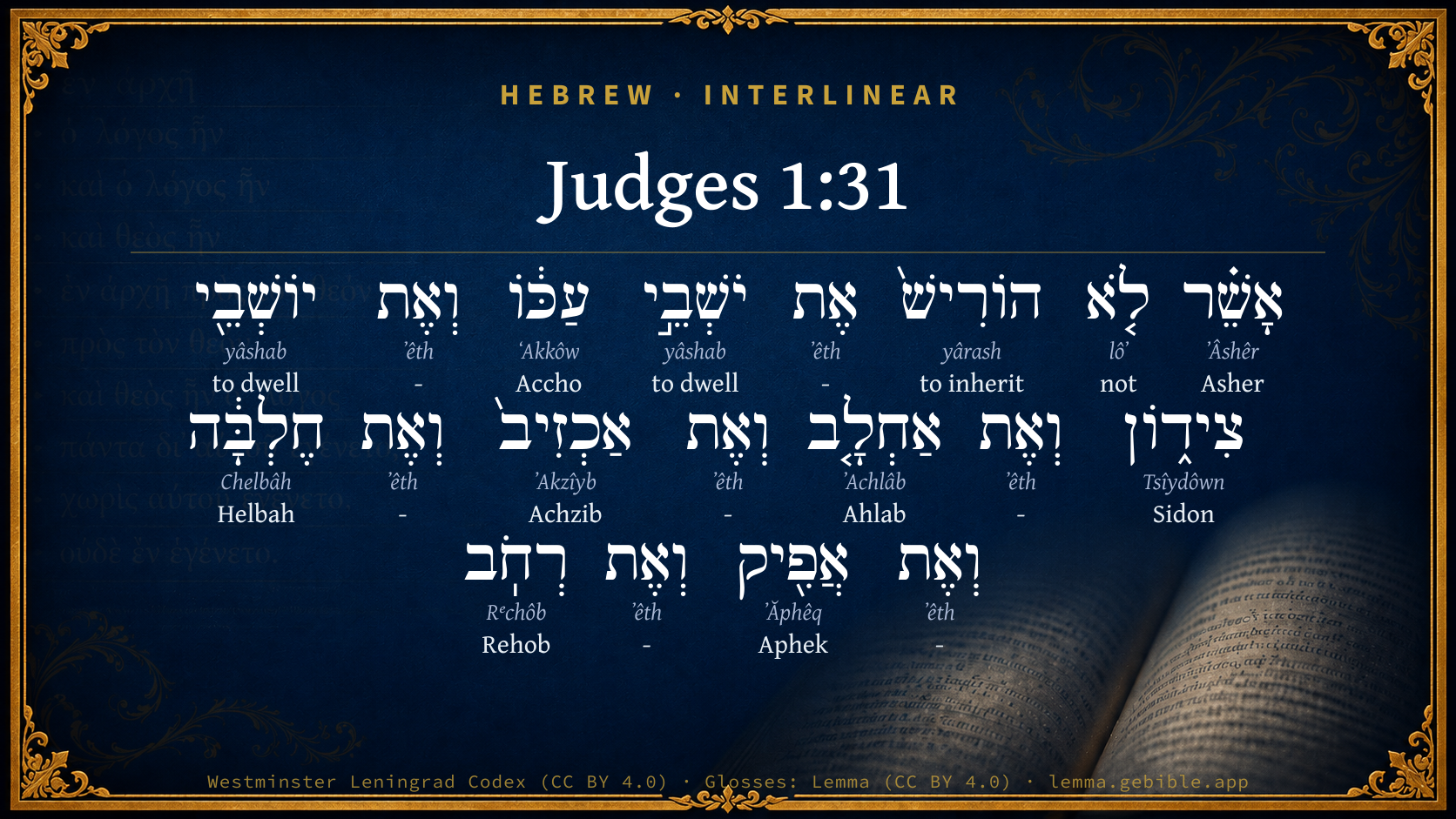
Judges 1:31

Hebrew (Westminster Leningrad Codex) Judges 1:31 appears in the Hebrew Old Testament. The text above is from the Westminster Leningrad Codex. Each word links to its Strong’s number, a concise gloss, and parsing drawn from the Open Scriptures Hebrew Bible morphology. Click any word for its full Brown-Driver-Briggs (BDB) entry.
Download image
Cite this verse

Judges 1:31 (World English Bible). Public Domain. Lemma interlinear Bible study tool, https://lemma.gebible.app/v/judges/1/31.

Show BibTeX & RIS
BibTeX
RIS
English Translation
Asher didn't drive out the inhabitants of Acco, nor the inhabitants of Sidon, nor of Ahlab, nor of Achzib, nor of Helbah, nor of Aphik, nor of Rehob;
World English Bible · Public Domain
Highlights Full analysis ↓
Download a study sheet

One document with this verse’s original text, its word-by-word gloss line, the meaning frame, cross-references with their text, attributed commentary, and full source and license credits — printable, and it pastes into notes with its structure intact.

This verse Autodidact and up

Study sheet (.html) Plain text (.txt)

A passage Seminary Student

Up to 50 verses in one chapter. A passage sheet keeps up to 6 commentary sources and 12 cross-references per verse, in the order this page ranks them, and says so on the sheet whenever that leaves anything out. Ask for a single verse and you get the Autodidact verse sheet above.

Everything on this page stays free to read, with no account — the sheet is a download of what is already on screen, not access to it.

Want to remove ads? Support Godless Engineer
Compare translations 3

The same verse in 3 English versions, stacked beneath the original-language interlinear above. Click any original word for its lexicon entry.

Each is an independent rendering of the whole verse — the interlinear is not word-aligned to these translations.

Highlighted words mark where these versions differ — a whole-verse word diff, not a word-by-word alignment.

  • World English Bible Public Domain
    Asher didn't drive out the inhabitants of Acco, nor the inhabitants of Sidon, nor of Ahlab, nor of Achzib, nor of Helbah, nor of Aphik, nor of Rehob;
  • King James Version Public Domain
    Neither did Asher drive out the inhabitants of Accho, nor the inhabitants of Zidon, nor of Ahlab, nor of Achzib, nor of Helbah, nor of Aphik, nor of Rehob:
  • unfoldingWord Literal Text CC BY-SA 4.0
    Asher did not dispossess the dwellers of Akko or the dwellers of Sidon or Ahlab or Akzib or Helbah or Aphek or Rehob.

unfoldingWord Literal Text — © unfoldingWord, licensed CC BY-SA 4.0. Word-aligned USFM3 via Door43 (git.door43.org/unfoldingWord/en_ult).

Versions to compare (up to 4)

3 of 4 selected

Show all 18 translations

Every available English version of this verse, each an independent rendering of the whole verse.

  • World English Bible Public Domain
    Asher didn't drive out the inhabitants of Acco, nor the inhabitants of Sidon, nor of Ahlab, nor of Achzib, nor of Helbah, nor of Aphik, nor of Rehob;
  • Berean Standard Bible Public Domain
    Asher failed to drive out the inhabitants of Acco, Sidon, Ahlab, Achzib, Helbah, Aphik, and Rehob.
  • Majority Standard Bible Public Domain
    Asher failed to drive out the inhabitants of Acco, Sidon, Ahlab, Achzib, Helbah, Aphik, and Rehob.
  • King James Version Public Domain
    Neither did Asher drive out the inhabitants of Accho, nor the inhabitants of Zidon, nor of Ahlab, nor of Achzib, nor of Helbah, nor of Aphik, nor of Rehob:
  • American Standard Version (1901) Public Domain
    Asher drove not out the inhabitants of Acco, nor the inhabitants of Sidon, nor of Ahlab, nor of Achzib, nor of Helbah, nor of Aphik, nor of Rehob;
  • Revised Version (1885) Public Domain
    Asher drave not out the inhabitants of Acco, nor the inhabitants of Zidon, nor of Ahlab, nor of Achzib, nor of Helbah, nor of Aphik, nor of Rehob:
  • Geneva Bible (1599) Public Domain
    Neither did Asher cast out the inhabitants of Accho, nor the inhabitants of Zidon, nor of Ahlab, nor of Achzib, nor of Helbah, nor of Aphik, nor of Rehob,
  • Douay-Rheims (1899) Public Domain
    Aser also destroyed not the inhabitants of Accho, and of Sidon, of Ahalab, and of Achazib, and of Helba, and of Aphec, and of Rohob:
  • Young's Literal Translation Public Domain
    Asher hath not dispossessed the inhabitants of Accho, and the inhabitants of Zidon, and Ahlab, and Achzib, and Helbah, and Aphik, and Rehob;
  • Literal Standard Version CC BY-SA 4.0
    Asher has not dispossessed the inhabitants of Accho, and the inhabitants of Sidon, and Ahlab, and Achzib, and Helbah, and Aphik, and Rehob;
  • Unlocked Literal Bible CC BY-SA 4.0
    Asher did not drive out the people living in Akko, or the people living in Sidon, or those living in Ahlab, Akzib, Helbah, Aphek, or Rehob.
  • unfoldingWord Literal Text CC BY-SA 4.0
    Asher did not dispossess the dwellers of Akko or the dwellers of Sidon or Ahlab or Akzib or Helbah or Aphek or Rehob.
  • Darby Bible Public Domain
    Asher did not drive out the inhabitants of Acco, or the inhabitants of Sidon, or of Ahlab, or of Achzib, or of Helbah, or of Aphik, or of Rehob;
  • World Messianic Bible Public Domain
    Asher didn’t drive out the inhabitants of Acco, nor the inhabitants of Sidon, nor of Ahlab, nor of Achzib, nor of Helbah, nor of Aphik, nor of Rehob;
  • Webster's Bible Public Domain
    Neither did Asher expel the inhabitants of Accho, nor the inhabitants of Zidon, nor of Ahlab, nor of Achzib, nor of Helbah, nor of Aphik, nor of Rehob:
  • Free Bible Version CC BY-SA 4.0
    Asher didn't drive out the people living in the towns of Acco, Sidon, Ahlab, Achzib, Helbah, Aphik, and Rehob,
  • Bible in Basic English Public Domain
    And Asher did not take the land of the people of Acco, or Zidon, or Ahlab, or Achzib, or Helbah, or Aphik, or Rehob, driving them out;
  • JPS Tanakh (1917) Public Domain
    Asher drove not out the inhabitants of Acco, nor the inhabitants of Zidon, nor of Ahlab, nor of Achzib, nor of Helbah, nor of Aphik, nor of Rehob;

Literal Standard Version (2020), Covenant Press — licensed CC BY-SA 4.0. Text via the HelloAO Bible API (eBible.org). Unlocked Literal Bible (unfoldingWord) — licensed CC BY-SA 4.0. Text via the HelloAO Bible API (eBible.org). unfoldingWord Literal Text — © unfoldingWord, licensed CC BY-SA 4.0. Word-aligned USFM3 via Door43 (git.door43.org/unfoldingWord/en_ult). Free Bible Version, Dr. Jonathan Gallagher — licensed CC BY-SA 4.0. Text via the HelloAO Bible API (eBible.org).

Word by word

More ways to search: Search by grammar → Find every occurrence → Compare this word →

Practice this passage: Drill this verse → Learn its vocabulary →

עַכּ֔וֹ
ʻAkkôw
H5910
“Accho”
Noun, Proper
Part of Speech
Noun
Type
Proper
Full BDB Definition

Origin: apparently from an unused root meaning to hem in

TWOT: None

Accho = "his straitness" - a seaport town in Asher north of Mount Carmel and south or Tyre
  1. אָשֵׁ֗ר ʼÂshêr H836 “Asher” Noun, Proper
  2. לֹ֤א lôʼ H3808 “not” Particle, Negative
  3. הוֹרִישׁ֙ yârash H3423 “to inherit” Verb, Hiphil, Perfect, 3rd Person, Masculine, Singular
  4. אֶת ʼêth H853 “-” Particle, Direct Object
  5. יֹשְׁבֵ֣י yâshab H3427 “dwelling” Verb, Qal, Participle Active, Masculine, Plural, Construct
  6. וְאֶת ʼêth H853 “and · -” Conjunction + Particle, Direct Object
  7. יוֹשְׁבֵ֖י yâshab H3427 “dwelling” Verb, Qal, Participle Active, Masculine, Plural, Construct
  8. צִיד֑וֹן Tsîydôwn H6721 “Sidon” Noun, Proper
  9. וְאֶת ʼêth H853 “and · -” Conjunction + Particle, Direct Object
  10. אַחְלָ֤ב ʼAchlâb H303 “Ahlab” Noun, Proper
  11. וְאֶת ʼêth H853 “and · -” Conjunction + Particle, Direct Object
  12. אַכְזִיב֙ ʼAkzîyb H392 “Achzib” Noun, Proper
  13. וְאֶת ʼêth H853 “and · -” Conjunction + Particle, Direct Object
  14. חֶלְבָּ֔ה Chelbâh H2462 “Helbah” Noun, Proper
  15. וְאֶת ʼêth H853 “and · -” Conjunction + Particle, Direct Object
  16. אֲפִ֖יק ʼĂphêq H663 “Aphek” Noun, Proper
  17. וְאֶת ʼêth H853 “and · -” Conjunction + Particle, Direct Object
  18. רְחֹֽב Rᵉchôb H7340 “Rehob” Noun, Proper

About this verse

These counts appear in no published source. They are computed here, from the morphology-tagged text and Lemma’s own curated glosses. What Lemma adds →

19
words
12
distinct lemmas
Historical
section

Notable vocabulary

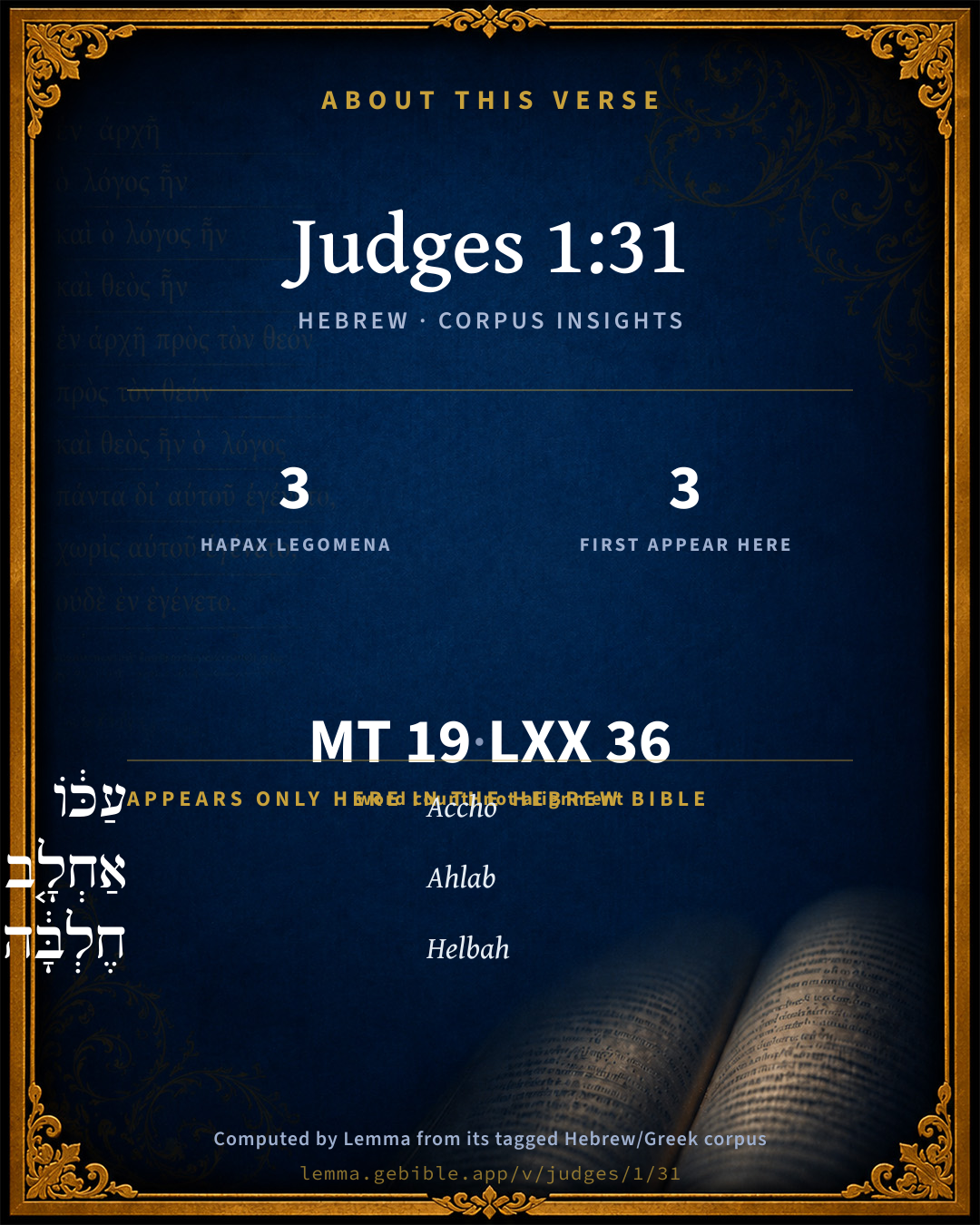
3 hapax legomena — words that appear only here in the entire Hebrew Bible:

  • עַכּ֔וֹ Accho H5910
  • אַחְלָ֤ב Ahlab H303
  • חֶלְבָּ֔ה Helbah H2462

First appearance in Scripture

These words make their first canonical appearance in the Hebrew Bible here:

  • עַכּ֔וֹ Accho H5910
  • אַחְלָ֤ב Ahlab H303
  • חֶלְבָּ֔ה Helbah H2462

Shared distinctive vocabulary

אַכְזִיב֙ Achzib H392 occurs in 4 verses of the Hebrew Bible. Also found in:

Grammatical profile

  • 3 verbs
  • 8 nouns
  • 8 particles

Verb forms

  • הוֹרִישׁ֙ Hiphil · Perfect
  • יֹשְׁבֵ֣י Qal · Participle Active
  • יוֹשְׁבֵ֖י Qal · Participle Active

Repetition

A word recurs within this verse — often emphatic in Hebrew:

  • יֹשְׁבֵ֣י to dwell H3427 ×2

Hebrew & Septuagint length

In English translation the verse runs 28 words from the Hebrew and 40 from the Septuagint (LXX English) — the Septuagint runs noticeably longer here. See the side-by-side →

A rough comparison of the two English renderings, which tokenize alike — not a word-level alignment.

Word counts can differ between the Hebrew and the Greek without any difference in meaning — e.g. the Hebrew direct-object marker אֵת has no separate Greek word, and Greek often adds the article ὁ.

In the original languages it is 19 Hebrew tokens and 36 Greek tokens — but the two are counted differently (Hebrew bundles its prefixes and suffixes into one token; the Greek is in lemma form), so that isn’t a like-for-like length.

Cross-references

1

Topical passages linked to Judges 1:31 in the Treasury of Scripture Knowledge — connected by theme and wording, ordered by reader-vote popularity; previews shown in the World English Bible.

  • Joshua 19:24–30 The fifth lot came out for the tribe of the children of Asher according to their families.

Cross-references courtesy of OpenBible.info (CC BY 4.0).

Hebrew and Greek witnesses Masoretic Hebrew ↔ Greek Septuagint

The same verse in the two great witnesses to the Old Testament, shown verse-for-verse.

Here the Septuagint runs noticeably longer than the Hebrew — LXX2012 (modern English Septuagint) 40 words vs World English Bible 28. A rough length comparison of the two English translations, not a word-level alignment — read both below.

These are two independent witnesses, not word-aligned to each other, and the Septuagint is shown in lemma (dictionary) form.

Hebrew Judges 1:31 Masoretic · Westminster Leningrad Codex

אָשֵׁ֗ר לֹ֤א הוֹרִישׁ֙ אֶת יֹשְׁבֵ֣י עַכּ֔וֹ וְאֶת יוֹשְׁבֵ֖י צִיד֑וֹן וְאֶת אַחְלָ֤ב וְאֶת אַכְזִיב֙ וְאֶת חֶלְבָּ֔ה וְאֶת אֲפִ֖יק וְאֶת רְחֹֽב

Asher didn't drive out the inhabitants of Acco, nor the inhabitants of Sidon, nor of Ahlab, nor of Achzib, nor of Helbah, nor of Aphik, nor of Rehob;

World English Bible · Public Domain

Greek LXX Judges 1:31 Septuagint · lemma form

καί ασηρ οὐ ἐκαἴρω ὁ καταοἰκέω ακχω καί γίγνομαι αὐτός εἰς φόρος καί ὁ καταοἰκέω δωρ καί ὁ καταοἰκέω σιδών καί ὁ καταοἰκέω ααλαφ καί ὁ ασχαζι καί ὁ χελβα καί ὁ ναϊ καί ὁ ερεω

And Aser did not drive out the inhabitants of Accho, and that people became tributary to him, nor the inhabitants of Dor, nor the inhabitants of Sidon, nor the inhabitants of Dalaph, nor Aschazi, nor Chebda, nor Nai, nor Ereo.

LXX2012 (modern English Septuagint) · Public Domain

Hebrew: Westminster Leningrad Codex (CC BY 4.0). Greek: Septuagint (public domain); English from LXX2012 (modern English Septuagint) (Public Domain). How the Septuagint differs from the Hebrew →

Targum (Aramaic paraphrase)

1

The Targum is the ancient Jewish Aramaic paraphrase of the Hebrew Scriptures — an interpretive translation, not the Hebrew text itself. Onkelos (literal) and Pseudo-Jonathan (expansive) render the Torah, and Jonathan the Prophets. Coverage is partial: where no permissively-licensed English translation exists for a verse, only the Aramaic is shown. This is verse-level text, not a word-by-word alignment to the Hebrew.

  1. Targum Jonathan Prophets (Joshua–Malachi)
    דְבֵית אָשֵׁר לָא תָרִיכוּ יַת יַתְבֵי עַכּוֹ וְיַת יַתְבֵי צִידוֹן וְיַת אַחְלָב וְיַת אַכְזִיב וְיַת חֶלְבָּה וְיַת אֲפִיק וְיַת רְחוֹב:

    (no public-domain English translation for this verse)

    Targum Jonathan — Aramaic: “Mikraot Gedolot” (public domain). English: “Sefaria Community Translation” (CC0 1.0 (public-domain dedication)); “London "Chaldee Paraphrase," 1871” (public domain). Text via Sefaria.

Commentary

Notes on Judges 1:31 from classic Christian and Jewish commentators (each source and its license shown beneath its notes). The classic Christian expositions comment on the surrounding passage and are grouped to its opening verse, so a note may address several verses; the Jewish commentaries on the Tanakh (Rashi and others) are per-verse, so they appear only where the commentator wrote on this verse.

Lemma curates 59 commentaries, every one of them public domain or Creative Commons licensed, each selected and text-cleaned for this edition rather than reprinted as found. About our sources →

Adam Clarke's Commentary

Verse 31. Neither did Asher] See on Jos 19:24-31.

Accho] Supposed to be the city of Ptolemais, near to Mount Carmel.

Adam Clarke's Commentary on the Bible (1810–1826) — public domain. Text from a community e-Sword/MySword module.

Ellicott's Commentary for English Readers

(31) Neither did Asher.—See Jos_19:24-31.

Accho.—The seaport so famous under the names of Ptolemais (Act_21:7; 1Ma_5:15; 1Ma_10:1), Acre, and St. Jean d’Acre (now Acca). Josephus called it Ako (Antt. ix. 14, § 2).

Zidon.—(Jos_11:8.) Asher never succeeded in conquering Zidon, which was the capital of Phœnicia, though eclipsed by its neighbour Tyre. (2Sa_5:11; Isaiah 23; Jeremiah 27, 47; Mat_11:22, &c.) It is now called Saida.

Ahlab.—An unknown town.

Achzib.—(See Jos_19:29.) Better known as Ecdippa (Jos. B. J. i. 13, § 4), the modern Zib, about nine miles north of Akka. There was a less well-known Achzib in Judah (Chezib)—Gen_38:5; Mic_1:14; Jos_15:44.

Helbah.—The name is rendered “the coast” in Jos_19:29. The site is unknown.

Aphik.—The Aphek of Jos_19:30, now Afka (Robinson, Bible Res., 3:606). The name means “strength.” It was famous for a Temple of Venus, destroyed by Constantine. (Euseb. Vit. Const.) There seems to have been another Aphek near Hebron. (Jos_12:18.)

Rehob.—A Levitical city (Jos_21:31; 1Ch_6:75).

A Bible Commentary for English Readers, edited by Charles John Ellicott (1878–1897) — public domain. Text from a community e-Sword module.

The Cambridge Bible for Schools and Colleges

gen. ed. J. J. S. Perowne

31. Asher] dwelt in a productive strip of country (Gen_49:20), extending northwards from Carmel along the sea-coast (Jdg_5:17) to Phoenicia; P indicates the boundaries in Jos_19:24-31, but not many of the places can be identified. Occupying an indefinite territory between the Phoenicians and the tribes of Naphtali and Zebulun, the Asherites seem to have been only partially identified with Israel; historically their importance was small, they took no part in the combination against Sisera (Jdg_5:17), and here it is implied that they could not hold their own against the older population. In the period of Seti I and Ramses II Egyptian sources mention ’A-sa-ru, a somewhat vigorous state located in the ‘Hinterland’ of S. Phoenicia up to the Lebanon, the very district occupied by the tribe of Asher. ’Asaru is simply the Egyptian form of Asher; but until fresh discoveries reveal the nature of the connexion between the two, no safe conclusions can be drawn for purposes of history. It has been supposed that some part of the Israelite nation, at any rate the tribe of Asher, was resident in Palestine under the 18th Dynasty, i.e. circ. 1400 b.c., before the time of Moses. See W. Max Müller, Asien u. Europa, p. 236 ff.

Acco] is the mod. ‘Akka (so in the Amarna tablets nos. 157–9), the S. Jean d’Acre of the Crusaders, N. of Carmel on the coast; in Act_21:7 it is called Ptolemais, probably after Ptolemy II. This is the southernmost point on the coast in the present list; the northernmost is Zidon, the mod. Ṣaida, called Ziduna in the Am. tablets (nos. 147, 149, 150 f.), the famous Phoenician city. The Phoenicians are called Zidonians in the O.T., Jdg_3:3, 1Ki_11:5; they were never subjected by Israel. It is significant that Tyre, which is situated between these two points, is not mentioned.

Ahlab] is probably only another form of Helbah, of which a third form is Mahalab Jos_19:29 (read ‘from Mahalab to Achzib’). It seems to be the place called Maḫalliba by Sennacherib (Taylor Cyl. COT, 288), who mentions Achzib and Acco in the same line. It is conjectured (Moore) that this was the old name of Râs el-Abyaḍ, the ‘promontorium album’ of Pliny, three hours S. of Tyre.

Achzib] called Ecdippa by the classical geographers, is the mod. ez-Zîb, 2½ hours N. of ‘Akka on the coast; Jos_19:29.

Aphik … Rehob] Jos_19:30, not uncommon names; in this region they have not been identified. Rehob (Josh. ib., Jos_21:31; 1Ch_6:75) may be the Egyptian Raḥubu, N. of the Kishon (Müller, As. u. Eur., p. 153); it is probable that both places were inland, not on the coast.

The Cambridge Bible for Schools and Colleges (gen. ed. J. J. S. Perowne; Cambridge University Press, 1878–1918) — public domain. Text from a community e-Sword module.

John Gill's Exposition

Neither did Asher drive out the inhabitants of Accho,.... The same with Ptolemais; see Gill on Act 21:7; so called from the first Ptolemy king of Egypt, who enlarged it; but it has since recovered its ancient name pretty nearly, and is now called Acca or Acra."On its north and east sides (Mr. Maundrell says (w)) it is encompassed with a spacious and fertile plain; on the west it is washed by the Mediterranean sea; and on the south by a large bay, extending from the city as far as Mount Carmel:"

nor the inhabitants of Zidon; a well known city in Phoenicia, belonging to this tribe, see Jos 19:28,

nor of Ahlab, nor of Achzib, nor Helbah, nor Aphik, nor of Rehob; two of these places, Ahlab and Helbah, are not mentioned among the cities of the tribe of Asher, Jos 19:24; unless Helbah is the same with Helkath, Jdg 1:25; of the rest, Achzib; see Gill on Jos 19:29, Aphik, and Rehob; see Gill on Jos 19:30.

(w) Journey from Aleppo, p. 54.

John Gill's Exposition of the Whole Bible (1746–1763) — public domain (CC PDM 1.0). Text via the HelloAO Bible API.

Albert Barnes' Notes on the Bible

Compare the marginal reference. Accho, afterward called Ptolemais, now Akka or St. Jean d’Acre, is named here for the first time.

Albert Barnes' Notes on the Bible (1834–1885) — public domain. Text from a community e-Sword/MySword module.

Haydock's Catholic Bible Commentary

Accho. Hebrew haco. The Greeks not knowing the derivation of this word, supposed that the city was so called from ake, "a remedy," as they pretend that Hercules was cured in this place. It was also called Ptolemais, after the king of Egypt. The little river Belus, and the famous bed of sand so proper for making glass, were in the neighbourhood. (Pliny, [Natural History?] v. 19.) --- Ahalab. The situation is unknown, unless it be Aleppo. They say it is the famous city of Berea. (Calmet)

George Leo Haydock (1774–1849), Haydock's Catholic Family Bible and Commentary, 1859 edition — public domain. Excludes Psalms (Douay-Rheims chapter numbering differs from Protestant) and Deuterocanonical books (Catholic canon only).

Whedon's Commentary on the Bible

Daniel D. Whedon

31. Accho is a flourishing seaport on a bay of the same name, just north of Mount Carmel. It was named Ptolemais, in honour of one of the Ptolemies. Its modern name is Acre. It contains a mixed population of five thousand. On Zidon, or great Sidon, see Jos_11:8. “The district of Sidon,” says Wilkins, “had apparently been included in the earliest scheme of conquest. But it had not fallen to the lot of either of the two most powerful and warlike tribes — Judah and Ephraim; it was destined for the feebler and less energetic Asher, Zebulun, Issachar, and Naphtali. The impetuous rush of the hardy warriors of the desert, thirsting for the blessings of the Promised Land, had spent itself in early efforts, and the northern tribes were well contented with the marvellous fertility of the plain of Esdraelon, which probably furnished abundant supplies for their scanty numbers. The Phenicians would, on the other hand, have the strongest inducements to live on terms of amity with their new neighbours. The great lines of traffic with Egypt, Arabia, Babylon, and Assyria, were in the hands of the invaders, and any hostilities with them must necessarily have caused a ruinous suspension of commerce.” — Phenicia and Israel. Ahlab is named in this place only. In Jos_19:29, this name is wanting; but the word Cheleb, translated coast, is, in the opinion of Fuerst, the name of the town here written Ahlab. Its site is unknown, as is also Helbah.

Achzib — Jos_19:29, note. Aphik is written Aphek in Jos_13:4, where see note. Rehob is not identified.

Daniel D. Whedon (gen. ed.), Commentary on the Old and New Testaments (1874–1909) — public domain. Text from a community e-Sword module.

unfoldingWord translationNotes

Door43 World Missions Community

Asher did not drive

Here "Asher" represents the men or the soldiers of the tribe of Asher. (See: Metonymy)

Akko ... Sidon ... Ahlab, Akzib, Helbah, Aphek ... Rehob

These are names of cities in the land of Canaan. (See: How to Translate Names)

translationWords

Asher

cast out

life

Sidon

unfoldingWord translationNotes — © Distant Shores Media and the Door43 World Missions Community, licensed CC BY-SA 4.0. Source: git.door43.org/Door43/en_tn.

Lesson kit

Teaching starters — assembled from the data on this page, not authored interpretation. Every prompt links to the verse data it draws on. Edit before teaching.

Judges, in the Historical, opens this verse with 19 words (12 distinct Hebrew lemmas). Its most distinctive word is ʻAkkôw (“Accho”). The Greek Septuagint runs longer here. A historical commentator’s framing appears above. Read the whole chapter for the surrounding context.

Discussion questions

  1. The word ʻAkkôw carries the sense “Accho.” How does it shape the verse?
  2. 3 words here appear nowhere else in the Hebrew Bible. Why might the author reach for such rare wording?
  3. 3 words make their first appearance in Scripture here. What does this debut establish?
  4. How does Joshua 15:44, which shares the word «Achzib», read alongside this verse?
  5. What does the repetition of “to dwell” (2× in this one verse) do in this verse?
  6. The Septuagint runs longer here than the Hebrew. What might account for the difference?
  7. The translations on this page render this verse differently — a whole-verse word diff, not a word-by-word alignment. What might account for the different wordings?
  8. «הוֹרִישׁ֙» is a Hiphil Perfect verb. How does that grammatical form shape the action described?

Things to notice

  • 3 words in this verse appear nowhere else in the Hebrew Bible.
  • 3 words make their first canonical appearance in Scripture here.
  • This verse counts 19 Hebrew ↔ 36 Greek words.
  • These translations choose different wording for 17 words in this verse.
  • “to dwell” occurs 2× in this single verse.

Reading settings

Reading text

Shown beneath each verse's original-language words.

Old Testament
Old Testament edition

Read the OT as the Masoretic Hebrew (MT) or the Greek Septuagint (LXX).

English shown for the Greek Septuagint (in the Hebrew ↔ Greek comparison).

Comparing translations? Open the Compare panel on any verse page to stack up to four side by side.