
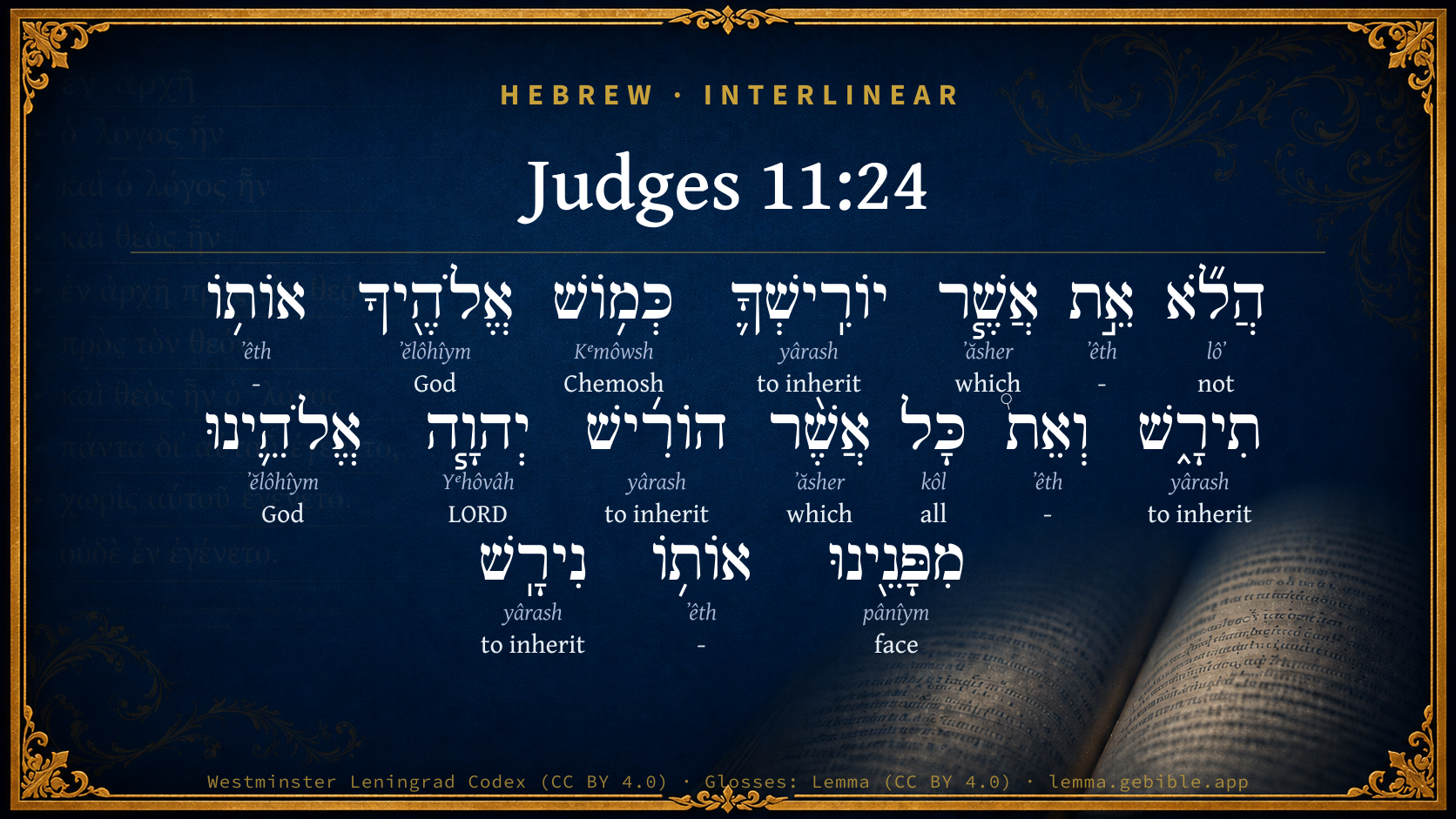
Judges 11:24

Hebrew (Westminster Leningrad Codex) Judges 11:24 appears in the Hebrew Old Testament. The text above is from the Westminster Leningrad Codex. Each word links to its Strong’s number, a concise gloss, and parsing drawn from the Open Scriptures Hebrew Bible morphology. Click any word for its full Brown-Driver-Briggs (BDB) entry.
Download image
Cite this verse

Judges 11:24 (World English Bible). Public Domain. Lemma interlinear Bible study tool, https://lemma.gebible.app/v/judges/11/24.

Show BibTeX & RIS
BibTeX
RIS
English Translation
Won't you possess that which Chemosh your god gives you to possess? So whoever Yahweh our God has dispossessed from before us, them will we possess.
World English Bible · Public Domain
Download a study sheet

One document with this verse’s original text, its word-by-word gloss line, the meaning frame, cross-references with their text, attributed commentary, and full source and license credits — printable, and it pastes into notes with its structure intact.

This verse Autodidact and up

Study sheet (.html) Plain text (.txt)

A passage Seminary Student

Up to 50 verses in one chapter. A passage sheet keeps up to 6 commentary sources and 12 cross-references per verse, in the order this page ranks them, and says so on the sheet whenever that leaves anything out. Ask for a single verse and you get the Autodidact verse sheet above.

Everything on this page stays free to read, with no account — the sheet is a download of what is already on screen, not access to it.

Want to remove ads? Support Godless Engineer
Compare translations 3

The same verse in 3 English versions, stacked beneath the original-language interlinear above. Click any original word for its lexicon entry.

Each is an independent rendering of the whole verse — the interlinear is not word-aligned to these translations.

Highlighted words mark where these versions differ — a whole-verse word diff, not a word-by-word alignment.

  • World English Bible Public Domain
    Won't you possess that which Chemosh your god gives you to possess? So whoever Yahweh our God has dispossessed from before us, them will we possess.
  • King James Version Public Domain
    Wilt not thou possess that which Chemosh thy god giveth thee to possess? So whomsoever the LORD our God shall drive out from before us, them will we possess.
  • unfoldingWord Literal Text CC BY-SA 4.0
    What Chemosh your god causes you to possess, will you not possess it? And all of what Yahweh our God has dispossessed from our face, we will possess it.

unfoldingWord Literal Text — © unfoldingWord, licensed CC BY-SA 4.0. Word-aligned USFM3 via Door43 (git.door43.org/unfoldingWord/en_ult).

Versions to compare (up to 4)

3 of 4 selected

Show all 18 translations

Every available English version of this verse, each an independent rendering of the whole verse.

  • World English Bible Public Domain
    Won't you possess that which Chemosh your god gives you to possess? So whoever Yahweh our God has dispossessed from before us, them will we possess.
  • Berean Standard Bible Public Domain
    Do you not possess whatever your god Chemosh grants you? So also, we possess whatever the LORD our God has granted us.
  • Majority Standard Bible Public Domain
    Do you not possess whatever your god Chemosh grants you? So also, we possess whatever the LORD our God has granted us.
  • King James Version Public Domain
    Wilt not thou possess that which Chemosh thy god giveth thee to possess? So whomsoever the LORD our God shall drive out from before us, them will we possess.
  • American Standard Version (1901) Public Domain
    Wilt not thou possess that which Chemosh thy god giveth thee to possess? So whomsoever Jehovah our God hath dispossessed from before us, them will we possess.
  • Revised Version (1885) Public Domain
    Wilt not thou possess that which Chemosh thy god giveth thee to possess? So whomsoever the LORD our God hath dispossessed from before us, them will we possess.
  • Geneva Bible (1599) Public Domain
    Wouldest not thou possesse that which Chemosh thy god giueth thee to possesse? So whomesoeuer the Lord our God driueth out before vs, them will we possesse.
  • Douay-Rheims (1899) Public Domain
    Are not those things which thy god Chamos possesseth, due to thee by right? But what the Lord our God hath obtained by conquest, shall be our possession:
  • Young's Literal Translation Public Domain
    That which Chemosh thy god causeth thee to possess -- dost thou not possess it? and all that which Jehovah our God hath dispossessed from our presence, -- it we do possess.
  • Literal Standard Version CC BY-SA 4.0
    That which your god Chemosh causes you to possess—do you not possess it? And all that which our God YHWH has dispossessed from our presence—we possess it.
  • Unlocked Literal Bible CC BY-SA 4.0
    Will you not take over the land that Chemosh, your god, gives you? So whatever land Yahweh our God has given us, we will take over.
  • unfoldingWord Literal Text CC BY-SA 4.0
    What Chemosh your god causes you to possess, will you not possess it? And all of what Yahweh our God has dispossessed from our face, we will possess it.
  • Darby Bible Public Domain
    Will you not possess what Chemosh your god gives you to possess? And all that the LORD our God has dispossessed before us, we will possess.
  • World Messianic Bible Public Domain
    Won’t you possess that which Chemosh your god gives you to possess? So whoever the LORD our God has dispossessed from before us, them will we possess.
  • Webster's Bible Public Domain
    Wilt not thou possess that which Chemosh thy god giveth thee to possess? So whomsoever the LORD our God shall drive out from before us, them will we possess.
  • Free Bible Version CC BY-SA 4.0
    Why don't you keep whatever your god Chemosh gave you, and we'll keep whatever the Lord our God has given us?
  • Bible in Basic English Public Domain
    Do you not keep the lands of those whom Chemosh your god sends out from before you? So we will keep all the lands of those whom the Lord our God sends out from before us.
  • JPS Tanakh (1917) Public Domain
    Wilt not thou possess that which Chemosh thy god giveth thee to possess? So whomsoever the LORD our God hath dispossessed from before us, them will we possess.

Literal Standard Version (2020), Covenant Press — licensed CC BY-SA 4.0. Text via the HelloAO Bible API (eBible.org). Unlocked Literal Bible (unfoldingWord) — licensed CC BY-SA 4.0. Text via the HelloAO Bible API (eBible.org). unfoldingWord Literal Text — © unfoldingWord, licensed CC BY-SA 4.0. Word-aligned USFM3 via Door43 (git.door43.org/unfoldingWord/en_ult). Free Bible Version, Dr. Jonathan Gallagher — licensed CC BY-SA 4.0. Text via the HelloAO Bible API (eBible.org).

Word by word

More ways to search: Search by grammar → Find every occurrence → Compare this word →

Practice this passage: Drill this verse → Learn its vocabulary →

כְּמ֥וֹשׁ
Kᵉmôwsh
H3645
“Chemosh”
Noun, Proper
Part of Speech
Noun
Type
Proper
Full BDB Definition

Origin: from an unused root meaning to subdue

TWOT: None

Chemosh = "subduer" - the national deity of the Moabites and a god of the Ammonites - also identified with 'Baal-peor', 'Baal-zebub', 'Mars' and 'Saturn' - worship of this god was introduced into Jerusalem by Solomon and abolished by king Josiah of Judah
  1. הֲלֹ֞א lôʼ H3808 “not” Particle, Interrogative + Particle, Negative
  2. אֵ֣ת ʼêth H853 “-” Particle, Direct Object
  3. אֲשֶׁ֧ר ʼăsher H834 “which” Particle, Relative
  4. יוֹרִֽישְׁךָ֛ yârash H3423 “to inherit · you” Verb, Hiphil, Imperfect, 3rd Person, Masculine, Singular + Suffix, Personal, 2nd Person, Masculine, Singular
  5. אֱלֹהֶ֖יךָ ʼĕlôhîym H430 “God(s) · your” Noun, Common, Masculine, Plural, Construct + Suffix, Personal, 2nd Person, Masculine, Singular
  6. אוֹת֥וֹ ʼêth H853 “- · him” Particle, Direct Object + Suffix, Personal, 3rd Person, Masculine, Singular
  7. תִירָ֑שׁ yârash H3423 “to inherit” Verb, Qal, Imperfect, 2nd Person, Masculine, Singular
  8. וְאֵת֩ ʼêth H853 “and · -” Conjunction + Particle, Direct Object
  9. כָּל kôl H3605 “all of” Noun, Common, Masculine, Singular, Construct
  10. אֲשֶׁ֨ר ʼăsher H834 “which” Particle, Relative
  11. הוֹרִ֜ישׁ yârash H3423 “to inherit” Verb, Hiphil, Perfect, 3rd Person, Masculine, Singular
  12. יְהוָ֧ה Yᵉhôvâh H3068 “LORD” Noun, Proper
  13. אֱלֹהֵ֛ינוּ ʼĕlôhîym H430 “God(s) · our” Noun, Common, Masculine, Plural, Construct + Suffix, Personal, 1st Person, Common, Plural
  14. מִפָּנֵ֖ינוּ pânîym H6440 “from · face(s) · our” Preposition + Noun, Common, Both, Plural, Construct + Suffix, Personal, 1st Person, Common, Plural
  15. אוֹת֥וֹ ʼêth H853 “- · him” Particle, Direct Object + Suffix, Personal, 3rd Person, Masculine, Singular
  16. נִירָֽשׁ yârash H3423 “to inherit” Verb, Qal, Imperfect, 1st Person, Common, Plural

About this verse

These counts appear in no published source. They are computed here, from the morphology-tagged text and Lemma’s own curated glosses. What Lemma adds →

17
words
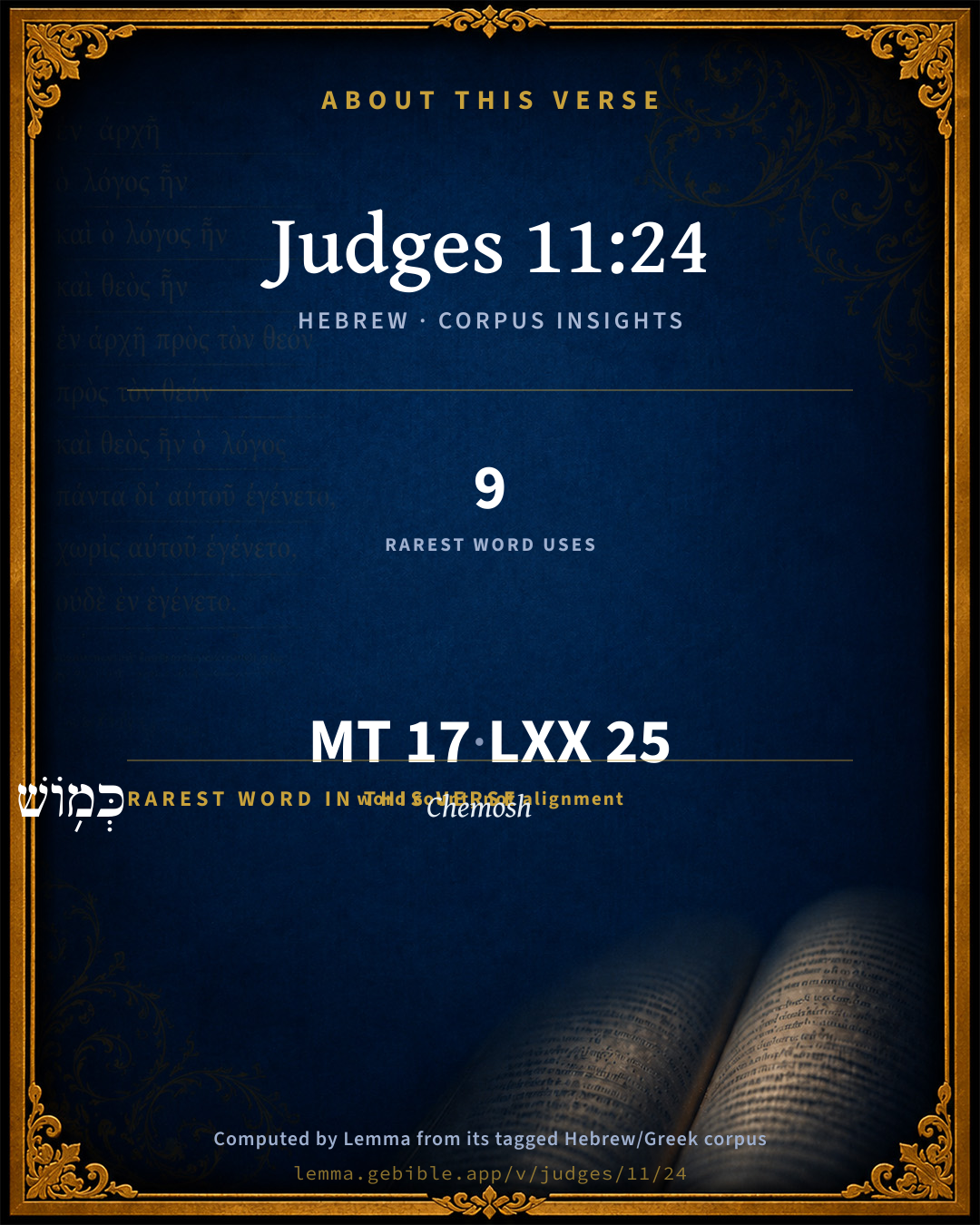
9
distinct lemmas
Historical
section

Notable vocabulary

The rarest word here is כְּמ֥וֹשׁ Chemosh H3645 — appearing just 9 times in the whole Hebrew Bible.

Shared distinctive vocabulary

כְּמ֥וֹשׁ Chemosh H3645 occurs in 8 verses of the Hebrew Bible. Also found in:

Grammatical profile

  • 4 verbs
  • 6 nouns
  • 7 particles

Verb forms

  • יוֹרִֽישְׁךָ֛ Hiphil · Imperfect
  • תִירָ֑שׁ Qal · Imperfect
  • הוֹרִ֜ישׁ Hiphil · Perfect
  • נִירָֽשׁ Qal · Imperfect

Repetition

Words recur within this verse — often emphatic in Hebrew:

  • יוֹרִֽישְׁךָ֛ to inherit H3423 ×4
  • אֱלֹהֶ֖יךָ God H430 ×2
  • אֲשֶׁ֧ר which H834 ×2

Hebrew & Septuagint length

In English translation the verse runs 26 words from the Hebrew and 35 from the Septuagint (LXX English) — closely comparable.

A rough comparison of the two English renderings, which tokenize alike — not a word-level alignment.

Word counts can differ between the Hebrew and the Greek without any difference in meaning — e.g. the Hebrew direct-object marker אֵת has no separate Greek word, and Greek often adds the article ὁ.

In the original languages it is 17 Hebrew tokens and 25 Greek tokens — but the two are counted differently (Hebrew bundles its prefixes and suffixes into one token; the Greek is in lemma form), so that isn’t a like-for-like length.

Cross-references

10

Topical passages linked to Judges 11:24 in the Treasury of Scripture Knowledge — connected by theme and wording, ordered by reader-vote popularity; previews shown in the World English Bible.

  • Numbers 21:29 Woe to you, Moab! You are undone, people of Chemosh: He has given his sons as fugitives, His daughters into captivity, To Sihon king of the Amorites.
  • Psalms 78:55 He also drove out the nations before them, Allotted them for an inheritance by line, And made the tribes of Israel to dwell in their tents.
  • Micah 4:5 Indeed all the nations may walk in the name of their gods; But we will walk in the name of Yahweh our God forever and ever.
  • Joshua 3:10 Joshua said, Hereby you shall know that the living God is among you, and that he will without fail drive out from before you the Canaanite, and the Hittite, and the Hivite, and the Perizzite, and the Girgashite, and the Amorite, and the Jebusite.
  • 1 Kings 11:7 Then did Solomon build a high place for Chemosh the abomination of Moab, on the mountain that is before Jerusalem, and for Molech the abomination of the children of Ammon.
  • Deuteronomy 18:12 For whoever does these things is an abomination to Yahweh: and because of these abominations Yahweh your God does drive them out from before you.
  • Deuteronomy 9:4–5 Don't speak in your heart, after that Yahweh your God has thrust them out from before you, saying, For my righteousness Yahweh has brought me in to possess this land; whereas for the wickedness of these nations Yahweh does drive them out from before you.
  • Psalms 44:2 You drove out the nations with your hand, But you planted them. You afflicted the peoples, But you spread them abroad.
  • Jeremiah 48:7 For, because you have trusted in your works and in your treasures, you also shall be taken: and Chemosh shall go forth into captivity, his priests and his princes together.
  • Jeremiah 48:46 Woe to you, O Moab! the people of Chemosh is undone; for your sons are taken away captive, and your daughters into captivity.

Cross-references courtesy of OpenBible.info (CC BY 4.0).

Hebrew and Greek witnesses Masoretic Hebrew ↔ Greek Septuagint

The same verse in the two great witnesses to the Old Testament, shown verse-for-verse.

These are two independent witnesses, not word-aligned to each other, and the Septuagint is shown in lemma (dictionary) form.

Hebrew Judges 11:24 Masoretic · Westminster Leningrad Codex

הֲלֹ֞א אֵ֣ת אֲשֶׁ֧ר יוֹרִֽישְׁךָ֛ כְּמ֥וֹשׁ אֱלֹהֶ֖יךָ אוֹת֥וֹ תִירָ֑שׁ וְאֵת֩ כָּל אֲשֶׁ֨ר הוֹרִ֜ישׁ יְהוָ֧ה אֱלֹהֵ֛ינוּ מִפָּנֵ֖ינוּ אוֹת֥וֹ נִירָֽשׁ

Won't you possess that which Chemosh your god gives you to possess? So whoever Yahweh our God has dispossessed from before us, them will we possess.

World English Bible · Public Domain

Greek LXX Judges 11:24 Septuagint · lemma form

οὐ ὅς ἐάν κληρονομέω σύ χαμως ὁ θεός σύ αὐτός κληρονομέω καί ὁ πᾶς ὅς ἐκαἴρω κύριος ὁ θεός ἐγώ ἀπό πρόσωπον ἐγώ αὐτός κληρονομέω

Will you not inherit those possessions which Chamos your god shall cause you to inherit; and shall not we inherit the land of all those whom the Lord our God has removed from before you?

LXX2012 (modern English Septuagint) · Public Domain

Hebrew: Westminster Leningrad Codex (CC BY 4.0). Greek: Septuagint (public domain); English from LXX2012 (modern English Septuagint) (Public Domain). How the Septuagint differs from the Hebrew →

Targum (Aramaic paraphrase)

1

The Targum is the ancient Jewish Aramaic paraphrase of the Hebrew Scriptures — an interpretive translation, not the Hebrew text itself. Onkelos (literal) and Pseudo-Jonathan (expansive) render the Torah, and Jonathan the Prophets. Coverage is partial: where no permissively-licensed English translation exists for a verse, only the Aramaic is shown. This is verse-level text, not a word-by-word alignment to the Hebrew.

  1. Targum Jonathan Prophets (Joshua–Malachi)
    הֲלָא יַת דְיַחְסְנִנָךְ כְּמוֹשׁ טַעֲוָתָךְ יָתֵיהּ תַּחְסִין וְיַת כָּל דְתָרֵיךְ יְיָ אֱלָהָנָא מִן קֳדָמָנָא יָתֵיהּ נִירָת:

    (no public-domain English translation for this verse)

    Targum Jonathan — Aramaic: “Mikraot Gedolot” (public domain). English: “Sefaria Community Translation” (CC0 1.0 (public-domain dedication)); “London "Chaldee Paraphrase," 1871” (public domain). Text via Sefaria.

Commentary

Notes on Judges 11:24 from classic Christian and Jewish commentators (each source and its license shown beneath its notes). The classic Christian expositions comment on the surrounding passage and are grouped to its opening verse, so a note may address several verses; the Jewish commentaries on the Tanakh (Rashi and others) are per-verse, so they appear only where the commentator wrote on this verse.

Lemma curates 59 commentaries, every one of them public domain or Creative Commons licensed, each selected and text-cleaned for this edition rather than reprinted as found. About our sources →

Trapp's Complete Commentary

John Trapp

Jdg 11:24 Wilt not thou possess that which Chemosh thy god giveth thee to possess? So whomsoever the LORD our God shall drive out from before us, them will we possess.

Ver. 24. That which Chemosh thy god giveth thee.] Namely, The land of the Zanzummims, {Deu 2:19-20} which their god Chemosh had not in very deed given them, for "we know that an idol is nothing in the world," {1Co 8:4} and nothing he can give, {Jer 10:5} but only the king of Ammon thought so; like as in 2Ch 28:23, it is said that "the gods of Damascus smote" or plagued Ahaz, that is, in the opinion of Ahaz.

John Trapp, A Commentary or Exposition upon All the Books of the Old and New Testament (1647–1656) — public domain. Text from a community e-Sword module.

Joseph Benson's Commentary

Jdg 11:24. Wilt not thou possess, &c. — He does not call Chemosh a god; but only argues from the opinion that they had of him, which was such as all nations entertained of their gods, namely, that they owed their conquests to them: to whom, therefore, they gave thanks for all their victories. The Ammonites and Moabites got their land by conquest of the old inhabitants, whom they cast out; and their success, though given them by the true God, for Lot’s sake, Deu 2:9; Deu 2:19, they impiously ascribed to their god Chemosh, whose gift they owned to be a sufficient title. Jephthah, therefore, here appeals to themselves, whether they would not keep what they believed their god had given them, and consider it as lawfully possessed by them. So whomsoever the Lord our God shall drive out, them will we possess — By the very same title whereby the Moabites and Ammonites conceived that they possessed the country in which they now lived, and from whence they had driven out the ancient inhabitants.

Joseph Benson's Commentary on the Old and New Testaments (1811–1818) — public domain. Text from a community e-Sword module.

Geneva Bible (1599)

Geneva Bible translators

For we ought more to believe and obey God, than thou thine idols.

Geneva Bible (1599) marginal notes — public domain. Text via Bolls.life.

Adam Clarke's Commentary

Verse 24. Wilt not thou possess that which Chemosh thy god giveth thee] As if he had said: "It is a maxim with you, as it is among all nations, that the lands which they conceive to be given them by their gods, they have an absolute right to, and should not relinquish them to any kind of claimant. You suppose that the land which you possess was given you by your god Chemosh and therefore you will not relinquish what you believe you hold by a Divine right. Now, we know that Jehovah, our God, who is the Lord of heaven and earth, has given the Israelites the land of the Amorites; and therefore we will not give it up." The ground of Jephthah's remonstrance was sound and good.

1. The Ammonites had lost their lands in their contests with the Amorites.

2. The Israelites conquered these lands from the Amorites, who had waged a most unprincipled war against them.

3. God, who is the Maker of heaven and earth had given those very lands as a Divine grant to the Israelites.

4. In consequence of this they had possession of them for upwards of three hundred years.

5. These lands were never reclaimed by the Ammonites, though they had repeated opportunities of doing it, whilst the Israelites dwelt in Heshbon, in Aroer, and in the coasts of Arnon; but they did not reclaim them because they knew that the Israelites held them legally. The present pretensions of Ammon were unsupported and unjustifiable.

Adam Clarke's Commentary on the Bible (1810–1826) — public domain. Text from a community e-Sword/MySword module.

Ellicott's Commentary for English Readers

(24) Chemosh thy god.—The expression shows the close connection between Ammon and Moab. Chemosh was distinctively the god of Moab, and Moloch of Ammon; but the two nations were of kindred blood and allied institutions (Jdg_3:12-13). The name Chemosh means “subduer,” and there is here, perhaps, a tacit reference to the wild popular song of triumph over the conquest of Heshbon, in which Chemosh is taunted by name (Num_21:29; comp. Jer_48:7). The clause might be rendered, “Whatever Jehovah our God hath dispossessed before us, that take we in possession.”

A Bible Commentary for English Readers, edited by Charles John Ellicott (1878–1897) — public domain. Text from a community e-Sword module.

The Cambridge Bible for Schools and Colleges

gen. ed. J. J. S. Perowne

24. Chemosh thy god … the Lord our God] What Jehovah was to Israel Chemosh was to Moab; Num_21:29, Moab. St. passim. Obviously Moabites are in the speaker’s mind, not Ammonites, whose national god was Milcom. According to ancient ideas each nation had its own god, whose influence extended over the country where he was worshipped and no further; Mic_4:5, cf. 1Sa_26:19, Deu_4:19 etc.; an Israelite worshipper of Jehovah would not, therefore, deny the divinity of the gods of his neighbours. A belief in the sole Godhead of Jehovah had not yet been reached.

Will not thou … giveth thee to possess] Read Wilt not thou possess (the territory of) those whom Chemosh thy god dispossesseth? omitting thee, and thus making the two halves of the verse correspond.

The Cambridge Bible for Schools and Colleges (gen. ed. J. J. S. Perowne; Cambridge University Press, 1878–1918) — public domain. Text from a community e-Sword module.

John Gill's Exposition

And now art thou anything better than Balak the son of Zippor king of Moab?.... This argument seems to strengthen the conjecture, that this king was king of Moab at this time, and so Balak was one of his predecessors. Now he is asked, whether he thought he was a wiser and more knowing prince than he, as to what was his right and due; or whether he had a better claim, or any additional one to the land in dispute the other had not; or whether he judged he was more able to regain what belonged to him:

did he ever strive against Israel? for the land they took away from Sihon formerly in the possession of the Moabites? did he ever lay any claim to it, or enter into any dispute, or litigate with Israel about it? not at all:

or did he ever fight against Israel? that is, on that account; no, he sent for Balaam to curse Israel, and sought to defend and secure his own country he was in possession of, which he thought was in danger by the Israelites being so near him; but he never made war with them under any such pretence, that they had done him any injury by inheriting the land they had taken from Sihon and Og, kings of the Amorites.

John Gill's Exposition of the Whole Bible (1746–1763) — public domain (CC PDM 1.0). Text via the HelloAO Bible API.

Haydock's Catholic Bible Commentary

Chamos. The idol of the Moabites and Ammonites. He argues from their opinion, who thought they had a just title to the countries which they imagined they had conquered by the help of their gods: how much more then had Israel an indisputable title to the countries which God, by visible miracles, had conquered for them. (Challoner) --- Hebrew, "And shall not we possess those (counties occupied by the people whom) the Lord our God has driven out from before us?" (Haydock) --- The Emim had been expelled by the people, Deuteronomy ii. 10. Chamos was the peculiar deity of Moab, (Numbers xxi. 29., and Jeremias xlviii. 46., &c.; Calmet) and signifies "as taking away." It is commonly supposed to be the sun. (Haydock)

George Leo Haydock (1774–1849), Haydock's Catholic Family Bible and Commentary, 1859 edition — public domain. Excludes Psalms (Douay-Rheims chapter numbering differs from Protestant) and Deuterocanonical books (Catholic canon only).

Matthew Poole's English Annotations

He speaks according to their fond and absurd opinion. The Ammonites and Moabites got their land by right of war, and conquest of the old inhabitants, whom they cast out; and this success, though given them by the true God, for Lot’s sake, Deu 2:19, they impiously and ridiculously ascribe to their god Chemosh, whose gift they owned to be a firm and sufficient title.

Matthew Poole's English Annotations on the Holy Bible (1683–1685) — public domain. Text from a community e-Sword/MySword module.

Whedon's Commentary on the Bible

Daniel D. Whedon

24. Wilt thou not — The thought involved in the previous verse is here expanded in a sort of argumentum ad hominem. You yourselves, it is urged, would most earnestly insist on possessing that which your god had given into your hands; and shall not we do the same?

Chemosh — The great deity of the Moabites and Ammonites. “Jewish tradition affirms that he was worshipped under the symbol of a black star; and Maimonides states that his worshippers went bareheaded, and abstained from the use of garments sewn together by the needle. The black star, the connexion with Arabian idolatry, and the fact that Chemosh is coupled with Moloch, favour the theory that he had some analogy with the planet Saturn.” — Kitto’s Cyclopaedia. He is here spoken of as a local and national deity, but it is not necessary to assume that Jephthah himself believed in his real existence and divinity. He speaks with respect, however, of the religion of his foe, and this fact, together with the recent existence of Ammonitish idolatry in Israel, (Jdg_10:6,) affords some ground to believe that there was still among the Israelites too much reverence for the gods of the heathen. {

The Lord — Jehovah. Note the antithesis. Chemosh thy god — Jehovah our God. The Ammonites held both to be national deities. The more ignorant Israelites always inclined to the same view; the well-taught Israelite recognised that Jehovah was indeed the national God, but also God over all; and the truly pious held him to be sole God, all else being “a lie.”}

Daniel D. Whedon (gen. ed.), Commentary on the Old and New Testaments (1874–1909) — public domain. Text from a community e-Sword module.

The Pulpit Commentary

Chemosh. The national god of the Moabites. (of 1Ki_11:7, 33 Jer_48:7, Jer_48:13, Jer_48:46, etc.) Thy god. The phrase indicates a very close connection between Moab and Ammon at the present time, both possibly being under one king. Chemosh, rather than Moloch, is mentioned because the territory had belonged to the Moabites, but Chemosh had not been able to save it from the Amorites. The Lord our God. Jehovah was the God of Israel as truly as Chemosh was the god of Moab, in one sense. Possibly Jephthah had not risen to the conception of Jehovah as the God of the whole earth.

The Pulpit Commentary (1880–1919), ed. H.D.M. Spence-Jones & Joseph S. Exell — public domain. Text from a community e-Sword module.

John Wesley's Explanatory Notes

Wilt not thou - He speaks according to their absurd opinion: the Ammonites and Moabites got their land by conquest of the old inhabitants, whom they cast out; and this success, though given them by the true God, for Lot's sake, Deut. ii, 9, 19, they impiously ascribe to their God Chemosh, whose gift they owned to be a sufficient title.

John Wesley, Explanatory Notes Upon the Whole Bible (1754–1765) — public domain. Text via the GEBible commentary corpus.

Lesson kit

Teaching starters — assembled from the data on this page, not authored interpretation. Every prompt links to the verse data it draws on. Edit before teaching.

Judges, in the Historical, opens this verse with 17 words (9 distinct Hebrew lemmas). Its most distinctive word is Kᵉmôwsh (“Chemosh”). A historical commentator’s framing appears above. Read the whole chapter for the surrounding context.

Discussion questions

  1. The word Kᵉmôwsh carries the sense “Chemosh.” How does it shape the verse?
  2. Numbers 21:29 shares the word «Chemosh» with this verse. How do the two illuminate each other?
  3. “to inherit” occurs 4× in this one verse. What is the effect of the repetition?
  4. These translations render this verse differently; the difference is in the English rendering, not the original. What questions does that raise?
  5. The verb «יוֹרִֽישְׁךָ֛» is Hiphil Imperfect. How does its form color the action?
  6. Reading how Trapp's Complete Commentary and Joseph Benson's Commentary read this verse, where do the two commentators agree and where do they part?

Things to notice

Reading settings

Reading text

Shown beneath each verse's original-language words.

Old Testament
Old Testament edition

Read the OT as the Masoretic Hebrew (MT) or the Greek Septuagint (LXX).

English shown for the Greek Septuagint (in the Hebrew ↔ Greek comparison).

Comparing translations? Open the Compare panel on any verse page to stack up to four side by side.