
Joshua 17:18

Hebrew (Westminster Leningrad Codex) Joshua 17:18 appears in the Hebrew Old Testament. The text above is from the Westminster Leningrad Codex. Each word links to its Strong’s number, a concise gloss, and parsing drawn from the Open Scriptures Hebrew Bible morphology. Click any word for its full Brown-Driver-Briggs (BDB) entry.
Download image
Cite this verse

Joshua 17:18 (World English Bible). Public Domain. Lemma interlinear Bible study tool, https://lemma.gebible.app/v/joshua/17/18.

Show BibTeX & RIS
BibTeX
RIS
English Translation
but the hill-country shall be yours; for though it is a forest, you shall cut it down, and the goings out of it shall be yours; for you shall drive out the Canaanites, though they have chariots of iron, and though they are strong.
World English Bible · Public Domain
Download a study sheet

One document with this verse’s original text, its word-by-word gloss line, the meaning frame, cross-references with their text, attributed commentary, and full source and license credits — printable, and it pastes into notes with its structure intact.

This verse Autodidact and up

Study sheet (.html) Plain text (.txt)

A passage Seminary Student

Up to 50 verses in one chapter. A passage sheet keeps up to 6 commentary sources and 12 cross-references per verse, in the order this page ranks them, and says so on the sheet whenever that leaves anything out. Ask for a single verse and you get the Autodidact verse sheet above.

Everything on this page stays free to read, with no account — the sheet is a download of what is already on screen, not access to it.

Want to remove ads? Support Godless Engineer
Compare translations 3

The same verse in 3 English versions, stacked beneath the original-language interlinear above. Click any original word for its lexicon entry.

Each is an independent rendering of the whole verse — the interlinear is not word-aligned to these translations.

Highlighted words mark where these versions differ — a whole-verse word diff, not a word-by-word alignment.

  • World English Bible Public Domain
    but the hill-country shall be yours; for though it is a forest, you shall cut it down, and the goings out of it shall be yours; for you shall drive out the Canaanites, though they have chariots of iron, and though they are strong.
  • King James Version Public Domain
    But the mountain shall be thine; for it is a wood, and thou shalt cut it down: and the outgoings of it shall be thine: for thou shalt drive out the Canaanites, though they have iron chariots, and though they be strong.
  • unfoldingWord Literal Text CC BY-SA 4.0
    For the hill country will be to you, though it a forest, and you shall clear it, and its goings out will be to you. For you will dispossess the Canaanite, though a chariot of iron is to him, though he strong.”

unfoldingWord Literal Text — © unfoldingWord, licensed CC BY-SA 4.0. Word-aligned USFM3 via Door43 (git.door43.org/unfoldingWord/en_ult).

Versions to compare (up to 4)

3 of 4 selected

Show all 18 translations

Every available English version of this verse, each an independent rendering of the whole verse.

  • World English Bible Public Domain
    but the hill-country shall be yours; for though it is a forest, you shall cut it down, and the goings out of it shall be yours; for you shall drive out the Canaanites, though they have chariots of iron, and though they are strong.
  • Berean Standard Bible Public Domain
    because the hill country will be yours as well. It is a forest; clear it, and its farthest limits will be yours. Although the Canaanites have iron chariots and although they are strong, you can drive them out.”
  • Majority Standard Bible Public Domain
    because the hill country will be yours as well. It is a forest; clear it, and its farthest limits will be yours. Although the Canaanites have iron chariots and although they are strong, you can drive them out.”
  • King James Version Public Domain
    But the mountain shall be thine; for it is a wood, and thou shalt cut it down: and the outgoings of it shall be thine: for thou shalt drive out the Canaanites, though they have iron chariots, and though they be strong.
  • American Standard Version (1901) Public Domain
    but the hill-country shall be thine; for though it is a forest, thou shalt cut it down, and the goings out thereof shall be thine; for thou shalt drive out the Canaanites, though they have chariots of iron, and though they are strong.
  • Revised Version (1885) Public Domain
    but the hill country shall be thine; for though it is a forest, thou shalt cut it down, and the goings out thereof shall be thine: for thou shalt drive out the Canaanites, though they have chariots of iron, and though they be strong.
  • Geneva Bible (1599) Public Domain
    Therefore the mountaine shall be thine: for it is a wood, and thou shalt cut it downe: and the endes of it shall be thine, and thou shalt cast out the Canaanites, though they haue yron charets, and though they be strong.
  • Douay-Rheims (1899) Public Domain
    But thou shalt pass to the mountain, and shalt cut down the wood, and make thyself room to dwell in: and mayst proceed farther, when thou hast destroyed the Chanaanites, who as thou sayest have iron chariots, and are very strong.
  • Young's Literal Translation Public Domain
    because the mountain is thine; because it `is' a forest -- thou hast prepared it, and its outgoings have been thine; because thou dost dispossess the Canaanite, though it hath chariots of iron -- though it `is' strong.'
  • Literal Standard Version CC BY-SA 4.0
    because the mountain is yours; because it [is] a forest—you have created it, and its outgoings have been yours; because you dispossess the Canaanite, though it has chariots of iron—though it [is] strong.”
  • Unlocked Literal Bible CC BY-SA 4.0
    The hill country will also be yours. Though it is a forest, you will clear it and take possession of it to its farthest borders. You will drive out the Canaanites, even though they have chariots of iron, and even though they are strong.”
  • unfoldingWord Literal Text CC BY-SA 4.0
    For the hill country will be to you, though it a forest, and you shall clear it, and its goings out will be to you. For you will dispossess the Canaanite, though a chariot of iron is to him, though he strong.”
  • Darby Bible Public Domain
    but the hill-country shall be thine, as it is a wood, thou shalt cut it down, and its outgoings shall be thine; for thou shalt dispossess the Canaanites, though they have iron chariots; for they are powerful.
  • World Messianic Bible Public Domain
    but the hill country shall be yours. Although it is a forest, you shall cut it down, and it’s farthest extent shall be yours; for you shall drive out the Canaanites, though they have chariots of iron, and though they are strong.”
  • Webster's Bible Public Domain
    But the mountain shall be thine; for it is a wood, and thou shalt cut it down: and the limits of it shall be thine: for thou shalt drive out the Canaanites, though they have iron chariots, and though they are strong.
  • Free Bible Version CC BY-SA 4.0
    You will be allocated the hill country in addition. Though it is forest, you will clear it and own it, from one end to the other. You will drive out the Canaanites, even though they have iron chariots, and even though they are strong.”
  • Bible in Basic English Public Domain
    For the hill-country of Gilead will be yours... the woodland and cut down... its outskirts will be yours... get the Canaanites out, for they have iron war-carriages... strong.
  • JPS Tanakh (1917) Public Domain
    but the hill-country shall be thine; for though it is a forest, thou shalt cut it down, and the goings out thereof shall be thine; for thou shalt drive out the Canaanites, though they have chariots of iron, and though they be strong.'

Literal Standard Version (2020), Covenant Press — licensed CC BY-SA 4.0. Text via the HelloAO Bible API (eBible.org). Unlocked Literal Bible (unfoldingWord) — licensed CC BY-SA 4.0. Text via the HelloAO Bible API (eBible.org). unfoldingWord Literal Text — © unfoldingWord, licensed CC BY-SA 4.0. Word-aligned USFM3 via Door43 (git.door43.org/unfoldingWord/en_ult). Free Bible Version, Dr. Jonathan Gallagher — licensed CC BY-SA 4.0. Text via the HelloAO Bible API (eBible.org).

Word by word

More ways to search: Search by grammar → Find every occurrence → Compare this word →

Practice this passage: Drill this verse → Learn its vocabulary →

תֹּֽצְאֹתָ֑יו
tôwtsâʼâh
H8444
“outgoings · his”
Noun, Common, Feminine, Plural, Construct + Suffix, Personal, 3rd Person, Masculine, Singular
Part of Speech
Noun
Type
Common
Gender
Feminine
Number
Plural
State
Construct
Full BDB Definition

Origin: from H3318

TWOT: 893e

outgoing, border, a going out, extremity, end, source, escape - outgoing, extremity (of border) - source (of life) - escape (from death)
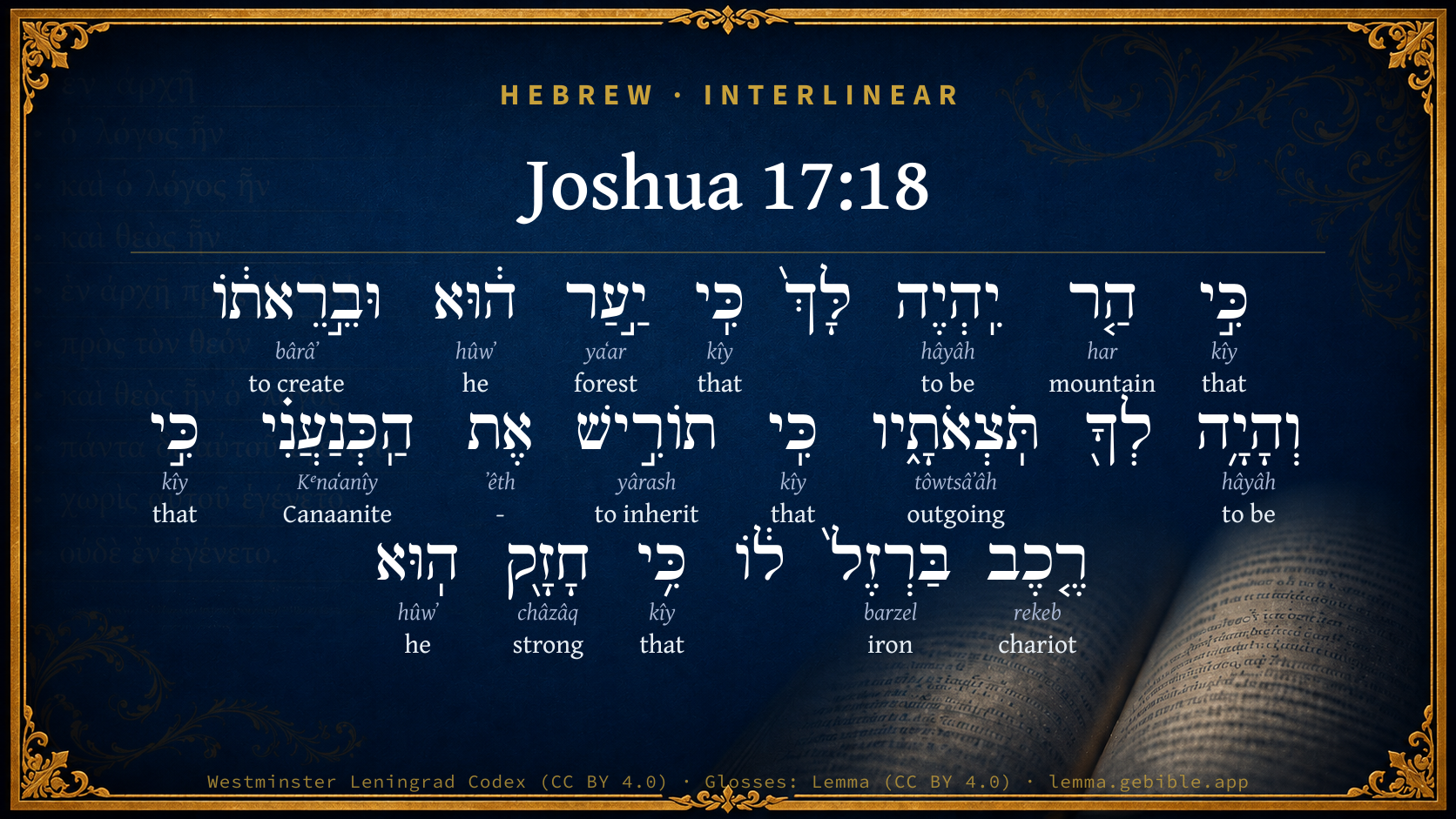
  1. כִּ֣י kîy H3588 “that” Conjunction
  2. הַ֤ר har H2022 “mountain” Noun, Common, Masculine, Singular, Absolute
  3. יִֽהְיֶה hâyâh H1961 “to be” Verb, Qal, Imperfect, 3rd Person, Masculine, Singular
  4. כִּֽי kîy H3588 “that” Conjunction
  5. יַ֣עַר yaʻar H3293 “forest” Noun, Common, Masculine, Singular, Absolute
  6. ה֔וּא hûwʼ H1931 “he” Pronoun, Personal, 3rd Person, Masculine, Singular
  7. וּבֵ֣רֵאת֔וֹ bârâʼ H1254 “and · to create · him” Conjunction + Verb, Piel, Sequential Perfect, 2nd Person, Masculine, Singular + Suffix, Personal, 3rd Person, Masculine, Singular
  8. וְהָיָ֥ה hâyâh H1961 “and · to be” Conjunction + Verb, Qal, Sequential Perfect, 3rd Person, Masculine, Singular
  9. כִּֽי kîy H3588 “that” Conjunction
  10. תוֹרִ֣ישׁ yârash H3423 “to inherit” Verb, Hiphil, Imperfect, 2nd Person, Masculine, Singular
  11. אֶת ʼêth H853 “-” Particle, Direct Object
  12. הַֽכְּנַעֲנִ֗י Kᵉnaʻanîy H3669 “the · Canaanite” Particle, Definite Article + Noun, Gentilic, Masculine, Singular, Absolute
  13. כִּ֣י kîy H3588 “that” Conjunction
  14. רֶ֤כֶב rekeb H7393 “chariot of” Noun, Common, Masculine, Singular, Construct
  15. בַּרְזֶל֙ barzel H1270 “iron” Noun, Common, Masculine, Singular, Absolute
  16. כִּ֥י kîy H3588 “that” Conjunction
  17. חָזָ֖ק châzâq H2389 “strong” Adjective, Adjective, Masculine, Singular, Absolute
  18. הֽוּא hûwʼ H1931 “he” Pronoun, Personal, 3rd Person, Masculine, Singular

About this verse

These counts appear in no published source. They are computed here, from the morphology-tagged text and Lemma’s own curated glosses. What Lemma adds →

22
words
13
distinct lemmas
Historical
section

Notable vocabulary

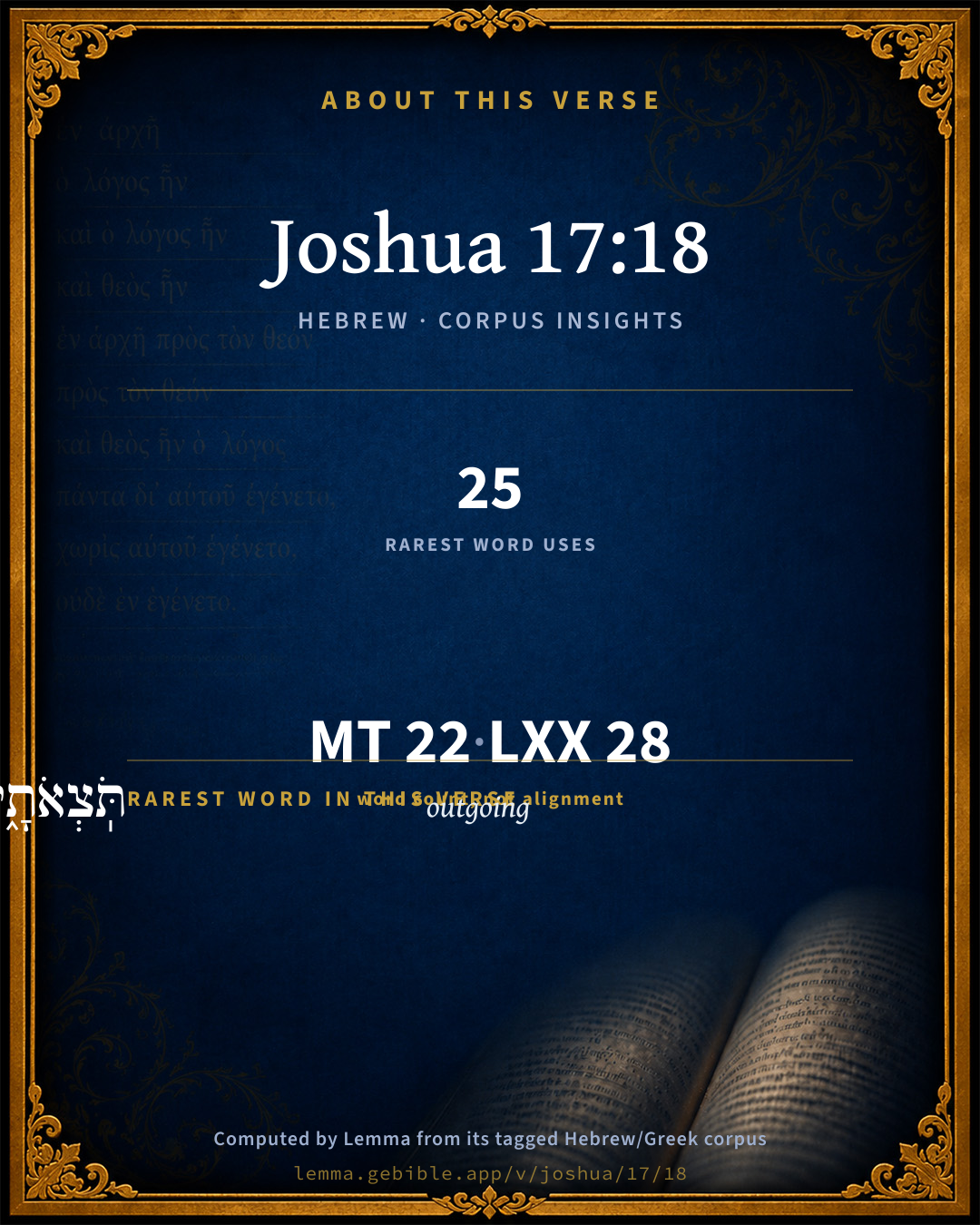
The rarest word here is תֹּֽצְאֹתָ֑יו outgoing H8444 — appearing just 25 times in the whole Hebrew Bible.

Shared distinctive vocabulary

תֹּֽצְאֹתָ֑יו outgoing H8444 occurs in 23 verses of the Hebrew Bible. Also found in:

Grammatical profile

  • 4 verbs
  • 6 nouns
  • 1 adjective
  • 2 pronouns
  • 3 prepositions
  • 5 conjunctions
  • 1 particle

Verb forms

  • יִֽהְיֶה Qal · Imperfect
  • וּבֵ֣רֵאת֔וֹ Piel · Sequential Perfect
  • וְהָיָ֥ה Qal · Sequential Perfect
  • תוֹרִ֣ישׁ Hiphil · Imperfect

Repetition

Words recur within this verse — often emphatic in Hebrew:

  • יִֽהְיֶה to be H1961 ×2
  • כִּ֣י that H3588 ×5
  • ה֔וּא he H1931 ×2

Hebrew & Septuagint length

In English translation the verse runs 44 words from the Hebrew and 42 from the Septuagint (LXX English) — closely comparable.

A rough comparison of the two English renderings, which tokenize alike — not a word-level alignment.

Word counts can differ between the Hebrew and the Greek without any difference in meaning — e.g. the Hebrew direct-object marker אֵת has no separate Greek word, and Greek often adds the article ὁ.

In the original languages it is 22 Hebrew tokens and 28 Greek tokens — but the two are counted differently (Hebrew bundles its prefixes and suffixes into one token; the Greek is in lemma form), so that isn’t a like-for-like length.

Cross-references

13

Topical passages linked to Joshua 17:18 in the Treasury of Scripture Knowledge — connected by theme and wording, ordered by reader-vote popularity; previews shown in the World English Bible.

  • Hebrews 13:6 So that with good courage we say, "The Lord is my helper. I will not fear. What can man do to me?"
  • Romans 8:31 What then shall we say about these things? If God is for us, who can be against us?
  • Numbers 14:6–9 Joshua the son of Nun and Caleb the son of Jephunneh, who were of those who spied out the land, tore their clothes:
  • Isaiah 41:10–16 Don't you be afraid, for I am with you; don't be dismayed, for I am your God; I will strengthen you; yes, I will help you; yes, I will uphold you with the right hand of my righteousness.
  • Romans 8:37 No, in all these things, we are more than conquerors through him who loved us.
  • Deuteronomy 20:1–4 When you go forth to battle against your enemies, and see horses, and chariots, [and] a people more than you, you shall not be afraid of them; for Yahweh your God is with you, who brought you up out of the land of Egypt.
  • Joshua 15:9 and the border extended from the top of the mountain to the spring of the waters of Nephtoah, and went out to the cities of Mount Ephron; and the border extended to Baalah (the same is Kiriath Jearim);
  • Joshua 17:15–16 Joshua said to them, If you are a great people, go up to the forest, and cut down for yourself there in the land of the Perizzites and of the Rephaim; since the hill-country of Ephraim is too narrow for you.
  • Psalms 27:1–2 Yahweh is my light and my salvation. Whom shall I fear? Yahweh is the strength of my life. Of whom shall I be afraid?
  • Isaiah 51:12–13 I, even I, am he who comforts you: who are you, that you are afraid of man who shall die, and of the son of man who shall be made as grass;
  • Joshua 11:4–6 They went out, they and all their hosts with them, much people, even as the sand that is on the sea-shore in multitude, with horses and chariots very many.
  • Joshua 13:6 all the inhabitants of the hill-country from Lebanon to Misrephoth Maim, even all the Sidonians; them will I drive out from before the children of Israel: only allot you it to Israel for an inheritance, as I have commanded you.
  • Joshua 20:7 They set apart Kedesh in Galilee in the hill-country of Naphtali, and Shechem in the hill-country of Ephraim, and Kiriath Arba (the same is Hebron) in the hill-country of Judah.

Cross-references courtesy of OpenBible.info (CC BY 4.0).

Hebrew and Greek witnesses Masoretic Hebrew ↔ Greek Septuagint

The same verse in the two great witnesses to the Old Testament, shown verse-for-verse.

These are two independent witnesses, not word-aligned to each other, and the Septuagint is shown in lemma (dictionary) form.

Hebrew Joshua 17:18 Masoretic · Westminster Leningrad Codex

כִּ֣י הַ֤ר יִֽהְיֶה לָּךְ֙ כִּֽי יַ֣עַר ה֔וּא וּבֵ֣רֵאת֔וֹ וְהָיָ֥ה לְךָ֖ תֹּֽצְאֹתָ֑יו כִּֽי תוֹרִ֣ישׁ אֶת הַֽכְּנַעֲנִ֗י כִּ֣י רֶ֤כֶב בַּרְזֶל֙ ל֔וֹ כִּ֥י חָזָ֖ק הֽוּא

but the hill-country shall be yours; for though it is a forest, you shall cut it down, and the goings out of it shall be yours; for you shall drive out the Canaanites, though they have chariots of iron, and though they are strong.

World English Bible · Public Domain

Greek LXX Joshua 17:18 Septuagint · lemma form

ὁ γάρ δρυμός εἰμί σύ ὅτι δρυμός εἰμί καί ἐκκαθαρίζω αὐτός καί εἰμί σύ καί ὅταν ἐκὀλεθρεύω ὁ χαναναῖος ὅτι ἵππος ἐπίλεκτος εἰμί αὐτός σύ γάρ ὑπερἰσχύω αὐτός

For you shall have the wood, for there is a wood, and you shall clear it, and the land shall be yours; even when you shall have utterly destroyed the Chananite, for he has chosen cavalry; yet you are stronger than he.

LXX2012 (modern English Septuagint) · Public Domain

Hebrew: Westminster Leningrad Codex (CC BY 4.0). Greek: Septuagint (public domain); English from LXX2012 (modern English Septuagint) (Public Domain). How the Septuagint differs from the Hebrew →

Targum (Aramaic paraphrase)

1

The Targum is the ancient Jewish Aramaic paraphrase of the Hebrew Scriptures — an interpretive translation, not the Hebrew text itself. Onkelos (literal) and Pseudo-Jonathan (expansive) render the Torah, and Jonathan the Prophets. Coverage is partial: where no permissively-licensed English translation exists for a verse, only the Aramaic is shown. This is verse-level text, not a word-by-word alignment to the Hebrew.

  1. Targum Jonathan Prophets (Joshua–Malachi)
    אֲרֵי טוּרָא יְהֵי לָךְ אֲרֵי חוּרְשָׁא הוּא וְתַתְקְנִינֵיהּ וִיהֵי לָךְ מַפְקָנוֹהִי אֲרֵי תְתַרְכוּן יַת כְּנַעֲנָאֵי אֲרֵי רְתִיכִין דְפַרְזְלָא לֵיהּ אֲרֵי תַּקִיפִין אִינוּן:

    (no public-domain English translation for this verse)

    Targum Jonathan — Aramaic: “Mikraot Gedolot” (public domain). English: “Sefaria Community Translation” (CC0 1.0 (public-domain dedication)); “London "Chaldee Paraphrase," 1871” (public domain). Text via Sefaria.

Commentary

Notes on Joshua 17:18 from classic Christian and Jewish commentators (each source and its license shown beneath its notes). The classic Christian expositions comment on the surrounding passage and are grouped to its opening verse, so a note may address several verses; the Jewish commentaries on the Tanakh (Rashi and others) are per-verse, so they appear only where the commentator wrote on this verse.

Lemma curates 59 commentaries, every one of them public domain or Creative Commons licensed, each selected and text-cleaned for this edition rather than reprinted as found. About our sources →

Trapp's Complete Commentary

John Trapp

Jos 17:18 But the mountain shall be thine; for it [is] a wood, and thou shalt cut it down: and the outgoings of it shall be thine: for thou shalt drive out the Canaanites, though they have iron chariots, [and] though they [be] strong.

Ver. 18. But the mountain shall be thine.] Since God hath promised it, thou art bound to believe it; and being armed with God, and going on in his strength, thou shalt do great exploits, and devour greatest difficulties. Faith eateth its way through the Alps of whatsoever opposition, and sticketh at nothing.

For thou shalt drive out the Canaanites.] Through the help of the Almighty, who will not fail thee, but give thee to feel and find, Quod nequaquam frustra nititur qui Deo innititur, that he laboureth not in vain who feareth God. Haec autem omnia cum suis tribulibus Iehoshuah quodammodo egit pertinacius, saith Junius. {a} Valiant Joshua seemeth here to bespeak his kinsmen, as once the Prince of Orange did his soldiers at the battle of Newport, where they had the sea on one side and the Spaniards on the other: If, said he, you will live, you must either eat up these Spaniards, or drink up this sea. {b} So here; either you must cast out these Canaanites, as you may, or still want room, as you must.

{a} Annot. in Loc.

{b} Hist. of Netherl.

John Trapp, A Commentary or Exposition upon All the Books of the Old and New Testament (1647–1656) — public domain. Text from a community e-Sword module.

Geneva Bible (1599)

Geneva Bible translators

So that thou shalt enlarge thy portion thereby.

Geneva Bible (1599) marginal notes — public domain. Text via Bolls.life.

Adam Clarke's Commentary

Verse 18. The outgoings of it shall be thine] Clear away the wood, occupy the mountain, and you shall soon be able to command all the valleys; and, possessing all the defiles of the country, you shall drive out the Canaanites, though they have chariots of iron: your situation will be advantageous, your numbers very respectable, and the hand of God will be upon you for good.

1. FROM the whole history of the Israelites we find that it was difficult to please them; they had a dissatisfied mind, and hence were rarely contented. From the above account we learn that the children of Joseph were much inclined to quarrel with Joshua, because they had not such a lot as they wished; though they could not be ignorant that their lot, as that of the others, had been determined by the especial providence of God.

2. Joshua treats them with great firmness; he would not attempt to alter the appointment of God, and he saw no reason to reverse or change the grant already made. They were both numerous and strong, and if they put forth their strength under the direction of even the ordinary providence of God, they had every reason to expect success.

3. Slothfulness is natural to man; it requires much training to induce him to labour for his daily bread; if God should miraculously send it he will wonder and eat it, and that is the whole. Strive to enter in at the strait gate is an ungracious word to many; they profess to trust in God's mercy, but labour not to enter into that rest: God will not reverse his purpose to meet their slothfulness; they alone who overcome shall sit with Jesus upon his throne. Reader, take unto thee the whole armour of God, that thou mayest be able to stand in the evil day, and having done all - to STAND. And remember, that he only who endures to the end shall be saved.

Adam Clarke's Commentary on the Bible (1810–1826) — public domain. Text from a community e-Sword/MySword module.

The Cambridge Bible for Schools and Colleges

gen. ed. J. J. S. Perowne

18. the mountain] i.e. “the mountain of Ephraim,” shall be thine, for it is a forest. It should fall to their lot because the house of Joseph was strong and able, and could clear the woodland.

the outgoings of it] i.e. the fields and plains bordering upon the wood.

though they have] Though they have war chariots, and are so formidable, yet wilt thou who art a great people and hast great power, drive them out. None of the tribes of Israel can compete with thee in strength! Use it then, and thou wilt gain not only the mountain, but the “outgoings” beyond, and as at the waters of Merom (Jos_11:7), the iron chariots and the military strength of thy foes will avail them nothing. “The long range of mountains running from Carmel south-eastward across central Palestine appeared like a frowning rampart defended by Canaanite foes.” But this was the very reason why the great house of Joseph should prove themselves worthy of their great power by scaling that rampart. It is plain from this passage that “at the time of the Israelitish invasion the mountains of Gilboa and the country adjacent were covered with dense forests, of which not a trace now remains, and which made them a more secure asylum for those who sought protection, than open fields could be. And it seems to have been a shrewd device of the great Hebrew chieftain, the counselling the descendants of Joseph to go up into the mountain land; for it would lead to the laying bare of the whole country, and would compel the adjacent inhabitants to come out from their places of refuge, and make open resistance to the invaders.” Ritter, ii. 328. Observe in the discontent now expressed by the “house of Joseph,” the mutterings of the louder complaints we afterwards hear them making against Gideon (Jdg_8:1-3), against Jephthah (Jdg_12:1-7), and against David (2Sa_20:1-5).

The Cambridge Bible for Schools and Colleges (gen. ed. J. J. S. Perowne; Cambridge University Press, 1878–1918) — public domain. Text from a community e-Sword module.

John Gill's Exposition

But the mountains shall be thine,.... Or "for" (s) it shall be thine; thou shalt get the possession of it, though attended with difficulties that seem insuperable:

for, or "if, though" (t).

it is a wood; the habitation of the Perizzites, and giants, and so dangerous to go un to it, and full of trees, and so seems unprofitable and useless:

and thou shalt cut it down; both the inhabitants of it, and the trees of it, and clear it of both, and make it both safe and commodious to dwell in, which would be a fine enlargement for them:

and the outgoings of it shall be thine; all it produces when cultivated, and all the parts adjacent to it:

for thou shall drive out the Canaanites; this Joshua assures them of, to encourage them to attempt it:

though they have iron chariots, and though they be strong; be not afraid of their chariots, though terrible, nor of their giants and mighty men, God will be on your side, and you have nothing to fear from them, see Jos 11:4; whether the tribes of Ephraim and Manasseh took this advice of Joshua is not said.

(s) "quia", Pagninus, Montanus, Junius & Tremellius, Gussetius, p. 378. (t) "si", Junius & Tremellius, "licet", Ar. vers. Lat.

Next: Joshua Chapter 18

John Gill's Exposition of the Whole Bible (1746–1763) — public domain (CC PDM 1.0). Text via the HelloAO Bible API.

Haydock's Catholic Bible Commentary

Mountain, probably of Gelboe, as that of Ephraim was not sufficient, ver. 15. Gelboe extended almost as far as Bethsan, and it would afford a fine opportunity of attacking the nations below. Josue persists in his first resolution; and though of the same tribe, he is so little actuated by partiality towards his brethren, that they alone seem to have been dissatisfied with their portion. (Calmet)

George Leo Haydock (1774–1849), Haydock's Catholic Family Bible and Commentary, 1859 edition — public domain. Excludes Psalms (Douay-Rheims chapter numbering differs from Protestant) and Deuterocanonical books (Catholic canon only).

Matthew Poole's English Annotations

The outgoings of it; either,

1. The productions or of that land, when it is cleared from the wood, and purged; or rather,

2. The valleys and fields belonging or adjoining to it, for there the Canaanites were, Jos 17:16.

Matthew Poole's English Annotations on the Holy Bible (1683–1685) — public domain. Text from a community e-Sword/MySword module.

Whedon's Commentary on the Bible

Daniel D. Whedon

18. The mountain — The same as the wood, Jos_17:15, and referring probably to Gilboa.

The outgoings of it — “The fields and the plains bordering upon the wood.” — Keil. “The defiles and avenues of approach.” — Bush. “Extremities.” — Furst.

[Though they have iron chariots, and though they be strong — It is altogether better to translate the word כי, here twice rendered though, by its ordinary meaning, for. This particle occurs five times in this verse, and has the same causal meaning every time. Render: For the mountain is thine; for it is a forest and thou shalt cut it down, and thine shall be its outgoings; for thou shalt drive out the Canaanite; for iron chariots are his! for strong is he! The force of Joshua’s words is in the irony they contain. The meaning is, Because the Canaanite has iron chariots and is so mighty, therefore thou — a great people — ought to glory in driving him out. He is a foeman worthy of thy steel.]

Daniel D. Whedon (gen. ed.), Commentary on the Old and New Testaments (1874–1909) — public domain. Text from a community e-Sword module.

The Pulpit Commentary

But the mountain shall be thine, for it is a wood. This passage makes it clear that it was not the whole territory of Mount Ephraim, but only the portion habitable at present, that was too small for Ephraim and Manasseh. When cleared it would afford them more space. But Joshua also recommends them to extend their operations beyond its borders, as is clear from the mention of the "plain," and the "chariots of iron" (see next note). The outgoings. Not only the mountain itself, but the country to which the mountain passes led. Thou shalt drive out. Perhaps thou mayest drive out i.e. , it is in thy power. Though they have iron chariots, and though they be strong. "No weapon can prosper" against him who trusts in the Lord. Yet, in spite of the encouragement given by Joshua, the children of Joseph did not drive the Canaanites out, as vers. 11-13 show. The only reason of this was that they did not trust in Gad, but preferred an unworthy compromise with neighbours who, however rich in warlike material, were sunk in sensuality and sloth. Keil would render "because" for "though," and regard the very fact of the strength of the Canaanites as the reason that the sons of Joseph would subdue them. But Exo_13:17 Psa_49:17 supply us with other instances of yki in the sense of although, which certainly is the best sense here. "Let it be remembered how long it was before the Saxons were firmly established in Britain, the Islamite Arabs in Egypt. Israel could look for no reinforcements from kindred left behind. So much the worse might afterwards be the position of the nation, left alone without hope of kindred auxiliaries to meet the repeated outbreaks of the half-subdued Canaanites" (Ewald, "Hist. Israel," 2 2. c.).

Ver. 18. The lot of Joseph.

I NO COMPROMISE WITH SIN. The Israelites, as we have seen, were promised the possession of Palestine on condition that they should exterminate its inhabitants. They did not do this, either

(1) because they were indisposed to the exertion, as in the case of the Jebusites, (Jos_15:63) or

(2) because they found the process of exacting tribute more convenient.

No type of the ordinary conduct of Christians is more precisely accurate. Constantly in youth they either

(1) will not give themselves the trouble to root out evil habits, but give way to them, because the task is so difficult, or

(2) indulge themselves in sin because it is so pleasant. The consequences are a disastrous captivity to sinful habits which lasts half a lifetime, and leaves its mark upon the sinner for his whole life. Great and mighty deliverers may arise within, as they did in Israel, but there is a liability to relapse, which long asserts itself. Instances of these truths are hardly difficult to find.

II THEY THAT TOUCH PITCH SHALL BE DEFILED THEREWITH. The command to exterminate the Israelites was not an arbitrary one. It was given because of the terrible depravity of the Phoenician people, and because of the equally terrible attractiveness of their sins. God well knew (and the narrative in Nu 26 is sufficient to prove it to us) that the Israelites could not resist the contamination of this evil influence if they allowed themselves to be exposed to it. But they did not, or would not, believe this. And consequently, till the Babylonish captivity, with its stern lessons, taught them better, they continued to fall lower and lower into the abominations of the abominable, revolting, and unfeeling worship of their neighbours; nor was it surprising, when we find that Solomon, with all his wisdom, could not escape the contagion. We may learn thus that neither intellect, nor prudence, nor even the sanctifying influences of a holy calling, will enable us to resist the allurements of bad company, when we voluntarily surrender ourselves to them. The only safe way for the Israelites to meet the Canaanites was in battle array, with arms in their hands. So the Christian"s only safeguard against evil company is never to enter it, save on the path of duty, and never to part with his weapons of faith and prayer. "Surely," then, "in vain is the net spread in the sight of any bird". (Pro_1:17)

III WE MUST MAKE THE MOST OF THE OPPORTUNITIES WE HAVE. Ephraim complained of the narrowness of his lot, instead of cutting down the woods and thus finding room in what had been assigned to him. He is the type of many Christians who complain of the scantiness of their opportunities, while they are leaving one half of them unemployed. God will not vouchsafe us more opportunities if we neglect those He gives us. He did not give five more talents to the man who kept the one he had wrapped in a napkin.

IV WE MUST NOT MAKE CIRCUMSTANCES A REASON FOR NOT DOING OUR DUTY. The Ephraimites wanted an increase of territory, no doubt at some one else"s expense, while they did not make the most of their own. They not only did not cut down the wood, but they assigned as a reason for not driving out the Canaanites that they had chariots of iron, in spite of the promise God had given them that these should not be a hindrance to their success. So men assign circumstances now

(1) as a reason why they succumb to temptation,

(2) as a reason why they do not combat evil habits,

(3) as a reason why they leave work undone which they ought to have undertaken and carried out.

V GOD"S BLESSINGS WILL NOT BE GIVEN TO THOSE WHO NEGLECT THE CONDITIONS UNDER WHICH THEY WERE PROMISED. Ephraim had inherited blessings, and was fully conscious of the fact. Yet he makes this a reason why God should prosper him without any effort on his own part. So Christians very often expect God to work out their salvation for them without any labour or effort of their own. They permit evil tempers to take root in their hearts, and to grow and flourish there. They make no effort to cast them out, because "God hath blessed them hitherto." They are called to inherit God"s blessings, and so they think they will have them without any trouble. They are "called to be saints," and expect to be so without the self discipline saintliness requires. God will not fulfil such expectations. He has promised "His Holy Spirit to them that ask it," but He expects them to "work out their own salvation" with His aid. Those who would appropriate the promises of Christianity without the endeavour necessary to give them effect, either become self-deceiving professors, who "have a form of godliness but deny the power thereof," or if more sincere in heart and less capable of hypocrisy, fall back into a state of indifference because their Christian calling has failed to realise all the hopes that they had formed,

Let such remember Joshua"s words, "Thou shalt drive out the Canaanites, though they have iron chariots, and though they be strong."

The Pulpit Commentary (1880–1919), ed. H.D.M. Spence-Jones & Joseph S. Exell — public domain. Text from a community e-Sword module.

John Wesley's Explanatory Notes

The out-goings of it - The valleys and fields belonging or adjoining to it, for there the Canaanites were, ver. 16.

John Wesley, Explanatory Notes Upon the Whole Bible (1754–1765) — public domain. Text via the GEBible commentary corpus.

Rashi

Rabbi Shlomo Yitzchaki (Rashi)

For the mountain will be yours. The mountain of which I said to you “Go up to the forest.”

For it is a forest and you will cut it down. For it is a forest and it is only fitting for a multitude of people, that will cut it down and clear it.

And you will cut it down. You who are a multitude of people.

And as far as it extends will be yours. For you will drive out the Canaanites. Because you are a multitude of people.

Even though they possess iron chariots. None of the other tribes have sufficient man power to fight them.

Even though they are stong. You have the ability and will drive them out. Our Rabbis explained [the meaning of] ‘Go up to the forest— Hide yourselves in the forest and the “evil eye” will have no power over you.’

Rashi on the Tanakh — English translations: “The Judaica Press complete Tanach with Rashi, translated by A. J. Rosenberg” (CC BY 4.0); “Pentateuch with Rashi's commentary by M. Rosenbaum and A.M. Silbermann, 1929-1934” (public domain); “The Metsudah Tanach series, Lakewood, N.J” (CC BY 4.0); and “The Book of Joshua, Metsudah Publications, 1997” (CC BY 4.0). Text via Sefaria.

Lesson kit

Teaching starters — assembled from the data on this page, not authored interpretation. Every prompt links to the verse data it draws on. Edit before teaching.

Joshua, in the Historical, opens this verse with 22 words (13 distinct Hebrew lemmas). Its most distinctive word is tôwtsâʼâh (“outgoing”). A historical commentator’s framing appears above. Read the whole chapter for the surrounding context.

Discussion questions

  1. How does “outgoing” (tôwtsâʼâh) shape what this verse is saying?
  2. How does Numbers 34:4, which shares the word «outgoing», read alongside this verse?
  3. What does the repetition of “to be” (2× in this one verse) do in this verse?
  4. These translations render this verse differently; the difference is in the English rendering, not the original. What questions does that raise?
  5. «יִֽהְיֶה» is a Qal Imperfect verb. How does that grammatical form shape the action described?
  6. Compare how Trapp's Complete Commentary and Geneva Bible (1599) read this verse. Where do they agree or differ?

Things to notice

Reading settings

Reading text

Shown beneath each verse's original-language words.

Old Testament
Old Testament edition

Read the OT as the Masoretic Hebrew (MT) or the Greek Septuagint (LXX).

English shown for the Greek Septuagint (in the Hebrew ↔ Greek comparison).

Comparing translations? Open the Compare panel on any verse page to stack up to four side by side.