Zechariah 9:4

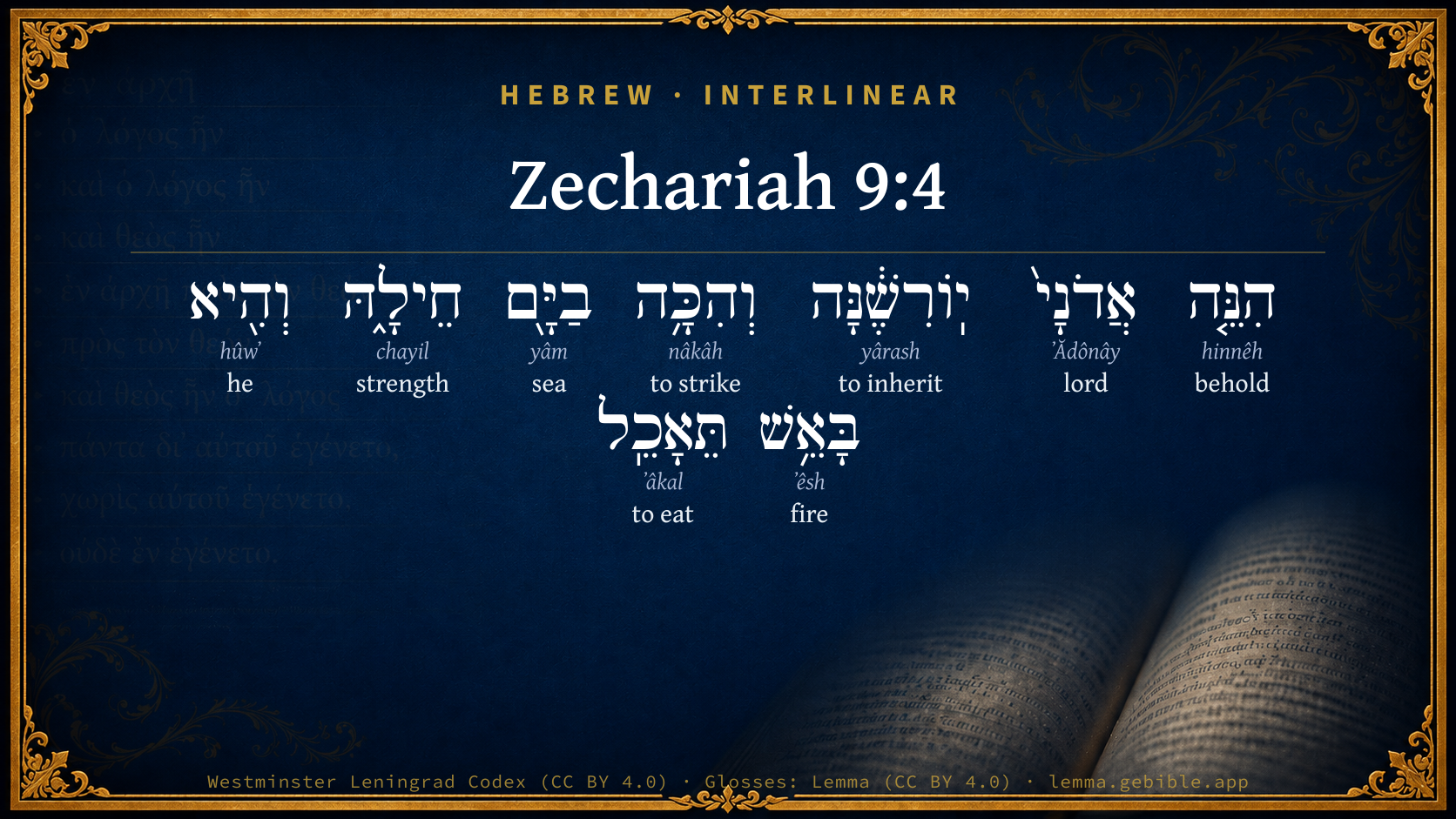
Hebrew (Westminster Leningrad Codex) Zechariah 9:4 appears in the Hebrew Old Testament. The text above is from the Westminster Leningrad Codex. Each word links to its Strong’s number, a concise gloss, and parsing drawn from the Open Scriptures Hebrew Bible morphology. Click any word for its full Brown-Driver-Briggs (BDB) entry.
Download image
Cite this verse

Zechariah 9:4 (World English Bible). Public Domain. Lemma interlinear Bible study tool, https://lemma.gebible.app/v/zechariah/9/4.

Show BibTeX & RIS
BibTeX
RIS
English Translation
Behold, the Lord will dispossess her, And he will strike her power in the sea; And she will be devoured with fire.
World English Bible · Public Domain
Download a study sheet

One document with this verse’s original text, its word-by-word gloss line, the meaning frame, cross-references with their text, attributed commentary, and full source and license credits — printable, and it pastes into notes with its structure intact.

This verse Autodidact and up

Study sheet (.html) Plain text (.txt)

A passage Seminary Student

Up to 50 verses in one chapter. A passage sheet keeps up to 6 commentary sources and 12 cross-references per verse, in the order this page ranks them, and says so on the sheet whenever that leaves anything out. Ask for a single verse and you get the Autodidact verse sheet above.

Everything on this page stays free to read, with no account — the sheet is a download of what is already on screen, not access to it.

Want to remove ads? Support Godless Engineer
Compare translations 3

The same verse in 3 English versions, stacked beneath the original-language interlinear above. Click any original word for its lexicon entry.

Each is an independent rendering of the whole verse — the interlinear is not word-aligned to these translations.

Highlighted words mark where these versions differ — a whole-verse word diff, not a word-by-word alignment.

  • World English Bible Public Domain
    Behold, the Lord will dispossess her, And he will strike her power in the sea; And she will be devoured with fire.
  • King James Version Public Domain
    Behold, the LORD will cast her out, and he will smite her power in the sea; and she shall be devoured with fire.
  • unfoldingWord Literal Text CC BY-SA 4.0
    Look! The Lord will dispossess her and destroy her strength on the sea, so she will be devoured by fire.

unfoldingWord Literal Text — © unfoldingWord, licensed CC BY-SA 4.0. Word-aligned USFM3 via Door43 (git.door43.org/unfoldingWord/en_ult).

Versions to compare (up to 4)

3 of 4 selected

Show all 18 translations

Every available English version of this verse, each an independent rendering of the whole verse.

  • World English Bible Public Domain
    Behold, the Lord will dispossess her, And he will strike her power in the sea; And she will be devoured with fire.
  • Berean Standard Bible Public Domain
    Behold, the Lord will impoverish her and cast her wealth into the sea, and she will be consumed by fire.
  • Majority Standard Bible Public Domain
    Behold, the Lord will impoverish her and cast her wealth into the sea, and she will be consumed by fire.
  • King James Version Public Domain
    Behold, the LORD will cast her out, and he will smite her power in the sea; and she shall be devoured with fire.
  • American Standard Version (1901) Public Domain
    Behold, the Lord will dispossess her, and he will smite her power in the sea; and she shall be devoured with fire.
  • Revised Version (1885) Public Domain
    Behold, the Lord will dispossess her, and he will smite her power in the sea; and she shall be devoured with fire.
  • Geneva Bible (1599) Public Domain
    Beholde, the Lord wil spoyle her, and he wil smite her power in the Sea, and she shalbe deuoured with fire.
  • Douay-Rheims (1899) Public Domain
    Behold the Lord shall possess her, and shall strike her strength in the sea, and she shall be devoured with fire.
  • Young's Literal Translation Public Domain
    Lo, the Lord doth dispossess her, And He hath smitten in the sea her force, And she with fire is consumed.
  • Literal Standard Version CC BY-SA 4.0
    Behold, the Lord dispossesses her, || And He has struck her force in the sea, || And she is consumed with fire.
  • Unlocked Literal Bible CC BY-SA 4.0
    Look! The Lord will dispossess her and destroy her strength on the sea, so she will be devoured by fire.
  • unfoldingWord Literal Text CC BY-SA 4.0
    Look! The Lord will dispossess her and destroy her strength on the sea, so she will be devoured by fire.
  • Darby Bible Public Domain
    Behold, the Lord will take possession of her, and he will smite her power in the sea; and she shall be devoured with fire.
  • World Messianic Bible Public Domain
    Behold, the Lord will dispossess her, and he will strike her power in the sea; and she will be devoured with fire.
  • Webster's Bible Public Domain
    Behold, the Lord will cast her out, and he will smite her power in the sea; and she shall be devoured with fire.
  • Free Bible Version CC BY-SA 4.0
    But look at what will happen. The Lord will take away everything they have, and knock down their strong defenses into the sea. The city will be burned down.
  • Bible in Basic English Public Domain
    See, the Lord will take away her heritage, overturning her power in the sea; and she will be burned up with fire.
  • JPS Tanakh (1917) Public Domain
    Behold, the Lord will impoverish her, and He will smite her power into the sea; and she shall be devoured with fire.

Literal Standard Version (2020), Covenant Press — licensed CC BY-SA 4.0. Text via the HelloAO Bible API (eBible.org). Unlocked Literal Bible (unfoldingWord) — licensed CC BY-SA 4.0. Text via the HelloAO Bible API (eBible.org). unfoldingWord Literal Text — © unfoldingWord, licensed CC BY-SA 4.0. Word-aligned USFM3 via Door43 (git.door43.org/unfoldingWord/en_ult). Free Bible Version, Dr. Jonathan Gallagher — licensed CC BY-SA 4.0. Text via the HelloAO Bible API (eBible.org).

Word by word

More ways to search: Search by grammar → Find every occurrence → Compare this word →

Practice this passage: Drill this verse → Learn its vocabulary →

יֽוֹרִשֶׁ֔נָּה
yârash
H3423
“to inherit · her”
Verb, Hiphil, Imperfect, 3rd Person, Masculine, Singular + Suffix, Personal, 3rd Person, Feminine, Singular
Part of Speech
Verb
Stem
Hiphil
Form
Imperfect
Person
3rd Person
Gender
Masculine
Number
Singular
Full BDB Definition

Origin: a primitive root

TWOT: 920

to seize, dispossess, take possession off, inherit, disinherit, occupy, impoverish, be an heir - (Qal) - to take possession of - to inherit - to impoverish, come to poverty, be poor - (Niphal) to be dispossessed, be impoverished, come to poverty - (Piel) to devour - (Hiphil) - to cause to possess or inherit - to cause others to possess or inherit - to impoverish - to dispossess - to destroy, bring to ruin, disinherit
  1. הִנֵּ֤ה hinnêh H2009 “behold” Particle, Demonstrative
  2. אֲדֹנָי֙ ʼĂdônây H136 “Lord · my” Noun, Common, Masculine, Plural, Construct + Suffix, Personal, 1st Person, Common, Singular
  3. וְהִכָּ֥ה nâkâh H5221 “and · to strike” Conjunction + Verb, Hiphil, Perfect, 3rd Person, Masculine, Singular
  4. בַיָּ֖ם yâm H3220 “in/at the · sea” Preposition, Determined + Noun, Common, Masculine, Singular, Absolute
  5. חֵילָ֑הּ chayil H2428 “strength · her” Noun, Common, Masculine, Singular, Construct + Suffix, Personal, 3rd Person, Feminine, Singular
  6. וְהִ֖יא hûwʼ H1931 “and · he” Conjunction + Pronoun, Personal, 3rd Person, Feminine, Singular
  7. בָּאֵ֥שׁ ʼêsh H784 “in/at the · fire” Preposition, Determined + Noun, Common, Both, Singular, Absolute
  8. תֵּאָכֵֽל ʼâkal H398 “to eat” Verb, Niphal, Imperfect, 3rd Person, Feminine, Singular

About this verse

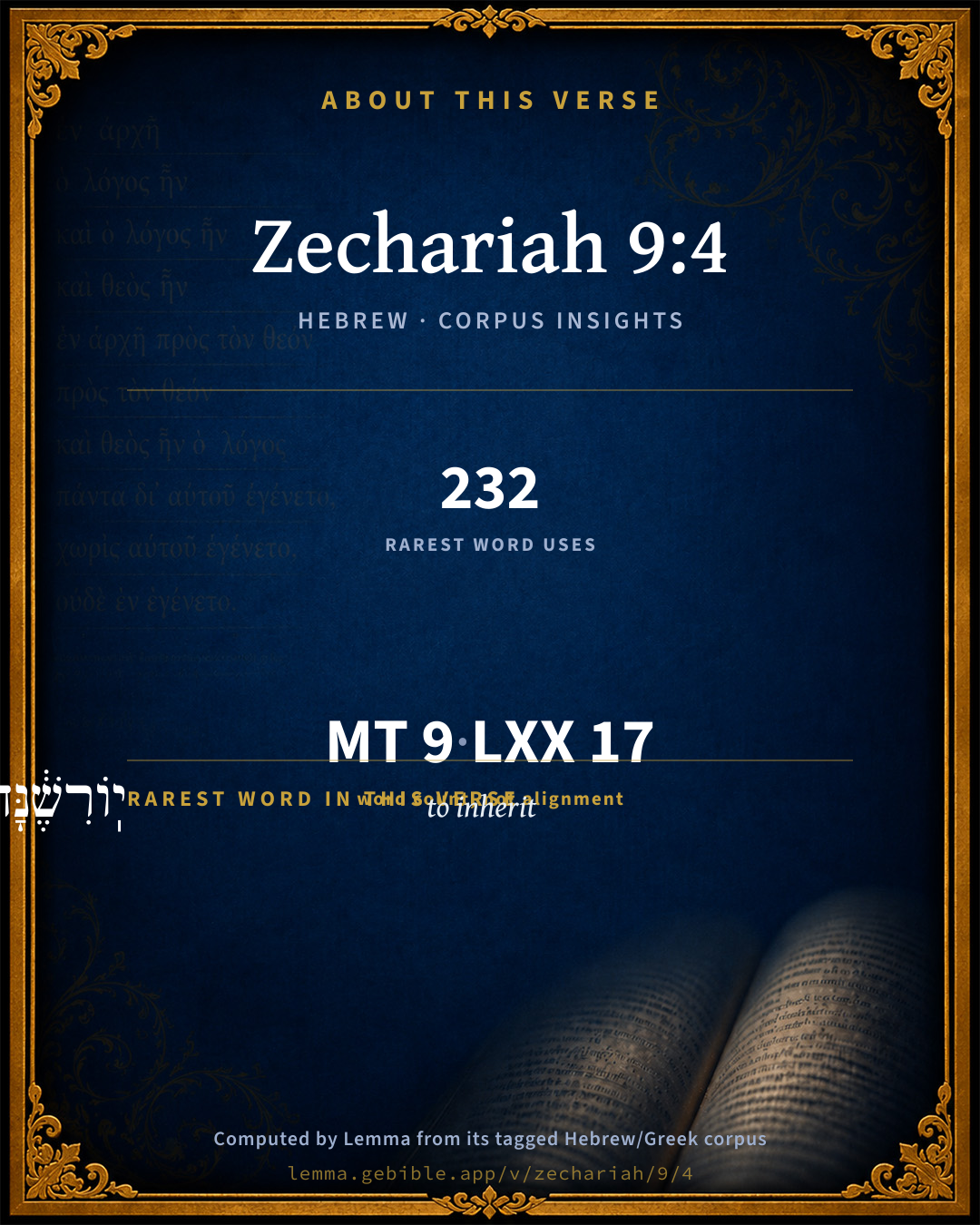
These counts appear in no published source. They are computed here, from the morphology-tagged text and Lemma’s own curated glosses. What Lemma adds →

9
words
9
distinct lemmas
Prophets
section

Grammatical profile

  • 3 verbs
  • 4 nouns
  • 1 pronoun
  • 1 particle

Verb forms

  • יֽוֹרִשֶׁ֔נָּה Hiphil · Imperfect
  • וְהִכָּ֥ה Hiphil · Perfect
  • תֵּאָכֵֽל Niphal · Imperfect

Hebrew & Septuagint length

In English translation the verse runs 22 words from the Hebrew and 25 from the Septuagint (LXX English) — closely comparable.

A rough comparison of the two English renderings, which tokenize alike — not a word-level alignment.

Word counts can differ between the Hebrew and the Greek without any difference in meaning — e.g. the Hebrew direct-object marker אֵת has no separate Greek word, and Greek often adds the article ὁ.

In the original languages it is 9 Hebrew tokens and 17 Greek tokens — but the two are counted differently (Hebrew bundles its prefixes and suffixes into one token; the Greek is in lemma form), so that isn’t a like-for-like length.

Cross-references

12

Topical passages linked to Zechariah 9:4 in the Treasury of Scripture Knowledge — connected by theme and wording, ordered by reader-vote popularity; previews shown in the World English Bible.

  • Ezekiel 28:18 By the multitude of your iniquities, in the unrighteousness of your traffic, you have profaned your sanctuaries; therefore have I brought forth a fire from the midst of you; it has devoured you, and I have turned you to ashes on the earth in the sight of all those who see you.
  • Ezekiel 26:17 They shall take up a lamentation over you, and tell you, How are you destroyed, who were inhabited by seafaring men, the renowned city, who was strong in the sea, she and her inhabitants, who caused their terror to be on all who lived there!
  • Amos 1:10 But I will send a fire on the wall of Tyre, And it will devour its palaces."
  • Proverbs 10:2 Treasures of wickedness profit nothing, But righteousness delivers from death.
  • Proverbs 11:4 Riches don't profit in the day of wrath, But righteousness delivers from death.
  • Isaiah 23:1–7 The burden of Tyre. Howl, you ships of Tarshish; for it is laid waste, so that there is no house, no entering in: from the land of Kittim it is revealed to them.
  • Ezekiel 26:3–5 therefore thus says the Lord Yahweh, Behold, I am against you, Tyre, and will cause many nations to come up against you, as the sea causes its waves to come up.
  • Ezekiel 27:26–36 Your rowers have brought you into great waters: the east wind has broken you in the heart of the seas.
  • Ezekiel 28:2 Son of man, tell the prince of Tyre, Thus says the Lord Yahweh: Because your heart is lifted up, and you have said, I am a god, I sit in the seat of God, in the midst of the seas; yet you are man, and not God, though you did set your heart as the heart of God;-
  • Ezekiel 28:8 They shall bring you down to the pit; and you shall die the death of those who are slain, in the heart of the seas.
  • Ezekiel 28:16 By the abundance of your traffic they filled the midst of you with violence, and you have sinned: therefore I have cast you as profane out of the mountain of God; and I have destroyed you, covering cherub, from the midst of the stones of fire.
  • Joel 3:8 And I will sell your sons and your daughters into the hands of the children of Judah, And they will sell them to the men of Sheba, To a faraway nation, For Yahweh has spoken it."

Cross-references courtesy of OpenBible.info (CC BY 4.0).

Hebrew and Greek witnesses Masoretic Hebrew ↔ Greek Septuagint

The same verse in the two great witnesses to the Old Testament, shown verse-for-verse.

These are two independent witnesses, not word-aligned to each other, and the Septuagint is shown in lemma (dictionary) form.

Hebrew Zechariah 9:4 Masoretic · Westminster Leningrad Codex

הִנֵּ֤ה אֲדֹנָי֙ יֽוֹרִשֶׁ֔נָּה וְהִכָּ֥ה בַיָּ֖ם חֵילָ֑הּ וְהִ֖יא בָּאֵ֥שׁ תֵּאָכֵֽל

Behold, the Lord will dispossess her, And he will strike her power in the sea; And she will be devoured with fire.

World English Bible · Public Domain

Greek LXX Zechariah 9:4 Septuagint · lemma form

διά οὗτος κύριος κληρονομέω αὐτός καί πατάσσω εἰς θάλασσα δύναμις αὐτός καί οὗτος ἐν πῦρ κατα ἀναἁλίσκω

And therefore the Lord will take them for a possession, and will strike her power in the sea; and she shall be consumed with fire.

LXX2012 (modern English Septuagint) · Public Domain

On this verse, John Gill's Exposition discusses the Septuagint’s reading. Read the note in Commentary ↓

Hebrew: Westminster Leningrad Codex (CC BY 4.0). Greek: Septuagint (public domain); English from LXX2012 (modern English Septuagint) (Public Domain). How the Septuagint differs from the Hebrew →

Targum (Aramaic paraphrase)

1

The Targum is the ancient Jewish Aramaic paraphrase of the Hebrew Scriptures — an interpretive translation, not the Hebrew text itself. Onkelos (literal) and Pseudo-Jonathan (expansive) render the Torah, and Jonathan the Prophets. Coverage is partial: where no permissively-licensed English translation exists for a verse, only the Aramaic is shown. This is verse-level text, not a word-by-word alignment to the Hebrew.

  1. Targum Jonathan Prophets (Joshua–Malachi)
    הָא יְיָ מְתָרֵיךְ לָהּ וְיִרְמֵי בְיַמָא עָתְרָהּ וְהִיא בְּנוּרָא תִּתּוֹקָד:

    (no public-domain English translation for this verse)

    Targum Jonathan — Aramaic: “Mikraot Gedolot” (public domain). English: “Sefaria Community Translation” (CC0 1.0 (public-domain dedication)); “London "Chaldee Paraphrase," 1871” (public domain). Text via Sefaria.

Commentary

Notes on Zechariah 9:4 from classic Christian and Jewish commentators (each source and its license shown beneath its notes). The classic Christian expositions comment on the surrounding passage and are grouped to its opening verse, so a note may address several verses; the Jewish commentaries on the Tanakh (Rashi and others) are per-verse, so they appear only where the commentator wrote on this verse.

Lemma curates 59 commentaries, every one of them public domain or Creative Commons licensed, each selected and text-cleaned for this edition rather than reprinted as found. About our sources →

Trapp's Complete Commentary

John Trapp

Zec 9:4 Behold, the Lord will cast her out, and he will smite her power in the sea; and she shall be devoured with fire.

Ver. 4. Behold, the Lord will cast her out] Or, impoverish her, as some render it; that is, for her money. God can soon let her blood in the vena cava, cavities of her veins, called Marsupium; and make her nudam tanquam ex mari. bare just as out of the sea, And then for her munitions,

He will smite her power in the sea] She was seated in an island, upon munitions of rocks; the sea was to her instead of a threefold wall and ditch. She was better fortified than Venice is; which yet hath flourished above nine hundred years, and was never in the enemy’s hands; whence she hath for her motto, Intacta manet. It remains intact. But Tyre was taken by Nebuchadnezzar, as his wages; and afterwards by Alexander, who never held anything impossible that he undertook, however unlikely it were to be effected. He found means to fill up the sea with stones, trees, and rubbish, where it divided Tyre from the continent; and made himself master of it.

And she shall be devoured with fire] Though seated in the heart of the sea, Eze 28:2, and had motted up herself against God’s fire. Nothing shall quench the fire that he kindleth.

John Trapp, A Commentary or Exposition upon All the Books of the Old and New Testament (1647–1656) — public domain. Text from a community e-Sword module.

Geneva Bible (1599)

Geneva Bible translators

Though they of Tyre think themselves invincible by reason of the sea that compass them round about, yet they shall not escape God’s judgments.

Geneva Bible (1599) marginal notes — public domain. Text via Bolls.life.

Jamieson, Fausset & Brown

Robert Jamieson, A. R. Fausset & David Brown

(Eze 26:4, Eze 26:12; Eze 27:27).

cast her out--Hebrew, "dispossess her," that is, will cast her inhabitants into exile [GROTIUS]. Alexander, though without a navy, by incredible labor constructed a mole of the ruins of Old Tyre (fulfilling Eze 26:4-12, &c., by "scraping her dust from her," and "laying her stones, timber, and dust in the midst of the water"), from the shore to the island, and, after a seven months' siege, took the city by storm, slew with the sword about eight thousand, enslaved thirteen thousand, crucified two thousand, and set the city on "fire," as here foretold [CURTIUS, Book 4].

smite her power in the sea--situated though she be in the sea, and so seeming impregnable (compare Eze 28:2, "I sit in the seat of God, in the midst of the sea"). "Her power" includes not only her fortifications, but her fleet, all of which Alexander sank in the sea before her very walls [CURTIUS, Book 4]. Eze 26:17 corresponds, "How art thou destroyed which wast strong in the sea!"

Jamieson, Fausset & Brown — Commentary Critical and Explanatory on the Whole Bible (1871) — public domain (CC PDM 1.0). Text via the HelloAO Bible API.

Adam Clarke's Commentary

Verse 4. Will smite her power in the sea] See Eze 26:17. Though Alexander did take Tyre, Sidon, Gaza, c. yet it seems that the prediction relative to their destruction was fulfilled by Nebuchadnezzar. See Am 1:6-8; Zep 2:4; Zep 2:7.

Adam Clarke's Commentary on the Bible (1810–1826) — public domain. Text from a community e-Sword/MySword module.

John Calvin's Commentaries

He now declares that God would be an avenger. Behold, he says, Jehovah will possess, or cause to possess, as some read, but they are mistaken, owing to the two meanings of the verb ירש, iresh, which means to possess and also to expel or impoverish; for interpreters think that a hope of favor and of salvation is here given to these cities, and say that they are now chosen by God as a possession. But this is wholly contrary to the intention of the Prophet, as it appears more clearly from a view of each clause.

Jehovah then will expel her, and smite her strength. The Prophet no doubt alludes to what he had already said — that Tyrus had heaped silver and gold; now on the other hand he declares that Tyrus would be exposed to a scattering; for the heap of gold and silver it had laid up would be dissipated by God: he will then dissipate; or if one chooses to take the verb as meaning to reduce to want, the contrast would thus be suitable — God will then impoverish, or expel her. Afterwards he adds, In the sea will he smite her strength. As Tyrus, we know, was surrounded by the sea, the Prophet by this reference shows God’s power in taking vengeance on her; for the sea would be no restraint or hindrance to God, when he resolved to enter there. The Syrians, indeed, thought themselves safe from every hostile attack, for they had the sea on every side as a triple wall and a triple rampart. Nor was Tyrus altogether like Venice; for Venice is situated in a stagnant sea, while the situation of Tyrus was in a very deep sea, as historians plainly show who relate its assault by Alexander the Great. It had indeed been before taken and plundered; but he did what none had ever thought of — he filled up a part of the sea, so that Tyrus was no longer an island.

We now see what Zechariah had in view, when he threatened ruin to Tyrus, though its strength was in the midst of the sea, beyond the reach of fortune, as it is commonly said. And she shall be consumed by fire. He means that Tyrus would not only be plundered, but wholly demolished; for we know that even the strongest things are consumed by fire. It follows —

John Calvin's Commentaries (1540-1563) — public domain. Text from the Calvin Translation Society English edition (1840s-50s) via the Christian Classics Ethereal Library (ccel.org). Calvin's coverage is partial (roughly two-thirds of the Bible); uncommented books and verses are honest gaps, never fabricated. The 19th-century editor's footnotes and remarks are omitted so the notes are faithfully Calvin's own voice.

The Cambridge Bible for Schools and Colleges

gen. ed. J. J. S. Perowne

4. cast her out] Or, dispossess her, R. V. Lit. take possession of her, i.e. by ejecting her and coming into her place. Comp. Exo_34:24. Ewald renders less satisfactorily will impoverish her.

her power in the sea] The order of the Hebrew words is, shall smite in the sea her power; where “power” does not mean only, though it may possibly include, her bastions and fortifications (Psa_48:14; Psa_122:7), but is to be taken in its widest sense. “The scene of her pride was to be that of her overthrow; the waves which girt her round should bury her ruins and wash over her site. Even in the sea the hand of God should find her and smite her in it and into it, and so that she should abide in it.” Pusey.

devoured with fire] “Proudly confident in the strength of their island fortress, the Tyrians mocked the attempts of Alexander to reduce their city. Every engine of war suited for defence had been stored up in their bulwarks, and every device which their skilful engineers could suggest was had recourse to, and for a time with marked success. ‘Ye despise this land army through confidence in the place that ye dwell in as an island, but I will show you that ye dwell on a continent,’ was the language of Alexander (Q. Curtius, de reb. gest. Alex. Magn. iv. 2). The shallow channel between the mainland and the island was at last bridged over by a huge dam of earth erected after repeated failures, and the city which had stood a five years’ siege from the Assyrians, a thirteen years’ siege from the Chaldæans, was taken after a short siege of seven months by Alexander. Ten thousand of its brave defenders were either massacred or crucified” (2,000 were crucified, from 6,000 to 8,000 are said to have been massacred), “the rest were sold into slavery, none escaped save those who were concealed by the Sidonians in the ships. Q. Curtius adds distinctly (Zec_4:4) that ‘Alexander having slain all, save those who fled to the temples, ordered the houses to be set on fire.’ ” Rev. C. H. H. Wright.

The Cambridge Bible for Schools and Colleges (gen. ed. J. J. S. Perowne; Cambridge University Press, 1878–1918) — public domain. Text from a community e-Sword module.

John Gill's Exposition

Behold, the Lord will cast her out,.... Or "inherit her" (f), or "them", as the Septuagint render the words; when, being converted, she would become the Lord's inheritance and possession, and her riches should be devoted to his service:

and he will smite her power in the sea; for Tyre was situated in the sea, at the entry of it, and was strong in it, Eze 26:17. Kimchi interprets this of her humiliation and subjection in the days of the Messiah; and in a spiritual sense it has been verified in such who have been spoiled of their carnal strength, in which they trusted, and have laid down their weapons, and have submitted to the sceptre of Christ:

and she shall be devoured with fire; with the spirit of judgment, and of burning, which purges and removes the filth of sin; and with the fire of the word, which burns up and consumes its lusts; and with the flames of divine love, which make souls as a whole burnt offering to the Lord. This was literally accomplished in the burning of Tyre by Alexander (g), which injected fear and dread in cities near it, as follow:

(f) , Setp.; "possidebit eam", V. L. Munster, Castalio. So some in Vatablus. (g) Curtius, l. 4. c. 4.

John Gill's Exposition of the Whole Bible (1746–1763) — public domain (CC PDM 1.0). Text via the HelloAO Bible API.

Albert Barnes' Notes on the Bible

Behold - Such were the preparations of Tyre. Over against them, as it were, the prophet sets before our eyes the counsels of God. Theodoret: “Since they had severed themselves from the providence of God, they were now to experience His power.” “The Lord will cast her out” , literally, deprive her of her possessions, give her an heir of what she had amassed, namely: the enemy; “and he will smite her power or wealth” , of which Ezekiel says, “With thy wisdom and with thine understanding thou hast gotten thee riches, and hast gotten gold and silver into thy treasures: by the greediness of thy wisdom and by thy traffic thou hast increased thy riches, and thine heart is lifted up because of thy riches” Eze 28:4-5. All wherein she relied, and so too the stronghold itself, God would smite in the sea. The sea was her confidence and boast. She said “I am a God; I sit in the seat of God, in the midst of the seas” Eze 28:2.

The scene of her pride was to be that of her overthrow; the waves, which girt her round, should bury her ruins and wash over her site. Even in the sea the hand of God should find her, and smite her in it, and into it, and so that she should abide in it. “They mocked at the king, as though be thought to prevail against Neptune (the sea).” “Ye despise this land-army, through confidence in the place, that ye dwell in an island,” was the message of Alexander, “but soon will I show you that ye dwell on a continent.”

Every device had been put in force in its defense: the versatility by which the inhabitants of an island, some 2 12 miles in circumference, held at bay the conqueror of the battle of Issus with unlimited resources, , “engineers from Cyprus and all Phoenicia,” and , “a fleet of 180 ships from Cyprus,” attests the wisdom in which the prophet says, she would trust. “She had already a profusion of catapults and other machines useful in a siege, and easily prepared manifold others by the makers of war-engines and all sorts of artificers whom she had, and these invented new engines of all sorts; so that the whole circuit of the city was filled with engines.” Divers who should loosen the mole; grappling hooks and nets to entangle near-assailants; melted metal or heated sand to penetrate between the joints of their armor; bags of sea-weed to deaden the blows of the battering machines; a fireship navigated so as to destroy the works of the enemy, while its sailors escaped; fiery arrows; wheels set in continual motion, to turn aside the missiles against them, , bear witness to an unwearied inventiveness of defense. The temporary failures might have shaken any mind but Alexander’s (who is even said to have hesitated but that he dared not, by abandoning the enterprise, lose the prestige of victory. Yet all ended in the massacre of 6,000, 7,000, or 8,000 of her men, the crucifixion of 2,000, the sale of the rest, whether 13,000 or 30,000, into slavery . None escaped save those whom the Sidonians secreted in the vessels, , with which they had been compelled to serve against her.

And she herself - When her strength is overthrown, “shall be devoured with fire.” : “Alexander, having slain all, save those who fled to the temples, ordered the houses to be set on fire.”

Albert Barnes' Notes on the Bible (1834–1885) — public domain. Text from a community e-Sword/MySword module.

Matthew Poole's English Annotations

Behold; observe it, for I tell you truth; though strange, it will be so.

The Lord will cast her out; the Lord will do this, he will eject and cast her out of her inheritance, as the word in the Hebrew, and he will inherit her, as the word also bears. God will do both, he will seize into his hand by some or other, and so put them out of all. Her fortifications shall not be able to secure her possession.

He will smite her power in the sea; the Lord declares how he will do what he threatens against Tyre, where their strength lieth; he will break them, take away their shipping, and then both treasures will waste, trade will fail, and auxiliaries will not be gotten.

And she, Tyre, probably Zidon with her,

shall be devoured with fire; that is, by the enemy in the siege, or at the taking of her. All which was done about A.M. 3672, one hundred and eighty-five years after this prophecy, when Alexander the Great mastered Tyre at sea with a fleet of one hundred and ninety or two hundred ships, took the city, slew many thousands of them, and, as Curtius reports, burnt the city.

Matthew Poole's English Annotations on the Holy Bible (1683–1685) — public domain. Text from a community e-Sword/MySword module.

John Wesley's Explanatory Notes

Cast her out - Of her inheritance, as the word properly means.

John Wesley, Explanatory Notes Upon the Whole Bible (1754–1765) — public domain. Text via the GEBible commentary corpus.

Rashi

Rabbi Shlomo Yitzchaki (Rashi)

Behold, the Lord Who is the ruler over all.

shall impoverish her an expression similar to (I Sam. 2: 7) “impoverishes and makes rich.”

He shall smite her wealth in the sea And shall cause her wealth to be swallowed in the midst of the seas. He shall cause the sea to rise over it and sink it, as Ezekiel said (27).

Rashi on the Tanakh — English translations: “The Judaica Press complete Tanach with Rashi, translated by A. J. Rosenberg” (CC BY 4.0); “Pentateuch with Rashi's commentary by M. Rosenbaum and A.M. Silbermann, 1929-1934” (public domain); “The Metsudah Tanach series, Lakewood, N.J” (CC BY 4.0); and “The Book of Joshua, Metsudah Publications, 1997” (CC BY 4.0). Text via Sefaria.

Lesson kit

Teaching starters — assembled from the data on this page, not authored interpretation. Every prompt links to the verse data it draws on. Edit before teaching.

Zechariah, in the Prophets, opens this verse with 9 words (9 distinct Hebrew lemmas). Its most distinctive word is yârash (“to inherit”). A historical commentator’s framing appears above. Read the whole chapter for the surrounding context.

Discussion questions

  1. What does “to inherit” (yârash) contribute to the verse as a whole?
  2. Ezekiel 28:18 shares this passage’s theme. How do the two illuminate each other?
  3. These translations render this verse differently. What is at stake in choosing one wording over another?
  4. The verb «יֽוֹרִשֶׁ֔נָּה» is Hiphil Imperfect. How does its form color the action?
  5. Reading how Trapp's Complete Commentary and Geneva Bible (1599) read this verse, where do the two commentators agree and where do they part?

Things to notice

Reading settings

Reading text

Shown beneath each verse's original-language words.

Old Testament
Old Testament edition

Read the OT as the Masoretic Hebrew (MT) or the Greek Septuagint (LXX).

English shown for the Greek Septuagint (in the Hebrew ↔ Greek comparison).

Comparing translations? Open the Compare panel on any verse page to stack up to four side by side.