
Numbers 33:52

Hebrew (Westminster Leningrad Codex) Numbers 33:52 appears in the Hebrew Old Testament. The text above is from the Westminster Leningrad Codex. Each word links to its Strong’s number, a concise gloss, and parsing drawn from the Open Scriptures Hebrew Bible morphology. Click any word for its full Brown-Driver-Briggs (BDB) entry.
Download image
Cite this verse

Numbers 33:52 (World English Bible). Public Domain. Lemma interlinear Bible study tool, https://lemma.gebible.app/v/numbers/33/52.

Show BibTeX & RIS
BibTeX
RIS
English Translation
then you shall drive out all the inhabitants of the land from before you, and destroy all their figured [stones], and destroy all their molten images, and demolish all their high places:
World English Bible · Public Domain
Download a study sheet

One document with this verse’s original text, its word-by-word gloss line, the meaning frame, cross-references with their text, attributed commentary, and full source and license credits — printable, and it pastes into notes with its structure intact.

This verse Autodidact and up

Study sheet (.html) Plain text (.txt)

A passage Seminary Student

Up to 50 verses in one chapter. A passage sheet keeps up to 6 commentary sources and 12 cross-references per verse, in the order this page ranks them, and says so on the sheet whenever that leaves anything out. Ask for a single verse and you get the Autodidact verse sheet above.

Everything on this page stays free to read, with no account — the sheet is a download of what is already on screen, not access to it.

Want to remove ads? Support Godless Engineer
Compare translations 3

The same verse in 3 English versions, stacked beneath the original-language interlinear above. Click any original word for its lexicon entry.

Each is an independent rendering of the whole verse — the interlinear is not word-aligned to these translations.

Highlighted words mark where these versions differ — a whole-verse word diff, not a word-by-word alignment.

  • World English Bible Public Domain
    then you shall drive out all the inhabitants of the land from before you, and destroy all their figured [stones], and destroy all their molten images, and demolish all their high places:
  • King James Version Public Domain
    Then ye shall drive out all the inhabitants of the land from before you, and destroy all their pictures, and destroy all their molten images, and quite pluck down all their high places:
  • unfoldingWord Literal Text CC BY-SA 4.0
    then you shall dispossess all those who dwell in the land from your face, and you shall destroy all their carved figures, and you shall destroy all the figures of their molten metal, and you shall destroy all their high places.

unfoldingWord Literal Text — © unfoldingWord, licensed CC BY-SA 4.0. Word-aligned USFM3 via Door43 (git.door43.org/unfoldingWord/en_ult).

Versions to compare (up to 4)

3 of 4 selected

Show all 18 translations

Every available English version of this verse, each an independent rendering of the whole verse.

  • World English Bible Public Domain
    then you shall drive out all the inhabitants of the land from before you, and destroy all their figured [stones], and destroy all their molten images, and demolish all their high places:
  • Berean Standard Bible Public Domain
    you must drive out before you all the inhabitants of the land, destroy all their carved images and cast idols, and demolish all their high places.
  • Majority Standard Bible Public Domain
    you must drive out before you all the inhabitants of the land, destroy all their carved images and cast idols, and demolish all their high places.
  • King James Version Public Domain
    Then ye shall drive out all the inhabitants of the land from before you, and destroy all their pictures, and destroy all their molten images, and quite pluck down all their high places:
  • American Standard Version (1901) Public Domain
    then ye shall drive out all the inhabitants of the land from before you, and destroy all their figured `stones', and destroy all their molten images, and demolish all their high places:
  • Revised Version (1885) Public Domain
    then ye shall drive out all the inhabitants of the land from before you, and destroy all their figured stones, and destroy all their molten images, and demolish all their high places:
  • Geneva Bible (1599) Public Domain
    Ye shall then driue out all the inhabitants of the land before you, and destroy all their pictures, and breake asunder all their images of metall, and plucke downe all their hie places.
  • Douay-Rheims (1899) Public Domain
    Destroy all the inhabitants of that land: beat down their pillars, and break in pieces their statues, and waste all their high places,
  • Young's Literal Translation Public Domain
    then ye have dispossessed all the inhabitants of the land from before you, and have destroyed all their imagery, yea, all their molten images ye destroy, and all their high places ye lay waste,
  • Literal Standard Version CC BY-SA 4.0
    then you have dispossessed all the inhabitants of the land from before you, and have destroyed all their imagery, indeed, you destroy all their molten images, and you lay waste [to] all their high places,
  • Unlocked Literal Bible CC BY-SA 4.0
    then you must drive out all the land's inhabitants before you. You must destroy all their carved figures. You must destroy all their cast figures and demolish all their high places.
  • unfoldingWord Literal Text CC BY-SA 4.0
    then you shall dispossess all those who dwell in the land from your face, and you shall destroy all their carved figures, and you shall destroy all the figures of their molten metal, and you shall destroy all their high places.
  • Darby Bible Public Domain
    then ye shall dispossess all the inhabitants of the land from before you, and ye shall destroy all their figured images, and all their molten images shall ye destroy, and all their high places shall ye lay waste;
  • World Messianic Bible Public Domain
    then you shall drive out all the inhabitants of the land from before you, destroy all their stone idols, destroy all their molten images, and demolish all their high places.
  • Webster's Bible Public Domain
    Then ye shall drive out all the inhabitants of the land from before you, and destroy all their pictures, and destroy all their molten images, and quite demolish all their high places:
  • Free Bible Version CC BY-SA 4.0
    you must drive out everyone living in the land, destroy all their carved images and metal idols, and tear down all their pagan temples.
  • Bible in Basic English Public Domain
    See that all the people of the land are forced out from before you, and put to destruction all their pictured stones, and all their metal images, and all their high places:
  • JPS Tanakh (1917) Public Domain
    then ye shall drive out all the inhabitants of the land from before you, and destroy all their figured stones, and destroy all their molten images, and demolish all their high places.

Literal Standard Version (2020), Covenant Press — licensed CC BY-SA 4.0. Text via the HelloAO Bible API (eBible.org). Unlocked Literal Bible (unfoldingWord) — licensed CC BY-SA 4.0. Text via the HelloAO Bible API (eBible.org). unfoldingWord Literal Text — © unfoldingWord, licensed CC BY-SA 4.0. Word-aligned USFM3 via Door43 (git.door43.org/unfoldingWord/en_ult). Free Bible Version, Dr. Jonathan Gallagher — licensed CC BY-SA 4.0. Text via the HelloAO Bible API (eBible.org).

Word by word

More ways to search: Search by grammar → Find every occurrence → Compare this word →

Practice this passage: Drill this verse → Learn its vocabulary →

מַשְׂכִּיֹּתָ֑ם
maskîyth
H4906
“images · their”
Noun, Common, Feminine, Plural, Construct + Suffix, Personal, 3rd Person, Masculine, Plural
Part of Speech
Noun
Type
Common
Gender
Feminine
Number
Plural
State
Construct
Full BDB Definition

Origin: from the same as H7906

TWOT: 2257c

show-piece, figure, imagination, image, idol, picture - show-piece, carved figure (of idols) - imagination, conceit
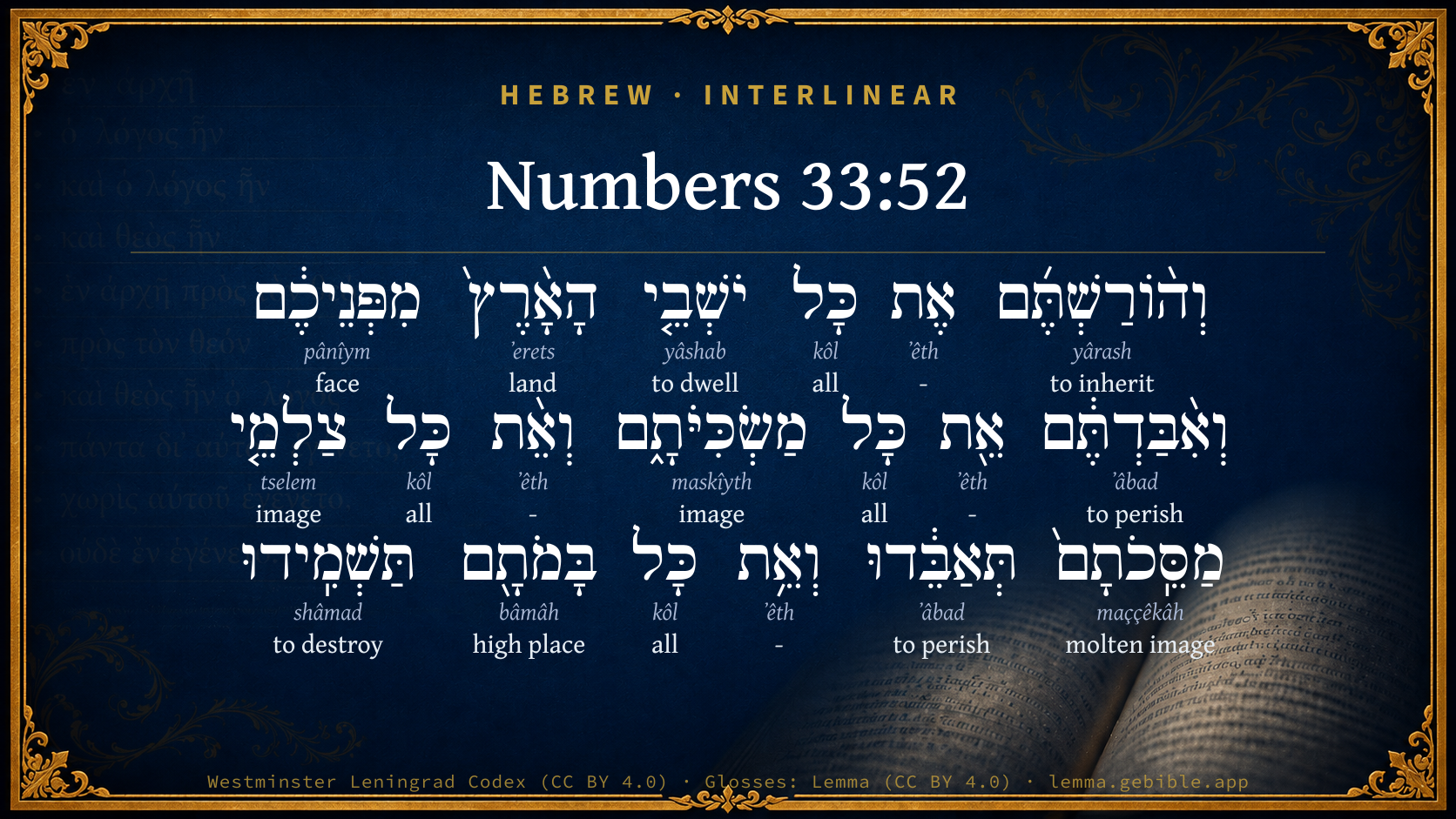
  1. וְה֨וֹרַשְׁתֶּ֜ם yârash H3423 “and · to inherit” Conjunction + Verb, Hiphil, Sequential Perfect, 2nd Person, Masculine, Plural
  2. אֶת ʼêth H853 “-” Particle, Direct Object
  3. כָּל kôl H3605 “all of” Noun, Common, Masculine, Singular, Construct
  4. יֹשְׁבֵ֤י yâshab H3427 “dwelling” Verb, Qal, Participle Active, Masculine, Plural, Construct
  5. הָאָ֨רֶץ֙ ʼerets H776 “the · land” Particle, Definite Article + Noun, Common, Both, Singular, Absolute
  6. מִפְּנֵיכֶ֔ם pânîym H6440 “from · face(s) · your” Preposition + Noun, Common, Both, Plural, Construct + Suffix, Personal, 2nd Person, Masculine, Plural
  7. וְאִ֨בַּדְתֶּ֔ם ʼâbad H6 “and · to perish” Conjunction + Verb, Piel, Sequential Perfect, 2nd Person, Masculine, Plural
  8. אֵ֖ת ʼêth H853 “-” Particle, Direct Object
  9. כָּל kôl H3605 “all of” Noun, Common, Masculine, Singular, Construct
  10. וְאֵ֨ת ʼêth H853 “and · -” Conjunction + Particle, Direct Object
  11. כָּל kôl H3605 “all of” Noun, Common, Masculine, Singular, Construct
  12. צַלְמֵ֤י tselem H6754 “images of” Noun, Common, Masculine, Plural, Construct
  13. מַסֵּֽכֹתָם֙ maççêkâh H4541 “molten images · their” Noun, Common, Feminine, Plural, Construct + Suffix, Personal, 3rd Person, Masculine, Plural
  14. תְּאַבֵּ֔דוּ ʼâbad H6 “to perish” Verb, Piel, Imperfect, 2nd Person, Masculine, Plural
  15. וְאֵ֥ת ʼêth H853 “and · -” Conjunction + Particle, Direct Object
  16. כָּל kôl H3605 “all of” Noun, Common, Masculine, Singular, Construct
  17. בָּמֹתָ֖ם bâmâh H1116 “high places · their” Noun, Common, Feminine, Plural, Construct + Suffix, Personal, 3rd Person, Masculine, Plural
  18. תַּשְׁמִֽידוּ shâmad H8045 “to destroy” Verb, Hiphil, Imperfect, 2nd Person, Masculine, Plural

About this verse

These counts appear in no published source. They are computed here, from the morphology-tagged text and Lemma’s own curated glosses. What Lemma adds →

19
words
12
distinct lemmas
Pentateuch
section

Notable vocabulary

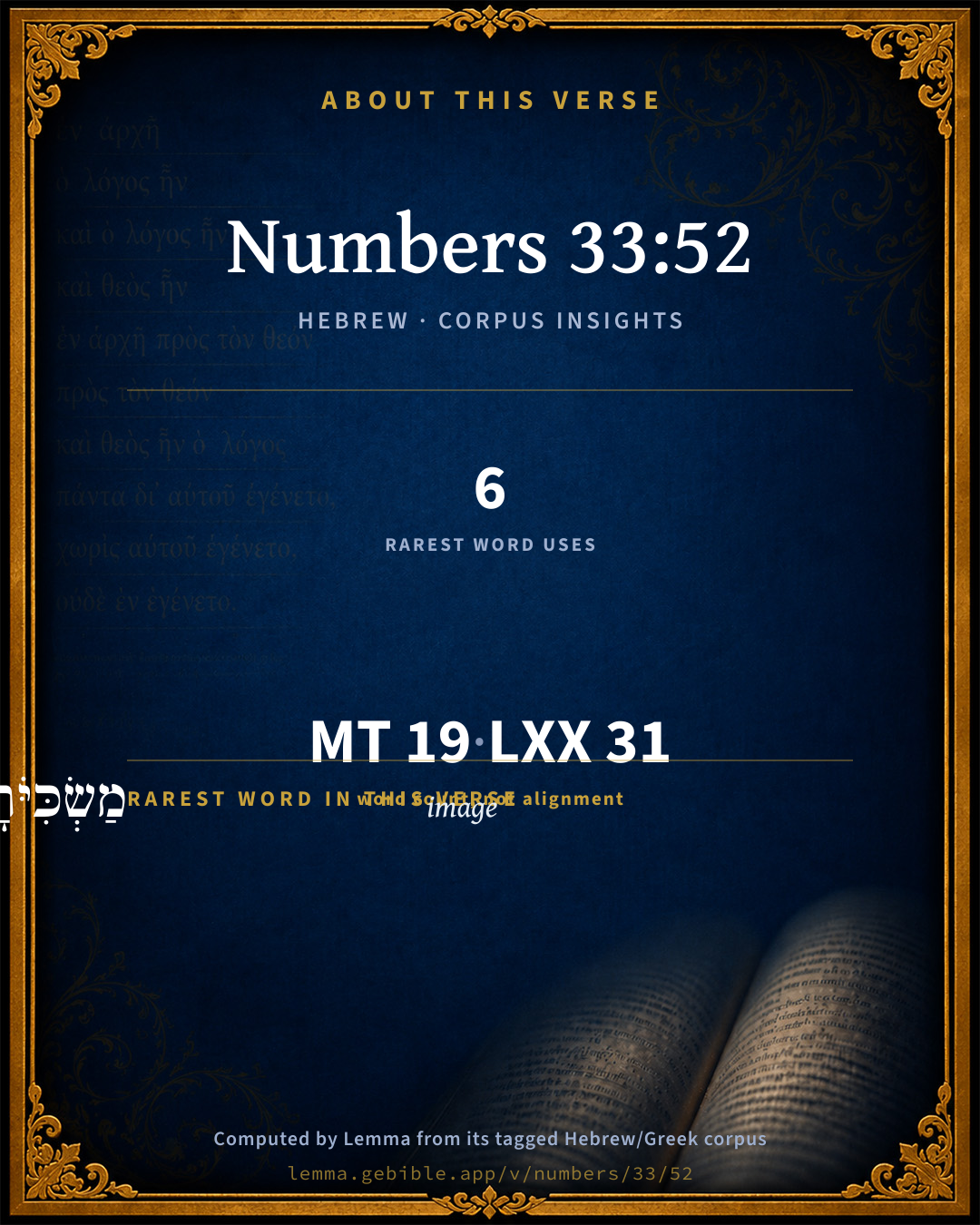
The rarest word here is מַשְׂכִּיֹּתָ֑ם image H4906 — appearing just 6 times in the whole Hebrew Bible.

Shared distinctive vocabulary

מַשְׂכִּיֹּתָ֑ם image H4906 occurs in 6 verses of the Hebrew Bible. Also found in:

Grammatical profile

  • 5 verbs
  • 10 nouns
  • 4 particles

Verb forms

  • וְה֨וֹרַשְׁתֶּ֜ם Hiphil · Sequential Perfect
  • יֹשְׁבֵ֤י Qal · Participle Active
  • וְאִ֨בַּדְתֶּ֔ם Piel · Sequential Perfect
  • תְּאַבֵּ֔דוּ Piel · Imperfect
  • תַּשְׁמִֽידוּ Hiphil · Imperfect

Repetition

Words recur within this verse — often emphatic in Hebrew:

  • כָּל all H3605 ×4
  • וְאִ֨בַּדְתֶּ֔ם to perish H6 ×2

Hebrew & Septuagint length

In English translation the verse runs 32 words from the Hebrew and 35 from the Septuagint (LXX English) — closely comparable.

A rough comparison of the two English renderings, which tokenize alike — not a word-level alignment.

Word counts can differ between the Hebrew and the Greek without any difference in meaning — e.g. the Hebrew direct-object marker אֵת has no separate Greek word, and Greek often adds the article ὁ.

In the original languages it is 19 Hebrew tokens and 31 Greek tokens — but the two are counted differently (Hebrew bundles its prefixes and suffixes into one token; the Greek is in lemma form), so that isn’t a like-for-like length.

Cross-references

13

Topical passages linked to Numbers 33:52 in the Treasury of Scripture Knowledge — connected by theme and wording, ordered by reader-vote popularity; previews shown in the World English Bible.

  • Exodus 23:24 You shall not bow down to their gods, nor serve them, nor follow their practices, but you shall utterly overthrow them and demolish their pillars.
  • Leviticus 26:1 "'You shall make for yourselves no idols, neither shall you raise up an engraved image or a pillar, neither shall you place any figured stone in your land, to bow down to it: for I am Yahweh your God.
  • Deuteronomy 20:16–18 But of the cities of these peoples, that Yahweh your God gives you for an inheritance, you shall save alive nothing that breathes;
  • Deuteronomy 7:2–5 and when Yahweh your God shall deliver them up before you, and you shall strike them; then you shall utterly destroy them: you shall make no covenant with them, nor show mercy to them;
  • Deuteronomy 12:2–3 You shall surely destroy all the places in which the nations that you shall dispossess served their gods, on the high mountains, and on the hills, and under every green tree:
  • Judges 2:2 and you shall make no covenant with the inhabitants of this land; you shall break down their altars. But you have not listened to my voice: why have you done this?
  • Exodus 23:31–33 I will set your border from the Red Sea even to the sea of the Philistines, and from the wilderness to the River; for I will deliver the inhabitants of the land into your hand, and you shall drive them out before you.
  • Exodus 34:12–17 Be careful, lest you make a covenant with the inhabitants of the land where you are going, lest it be for a snare in the midst of you:
  • Deuteronomy 7:25–26 The engraved images of their gods shall you burn with fire: you shall not covet the silver or the gold that is on them, nor take it to you, lest you be snared therein; for it is an abomination to Yahweh your God.
  • Deuteronomy 12:30–31 take heed to yourself that you not be ensnared to follow them, after that they are destroyed from before you; and that you not inquire after their gods, saying, How do these nations serve their gods? even so will I do likewise.
  • Joshua 11:11–12 They struck all the souls who were therein with the edge of the sword, utterly destroying them; there was none left who breathed: and he burnt Hazor with fire.
  • Joshua 23:7 that you not come among these nations, these that remain among you; neither make mention of the name of their gods, nor cause to swear [by them], neither serve them, nor bow down yourselves to them;
  • Psalms 106:34–36 They didn't destroy the peoples, As Yahweh commanded them,

Cross-references courtesy of OpenBible.info (CC BY 4.0).

Hebrew and Greek witnesses Masoretic Hebrew ↔ Greek Septuagint

The same verse in the two great witnesses to the Old Testament, shown verse-for-verse.

These are two independent witnesses, not word-aligned to each other, and the Septuagint is shown in lemma (dictionary) form.

Hebrew Numbers 33:52 Masoretic · Westminster Leningrad Codex

וְה֨וֹרַשְׁתֶּ֜ם אֶת כָּל יֹשְׁבֵ֤י הָאָ֨רֶץ֙ מִפְּנֵיכֶ֔ם וְאִ֨בַּדְתֶּ֔ם אֵ֖ת כָּל מַשְׂכִּיֹּתָ֑ם וְאֵ֨ת כָּל צַלְמֵ֤י מַסֵּֽכֹתָם֙ תְּאַבֵּ֔דוּ וְאֵ֥ת כָּל בָּמֹתָ֖ם תַּשְׁמִֽידוּ

then you shall drive out all the inhabitants of the land from before you, and destroy all their figured [stones], and destroy all their molten images, and demolish all their high places:

World English Bible · Public Domain

Greek LXX Numbers 33:52 Septuagint · lemma form

καί ἀποὀλλύω πᾶς ὁ καταοἰκέω ἐν ὁ γῆ πρό πρόσωπον σύ καί ἐκαἴρω ὁ σκοπιά αὐτός καί πᾶς ὁ εἴδωλον ὁ χωνευτός αὐτός ἀποὀλλύω αὐτός καί πᾶς ὁ στήλη αὐτός ἐκαἴρω

And you⌃ shall destroy all that dwell in the land before your face, and you⌃ shall abolish their high places, and all their molten images you⌃ shall destroy, and you⌃ shall demolish all their pillars.

LXX2012 (modern English Septuagint) · Public Domain

On this verse, Haydock's Catholic Bible Commentary discusses the Septuagint’s reading. Read the note in Commentary ↓

Hebrew: Westminster Leningrad Codex (CC BY 4.0). Greek: Septuagint (public domain); English from LXX2012 (modern English Septuagint) (Public Domain). How the Septuagint differs from the Hebrew →

Targum (Aramaic paraphrase)

2

The Targum is the ancient Jewish Aramaic paraphrase of the Hebrew Scriptures — an interpretive translation, not the Hebrew text itself. Onkelos (literal) and Pseudo-Jonathan (expansive) render the Torah, and Jonathan the Prophets. Coverage is partial: where no permissively-licensed English translation exists for a verse, only the Aramaic is shown. This is verse-level text, not a word-by-word alignment to the Hebrew.

  1. Targum Onkelos Torah (Genesis–Deuteronomy)
    וּתְתָרְכוּן יָת כָּל יָתְבֵי אַרְעָא מִן קֳדָמֵיכוֹן וְתֵבְדוּן יָת כָּל בֵּית סִגְדַתְהוֹן וְיָת כָּל צַלְמֵי מַתְּכַתְהוֹן תֵּבְדוּן וְיָת כָּל בָּמַתְהוֹן תְּשֵׁצוּן

    (no public-domain English translation for this verse)

    Targum Onkelos — Aramaic: “Onkelos Genesis” (public domain); “Onkelos Exodus” (public domain); “Onkelos Leviticus” (public domain); “Onkelos Numbers” (public domain); “Onkelos Deuteronomy” (public domain). English: “Sefaria Community Translation” (CC0 1.0 (public-domain dedication)); “J.W. Etheridge. The Targums of Onkelos and Jonathan Ben Uzziel on the Pentateuch. London: Longmans, Green, 1862” (public domain). Text via Sefaria.

  2. Targum Pseudo-Jonathan Torah (Genesis–Deuteronomy)
    וּתְתַרְכוּן יַת כָּל יַתְבֵי אַרְעָא מִן קֳדָמֵיכוֹן וְתִסְפוּן יַת כָּל בֵּית סִגְדֵיהוֹן וְיַת כָּל צַלְמֵי מַתְּכַוַותְהוֹן תְּסַיְיפוּן וְיַת כָּל בַּמְסֵיהוֹן תְּשֵׁיצוּן

    you shall drive out all the inhabitants of the country from before you, and lay waste all the houses of their worship, destroy all their molten images, and overthrow all their high places.

    Targum Pseudo-Jonathan — Aramaic: “Targum Jonathan on Genesis” (public domain); “Targum Jonathan on Exodus” (public domain); “Targum Jonathan on Leviticus” (public domain); “Targum Jonathan on Numbers” (public domain); “Targum Jonathan on Deuteronomy” (public domain). English: “The Targum of Jonathan ben Uzziel, trans. J. W. Etheridge, London, 1862” (public domain). Text via Sefaria.

Commentary

Notes on Numbers 33:52 from classic Christian and Jewish commentators (each source and its license shown beneath its notes). The classic Christian expositions comment on the surrounding passage and are grouped to its opening verse, so a note may address several verses; the Jewish commentaries on the Tanakh (Rashi and others) are per-verse, so they appear only where the commentator wrote on this verse.

Lemma curates 59 commentaries, every one of them public domain or Creative Commons licensed, each selected and text-cleaned for this edition rather than reprinted as found. About our sources →

Trapp's Complete Commentary

John Trapp

Num 33:52 Then ye shall drive out all the inhabitants of the land from before you, and destroy all their pictures, and destroy all their molten images, and quite pluck down all their high places:

Ver. 52. Destroy all the pictures.] Those Balaam’s blocks, those excellent instruments of idolatry; such as was the cross of Hailes, and Cockram cross, which, if it would not serve to make a god, yet with a pair of horns clapped on his head, might make an excellent devil, as the mayor of Doncaster persuaded the men of Cockram, who came to him to complain of the joiner that made it, and refused to pay him his money for the making of it. {a}

{a} Act. and Mon., 1340.

John Trapp, A Commentary or Exposition upon All the Books of the Old and New Testament (1647–1656) — public domain. Text from a community e-Sword module.

Geneva Bible (1599)

Geneva Bible translators

Which were set up in their high places to worship.

Geneva Bible (1599) marginal notes — public domain. Text via Bolls.life.

Adam Clarke's Commentary

Verse 52. Ye shall - destroy all their pictures] משכיתם maskiyotham, from שחה sachah, to be like, or resemble, either pictures, carved work, or embroidery, as far as these things were employed to exhibit the abominations of idolatry. Molten images צלמי מסכתם tsalmey massechotham, metallic talismanical figures, made under certain constellations, and supposed in consequence to be possessed of some extraordinary influences and virtues.

Adam Clarke's Commentary on the Bible (1810–1826) — public domain. Text from a community e-Sword/MySword module.

Ellicott's Commentary for English Readers

(52) And destroy all their pictures.—The word which is here rendered “pictures” denotes “imagery,” or “engraved figures.” In Lev_26:1 the material named is stone—“a stone of imagery,” i.e., a stone which has been formed into an idol. (Comp. Exo_34:13, where, however, a different word is used for “ images.”)

All their high places.—Hebrew, bamoth. The reference here is probably to the altars which were frequently erected on the high places. (Comp. Num_22:41, where Balaam is brought by Balak “up into the high places of Baal.”)

A Bible Commentary for English Readers, edited by Charles John Ellicott (1878–1897) — public domain. Text from a community e-Sword module.

The Cambridge Bible for Schools and Colleges

gen. ed. J. J. S. Perowne

52. ye shall drive out] ye shall dispossess. The word הוֹריש in this sense is very frequent in Deut.

their figured stones] The literal meaning of the word seems to be ‘something to be looked at.’ It denotes the carved figures and symbols used in Canaanite idolatrous worship. Cf. Lev_26:1, Eze_8:12.

their high places] The Hebrews learnt from the Canaanites the practice of erecting altars and sanctuaries on hills and natural mounds, to which the technical term bâmôth was applied. But the word seems to have acquired a more general force, and to have been used for any sanctuaries, even in valleys and by the gates of cities (cf. Jer_7:31, 2Ki_23:8). In the present passage the word cannot refer to hills, for the Israelites are bidden to ‘demolish them.’ Some think that the bâmôth of later times may have been small artificial mounds, to represent the hills of the ancient worship; but there is no certain evidence of this.

The Cambridge Bible for Schools and Colleges (gen. ed. J. J. S. Perowne; Cambridge University Press, 1878–1918) — public domain. Text from a community e-Sword module.

Haydock's Catholic Bible Commentary

Pillars. Hebrew, stones placed on high "to be seen." Septuagint, "towers of the sentinels." Chaldean, "temples, where they adore their idols."

George Leo Haydock (1774–1849), Haydock's Catholic Family Bible and Commentary, 1859 edition — public domain. Excludes Psalms (Douay-Rheims chapter numbering differs from Protestant) and Deuterocanonical books (Catholic canon only).

Matthew Poole's English Annotations

Ye shall drive out; not by banishing, but by destroying them, as it is explained, Deu 7:1,2, and elsewhere. Their pictures seem to have been stones curiously engraven, and set up for worship. See Deu 16:22.

Molten images. See Exo 23:24,32; Deu 7:5.

High places, i.e. by a metonymy, the chapels, altars, groves, or other means of worship there set up, for the hills themselves could not be destroyed by them. See Poole "Deu 12:2".

Matthew Poole's English Annotations on the Holy Bible (1683–1685) — public domain. Text from a community e-Sword/MySword module.

The Pulpit Commentary

Ye shall drive out. The Hebrew word (from vry) is the same which is translated "dispossess" in the next verse. The Septuagint has in both eases apoleite , supplying (like the A.V) the word "inhabitants" in verse 53. The Hebrew word, however, seems to have much the same sense as the English phrase "clear out," and is, therefore, equally applied to the land and the occupants of it. No doubt it implies extermination as a necessary condition of the clearance. Their pictures. Septuagint, ta , (their outlooks, or high places). The Targums of Onkelos and Palestine have "the houses of their worship;" the Targum of Jerusalem has "their idols." The same word occurs in Lev_26:1, in the phrase tyKicm bae, which is usually rendered "a stone image," i.e., a stone shaped into some likeness of man. If so, tyKicm by itself has probably the same meaning; at any rate it can hardly be "a picture," nor is there the least evidence that the art of painting was at all practiced among the rude tribes of" Canaan. The same word, maskith, is indeed found in Eze_8:12 in connection with "gravings" (from qqj; cf. Isa_22:16 Isa_49:18 with Eze_4:1 Eze_23:14) on a wall; but even this belonged to a very different age.

Their molten images, ymelx, "images cast of brass." Septuagint, ta eidwla ta coneuta . The word tselem is only elsewhere used in the Pentateuch for that "likeness" which is reproduced in Divine creation (Gen_1:26, 27 9:6) or in human generation; (Gen_5:3) in the later books, however (especially in Daniel), it is freely used for idols. On "massakah, see on Exo_32:4 Isa_30:22. Their high places See on Lev_26:30. The Septuagint translates Bamoth in both places by sthlai , and of course it was not the high places themselves, which were simply certain prominent elevations, but the monuments (of whatever kind) which superstition had erected upon them, which were to be plucked down. As a fact, it would seem that the Jews, instead of obeying this command, appropriated the Bamoth to their own religious uses. (cf. 1Sa_9:12 1Ki_3:2 Psa_78:58, &c.); The natural result was, as in all similar cases, that not only the Bamoth, but very many of the superstitions and idolatries connected with them, were taken over into the service of the Lord.

The Pulpit Commentary (1880–1919), ed. H.D.M. Spence-Jones & Joseph S. Exell — public domain. Text from a community e-Sword module.

John Wesley's Explanatory Notes

Drive out - Not by banishing, but by destroying them. Pictures - Which seem to have been stones curiously engraven, and set up for worship. High Places - Chapels, altars, groves, or other means of worship there set up.

John Wesley, Explanatory Notes Upon the Whole Bible (1754–1765) — public domain. Text via the GEBible commentary corpus.

Rashi

Rabbi Shlomo Yitzchaki (Rashi)

והורשתם means, AND YE SHALL DRIVE OUT.

משכיתם — Understand this as the Targum does: THEIR SPOTS FOR WORSHIP; it is called משכית (connected with the root סכך = סכה “to cover”), because they used to cover the ground with marble stone to prostrate themselves upon it with hands and feet stretched forth, as it is said, (Leviticus 26:1): “And no stone of משכית, covering (no mosaic) shall ye put on your ground to prostrate yourself upon it” (because this is a heathen form of worship).

מסכיתם — Understand this as the Targum does: their molten gods.

Rashi on the Tanakh — English translations: “The Judaica Press complete Tanach with Rashi, translated by A. J. Rosenberg” (CC BY 4.0); “Pentateuch with Rashi's commentary by M. Rosenbaum and A.M. Silbermann, 1929-1934” (public domain); “The Metsudah Tanach series, Lakewood, N.J” (CC BY 4.0); and “The Book of Joshua, Metsudah Publications, 1997” (CC BY 4.0). Text via Sefaria.

Lesson kit

Teaching starters — assembled from the data on this page, not authored interpretation. Every prompt links to the verse data it draws on. Edit before teaching.

Numbers, in the Pentateuch, opens this verse with 19 words (12 distinct Hebrew lemmas). Its most distinctive word is maskîyth (“image”). A historical commentator’s framing appears above. Read the whole chapter for the surrounding context.

Discussion questions

  1. The word maskîyth carries the sense “image.” How does it shape the verse?
  2. How does Leviticus 26:1, which shares the word «image», read alongside this verse?
  3. What does the repetition of “all” (4× in this one verse) do in this verse?
  4. These translations render this verse differently. What is at stake in choosing one wording over another?
  5. «וְה֨וֹרַשְׁתֶּ֜ם» is a Hiphil Sequential Perfect verb. How does that grammatical form shape the action described?
  6. Compare how Trapp's Complete Commentary and Geneva Bible (1599) read this verse. Where do they agree or differ?

Things to notice

Reading settings

Reading text

Shown beneath each verse's original-language words.

Old Testament
Old Testament edition

Read the OT as the Masoretic Hebrew (MT) or the Greek Septuagint (LXX).

English shown for the Greek Septuagint (in the Hebrew ↔ Greek comparison).

Comparing translations? Open the Compare panel on any verse page to stack up to four side by side.