Judges 11:23

Hebrew (Westminster Leningrad Codex) Judges 11:23 appears in the Hebrew Old Testament. The text above is from the Westminster Leningrad Codex. Each word links to its Strong’s number, a concise gloss, and parsing drawn from the Open Scriptures Hebrew Bible morphology. Click any word for its full Brown-Driver-Briggs (BDB) entry.
Download image
Cite this verse

Judges 11:23 (World English Bible). Public Domain. Lemma interlinear Bible study tool, https://lemma.gebible.app/v/judges/11/23.

Show BibTeX & RIS
BibTeX
RIS
English Translation
So now Yahweh, the God of Israel, has dispossessed the Amorites from before his people Israel, and should you possess them?
World English Bible · Public Domain
Download a study sheet

One document with this verse’s original text, its word-by-word gloss line, the meaning frame, cross-references with their text, attributed commentary, and full source and license credits — printable, and it pastes into notes with its structure intact.

This verse Autodidact and up

Study sheet (.html) Plain text (.txt)

A passage Seminary Student

Up to 50 verses in one chapter. A passage sheet keeps up to 6 commentary sources and 12 cross-references per verse, in the order this page ranks them, and says so on the sheet whenever that leaves anything out. Ask for a single verse and you get the Autodidact verse sheet above.

Everything on this page stays free to read, with no account — the sheet is a download of what is already on screen, not access to it.

Want to remove ads? Support Godless Engineer
Compare translations 3

The same verse in 3 English versions, stacked beneath the original-language interlinear above. Click any original word for its lexicon entry.

Each is an independent rendering of the whole verse — the interlinear is not word-aligned to these translations.

Highlighted words mark where these versions differ — a whole-verse word diff, not a word-by-word alignment.

  • World English Bible Public Domain
    So now Yahweh, the God of Israel, has dispossessed the Amorites from before his people Israel, and should you possess them?
  • King James Version Public Domain
    So now the LORD God of Israel hath dispossessed the Amorites from before his people Israel, and shouldest thou possess it?
  • unfoldingWord Literal Text CC BY-SA 4.0
    And now, Yahweh, the God of Israel, has dispossessed the Amorite from the face of his people Israel. So will you possess it?

unfoldingWord Literal Text — © unfoldingWord, licensed CC BY-SA 4.0. Word-aligned USFM3 via Door43 (git.door43.org/unfoldingWord/en_ult).

Versions to compare (up to 4)

3 of 4 selected

Show all 18 translations

Every available English version of this verse, each an independent rendering of the whole verse.

  • World English Bible Public Domain
    So now Yahweh, the God of Israel, has dispossessed the Amorites from before his people Israel, and should you possess them?
  • Berean Standard Bible Public Domain
    Now since the LORD, the God of Israel, has driven out the Amorites from before His people Israel, should you now possess it?
  • Majority Standard Bible Public Domain
    Now since the LORD, the God of Israel, has driven out the Amorites from before His people Israel, should you now possess it?
  • King James Version Public Domain
    So now the LORD God of Israel hath dispossessed the Amorites from before his people Israel, and shouldest thou possess it?
  • American Standard Version (1901) Public Domain
    So now Jehovah, the God of Israel, hath dispossessed the Amorites from before his people Israel, and shouldest thou possess them?
  • Revised Version (1885) Public Domain
    So now the LORD, the God of Israel, hath dispossessed the Amorites from before his people Israel, and shouldest thou possess them?
  • Geneva Bible (1599) Public Domain
    Nowe therefore the Lord God of Israel hath cast out the Amorites before his people Israel, and shouldest thou possesse it?
  • Douay-Rheims (1899) Public Domain
    So the Lord the God of Israel destroyed the Amorrhite, his people of Israel fighting against him, and wilt thou now possess this land?
  • Young's Literal Translation Public Domain
    `And now, Jehovah, God of Israel, hath dispossessed the Amorite from the presence of His people Israel, and thou wouldst possess it!
  • Literal Standard Version CC BY-SA 4.0
    And now, YHWH, God of Israel, has dispossessed the Amorite from the presence of His people Israel, and you would possess it!
  • Unlocked Literal Bible CC BY-SA 4.0
    So then Yahweh, the God of Israel, has driven out the Amorites before his people Israel, and should you now take possession of their land?
  • unfoldingWord Literal Text CC BY-SA 4.0
    And now, Yahweh, the God of Israel, has dispossessed the Amorite from the face of his people Israel. So will you possess it?
  • Darby Bible Public Domain
    So then the LORD, the God of Israel, dispossessed the Amorites from before his people Israel; and are you to take possession of them?
  • World Messianic Bible Public Domain
    So now the LORD, the God of Israel, has dispossessed the Amorites from before his people Israel, and should you possess them?
  • Webster's Bible Public Domain
    So now the LORD God of Israel hath dispossessed the Amorites from before his people Israel, and shouldst thou possess it?
  • Free Bible Version CC BY-SA 4.0
    It was the Lord, the God of Israel, who drove out the Amorites before his people Israel, so why should you take it over?
  • Bible in Basic English Public Domain
    So now the Lord, the God of Israel, has taken away their land from the Amorites and given it to his people Israel; are you then to have it?
  • JPS Tanakh (1917) Public Domain
    So now the LORD, the God of Israel, hath dispossessed the Amorites from before His people Israel, and shouldest thou possess them?

Literal Standard Version (2020), Covenant Press — licensed CC BY-SA 4.0. Text via the HelloAO Bible API (eBible.org). Unlocked Literal Bible (unfoldingWord) — licensed CC BY-SA 4.0. Text via the HelloAO Bible API (eBible.org). unfoldingWord Literal Text — © unfoldingWord, licensed CC BY-SA 4.0. Word-aligned USFM3 via Door43 (git.door43.org/unfoldingWord/en_ult). Free Bible Version, Dr. Jonathan Gallagher — licensed CC BY-SA 4.0. Text via the HelloAO Bible API (eBible.org).

Word by word

More ways to search: Search by grammar → Find every occurrence → Compare this word →

Practice this passage: Drill this verse → Learn its vocabulary →

הָ֣אֱמֹרִ֔י
ʼĔmôrîy
H567
“the · Amorite”
Particle, Definite Article + Noun, Gentilic, Masculine, Singular, Absolute
Part of Speech
Particle + Noun
Type
Gentilic
Gender
Masculine
Number
Singular
State
Absolute
Full BDB Definition

Origin: probably a patronymic from an unused name derived from H559 in the sense of publicity, i.e. prominence

TWOT: 119

Amorite = "a sayer" - one of the peoples of east Canaan and beyond the Jordan, dispossessed by the Israelite incursion from Egypt
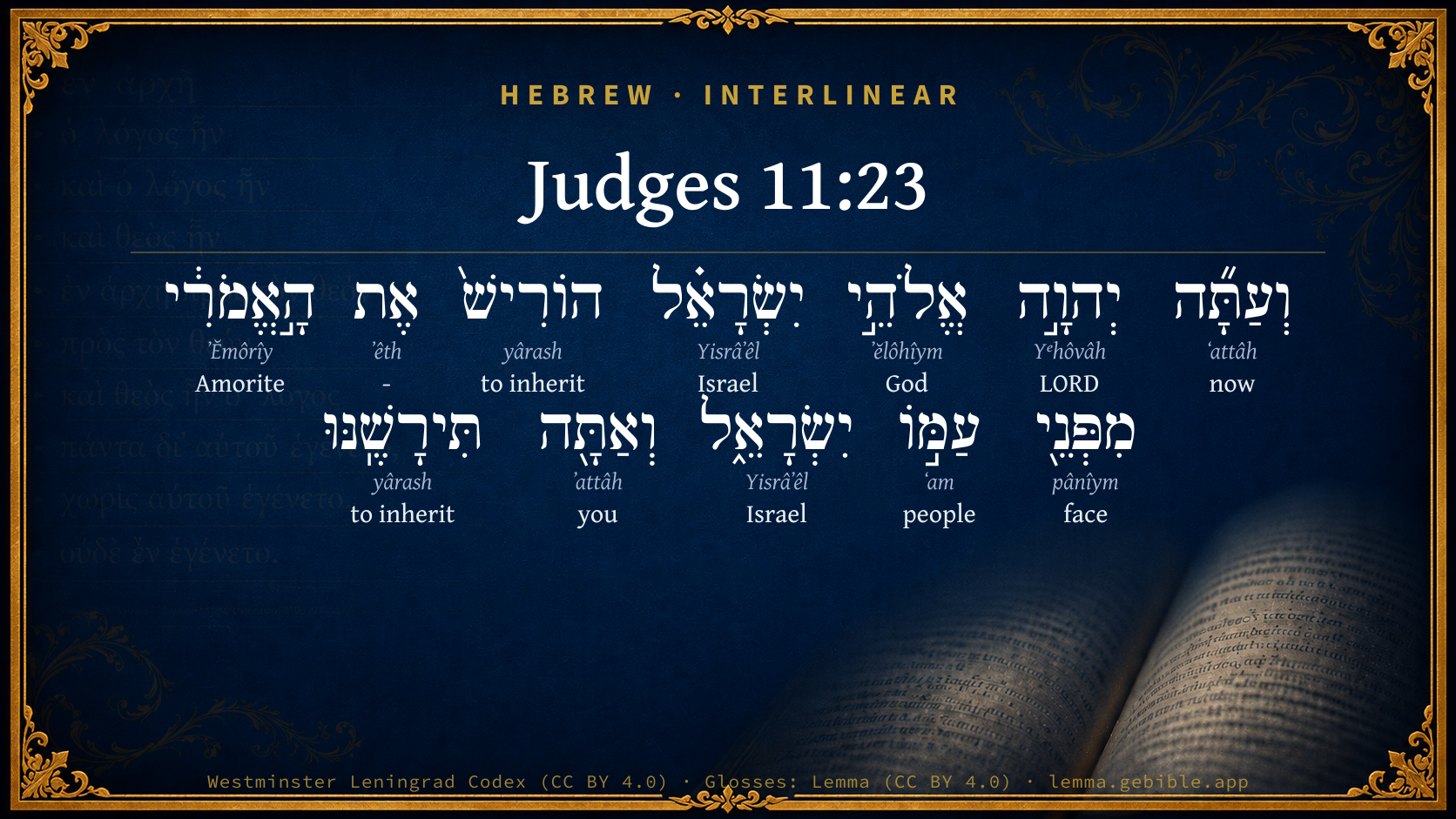
  1. וְעַתָּ֞ה ʻattâh H6258 “and · now” Conjunction + Adverb
  2. יְהוָ֣ה Yᵉhôvâh H3068 “LORD” Noun, Proper
  3. אֱלֹהֵ֣י ʼĕlôhîym H430 “God(s) of” Noun, Common, Masculine, Plural, Construct
  4. יִשְׂרָאֵ֗ל Yisrâʼêl H3478 “Israel” Noun, Proper
  5. הוֹרִישׁ֙ yârash H3423 “to inherit” Verb, Hiphil, Perfect, 3rd Person, Masculine, Singular
  6. אֶת ʼêth H853 “-” Particle, Direct Object
  7. מִפְּנֵ֖י pânîym H6440 “from · face(s) of” Preposition + Noun, Common, Both, Plural, Construct
  8. עַמּ֣וֹ ʻam H5971 “people · his” Noun, Common, Masculine, Singular, Construct + Suffix, Personal, 3rd Person, Masculine, Singular
  9. יִשְׂרָאֵ֑ל Yisrâʼêl H3478 “Israel” Noun, Proper
  10. וְאַתָּ֖ה ʼattâh H859 “and · you” Conjunction + Pronoun, Personal, 2nd Person, Masculine, Singular
  11. תִּירָשֶֽׁנּוּ yârash H3423 “to inherit · him” Verb, Qal, Imperfect, 2nd Person, Masculine, Singular + Suffix, Personal, 3rd Person, Masculine, Singular

About this verse

These counts appear in no published source. They are computed here, from the morphology-tagged text and Lemma’s own curated glosses. What Lemma adds →

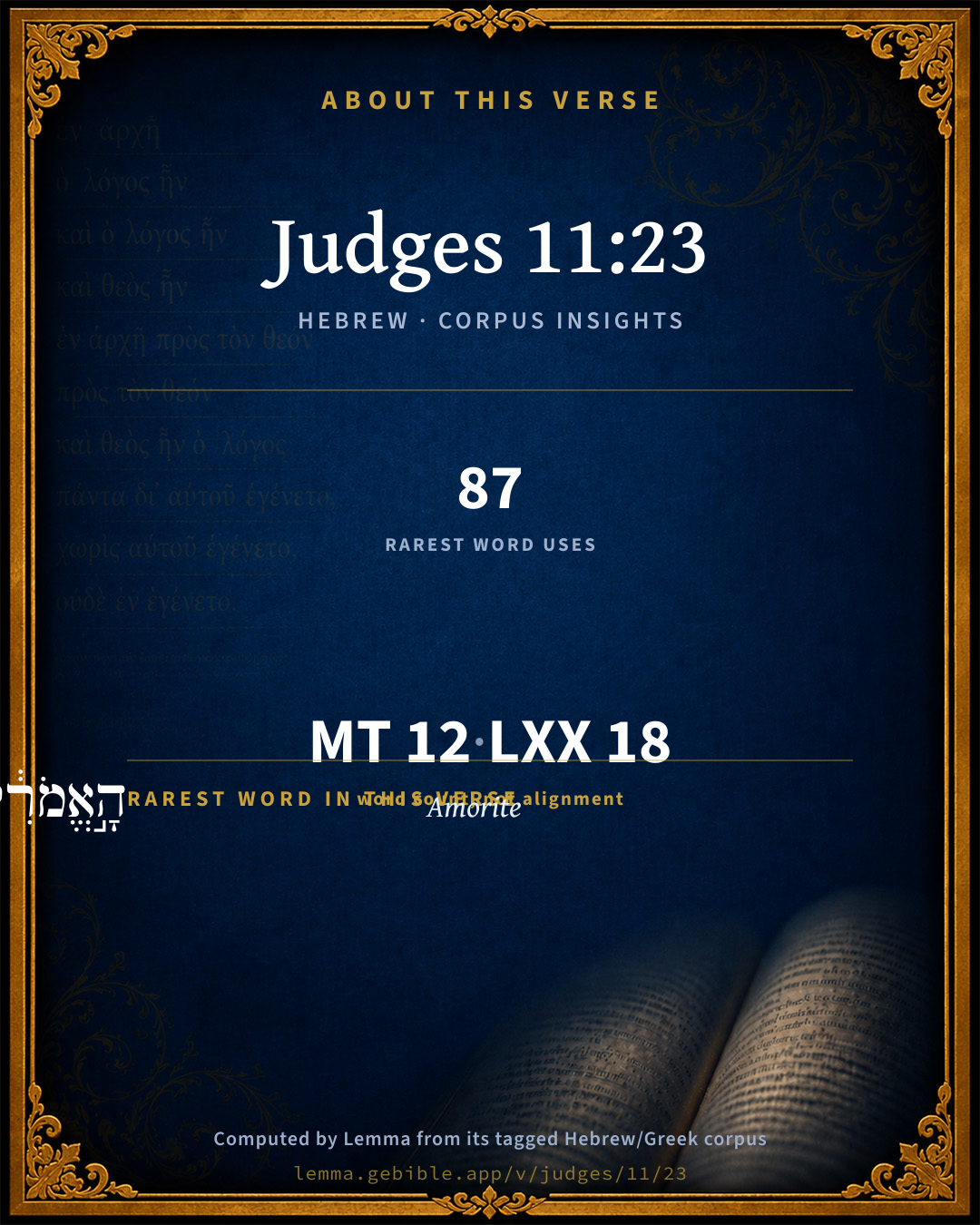
12
words
10
distinct lemmas
Historical
section

Grammatical profile

  • 2 verbs
  • 7 nouns
  • 1 pronoun
  • 1 adverb
  • 1 particle

Verb forms

  • הוֹרִישׁ֙ Hiphil · Perfect
  • תִּירָשֶֽׁנּוּ Qal · Imperfect

Repetition

Words recur within this verse — often emphatic in Hebrew:

  • יִשְׂרָאֵ֗ל Israel H3478 ×2
  • הוֹרִישׁ֙ to inherit H3423 ×2

Hebrew & Septuagint length

In English translation the verse runs 21 words from the Hebrew and 22 from the Septuagint (LXX English) — closely comparable.

A rough comparison of the two English renderings, which tokenize alike — not a word-level alignment.

Word counts can differ between the Hebrew and the Greek without any difference in meaning — e.g. the Hebrew direct-object marker אֵת has no separate Greek word, and Greek often adds the article ὁ.

In the original languages it is 12 Hebrew tokens and 18 Greek tokens — but the two are counted differently (Hebrew bundles its prefixes and suffixes into one token; the Greek is in lemma form), so that isn’t a like-for-like length.

Hebrew and Greek witnesses Masoretic Hebrew ↔ Greek Septuagint

The same verse in the two great witnesses to the Old Testament, shown verse-for-verse.

These are two independent witnesses, not word-aligned to each other, and the Septuagint is shown in lemma (dictionary) form.

Hebrew Judges 11:23 Masoretic · Westminster Leningrad Codex

וְעַתָּ֞ה יְהוָ֣ה אֱלֹהֵ֣י יִשְׂרָאֵ֗ל הוֹרִישׁ֙ אֶת הָ֣אֱמֹרִ֔י מִפְּנֵ֖י עַמּ֣וֹ יִשְׂרָאֵ֑ל וְאַתָּ֖ה תִּירָשֶֽׁנּוּ

So now Yahweh, the God of Israel, has dispossessed the Amorites from before his people Israel, and should you possess them?

World English Bible · Public Domain

Greek LXX Judges 11:23 Septuagint · lemma form

καί νῦν κύριος ὁ θεός ἰσραήλ ἐκαἴρω ὁ ἀμορραῖος ἀπό πρόσωπον λαός αὐτός ἰσραήλ καί σύ κληρονομέω αὐτός

And now the Lord God of Israel has removed the Amorite from before his people Israel, and shall you inherit his land?

LXX2012 (modern English Septuagint) · Public Domain

Hebrew: Westminster Leningrad Codex (CC BY 4.0). Greek: Septuagint (public domain); English from LXX2012 (modern English Septuagint) (Public Domain). How the Septuagint differs from the Hebrew →

Targum (Aramaic paraphrase)

1

The Targum is the ancient Jewish Aramaic paraphrase of the Hebrew Scriptures — an interpretive translation, not the Hebrew text itself. Onkelos (literal) and Pseudo-Jonathan (expansive) render the Torah, and Jonathan the Prophets. Coverage is partial: where no permissively-licensed English translation exists for a verse, only the Aramaic is shown. This is verse-level text, not a word-by-word alignment to the Hebrew.

  1. Targum Jonathan Prophets (Joshua–Malachi)
    וּכְעַן יְיָ אֱלָהָא דְיִשְׂרָאֵל תָּרִיךְ יַת אֱמוֹרָאָה מִן קֳדָם עַמֵיהּ יִשְׂרָאֵל וְאַתְּ מְדַמֵי לְמֵירְתֵיהּ:

    (no public-domain English translation for this verse)

    Targum Jonathan — Aramaic: “Mikraot Gedolot” (public domain). English: “Sefaria Community Translation” (CC0 1.0 (public-domain dedication)); “London "Chaldee Paraphrase," 1871” (public domain). Text via Sefaria.

Commentary

Notes on Judges 11:23 from classic Christian and Jewish commentators (each source and its license shown beneath its notes). The classic Christian expositions comment on the surrounding passage and are grouped to its opening verse, so a note may address several verses; the Jewish commentaries on the Tanakh (Rashi and others) are per-verse, so they appear only where the commentator wrote on this verse.

Lemma curates 59 commentaries, every one of them public domain or Creative Commons licensed, each selected and text-cleaned for this edition rather than reprinted as found. About our sources →

Trapp's Complete Commentary

John Trapp

Jdg 11:23 So now the LORD God of Israel hath dispossessed the Amorites from before his people Israel, and shouldest thou possess it?

Ver. 23. So now the Lord God of Israel hath dispossessed.] He argueth that the land in question is Israel’s out of all question, by a threefold right: (1.) Of conquest; (2.) Of divine donation; (3.) Of prescription. {Jdg 11:25}

John Trapp, A Commentary or Exposition upon All the Books of the Old and New Testament (1647–1656) — public domain. Text from a community e-Sword module.

Joseph Benson's Commentary

Jdg 11:23. So now the Lord, &c. — God, the sovereign Lord of all lands, hath given us this land; this he adds, as a further and convincing reason; because otherwise it might have been alleged against the former argument, that they could gain no more right to that land from Sihon, than Sihon himself had. And shouldest thou possess it? — It was absurd to think that they should take pains to conquer it, and God should give it to them, only that they might reinstate the Moabites or Ammonites in the possession of it, with whom they had no alliance.

Joseph Benson's Commentary on the Old and New Testaments (1811–1818) — public domain. Text from a community e-Sword module.

Adam Clarke's Commentary

Verse 23. The Lord God of Israel hath dispossessed the Amorites] Jephthah shows that the Israelites did not take the land of the Moabites or Ammonites, but that of the Amorites, which they had conquered from Sihon their king, who had, without cause or provocation, attacked them; and although the Amorites had taken the lands in question from the Ammonites, yet the title by which Israel held them was good, because they took them not from the Ammonites, but conquered them from the Amorites.

So now the Lord - hath dispossessed the Amorites. - The circumstances in which the Israelites were when they were attacked by the Amorites, plainly proved, that, unless Jehovah had helped them, they must have been overcome. God defeated the Amorites, and made a grant of their lands to the Israelites; and they had, in consequence, possessed them for three hundred years, Jdg 11:26.

Adam Clarke's Commentary on the Bible (1810–1826) — public domain. Text from a community e-Sword/MySword module.

Ellicott's Commentary for English Readers

(23) Shouldest thou possess it?—Is it likely that Israel would fight battles solely to benefit Ammon and Moab?

A Bible Commentary for English Readers, edited by Charles John Ellicott (1878–1897) — public domain. Text from a community e-Sword module.

John Gill's Exposition

Wilt not thou possess that which Chemosh thy god giveth thee to possess?.... Chemosh was the idol of the Moabites, see Num 21:29, which has led some to think, that the present king of Ammon was also king of Moab, and who insisted on that part of the country, which formerly belonged to Moab, to be delivered to him, as well as that which had belonged to Ammon. Now since the land, which they now inhabited, as well as what they had lost, they had taken away from others, Deu 2:10, having conquered them, and which they ascribed to the help and assistance they had from their idol, and possessed as his gift; Jephthah argues with them "ad hominem", from the less to the greater:

so whomsoever the Lord our God shall drive out from before us, them will we possess; we have surely as good a claim to what the Lord our God gives to us in a way of conquest, as you have, or can think you have, to what your idol, as you suppose, has given you: however, what we have got, or get this way, we are determined to possess, and keep possession of.

John Gill's Exposition of the Whole Bible (1746–1763) — public domain (CC PDM 1.0). Text via the HelloAO Bible API.

Haydock's Catholic Bible Commentary

His land, which the Amorrhite had first conquered, and which God took from him to give to Israel. It was clear that this country was not then considered as the property of the sons of Lot, since God expressly forbad his people to molest them. (Haydock) --- Jephte produces the right of conquest, the grant of God, and the possession of 300 years, to prove that the country belonged to the Israelites. All acknowledge that the right of conquest, in a just war, give a good title. (Grotius, Jur. iii. 6, 7.) --- The children of Lot had lost all hopes of recovering what Sehon had taken from them. (Calmet) --- He could not be proved to be a thief or an usurper, but was in peaceable possession when the war with Israel commenced, in which he lost all his dominions. (Haydock) --- By the same right, David kept what he had taken from the Amalecite plunderers, (1 Kings xxx. 20,) and Abraham might have retained the spoils which had been carried off from Sodom, Genesis xiv. 21. The Roman and Grecian histories are full of such examples; and this right was admitted by all as the law of nations, Quæ ex hostibus, jure gentium, statim capientium fiunt. (Caius. J. C.) --- The second argument of Jepthe is unanswerable, since God may undoubtedly transfer the property of one to another. But as the Ammonites might reply that they did not admit the God of Israel, he observes that the latter might at least have the same privilege as their Chamos, ver. 24. Prescription of so long a time, with good faith, was the third argument, as the Amorrhites being destroyed, and the Moabites disheartened, could not pretend to reclaim the conquered country. There would never be an end of disputes among men, if the undisturbed possession of a country for such a length of time did not confirm their right to it. These principles establish the tranquillity of families and of states. (Calmet; Grotius, Jur. ii. 4.)

George Leo Haydock (1774–1849), Haydock's Catholic Family Bible and Commentary, 1859 edition — public domain. Excludes Psalms (Douay-Rheims chapter numbering differs from Protestant) and Deuterocanonical books (Catholic canon only).

Matthew Poole's English Annotations

God, the sovereign Lord of all lands, hath given us this land: this he adds, as a further and a convincing reason; because otherwise it might have been alleged against the former argument, that they could gain no more right to that land from Sihon than Sihon himself had, and he had but an unjust claim to it.

Matthew Poole's English Annotations on the Holy Bible (1683–1685) — public domain. Text from a community e-Sword/MySword module.

Whedon's Commentary on the Bible

Daniel D. Whedon

23. Shouldest thou possess it — Is it right for thee to seize upon possessions which our God has so signally given to us?

Daniel D. Whedon (gen. ed.), Commentary on the Old and New Testaments (1874–1909) — public domain. Text from a community e-Sword module.

John Wesley's Explanatory Notes

So the Lord - God, the sovereign Lord of all lands, hath given us this land; this he adds, as a farther and convincing reason; because otherwise it might have been alledged against the former argument, that they could gain no more right to that land from Sihon, than Sihon himself had.

John Wesley, Explanatory Notes Upon the Whole Bible (1754–1765) — public domain. Text via the GEBible commentary corpus.

unfoldingWord translationNotes

Door43 World Missions Community

General Information:

Jephthah's messengers continue to speak.

should you now take possession of their land?

Jephthah is rebuking the king of the Ammonites with this rhetorical question. The word "their" refers to the Israel. This question can be translated as a statement. AT: "therefore, you should not take possession of their land." (See: Rhetorical Question)

Will you not take over the land that Chemosh, your god, gives you?

Jephthah is rebuking the king of the Ammonites with a rhetorical question. This question can be translated as a statement. AT: "You should only take over the land that Chemosh, your god, gives you." (See: Rhetorical Question)

take over

This is an idiom which means to take control of something. AT: "take control of" or "take possession of" (See: Idiom)

Chemosh

This is the name of a false god. (See: How to Translate Names)

Now are you really better than Balak son of Zippor, king of Moab?

Jephthah is rebuking the king of the Ammonites with a rhetorical question. This question can be translated as a statement. AT: "You are not better than Balak son of Zippor, who was king of Moab." (See: Rhetorical Question)

Balak ... Zippor

These are the names of men. (See: How to Translate Names)

Did he dare to have an argument with Israel?

Jephthah is rebuking the king of the Ammonites with a rhetorical question. This question can be translated with a statement. AT: "Yet he did not dare to have an argument with Israel." (See: Rhetorical Question)

Did he ever wage war against them?

Jephthah is rebuking the king of the Ammonites with a rhetorical question. This question can be translated with a statement. AT: "Nor did he ever wage war against them." (See: Rhetorical Question)

translationWords

Yahweh

God

Israel

Amorite

possess

false god

Moab

unfoldingWord translationNotes — © Distant Shores Media and the Door43 World Missions Community, licensed CC BY-SA 4.0. Source: git.door43.org/Door43/en_tn.

Lesson kit

Teaching starters — assembled from the data on this page, not authored interpretation. Every prompt links to the verse data it draws on. Edit before teaching.

Judges, in the Historical, opens this verse with 12 words (10 distinct Hebrew lemmas). Its most distinctive word is ʼĔmôrîy (“Amorite”). A historical commentator’s framing appears above. Read the whole chapter for the surrounding context.

Discussion questions

  1. The word ʼĔmôrîy carries the sense “Amorite.” How does it shape the verse?
  2. What does the repetition of “Israel” (2× in this one verse) do in this verse?
  3. These translations render this verse differently; the difference is in the English rendering, not the original. What questions does that raise?
  4. «הוֹרִישׁ֙» is a Hiphil Perfect verb. How does that grammatical form shape the action described?
  5. Compare how Trapp's Complete Commentary and Joseph Benson's Commentary read this verse. Where do they agree or differ?

Things to notice

Reading settings

Reading text

Shown beneath each verse's original-language words.

Old Testament
Old Testament edition

Read the OT as the Masoretic Hebrew (MT) or the Greek Septuagint (LXX).

English shown for the Greek Septuagint (in the Hebrew ↔ Greek comparison).

Comparing translations? Open the Compare panel on any verse page to stack up to four side by side.