Numbers 33:53

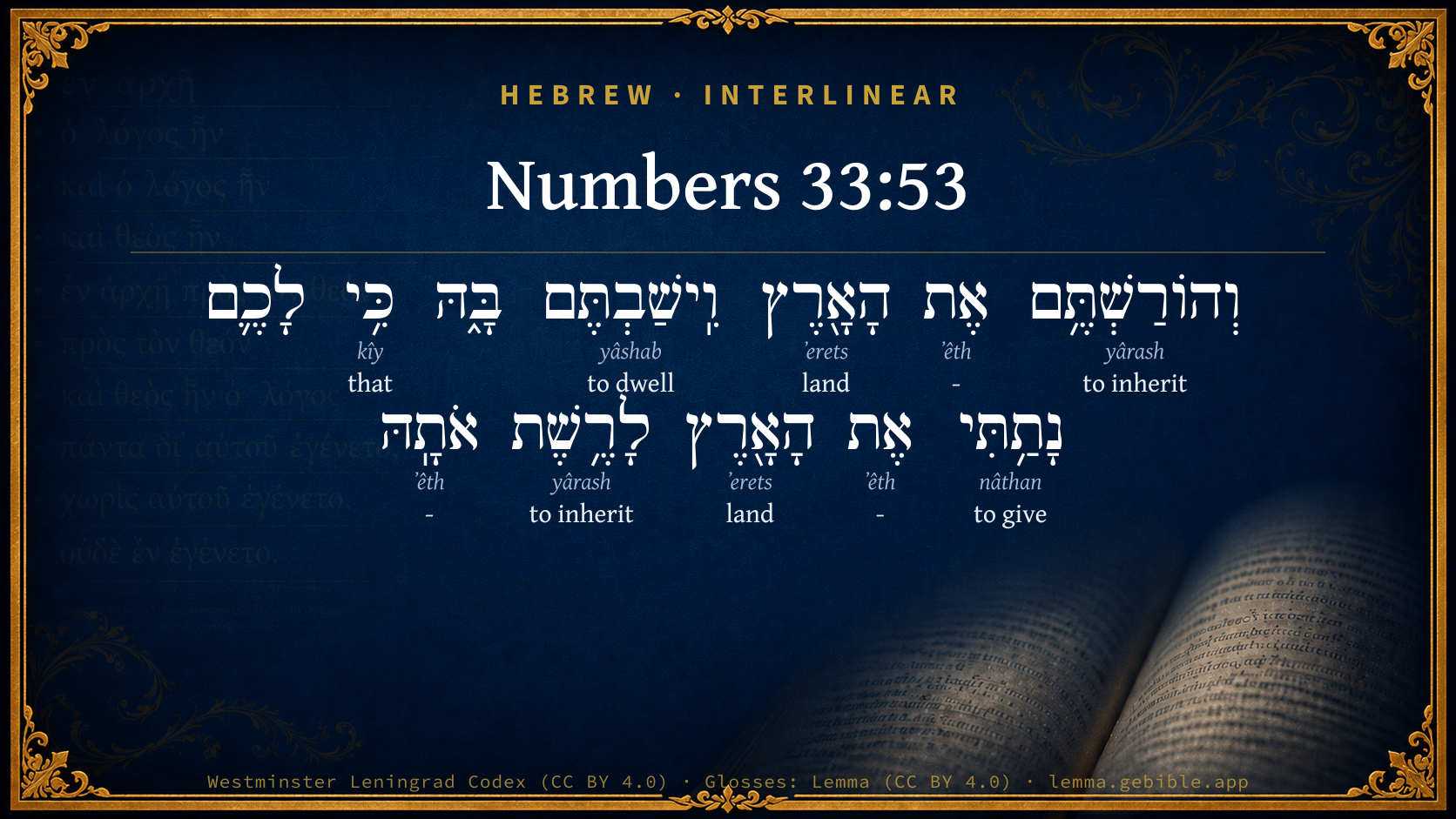
Hebrew (Westminster Leningrad Codex) Numbers 33:53 appears in the Hebrew Old Testament. The text above is from the Westminster Leningrad Codex. Each word links to its Strong’s number, a concise gloss, and parsing drawn from the Open Scriptures Hebrew Bible morphology. Click any word for its full Brown-Driver-Briggs (BDB) entry.
Download image
Cite this verse

Numbers 33:53 (World English Bible). Public Domain. Lemma interlinear Bible study tool, https://lemma.gebible.app/v/numbers/33/53.

Show BibTeX & RIS
BibTeX
RIS
English Translation
and you shall take possession of the land, and dwell therein; for to you have I given the land to possess it.
World English Bible · Public Domain
Download a study sheet

One document with this verse’s original text, its word-by-word gloss line, the meaning frame, cross-references with their text, attributed commentary, and full source and license credits — printable, and it pastes into notes with its structure intact.

This verse Autodidact and up

Study sheet (.html) Plain text (.txt)

A passage Seminary Student

Up to 50 verses in one chapter. A passage sheet keeps up to 6 commentary sources and 12 cross-references per verse, in the order this page ranks them, and says so on the sheet whenever that leaves anything out. Ask for a single verse and you get the Autodidact verse sheet above.

Everything on this page stays free to read, with no account — the sheet is a download of what is already on screen, not access to it.

Want to remove ads? Support Godless Engineer
Compare translations 3

The same verse in 3 English versions, stacked beneath the original-language interlinear above. Click any original word for its lexicon entry.

Each is an independent rendering of the whole verse — the interlinear is not word-aligned to these translations.

Highlighted words mark where these versions differ — a whole-verse word diff, not a word-by-word alignment.

  • World English Bible Public Domain
    and you shall take possession of the land, and dwell therein; for to you have I given the land to possess it.
  • King James Version Public Domain
    And ye shall dispossess the inhabitants of the land, and dwell therein: for I have given you the land to possess it.
  • unfoldingWord Literal Text CC BY-SA 4.0
    And you shall take possession of the land and dwell in it, because I have given the land to you to possess it.

unfoldingWord Literal Text — © unfoldingWord, licensed CC BY-SA 4.0. Word-aligned USFM3 via Door43 (git.door43.org/unfoldingWord/en_ult).

Versions to compare (up to 4)

3 of 4 selected

Show all 18 translations

Every available English version of this verse, each an independent rendering of the whole verse.

  • World English Bible Public Domain
    and you shall take possession of the land, and dwell therein; for to you have I given the land to possess it.
  • Berean Standard Bible Public Domain
    You are to take possession of the land and settle in it, for I have given you the land to possess.
  • Majority Standard Bible Public Domain
    You are to take possession of the land and settle in it, for I have given you the land to possess.
  • King James Version Public Domain
    And ye shall dispossess the inhabitants of the land, and dwell therein: for I have given you the land to possess it.
  • American Standard Version (1901) Public Domain
    and ye shall take possession of the land, and dwell therein; for unto you have I given the land to possess it.
  • Revised Version (1885) Public Domain
    and ye shall take possession of the land, and dwell therein: for unto you have I given the land to possess it.
  • Geneva Bible (1599) Public Domain
    And ye shall possesse the lande and dwell therein: for I haue giue you ye land to possesse it.
  • Douay-Rheims (1899) Public Domain
    Cleansing the land, and dwelling in it. For I have given it you for a possession.
  • Young's Literal Translation Public Domain
    and ye have possessed the land, and dwelt in it, for to you I have given the land -- to possess it.
  • Literal Standard Version CC BY-SA 4.0
    and you have possessed the land and dwelt in it, for I have given the land to you to possess it.
  • Unlocked Literal Bible CC BY-SA 4.0
    You must take possession of the land and settle in it, because I have given you the land to possess.
  • unfoldingWord Literal Text CC BY-SA 4.0
    And you shall take possession of the land and dwell in it, because I have given the land to you to possess it.
  • Darby Bible Public Domain
    and ye shall take possession of the land, and dwell therein, for to you have I given the land to possess it.
  • World Messianic Bible Public Domain
    You shall take possession of the land, and dwell therein; for I have given the land to you to possess it.
  • Webster's Bible Public Domain
    And ye shall dispossess the inhabitants of the land, and dwell in it; for I have given you the land to possess it.
  • Free Bible Version CC BY-SA 4.0
    You are to take over the country and settle there, because I have given you the land and it belongs to you.
  • Bible in Basic English Public Domain
    And take the land for yourselves, for your resting-place: for to you I have given the land as your heritage.
  • JPS Tanakh (1917) Public Domain
    And ye shall drive out the inhabitants of the land, and dwell therein; for unto you have I given the land to possess it.

Literal Standard Version (2020), Covenant Press — licensed CC BY-SA 4.0. Text via the HelloAO Bible API (eBible.org). Unlocked Literal Bible (unfoldingWord) — licensed CC BY-SA 4.0. Text via the HelloAO Bible API (eBible.org). unfoldingWord Literal Text — © unfoldingWord, licensed CC BY-SA 4.0. Word-aligned USFM3 via Door43 (git.door43.org/unfoldingWord/en_ult). Free Bible Version, Dr. Jonathan Gallagher — licensed CC BY-SA 4.0. Text via the HelloAO Bible API (eBible.org).

Word by word

More ways to search: Search by grammar → Find every occurrence → Compare this word →

Practice this passage: Drill this verse → Learn its vocabulary →

וְהוֹרַשְׁתֶּ֥ם
yârash
H3423
“and · to inherit”
Conjunction + Verb, Hiphil, Sequential Perfect, 2nd Person, Masculine, Plural
Part of Speech
Conjunction + Verb
Stem
Hiphil
Form
Sequential Perfect
Person
2nd Person
Gender
Masculine
Number
Plural
Full BDB Definition

Origin: a primitive root

TWOT: 920

to seize, dispossess, take possession off, inherit, disinherit, occupy, impoverish, be an heir - (Qal) - to take possession of - to inherit - to impoverish, come to poverty, be poor - (Niphal) to be dispossessed, be impoverished, come to poverty - (Piel) to devour - (Hiphil) - to cause to possess or inherit - to cause others to possess or inherit - to impoverish - to dispossess - to destroy, bring to ruin, disinherit
  1. אֶת ʼêth H853 “-” Particle, Direct Object
  2. הָאָ֖רֶץ ʼerets H776 “the · land” Particle, Definite Article + Noun, Common, Both, Singular, Absolute
  3. וִֽישַׁבְתֶּם yâshab H3427 “and · to dwell” Conjunction + Verb, Qal, Sequential Perfect, 2nd Person, Masculine, Plural
  4. כִּ֥י kîy H3588 “that” Conjunction
  5. נָתַ֥תִּי nâthan H5414 “to give” Verb, Qal, Perfect, 1st Person, Common, Singular
  6. אֶת ʼêth H853 “-” Particle, Direct Object
  7. הָאָ֖רֶץ ʼerets H776 “the · land” Particle, Definite Article + Noun, Common, Both, Singular, Absolute
  8. לָרֶ֥שֶׁת yârash H3423 “to inherit” Preposition + Verb, Qal, Infinitive Construct
  9. אֹתָֽהּ ʼêth H853 “- · her” Particle, Direct Object + Suffix, Personal, 3rd Person, Feminine, Singular

About this verse

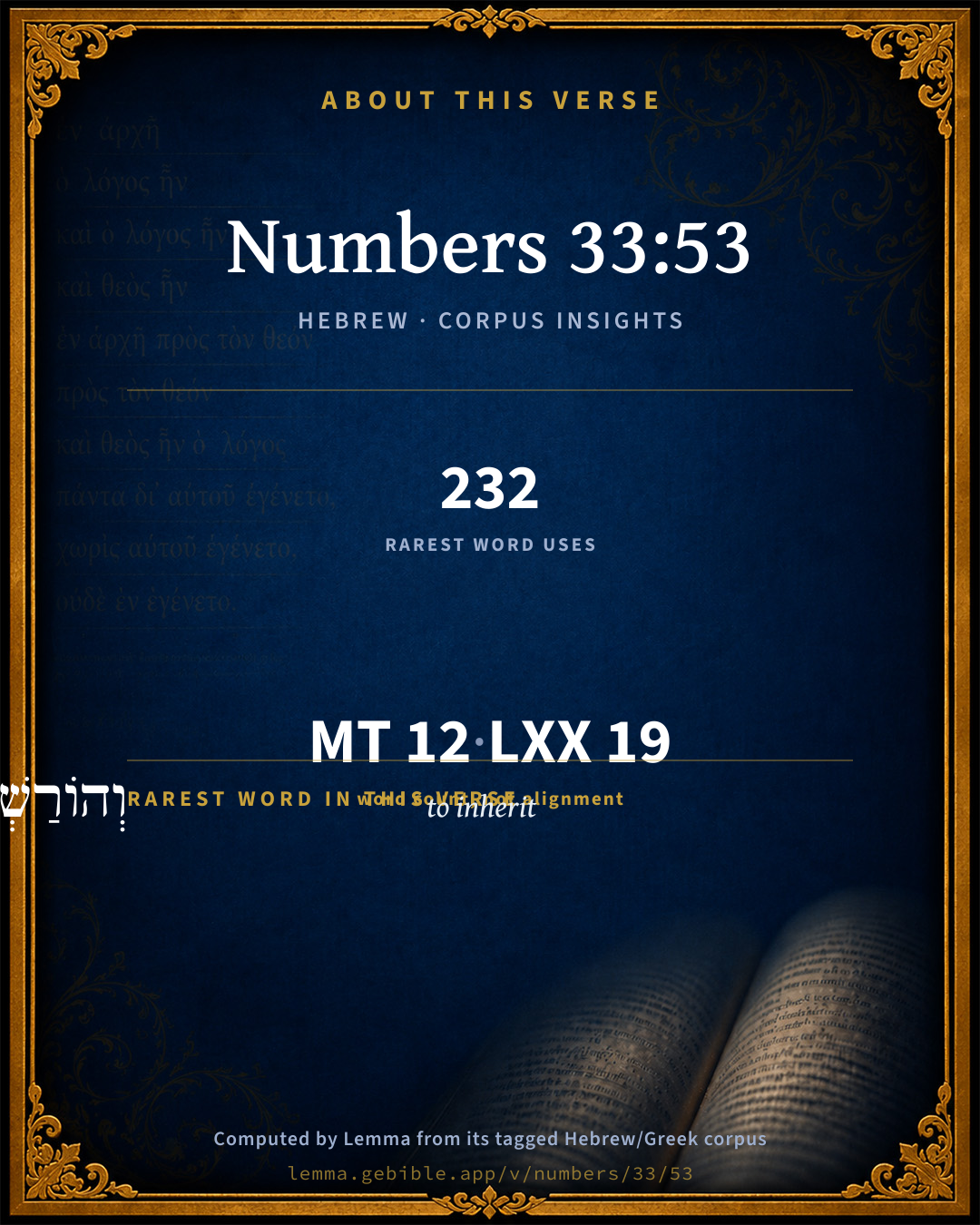
These counts appear in no published source. They are computed here, from the morphology-tagged text and Lemma’s own curated glosses. What Lemma adds →

12
words
6
distinct lemmas
Pentateuch
section

Grammatical profile

  • 4 verbs
  • 2 nouns
  • 2 prepositions
  • 1 conjunction
  • 3 particles

Verb forms

  • וְהוֹרַשְׁתֶּ֥ם Hiphil · Sequential Perfect
  • וִֽישַׁבְתֶּם Qal · Sequential Perfect
  • נָתַ֥תִּי Qal · Perfect
  • לָרֶ֥שֶׁת Qal · Infinitive Construct

Repetition

Words recur within this verse — often emphatic in Hebrew:

  • וְהוֹרַשְׁתֶּ֥ם to inherit H3423 ×2
  • הָאָ֖רֶץ land H776 ×2

Hebrew & Septuagint length

In English translation the verse runs 22 words from the Hebrew and 27 from the Septuagint (LXX English) — closely comparable.

A rough comparison of the two English renderings, which tokenize alike — not a word-level alignment.

Word counts can differ between the Hebrew and the Greek without any difference in meaning — e.g. the Hebrew direct-object marker אֵת has no separate Greek word, and Greek often adds the article ὁ.

In the original languages it is 12 Hebrew tokens and 19 Greek tokens — but the two are counted differently (Hebrew bundles its prefixes and suffixes into one token; the Greek is in lemma form), so that isn’t a like-for-like length.

Cross-references

10

Topical passages linked to Numbers 33:53 in the Treasury of Scripture Knowledge — connected by theme and wording, ordered by reader-vote popularity; previews shown in the World English Bible.

  • Deuteronomy 11:31 For you are to pass over the Jordan to go in to possess the land which Yahweh your God gives you, and you shall possess it, and dwell therein.
  • Deuteronomy 32:8 When the Most High gave to the nations their inheritance, When he separated the children of men, He set the bounds of the peoples According to the number of the children of Israel.
  • Joshua 21:43 So Yahweh gave to Israel all the land which he swore to give to their fathers; and they possessed it, and lived therein.
  • Psalms 115:16 The heavens are the heavens of Yahweh; But the earth has he given to the children of men.
  • Psalms 24:1–2 The earth is Yahweh's, with its fullness; The world, and those who dwell therein.
  • Jeremiah 27:5–6 I have made the earth, the men and the animals that are on the surface of the earth, by my great power and by my outstretched arm; and I give it to whom it seems right to me.
  • Daniel 4:17 The sentence is by the decree of the watchers, and the demand by the word of the holy ones; to the intent that the living may know that the Most High rules in the kingdom of men, and gives it to whoever he will, and sets up over it the lowest of men.
  • Daniel 4:25 that you shall be driven from men, and your dwelling shall be with the animals of the field, and you shall be made to eat grass as oxen, and shall be wet with the dew of the sky, and seven times shall pass over you; until you know that the Most High rules in the kingdom of men, and gives it to whoever he will.
  • Daniel 4:32 and you shall be driven from men; and they dwelling shall be with the animals of the field; you shall be made to eat grass as oxen; and seven times shall pass over you; until you know that the Most High rules in the kingdom of men, and gives it to whoever he will.
  • Matthew 20:15 Isn't it lawful for me to do what I want to with what I own? Or is your eye evil, because I am good?'

Cross-references courtesy of OpenBible.info (CC BY 4.0).

Hebrew and Greek witnesses Masoretic Hebrew ↔ Greek Septuagint

The same verse in the two great witnesses to the Old Testament, shown verse-for-verse.

These are two independent witnesses, not word-aligned to each other, and the Septuagint is shown in lemma (dictionary) form.

Hebrew Numbers 33:53 Masoretic · Westminster Leningrad Codex

וְהוֹרַשְׁתֶּ֥ם אֶת הָאָ֖רֶץ וִֽישַׁבְתֶּם בָּ֑הּ כִּ֥י לָכֶ֛ם נָתַ֥תִּי אֶת הָאָ֖רֶץ לָרֶ֥שֶׁת אֹתָֽהּ

and you shall take possession of the land, and dwell therein; for to you have I given the land to possess it.

World English Bible · Public Domain

Greek LXX Numbers 33:53 Septuagint · lemma form

καί ἀποὀλλύω πᾶς ὁ καταοἰκέω ὁ γῆ καί καταοἰκέω ἐν αὐτός σύ γάρ δίδωμι ὁ γῆ αὐτός ἐν κλῆρος

And you⌃ shall destroy all the inhabitants of the land, and you⌃ shall dwell in it, for I have given their land to you for an inheritance.

LXX2012 (modern English Septuagint) · Public Domain

On this verse, Haydock's Catholic Bible Commentary discusses the Septuagint’s reading. Read the note in Commentary ↓

Hebrew: Westminster Leningrad Codex (CC BY 4.0). Greek: Septuagint (public domain); English from LXX2012 (modern English Septuagint) (Public Domain). How the Septuagint differs from the Hebrew →

Targum (Aramaic paraphrase)

2

The Targum is the ancient Jewish Aramaic paraphrase of the Hebrew Scriptures — an interpretive translation, not the Hebrew text itself. Onkelos (literal) and Pseudo-Jonathan (expansive) render the Torah, and Jonathan the Prophets. Coverage is partial: where no permissively-licensed English translation exists for a verse, only the Aramaic is shown. This is verse-level text, not a word-by-word alignment to the Hebrew.

  1. Targum Onkelos Torah (Genesis–Deuteronomy)
    וּתְתָרְכוּן יָת יָתְבֵי אַרְעָא וְתֵיתְבוּן בָּהּ אֲרֵי לְכוֹן יְהָבִית יָת אַרְעָא לְמֵירַת יָתָהּ

    (no public-domain English translation for this verse)

    Targum Onkelos — Aramaic: “Onkelos Genesis” (public domain); “Onkelos Exodus” (public domain); “Onkelos Leviticus” (public domain); “Onkelos Numbers” (public domain); “Onkelos Deuteronomy” (public domain). English: “Sefaria Community Translation” (CC0 1.0 (public-domain dedication)); “J.W. Etheridge. The Targums of Onkelos and Jonathan Ben Uzziel on the Pentateuch. London: Longmans, Green, 1862” (public domain). Text via Sefaria.

  2. Targum Pseudo-Jonathan Torah (Genesis–Deuteronomy)
    וּתְתַרְכוּן יַת יַתְבֵי אַרְעָא וְתֵיתְבוּן בָּהּ אֲרוּם לְכוֹן יְהָבִית יַת אַרְעָא לְמֵירוּת יָתָהּ

    And you shall drive out the inhabitants of the land, and dwell therein, for I have given you the land to possess it.

    Targum Pseudo-Jonathan — Aramaic: “Targum Jonathan on Genesis” (public domain); “Targum Jonathan on Exodus” (public domain); “Targum Jonathan on Leviticus” (public domain); “Targum Jonathan on Numbers” (public domain); “Targum Jonathan on Deuteronomy” (public domain). English: “The Targum of Jonathan ben Uzziel, trans. J. W. Etheridge, London, 1862” (public domain). Text via Sefaria.

Commentary

Notes on Numbers 33:53 from classic Christian and Jewish commentators (each source and its license shown beneath its notes). The classic Christian expositions comment on the surrounding passage and are grouped to its opening verse, so a note may address several verses; the Jewish commentaries on the Tanakh (Rashi and others) are per-verse, so they appear only where the commentator wrote on this verse.

Lemma curates 59 commentaries, every one of them public domain or Creative Commons licensed, each selected and text-cleaned for this edition rather than reprinted as found. About our sources →

Haydock's Catholic Bible Commentary

Land of its old inhabitants, and of the places dedicated to superstitious purposes. (Haydock) --- Hebrew, "occupy the land." Septuagint, "drive out the inhabitants, and dwell there."

George Leo Haydock (1774–1849), Haydock's Catholic Family Bible and Commentary, 1859 edition — public domain. Excludes Psalms (Douay-Rheims chapter numbering differs from Protestant) and Deuterocanonical books (Catholic canon only).

Whedon's Commentary on the Bible

Daniel D. Whedon

53. Ye shall dispossess — The same in Hebrew as “drive out,” in Num_33:52, signifying to take possession of their land, to drive out and to exterminate all who remain.

Daniel D. Whedon (gen. ed.), Commentary on the Old and New Testaments (1874–1909) — public domain. Text from a community e-Sword module.

The Pulpit Commentary

I have given you the land. "The earth is the Lord"s," and no one, therefore, can dispute his right in the abstract to evict any of his tenants and to put others in possession. But while the whole earth was the Lord"s, it is clear that he assumed a special relation towards the land of Canaan, as to which he chose to exercise directly the rights and duties of landlord. (see on Deu_22:8 for a small but striking instance) The first duty of a landlord is to see that the occupancy of his property is not abused for illegal or immoral ends; and this duty excuses, because it necessitates, eviction under certain circumstances. It is not, therefore, necessary to argue that the Canaanites were more infamous than many others; it is enough to remember that God had assumed towards the land which they occupied (apparently by conquest) a relation which did not allow him to overlook their enormities, as he might those of other nations. (see on Exo_23:23-33 Exo_34:11-17, and cf. Act_14:16 Act_17:30) It was (if we like to put it so) the misfortune of the Canaanites that they alone of "all nations" could not be suffered to "walk in their own ways," because they had settled in a land which the Lord had chosen to administer directly as his own earthly kingdom.

The Pulpit Commentary (1880–1919), ed. H.D.M. Spence-Jones & Joseph S. Exell — public domain. Text from a community e-Sword module.

unfoldingWord translationNotes

Door43 World Missions Community

General Information:

Yahweh continues telling Moses what the people must do.

inherit the land

The Israelites claiming the land as their permanent possession is spoken of as if they were inheriting the land. (See: Metaphor)

Wherever the lot falls to each clan, that land will belong to it

"Each clan will receive the land according to how the lot falls"

translationWords

possess

inherit

lots

clan

tribe

unfoldingWord translationNotes — © Distant Shores Media and the Door43 World Missions Community, licensed CC BY-SA 4.0. Source: git.door43.org/Door43/en_tn.

Rashi

Rabbi Shlomo Yitzchaki (Rashi)

והורשתם את הארץ (lit., ye shall drive out the land) — this means: and you shall dispossess it of its inhabitants, and then, וישבתם בה YOU WILL DWELL IN IT — i.e., you will be able to remain in it, but if not, you will not be able to remain in it.

Rashi on the Tanakh — English translations: “The Judaica Press complete Tanach with Rashi, translated by A. J. Rosenberg” (CC BY 4.0); “Pentateuch with Rashi's commentary by M. Rosenbaum and A.M. Silbermann, 1929-1934” (public domain); “The Metsudah Tanach series, Lakewood, N.J” (CC BY 4.0); and “The Book of Joshua, Metsudah Publications, 1997” (CC BY 4.0). Text via Sefaria.

Ramban (Nachmanides)

Rabbi Moshe ben Nachman (Ramban / Nachmanides)

AND YE SHALL DRIVE OUT THE INHABITANTS OF THE LAND, AND DWELL THEREIN; FOR UNTO YOU HAVE I GIVEN THE LAND TO POSSESS IT. In my opinion this is a positive commandment, (Book of the Commandments), in the section on “additional” positive commandments, No. 4, Ramban discusses this opinion at length. Here in his commentary on the Torah, he mentions it briefly, relying presumably on his explanation in the work quoted above. in which He is commanding them to dwell in the Land and inherit it, because He has given it to them and they should not reject the inheritance of the Eternal. Thus if the thought occurs to them to go and conquer the land of Shinar or the land of Assyria or any other country and to settle therein, they are [thereby] transgressing the commandment of G-d. And that which our Rabbis have emphasized, the significance of the commandment of settling in the Land of Israel, and that it is forbidden to leave it [except for certain specified reasons], and [the fact] that they consider a woman who does not want to emigrate with her husband to live in the Land of Israel as a “rebellious [wife],” (marriage contract — see Vol. II, pp. 385-386). and likewise the man (ibid.). — the source of all these statements is here [in this verse] where we have been given this commandment, for this verse constitutes a positive commandment. This commandment He repeats in many places, such as Go in and possess the Land. (ibid., Verse 26 — Ramban on Sefer Hamitzvoth, ibid.). Rashi, however, explained: “And ye shall drive out the inhabitants of the Land — [if] you dispossess it of its inhabitants, then ye will be able to dwell therein, and to remain there, but if not, you will not be able to remain in it.” But our interpretation [of the verse] is the principal one.

Ramban (Nachmanides) on the Tanakh — English translation: “Commentary on the Torah by Ramban (Nachmanides). Translated and annotated by Charles B. Chavel. New York, Shilo Pub. House, 1971-1976” (CC BY 4.0). Text via Sefaria.

Sforno

Rabbi Ovadia Sforno

Drive out [the inhabitants of] the land. If you will destroy the inhabitants of the land then you will merit bequeathing the land as an inheritance for your sons. However if you do not destroy them, even though you conquer the land, you will not merit bequeathing it to your children as an inheritance.

Sforno on the Tanakh — English translation: “Yalkut, Sifsei Chachomim Chumash, Metsudah Publications, 2009” (CC BY 4.0). Text via Sefaria.

Lesson kit

Teaching starters — assembled from the data on this page, not authored interpretation. Every prompt links to the verse data it draws on. Edit before teaching.

Numbers, in the Pentateuch, opens this verse with 12 words (6 distinct Hebrew lemmas). Its most distinctive word is yârash (“to inherit”). A historical commentator’s framing appears above. Read the whole chapter for the surrounding context.

Discussion questions

  1. What does “to inherit” (yârash) contribute to the verse as a whole?
  2. Deuteronomy 11:31 shares this passage’s theme. How do the two illuminate each other?
  3. “to inherit” occurs 2× in this one verse. What is the effect of the repetition?
  4. The translations on this page render this verse differently — a whole-verse word diff, not a word-by-word alignment. What might account for the different wordings?
  5. The verb «וְהוֹרַשְׁתֶּ֥ם» is Hiphil Sequential Perfect. How does its form color the action?
  6. Reading how Haydock's Catholic Bible Commentary and Whedon's Commentary on the Bible read this verse, where do the two commentators agree and where do they part?

Things to notice

Reading settings

Reading text

Shown beneath each verse's original-language words.

Old Testament
Old Testament edition

Read the OT as the Masoretic Hebrew (MT) or the Greek Septuagint (LXX).

English shown for the Greek Septuagint (in the Hebrew ↔ Greek comparison).

Comparing translations? Open the Compare panel on any verse page to stack up to four side by side.