
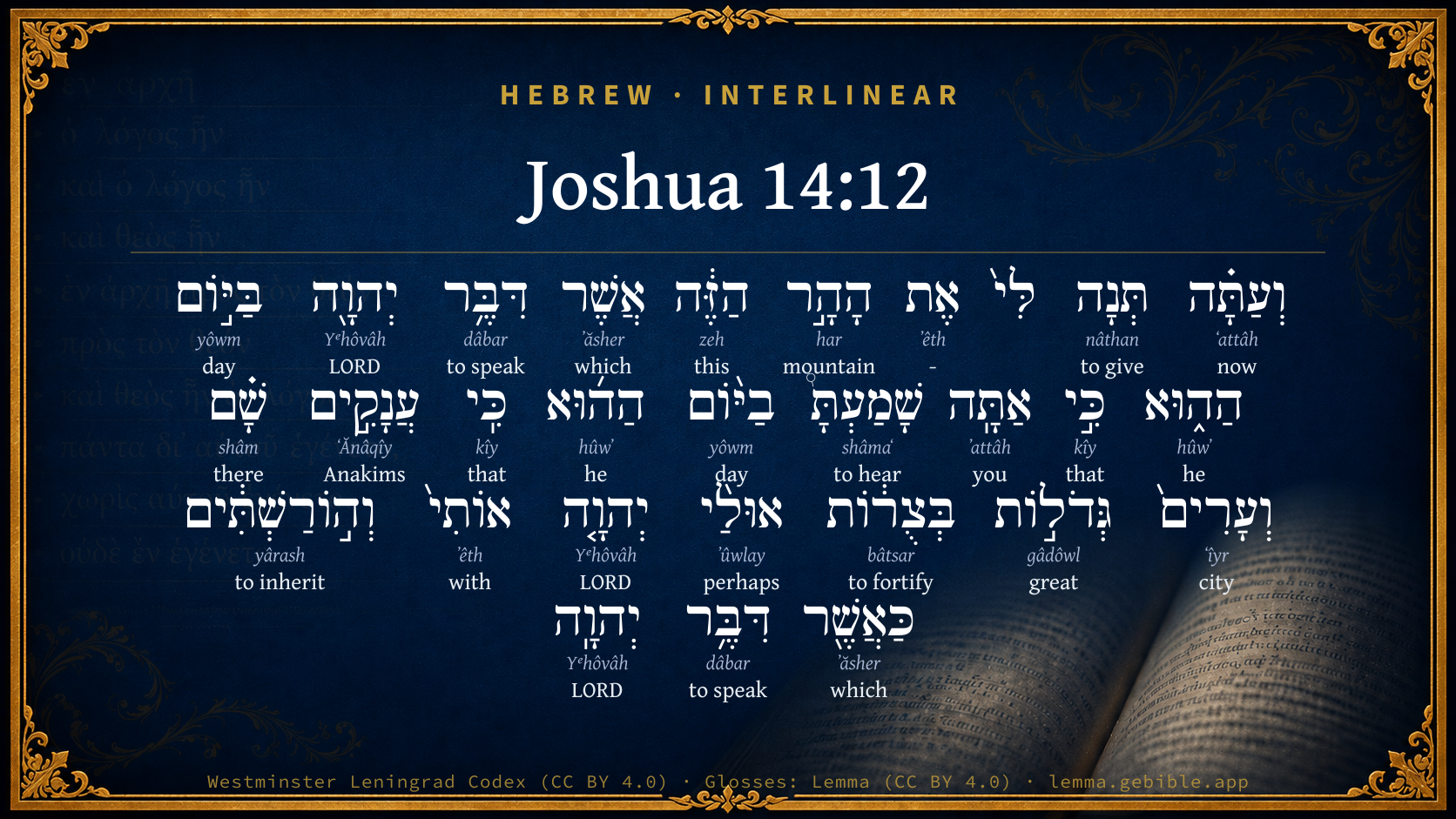
Joshua 14:12

Hebrew (Westminster Leningrad Codex) Joshua 14:12 appears in the Hebrew Old Testament. The text above is from the Westminster Leningrad Codex. Each word links to its Strong’s number, a concise gloss, and parsing drawn from the Open Scriptures Hebrew Bible morphology. Click any word for its full Brown-Driver-Briggs (BDB) entry.
Download image
Cite this verse

Joshua 14:12 (World English Bible). Public Domain. Lemma interlinear Bible study tool, https://lemma.gebible.app/v/joshua/14/12.

Show BibTeX & RIS
BibTeX
RIS
English Translation
Now therefore give me this hill-country, of which Yahweh spoke in that day; for you heard in that day how the Anakim were there, and cities great and fortified: it may be that Yahweh will be with me, and I shall drive them out, as Yahweh spoke.
World English Bible · Public Domain
Download a study sheet

One document with this verse’s original text, its word-by-word gloss line, the meaning frame, cross-references with their text, attributed commentary, and full source and license credits — printable, and it pastes into notes with its structure intact.

This verse Autodidact and up

Study sheet (.html) Plain text (.txt)

A passage Seminary Student

Up to 50 verses in one chapter. A passage sheet keeps up to 6 commentary sources and 12 cross-references per verse, in the order this page ranks them, and says so on the sheet whenever that leaves anything out. Ask for a single verse and you get the Autodidact verse sheet above.

Everything on this page stays free to read, with no account — the sheet is a download of what is already on screen, not access to it.

Want to remove ads? Support Godless Engineer
Compare translations 3

The same verse in 3 English versions, stacked beneath the original-language interlinear above. Click any original word for its lexicon entry.

Each is an independent rendering of the whole verse — the interlinear is not word-aligned to these translations.

Highlighted words mark where these versions differ — a whole-verse word diff, not a word-by-word alignment.

  • World English Bible Public Domain
    Now therefore give me this hill-country, of which Yahweh spoke in that day; for you heard in that day how the Anakim were there, and cities great and fortified: it may be that Yahweh will be with me, and I shall drive them out, as Yahweh spoke.
  • King James Version Public Domain
    Now therefore give me this mountain, whereof the LORD spake in that day; for thou heardest in that day how the Anakims were there, and that the cities were great and fenced: if so be the LORD will be with me, then I shall be able to drive them out, as the LORD said.
  • unfoldingWord Literal Text CC BY-SA 4.0
    And now, give to me this hill country that Yahweh spoke on that day. For you yourself heard on that day that the Anakites there and great fortified cities. Perhaps Yahweh with me and I will dispossess them, just as Yahweh has spoken.”

unfoldingWord Literal Text — © unfoldingWord, licensed CC BY-SA 4.0. Word-aligned USFM3 via Door43 (git.door43.org/unfoldingWord/en_ult).

Versions to compare (up to 4)

3 of 4 selected

Show all 18 translations

Every available English version of this verse, each an independent rendering of the whole verse.

  • World English Bible Public Domain
    Now therefore give me this hill-country, of which Yahweh spoke in that day; for you heard in that day how the Anakim were there, and cities great and fortified: it may be that Yahweh will be with me, and I shall drive them out, as Yahweh spoke.
  • Berean Standard Bible Public Domain
    Now therefore give me this hill country that the LORD promised me on that day, for you yourself heard then that the Anakim were there, with great and fortified cities. Perhaps with the LORD’s help I will drive them out, as the LORD has spoken.”
  • Majority Standard Bible Public Domain
    Now therefore give me this hill country that the LORD promised me on that day, for you yourself heard then that the Anakim were there, with great and fortified cities. Perhaps with the LORD’s help I will drive them out, as the LORD has spoken.”
  • King James Version Public Domain
    Now therefore give me this mountain, whereof the LORD spake in that day; for thou heardest in that day how the Anakims were there, and that the cities were great and fenced: if so be the LORD will be with me, then I shall be able to drive them out, as the LORD said.
  • American Standard Version (1901) Public Domain
    Now therefore give me this hill-country, whereof Jehovah spake in that day; for thou heardest in that day how the Anakim were there, and cities great and fortified: it may be that Jehovah will be with me, and I shall drive them out, as Jehovah spake.
  • Revised Version (1885) Public Domain
    Now therefore give me this mountain, whereof the LORD spake in that day; for thou heardest in that day how the Anakim were there, and cities great and fenced: it may be that the LORD will be with me, and I shall drive them out, as the LORD spake.
  • Geneva Bible (1599) Public Domain
    Nowe therefore giue me this mountaine whereof ye Lord spake in that day (for thou heardest in that day, how the Anakims were there, and the cities great and walled) if so be the Lord will be with me, that I may driue them out, as the Lord said.
  • Douay-Rheims (1899) Public Domain
    Give me therefore this mountain, which the Lord promised, in thy hearing also, wherein are the Enacims, and cities great and strong: if so be the Lord will be with me, and I shall be able to destroy them, as he promised me.
  • Young's Literal Translation Public Domain
    `And now, give to me this hill-country, of which Jehovah spake in that day, for thou didst hear in that day, for Anakim `are' there, and cities, great, fenced; if so be Jehovah `is' with me, then I have dispossessed them, as Jehovah hath spoken.'
  • Literal Standard Version CC BY-SA 4.0
    And now, give this hill-country to me, of which YHWH spoke in that day, for you heard in that day, for Anakim [are] there, and great, fortified cities; if [it] so be [that] YHWH [is] with me, then I have dispossessed them, as YHWH has spoken.”
  • Unlocked Literal Bible CC BY-SA 4.0
    Now therefore give me this hill country, which Yahweh promised me on that day. For you heard on that day that the Anakim were there with great fortified cities. It may be that Yahweh will be with me and that I will drive them out, just as Yahweh said.”
  • unfoldingWord Literal Text CC BY-SA 4.0
    And now, give to me this hill country that Yahweh spoke on that day. For you yourself heard on that day that the Anakites there and great fortified cities. Perhaps Yahweh with me and I will dispossess them, just as Yahweh has spoken.”
  • Darby Bible Public Domain
    And now give me this mountain, of which Jehovah spoke in that day; for thou heardest in that day that Anakim are there, and great fortified cities. If so be Jehovah shall be with me, then I shall dispossess them, as Jehovah said.
  • World Messianic Bible Public Domain
    Now therefore give me this hill country, of which the LORD spoke in that day; for you heard in that day how the Anakim were there, and great and fortified cities. It may be that the LORD will be with me, and I shall drive them out, as the LORD said.”
  • Webster's Bible Public Domain
    Now therefore give me this mountain, of which the LORD spoke in that day; for thou heardest in that day how the Anakims were there, and that the cities were great and fortified: if the LORD will be with me, then I shall be able to drive them out, as the LORD said.
  • Free Bible Version CC BY-SA 4.0
    So give me the hill country that the Lord spoke about. You heard at that time about the descendants of Anak who lived there in large, fortified towns. If the Lord is with me I will drive them out as the Lord promised.”
  • Bible in Basic English Public Domain
    So now, give me this hill-country named by the Lord at that time; for you had an account of it then, how the Anakim were there, and great walled towns: it may be that the Lord will be with me, and I will be able to take their land, as the Lord said.
  • JPS Tanakh (1917) Public Domain
    Now therefore give me this mountain, whereof the LORD spoke in that day; for thou heardest in that day how the Anakim were there, and cities great and fortified; it may be that the LORD will be with me, and I shall drive them out, as the LORD spoke.'

Literal Standard Version (2020), Covenant Press — licensed CC BY-SA 4.0. Text via the HelloAO Bible API (eBible.org). Unlocked Literal Bible (unfoldingWord) — licensed CC BY-SA 4.0. Text via the HelloAO Bible API (eBible.org). unfoldingWord Literal Text — © unfoldingWord, licensed CC BY-SA 4.0. Word-aligned USFM3 via Door43 (git.door43.org/unfoldingWord/en_ult). Free Bible Version, Dr. Jonathan Gallagher — licensed CC BY-SA 4.0. Text via the HelloAO Bible API (eBible.org).

Word by word

More ways to search: Search by grammar → Find every occurrence → Compare this word →

Practice this passage: Drill this verse → Learn its vocabulary →

עֲנָקִ֣ים
ʻĂnâqîy
H6062
“Anakims”
Noun, Common, Masculine, Plural, Absolute
Part of Speech
Noun
Type
Common
Gender
Masculine
Number
Plural
State
Absolute
Full BDB Definition

Origin: from H6061

TWOT: None

Anakims = "long-necked" - a tribe of giants, descendants of Anak, which dwelled in southern Canaan
  1. וְעַתָּ֗ה ʻattâh H6258 “and · now” Conjunction + Adverb
  2. תְּנָה nâthan H5414 “give” Verb, Qal, Imperative, 2nd Person, Masculine, Singular + Suffix, h
  3. אֶת ʼêth H853 “-” Particle, Direct Object
  4. הָהָ֣ר har H2022 “the · mountain” Particle, Definite Article + Noun, Common, Masculine, Singular, Absolute
  5. הַזֶּ֔ה zeh H2088 “the · this” Particle, Definite Article + Pronoun, Demonstrative, Masculine, Singular
  6. אֲשֶׁר ʼăsher H834 “which” Particle, Relative
  7. דִּבֶּ֥ר dâbar H1696 “to speak” Verb, Piel, Perfect, 3rd Person, Masculine, Singular
  8. יְהוָ֖ה Yᵉhôvâh H3068 “LORD” Noun, Proper
  9. בַּיּ֣וֹם yôwm H3117 “in/at the · day” Preposition, Determined + Noun, Common, Masculine, Singular, Absolute
  10. הַה֑וּא hûwʼ H1931 “the · he” Particle, Definite Article + Pronoun, Personal, 3rd Person, Masculine, Singular
  11. כִּ֣י kîy H3588 “that” Conjunction
  12. אַתָּֽה ʼattâh H859 “you” Pronoun, Personal, 2nd Person, Masculine, Singular
  13. שָׁמַעְתָּ֩ shâmaʻ H8085 “to hear” Verb, Qal, Perfect, 2nd Person, Masculine, Singular
  14. בַיּ֨וֹם yôwm H3117 “in/at the · day” Preposition, Determined + Noun, Common, Masculine, Singular, Absolute
  15. הַה֜וּא hûwʼ H1931 “the · he” Particle, Definite Article + Pronoun, Personal, 3rd Person, Masculine, Singular
  16. כִּֽי kîy H3588 “that” Conjunction
  17. שָׁ֗ם shâm H8033 “there” Adverb
  18. וְעָרִים֙ ʻîyr H5892 “and · cities” Conjunction + Noun, Common, Feminine, Plural, Absolute
  19. גְּדֹל֣וֹת gâdôwl H1419 “great” Adjective, Adjective, Feminine, Plural, Absolute
  20. בְּצֻר֔וֹת bâtsar H1219 “fortified” Adjective, Adjective, Feminine, Plural, Absolute
  21. אוּלַ֨י ʼûwlay H194 “perhaps” Adverb
  22. יְהוָ֤ה Yᵉhôvâh H3068 “LORD” Noun, Proper
  23. אוֹתִי֙ ʼêth H854 “with · me” Preposition + Suffix, Personal, 1st Person, Common, Singular
  24. וְה֣וֹרַשְׁתִּ֔ים yârash H3423 “and · to inherit · them” Conjunction + Verb, Hiphil, Sequential Perfect, 1st Person, Common, Singular + Suffix, Personal, 3rd Person, Masculine, Plural
  25. כַּאֲשֶׁ֖ר ʼăsher H834 “like/as · which” Preposition + Particle, Relative
  26. דִּבֶּ֥ר dâbar H1696 “to speak” Verb, Piel, Perfect, 3rd Person, Masculine, Singular
  27. יְהוָֽה Yᵉhôvâh H3068 “LORD” Noun, Proper

About this verse

These counts appear in no published source. They are computed here, from the morphology-tagged text and Lemma’s own curated glosses. What Lemma adds →

29
words
21
distinct lemmas
Historical
section

Notable vocabulary

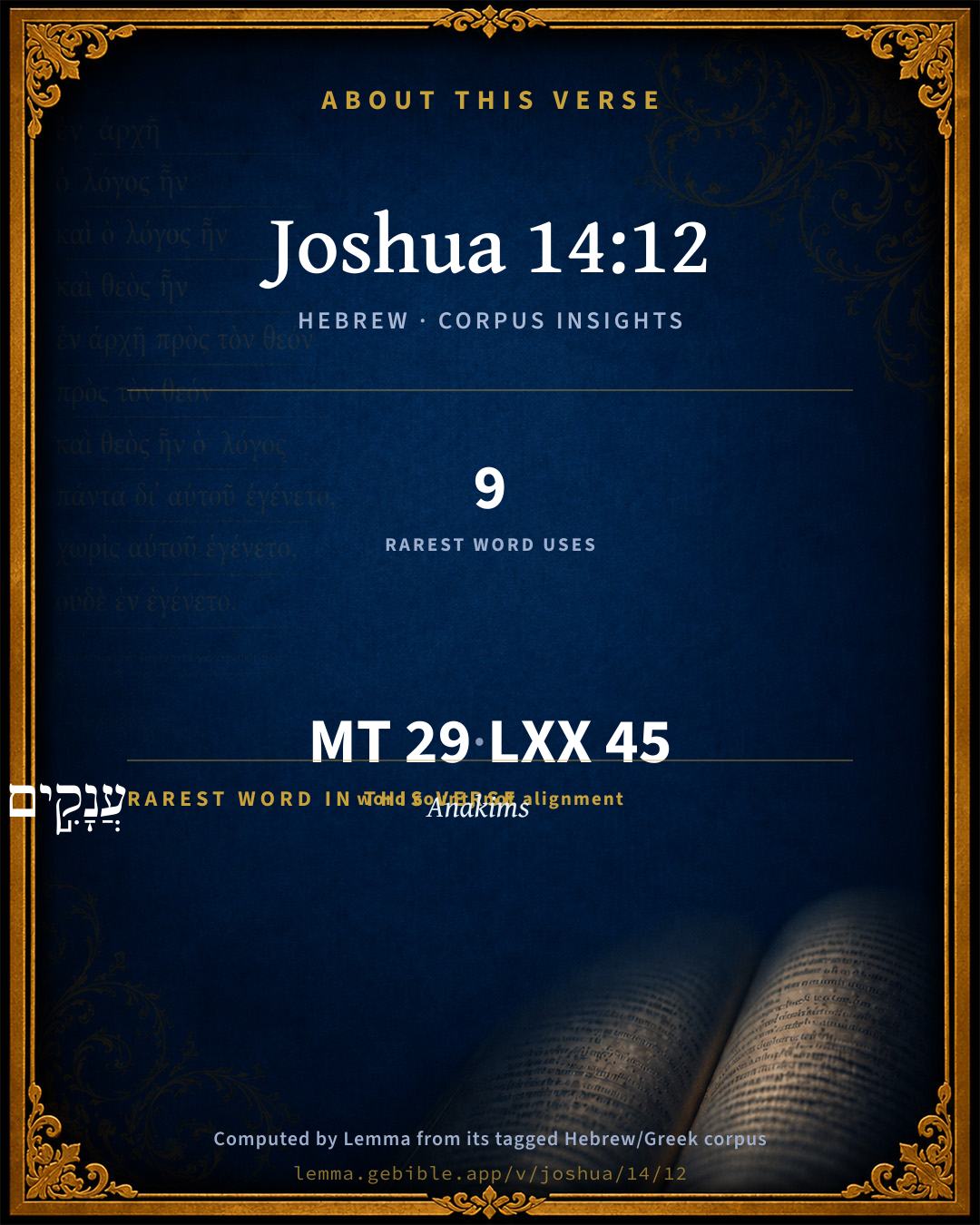
The rarest word here is עֲנָקִ֣ים Anakims H6062 — appearing just 9 times in the whole Hebrew Bible.

Shared distinctive vocabulary

עֲנָקִ֣ים Anakims H6062 occurs in 9 verses of the Hebrew Bible. Also found in:

Grammatical profile

  • 5 verbs
  • 8 nouns
  • 2 adjectives
  • 4 pronouns
  • 2 prepositions
  • 2 conjunctions
  • 3 adverbs
  • 3 particles

Verb forms

  • תְּנָה Qal · Imperative
  • דִּבֶּ֥ר Piel · Perfect
  • שָׁמַעְתָּ֩ Qal · Perfect
  • וְה֣וֹרַשְׁתִּ֔ים Hiphil · Sequential Perfect
  • דִּבֶּ֥ר Piel · Perfect

Repetition

Words recur within this verse — often emphatic in Hebrew:

  • יְהוָ֖ה LORD H3068 ×3
  • דִּבֶּ֥ר to speak H1696 ×2
  • בַּיּ֣וֹם day H3117 ×2
  • אֲשֶׁר which H834 ×2
  • הַה֑וּא he H1931 ×2
  • כִּ֣י that H3588 ×2

Hebrew & Septuagint length

In English translation the verse runs 47 words from the Hebrew and 52 from the Septuagint (LXX English) — closely comparable.

A rough comparison of the two English renderings, which tokenize alike — not a word-level alignment.

Word counts can differ between the Hebrew and the Greek without any difference in meaning — e.g. the Hebrew direct-object marker אֵת has no separate Greek word, and Greek often adds the article ὁ.

In the original languages it is 29 Hebrew tokens and 45 Greek tokens — but the two are counted differently (Hebrew bundles its prefixes and suffixes into one token; the Greek is in lemma form), so that isn’t a like-for-like length.

Cross-references

17

Topical passages linked to Joshua 14:12 in the Treasury of Scripture Knowledge — connected by theme and wording, ordered by reader-vote popularity; previews shown in the World English Bible.

  • Hebrews 11:33 who, through faith subdued kingdoms, worked out righteousness, obtained promises, stopped the mouths of lions,
  • Philippians 4:13 I can do all things through Christ, who strengthens me.
  • Numbers 13:33 There we saw the Nephilim, the sons of Anak, who come of the Nephilim: and we were in our own sight as grasshoppers, and so we were in their sight.
  • Numbers 13:28 However the people who dwell in the land are strong, and the cities are fortified, [and] very great: and moreover we saw the children of Anak there.
  • Joshua 15:14 Caleb drove out there the three sons of Anak: Sheshai, and Ahiman, and Talmai, the children of Anak.
  • Romans 8:31 What then shall we say about these things? If God is for us, who can be against us?
  • Numbers 14:8–9 If Yahweh delight in us, then he will bring us into this land, and give it to us; a land which flows with milk and honey.
  • Psalms 27:1–3 Yahweh is my light and my salvation. Whom shall I fear? Yahweh is the strength of my life. Of whom shall I be afraid?
  • Psalms 44:3 For they didn't get the land in possession by their own sword, Neither did their own arm save them; But your right hand, and your arm, and the light of your face, Because you were favorable to them.
  • Psalms 60:12 Through God we shall do valiantly, For it is he who will tread down our adversaries.
  • Joshua 11:21–22 Joshua came at that time, and cut off the Anakim from the hill-country, from Hebron, from Debir, from Anab, and from all the hill-country of Judah, and from all the hill-country of Israel: Joshua utterly destroyed them with their cities.
  • Judges 1:20 They gave Hebron to Caleb, as Moses had spoken: and he drove out there the three sons of Anak.
  • 1 Samuel 14:6 Jonathan said to the young man who bore his armor, Come, and let us go over to the garrison of these uncircumcised: it may be that Yahweh will work for us; for there is no restraint to Yahweh to save by many or by few.
  • 2 Chronicles 14:11 Asa cried to Yahweh his God, and said, Yahweh, there is none besides you to help, between the mighty and him who has no strength: help us, Yahweh our God; for we rely on you, and in your name are we come against this multitude. Yahweh, you are our God; don't let man prevail against you.
  • Psalms 18:32–34 The God who arms me with strength, and makes my way perfect?
  • Psalms 118:10–12 All the nations surrounded me, But in the name of Yahweh, I cut them off.
  • Numbers 21:34 Yahweh said to Moses, Don't fear him: for I have delivered him into your hand, and all his people, and his land; and you shall do to him as you did to Sihon king of the Amorites, who lived at Heshbon.

Cross-references courtesy of OpenBible.info (CC BY 4.0).

Hebrew and Greek witnesses Masoretic Hebrew ↔ Greek Septuagint

The same verse in the two great witnesses to the Old Testament, shown verse-for-verse.

These are two independent witnesses, not word-aligned to each other, and the Septuagint is shown in lemma (dictionary) form.

Hebrew Joshua 14:12 Masoretic · Westminster Leningrad Codex

וְעַתָּ֗ה תְּנָה לִּי֙ אֶת הָהָ֣ר הַזֶּ֔ה אֲשֶׁר דִּבֶּ֥ר יְהוָ֖ה בַּיּ֣וֹם הַה֑וּא כִּ֣י אַתָּֽה שָׁמַעְתָּ֩ בַיּ֨וֹם הַה֜וּא כִּֽי עֲנָקִ֣ים שָׁ֗ם וְעָרִים֙ גְּדֹל֣וֹת בְּצֻר֔וֹת אוּלַ֨י יְהוָ֤ה אוֹתִי֙ וְה֣וֹרַשְׁתִּ֔ים כַּאֲשֶׁ֖ר דִּבֶּ֥ר יְהוָֽה

Now therefore give me this hill-country, of which Yahweh spoke in that day; for you heard in that day how the Anakim were there, and cities great and fortified: it may be that Yahweh will be with me, and I shall drive them out, as Yahweh spoke.

World English Bible · Public Domain

Greek LXX Joshua 14:12 Septuagint · lemma form

καί νῦν αἰτέω σύ ὁ ὄρος οὗτος καθά εἶπον κύριος ὁ ἡμέρα ἐκεῖνος ὅτι σύ ἀκούω ὁ ῥῆμα οὗτος ὁ ἡμέρα ἐκεῖνος νυνί δέ ὁ ενακιμ ἐκεῖ εἰμί πόλις ὀχυρός καί μέγας ἐάν οὖν κύριος μετά ἐγώ εἰμί ἐκὀλεθρεύω αὐτός ὅς τρόπος εἶπον ἐγώ κύριος

And now I ask of you this mountain, as the Lord said in that day; for you heard this word on that day; and now the Enakim are there, cities great and strong: if then the Lord should be with me, I will utterly destroy them, as the Lord said to me.

LXX2012 (modern English Septuagint) · Public Domain

On this verse, The Pulpit Commentary discusses the Septuagint’s reading. Read the note in Commentary ↓

Hebrew: Westminster Leningrad Codex (CC BY 4.0). Greek: Septuagint (public domain); English from LXX2012 (modern English Septuagint) (Public Domain). How the Septuagint differs from the Hebrew →

Targum (Aramaic paraphrase)

1

The Targum is the ancient Jewish Aramaic paraphrase of the Hebrew Scriptures — an interpretive translation, not the Hebrew text itself. Onkelos (literal) and Pseudo-Jonathan (expansive) render the Torah, and Jonathan the Prophets. Coverage is partial: where no permissively-licensed English translation exists for a verse, only the Aramaic is shown. This is verse-level text, not a word-by-word alignment to the Hebrew.

  1. Targum Jonathan Prophets (Joshua–Malachi)
    וּכְעַן הַב לִי יַת טוּרָא הָדֵין דְמַלֵיל יְיָ בְּיוֹמָא הַהוּא אֲרֵי אַתְּ שְׁמַעְתָּא בְּיוֹמָא הַהוּא אֲרֵי גִבָּרִין תַמָן וְקִרְוִין רַבְרְבָן כְּרִיכָן מָאִים יְהֵא מֵימְרָא דַייָ בְּסַעֲדִי וְאֵירְתִינוּן כְּמָא דִי מַלֵיל יְיָ:

    (no public-domain English translation for this verse)

    Targum Jonathan — Aramaic: “Mikraot Gedolot” (public domain). English: “Sefaria Community Translation” (CC0 1.0 (public-domain dedication)); “London "Chaldee Paraphrase," 1871” (public domain). Text via Sefaria.

Commentary

Notes on Joshua 14:12 from classic Christian and Jewish commentators (each source and its license shown beneath its notes). The classic Christian expositions comment on the surrounding passage and are grouped to its opening verse, so a note may address several verses; the Jewish commentaries on the Tanakh (Rashi and others) are per-verse, so they appear only where the commentator wrote on this verse.

Lemma curates 59 commentaries, every one of them public domain or Creative Commons licensed, each selected and text-cleaned for this edition rather than reprinted as found. About our sources →

Trapp's Complete Commentary

John Trapp

Jos 14:12 Now therefore give me this mountain, whereof the LORD spake in that day; for thou heardest in that day how the Anakims [were] there, and [that] the cities [were] great [and] fenced: if so be the LORD [will be] with me, then I shall be able to drive them out, as the LORD said.

Ver. 12. Now therefore give me this mountain,] i.e., This mountainous territory about Hebron, extraordinarily and without lot. That was a Lucifer like monk who said when he died, Redde mihi aeternam vitam quam debes: and another proud Papist blusheth not to say in print, Caelum gratis non accipiam; I will not have heaven of free gift.

If so be the Lord will be with me.] This he speaketh not out of distrust, but self-denial; and to imply a difficulty, which yet doth but whet on heroic spirits.

John Trapp, A Commentary or Exposition upon All the Books of the Old and New Testament (1647–1656) — public domain. Text from a community e-Sword module.

Joseph Benson's Commentary

Jos 14:12. Now, therefore, give me this mountain — The mountainous country where Hebron lay, (Jos 11:21,) which was the place promised to him. He names the country rather than the city, because that was given to the Levites, Jos 21:11-13. Thou heardest in that day — Didst understand, both by the reports of others and by thy own observation. Hearing, the sense by which we get knowledge, is often put for knowing or understanding. If so be the Lord will be with me — These are not the words of diffidence; but an humble and pious acknowledgment that nothing could be successfully enterprised without God’s gracious assistance; of which Caleb was undoubtedly deeply sensible. By this expression he both signifies the absolute necessity of God’s help, and his godly fear, lest, for his sins, God should deny his assistance to him; for although he was well assured, in general, that God would crown his people with success in this war, yet he might doubt of his particular success in this or that enterprise. Then I shall be able to drive them out — Out of their fastnesses, where they yet remained. Caleb desires this difficult work as a testimony of his own faith, and as a motive to quicken his brethren to the like attempts.

Joseph Benson's Commentary on the Old and New Testaments (1811–1818) — public domain. Text from a community e-Sword module.

Keil & Delitzsch

C. F. Keil & F. Delitzsch

"The mountain," according to the context, is the mountainous region of Hebron, where the spies had seen the Anakites (Num 13:22, Num 13:28). The two clauses, in Jos 14:12, beginning with כּי are not to be construed as subordinate to one another, but are co-ordinate clauses, and contain two distinct motives in support of his petition: viz., "for thou heardest in that day," sc., what Jehovah said to me then, and also "for (because) the Anakites are there;" ... "perhaps Jehovah is with me (אתי for אתּי, see Ges. 103, 1, anm. 1, and Ewald, 264, b.), and I root them out" (vid., Jos 15:14). The word "perhaps" does not express a doubt, but a hope or desire, or else, as Masius says, "hope mixed with difficulty; and whilst the difficulty detracts from the value, the hope stimulates the desire for the gift."

Keil & Delitzsch — Biblical Commentary on the Old Testament (1861–1891) — public domain (CC PDM 1.0). Text via the HelloAO Bible API. (Old Testament only.)

Tyndale Open Study Notes

Tyndale Open Resources

14:12 Israel had stayed out of Canaan forty-five years earlier because they feared the descendants of Anak, a tall, strong people who lived in the hill country of Judah (Num 13:32-33).

Tyndale Open Study Notes — © Tyndale Open Resources, licensed CC BY-SA 4.0. Text via the HelloAO Bible API.

Geneva Bible (1599)

Geneva Bible translators

This he spake of modesty, and not of doubting.

Or, giants.

Geneva Bible (1599) marginal notes — public domain. Text via Bolls.life.

Jamieson, Fausset & Brown

Robert Jamieson, A. R. Fausset & David Brown

give me this mountain, whereof the Lord spake in that day--this highland region.

for thou heardest in that day how the Anakims were there--The report of the spies, who tried to kindle the flame of sedition and discontent, related chiefly to the people and condition of this mountain district, and hence it was promised as the reward of Caleb's truth, piety, and faithfulness.

Jamieson, Fausset & Brown — Commentary Critical and Explanatory on the Whole Bible (1871) — public domain (CC PDM 1.0). Text via the HelloAO Bible API.

Adam Clarke's Commentary

Verse 12. I shall be able to drive them out] He cannot mean Hebron merely, for that had been taken before by Joshua; but in the request of Caleb doubtless all the circumjacent country was comprised, in many parts of which the Anakim were still in considerable force. It has been conjectured that Hebron itself had again fallen under the power of its former possessors, who, taking the advantage of the absence of the Israelitish army, who were employed in other parts of the country, re-entered the city, and restored their ancient domination. But the first opinion seems best founded.

Adam Clarke's Commentary on the Bible (1810–1826) — public domain. Text from a community e-Sword/MySword module.

The Cambridge Bible for Schools and Colleges

gen. ed. J. J. S. Perowne

12. this mountain] i.e. the mountain of Hebron. “The great elevation of this country above the level of the sea is most forcibly brought out by the journey we have made. From the moment of leaving the ’Arabah has been almost a continual ascent. We mounted the great Pass of Sâfeh, and, having mounted, hardly descended at all—crossed the great tableland of Beersheba—and then mounted the barrier of the hills of Judah—and thence have been mounting ever since. Hebron is, in fact, only four hundred feet lower than Helvellyn.”—Stanley’s Sinai and Palestine, p. 102.

whereof the Lord spake] These words are a proof that it was not merely a general promise, but a special one in reference to Hebron which Caleb had received.

how the Anakims were there] The names of some are specially mentioned, Num_13:22; Jdg_1:10 : Sheshai, Ahiman, and Talmai.

if so be the Lord] More literally, perhaps Jehovah will be with me, and I may drive them out, as Jehovah said. The word “perhaps” does not indicate any doubt, but expresses a hope and desire. “If in hap the Lord is with me, and Y may do hem awai, as he bihiçte to me,” Wyclif.

The Cambridge Bible for Schools and Colleges (gen. ed. J. J. S. Perowne; Cambridge University Press, 1878–1918) — public domain. Text from a community e-Sword module.

John Gill's Exposition

Now therefore give me this mountain, whereof the Lord spake in that day,.... The mountainous part of the country, the hill country of Judea, in which Hebron, Debir, and other cities were; for it was not one particular city only that Caleb requested, but a large tract of ground:

for thou heardest in that day how the Anakims were there, and that the cities were great and fenced; that the giants, called Anakims, dwelt in the mountainous country, and their cities, Hebron, Debir, and Anab, were very large, and well fortified; this Joshua heard at the time the spies were sent into the land, he being one of them; and this he heard, not from the report of the spies, but from the people of the country, and therefore must know that to conquer these men, and subdue their cities, was an arduous undertaking; but since he had strength and courage, he hoped his request would be granted:

if so be the Lord will be with me; which he spake not as doubting of his presence and power to be with him, and assist him, but as placing his confidence therein, and, distrusting his own power and ability, having no dependence or that, but believing that the Lord, or, as the Targum, the Word of the Lord, would be with him for his help:

then, says Caleb:

I shall be able to drive them out, as the Lord said; that is, to drive the Anakims out of their cities, or out of the mountains, the caves and dens there, to which they betook themselves, since the taking of Hebron, Debir, and Anab, by Joshua, Jos 11:22; and he relied upon the promise of God to enable him to do this, and not upon his natural strength and courage, or the number and prowess of the warlike tribe of Judah, of which he was prince.

John Gill's Exposition of the Whole Bible (1746–1763) — public domain (CC PDM 1.0). Text via the HelloAO Bible API.

Albert Barnes' Notes on the Bible

The Anakims had in the course of Joshua’s campaigns in the south been expelled from “this mountain,” i. e. the mountain country round Hebron, but they had only withdrawn to the neighboring cities of Philistia Jos 11:22. Thence, they had, as must be inferred from the text here, returned and reoccupied Hebron, probably when Joshua and the main force of the Israelites had marched northward to deal with Jabin and his confederates. Caleb finally drove out this formidable race and occupied Hebron and its dependent towns and district permanently. See Jos 15:13 following.

Albert Barnes' Notes on the Bible (1834–1885) — public domain. Text from a community e-Sword/MySword module.

Haydock's Catholic Bible Commentary

Me. He trusts not in his own strength, but in the assistance of God, which he modestly acknowledges is not due to him. (Calmet) --- God’s promises are indeed sure on his part; but being conditional, and the will of man being free, he adds perhaps. (Worthington)

George Leo Haydock (1774–1849), Haydock's Catholic Family Bible and Commentary, 1859 edition — public domain. Excludes Psalms (Douay-Rheims chapter numbering differs from Protestant) and Deuterocanonical books (Catholic canon only).

Matthew Poole's English Annotations

This mountain, i.e. this mountainous country, in which was Hebron, Jos 11:21; 20:7, and Debir, and Anab. He names the country rather than the cities, either,

1. Because the giants here following were already driven out of their cities, but yet abode in their caves or holds in the mountains, whence they much molested the Israelites. Or,

2. Because the cities were given to the Levites, Jos 21:11,13.

Thou heardest, i.e. didst understand, both by the reports of others, and by thy own observation, as I also did. Hearing, the sense by which we get knowledge, is off put for knowing or understanding, as Gen 11:7; 42:23; 2Ki 18:26.

If so be the Lord will be with me; a modest, and humble, and pious expression, signifying both the absolute necessity of God’s help, and his godly fear, lest God for his sins should deny his assistance to him, as he might justly do; for although he was well assured in general that God would crown his people with success in this war, yet he might doubt of his particular success in this or that enterprise.

To drive them out; out of their fastnesses, where they yet remain. Caleb desires this difficult work as a testimony of his own faith, and as a motive to quicken and encourage his brethren to thee like attempts.

Matthew Poole's English Annotations on the Holy Bible (1683–1685) — public domain. Text from a community e-Sword/MySword module.

Whedon's Commentary on the Bible

Daniel D. Whedon

12. Give me this mountain — Hebron is the highest point of southern Palestine, (see Jos_10:3, note,) higher even than Jerusalem. “The spot on which Caleb had set his heart was the fertile valley of Hebron. Of all the country which the twelve spies, with Caleb and Joshua at their head, had traversed, this is the one scene which remains fixed in the sacred narrative, as if because fixed in the memory of those who made their report. There was one field in the whole land which they might fairly call their own, the field which contained the rocky cave of Machpelah, with the graves of their first ancestors. But it was not even this sacred enclosure which had most powerfully impressed the simple explorers of that childlike age. It was the winding valley whose terraces were covered with the rich verdure and the golden clusters of the Syrian vine, so rarely seen in Egypt, so beautiful a vesture of the bare hills of Palestine. In its rocky hills are still to be seen the ancient winepresses. Thence came the gigantic cluster, (Num_13:24,) the only relic of the Promised Land which was laid at the feet of Moses.” — Stanley.

Anakim — The long-necked; called also sons of Anak; a race of giants in southern Canaan. See on Num_13:28; Num_13:33.

Daniel D. Whedon (gen. ed.), Commentary on the Old and New Testaments (1874–1909) — public domain. Text from a community e-Sword module.

The Pulpit Commentary

This mountain. The neighbourhood of Hebron is described by Bartlett "Egypt to Palestine," p. 401, as "a region of hills and valleys." In one of the hollows in this "hill country of Judaea" Hebron still nestles, hut at a height which (see Stanley, "Sinai and Palestine," p. 102) is "only 400 feet lower than Helvellyn," the highest point but one in England. The Dean remarks on the fact that Palestine was a mountainous country, and that therefore in its history we may expect the characteristics of a mountain people. Whereof the Lord spake in that day. There must therefore have been a promise made to Caleb, regarding which the Pentateuch, having to deal with matters of more general interest, is silent, that he should lead the forlorn hope, as it were, of the children of Israel, and that the task of subduing the mountain fastnesses of the most powerful tribes in Palestine should be assigned to him. That the original inhabitants reoccupied the districts round Hebron, while the Israelites were otherwise engaged, we have already seen. (see note on Jos_11:21) The final work was to be carried out by Caleb. Houbigant, it is true, thinks that here the same incident is referred to as in Jos_11:21, Jos_11:22, and that Joshua is there credited with what was clone by Caleb at his command. But we read that that expedition followed close upon the battle of Merom, whereas seven years elapsed before the final expulsion of the Anakim by Caleb. It is important to notice that the author of the Book of Joshua has access to sources of information beside the Pentateuch. This, though not sufficient to disprove, does at least seem inconsistent with the "Elohist" and "Jehovist" theory. For thou heartiest in that day. The LXX and Vulgate avoid the difficulty here by referring these words to what goes beforei.e. , the promise made to Caleb. In that case we must render the second yKi "for," instead of "that," or "how." Joshua can hardly have heard for the first time that the Anakim were in Hebron if, as Num_13:22 appears to assert, he, in common with the other spies, had visited the place. But it is possible, though the narrative as it stands seems to suggest that they went together, that the spies went different ways, either separately or in pairs, and that Caleb visited Hebron, and that Joshua heard the account of it for the first time from Caleb"s lips, as they brought their report to Moses, and that Caleb then asked and received the grant of Hebron. We may observe the minute agreement here in matters of detail between the Pentateuch and the Book of Joshua. The Pentateuch states that the spies visited Hebron. The Book of Joshua, without mentioning this, makes Caleb appeal to Joshua as a witness that a premise had been made to him, long before the entrance of Israel into the promised land, that this particular place should be allotted to him. The description of Hebron also in Numbers 13. agrees in every respect with what is stated here. Fenced. Literally, inaccessible, as surrounded by walls. If so be. Rather, perhaps.

HOMILIES BY W.F. ADENEY Ver. 12. The Anakims.

I WE HAVE "ANAKIMS" IN OUR INHERITANCE. Some of the highest blessings are fenced about with She greatest difficulties.

1. No earthly inheritance is without its peculiar disadvantages. Some of the "Anakims" which resist us in our efforts to fulfil our mission are

a. the evil in our own heart, e.g., indolence, fear, earthliness;

b. the temptations of the world, arising from bad examples, customs, distracting pleasures;

c. direct hindrance in persecution and opposition growing out of the world"s ignorance, prejudice, envy, etc.

2. Nevertheless it is best for us, as it was for Caleb, to have such an inheritance. Difficulties

a. try our faith and courage;

b. give scope for energy and devotion;

c. make the ultimate peace the more blessed.

3. Apply these truths

a. to private life;

b. to Church work and the difficulties in evangelising the world;

c. to public interests, and the hindrances to the work of high principled statesmen and philanthropists which stay the progress of liberty, civilisation, and national prosperity.

II WE GAVE MEANS FOR OVERCOMING THE "ANAKIMS.

1. God with us. This fact is Caleb"s ground of confidence. God does not only approve of the right; He aids it. He does not merely send assistance for the battle of life; He is present as the light to guide and the power to strengthen. Caleb had faith in the real and active presence of God.

2. Brave effort. Caleb says, "I shall be able to drive them out." He names God"s help first as indispensable; but he does not stay with this. God"s grace is no excuse for man"s indolence. God fights for us by fighting in us. Ours is the effort, while His is the strength. True faith in God will not paralyse our energies, but inspire them; because it will show us

(a) that, while the victory will not be given unless we fight, when we fight in the strength of God omnipotence is on our side;

(b) and that God then assures us of victory, and that as He is faithful we may be confident of it. Caleb is confident that with God"s help he will drive out the Anakims, because this is "as the Lord said. W.F.A.

HOMILIES BY S.R. ALDRIDGE Ver. 12. Caleb"s inheritance.

But little comparatively is said in the sacred writings concerning Caleb. What is recorded is decidedly in his favour, He stands before us as a model of unbending integrity. Selected from among the princes of Judah to be one of the twelve appointed to search the land of Canaan, he remained stedfast in his adherence to the will of God. Neither the remembrance of the giant sons of Anak and their fortified towns, nor the passionate wailings of his brethren, could make Caleb falter and falsify the report he had to give, and the recommendation he desired to make. For this he received the praise of Jehovah, and the promise that, not only should he be preserved to enter the land of Palestine, but also that the very part of the country concerning which some had given an unfavorable report should be allotted to him as his portion. Forty-five years had passed. The wilderness was full of graves. Joshua had succeeded Moses as leader of the Israelites; had overthrown in pitched battles the chief nations of Canaan; it was time to distribute to the tribes their inheritance. The partition was made in the first instance by lot. Then the arrangements for families were made by commissioners, and, as one of these, Caleb might have seized the city he desired. But, avoiding all suspicion of unfairness, he came with the children of Judah publicly to offer his petition. The text presents us therefore with

I A REQUEST FOR THE FULFILMENT OF A PROMISE, "Give me this mountain whereof the Lord spake in that day." As God"s representative Joshua is desired to see that the ancient oath is not made void. The declaration of God would not remain without effect, yet observe the manner in which it was to be accomplished, viz., by the petition of the man to whom the declaration was granted. Caleb set a high value on the promise of God. Lightly would he have treated it had he allowed it to rest uncherished in his thoughts. God loves to see His people appreciate what He has offered to bestow. He has given "exceeding great and precious promises," and yet "will be inquired of" to do it for them. Our duty is clear. To lay hold of the announcements of His Word and ground on them our requests. Surely the reason why multitudes never pray is that they think little of the blessings promised to those that ask. We need quickened memories. Are the Scriptures to be empty volumes or full of life and power? The Bible may be our charter; the will of our Father bequeathing rich portions in this world and the world to come; our catalogue of precious furniture that may be had to adorn the household of saints. How many things we have never asked for or claimed as our own! Graces to beautify, gifts to enrich for evermore. "All Scripture is given that the man of God may be perfect, thoroughly furnished unto all good works." Man is expected to do his part even in the obtaining of a privilege. Some think, "If we are to be saved we shall be." Caleb might have thought similarly, and neglected to make his request, and gone without his portion. God requires men to use their reasoning powers, to examine the evidences of religion, to repent and believe in Christ yes, to ask for the adoption that shall make them members of His family.

II A REWARD SOUGHT LITTLE TO BE DESIRED IN THE EYES OF SOME. Hebron was a large city, a royal city, but the surrounding hills were the fastnesses of giants, who must be attacked and driven away. Before the owner could settle down on the estate he must dislodge the former proprietors. No easy conquest was to be anticipated, yet the courageous soldier said, "Give me this mountain. Others may choose quiet resting places, let me go to the high places of the field." Is there not here an example worthy of imitation? Who will be the advanced guard of the Christian army to attack the fortresses of Sin and Satan? An infusion of Caleb"s spirit would do much to reconcile us to what we mourn over as the hardships of our lot. We should take a different view and regard them as our reward, increasing the honour put upon us by God. One man has to struggle in business against fearful odds, another is plagued by a wretched temper, a third is sorely tempted to murmur under a heavy bereavement. God intends these various trims as discipline and as honours. The troubles are the Anakim, who must be cheerfully, bravely encountered. How deep felt will be the joy of triumph! No soldier ought to lament when placed by God in the forefront of the battle. When Jesus drew near His hour of suffering He exclaimed, "Now is the Son of man glorified." Caleb believed that special power had been given for special work. He appealed to facts as indicative of Jehovah"s intention respecting him. Not for indolence had he been "kept alive these forty and five years," and his strength preserved, his strength "for war both to go out and to come in" (vers. 10, 11). This principle admits of wide application. The gifts of God are various. To one is granted money, that institutions may be supported and enterprises commenced. To another the power of speech, that he may "speak to the people all the words of this life." To another a persuasive manner, a winning smile, the grace of hospitality. These are so many talents of which the Master will exact an account. bier will the question turn so much on actual accomplishment as on the ratio of abilities to results.

III AN ACKNOWLEDGMENT OF DEPENDENCE UPON THE HELP OF GOD. His speech would sound like the utterance of self confidence and presumption did there not run through it a tone of devout thanksgiving, which removes the charge of boastfulness and reveals the source of his assurance. The Lord had kept him alive, and if the Lord were with him he would soon drive out the giants from their strongholds. When David essayed to fight the Philistine he reasoned from past experience. "The Lord that delivered me... bear, will deliver me from... Philistine." The same succour is assured to all Christian warriors. We want this mingled dependence and confidence. "If God be for us, who can be against us?" The commission, "Go therefore, preach the gospel to all nations," was preceded by the announcement, "All power is given unto Me in heaven and in earth." Can we complain of tribulation and distress? "Nay, in all these things we are more than conquerors;" they do but heighten the victory we gain, "through Him that loved us. A.

The Pulpit Commentary (1880–1919), ed. H.D.M. Spence-Jones & Joseph S. Exell — public domain. Text from a community e-Sword module.

John Wesley's Explanatory Notes

This mountain - That is, this mountainous country. He names the country rather than the cities, because the cities were given to the Levites, chap. xxi, 11, 13. Thou heardest - Didst understand, both by the reports of others, and by thy own observation. Hearing, the sense by which we get knowledge, is often put for knowing or understanding. If the Lord will be with me - A modest and pious expression, signifying both the absolute necessity of God's help, and his godly fear, lest God for his sins should deny his assistance to him; for although he was well assured in general, that God would crown his people with success in this war, yet he might doubt of his particular success in this or that enterprize. To drive them out - Out of their fastnesses where they yet remain, Caleb desires this difficult work as a testimony of his own faith, and as a motive to quicken his brethren to the like attempts.

John Wesley, Explanatory Notes Upon the Whole Bible (1754–1765) — public domain. Text via the GEBible commentary corpus.

unfoldingWord translationNotes

Door43 World Missions Community

hill country

Possible meanings are 1) many large hills or small mountains or 2) one mountain.

Anakim

This is the name of a people group. (See: How to Translate Names)

translationWords

promise

cast out

unfoldingWord translationNotes — © Distant Shores Media and the Door43 World Missions Community, licensed CC BY-SA 4.0. Source: git.door43.org/Door43/en_tn.

Lesson kit

Teaching starters — assembled from the data on this page, not authored interpretation. Every prompt links to the verse data it draws on. Edit before teaching.

Joshua, in the Historical, opens this verse with 29 words (21 distinct Hebrew lemmas). Its most distinctive word is ʻĂnâqîy (“Anakims”). A historical commentator’s framing appears above. Read the whole chapter for the surrounding context.

Discussion questions

  1. What does “Anakims” (ʻĂnâqîy) contribute to the verse as a whole?
  2. Deuteronomy 1:28 shares the word «Anakims» with this verse. How do the two illuminate each other?
  3. “LORD” occurs 3× in this one verse. What is the effect of the repetition?
  4. The translations on this page render this verse differently — a whole-verse word diff, not a word-by-word alignment. What might account for the different wordings?
  5. The verb «תְּנָה» is Qal Imperative. How does its form color the action?
  6. Reading how Trapp's Complete Commentary and Joseph Benson's Commentary read this verse, where do the two commentators agree and where do they part?

Things to notice

Reading settings

Reading text

Shown beneath each verse's original-language words.

Old Testament
Old Testament edition

Read the OT as the Masoretic Hebrew (MT) or the Greek Septuagint (LXX).

English shown for the Greek Septuagint (in the Hebrew ↔ Greek comparison).

Comparing translations? Open the Compare panel on any verse page to stack up to four side by side.