Joshua 15:14

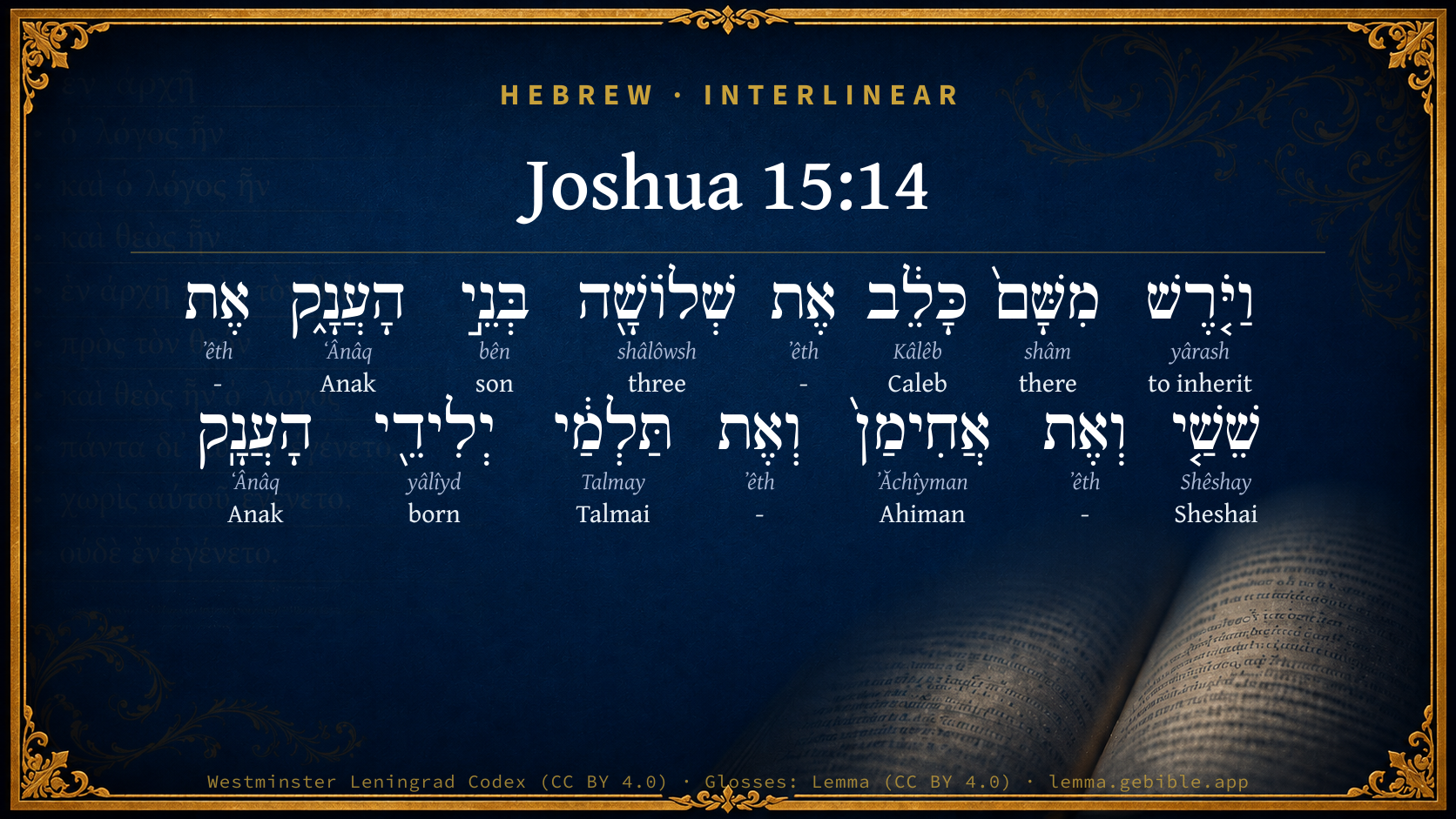
Hebrew (Westminster Leningrad Codex) Joshua 15:14 appears in the Hebrew Old Testament. The text above is from the Westminster Leningrad Codex. Each word links to its Strong’s number, a concise gloss, and parsing drawn from the Open Scriptures Hebrew Bible morphology. Click any word for its full Brown-Driver-Briggs (BDB) entry.
Download image
Cite this verse

Joshua 15:14 (World English Bible). Public Domain. Lemma interlinear Bible study tool, https://lemma.gebible.app/v/joshua/15/14.

Show BibTeX & RIS
BibTeX
RIS
English Translation
Caleb drove out there the three sons of Anak: Sheshai, and Ahiman, and Talmai, the children of Anak.
World English Bible · Public Domain
Download a study sheet

One document with this verse’s original text, its word-by-word gloss line, the meaning frame, cross-references with their text, attributed commentary, and full source and license credits — printable, and it pastes into notes with its structure intact.

This verse Autodidact and up

Study sheet (.html) Plain text (.txt)

A passage Seminary Student

Up to 50 verses in one chapter. A passage sheet keeps up to 6 commentary sources and 12 cross-references per verse, in the order this page ranks them, and says so on the sheet whenever that leaves anything out. Ask for a single verse and you get the Autodidact verse sheet above.

Everything on this page stays free to read, with no account — the sheet is a download of what is already on screen, not access to it.

Want to remove ads? Support Godless Engineer
Compare translations 3

The same verse in 3 English versions, stacked beneath the original-language interlinear above. Click any original word for its lexicon entry.

Each is an independent rendering of the whole verse — the interlinear is not word-aligned to these translations.

Highlighted words mark where these versions differ — a whole-verse word diff, not a word-by-word alignment.

  • World English Bible Public Domain
    Caleb drove out there the three sons of Anak: Sheshai, and Ahiman, and Talmai, the children of Anak.
  • King James Version Public Domain
    And Caleb drove thence the three sons of Anak, Sheshai, and Ahiman, and Talmai, the children of Anak.
  • unfoldingWord Literal Text CC BY-SA 4.0
    And Caleb dispossessed from there the three sons of Anak, Sheshai and Ahiman and Talmai, the children of Anak.

unfoldingWord Literal Text — © unfoldingWord, licensed CC BY-SA 4.0. Word-aligned USFM3 via Door43 (git.door43.org/unfoldingWord/en_ult).

Versions to compare (up to 4)

3 of 4 selected

Show all 18 translations

Every available English version of this verse, each an independent rendering of the whole verse.

  • World English Bible Public Domain
    Caleb drove out there the three sons of Anak: Sheshai, and Ahiman, and Talmai, the children of Anak.
  • Berean Standard Bible Public Domain
    And Caleb drove out from there the three sons of Anak—the descendants of Sheshai, Ahiman, and Talmai, the children of Anak.
  • Majority Standard Bible Public Domain
    And Caleb drove out from there the three sons of Anak—the descendants of Sheshai, Ahiman, and Talmai, the children of Anak.
  • King James Version Public Domain
    And Caleb drove thence the three sons of Anak, Sheshai, and Ahiman, and Talmai, the children of Anak.
  • American Standard Version (1901) Public Domain
    And Caleb drove out thence the three sons of Anak: Sheshai, and Ahiman, and Talmai, the children of Anak.
  • Revised Version (1885) Public Domain
    And Caleb drove out thence the three sons of Anak, Sheshai, and Ahiman, and Talmai, the children of Anak.
  • Geneva Bible (1599) Public Domain
    And Caleb droue thence three sonnes of Anak, Sheshai, and Ahiman, and Talmai, the sonnes of Anak.
  • Douay-Rheims (1899) Public Domain
    And Caleb destroyed out of it the three sons of Ehac, Sesai and Ahiman. and Tholmai of the race of Enac.
  • Young's Literal Translation Public Domain
    And Caleb is dispossessing thence the three sons of Anak, Sheshai, and Ahiman, and Talmai, children of Anak,
  • Literal Standard Version CC BY-SA 4.0
    And Caleb is dispossessing there the three sons of Anak: Sheshai, and Ahiman, and Talmai, children of Anak,
  • Unlocked Literal Bible CC BY-SA 4.0
    Caleb drove out from there the three sons of Anak: Sheshai, Ahiman and Talmai, descendants of Anak.
  • unfoldingWord Literal Text CC BY-SA 4.0
    And Caleb dispossessed from there the three sons of Anak, Sheshai and Ahiman and Talmai, the children of Anak.
  • Darby Bible Public Domain
    And thence Caleb dispossessed the three sons of Anak, Sheshai and Ahiman and Talmai, who were born of Anak.
  • World Messianic Bible Public Domain
    Caleb drove out the three sons of Anak: Sheshai, and Ahiman, and Talmai, the children of Anak.
  • Webster's Bible Public Domain
    And Caleb drove thence the three sons of Anak, Sheshai, and Ahiman, and Talmai, the children of Anak.
  • Free Bible Version CC BY-SA 4.0
    Caleb drove out three family groups—Sheshai, Ahiman, and Talmai, descendants of Anak.
  • Bible in Basic English Public Domain
    And the three sons of Anak, Sheshai and Ahiman and Talmai, the children of Anak, were forced out from there by Caleb.
  • JPS Tanakh (1917) Public Domain
    And Caleb drove out thence the three sons of Anak, Sheshai, and Ahiman, and Talmai, the children of Anak.

Literal Standard Version (2020), Covenant Press — licensed CC BY-SA 4.0. Text via the HelloAO Bible API (eBible.org). Unlocked Literal Bible (unfoldingWord) — licensed CC BY-SA 4.0. Text via the HelloAO Bible API (eBible.org). unfoldingWord Literal Text — © unfoldingWord, licensed CC BY-SA 4.0. Word-aligned USFM3 via Door43 (git.door43.org/unfoldingWord/en_ult). Free Bible Version, Dr. Jonathan Gallagher — licensed CC BY-SA 4.0. Text via the HelloAO Bible API (eBible.org).

Word by word

More ways to search: Search by grammar → Find every occurrence → Compare this word →

Practice this passage: Drill this verse → Learn its vocabulary →

שֵׁשַׁ֤י
Shêshay
H8344
“Sheshai”
Noun, Proper
Part of Speech
Noun
Type
Proper
Full BDB Definition

Origin: probably for H8343

TWOT: None

Sheshai = "noble" - son of Anak, one of the giants in the land of Canaan
  1. וַיֹּ֤רֶשׁ yârash H3423 “and · to inherit” Conjunction + Verb, Hiphil, Sequential Imperfect, 3rd Person, Masculine, Singular
  2. מִשָּׁם֙ shâm H8033 “from · there” Preposition + Adverb
  3. כָּלֵ֔ב Kâlêb H3612 “Caleb” Noun, Proper
  4. אֶת ʼêth H853 “-” Particle, Direct Object
  5. שְׁלוֹשָׁ֖ה shâlôwsh H7969 “three” Adjective, Cardinal number, Masculine, Singular, Absolute
  6. בְּנֵ֣י bên H1121 “sons of” Noun, Common, Masculine, Plural, Construct
  7. הָעֲנָ֑ק ʻÂnâq H6061 “the · Anak” Particle, Definite Article + Noun, Proper
  8. אֶת ʼêth H853 “-” Particle, Direct Object
  9. וְאֶת ʼêth H853 “and · -” Conjunction + Particle, Direct Object
  10. אֲחִימַן֙ ʼĂchîyman H289 “Ahiman” Noun, Proper
  11. וְאֶת ʼêth H853 “and · -” Conjunction + Particle, Direct Object
  12. תַּלְמַ֔י Talmay H8526 “Talmai” Noun, Proper
  13. יְלִידֵ֖י yâlîyd H3211 “those born of” Noun, Common, Masculine, Plural, Construct
  14. הָעֲנָֽק ʻÂnâq H6061 “the · Anak” Particle, Definite Article + Noun, Proper

About this verse

These counts appear in no published source. They are computed here, from the morphology-tagged text and Lemma’s own curated glosses. What Lemma adds →

15
words
11
distinct lemmas
Historical
section

Notable vocabulary

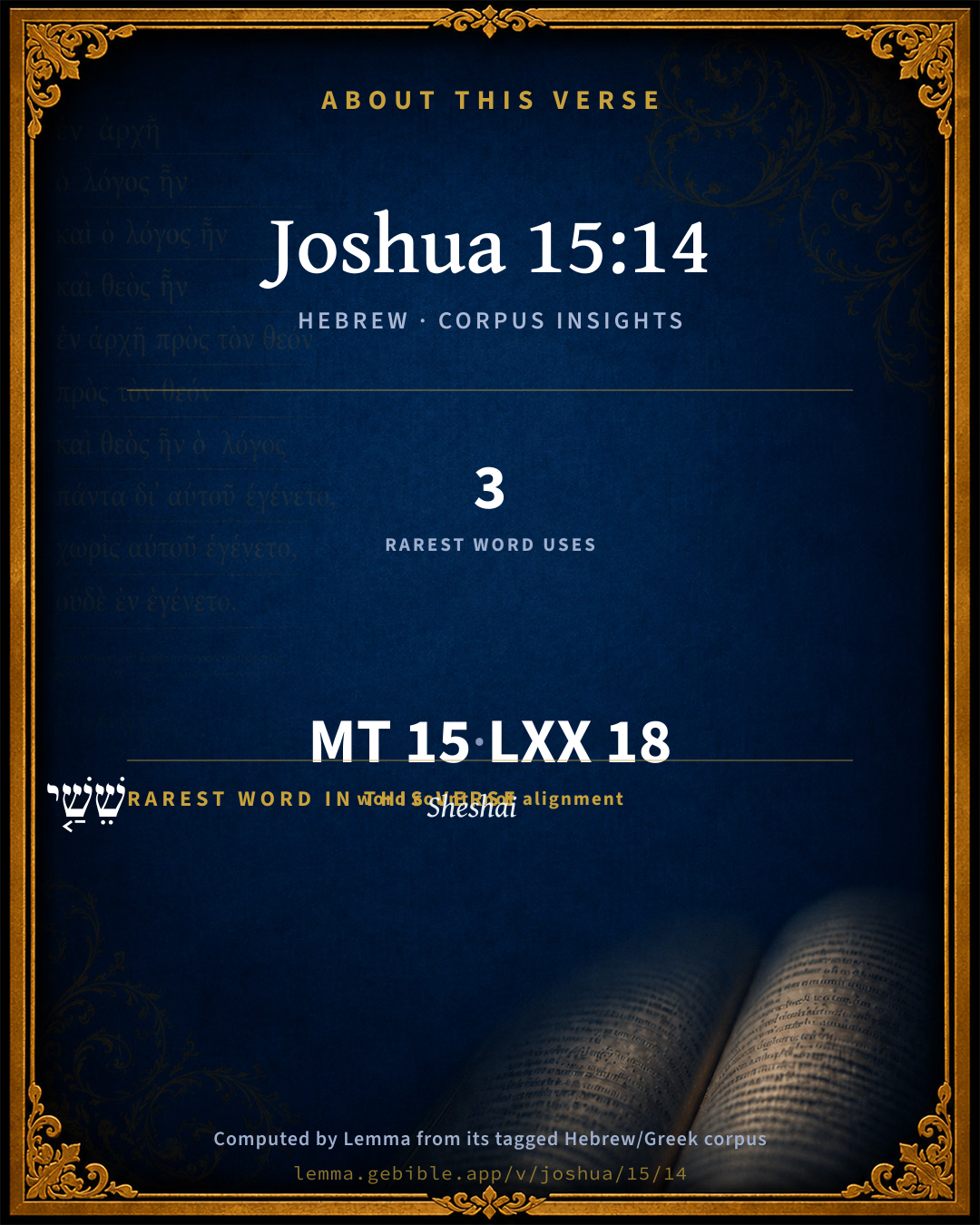
The rarest word here is שֵׁשַׁ֤י Sheshai H8344 — appearing just 3 times in the whole Hebrew Bible.

Shared distinctive vocabulary

שֵׁשַׁ֤י Sheshai H8344 occurs in 3 verses of the Hebrew Bible. Also found in:

Grammatical profile

  • 1 verb
  • 8 nouns
  • 1 adjective
  • 1 adverb
  • 4 particles

Verb forms

  • וַיֹּ֤רֶשׁ Hiphil · Sequential Imperfect

Repetition

A word recurs within this verse — often emphatic in Hebrew:

  • הָעֲנָ֑ק Anak H6061 ×2

Hebrew & Septuagint length

In English translation the verse runs 18 words from the Hebrew and 18 from the Septuagint (LXX English) — the same length.

A rough comparison of the two English renderings, which tokenize alike — not a word-level alignment.

Word counts can differ between the Hebrew and the Greek without any difference in meaning — e.g. the Hebrew direct-object marker אֵת has no separate Greek word, and Greek often adds the article ὁ.

In the original languages it is 15 Hebrew tokens and 18 Greek tokens — but the two are counted differently (Hebrew bundles its prefixes and suffixes into one token; the Greek is in lemma form), so that isn’t a like-for-like length.

Cross-references

6

Topical passages linked to Joshua 15:14 in the Treasury of Scripture Knowledge — connected by theme and wording, ordered by reader-vote popularity; previews shown in the World English Bible.

  • Judges 1:10 Judah went against the Canaanites who lived in Hebron (now the name of Hebron before was Kiriath Arba); and they struck Sheshai, and Ahiman, and Talmai.
  • Judges 1:20 They gave Hebron to Caleb, as Moses had spoken: and he drove out there the three sons of Anak.
  • Numbers 13:22–23 They went up by the South, and came to Hebron; and Ahiman, Sheshai, and Talmai, the children of Anak, were there. (Now Hebron was built seven years before Zoan in Egypt.)
  • Joshua 11:21 Joshua came at that time, and cut off the Anakim from the hill-country, from Hebron, from Debir, from Anab, and from all the hill-country of Judah, and from all the hill-country of Israel: Joshua utterly destroyed them with their cities.
  • Numbers 13:33 There we saw the Nephilim, the sons of Anak, who come of the Nephilim: and we were in our own sight as grasshoppers, and so we were in their sight.
  • Joshua 10:36–37 Joshua went up from Eglon, and all Israel with him, to Hebron; and they fought against it:

Cross-references courtesy of OpenBible.info (CC BY 4.0).

Hebrew and Greek witnesses Masoretic Hebrew ↔ Greek Septuagint

The same verse in the two great witnesses to the Old Testament, shown verse-for-verse.

These are two independent witnesses, not word-aligned to each other, and the Septuagint is shown in lemma (dictionary) form.

Hebrew Joshua 15:14 Masoretic · Westminster Leningrad Codex

וַיֹּ֤רֶשׁ מִשָּׁם֙ כָּלֵ֔ב אֶת שְׁלוֹשָׁ֖ה בְּנֵ֣י הָעֲנָ֑ק אֶת שֵׁשַׁ֤י וְאֶת אֲחִימַן֙ וְאֶת תַּלְמַ֔י יְלִידֵ֖י הָעֲנָֽק

Caleb drove out there the three sons of Anak: Sheshai, and Ahiman, and Talmai, the children of Anak.

World English Bible · Public Domain

Greek LXX Joshua 15:14 Septuagint · lemma form

καί ἐκὀλεθρεύω ἐκεῖθεν χαλεβ υἱός ιεφοννη ὁ τρεῖς υἱός ενακ ὁ σουσι καί ὁ θολμι καί ὁ αχιμα

And Chaleb the son of Jephone destroyed thence the three sons of Enac, Susi, and Tholami, and Achima.

LXX2012 (modern English Septuagint) · Public Domain

Hebrew: Westminster Leningrad Codex (CC BY 4.0). Greek: Septuagint (public domain); English from LXX2012 (modern English Septuagint) (Public Domain). How the Septuagint differs from the Hebrew →

Targum (Aramaic paraphrase)

1

The Targum is the ancient Jewish Aramaic paraphrase of the Hebrew Scriptures — an interpretive translation, not the Hebrew text itself. Onkelos (literal) and Pseudo-Jonathan (expansive) render the Torah, and Jonathan the Prophets. Coverage is partial: where no permissively-licensed English translation exists for a verse, only the Aramaic is shown. This is verse-level text, not a word-by-word alignment to the Hebrew.

  1. Targum Jonathan Prophets (Joshua–Malachi)
    וְתָרֵיךְ מִתַּמָן כָּלֵב יַת תְּלָתָא בְּנֵי גִבָּרַיָא יַת שֵׁשַׁי וְיַת אֲחִימָן וְיַת תַּלְמַי בְנֵי גִבָּרַיָא:

    (no public-domain English translation for this verse)

    Targum Jonathan — Aramaic: “Mikraot Gedolot” (public domain). English: “Sefaria Community Translation” (CC0 1.0 (public-domain dedication)); “London "Chaldee Paraphrase," 1871” (public domain). Text via Sefaria.

Commentary

Notes on Joshua 15:14 from classic Christian and Jewish commentators (each source and its license shown beneath its notes). The classic Christian expositions comment on the surrounding passage and are grouped to its opening verse, so a note may address several verses; the Jewish commentaries on the Tanakh (Rashi and others) are per-verse, so they appear only where the commentator wrote on this verse.

Lemma curates 59 commentaries, every one of them public domain or Creative Commons licensed, each selected and text-cleaned for this edition rather than reprinted as found. About our sources →

Trapp's Complete Commentary

John Trapp

Jos 15:14 And Caleb drove thence the three sons of Anak, Sheshai, and Ahiman, and Talmai, the children of Anak.

Ver. 14. And Caleb drove thence.] Nos quoque militemus, Heaven is not to be had sine sanguine et sudore, without pains, patience, violence.

John Trapp, A Commentary or Exposition upon All the Books of the Old and New Testament (1647–1656) — public domain. Text from a community e-Sword module.

Joseph Benson's Commentary

Jos 15:14. Caleb drove thence — That is, from the said territory, from their caves and forts in it; these giants having either recovered their cities, or defended themselves in the mountains. Caleb did not drive them out by his own power alone, but by the confederate army of the tribes of Judah and Simeon, (Jdg 1:3-9,) in which it is probable he had a principal command, and led on that party which assaulted this city. The three sons of Anak — Either the same whom he had seen forty-five years before, and was not at all affrighted at them; (Num 13:22; Jdg 1:10;) and so they were long-lived men, as many were in those times and places; or their sons called by their fathers’ names, which was very usual.

Joseph Benson's Commentary on the Old and New Testaments (1811–1818) — public domain. Text from a community e-Sword module.

Geneva Bible (1599)

Geneva Bible translators

This was done after the death of Joshua, Judg. 1:10, 20.

Geneva Bible (1599) marginal notes — public domain. Text via Bolls.life.

Jamieson, Fausset & Brown

Robert Jamieson, A. R. Fausset & David Brown

drove thence the three sons of Anak--rather three chiefs of the Anakim race. This exploit is recorded to the honor of Caleb, as the success of it was the reward of his trust in God.

Jamieson, Fausset & Brown — Commentary Critical and Explanatory on the Whole Bible (1871) — public domain (CC PDM 1.0). Text via the HelloAO Bible API.

Adam Clarke's Commentary

Verse 14. The three sons of Anak] See Clarke on Jos 14:15.

Adam Clarke's Commentary on the Bible (1810–1826) — public domain. Text from a community e-Sword/MySword module.

John Calvin's Commentaries

Here we have a narrative of what plainly appears from the book of Joshua to have taken place subsequent to the death of Joshua; but lest a question might have been raised by the novelty of the procedure, in giving a fertile and well watered field as the patrimony of a woman, the writer of the book thought proper to insert a history of that which afterwards happened, in order that no ambiguity might remain in regard to the lot of the tribe of Judah. First, Caleb is said, after he had taken the city of Hebron, to have attacked Debir or Ciriath-sepher, and to have declared, that the person who should be the first to enter it, would be his son-in-law. And it appears, that when he held out this rare prize to his fellow-soldiers for taking the city, no small achievement was required. This confirms what formerly seemed to be the case, that it was a dangerous and difficult task which had been assigned him, when he obtained his conditional grant. Accordingly, with the view of urging the bravest to exert themselves, he promises his daughter in marriage as a reward to the valor of the man who should first scale the wall.

It is afterwards added that Othniel who was his nephew by a brother, gained the prize by his valor. I know not how it has crept into the common translation that he was a younger brother of Caleb; for nothing in the least degree plausible can be said in defense of the blunder. Hence some expositors perplex themselves very unnecessarily in endeavoring to explain how Othniel could have married his niece, since such marriage was forbidden by the law. It is easy to see that he was not the uncle, but the cousin of his wife.

But here another question arises, How did Caleb presume to bargain concerning his daughter until he was made acquainted with her inclinations? Although it is the office of parents to settle their daughters in life, they are not permitted to exercise tyrannical power and assign them to whatever husbands they think fit without consulting them. For while all contracts ought to be voluntary, freedom ought to prevail especially in marriage that no one may pledge his faith against his will. But Caleb was probably influenced by the belief that his daughter would willingly give her consent, as she could not modestly reject such honorable terms; for the husband to be given her was no common man, but one who should excel all others in warlike prowess. It is quite possible, however, that Caleb in the heat of battle inconsiderately promised what it was not in his power to perform. It seems to me, however, that according to common law, the agreement implied the daughter’s consent, and was only to take effect if it was obtained. God certainly heard the prayer of Caleb, when he gave him a son-in-law exactly to his mind. For had the free choice been given him, there was none whom he would have preferred.

John Calvin's Commentaries (1540-1563) — public domain. Text from the Calvin Translation Society English edition (1840s-50s) via the Christian Classics Ethereal Library (ccel.org). Calvin's coverage is partial (roughly two-thirds of the Bible); uncommented books and verses are honest gaps, never fabricated. The 19th-century editor's footnotes and remarks are omitted so the notes are faithfully Calvin's own voice.

The Cambridge Bible for Schools and Colleges

gen. ed. J. J. S. Perowne

14. the three sons of Anak] Three chiefs of the Anakims. Comp. Num_13:22.

The Cambridge Bible for Schools and Colleges (gen. ed. J. J. S. Perowne; Cambridge University Press, 1878–1918) — public domain. Text from a community e-Sword module.

John Gill's Exposition

And Caleb drove thence the three sons of Anak,.... Some think this was after the death of Joshua, and is here inserted by some other person divinely inspired, and thoroughly acquainted with this fact, that the gift and the possession of this place might appear in one view; but it rather seems to be done before:

Sheshai, and Ahiman, and Talmai, the children of Anak; the very same giants Caleb saw at Hebron, when he was sent a spy into the land, Num 13:22; for these may as well be supposed to have lived to this time as himself, unless it can be thought that they were the sons of those men, called by their fathers' names; and though they were driven out when Joshua took Hebron, yet while he was engaged in making other conquests, or however before he died, they regained the possession of that city, and of the parts adjacent to it, from whence Caleb, with the help of his tribe, expelled them, conquered, and slew them, Jdg 1:10.

John Gill's Exposition of the Whole Bible (1746–1763) — public domain (CC PDM 1.0). Text via the HelloAO Bible API.

Albert Barnes' Notes on the Bible

See the marginal references.

Albert Barnes' Notes on the Bible (1834–1885) — public domain. Text from a community e-Sword/MySword module.

Haydock's Catholic Bible Commentary

Enac. These three giants were at Hebron when the spies came thither, Numbers xiii.

George Leo Haydock (1774–1849), Haydock's Catholic Family Bible and Commentary, 1859 edition — public domain. Excludes Psalms (Douay-Rheims chapter numbering differs from Protestant) and Deuterocanonical books (Catholic canon only).

Matthew Poole's English Annotations

Thence, i.e. from the said territory, from their caves and and forts in it: compare Jos 14:12. This and the following work was done either in Joshua’s life-time, as may seem from Jos 11:21, or after his death, as is related Jdg 1:10; these giants having either recovered their cities or defended themselves in the mountains.

Sheshai, and Ahiman, and Talmai; either the same who are mentioned Num 13:33, and so they were long-lived men, such as many were in those times and places; or their sons, called by their fathers’ names, which is very usual.

Matthew Poole's English Annotations on the Holy Bible (1683–1685) — public domain. Text from a community e-Sword/MySword module.

Whedon's Commentary on the Bible

Daniel D. Whedon

14. The three sons of Anak — Joshua had cut off the Anakim from the mountains and destroyed their cities, (Jos_11:21,) but after his army retired northward these three old chieftains had rallied their scattered adherents and repossessed their cities.

Daniel D. Whedon (gen. ed.), Commentary on the Old and New Testaments (1874–1909) — public domain. Text from a community e-Sword module.

The Pulpit Commentary

The three sons of Anak. This also must not he pressed literally. Possibly these men were three chiefs of the Anakim. The children of Anak. ydeyliy descendants, thus supporting the view taken in the last note. (see for the word Gen_14:14 Gen_17:12, where it is used of a slave born in the house)

The Pulpit Commentary (1880–1919), ed. H.D.M. Spence-Jones & Joseph S. Exell — public domain. Text from a community e-Sword module.

John Wesley's Explanatory Notes

Drove thence - That is, from the said territory, from their caves and forts in it. These giants having either recovered their cities, or defended themselves in the mountains. Three sons of Anak - Either the same who are mentioned, Num. xiii, 33, and so they were long-lived men, such as mainly were in those times and places: or their sons, called by their father's names, which is very usual.

John Wesley, Explanatory Notes Upon the Whole Bible (1754–1765) — public domain. Text via the GEBible commentary corpus.

Rashi

Rabbi Shlomo Yitzchaki (Rashi)

And Caleiv drove out from there. This happened after the death of Yehoshua, for during the days of Yehoshua Chevron had not yet been captured, as it is said in the book of Shoftim. It was recorded here only because of its relationship to the division of the land [among the tribes.]

Rashi on the Tanakh — English translations: “The Judaica Press complete Tanach with Rashi, translated by A. J. Rosenberg” (CC BY 4.0); “Pentateuch with Rashi's commentary by M. Rosenbaum and A.M. Silbermann, 1929-1934” (public domain); “The Metsudah Tanach series, Lakewood, N.J” (CC BY 4.0); and “The Book of Joshua, Metsudah Publications, 1997” (CC BY 4.0). Text via Sefaria.

Lesson kit

Teaching starters — assembled from the data on this page, not authored interpretation. Every prompt links to the verse data it draws on. Edit before teaching.

Joshua, in the Historical, opens this verse with 15 words (11 distinct Hebrew lemmas). Its most distinctive word is Shêshay (“Sheshai”). A historical commentator’s framing appears above. Read the whole chapter for the surrounding context.

Discussion questions

  1. The word Shêshay carries the sense “Sheshai.” How does it shape the verse?
  2. How does Numbers 13:22, which shares the word «Sheshai», read alongside this verse?
  3. What does the repetition of “Anak” (2× in this one verse) do in this verse?
  4. These translations render this verse differently. What is at stake in choosing one wording over another?
  5. «וַיֹּ֤רֶשׁ» is a Hiphil Sequential Imperfect verb. How does that grammatical form shape the action described?
  6. Compare how Trapp's Complete Commentary and Joseph Benson's Commentary read this verse. Where do they agree or differ?

Things to notice

Reading settings

Reading text

Shown beneath each verse's original-language words.

Old Testament
Old Testament edition

Read the OT as the Masoretic Hebrew (MT) or the Greek Septuagint (LXX).

English shown for the Greek Septuagint (in the Hebrew ↔ Greek comparison).

Comparing translations? Open the Compare panel on any verse page to stack up to four side by side.