Isaiah 60:21

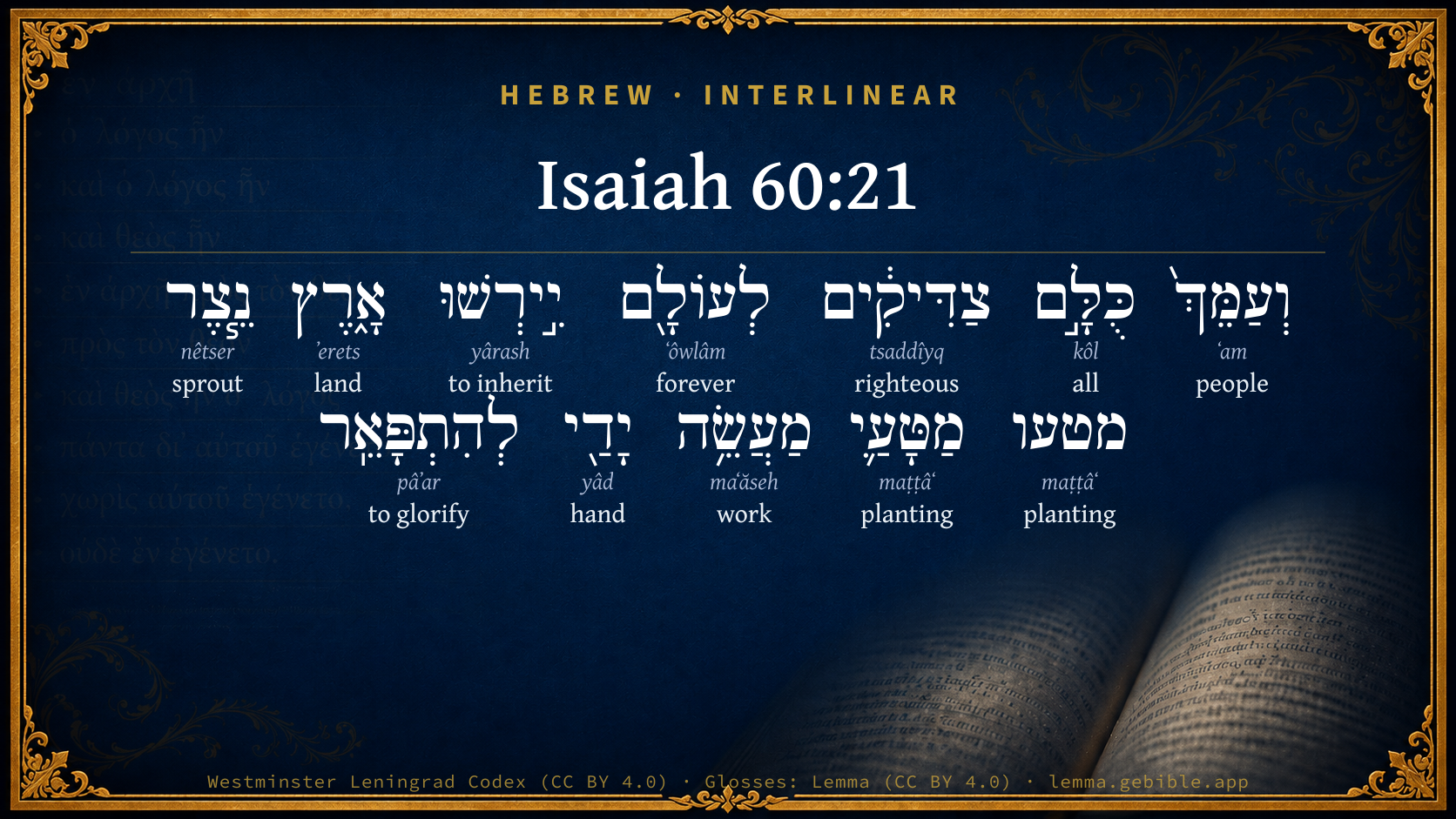
Hebrew (Westminster Leningrad Codex) Isaiah 60:21 appears in the Hebrew Old Testament. The text above is from the Westminster Leningrad Codex. Each word links to its Strong’s number, a concise gloss, and parsing drawn from the Open Scriptures Hebrew Bible morphology. Click any word for its full Brown-Driver-Briggs (BDB) entry.
Download image
Cite this verse

Isaiah 60:21 (World English Bible). Public Domain. Lemma interlinear Bible study tool, https://lemma.gebible.app/v/isaiah/60/21.

Show BibTeX & RIS
BibTeX
RIS
English Translation
Your people also shall be all righteous; they shall inherit the land forever, the branch of my planting, the work of my hands, that I may be glorified.
World English Bible · Public Domain
Highlights
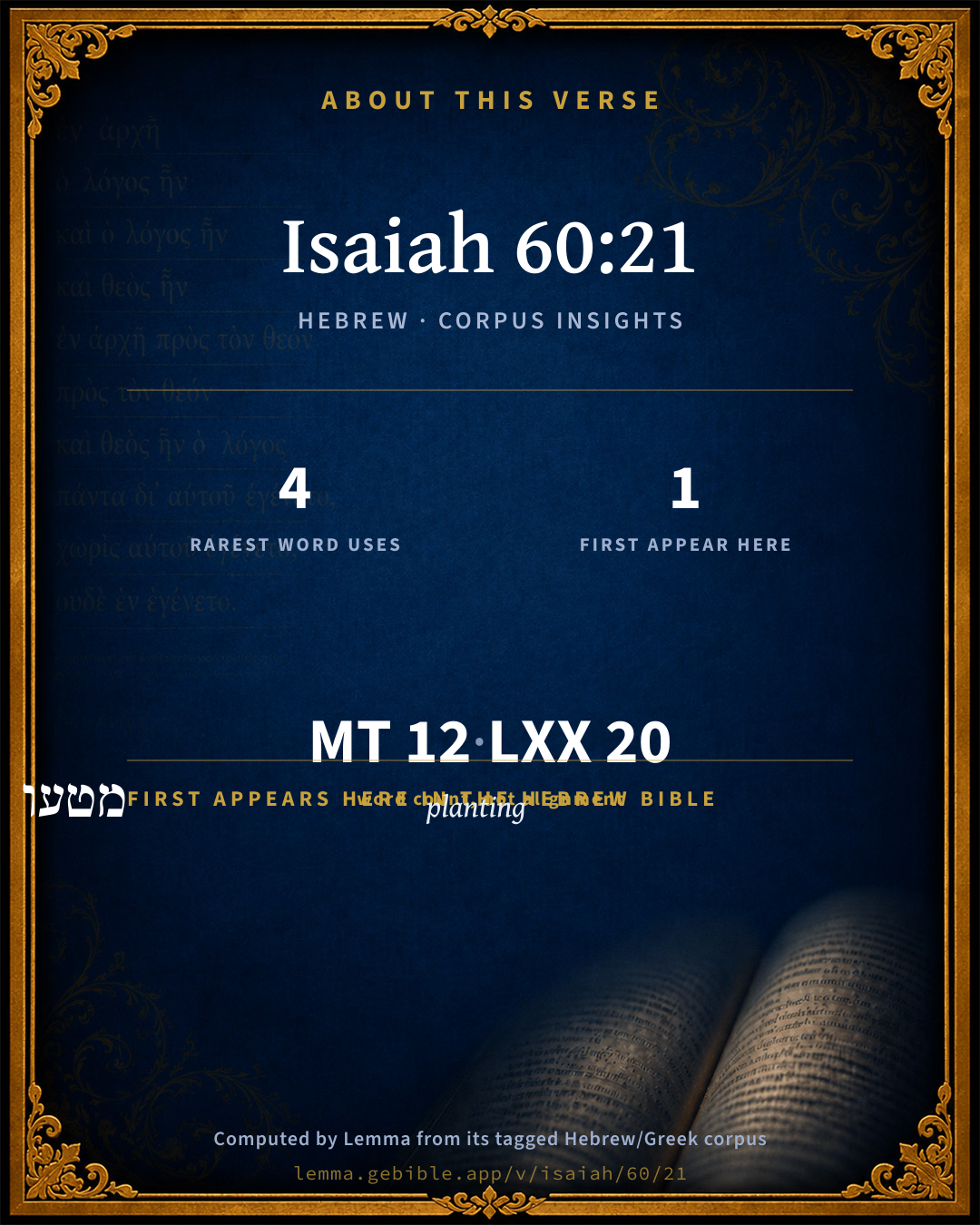
  • 1 first appearance in the Hebrew Bible
Full analysis ↓
Download a study sheet

One document with this verse’s original text, its word-by-word gloss line, the meaning frame, cross-references with their text, attributed commentary, and full source and license credits — printable, and it pastes into notes with its structure intact.

This verse Autodidact and up

Study sheet (.html) Plain text (.txt)

A passage Seminary Student

Up to 50 verses in one chapter. A passage sheet keeps up to 6 commentary sources and 12 cross-references per verse, in the order this page ranks them, and says so on the sheet whenever that leaves anything out. Ask for a single verse and you get the Autodidact verse sheet above.

Everything on this page stays free to read, with no account — the sheet is a download of what is already on screen, not access to it.

Want to remove ads? Support Godless Engineer
Compare translations 3

The same verse in 3 English versions, stacked beneath the original-language interlinear above. Click any original word for its lexicon entry.

Each is an independent rendering of the whole verse — the interlinear is not word-aligned to these translations.

Highlighted words mark where these versions differ — a whole-verse word diff, not a word-by-word alignment.

  • World English Bible Public Domain
    Your people also shall be all righteous; they shall inherit the land forever, the branch of my planting, the work of my hands, that I may be glorified.
  • King James Version Public Domain
    Thy people also shall be all righteous: they shall inherit the land for ever, the branch of my planting, the work of my hands, that I may be glorified.
  • unfoldingWord Literal Text CC BY-SA 4.0
    And your people, all of them righteous; to eternity, they will possess the land, the branch of my planting, the work of my hands, that I may be glorified.

unfoldingWord Literal Text — © unfoldingWord, licensed CC BY-SA 4.0. Word-aligned USFM3 via Door43 (git.door43.org/unfoldingWord/en_ult).

Versions to compare (up to 4)

3 of 4 selected

Show all 18 translations

Every available English version of this verse, each an independent rendering of the whole verse.

  • World English Bible Public Domain
    Your people also shall be all righteous; they shall inherit the land forever, the branch of my planting, the work of my hands, that I may be glorified.
  • Berean Standard Bible Public Domain
    Then all your people will be righteous; they will possess the land forever; they are the branch of My planting, the work of My hands, so that I may be glorified.
  • Majority Standard Bible Public Domain
    Then all your people will be righteous; they will possess the land forever; they are the branch of My planting, the work of My hands, so that I may be glorified.
  • King James Version Public Domain
    Thy people also shall be all righteous: they shall inherit the land for ever, the branch of my planting, the work of my hands, that I may be glorified.
  • American Standard Version (1901) Public Domain
    Thy people also shall be all righteous; they shall inherit the land for ever, the branch of my planting, the work of my hands, that I may be glorified.
  • Revised Version (1885) Public Domain
    Thy people also shall be all righteous, they shall inherit the land for ever; the branch of my planting, the work of my hands, that I may be glorified.
  • Geneva Bible (1599) Public Domain
    Thy people also shalbe all righteous: they shall possesse the land for euer, the grasse of my planting shalbe the worke of mine handes, that I may be glorified.
  • Douay-Rheims (1899) Public Domain
    And thy people shall be all just, they shall inherit the land for ever, the branch of my planting, the work of my hand to glorify me.
  • Young's Literal Translation Public Domain
    And thy people `are' all of them righteous, To the age they possess the earth, A branch of My planting, A work of My hands, to be beautified.
  • Literal Standard Version CC BY-SA 4.0
    And all your people [are] righteous, || They possess the earth for all time, || A branch of My planting, || A work of My hands, to be beautified.
  • Unlocked Literal Bible CC BY-SA 4.0
    All your people will be righteous; they will take possession of the land for all time, the branch of my planting, the work of my hands, that I may be glorified.
  • unfoldingWord Literal Text CC BY-SA 4.0
    And your people, all of them righteous; to eternity, they will possess the land, the branch of my planting, the work of my hands, that I may be glorified.
  • Darby Bible Public Domain
    Thy people also shall be all righteous: they shall possess the land for ever -- the branch of my planting, the work of my hands, that I may be glorified.
  • World Messianic Bible Public Domain
    Then your people will all be righteous. They will inherit the land forever, the branch of my planting, the work of my hands, that I may be glorified.
  • Webster's Bible Public Domain
    Thy people also shall be all righteous: they shall inherit the land for ever, the branch of my planting, the work of my hands, that I may be glorified.
  • Free Bible Version CC BY-SA 4.0
    All your people will be good, and they will own the land forever. They are the shoot I have planted with my hands, and they will reveal my glory.
  • Bible in Basic English Public Domain
    Your people will all be upright, the land will be their heritage for ever; the branch of my planting, the work of my hands, to be for my glory.
  • JPS Tanakh (1917) Public Domain
    Thy people also shall be all righteous, they shall inherit the land for ever; the branch of My planting, the work of My hands, wherein I glory.

Literal Standard Version (2020), Covenant Press — licensed CC BY-SA 4.0. Text via the HelloAO Bible API (eBible.org). Unlocked Literal Bible (unfoldingWord) — licensed CC BY-SA 4.0. Text via the HelloAO Bible API (eBible.org). unfoldingWord Literal Text — © unfoldingWord, licensed CC BY-SA 4.0. Word-aligned USFM3 via Door43 (git.door43.org/unfoldingWord/en_ult). Free Bible Version, Dr. Jonathan Gallagher — licensed CC BY-SA 4.0. Text via the HelloAO Bible API (eBible.org).

Word by word

More ways to search: Search by grammar → Find every occurrence → Compare this word →

Practice this passage: Drill this verse → Learn its vocabulary →

נֵ֧צֶר
nêtser
H5342
“sprout of”
Noun, Common, Masculine, Singular, Construct
Part of Speech
Noun
Type
Common
Gender
Masculine
Number
Singular
State
Construct
Full BDB Definition

Origin: from H5341 in the sense of greenness as a striking colour

TWOT: TWOT - 1408a

sprout, shoot, branch (always figuratively)
  1. וְעַמֵּךְ֙ ʻam H5971 “and · people · your” Conjunction + Noun, Common, Masculine, Singular, Construct + Suffix, Personal, 2nd Person, Feminine, Singular
  2. כֻּלָּ֣ם kôl H3605 “all · their” Noun, Common, Masculine, Singular, Construct + Suffix, Personal, 3rd Person, Masculine, Plural
  3. צַדִּיקִ֔ים tsaddîyq H6662 “righteous” Adjective, Adjective, Masculine, Plural, Absolute
  4. לְעוֹלָ֖ם ʻôwlâm H5769 “to/for · forever” Preposition + Noun, Common, Masculine, Singular, Absolute
  5. יִ֣ירְשׁוּ yârash H3423 “to inherit” Verb, Qal, Imperfect, 3rd Person, Masculine, Plural
  6. אָ֑רֶץ ʼerets H776 “land” Noun, Common, Both, Singular, Absolute
  7. מטעו maṭṭâʻ H4302 “planting · his” Noun, Common, Masculine, Singular, Construct + Suffix, Personal, 3rd Person, Masculine, Singular
  8. מַטָּעַ֛י maṭṭâʻ H4302 “plantings · my” Noun, Common, Masculine, Plural, Construct + Suffix, Personal, 1st Person, Common, Singular
  9. מַעֲשֵׂ֥ה maʻăseh H4639 “work of” Noun, Common, Masculine, Singular, Construct
  10. יָדַ֖י yâd H3027 “hands · my” Noun, Common, Both, Dual, Construct + Suffix, Personal, 1st Person, Common, Singular
  11. לְהִתְפָּאֵֽר pâʼar H6286 “to glorify” Preposition + Verb, Hithpael, Infinitive Construct

About this verse

These counts appear in no published source. They are computed here, from the morphology-tagged text and Lemma’s own curated glosses. What Lemma adds →

12
words
11
distinct lemmas
Prophets
section

Notable vocabulary

The rarest word here is נֵ֧צֶר sprout H5342 — appearing just 4 times in the whole Hebrew Bible.

First appearance in Scripture

This word makes its first canonical appearance in the Hebrew Bible here:

  • מטעו planting H4302

Shared distinctive vocabulary

נֵ֧צֶר sprout H5342 occurs in 4 verses of the Hebrew Bible. Also found in:

Grammatical profile

  • 2 verbs
  • 9 nouns
  • 1 adjective

Verb forms

  • יִ֣ירְשׁוּ Qal · Imperfect
  • לְהִתְפָּאֵֽר Hithpael · Infinitive Construct

Repetition

A word recurs within this verse — often emphatic in Hebrew:

  • מטעו planting H4302 ×2

Hebrew & Septuagint length

In English translation the verse runs 28 words from the Hebrew and 28 from the Septuagint (LXX English) — the same length.

A rough comparison of the two English renderings, which tokenize alike — not a word-level alignment.

Word counts can differ between the Hebrew and the Greek without any difference in meaning — e.g. the Hebrew direct-object marker אֵת has no separate Greek word, and Greek often adds the article ὁ.

In the original languages it is 12 Hebrew tokens and 20 Greek tokens — but the two are counted differently (Hebrew bundles its prefixes and suffixes into one token; the Greek is in lemma form), so that isn’t a like-for-like length.

Cross-references

30

Topical passages linked to Isaiah 60:21 in the Treasury of Scripture Knowledge — connected by theme and wording, ordered by reader-vote popularity; previews shown in the World English Bible.

  • Matthew 15:13 But he answered, "Every plant which my heavenly Father didn't plant will be uprooted.
  • Psalms 37:22 For such as are blessed by him shall inherit the land. Those who are cursed by him shall be cut off.
  • Psalms 37:11 But the humble shall inherit the land, And shall delight themselves in the abundance of peace.
  • Isaiah 29:23 But when he sees his children, the work of my hands, in the midst of him, they shall sanctify my name; yes, they shall sanctify the Holy One of Jacob, and shall stand in awe of the God of Israel.
  • Psalms 92:13 They are planted in Yahweh's house. They will flourish in our God's courts.
  • Isaiah 61:3 to appoint to those who mourn in Zion, to give to them a garland for ashes, the oil of joy for mourning, the garment of praise for the spirit of heaviness; that they may be called trees of righteousness, the planting of Yahweh, that he may be glorified.
  • John 15:2 Every branch in me that doesn't bear fruit, he takes away. Every branch that bears fruit, he prunes, that it may bear more fruit.
  • Isaiah 43:7 everyone who is called by my name, and whom I have created for my glory, whom I have formed, yes, whom I have made.
  • Isaiah 43:21 the people which I formed for myself, that they might set forth my praise.
  • Isaiah 45:11 Thus says Yahweh, the Holy One of Israel, and his Maker: Ask me of the things that are to come; concerning my sons, and concerning the work of my hands, command you me.
  • Isaiah 51:2 Look to Abraham your father, and to Sarah who bore you; for when he was but one I called him, and I blessed him, and made him many.
  • Isaiah 52:1 Awake, awake, put on your strength, Zion; put on your beautiful garments, Jerusalem, the holy city: for henceforth there shall no more come into you the uncircumcised and the unclean.
  • Isaiah 57:13 When you cry, let those who you have gathered deliver you; but the wind shall take them, a breath shall carry them all away: but he who takes refuge in me shall possess the land, and shall inherit my holy mountain.
  • Isaiah 61:7 Instead of your shame [you shall have] double; and instead of dishonor they shall rejoice in their portion: therefore in their land they shall possess double; everlasting joy shall be to them.
  • Isaiah 62:4 You shall no more be termed Forsaken; neither shall your land any more be termed Desolate: but you shall be called Hephzibah, and your land Beulah; for Yahweh delights in you, and your land shall be married.
  • Matthew 5:5 Blessed are the gentle, For they shall inherit the earth.
  • Ephesians 2:7 that in the ages to come he might show the exceeding riches of his grace in kindness toward us in Christ Jesus;
  • Ephesians 2:10 For we are his workmanship, created in Christ Jesus for good works, which God prepared before that we would walk in them.
  • Revelation 21:27 There will in no way enter into it anything profane, or one who causes an abomination or a lie, but only those who are written in the Lamb's book of life.
  • Isaiah 4:3–4 It will happen, that he who is left in Zion, and he who remains in Jerusalem, shall be called holy, even everyone who is written among the living in Jerusalem;
  • Isaiah 19:25 because Yahweh of Hosts has blessed them, saying, Blessed be Egypt my people, and Assyria the work of my hands, and Israel my inheritance.
  • Isaiah 44:23 Sing, you heavens, for Yahweh has done it; shout, you lower parts of the earth; break forth into singing, you mountains, O forest, and every tree therein: for Yahweh has redeemed Jacob, and will glorify himself in Israel.
  • Isaiah 49:3 and he said to me, You are my servant; Israel, in whom I will be glorified.
  • Zechariah 14:20–21 In that day there will be on the bells of the horses, "HOLY TO YAHWEH;" and the pots in Yahweh's house will be like the bowls before the altar.
  • Ephesians 1:6 to the praise of the glory of his grace, by which he freely bestowed favor on us in the Beloved,
  • Ephesians 1:12 to the end that we should be to the praise of his glory, we who had before hoped in Christ:
  • 2 Thessalonians 1:10 when he comes to be glorified in his saints, and to be admired among all those who have believed (because our testimony to you was believed) in that day.
  • 2 Peter 3:13 But, according to his promise, we look for new heavens and a new earth, in which dwells righteousness.
  • Revelation 5:10 And made them kings and priests to our God, And they reign on earth."
  • Revelation 21:7 He who overcomes, I will give him these things. I will be his God, and he will be my son.

Cross-references courtesy of OpenBible.info (CC BY 4.0).

Hebrew and Greek witnesses Masoretic Hebrew ↔ Greek Septuagint

The same verse in the two great witnesses to the Old Testament, shown verse-for-verse.

These are two independent witnesses, not word-aligned to each other, and the Septuagint is shown in lemma (dictionary) form.

Hebrew Isaiah 60:21 Masoretic · Westminster Leningrad Codex

וְעַמֵּךְ֙ כֻּלָּ֣ם צַדִּיקִ֔ים לְעוֹלָ֖ם יִ֣ירְשׁוּ אָ֑רֶץ נֵ֧צֶר מטעו מַטָּעַ֛י מַעֲשֵׂ֥ה יָדַ֖י לְהִתְפָּאֵֽר

Your people also shall be all righteous; they shall inherit the land forever, the branch of my planting, the work of my hands, that I may be glorified.

World English Bible · Public Domain

Greek LXX Isaiah 60:21 Septuagint · lemma form

καί ὁ λαός σύ πᾶς δίκαιος καί διά αἰών κληρονομέω ὁ γῆ φυλάσσω ὁ φύτευμα ἔργον χείρ αὐτός εἰς δόξα

Your people also shall be all righteous; they shall inherit the land for ever, preserving that which they have planted, even the works of their hands, for glory.

LXX2012 (modern English Septuagint) · Public Domain

Hebrew: Westminster Leningrad Codex (CC BY 4.0). Greek: Septuagint (public domain); English from LXX2012 (modern English Septuagint) (Public Domain). How the Septuagint differs from the Hebrew →

Targum (Aramaic paraphrase)

1

The Targum is the ancient Jewish Aramaic paraphrase of the Hebrew Scriptures — an interpretive translation, not the Hebrew text itself. Onkelos (literal) and Pseudo-Jonathan (expansive) render the Torah, and Jonathan the Prophets. Coverage is partial: where no permissively-licensed English translation exists for a verse, only the Aramaic is shown. This is verse-level text, not a word-by-word alignment to the Hebrew.

  1. Targum Jonathan Prophets (Joshua–Malachi)
    וְעַמִיךְ כּוּלְהוֹן זַכָּאִין לַעֲלַם יַחְסְנוּן אַרְעָא נִיצְבָא דְחֶדְוָתִי עוֹבַד גְבוּרְתִּי לְאִשְׁתַּבָּחָא:

    Thy people shall be all righteous: for ever shall they inherit the land, the plant of my delight, the work of my might, that I may assuredly be glorified.

    Targum Jonathan — Aramaic: “Mikraot Gedolot” (public domain). English: “Sefaria Community Translation” (CC0 1.0 (public-domain dedication)); “London "Chaldee Paraphrase," 1871” (public domain). Text via Sefaria.

Commentary

Notes on Isaiah 60:21 from classic Christian and Jewish commentators (each source and its license shown beneath its notes). The classic Christian expositions comment on the surrounding passage and are grouped to its opening verse, so a note may address several verses; the Jewish commentaries on the Tanakh (Rashi and others) are per-verse, so they appear only where the commentator wrote on this verse.

Lemma curates 59 commentaries, every one of them public domain or Creative Commons licensed, each selected and text-cleaned for this edition rather than reprinted as found. About our sources →

John Gill's Exposition

Thy people also shall be all righteous,.... That is, the church's people, or the members of the church; otherwise the Lord's people, who are truly so, always were, and ever will be, all righteous; but so have not always been the members of the churches; when Israel was the church of God, they were not all righteous; there was only a remnant among them, according to the election of grace, that were so; nor in the first Christian churches were they all such, there was a Judas among Christ's disciples; Ananias and Sapphira in the church at Jerusalem; and many in the church of Corinth, very disorderly and irregular; and so in all others; and in all ages since there are foolish virgins among the wise, tares among the wheat, and chaff among the corn on the floor; yea, even in the spiritual reign of Christ they will not be all truly gracious; some that will have only a form of godliness, and who, at the close of it, will be the greater number, and will form the lukewarm Laodicean state; but in the personal reign of Christ all the members of the church will be righteous, through the righteousness of Christ imputed to them: it will be a congregation of righteous persons, and not one sinner shall stand in it; yea, they shall be inherently righteous, perfectly holy, and free from sin; none shall enter into this state that defiles; every pot and vessel in Jerusalem shall be holiness to the Lord, Psa 1:5. The Jews (o) have a saying, that the son of David comes not but in an age in which men will be all righteous, or all wicked; in an age in which they will be all righteous, according to Isa 60:21, but this designs not his first, but his second coming:

they shall inherit the land for ever; not the land of Canaan only; though perhaps that may be the spot on which Christ will descend, and where he will reside; where he was treated with contempt and crucified, here he will reign, and reign gloriously; and the rather, since, when he comes with all his saints, his feet will stand upon the mount of Olives, Zac 14:4 but the new earth is meant, which John saw, and Peter says the saints expect, according to promise, in which righteousness men perfectly righteous shall dwell, and none but they, Rev 21:1 as also it may include a better country, the land afar off, the heavenly glory, which will be the inheritance of the saints to all eternity:

the branch of my planting; in Christ by election grace; in the likeness of his death and resurrection by redemption grace; and as branches in him, the Vine, by effectual calling grace; and in his church, through the ministry of the word; all which will appear true and real; and that they are plants of the Lord's planting, by their being in this church state, even in the paradise of God, near to the tree of life, the fruit of which they will always partake of:

the work of my hands; the workmanship of God, curiously wrought by him; the effect of his mighty power; wholly his own work and not another's; and entirely owing to his great love, abundant mercy, and rich grace; as will be evident in this state; this being the day of the Lord unto which it is performed, and become perfect; and there will be no more doubts of that matter:

that I may be glorified; as he will be then in all them that believe; and by these characters which they bear, and are to be ascribed to his power, grace, and righteousness; Christ, and he alone, will be exalted; he will reign before his ancients gloriously, until he delivers up the kingdom; and then God, Father, Son, and Spirit, will be all in all.

(o) T. Bab. Sanhedrin, fol. 98. 1.

John Gill's Exposition of the Whole Bible (1746–1763) — public domain (CC PDM 1.0). Text via the HelloAO Bible API.

Trapp's Complete Commentary

John Trapp

Isa 60:21 Thy people also [shall be] all righteous: they shall inherit the land for ever, the branch of my planting, the work of my hands, that I may be glorified.

Ver. 21. Thy people also shall be all righteous.] Professional saints at least they shall all be, - saints by calling; some of them also shall be really righteous and religious, justified by the merit, and sanctified by the Spirit of Christ. And these together make up a true visible Church, such as was that of Corinth and of Sardis. A mixture there will be to the world’s end.

They shall inherit the land for ever.] Those that are righteous indeed, are heirs of the world together with faithful Abraham. The meek shall inherit the earth; and as for the poor in spirit, theirs is the kingdom of heaven. {Mat 5:3; Mat 5:5}

The branch of my planting.] So may some be that yet bear no fruit. {Joh 15:2}

The work of my hands.] By regeneration. {Eph 2:10} And so are such as are sanctified by habitual infusion, and not by baptismal profession only. In both sorts God is glorified.

John Trapp, A Commentary or Exposition upon All the Books of the Old and New Testament (1647–1656) — public domain. Text from a community e-Sword module.

The Biblical Illustrator

Joseph S. Exell

Isa_60:21

Thy people also shall be all righteous

The people of God considered as righteous

I.

AS THEY ARE ALL INTERESTED IN THE RIGHTEOUSNESS OF CHRIST JESUS.

II. AS BY THE INFLUENCES OF THE HOLY SPIRIT, THEY HAVE AN INHERENT RIGHTEOUSNESS WROUGHT IN THEM.

III. BY ABOUNDING IN WORKS OF RIGHTEOUSNESS TO THE PRAISE AND GLORY OF GOD. Here two cautions are necessary, to prevent mistakes.

1. Virtuous actions do not constitute a person inherently righteous, but declare him so; as good fruit is rather a declaration of the goodness of the tree, than the thing which constitutes that goodness. Therefore,

2. Virtuous actions cannot be said to be necessary to salvation, in the same sense in which inherent holiness is so. It is possible that, where holiness is implanted, life may be so quickly taken away that there shall be no room for its discovering itself by the outward behaviour. Taking these cautions along with us, the necessity of works of righteousness, though not as a ground of our justification, yet, as an evidence of it, can never be too strongly asserted. Every motive, whether from interest or gratitude, whether from the beauty of religion or the pleasures of a virtuous life, still remains in full force. We further observe, that the reward of saints hereafter shall bear some proportion to their progress in holiness here below. (J. Erskine, D. D.)

A righteous people

The prophet here predicts the elevation of the Church to its normal or ideal state, a change of which we may already see the rudiments, however far we may get from its final consummation. (J. A. Alexander.)

The Biblical Illustrator, edited by Joseph S. Exell (c. 1880s–1900s) — public domain. Text from a community e-Sword module.

Joseph Benson's Commentary

Isa 60:21-22. Thy people shall be all righteous — Through righteousness imputed to them, Rom 4:3-8; Rom 4:23-24; implanted in them, Eph 4:22-24; and practised by them, 1Jn 3:7; in other words, through the justification of their persons, the renovation of their nature, and their practical obedience to God’s law. “It was proper,” says Vitringa, “that the prophetic discourse, big with such excellent promises, should set forth the quality of the citizens of this blessed city; for so many and excellent privileges cannot belong to any but to such as are fitted for these times by divine grace. The prophet therefore teaches that the inhabitants of this city should be all righteous; where there can be no doubt that the righteousness of faith is meant; of living faith, purifying the soul, sanctifying the affections, abounding in charity, and never separated from true holiness: so that they who are called righteous here are the same who are elsewhere called holy.” See the following parallel passages, Isa 4:3; Isa 33:24; Isa 35:8; Isa 52:1; Zec 14:20-21. They shall inherit the land for ever — They shall for ever be continued as God’s peculiar people; the branch of my planting — Born again of my Spirit, created in the Messiah, unto good works, Eph 2:10; broken off from the wild olive, and grafted into the good olive; transplanted out of the field into the nursery; that, being now planted in God’s garden on earth, they might shortly be removed into his paradise in heaven; that I may be glorified — By the good fruit which they bear. A little one shall become a thousand — Rather, this should be rendered, A little number shall become a thousand. Though their beginning be very small and contemptible, and the members of the church very few, yet shall they greatly multiply, and increase into many hundreds of thousands and millions. Thus Daniel describes the kingdom of Christ as a stone, which, in process of time, becomes a great mountain, and fills the whole earth, which will be verified at the proper season, as it follows. I the Lord will hasten it in his time — Namely, in due time, the time that I have appointed; as if he had said, Let not this be doubted, because I have undertaken it, to whom nothing is difficult. Indeed this has been already accomplished in a considerable degree by the great progress the gospel has made. Never were means more unlikely employed to effect any purpose, never was there a stronger opposition; yet the gospel prevailed, and multitudes of both sexes, in different countries, became obedient to the faith, and looked upon it as their greatest glory. Vitringa, who closes his comment on this chapter with some excellent remarks, tending to show that it particularly refers to some future glorious state of the church, which will take place after the conversion of the Jews, and the coming in of the fulness of the Gentiles, concludes with the following important observation: “However, all our care and endeavour should be to conduct ourselves in a manner worthy of so high a hope; and we should so form our lives and manners as rather to regard things present than future; neglecting no duty of a true citizen of the spiritual Jerusalem, whereof we now profess ourselves members; that the expectation of the future may not deprive us of those blessings and privileges which God offers at present to all those who seriously and sincerely seek them; in the mean time humbly and earnestly interceding with him that his kingdom may come.”

Joseph Benson's Commentary on the Old and New Testaments (1811–1818) — public domain. Text from a community e-Sword module.

Tyndale Open Study Notes

Tyndale Open Resources

60:21 The citizens of Zion will be righteous, enjoying a right relationship with God and with others (Rev 21:27). • their land: Or the entire earth (Isa 54:5; 62:7; 65:17; 66:22).

Tyndale Open Study Notes — © Tyndale Open Resources, licensed CC BY-SA 4.0. Text via the HelloAO Bible API.

Geneva Bible (1599)

Geneva Bible translators

The children of the Church.

Geneva Bible (1599) marginal notes — public domain. Text via Bolls.life.

Jamieson, Fausset & Brown

Robert Jamieson, A. R. Fausset & David Brown

all righteous-- (Isa 4:3; Isa 52:1; Rev 21:27).

inherit . . . land-- (Isa 49:8; Isa 54:3; Isa 65:9; Psa 37:11, Psa 37:22; Mat 5:5).

branch of my planting-- (Isa 61:3; Psa 92:13; Mat 15:13).

work of my hands--the converted Israelites (Isa 29:23; Isa 45:11).

that I may be glorified--the final end of all God's gracious dealings (Isa 49:3; Isa 61:3).

Jamieson, Fausset & Brown — Commentary Critical and Explanatory on the Whole Bible (1871) — public domain (CC PDM 1.0). Text via the HelloAO Bible API.

Adam Clarke's Commentary

Verse 21. Of my planting] מטעי mattai; so, with the Keri, read forty-four MSS. (seven ancient) and six editions; with which agree the Syriac, Chaldee, and Vulgate.

Adam Clarke's Commentary on the Bible (1810–1826) — public domain. Text from a community e-Sword/MySword module.

Ellicott's Commentary for English Readers

(21) Thy people also shall be all righteous . . .—The city is to realise the as yet unfulfilled ideal of Psalms 15 and Psa_21:5 Evil will be blotted out, and, therefore, there will be no forfeiture of the inheritance. In the “branch” we have the words which had been prominent in Isa_11:1, and which is now extended from the ideal representative of the nation to the whole body of the people.

A Bible Commentary for English Readers, edited by Charles John Ellicott (1878–1897) — public domain. Text from a community e-Sword module.

The Cambridge Bible for Schools and Colleges

gen. ed. J. J. S. Perowne

21, 22. The community, composed exclusively of righteous persons, shall possess the land for ever; and Jehovah shall be glorified in them.

inherit] Better: possess.

the branch of my planting] i.e. “which I have planted.” Cf. ch. Isa_61:3. The word for branch denotes strictly a “shoot”; so also in ch. Isa_11:1, Isa_14:19. For the figure cf. ch. Isa_5:7.

The Cambridge Bible for Schools and Colleges (gen. ed. J. J. S. Perowne; Cambridge University Press, 1878–1918) — public domain. Text from a community e-Sword module.

Albert Barnes' Notes on the Bible

Thy people also shall be all righteous - (See the notes at Isa 4:2).

They shall inherit the land for ever - (See the notes at Isa 49:8; Isa 54:3; compare Isa 65:9; Mat 5:5).

The branch of my planting - On the meaning of the word branch, see the notes at Isa 11:1; Isa 14:19. Here it means a scion or shoot which Yahweh had planted, and which had sprung up under his culture. Grotius supposes it means posterity. The idea seems to be, that they would inherit the land and all which would grow up under the culture of the hand of Yahweh.

The work of my hands - The language here is taken from the cultivation of the land of Canaan; but the sense is, that the church would inherit all that God had done for its welfare. Applied to the work of redemption, it means that the result of all the labors, self-denials, and sacrifices of the Redeemer, become the inheritance of the church. The comforts, joys, hopes, consolations of his people are the fruit of his self-denial, ‘the work of his hands,’ and they are permitted to enjoy it all - as if God should cultivate a fruitful field and give the avails entirely to them.

That I may be glorified - (See Isa 49:3; Isa 61:3; the notes at Isa 42:8; Isa 43:7). God would be glorified in having made so ample provision for their welfare, and in their being made happy by him. He is always glorified when others enjoy the fruits of his benevolence, and when they are made pure and happy as the result of his purposes and plans.

Albert Barnes' Notes on the Bible (1834–1885) — public domain. Text from a community e-Sword/MySword module.

Haydock's Catholic Bible Commentary

CHAPTER LX.

George Leo Haydock (1774–1849), Haydock's Catholic Family Bible and Commentary, 1859 edition — public domain. Excludes Psalms (Douay-Rheims chapter numbering differs from Protestant) and Deuterocanonical books (Catholic canon only).

Matthew Poole's English Annotations

Thy people also shall be all righteous, i.e. the greater part; the word in this use hath been shown frequently; or, altogether righteous, completely righteous. As this respects the Jews, the sense may be, they went into captivity wicked, but most of them being dead, and many of the survivors tarrying behind, they that are returned are said to be righteous, Isa 1:25-27; 4:4; but principally as it respects the church, they shall be all saints, either by profession, as Paul calls them frequently saints by calling; or rather by an inherent righteousness, or perfectly by the imputed righteousness of Christ: See Poole "Isa 35:8".

They shall inherit the land for ever, i.e. for a long time, as you have many instances; and this is spoken, lest that poor remnant should be afraid of being driven out again; but with reference to the church, that they should for ever be continued as God’s peculiar people.

The branch of my planting; put by apposition, viz. Thy people being of my planting, and so also the next clause, the

work of my hands, and therefore cannot miscarry, being what I shall take delight in; and thus the children of God are said to be his workmanship, created in Christ Jesus, Eph 2:10.

That I may be glorified; either that I may make them glorious in being thus planted, or myself glorious in thus planting them.

Matthew Poole's English Annotations on the Holy Bible (1683–1685) — public domain. Text from a community e-Sword/MySword module.

Whedon's Commentary on the Bible

Daniel D. Whedon

21. Thy people… all righteous — Because true disciples of the Lord. Isa_26:2.

They shall inherit the land — Or, as St. Paul transforms the words, it shall be “the inheritance of the saints in light.” Jehovah’s desire is expressed that what he has planted, watered, and pruned, shall be gloriously productive. That I may be glorified, contains the idea of such desire.

Daniel D. Whedon (gen. ed.), Commentary on the Old and New Testaments (1874–1909) — public domain. Text from a community e-Sword module.

The Pulpit Commentary

Thy people also shall be all righteous. Here the prophet touches the root of the matter. Pain and sorrow are the fruit of sin. Once let sin disappear, and sorrow goes with it. It is the foundation of all the glory and all the happiness of the redeemed in their Lord"s final kingdom, that they are cleansed from all defilement of sin, and "are as the angels". (Mar_12:25) They shall inherit the land; rather, the earth the "new heavens and new earth" of Isa 17 Isa_66:22. The branch of my planting; rather, a sprout of my planting; i.e. a sprout which I have planted.

The heaven of universal righteousness.

"Thy people also shall be all righteous." "There are no people on earth that are all righteous; there is a mixture of some bad in the best societies on this side of heaven; but there are no mixtures there. They shall be "all righteous," that is, they shall be entirely righteous; as there shall be none corrupt among them, so there shall be no corruption among them; the spirit of just men shall there be made perfect" (Matthew Henry). Universal righteousness includes the following things.

I THAT EVERY MAN HAS WON HIS OWN WILL WHOLLY FOR GOD.

II THAT EVERY MAN HAS WON HIS OWN LIFE AND CONDUCT FOR GOD.

III THAT EVERY MAN AS WON HIS OWN RELATIONSHIPS FOR GOD.

IV THAT EVERY MAN HAS WON ALL HIS OWN SURROUNDINGS FOR GOD.

No picture of a material heaven can be so inspiring to us as this sublime picture of a moral state, in which everybody tries to do the right, and finds triumphant grace given to him for the doing. R.T.

The Pulpit Commentary (1880–1919), ed. H.D.M. Spence-Jones & Joseph S. Exell — public domain. Text from a community e-Sword module.

John Wesley's Explanatory Notes

The branch - Thy people being of my planting, the work of my hands.

John Wesley, Explanatory Notes Upon the Whole Bible (1754–1765) — public domain. Text via the GEBible commentary corpus.

Keil & Delitzsch

C. F. Keil & F. Delitzsch

The next v. shows how deep was his consciousness of the close connection between darkness, wrath, and sin. "And thy people, they are all righteous; they possess the land for ever, a sprout of my plantations, a work of my hands for glorification." The church of the new Jerusalem consists of none but righteous ones, who have been cleansed from guilt, and keep themselves henceforth pure from sinning, and therefore possess the land of promise for ever, without having to fear repeated destruction and banishment: a "sprout" (nētser as in Isa 11:1; Isa 14:19; Arab. nadr, the green branch) "of my plantations" (מטּעי chethib, erroneously מטּעו or מטּעו), i.e., of my creative acts of grace (cf., Isa 5:7), a "work of my hands" (cf., Isa 19:25), "to glorify me," i.e., in which I possess that in which I glory (להתפּאר as in Isa 61:3).

Keil & Delitzsch — Biblical Commentary on the Old Testament (1861–1891) — public domain (CC PDM 1.0). Text via the HelloAO Bible API. (Old Testament only.)

J. A. Alexander on Isaiah

Joseph Addison Alexander

“And thy people, all of them righteous, forever shall inherit the earth, the branch (or shoot) of my planting, the work of my hands, to glorify myself (or to be glorified).” Compare Isa 4:2; Isa 33:24; Isa 35:8; Isa 52:1; Rev 21:7; Rev 21:27. The first clause may also be read as two distinct propositions, ‘thy people all of them are (or shall be) righteous, forever they shall inherit the earth.’ According to the literal interpretation, so called, this is a promise that the Jews shall possess the Holy Land forever. But even granting land to be a more literal and exact translation, which it is not, still the usage of the Scriptures has attached to this prophetic formula a much higher meaning, the possession of the land being just such a type or symbol of the highest future blessings as the Exodus from Egypt is of ultimate deliverance, or the overthrow of Sodom and Gomorrah of sudden, condign, irretrievable destruction. But in favor of the wider version, earth, is the analogy of Isa 49:8, where Israel is represented as occupying and restoring the desolate heritages of the whole earth. The dependence of God’s people on Himself for the origin and sustentation of their spiritual life is forcibly expressed by the figure of a plant which He has planted (Psa 92:13; Mat 15:13; Joh 15:1-2), and by that of a work which He has wrought (Isa 29:23; Isa 43:7) in reference to the last of which the Apostle says, (Eph 2:10), ‘we are his workmanship, created in Christ Jesus unto good works, which God hath before ordained that we should walk in them’; and in reference to the first, our Lord Himself says, (Joh 15:8), ‘herein is my Father glorified that ye bear much fruit, so shall ye be my disciples’; and again, with an entire change of figure, (Mat 5:16), ‘let your light so shine before men that they may see your good works and glorify your Father which is in heaven.’ The same ultimate design is set forth in the words of the verse before us, which predicts the elevation of the church to its normal or ideal state, a change of which we may already see the rudiments, however far we may be yet from its final consummation.

Joseph Addison Alexander, The Prophecies of Isaiah (1846–1847; New York: Scribner, 1870–1878) — public domain. Text from a community e-Sword module.

unfoldingWord translationNotes

Door43 World Missions Community

General Information:

Yahweh continues speaking to the people of Israel.

the branch of my planting, the work of my hands

These phrases mean approximately the same and are repeated for emphasis. (See: Parallelism)

the branch of my planting

Yahweh is comparing the people to young shoots coming up that he planted as if he was a gardener. Yahweh has placed his people in the land of Israel. This gives hope to the people. (See: Metaphor)

the work of my hands

Yahweh compares the people of Israel to something made by the skill of his handicraft. (See: Metaphor)

that I may be glorified

This can be stated in active form. AT: "so that all people may glorify me" (See: Active or Passive)

a thousand

"1,000" (See: Numbers)

translationWords

people of God

righteous

hand

glory

nation

Yahweh

unfoldingWord translationNotes — © Distant Shores Media and the Door43 World Missions Community, licensed CC BY-SA 4.0. Source: git.door43.org/Door43/en_tn.

Rashi

Rabbi Shlomo Yitzchaki (Rashi)

in which I will glory That I will glory with them. Pourvanter in French.

Rashi on the Tanakh — English translations: “The Judaica Press complete Tanach with Rashi, translated by A. J. Rosenberg” (CC BY 4.0); “Pentateuch with Rashi's commentary by M. Rosenbaum and A.M. Silbermann, 1929-1934” (public domain); “The Metsudah Tanach series, Lakewood, N.J” (CC BY 4.0); and “The Book of Joshua, Metsudah Publications, 1997” (CC BY 4.0). Text via Sefaria.

Ibn Ezra

Rabbi Abraham ibn Ezra

The branch. Comp. And a branch shall grow out of his roots (11:1).

The work of my hands, that I may be glorified. It is a figure taken from the joy which a man feels when his work proves to be successful.

Ibn Ezra on the Tanakh — English translations: “Sefaria Community Translation” (CC0 1.0 (public-domain dedication)); “Yalkut, Sifsei Chachomim Chumash, Metsudah Publications, 2009” (CC BY 4.0); and “Commentary of Ibn Ezra on Isaiah - trans. by M. Friedlander, 1873” (public domain). Text via Sefaria.

Lesson kit

Teaching starters — assembled from the data on this page, not authored interpretation. Every prompt links to the verse data it draws on. Edit before teaching.

Isaiah, in the Prophets, opens this verse with 12 words (11 distinct Hebrew lemmas). Its most distinctive word is nêtser (“sprout”). A historical commentator’s framing appears above. Read the whole chapter for the surrounding context.

Discussion questions

  1. How does “sprout” (nêtser) shape what this verse is saying?
  2. The word “planting” first appears here in Scripture. What is being introduced at this debut?
  3. Isaiah 11:1 shares the word «sprout» with this verse. How do the two illuminate each other?
  4. “planting” occurs 2× in this one verse. What is the effect of the repetition?
  5. The translations on this page render this verse differently — a whole-verse word diff, not a word-by-word alignment. What might account for the different wordings?
  6. The verb «יִ֣ירְשׁוּ» is Qal Imperfect. How does its form color the action?
  7. Reading how John Gill's Exposition and Trapp's Complete Commentary read this verse, where do the two commentators agree and where do they part?

Things to notice

Reading settings

Reading text

Shown beneath each verse's original-language words.

Old Testament
Old Testament edition

Read the OT as the Masoretic Hebrew (MT) or the Greek Septuagint (LXX).

English shown for the Greek Septuagint (in the Hebrew ↔ Greek comparison).

Comparing translations? Open the Compare panel on any verse page to stack up to four side by side.