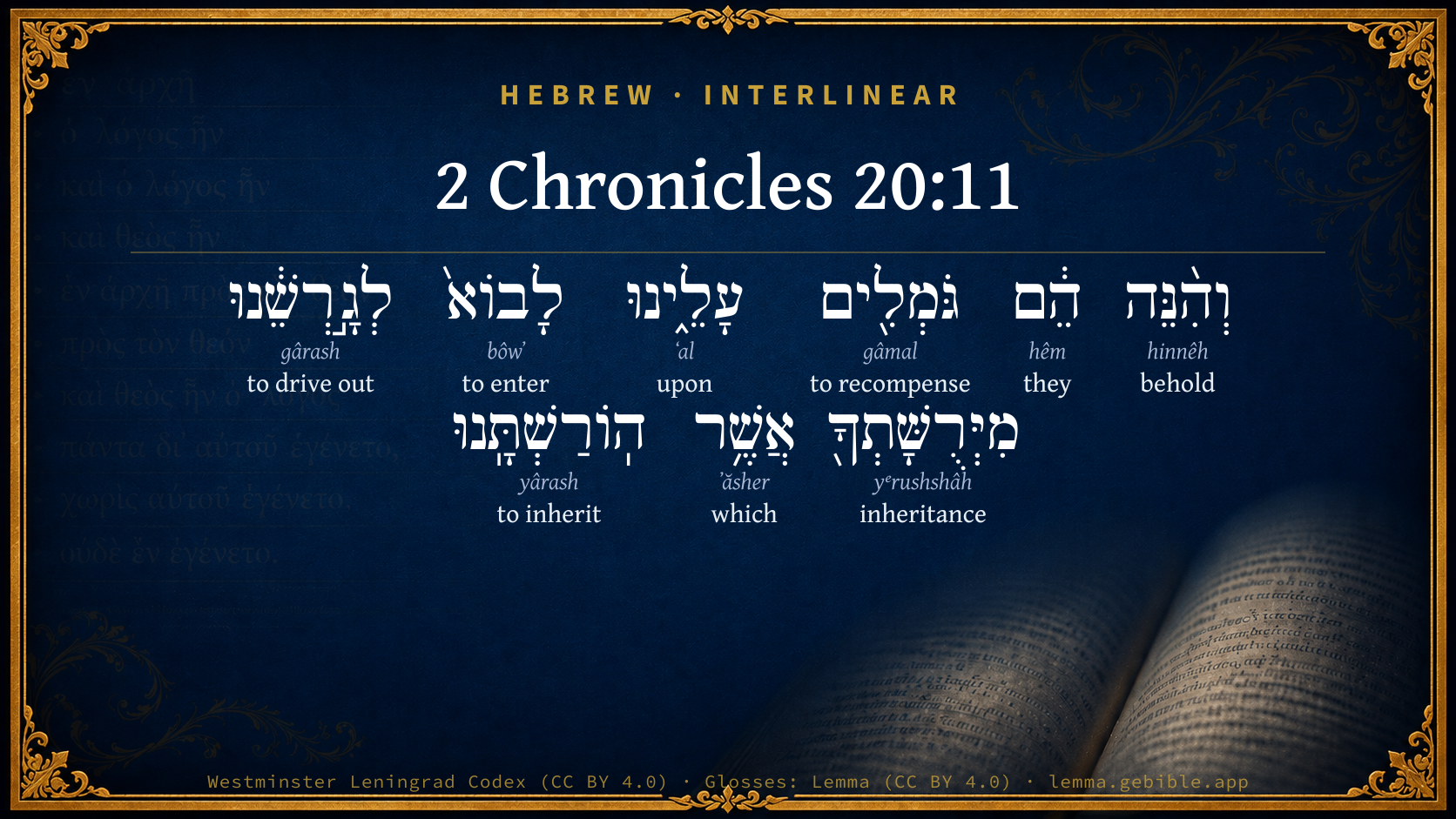
2 Chronicles 20:11

Hebrew (Westminster Leningrad Codex) 2 Chronicles 20:11 appears in the Hebrew Old Testament. The text above is from the Westminster Leningrad Codex. Each word links to its Strong’s number, a concise gloss, and parsing drawn from the Open Scriptures Hebrew Bible morphology. Click any word for its full Brown-Driver-Briggs (BDB) entry.
Download image
Cite this verse

2 Chronicles 20:11 (World English Bible). Public Domain. Lemma interlinear Bible study tool, https://lemma.gebible.app/v/2-chronicles/20/11.

Show BibTeX & RIS
BibTeX
RIS
English Translation
behold, how they reward us, to come to cast us out of your possession, which you have given us to inherit.
World English Bible · Public Domain
Download a study sheet

One document with this verse’s original text, its word-by-word gloss line, the meaning frame, cross-references with their text, attributed commentary, and full source and license credits — printable, and it pastes into notes with its structure intact.

This verse Autodidact and up

Study sheet (.html) Plain text (.txt)

A passage Seminary Student

Up to 50 verses in one chapter. A passage sheet keeps up to 6 commentary sources and 12 cross-references per verse, in the order this page ranks them, and says so on the sheet whenever that leaves anything out. Ask for a single verse and you get the Autodidact verse sheet above.

Everything on this page stays free to read, with no account — the sheet is a download of what is already on screen, not access to it.

Want to remove ads? Support Godless Engineer
Compare translations 3

The same verse in 3 English versions, stacked beneath the original-language interlinear above. Click any original word for its lexicon entry.

Each is an independent rendering of the whole verse — the interlinear is not word-aligned to these translations.

Highlighted words mark where these versions differ — a whole-verse word diff, not a word-by-word alignment.

  • World English Bible Public Domain
    behold, how they reward us, to come to cast us out of your possession, which you have given us to inherit.
  • King James Version Public Domain
    Behold, I say, how they reward us, to come to cast us out of thy possession, which thou hast given us to inherit.
  • unfoldingWord Literal Text CC BY-SA 4.0
    And behold they are repaying us, to come to drive us out from your possession which you caused us to possess.

unfoldingWord Literal Text — © unfoldingWord, licensed CC BY-SA 4.0. Word-aligned USFM3 via Door43 (git.door43.org/unfoldingWord/en_ult).

Versions to compare (up to 4)

3 of 4 selected

Show all 18 translations

Every available English version of this verse, each an independent rendering of the whole verse.

  • World English Bible Public Domain
    behold, how they reward us, to come to cast us out of your possession, which you have given us to inherit.
  • Berean Standard Bible Public Domain
    See how they are repaying us by coming to drive us out of the possession that You gave us as an inheritance.
  • Majority Standard Bible Public Domain
    See how they are repaying us by coming to drive us out of the possession that You gave us as an inheritance.
  • King James Version Public Domain
    Behold, I say, how they reward us, to come to cast us out of thy possession, which thou hast given us to inherit.
  • American Standard Version (1901) Public Domain
    behold, how they reward us, to come to cast us out of thy possession, which thou hast given us to inherit.
  • Revised Version (1885) Public Domain
    behold, how they reward us, to come to cast us out of thy possession, which thou hast given us to inherit.
  • Geneva Bible (1599) Public Domain
    Behold, I say, they reward vs, in comming to cast vs out of thine inheritance, which thou hast caused vs to inherit.
  • Douay-Rheims (1899) Public Domain
    Do the contrary, and endeavour to cast us out of the possession which thou hast delivered to us.
  • Young's Literal Translation Public Domain
    and lo, they are recompensing to us -- to come in to drive us out of Thy possession, that Thou hast caused us to possess.
  • Literal Standard Version CC BY-SA 4.0
    and behold, they are repaying to us—to come to drive us out of Your possession that You have caused us to possess.
  • Unlocked Literal Bible CC BY-SA 4.0
    See how they are rewarding us; they are coming to drive us out of your land that you have given us to inherit.
  • unfoldingWord Literal Text CC BY-SA 4.0
    And behold they are repaying us, to come to drive us out from your possession which you caused us to possess.
  • Darby Bible Public Domain
    behold, they reward us, in coming to cast us out of thy possession, which thou hast given us to possess.
  • World Messianic Bible Public Domain
    behold, how they reward us, to come to cast us out of your possession, which you have given us to inherit.
  • Webster's Bible Public Domain
    Behold, I say, how they reward us, to come to cast us out of thy possession, which thou hast given us to inherit.
  • Free Bible Version CC BY-SA 4.0
    See how they're rewarding us, coming to steal the land you gave us to possess forever!
  • Bible in Basic English Public Domain
    See now, how as our reward they have come to send us out of your land which you have given us as our heritage.
  • JPS Tanakh (1917) Public Domain
    behold, they render unto us evil, to come to cast us out of Thy possession, which Thou hast given us to inherit.

Literal Standard Version (2020), Covenant Press — licensed CC BY-SA 4.0. Text via the HelloAO Bible API (eBible.org). Unlocked Literal Bible (unfoldingWord) — licensed CC BY-SA 4.0. Text via the HelloAO Bible API (eBible.org). unfoldingWord Literal Text — © unfoldingWord, licensed CC BY-SA 4.0. Word-aligned USFM3 via Door43 (git.door43.org/unfoldingWord/en_ult). Free Bible Version, Dr. Jonathan Gallagher — licensed CC BY-SA 4.0. Text via the HelloAO Bible API (eBible.org).

Word by word

More ways to search: Search by grammar → Find every occurrence → Compare this word →

Practice this passage: Drill this verse → Learn its vocabulary →

מִיְּרֻשָּׁתְךָ֖
yᵉrushshâh
H3425
“from · inheritance · your”
Preposition + Noun, Common, Feminine, Singular, Construct + Suffix, Personal, 2nd Person, Masculine, Singular
Part of Speech
Preposition + Noun
Type
Common
Gender
Feminine
Number
Singular
State
Construct
Full BDB Definition

Origin: from H3423

TWOT: 920b

possession, inheritance
  1. וְהִ֨נֵּה hinnêh H2009 “and · behold” Conjunction + Particle, Demonstrative
  2. הֵ֔ם hêm H1992 “they” Pronoun, Personal, 3rd Person, Masculine, Plural
  3. גֹּמְלִ֖ים gâmal H1580 “recompensing” Verb, Qal, Participle Active, Masculine, Plural, Absolute
  4. עָלֵ֑ינוּ ʻal H5921 “upon · us” Preposition + Suffix, Personal, 1st Person, Common, Plural
  5. לָבוֹא֙ bôwʼ H935 “to enter” Preposition + Verb, Qal, Infinitive Construct
  6. לְגָ֣רְשֵׁ֔נוּ gârash H1644 “to drive out · us” Preposition + Verb, Piel, Infinitive Construct + Suffix, Personal, 1st Person, Common, Plural
  7. אֲשֶׁ֥ר ʼăsher H834 “which” Particle, Relative
  8. הֽוֹרַשְׁתָּֽנוּ yârash H3423 “to inherit · us” Verb, Hiphil, Perfect, 2nd Person, Masculine, Singular + Suffix, Personal, 1st Person, Common, Plural

About this verse

These counts appear in no published source. They are computed here, from the morphology-tagged text and Lemma’s own curated glosses. What Lemma adds →

9
words
9
distinct lemmas
Historical
section

Notable vocabulary

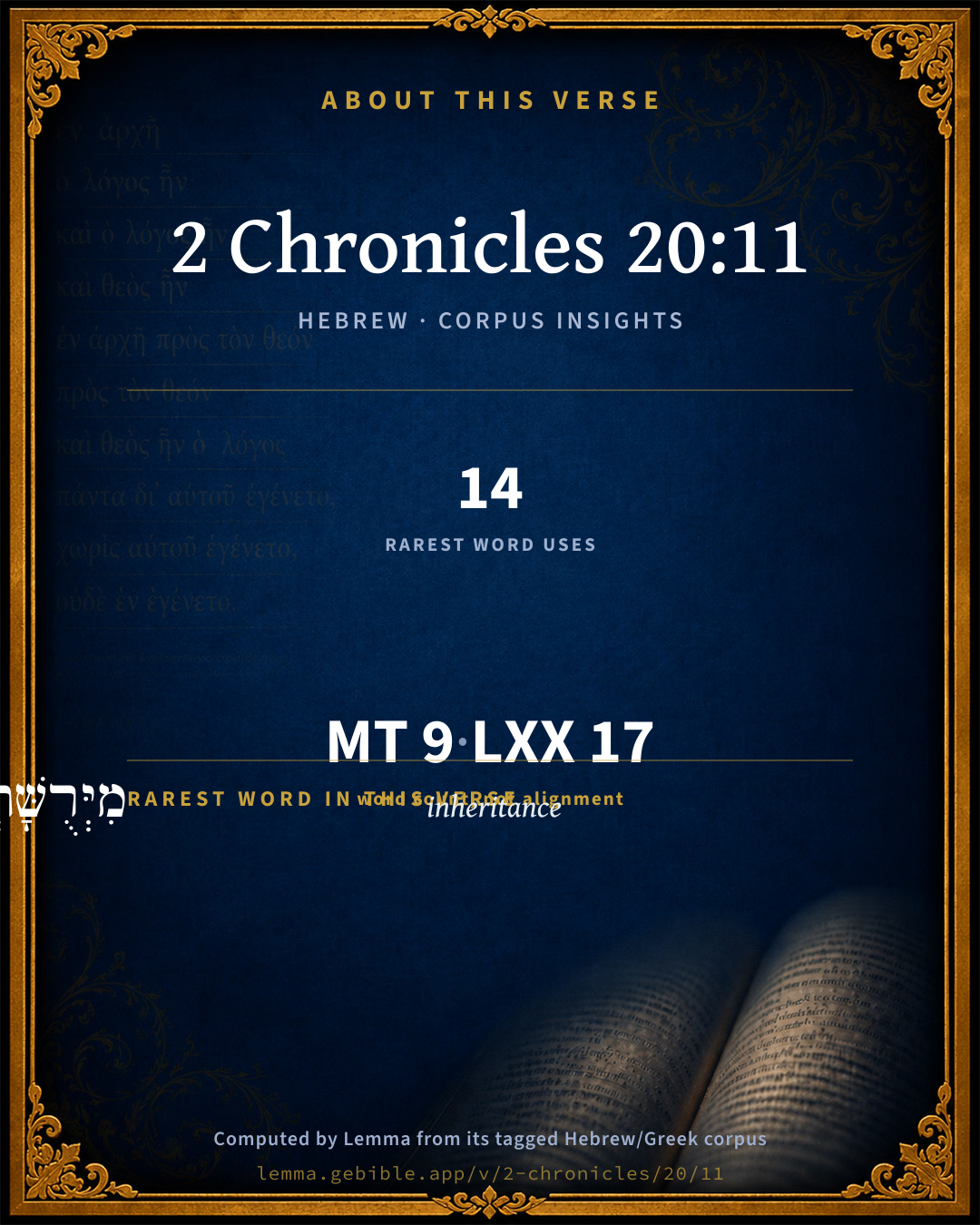
The rarest word here is מִיְּרֻשָּׁתְךָ֖ inheritance H3425 — appearing just 14 times in the whole Hebrew Bible.

Shared distinctive vocabulary

מִיְּרֻשָּׁתְךָ֖ inheritance H3425 occurs in 12 verses of the Hebrew Bible. Also found in:

Grammatical profile

  • 4 verbs
  • 1 noun
  • 1 pronoun
  • 1 preposition
  • 2 particles

Verb forms

  • גֹּמְלִ֖ים Qal · Participle Active
  • לָבוֹא֙ Qal · Infinitive Construct
  • לְגָ֣רְשֵׁ֔נוּ Piel · Infinitive Construct
  • הֽוֹרַשְׁתָּֽנוּ Hiphil · Perfect

Hebrew & Septuagint length

In English translation the verse runs 21 words from the Hebrew and 22 from the Septuagint (LXX English) — closely comparable.

A rough comparison of the two English renderings, which tokenize alike — not a word-level alignment.

Word counts can differ between the Hebrew and the Greek without any difference in meaning — e.g. the Hebrew direct-object marker אֵת has no separate Greek word, and Greek often adds the article ὁ.

In the original languages it is 9 Hebrew tokens and 17 Greek tokens — but the two are counted differently (Hebrew bundles its prefixes and suffixes into one token; the Greek is in lemma form), so that isn’t a like-for-like length.

Cross-references

7

Topical passages linked to 2 Chronicles 20:11 in the Treasury of Scripture Knowledge — connected by theme and wording, ordered by reader-vote popularity; previews shown in the World English Bible.

  • Psalms 83:3–12 They conspire with cunning against your people. They plot against your cherished ones.
  • Genesis 44:4 When they had gone out of the city, and were not yet far off, Joseph said to his steward, "Up, follow after the men. When you overtake them, ask them, 'Why have you rewarded evil for good?
  • Judges 11:23–24 So now Yahweh, the God of Israel, has dispossessed the Amorites from before his people Israel, and should you possess them?
  • Psalms 7:4 If I have rewarded evil to him who was at peace with me (Yes, I have delivered him who without cause was my adversary),
  • Psalms 35:12 They reward me evil for good, To the bereaving of my soul.
  • Proverbs 17:13 Whoever rewards evil for good, Evil shall not depart from his house.
  • Jeremiah 18:20 Shall evil be recompensed for good? for they have dug a pit for my soul. Remember how I stood before you to speak good for them, to turn away your wrath from them.

Cross-references courtesy of OpenBible.info (CC BY 4.0).

Hebrew and Greek witnesses Masoretic Hebrew ↔ Greek Septuagint

The same verse in the two great witnesses to the Old Testament, shown verse-for-verse.

These are two independent witnesses, not word-aligned to each other, and the Septuagint is shown in lemma (dictionary) form.

Hebrew 2 Chronicles 20:11 Masoretic · Westminster Leningrad Codex

וְהִ֨נֵּה הֵ֔ם גֹּמְלִ֖ים עָלֵ֑ינוּ לָבוֹא֙ לְגָ֣רְשֵׁ֔נוּ מִיְּרֻשָּׁתְךָ֖ אֲשֶׁ֥ר הֽוֹרַשְׁתָּֽנוּ

behold, how they reward us, to come to cast us out of your possession, which you have given us to inherit.

World English Bible · Public Domain

Greek LXX 2 Chronicles 20:11 Septuagint · lemma form

καί νῦν ἰδού αὐτός ἐπιχειρέω ἐπί ἐγώ ἐκἔρχομαι ἐκβάλλω ἐγώ ἀπό ὁ κληρονομία ἐγώ ὅς δίδωμι ἐγώ

yet now, behold, they make attempts against us, to come forth to cast us out from our inheritance which you gave us.

LXX2012 (modern English Septuagint) · Public Domain

Hebrew: Westminster Leningrad Codex (CC BY 4.0). Greek: Septuagint (public domain); English from LXX2012 (modern English Septuagint) (Public Domain). How the Septuagint differs from the Hebrew →

Commentary

Notes on 2 Chronicles 20:11 from classic Christian and Jewish commentators (each source and its license shown beneath its notes). The classic Christian expositions comment on the surrounding passage and are grouped to its opening verse, so a note may address several verses; the Jewish commentaries on the Tanakh (Rashi and others) are per-verse, so they appear only where the commentator wrote on this verse.

Lemma curates 59 commentaries, every one of them public domain or Creative Commons licensed, each selected and text-cleaned for this edition rather than reprinted as found. About our sources →

Trapp's Complete Commentary

John Trapp

2Ch 20:11 Behold, [I say, how] they reward us, to come to cast us out of thy possession, which thou hast given us to inherit.

Ver. 11. Behold, I say, how they reward us.] See the indignity of the fact, and avenge it. To render evil for evil is brutish; but evil for good is devilish.

John Trapp, A Commentary or Exposition upon All the Books of the Old and New Testament (1647–1656) — public domain. Text from a community e-Sword module.

Adam Clarke's Commentary

Verse 11. They reward us] Six of Kennicott's and De Rossi's MSS. add רעה evil: "Behold, they reward us EVIL." This is also the reading of the Targum.

Adam Clarke's Commentary on the Bible (1810–1826) — public domain. Text from a community e-Sword/MySword module.

Ellicott's Commentary for English Readers

(11) Behold, I say, how they reward us.—Literally, and behold they are requiting us by coming, &c. (Comp. Psa_83:4-9.)

Cast.—Drive out (Gen_3:24).

Thy possession.—The Promised Land is so called nowhere else in the Old Testament.

Thou hast given us to inherit.—Made us possess. (Comp. Jdg_11:24.)

A Bible Commentary for English Readers, edited by Charles John Ellicott (1878–1897) — public domain. Text from a community e-Sword module.

The Cambridge Bible for Schools and Colleges

gen. ed. J. J. S. Perowne

11. thy possession] A “possession” means that which one takes possession of by the sword. Canaan is God’s “possession” because it was conquered by His arm (Psa_44:3).

The Cambridge Bible for Schools and Colleges (gen. ed. J. J. S. Perowne; Cambridge University Press, 1878–1918) — public domain. Text from a community e-Sword module.

John Gill's Exposition

Behold, I say, how they reward us,.... Evil for good:

to come to cast us out of thy possession, which thou hast given us to inherit; the land of Canaan was their inheritance, an inheritance given them by God, their covenant God and Father, who had a right to dispose of it; and yet so given, that it was still his possession, he was the Lord and Proprietor, they but tenants under him; all which, as they were so many aggravations of the guilt of their enemies, so they were so many arguments with the Lord to protect them.

John Gill's Exposition of the Whole Bible (1746–1763) — public domain (CC PDM 1.0). Text via the HelloAO Bible API.

Haydock's Catholic Bible Commentary

CHAPTER XX.

George Leo Haydock (1774–1849), Haydock's Catholic Family Bible and Commentary, 1859 edition — public domain. Excludes Psalms (Douay-Rheims chapter numbering differs from Protestant) and Deuterocanonical books (Catholic canon only).

Rashi

Rabbi Shlomo Yitzchaki (Rashi)

to drive us out of Your inheritance, which You caused us to inherit You Yourself. Therefore, on what basis can they contest our inheritance?

Rashi on the Tanakh — English translations: “The Judaica Press complete Tanach with Rashi, translated by A. J. Rosenberg” (CC BY 4.0); “Pentateuch with Rashi's commentary by M. Rosenbaum and A.M. Silbermann, 1929-1934” (public domain); “The Metsudah Tanach series, Lakewood, N.J” (CC BY 4.0); and “The Book of Joshua, Metsudah Publications, 1997” (CC BY 4.0). Text via Sefaria.

Lesson kit

Teaching starters — assembled from the data on this page, not authored interpretation. Every prompt links to the verse data it draws on. Edit before teaching.

2 Chronicles, in the Historical, opens this verse with 9 words (9 distinct Hebrew lemmas). Its most distinctive word is yᵉrushshâh (“inheritance”). A historical commentator’s framing appears above. Read the whole chapter for the surrounding context.

Discussion questions

  1. How does “inheritance” (yᵉrushshâh) shape what this verse is saying?
  2. Deuteronomy 2:5 shares the word «inheritance» with this verse. How do the two illuminate each other?
  3. The translations on this page render this verse differently — a whole-verse word diff, not a word-by-word alignment. What might account for the different wordings?
  4. The verb «גֹּמְלִ֖ים» is Qal Participle Active. How does its form color the action?
  5. Reading how Trapp's Complete Commentary and Adam Clarke's Commentary read this verse, where do the two commentators agree and where do they part?

Things to notice

Reading settings

Reading text

Shown beneath each verse's original-language words.

Old Testament
Old Testament edition

Read the OT as the Masoretic Hebrew (MT) or the Greek Septuagint (LXX).

English shown for the Greek Septuagint (in the Hebrew ↔ Greek comparison).

Comparing translations? Open the Compare panel on any verse page to stack up to four side by side.