
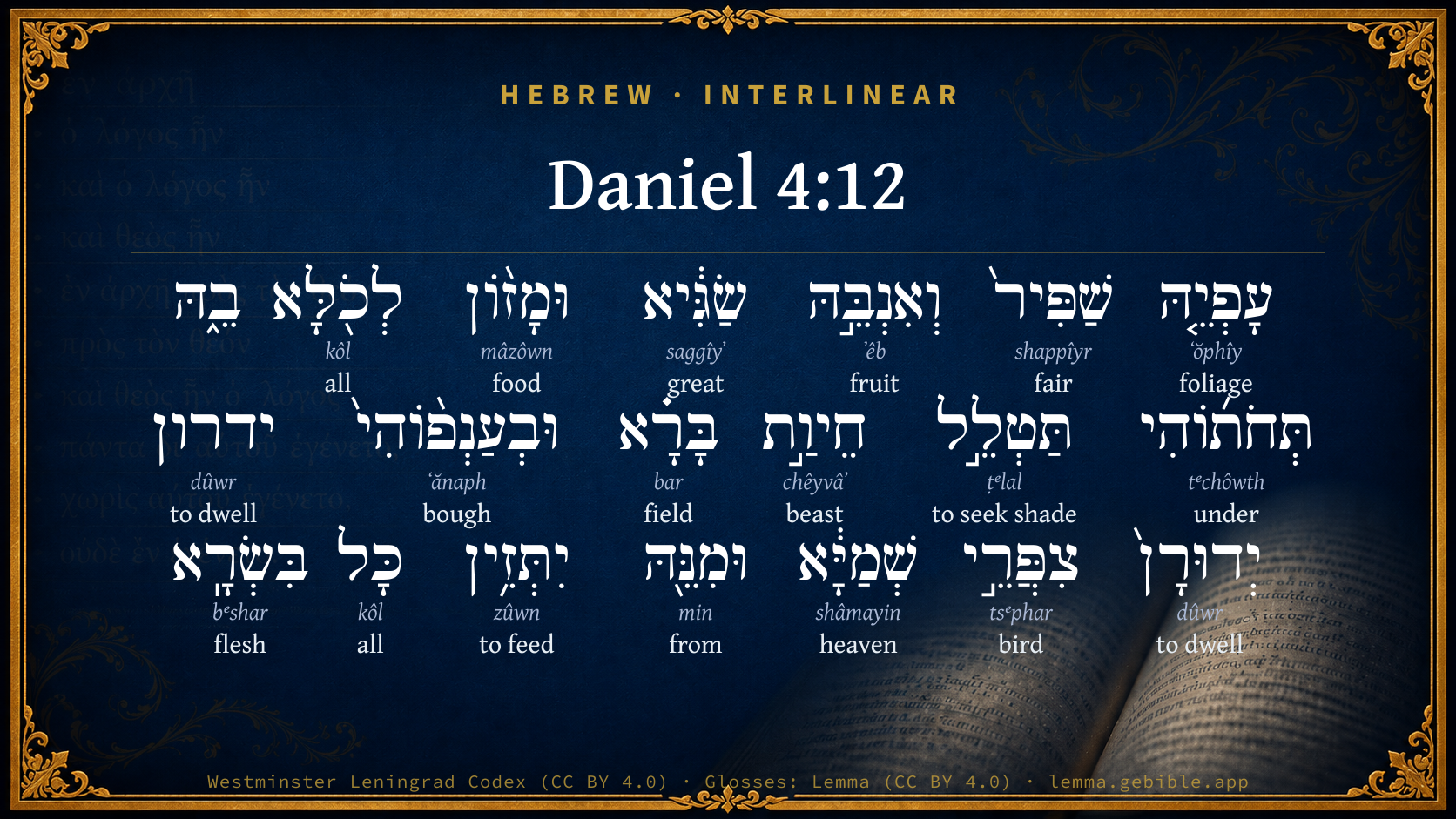
Daniel 4:12

Hebrew (Westminster Leningrad Codex) Daniel 4:12 appears in the Hebrew Old Testament. The text above is from the Westminster Leningrad Codex. Each word links to its Strong’s number, a concise gloss, and parsing drawn from the Open Scriptures Hebrew Bible morphology. Click any word for its full Brown-Driver-Briggs (BDB) entry.
Download image
Cite this verse

Daniel 4:12 (World English Bible). Public Domain. Lemma interlinear Bible study tool, https://lemma.gebible.app/v/daniel/4/12.

Show BibTeX & RIS
BibTeX
RIS
English Translation
The leaves of it were beautiful, and the fruit of it much, and in it was food for all: the animals of the field had shadow under it, and the birds of the sky lived in the branches of it, and all flesh was fed from it.
World English Bible · Public Domain
Highlights
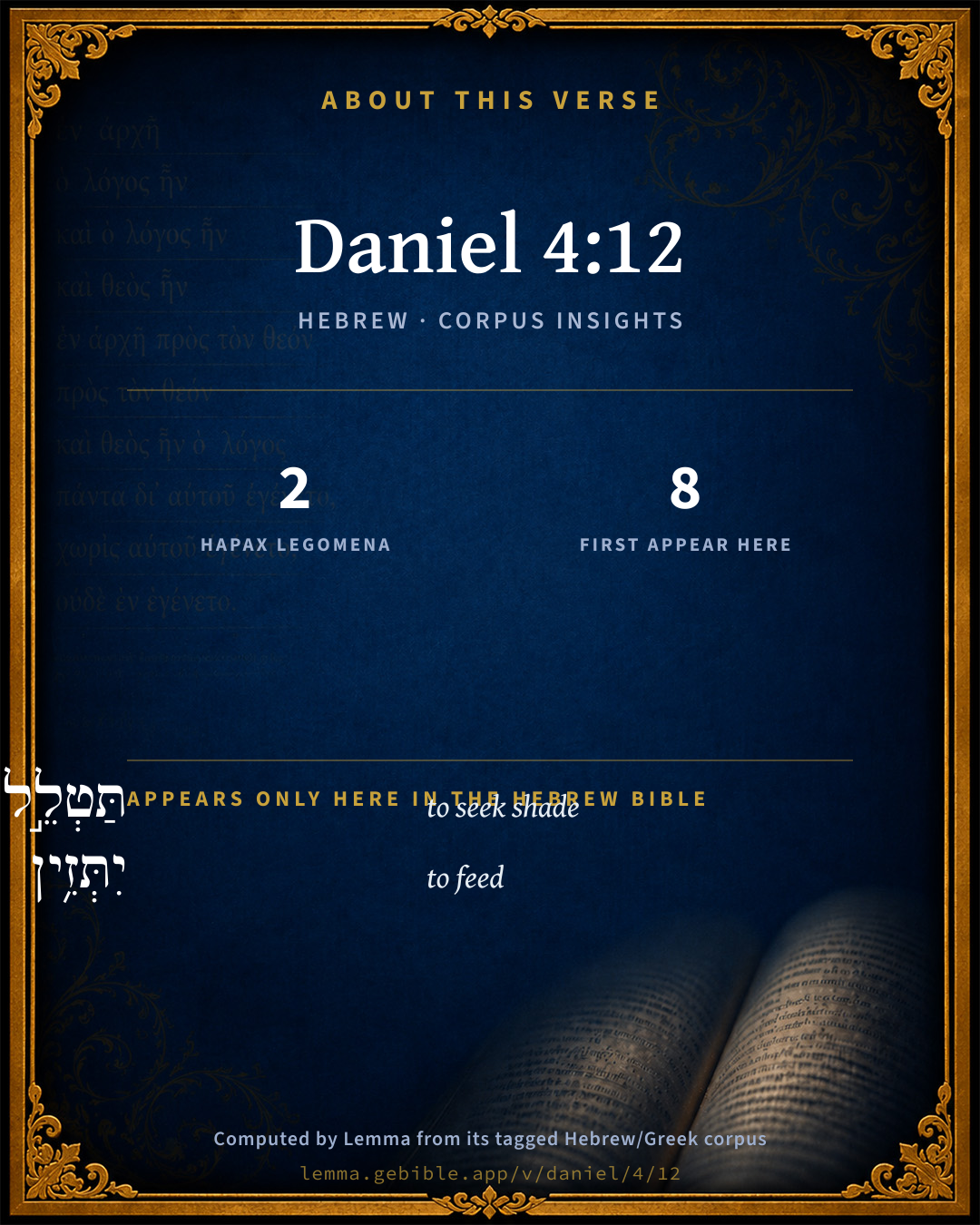
  • 2 hapax legomena — only here in the Hebrew Bible
  • 8 first appearances in the Hebrew Bible
Full analysis ↓
Download a study sheet

One document with this verse’s original text, its word-by-word gloss line, the meaning frame, cross-references with their text, attributed commentary, and full source and license credits — printable, and it pastes into notes with its structure intact.

This verse Autodidact and up

Study sheet (.html) Plain text (.txt)

A passage Seminary Student

Up to 50 verses in one chapter. A passage sheet keeps up to 6 commentary sources and 12 cross-references per verse, in the order this page ranks them, and says so on the sheet whenever that leaves anything out. Ask for a single verse and you get the Autodidact verse sheet above.

Everything on this page stays free to read, with no account — the sheet is a download of what is already on screen, not access to it.

Want to remove ads? Support Godless Engineer
Compare translations 3

The same verse in 3 English versions, stacked beneath the original-language interlinear above. Click any original word for its lexicon entry.

Each is an independent rendering of the whole verse — the interlinear is not word-aligned to these translations.

Highlighted words mark where these versions differ — a whole-verse word diff, not a word-by-word alignment.

  • World English Bible Public Domain
    The leaves of it were beautiful, and the fruit of it much, and in it was food for all: the animals of the field had shadow under it, and the birds of the sky lived in the branches of it, and all flesh was fed from it.
  • King James Version Public Domain
    The leaves thereof were fair, and the fruit thereof much, and in it was meat for all: the beasts of the field had shadow under it, and the fowls of the heaven dwelt in the boughs thereof, and all flesh was fed of it.
  • unfoldingWord Literal Text CC BY-SA 4.0
    Its leaves were beautiful, its fruit was abundant, and in it was food for all. The animals of the field found shade under it, and the birds of the heavens lived in its branches. All flesh was fed from it.

unfoldingWord Literal Text — © unfoldingWord, licensed CC BY-SA 4.0. Word-aligned USFM3 via Door43 (git.door43.org/unfoldingWord/en_ult).

Versions to compare (up to 4)

3 of 4 selected

Show all 18 translations

Every available English version of this verse, each an independent rendering of the whole verse.

  • World English Bible Public Domain
    The leaves of it were beautiful, and the fruit of it much, and in it was food for all: the animals of the field had shadow under it, and the birds of the sky lived in the branches of it, and all flesh was fed from it.
  • Berean Standard Bible Public Domain
    Its leaves were beautiful, its fruit was abundant, and upon it was food for all. Under it the beasts of the field found shelter, in its branches the birds of the air nested, and from it every creature was fed.
  • Majority Standard Bible Public Domain
    Its leaves were beautiful, its fruit was abundant, and upon it was food for all. Under it the beasts of the field found shelter, in its branches the birds of the air nested, and from it every creature was fed.
  • King James Version Public Domain
    The leaves thereof were fair, and the fruit thereof much, and in it was meat for all: the beasts of the field had shadow under it, and the fowls of the heaven dwelt in the boughs thereof, and all flesh was fed of it.
  • American Standard Version (1901) Public Domain
    The leaves thereof were fair, and the fruit thereof much, and in it was food for all: the beasts of the field had shadow under it, and the birds of the heavens dwelt in the branches thereof, and all flesh was fed from it.
  • Revised Version (1885) Public Domain
    The leaves thereof were fair, and the fruit thereof much, and in it was meat for all: the beasts of the field had shadow under it, and the fowls of the heaven dwelt in the branches thereof, and all flesh was fed of it.
  • Geneva Bible (1599) Public Domain
    Neuerthelesse leaue the stumpe of his rootes in the earth, and with a band of yron and brasse binde it among the grasse of the fielde, and let it be wet with the dewe of heauen, and let his portion be with the beastes among the grasse of the fielde.
  • Douay-Rheims (1899) Public Domain
    Its leaves were most beautiful, and its fruit exceeding much: and in it was food for all: under it dwelt cattle, and beasts, and in the branches thereof the fowls of the air had their abode: and all flesh did eat of it.
  • Young's Literal Translation Public Domain
    its leaves `are' fair, and its budding great, and food for all `is' in it: under it take shade doth the beast of the field, and in its boughs dwell do the birds of the heavens, and of it fed are all flesh.
  • Literal Standard Version CC BY-SA 4.0
    its leaves [are] beautiful, and its budding great, and food for all [is] in it: under it the beast of the field takes shade, and in its boughs dwell the birds of the heavens, and of it are all flesh fed.
  • Unlocked Literal Bible CC BY-SA 4.0
    Its leaves were beautiful, its fruit was abundant, and on it was food for all. The wild animals found shade under it, and the birds of the heavens lived in its branches. All living creatures were fed from it.
  • unfoldingWord Literal Text CC BY-SA 4.0
    Its leaves were beautiful, its fruit was abundant, and in it was food for all. The animals of the field found shade under it, and the birds of the heavens lived in its branches. All flesh was fed from it.
  • Darby Bible Public Domain
    Its leaves were beautiful, and its fruit abundant, and in it was food for all: the beasts of the field found shade under it, and the birds of the heavens dwelt in its branches, and all flesh was fed from it.
  • World Messianic Bible Public Domain
    Its leaves were beautiful, and it had much fruit, and in it was food for all. The animals of the field had shade under it, and the birds of the sky lived in its branches, and all flesh was fed from it.
  • Webster's Bible Public Domain
    Its leaves were fair, and its fruit abundant, and in it was food for all: the beasts of the field had shade under it, and the fowls of heaven dwelt among its boughs, and all flesh was fed from it.
  • Free Bible Version CC BY-SA 4.0
    Its leaves were beautiful, and it was full of fruit for all to eat. Wild animals rested in its shade, and birds nested in its branches. It fed all living creatures.
  • Bible in Basic English Public Domain
    Its leaves were fair and it had much fruit, and in it was food enough for all: the beasts of the field had shade under it, and the birds of heaven were resting in its branches, and it gave food to all living things.
  • JPS Tanakh (1917) Public Domain
    (4-9) The leaves thereof were fair, and the fruit thereof much, and in it was food for all; the beasts of the field had shadow under it, and the fowls of the heaven dwelt in the branches thereof, and all flesh was fed of it.

Literal Standard Version (2020), Covenant Press — licensed CC BY-SA 4.0. Text via the HelloAO Bible API (eBible.org). Unlocked Literal Bible (unfoldingWord) — licensed CC BY-SA 4.0. Text via the HelloAO Bible API (eBible.org). unfoldingWord Literal Text — © unfoldingWord, licensed CC BY-SA 4.0. Word-aligned USFM3 via Door43 (git.door43.org/unfoldingWord/en_ult). Free Bible Version, Dr. Jonathan Gallagher — licensed CC BY-SA 4.0. Text via the HelloAO Bible API (eBible.org).

Word by word

More ways to search: Search by grammar → Find every occurrence → Compare this word →

Practice this passage: Drill this verse → Learn its vocabulary →

תַּטְלֵ֣ל
ṭᵉlal
H2927
“to seek shade”
Adjective, V
Part of Speech
Adjective
Full BDB Definition

Origin: corresponding to H2926

TWOT: 2756

(Aphel) to seek shade, have shade
  1. עָפְיֵ֤הּ ʻŏphîy H6074 “foliage · his” Adjective, N, Common + Suffix, Personal, 3rd Person, Masculine, Singular
  2. שַׁפִּיר֙ shappîyr H8209 “fair” Adjective, A
  3. וְאִנְבֵּ֣הּ ʼêb H4 “and · fruit · his” Adjective, C + Noun, Common, Masculine, Singular, Construct + Suffix, Personal, 3rd Person, Masculine, Singular
  4. שַׂגִּ֔יא saggîyʼ H7690 “great” Adjective, A
  5. וּמָז֨וֹן mâzôwn H4203 “and · food” Adjective, C + Noun, Common, Masculine, Singular, Absolute
  6. לְכֹ֖לָּא kôl H3606 “to/for · all · the” Adjective, R + Noun, Common, Masculine, Singular, Determined + Particle, Definite Article
  7. תְּחֹת֜וֹהִי tᵉchôwth H8460 “under · him” Adjective, R + Suffix, Personal, 3rd Person, Masculine, Singular
  8. חֵיוַ֣ת chêyvâʼ H2423 “beast of” Adjective, N, Common
  9. בָּרָ֗א bar H1251 “field · the” Adjective, N, Common + Particle, Definite Article
  10. וּבְעַנְפ֨וֹהִי֙ ʻănaph H6056 “and · in/at · boughs · his” Adjective, C + Preposition + Noun, Common, Masculine, Plural, Construct + Suffix, Personal, 3rd Person, Masculine, Singular
  11. ידרון dûwr H1753 “to dwell” Adjective, V
  12. יְדוּרָן֙ dûwr H1753 “to dwell” Adjective, V
  13. צִפֲּרֵ֣י tsᵉphar H6853 “birds of” Adjective, N, Common
  14. שְׁמַיָּ֔א shâmayin H8065 “heaven(s) · the” Adjective, N, Common + Particle, Definite Article
  15. וּמִנֵּ֖הּ min H4481 “and · from · him” Adjective, C + Preposition + Suffix, Personal, 3rd Person, Masculine, Singular
  16. יִתְּזִ֥ין zûwn H2110 “to feed” Adjective, V
  17. כָּל kôl H3606 “all of” Adjective, N, Common
  18. בִּשְׂרָֽא bᵉshar H1321 “flesh · the” Adjective, N, Common + Particle, Definite Article

About this verse

These counts appear in no published source. They are computed here, from the morphology-tagged text and Lemma’s own curated glosses. What Lemma adds →

20
words
17
distinct lemmas
Prophets
section

Notable vocabulary

2 hapax legomena — words that appear only here in the entire Hebrew Bible:

  • תַּטְלֵ֣ל to seek shade H2927
  • יִתְּזִ֥ין to feed H2110

First appearance in Scripture

These words make their first canonical appearance in the Hebrew Bible here:

  • עָפְיֵ֤הּ foliage H6074
  • שַׁפִּיר֙ fair H8209
  • וְאִנְבֵּ֣הּ fruit H4
  • וּמָז֨וֹן food H4203
  • תַּטְלֵ֣ל to seek shade H2927
  • וּבְעַנְפ֨וֹהִי֙ bough H6056
  • צִפֲּרֵ֣י bird H6853
  • יִתְּזִ֥ין to feed H2110

Shared distinctive vocabulary

שַׁפִּיר֙ fair H8209 occurs in 2 verses of the Hebrew Bible. Also found in:

Grammatical profile

  • 3 nouns
  • 12 adjectives
  • 1 preposition
  • 4 particles

Repetition

Words recur within this verse — often emphatic in Hebrew:

  • לְכֹ֖לָּא all H3606 ×2
  • ידרון to dwell H1753 ×2

Hebrew & Septuagint length

In English translation the verse runs 47 words from the Hebrew and 50 from the Septuagint (LXX English) — closely comparable.

A rough comparison of the two English renderings, which tokenize alike — not a word-level alignment.

Word counts can differ between the Hebrew and the Greek without any difference in meaning — e.g. the Hebrew direct-object marker אֵת has no separate Greek word, and Greek often adds the article ὁ.

Cross-references

7

Topical passages linked to Daniel 4:12 in the Treasury of Scripture Knowledge — connected by theme and wording, ordered by reader-vote popularity; previews shown in the World English Bible.

  • Luke 13:19 It is like a grain of mustard seed, which a man took, and put in his own garden. It grew, and became a large tree, and the birds of the sky lodged in its branches."
  • Lamentations 4:20 The breath of our nostrils, the anointed of Yahweh, was taken in their pits; Of whom we said, Under his shadow we shall live among the nations.
  • Ezekiel 17:23 in the mountain of the height of Israel will I plant it; and it shall bring forth boughs, and bear fruit, and be a goodly cedar: and under it shall dwell all birds of every wing; in the shade of the branches of it shall they dwell.
  • Ezekiel 31:6–7 All the birds of the sky made their nests in its boughs; and under its branches did all the animals of the field bring forth their young; and under its shadow lived all great nations.
  • Jeremiah 27:6–7 Now have I given all these lands into the hand of Nebuchadnezzar the king of Babylon, my servant; and the animals of the field also have I given him to serve him.
  • Matthew 13:32 which indeed is smaller than all seeds. But when it is grown, it is greater than the herbs, and becomes a tree, so that the birds of the air come and lodge in its branches."
  • Mark 13:32 But of that day or that hour no one knows, not even the angels in heaven, nor the Son, but only the Father.

Cross-references courtesy of OpenBible.info (CC BY 4.0).

Hebrew and Greek witnesses Masoretic Hebrew ↔ Greek Septuagint

The same verse in the two great witnesses to the Old Testament, shown verse-for-verse.

These are two independent witnesses, not word-aligned to each other, and the Septuagint is shown in lemma (dictionary) form.

Hebrew Daniel 4:12 Masoretic · Westminster Leningrad Codex

עָפְיֵ֤הּ שַׁפִּיר֙ וְאִנְבֵּ֣הּ שַׂגִּ֔יא וּמָז֨וֹן לְכֹ֖לָּא בֵ֑הּ תְּחֹת֜וֹהִי תַּטְלֵ֣ל חֵיוַ֣ת בָּרָ֗א וּבְעַנְפ֨וֹהִי֙ ידרון יְדוּרָן֙ צִפֲּרֵ֣י שְׁמַיָּ֔א וּמִנֵּ֖הּ יִתְּזִ֥ין כָּל בִּשְׂרָֽא

The leaves of it were beautiful, and the fruit of it much, and in it was food for all: the animals of the field had shadow under it, and the birds of the sky lived in the branches of it, and all flesh was fed from it.

World English Bible · Public Domain

Greek LXX Daniel 4:12 Septuagint · lemma form

μεγάλως δέ θαυμάζω ὁ δανιηλ καί ὑπόνοια κατασπεύδω αὐτός καί φοβέω τρόμος λαμβάνω αὐτός καί ἀλλοιόω ὁ ὅρασις αὐτός κινέω ὁ κεφαλή ὥρα εἷς ἀποθαυμάζω ἀποκρίνω ἐγώ φωνή πραΰς βασιλεύς ὁ ἐνύπνιον οὗτος ὁ μισέω σύ καί ὁ σύγκρισις αὐτός ὁ ἐχθρός σύ ἐπιἔρχομαι

Only leave the stump of its roots in the earth, and bind it with an iron and brass band; and it shall lie in the grass that is without and in the dew of heaven, and its portion shall be with the wild beasts in the grass of the field.

LXX2012 (modern English Septuagint) · Public Domain

On this verse, The Pulpit Commentary discusses the Septuagint’s reading. Read the note in Commentary ↓

Hebrew: Westminster Leningrad Codex (CC BY 4.0). Greek: Septuagint (public domain); English from LXX2012 (modern English Septuagint) (Public Domain). How the Septuagint differs from the Hebrew →

Commentary

Notes on Daniel 4:12 from classic Christian and Jewish commentators (each source and its license shown beneath its notes). The classic Christian expositions comment on the surrounding passage and are grouped to its opening verse, so a note may address several verses; the Jewish commentaries on the Tanakh (Rashi and others) are per-verse, so they appear only where the commentator wrote on this verse.

Lemma curates 59 commentaries, every one of them public domain or Creative Commons licensed, each selected and text-cleaned for this edition rather than reprinted as found. About our sources →

Trapp's Complete Commentary

John Trapp

Dan 4:12 The leaves thereof [were] fair, and the fruit thereof much, and in it [was] meat for all: the beasts of the field had shadow under it, and the fowls of the heaven dwelt in the boughs thereof, and all flesh was fed of it.

Ver. 12. The leaves thereof were fair, and the fruit.] But because pride harboured under these leaves and poisoned these fair fruits, they were broken down and trod under foot.

The beasts of the field had shadow under it.] Great is the benefit of civil government, and far extending. But most men content themselves with a natural use of it, as beasts of the field do of their food, without improvement of any higher good.

John Trapp, A Commentary or Exposition upon All the Books of the Old and New Testament (1647–1656) — public domain. Text from a community e-Sword module.

Ibn Ezra

Rabbi Abraham ibn Ezra

[Daniel 4:12 (4:9 Heb)] But (בְּרַם): [Means] however/but (אַךְ - akh). Leave the stump of its roots in the ground (עִקַּ֤ר שׇׁרְש֙וֹהִי֙ בְּאַרְעָ֣א שְׁבֻ֔קוּ): [Meaning] Leave the stump of its roots in the earth, and let it stand among the grasses and among the vegetation (בֵּין הָעֲשָׂבִים וּבֵין הַדְּשָׁאִים - bein ha-asavim u-vein ha-desha'im). [This state of being left in the field, bound,] is like [the description of a captive king being] “bound... in fetters of bronze” (אָסוּר בַּנְחֻשְׁתַּיִם - asur ba-n'chushtayim) [cf. II Kings 25:7, Jeremiah 39:7, Jeremiah 52:11 regarding Zedekiah; II Chronicles 36:6 regarding Jehoiakim].

And let him be drenched with the dew (וּבְטַ֤ל... יִצְטַבַּ֔ע): [The word yitztaba means] he will be saturated/drenched (יִרְוֶה - yirveh).

Ibn Ezra on the Tanakh — English translations: “Sefaria Community Translation” (CC0 1.0 (public-domain dedication)); “Yalkut, Sifsei Chachomim Chumash, Metsudah Publications, 2009” (CC BY 4.0); and “Commentary of Ibn Ezra on Isaiah - trans. by M. Friedlander, 1873” (public domain). Text via Sefaria.

Jamieson, Fausset & Brown

Robert Jamieson, A. R. Fausset & David Brown

beasts . . . shadow under it--implying that God's purpose in establishing empires in the world is that they may be as trees affording men "fruits" for "meat," and a "shadow" for "rest" (compare Lam 4:20). But the world powers abuse their trust for self; therefore Messiah comes to plant the tree of His gospel kingdom, which alone shall realize God's purpose (Eze 17:23; Mat 13:32). HERODOTUS [7.19] mentions a dream (probably suggested by the tradition of this dream of Nebuchadnezzar in Daniel) which Xerxes had; namely, that he was crowned with olive, and that the branches of the olive filled the whole earth, but that afterwards the crown vanished from his head: signifying his universal dominion soon to come to an end.

Jamieson, Fausset & Brown — Commentary Critical and Explanatory on the Whole Bible (1871) — public domain (CC PDM 1.0). Text via the HelloAO Bible API.

John Calvin's Commentaries

It is now added, its height was great; then, it grew till it reached even to heaven, and its aspect extended itself to the furthest bounds of the land. This is restricted to the Babylonian monarchy, for there were then other empires in the world, but they were either powerless or but slightly important. The Chaldeans, also, were then so powerful that no prince could approach to such majesty and power. Since, therefore, King Nebuchadnezzar was so pre-eminent, the loftiness of the tree here described is not surprising, though it reached to heaven; while the altitude rendered it visible throughout the whole land. Some of the rabbis place Babylon in the middle of the earth, because it was under the same line or parallel with Jerusalem — which is very foolish. Those also who place Jerusalem in the center of the earth are equally childish; although Jerome, Origen, and other ancient authors, treat Jerusalem as in the center of the world. In this conjecture of theirs they deserve the laughter of the Cynic who, when asked to point out the middle of the earth:, touched the ground with his staff immediately under his feet! Then when the questioner objected to this determination of the center of the earth, he said,” Then do you measure the earth!” As far as concerns Jerusalem, their conjectures are not worth mentioning. That proud Barbinel [Abarbanel] wished to seem a philosopher, but nothing is more insipid than the Jews where they depart from their own rules of grammar; and the Lord so blinded them and delivered them up to a reprobate sense, when he wished them to be spectacles of horrible blindness and prodigious stupidity, — and in a small and minute matter that silly fellow shews his absurdity.

He now says, Its boughs were beautiful, and its fruit copious This must be referred to the common opinion of the vulgar; for we know men’s eyes to be dazzled by the splendor of princes. For if any one excels others in power, all men adore him and are seized with admiration, and are incapable of judging correctly. When the majesty of a general or a king comes before them, they are all astonished and perceive nothing, and they do not think it lawful for them to inquire strictly into the conduct of princes. Since, then, the power and wealth of King Nebuchadnezzar were so great, no wonder the Prophet says, His branches were beautiful, and their fruit copious But meanwhile we must remember what I lately said, namely, God’s blessing shines forth in princes, even if they materially neglect their duty, because God does not suffer all his grace in them to be extinguished; and hence they are compelled to bring forth some fruit. It is much better, therefore, to preserve the existence of some kind of dominion than to have all men’s condition equal, when each attracts the, eyes of his neighbors. And this is the meaning of what I have said—there was food and provision for all, as I have lately explained it.

John Calvin's Commentaries (1540-1563) — public domain. Text from the Calvin Translation Society English edition (1840s-50s) via the Christian Classics Ethereal Library (ccel.org). Calvin's coverage is partial (roughly two-thirds of the Bible); uncommented books and verses are honest gaps, never fabricated. The 19th-century editor's footnotes and remarks are omitted so the notes are faithfully Calvin's own voice.

Ellicott's Commentary for English Readers

(12) The fruit thereof much.—By this is implied the great quantity of fruit as well as the largeness of it.

A Bible Commentary for English Readers, edited by Charles John Ellicott (1878–1897) — public domain. Text from a community e-Sword module.

The Cambridge Bible for Schools and Colleges

gen. ed. J. J. S. Perowne

12. meat] in the old sense of the word (see on Amo_5:22; and cf. Gen_1:29-30), food in general, not what we now call ‘meat.’ So Dan_4:21. The Aram. word occurs in Syr. and the Targums; and twice in the Heb. of the O.T., Gen_45:23 (A.V. ‘meat,’ R.V. ‘victual’), 2Ch_11:23 (A.V., R.V. ‘victual’).

had shadow … dwelt … was fed of it] Better, were sheltering …, dwelling …, was being fed from it. The tenses of the original denote what was habitual, and therefore might be observed as taking place continuously at the time of the dream. Cf. for the thought Eze_31:6.

The Cambridge Bible for Schools and Colleges (gen. ed. J. J. S. Perowne; Cambridge University Press, 1878–1918) — public domain. Text from a community e-Sword module.

John Gill's Exposition

The leaves thereof were fair,.... Or "branches" (i), as some; and design either the provinces belonging to his empire, which were very large and flourishing; or the governors of them under him, as Saadiah, who made no small and contemptible figure; his princes were altogether kings:

and the fruit thereof much; great revenues from all parts of the empire were brought to him:

and in it was meat for all; the produce of the several countries, and the trade carried on in them, brought in a sufficient livelihood to all the inhabitants:

the beasts of the field had shadow under it; the inhabitants of the several Heathenish nations under him, and even those that were most savage, were protected in their lives and properties by him; so princes should be a screen, a protection to their subjects:

and the fowls of the heaven dwelt in the boughs thereof; which Saadiah interprets of the Israelites, in opposition to the foreign nations, comparable to the beasts of the field:

and all flesh was fed of it; all his subjects shared in the good things his victorious arms brought into his empire; all enriched, or however made comfortable, and had a sufficiency of food and raiment; so that there was no reason to complain of him as oppressive to his subjects.

(i) "ramus ejus", Pagninus, Montanus, Munster, Vatablus; "ramos ejus", Junius & Tremellius; "rami ejus", Piscator.

John Gill's Exposition of the Whole Bible (1746–1763) — public domain (CC PDM 1.0). Text via the HelloAO Bible API.

Albert Barnes' Notes on the Bible

The leaves thereof were fair - Were beautiful. That is, they were abundant, and green, and there were no signs of decay. Everything indicated a vigorous and healthy growth - a tree in its full beauty and majesty - a striking emblem of a monarch in his glory.

And the fruit thereof much - It was loaded with fruit - showing that the tree was in its full vigour.

And in it was meat for all - Food for all, for so the word meat was formerly used. This would indicate the dependence of the multitudes on him whom the tree represented, and would also denote that he was a liberal dispenser of his favors.

The beasts of the field had shadow under it - Found a grateful shade under it in the burning heat of noon - a striking emblem of the blessings of a monarchy affording protection, and giving peace to all under it.

And the fowls of the heaven dwelt in the boughs thereof - The fowls of the air. They built their nests and reared their young there undisturbed, another striking emblem of the protection afforded under the great monarchy designed to be represented.

And all flesh was fed of it - All animals; all that lived. It furnished protection, a home, and food for all. Bertholdt renders this, “all men.” In the Greek Codex Chisianus there is the following version or paraphrase given of this passage: “Its vision was great, its top reached to the heaven, and its breadth (κῦτος kutos) to the clouds - they filled the things (τὰ ta) under the heaven - there was a sun and moon, they dwelt in it, and enlightened all the earth.”

Albert Barnes' Notes on the Bible (1834–1885) — public domain. Text from a community e-Sword/MySword module.

Haydock's Catholic Bible Commentary

Let it, the tree, representing the king who was confined when he began to shew signs of madness: but he broke loose, and fled away. (Calmet)

George Leo Haydock (1774–1849), Haydock's Catholic Family Bible and Commentary, 1859 edition — public domain. Excludes Psalms (Douay-Rheims chapter numbering differs from Protestant) and Deuterocanonical books (Catholic canon only).

Matthew Poole's English Annotations

The fruit thereof much: this notes the public good and benefit of magistracy; so that it is better living under tyranny than anarchy, as Calvin saith.

Matthew Poole's English Annotations on the Holy Bible (1683–1685) — public domain. Text from a community e-Sword/MySword module.

The Pulpit Commentary

The leaves thereof were fair, and the fruit thereof much, and in it was meat for all: the beasts of the field had shadow under it, and the fowls of the heaven dwelt in the boughs thereof, and all flesh was fed of it. The Septuagint Version here is widely different: "Its branches were thirty furlongs in extent, and underneath its shadow all beasts of the earth took shelter, and in it the birds of heaven made their nests, and its fruit was much and good, and it supplied all living creatures." As already mentioned, this verse occurs before the one we have just been considering. It differs, like it, more than can be explained by a mistake in reading the Massoretic Aramaic; if it were translated from a cuneiform document, it is easily imaginable in what form the statement might be made. The reading, however, is not an unlikely one in the description of a dream, if we could have imagined the Indian banyan tree to have been known to the authors of this version, we might have understood the tree of the dream to have been like it. Theodotion is at one with the Massoretic text, as also the Peshitta. Whether we take the symbol of a tree used for the Babylonian empire, as drawn from the Babylonian tree of life, or merely devised by the poetic fancy of the monarch, inspired for the time, it must be recognized as very apt. From the Persian Gulf to the Mediterranean, it stretched from the cataracts of the Nile in all probability into Asia Minor. Over all this empire the monarch maintained the attitude of an earthly providence. It was because government was strong that peaceable men could live. It is useless to carry the similitude into the minutiae of Jephet-ibn-Ali, who maintains that the wild beasts are the nomads of the deserts, and the birds the strangers that came to Nebuchadnezzar from far. In the Aramaic here there are traces of the antiquity in the language: the use of inbbaya, "fruit," instead of ibbaya, is one instance. Saggeee (with sin) is a proof that the distinction between c and s was still understood, and probably beard. It is remarked by Keil that this word does not really mean "much," but rather "great," "strong." Although it is undeniable that he is correct as to the primitive meaning of the word, it can scarcely mean anything else than much" in the present connection. Mazon, "food," is rare as a Biblical word, but occurs in Genesis as well as Chronicles. Professor Bevan quotes Noldeke in favour of a Mandaean origin for it.

The Pulpit Commentary (1880–1919), ed. H.D.M. Spence-Jones & Joseph S. Exell — public domain. Text from a community e-Sword module.

Keil & Delitzsch

C. F. Keil & F. Delitzsch

At the same time the tree abounded with leaves and fruit, so that birds and beasts found shadow, protection, and nourishment from it. שׁגיא, neither great nor many, but powerful, expressing the quantity and the greatness of the fruit. The בּהּ the Masoretes have rightly connected with לכלּא, to which it is joined by Maqqeph. The meaning is not: food was in it, the tree had food for all (Hv., Maur., and others), but: (it had) food for all in it, i.e., dwelling within its district (Kran., Klief.). The words, besides, do not form an independent sentence, but are only a further view of the שׁגיא (Kran.), and return in the end of the verse into further expansion, while the first and the second clauses of the second hemistich give the further expansion of the first clause in the verse. אטלל, umbram captavit, enjoyed the shadow; in Targg. The Aphel has for the most part the meaning obumbravit. The Kethiv ידרוּן is not to be changed, since the צפּרין is gen. comm. The Keri is conform to Dan 4:18, where the word is construed as fem. The expression all flesh comprehends the beasts of the field and the fowls of heaven, but is chosen with reference to men represented under this image. For the tree, mighty, reaching even to the heavens, and visible over the whole earth, is an easily recognised symbol of a world-ruler whose power stretches itself over the whole earth. The description of the growth and of the greatness of the tree reminds us of the delineation of Pharaoh and his power under the figure of a mighty cedar of Lebanon, cf. Eze 31:3., also Eze 17:22., Eze 19:10. The comparison of the growth of men to the growth of the trees is every frequent in biblical and other writings.

Keil & Delitzsch — Biblical Commentary on the Old Testament (1861–1891) — public domain (CC PDM 1.0). Text via the HelloAO Bible API. (Old Testament only.)

Rashi

Rabbi Shlomo Yitzchaki (Rashi)

But leave its main roots in the ground but its main roots leave over.

and in fetters of iron and copper i.e., place his feet in iron fetters as is done to a horse that is left in the meadow; so shall you chain him with fetters.

in the grass Aram. בְדִתְאָא in the grass of the field, i.e., in the meadow, so that he should not move from there.

it shall be drenched Aram. יִצְטַבַּע, it shall always be drenched, an expression of immersion.

its lot [as translated,] its lot.

Rashi on the Tanakh — English translations: “The Judaica Press complete Tanach with Rashi, translated by A. J. Rosenberg” (CC BY 4.0); “Pentateuch with Rashi's commentary by M. Rosenbaum and A.M. Silbermann, 1929-1934” (public domain); “The Metsudah Tanach series, Lakewood, N.J” (CC BY 4.0); and “The Book of Joshua, Metsudah Publications, 1997” (CC BY 4.0). Text via Sefaria.

Lesson kit

Teaching starters — assembled from the data on this page, not authored interpretation. Every prompt links to the verse data it draws on. Edit before teaching.

Daniel, in the Prophets, opens this verse with 20 words (17 distinct Hebrew lemmas). Its most distinctive word is ṭᵉlal (“to seek shade”). A historical commentator’s framing appears above. Read the whole chapter for the surrounding context.

Discussion questions

  1. The word ṭᵉlal carries the sense “to seek shade.” How does it shape the verse?
  2. This verse holds 2 words here found nowhere else in the Hebrew Bible. What might the rare words draw attention to?
  3. 8 words here appear for the first time in Scripture. What is being introduced at this debut?
  4. Daniel 4:21 shares the word «fair» with this verse. How do the two illuminate each other?
  5. “all” occurs 2× in this one verse. What is the effect of the repetition?
  6. These translations render this verse differently. What is at stake in choosing one wording over another?
  7. Reading how Trapp's Complete Commentary and Ibn Ezra read this verse, where do the two commentators agree and where do they part?

Things to notice

  • 2 words in this verse appear nowhere else in the Hebrew Bible.
  • 8 words make their first canonical appearance in Scripture here.
  • These translations choose different wording for 22 words in this verse.
  • “all” occurs 2× in this single verse.
  • 17 distinct Hebrew lemmas span 20 words in this verse.

Reading settings

Reading text

Shown beneath each verse's original-language words.

Old Testament
Old Testament edition

Read the OT as the Masoretic Hebrew (MT) or the Greek Septuagint (LXX).

English shown for the Greek Septuagint (in the Hebrew ↔ Greek comparison).

Comparing translations? Open the Compare panel on any verse page to stack up to four side by side.