Hosea 2:11

Hebrew (Westminster Leningrad Codex) Hosea 2:11 appears in the Hebrew Old Testament. The text above is from the Westminster Leningrad Codex. Each word links to its Strong’s number, a concise gloss, and parsing drawn from the Open Scriptures Hebrew Bible morphology. Click any word for its full Brown-Driver-Briggs (BDB) entry.
Download image
Cite this verse

Hosea 2:11 (World English Bible). Public Domain. Lemma interlinear Bible study tool, https://lemma.gebible.app/v/hosea/2/11.

Show BibTeX & RIS
BibTeX
RIS
English Translation
I will also cause all her celebrations to cease: Her feasts, her new moons, her Sabbaths, and all her solemn assemblies.
World English Bible · Public Domain
Download a study sheet

One document with this verse’s original text, its word-by-word gloss line, the meaning frame, cross-references with their text, attributed commentary, and full source and license credits — printable, and it pastes into notes with its structure intact.

This verse Autodidact and up

Study sheet (.html) Plain text (.txt)

A passage Seminary Student

Up to 50 verses in one chapter. A passage sheet keeps up to 6 commentary sources and 12 cross-references per verse, in the order this page ranks them, and says so on the sheet whenever that leaves anything out. Ask for a single verse and you get the Autodidact verse sheet above.

Everything on this page stays free to read, with no account — the sheet is a download of what is already on screen, not access to it.

Want to remove ads? Support Godless Engineer
Compare translations 3

The same verse in 3 English versions, stacked beneath the original-language interlinear above. Click any original word for its lexicon entry.

Each is an independent rendering of the whole verse — the interlinear is not word-aligned to these translations.

Highlighted words mark where these versions differ — a whole-verse word diff, not a word-by-word alignment.

  • World English Bible Public Domain
    I will also cause all her celebrations to cease: Her feasts, her new moons, her Sabbaths, and all her solemn assemblies.
  • King James Version Public Domain
    I will also cause all her mirth to cease, her feast days, her new moons, and her sabbaths, and all her solemn feasts.
  • unfoldingWord Literal Text CC BY-SA 4.0
    And I will cause all of her joy to cease, her feast, her new moon, and her Sabbath, and all of her appointed festivals.

unfoldingWord Literal Text — © unfoldingWord, licensed CC BY-SA 4.0. Word-aligned USFM3 via Door43 (git.door43.org/unfoldingWord/en_ult).

Versions to compare (up to 4)

3 of 4 selected

Show all 18 translations

Every available English version of this verse, each an independent rendering of the whole verse.

  • World English Bible Public Domain
    I will also cause all her celebrations to cease: Her feasts, her new moons, her Sabbaths, and all her solemn assemblies.
  • Berean Standard Bible Public Domain
    I will put an end to all her exultation: her feasts, New Moons, and Sabbaths—all her appointed feasts.
  • Majority Standard Bible Public Domain
    I will put an end to all her exultation: her feasts, New Moons, and Sabbaths—all her appointed feasts.
  • King James Version Public Domain
    I will also cause all her mirth to cease, her feast days, her new moons, and her sabbaths, and all her solemn feasts.
  • American Standard Version (1901) Public Domain
    I will also cause all her mirth to cease, her feasts, her new moons, and her sabbaths, and all her solemn assemblies.
  • Revised Version (1885) Public Domain
    I will also cause all her mirth to cease, her feasts, her new moons, and her sabbaths, and all her solemn assemblies.
  • Geneva Bible (1599) Public Domain
    I will also cause all her mirth to cease, her feast daies, her newe moones, and her Sabbathes, and all her solemne feasts.
  • Douay-Rheims (1899) Public Domain
    And I will cause all her mirth to cease, her solemnities, her new moons, her sabbaths, and all her festival times.
  • Young's Literal Translation Public Domain
    And I have caused to cease all her joy, Her festival, her new moon, and her sabbath, Even all her appointed times,
  • Literal Standard Version CC BY-SA 4.0
    And I have caused all her joy to cease, || Her festival, her new moon, and her Sabbath, || Even all her appointed times,
  • Unlocked Literal Bible CC BY-SA 4.0
    I will also cause all her celebrations to cease— her feasts, her new moon celebrations, her Sabbaths, and all her appointed festivals.
  • unfoldingWord Literal Text CC BY-SA 4.0
    And I will cause all of her joy to cease, her feast, her new moon, and her Sabbath, and all of her appointed festivals.
  • Darby Bible Public Domain
    And I will cause all her mirth to cease: her feasts, her new moons, and her sabbaths! and all her solemnities.
  • World Messianic Bible Public Domain
    I will also cause all her celebrations to cease: her feasts, her new moons, her Sabbaths, and all her solemn assemblies.
  • Webster's Bible Public Domain
    I will also cause all her mirth to cease, her feast days, her new moons, and her sabbaths, and all her solemn feasts.
  • Free Bible Version CC BY-SA 4.0
    I will put a stop to all her festivities: her feasts, new moon celebrations, special Sabbaths—all her festivals.
  • Bible in Basic English Public Domain
    And I will put an end to all her joy, her feasts, her new moons, and her Sabbaths, and all her regular meetings.
  • JPS Tanakh (1917) Public Domain
    (2-13) I will also cause all her mirth to cease, her feasts, her new moons, and her sabbaths, and all her appointed seasons.

Literal Standard Version (2020), Covenant Press — licensed CC BY-SA 4.0. Text via the HelloAO Bible API (eBible.org). Unlocked Literal Bible (unfoldingWord) — licensed CC BY-SA 4.0. Text via the HelloAO Bible API (eBible.org). unfoldingWord Literal Text — © unfoldingWord, licensed CC BY-SA 4.0. Word-aligned USFM3 via Door43 (git.door43.org/unfoldingWord/en_ult). Free Bible Version, Dr. Jonathan Gallagher — licensed CC BY-SA 4.0. Text via the HelloAO Bible API (eBible.org).

Word by word

More ways to search: Search by grammar → Find every occurrence → Compare this word →

Practice this passage: Drill this verse → Learn its vocabulary →

מְשׂוֹשָׂ֔הּ
mâsôws
H4885
“joy · her”
Noun, Common, Masculine, Singular, Construct + Suffix, Personal, 3rd Person, Feminine, Singular
Part of Speech
Noun
Type
Common
Gender
Masculine
Number
Singular
State
Construct
Full BDB Definition

Origin: from H7797

TWOT: 2246b

exultation, joy, rejoicing
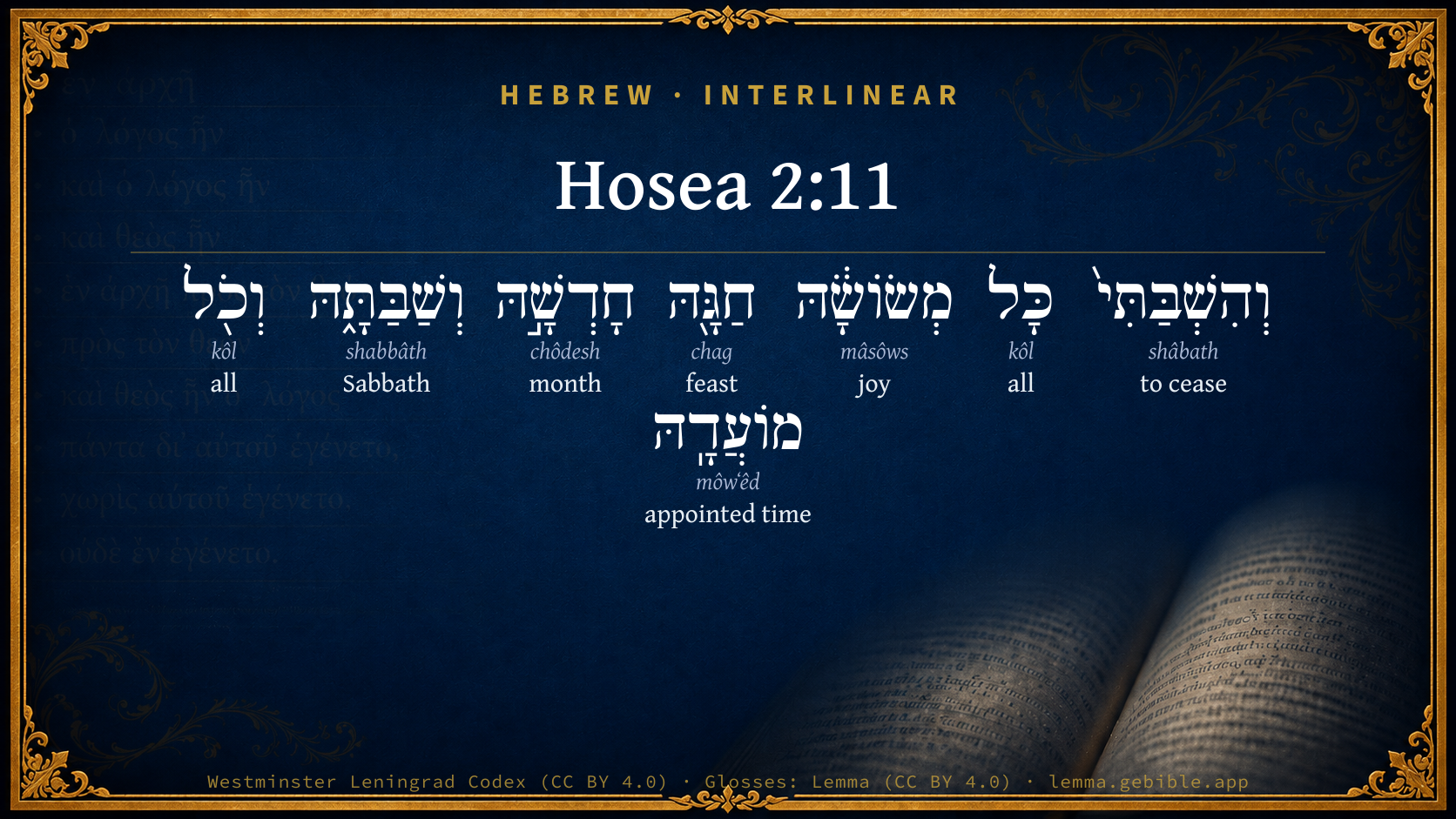
  1. וְהִשְׁבַּתִּי֙ shâbath H7673 “and · to cease” Conjunction + Verb, Hiphil, Sequential Perfect, 1st Person, Common, Singular
  2. כָּל kôl H3605 “all of” Noun, Common, Masculine, Singular, Construct
  3. חַגָּ֖הּ chag H2282 “feast · her” Noun, Common, Masculine, Singular, Construct + Suffix, Personal, 3rd Person, Feminine, Singular
  4. חָדְשָׁ֣הּ chôdesh H2320 “month · her” Noun, Common, Masculine, Singular, Construct + Suffix, Personal, 3rd Person, Feminine, Singular
  5. וְשַׁבַּתָּ֑הּ shabbâth H7676 “and · Sabbath · her” Conjunction + Noun, Common, Both, Singular, Construct + Suffix, Personal, 3rd Person, Feminine, Singular
  6. וְכֹ֖ל kôl H3605 “and · all of” Conjunction + Noun, Common, Masculine, Singular, Construct
  7. מוֹעֲדָֽהּ môwʻêd H4150 “appointed time · her” Noun, Common, Masculine, Singular, Construct + Suffix, Personal, 3rd Person, Feminine, Singular

About this verse

These counts appear in no published source. They are computed here, from the morphology-tagged text and Lemma’s own curated glosses. What Lemma adds →

8
words
7
distinct lemmas
Prophets
section

Notable vocabulary

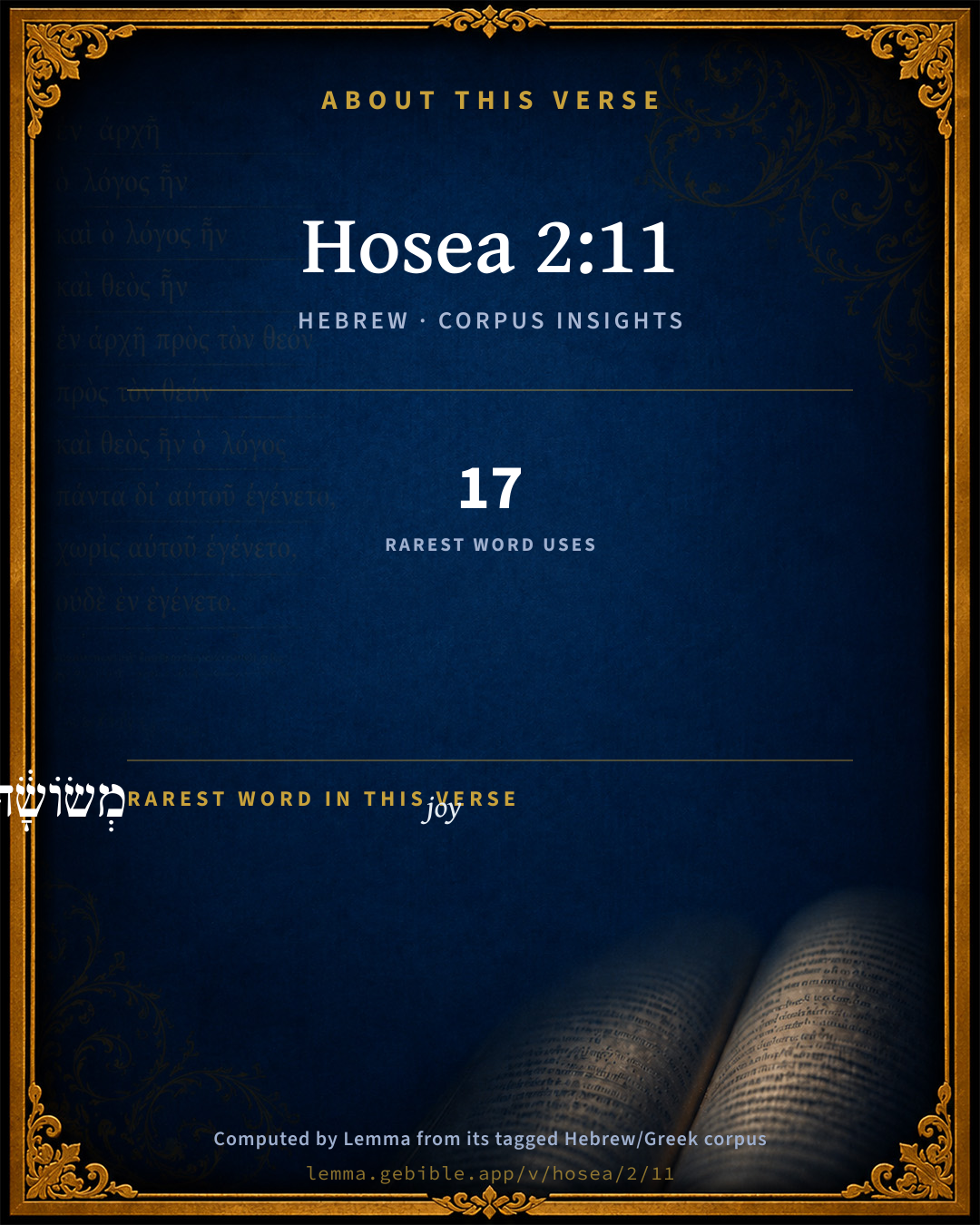
The rarest word here is מְשׂוֹשָׂ֔הּ joy H4885 — appearing just 17 times in the whole Hebrew Bible.

Shared distinctive vocabulary

מְשׂוֹשָׂ֔הּ joy H4885 occurs in 16 verses of the Hebrew Bible. Also found in:

Grammatical profile

  • 1 verb
  • 7 nouns

Verb forms

  • וְהִשְׁבַּתִּי֙ Hiphil · Sequential Perfect

Repetition

A word recurs within this verse — often emphatic in Hebrew:

Hebrew & Septuagint length

In English translation the verse runs 21 words from the Hebrew and 25 from the Septuagint (LXX English) — closely comparable.

A rough comparison of the two English renderings, which tokenize alike — not a word-level alignment.

Word counts can differ between the Hebrew and the Greek without any difference in meaning — e.g. the Hebrew direct-object marker אֵת has no separate Greek word, and Greek often adds the article ὁ.

Cross-references

15

Topical passages linked to Hosea 2:11 in the Treasury of Scripture Knowledge — connected by theme and wording, ordered by reader-vote popularity; previews shown in the World English Bible.

  • Isaiah 1:13–14 Bring no more vain offerings. Incense is an abomination to me; New moons, Sabbaths, and convocations: I can't bear with evil assemblies.
  • Amos 5:21 I hate, I despise your feasts, And I can't stand your solemn assemblies.
  • Amos 8:5 Saying, 'When will the new moon be gone, that we may sell grain? And the Sabbath, that we may market wheat, Making the ephah small, and the shekel large, And dealing falsely with balances of deceit;
  • Jeremiah 7:34 Then will I cause to cease from the cities of Judah, and from the streets of Jerusalem, the voice of mirth and the voice of gladness, the voice of the bridegroom and the voice of the bride; for the land shall become a waste.
  • Jeremiah 16:9 For thus says Yahweh of Hosts, the God of Israel: Behold, I will cause to cease out of this place, before your eyes and in your days, the voice of mirth and the voice of gladness, the voice of the bridegroom and the voice of the bride.
  • Revelation 18:22–23 The voice of harpists, minstrels, flute players, and trumpeters will be heard no more at all in you. No craftsman, of whatever craft, will be found any more at all in you. The sound of a mill will be heard no more at all in you.
  • 1 Kings 12:32 Jeroboam ordained a feast in the eighth month, on the fifteenth day of the month, like the feast that is in Judah, and he went up to the altar; so did he in Bethel, sacrificing to the calves that he had made: and he placed in Bethel the priests of the high places that he had made.
  • Isaiah 24:7–11 The new wine mourns, the vine languishes, all the merry-hearted do sigh.
  • Jeremiah 25:10 Moreover I will take from them the voice of mirth and the voice of gladness, the voice of the bridegroom and the voice of the bride, the sound of the millstones, and the light of the lamp.
  • Ezekiel 26:13 I will cause the noise of your songs to cease; and the sound of your harps shall be no more heard.
  • Hosea 3:4 For the children of Israel shall abide many days without king, and without prince, and without sacrifice, and without sacred stone, and without ephod or idols.
  • Hosea 9:1–5 Don't rejoice, Israel, to jubilation like the nations; For you were unfaithful to your God. You love the wages of a prostitute at every grain threshing floor.
  • Amos 8:3 The songs of the temple will be wailings in that day," says the Lord Yahweh. "The dead bodies will be many. In every place they will throw them out with silence.
  • Amos 8:9–10 "It will happen in that day," says the Lord Yahweh, "That I will cause the sun to go down at noon, And I will darken the earth in the clear day.
  • Nahum 1:10 For entangled like thorns, and drunken as with their drink, they are consumed utterly like dry stubble.

Cross-references courtesy of OpenBible.info (CC BY 4.0).

Hebrew and Greek witnesses Masoretic Hebrew ↔ Greek Septuagint

The same verse in the two great witnesses to the Old Testament, shown verse-for-verse.

These are two independent witnesses, not word-aligned to each other, and the Septuagint is shown in lemma (dictionary) form.

Hebrew Hosea 2:11 Masoretic · Westminster Leningrad Codex

וְהִשְׁבַּתִּי֙ כָּל מְשׂוֹשָׂ֔הּ חַגָּ֖הּ חָדְשָׁ֣הּ וְשַׁבַּתָּ֑הּ וְכֹ֖ל מוֹעֲדָֽהּ

I will also cause all her celebrations to cease: Her feasts, her new moons, her Sabbaths, and all her solemn assemblies.

World English Bible · Public Domain

Greek LXX Hosea 2:11 Septuagint · lemma form

διά οὗτος ἐπιστρέφω καί κομίζω ὁ σῖτος ἐγώ κατά ὥρα αὐτός καί ὁ οἶνος ἐγώ ἐν καιρός αὐτός καί ἀποαἱρέω ὁ ἱμάτιον ἐγώ καί ὁ ὀθόνιον ἐγώ ὁ μή καλύπτω ὁ ἀσχημοσύνη αὐτός

And I will take away all her gladness, her feasts, and her festivals at the new moon, and her sabbaths, and all her solemn assemblies.

LXX2012 (modern English Septuagint) · Public Domain

Hebrew: Westminster Leningrad Codex (CC BY 4.0). Greek: Septuagint (public domain); English from LXX2012 (modern English Septuagint) (Public Domain). How the Septuagint differs from the Hebrew →

Targum (Aramaic paraphrase)

1

The Targum is the ancient Jewish Aramaic paraphrase of the Hebrew Scriptures — an interpretive translation, not the Hebrew text itself. Onkelos (literal) and Pseudo-Jonathan (expansive) render the Torah, and Jonathan the Prophets. Coverage is partial: where no permissively-licensed English translation exists for a verse, only the Aramaic is shown. This is verse-level text, not a word-by-word alignment to the Hebrew.

  1. Targum Jonathan Prophets (Joshua–Malachi)
    בְּכֵן יְתוּב מֵימְרִי לְמִטַל עִבּוּרָא בְּעִדַן אִידְרֵיהּ וְחַמְרָא בְּעִדַן מַעֲצַרְתֵּיהּ וְאַצִיל כְסוּת מֵילָא וּבוּץ דִיהָבֵית לָהּ לְכַסְאָה יַת קְלָנָהּ:

    (no public-domain English translation for this verse)

    Targum Jonathan — Aramaic: “Mikraot Gedolot” (public domain). English: “Sefaria Community Translation” (CC0 1.0 (public-domain dedication)); “London "Chaldee Paraphrase," 1871” (public domain). Text via Sefaria.

Commentary

Notes on Hosea 2:11 from classic Christian and Jewish commentators (each source and its license shown beneath its notes). The classic Christian expositions comment on the surrounding passage and are grouped to its opening verse, so a note may address several verses; the Jewish commentaries on the Tanakh (Rashi and others) are per-verse, so they appear only where the commentator wrote on this verse.

Lemma curates 59 commentaries, every one of them public domain or Creative Commons licensed, each selected and text-cleaned for this edition rather than reprinted as found. About our sources →

Trapp's Complete Commentary

John Trapp

Hos 2:11 I will also cause all her mirth to cease, her feast days, her new moons, and her sabbaths, and all her solemn feasts.

Ver. 11. I will also cause her mirth to cease] Idolaters are frolic and jovial, the greatest mirth mongers, the merry Greeks of the world; set altogether upon the merry pin, they spend their days in pleasure, and suddenly turn into hell, Job 21:13. Thus it was with these old idolaters. See Amo 6:4. And thus it is with the Papists at this day. They have a proverb among them, Spiritns Calvinianus est spiritus melancholicus, A Calvinistic spirit is a melancholy spirit. Turn Protestant once, and you must for ever bid adieu to mirth and jollity, and lead a monkish, melancholy life. In their supplication to King James for a toleration, they used this as an argument for their religion above ours, because more suitable and pleasing to man’s nature. It is indeed an alluring, tempting, bewitching religion, Rev 13:14. Sir Walter Raleigh knew what he said, That were he to choose a religion for licentious liberty, lasciviousness, and merry making, he would be a Papist. Hence the whole world is said to wonder after the beast, which is said to be like unto a leopard or panther (πανθηρ, quod omnium animalium amicus sit. Isidor). Now the panther is admired and followed by most other beasts of the field (and thence hath his name), either for the beauty of his hide, or for the sweetness of his smell. So is the pope for those sensual delights and swinish pleasures he alloweth his followers. Lupanar utriusque Veneris Roma condidit, saith Agrippa, concerning Pope Sixtus Quintus. But what should I rake in that dunghill? Such sinful mirth, as it is base born, so it is of short continuance: God will make it to cease, and to go soon out in a vexing snuff. For what reason? There is a snare (or cord) in the sin of the wicked, sc. to strangle their joy with, but the righteous sing and are merry, Pro 29:6, yea, they are merry (or right set in their minds, as the apostle’s word, ενθυμει, signifies, Jas 5:13), and therefore they sing, yea, and shall sing for joy of heart, when wicked men shall cry for sorrow of heart, yea, howl again for vexation of spirit, Isa 65:14. Meanwhile their mirth is but the hypocrisy of mirth. It may wet the mouth, but not warm the heart; smooth the brow, but not fill the breast. It is like a little counterfeit complexion; as they repent only in the face, Mat 6:16, so they rejoice only in the face, 2Co 1:5; 2Co 1:12. Indeed, they revel rather than rejoice, and the end of that mirth is heaviness, Pro 14:13; as lightning is attended with thunder, and as comets end in a pestilent vapour. Let the Lord but turn his hand and take away his grain, &c., destroy vine and fig trees, &c., and this carnal mirth is at an end: their light is put out in obscure darkness, they lie down in sorrow, and are all amort, they are filled with unmedicinable perplexities, and are ready to run mad, Deu 28:34. Whereas a godly man, as he hath a constant spring of comfort within him, and can be merry without music, so he can stand under the greatest weight of affliction without buckling, as Paul: he can be mediis tranquillus in undis, as Noah: he can confidently say, with Habakkuk, Hab 3:17, "Although the fig tree shall not blossom, neither shall fruit be in the vines, yet will I rejoice in the Lord, I will joy in the God of my salvation."

Her feast days, her new moons] Not the matter of their joy only shall be abolished, but the times too; she shall neither have holy days nor good days (as they are called, Est 8:17), to keep and celebrate. Here then the Lord shows how he will uncover this harlot’s nakedness, viz. first he will strip her of her spirituals, and next of her temporals, Hos 2:12. Her feast days, new moons, sabbaths, and solemn feasts were but apish imitations of those commanded by God, whose ape Satan will needs be. Habent et vespse favos; simiae imitantur heroines: wasps also have honey combs as well as bees; and apes will be doing at men’s actions. Satan’s synagogue may seem a true Church. The ten revolted tribes kept also divers solemn days, partly commanded by the law (as new moons and sabbaths) and partly instituted by Jeroboam, in honour of their idols, as now among the Papists, in pretended honour of the saints, with feasting, dancing, ringing, roaring of organs, &c. These solemnities, therefore, the Lord here first utterly disowneth, calling them her feast days, her sabbaths, &c., and none of his, because they did lacte gypsum miscere, mingle lime with milk, as Irenaeus saith of Plato; Non mea, tua sunt, as Martial saith of his epigrams, ill read by another. And secondly, that he will take them away (sc. by carrying themselves away captive. See Hos 9:4-5), and so pull off their vizor, wash off their varnish of rites and ceremonies, and lay them open to all in their own colours.

John Trapp, A Commentary or Exposition upon All the Books of the Old and New Testament (1647–1656) — public domain. Text from a community e-Sword module.

The Biblical Illustrator

Joseph S. Exell

Hos_2:11

I will also cause all her mirth to cease.

The conjunction of sin and mirth

Mirth is not happiness. It is but tile mimicry of real joy. There is but little happiness in the world, but there is much mirth.

I. The conjunction of sin and mirth is common. The voices of jollity and fun are heard everywhere through society.

II. It is incongruous. Gaiety and laughter in a sinner are most revolting when rightly regarded.

III. It is temporary.

1. The separation is certain. An old writer says, If you will not take away sin from your mirth, God will take away your mirth from your sin.

2. The separation will be solemn. Do not then confound mirth with happiness. Happiness will follow holiness for ever; mirth will only, like the ignis fatuus, flare about sin for a short time at most, and then go out. (Homilist.)

Mingled promise and threatening

The prophet seems in this verse to contradict himself, for he promised reconciliation, and now he speaks of a new repudiation. But the passage is very consistent, and there is in the words no contrariety. He has indeed promised that at a future time God would be propitious to the Israelites: but as they had not yet repented, it was needful to deal again more severely with them, that they might return to their God really and thoroughly subdued. So we see that, in Scripture, promises and threatenings are mingled together, and rightly too. It is necessary for men to be reproved not only once and again, but very often. (John Calvin.)

The Biblical Illustrator, edited by Joseph S. Exell (c. 1880s–1900s) — public domain. Text from a community e-Sword module.

The Preacher's Complete Homiletical Commentary

Joseph S. Exell (gen. ed.)

CRITICAL NOTES.—

Hos_2:11. Feast days] and festivals retained in worship should cease because abused.

MIRTH TURNED INTO MOURNING.—Hos_2:11

Israel had forsaken the temple of God, and worshipped idols under the form of a calf—had changed some festivals, and kept up all in outward form. The monthly and yearly feasts were celebrated with mirth. God had commanded them to rejoice in their feasts (Deu_16:14); but their hymns and instrumental music, their priests and sacrifices, were licentiousness and falsehood, luxury and excess of every description and degree. Their joy must cease and their mirth would be turned into mourning.

I. Mirth connected with wickedness.

1. It is a most prevalent connection. “The notes of jollity and fun are heard everywhere through society. At theatres, taverns, divans, and social festivities, it flares and rattles. The drunkard has his mirth, the liar his mirth, the debaucher his mirth, the blasphemer his mirth, the sabbath-breaker his mirth. The union of sin and mirth is, alas, very common. “We meet it everywhere; in the dance and in the song, in the joke and in the gibe” [Dr Thomas].

2. It is a most unreasonable connection. Wickedness and mirth, how incongruous! “Sorrow is better than laughter” to the wicked. “For by the sadness of the countenance the heart is made better.” The condition and prospects of a sinner should make him weep rather than rejoice. Sin can never give true happiness. The world can never be our home, and the heart cannot rest there. Its resources are poor; its pleasures are not solid; and when its “joys are all packed up and gone,” then will be the days of mourning. Even in laughter the heart is sorrowful; and the end of that mirth is heaviness.

II. Mirth connected with false religion. If sin and mirth are unreasonable, how much more mirth and idolatry! Israel turned “her feast days, her new moons, and her sabbaths” into days of making merry. On the Sabbath they should have owned God as their Creator; on other festive days they should have thanked him for the gifts of Nature and the wonders of Providence. But the worship of God was blended with the service of idols; and feigned joy under the form of true joy. As Israel of old “made a calf in Horeb,” the place of solemnities and law: so men now worship “graven images;” cling to forms of their own device; and change true joy into false mirth. Joy becomes a feast; but the revelry that marked heathen festivals can never become the house of God. Communion with God can never be enjoyed through consecrated symbols. “Neither be ye idolaters, as were some of them; as it is written, The people sat down to eat and drink, and rose up to play.”

III. Mirth turned into mourning. Their songs were to cease, and their music and dancing turned into weeping and wailing. “I will turn your feasts into mourning, and all your songs into lamentation” (Amo_8:10). The mirthful songs of sinners suddenly change into shrieks of agony and death. Many a sigh is heard amid loudest laughter. The smiles of mirth are counterfeits to hide hearts of woe. Belshazzar’s impious feast to a thousand lords ended by his own destruction and that of his empire. “Be merry and wise.” “Fly the pleasure which bites to-morrow.” Mirth pursued, possessed, and enjoyed without God is vanity (Ecc_7:6).

1. It is of short duration. It is but “the crackling of thorns under a pot,” a blaze for a moment, an excitement which cannot last.

2. It is certain in its termination. I “will cause her mirth to cease.” It may be attractive in its appearance, supported by its resources, and spread by its devotees; but the solemn warning is read, “Woe unto you that laugh now; for ye shall mourn and weep.”

ILLUSTRATIONS TO CHAPTER 2

Hos_2:10-11. Mirth. Mirth is a vain and unprofitable passion, not fit for a wise man’s entertainment [Bp. Hall].

Often when in the full enjoyment of all that this world could bestow, my conscience told me, that in the true sense of the word I was not a Christian. I laughed. I sang. I was apparently gay and happy. But the thought would steal across me,—what madness is all this! to continue easy in a state, in which a sudden call out of the world would consign me to everlasting misery, and that when eternal happiness is within my grasp [Wilberforce]. Mirth at a funeral is scarce more indecent or unnatural than a perpetual flight of gaiety and burst of exultation in a world like this; a world which may seem a paradise to fools, but is an hospital with the wise [Dr Young].

Forgetfulness of God, Hos_2:13. Such is the character of all engrossing passion, such is the source of sin to which the soul gives way, in avarice, ambition, worldliness, sensual sin, godless science. The soul at last does not rebel against God; it forgets him. It is taken up with other things, with itself, with the subjects of its thoughts, the objects of its affections, and it has no time for God, because it has no love for him [Pusey].

The gradations of sin.

1. Neglecting God. Neglect of his word, house, and service.

2. Forgetting God. Forgetting his love, goodness, and claims.

3. Departing from God. Departing into danger, error, and punishment.

Forgetfulness of God—a sign of carelessness—a mark of ingratitude and contempt—springs from unbelief and disobedience to God’s command (Deu_4:9; Deu_8:14).

Idolatry in the Church—the top-stone, the height of all crime—hated by God, and pursued by the sinner. Professed believers are too slow after God, but sinners hasten after their lovers. Let their zeal rebuke our tardiness; their punishment turn our steps to God and duty

The two masters.

1. Jehovah forgotten, Baal loved and worshipped.

2. The sacred days of Jehovah turned into festive days of Baal.

3. The gifts of Jehovah devoted to the service and support of Baal. “No man can serve two masters,” &c. Which are you serving? “Choose you this day,” &c.

The Preacher's Complete Homiletical Commentary (gen. ed. Joseph S. Exell; Funk & Wagnalls, c. 1892) — public domain (pre-1929). A full-Bible homiletical/sermon-outline anthology covering 65 of 66 books (2 John is absent from the source module). Text from a community e-Sword module.

Tyndale Open Study Notes

Tyndale Open Resources

2:11 From the context (2:13, 16-17), as well as from similar passages in Isa 1:12-17 and Amos 5:21-24, it seems clear that the Israelites had defiled the legitimate festivals, new moon celebrations, and Sabbath days by combining worship of the Lord with worship of the Canaanite fertility god, Baal. God rejects such syncretism (mixing of different faiths) and declared that he would remove these unholy days from Israel’s calendar.

Tyndale Open Study Notes — © Tyndale Open Resources, licensed CC BY-SA 4.0. Text via the HelloAO Bible API.

Jamieson, Fausset & Brown

Robert Jamieson, A. R. Fausset & David Brown

her feast days--of Jeroboam's appointment, distinct from the Mosaic (Kg1 12:32). However, most of the Mosaic feasts, "new-moons" and "sabbaths" to Jehovah, remained, but to degenerate Israel worship was a weariness; they cared only for the carnal indulgence on them (Amo 8:5).

Jamieson, Fausset & Brown — Commentary Critical and Explanatory on the Whole Bible (1871) — public domain (CC PDM 1.0). Text via the HelloAO Bible API.

Adam Clarke's Commentary

Verse 11. Her feast days] Jerusalem shall be pillaged and destroyed; and therefore all her joyous assemblies, and religious feasts, &c., shall cease.

Adam Clarke's Commentary on the Bible (1810–1826) — public domain. Text from a community e-Sword/MySword module.

John Calvin's Commentaries

The Prophet now descends to particulars; and, in the first place, he says, that the people would be deprived of their sacrifices and feast-days, and of that whole external pomp, which was with them the guise of religion. He then adds, that they would be spoiled of their food, and all their abundance. He has hitherto been speaking of their nakedness; but he now describes what this nakedness would be: and he specially mentions, that sacrifices would cease, that feast days, new-moons, and whatever belonged to external worship, would cease. I will make to cease, he says, all her joy. He speaks doubtless, of sacred joys; and this may be easily collected from the context. He adds, her every festal-day As they were wont to dance on their festal-days, this word may be referred to that practice. He afterwards adds, “her sabbath”, and all feast-days. Then the first kind of nakedness was, that God would take away from the Israelites that fallacious and empty form of religion in which they foolishly delighted. The second kind of nakedness was, that they were to be stripped of all earthly riches, and be reduced to misery and extreme want. But I cannot finish to-day.

John Calvin's Commentaries (1540-1563) — public domain. Text from the Calvin Translation Society English edition (1840s-50s) via the Christian Classics Ethereal Library (ccel.org). Calvin's coverage is partial (roughly two-thirds of the Bible); uncommented books and verses are honest gaps, never fabricated. The 19th-century editor's footnotes and remarks are omitted so the notes are faithfully Calvin's own voice.

Ellicott's Commentary for English Readers

(11) Mirth . . . Cease.—The mirth is here indicative of the general character of the ceremonial—certainly not in itself a bad sign. David danced before the Lord, and justified the act. No one was to appear with sad countenance before Jehovah, any more than before an earthly potentate. (Comp. Neh_2:2.)

The “feast days” are to be distinguished from the “solemn feasts.” The latter term is more generic in Hebrew, while the former denoted the three great festivals of the year (especially the Feast of Tabernacles). These feasts, which Jeroboam I. had instituted, are not spoken of in themselves as sinful.

A Bible Commentary for English Readers, edited by Charles John Ellicott (1878–1897) — public domain. Text from a community e-Sword module.

The Cambridge Bible for Schools and Colleges

gen. ed. J. J. S. Perowne

11. her feast days, her new moons, and her sabbaths] (The Hebrew has the singular, ‘her feast-day’ &c.) These expressions are remarkable, for Hosea is a prophet of northern Israel. It would appear, then, that the separation of north and south did not involve a discontinuance of the festivals in the north (see Hos_9:5). Amos had already predicted the ruin of the ‘feasts’ in N. Israel (Amo_8:10). In addition to the ‘feasts’ which are doubtless those mentioned in the earliest body of legislation (Exo_23:14, &c., Exo_34:18, &c.), Hosea specifies the new moon and the sabbath (comp. 2Ki_4:23) as passing away together with the national independence. This was not strictly speaking the case with regard to the sabbath, which became one great bond of union among the Jews in exile. But the old, popular sabbath of unrestrained joy (comp. Hosea’s ‘all her mirth’) did pass away; the sabbath of Isa_58:13 was very different from that which was popularly observed in ancient Israel.

and all her solemn feasts] Or, festal assemblies. The term is more comprehensive than ‘feast’; the Levitical legislation recognizes seven ‘festal assemblies’, but only three ‘feasts’ (comp. Lev. 33).

The Cambridge Bible for Schools and Colleges (gen. ed. J. J. S. Perowne; Cambridge University Press, 1878–1918) — public domain. Text from a community e-Sword module.

John Gill's Exposition

And, I will visit upon her the days of Baalim,.... That is, punish them for all the idolatries committed by their forefathers, in the days that the several Baals, as Baalpeor, and Baalberith, and others, were worshipped by them; they their children, though not worshipping these Baalim, yet other lords, lusts and idols, they set up of themselves, and in their own hearts; see Mat 23:32,

wherein she burnt incense to them; to the Baalim; this one species of idolatrous worship being put for the rest:

and she decked herself with her earrings and her jewels; with her best and richest attire; the latter word signifying in the Arabic language, as Jarchi observes, the ornaments of women; this was done to grace the idolatrous worship, and for the honour of the idols:

and she went after her lovers; the traditions of the elders; the weak and beggarly elements of the ceremonial law now abolished, and their own legal righteousness:

and forgot me, saith the Lord: or, "left my worship", as the Targum; forgot and rejected the true Messiah, his word and ordinances.

John Gill's Exposition of the Whole Bible (1746–1763) — public domain (CC PDM 1.0). Text via the HelloAO Bible API.

Albert Barnes' Notes on the Bible

I will also cause her mirth to cease, her feast days ... - Israel had forsaken the temple of God; despised His priests; received from Jeroboam others whom God had not chosen; altered, at least, one of the festivals; celebrated all, where God had forbidden; and worshiped the Creator under the form of a brute creature (see Introduction). Yet they kept the great “feast-days,” whereby they commemorated His mercies to their forefathers; the “new moons,” whereby the first of every month was given to God; “the sabbaths,” whereby they owned God as the Creator of all things; and all the other “solemn feasts,” whereby they thanked God for acts of His special providence, or for His annual gifts of nature, and condemned themselves for trusting in false gods for those same gifts, and for associating His creatures with Himself. But man, even while he disobeys God, does not like to part with Him altogether, but would serve Him enough to soothe his own conscience, or as far as he can without parting with his sin which he loves better. Jeroboam retained all of God’s worship, which he could combine with his own political ends; and even in Ahab’s time Israel “halted between two opinions,” and Judah “sware both by the Lord and by Malcham” Zep 1:5, the true God and the false. All this their worship was vain, because contrary to the will of God. Yet since God says, “I will take away all her mirth,” they had, what they supposed to be, religious “mirth” in their “feasts,” fulfilling as they thought, the commandment of God, “Thou shalt rejoice in thy feasts” Deu 16:14. She could have no real joy, since true joy is “in the Lord” Phi 4:4. So, in order that she might not deceive herself anymore, God says that he will take away that feigned formal service of Himself, which they blended with the real service of idols, and will remove the hollow outward joy, that, through repentance, they might come to the true joy in Him.

Albert Barnes' Notes on the Bible (1834–1885) — public domain. Text from a community e-Sword/MySword module.

Haydock's Catholic Bible Commentary

CHAPTER II.

Times. This was verified during the captivity.

George Leo Haydock (1774–1849), Haydock's Catholic Family Bible and Commentary, 1859 edition — public domain. Excludes Psalms (Douay-Rheims chapter numbering differs from Protestant) and Deuterocanonical books (Catholic canon only).

Matthew Poole's English Annotations

I will also cause all her mirth to cease; the jollity of Israel was certainly damped when Tiglath-pileser took Ijon, and other cities, and captivated Naphtali, 2Ki 15:29, which was some, yet but few, years after this prophecy: but sure all their joy ceased about ten or twelve years after, when Samaria was taken, and Hoshea and all Israel made captives: so the threat was executed in this sense. But the prophet speaks (as by what follows appeareth) of their sacred or religious joys, which God will abolish. He did not set them up, but he will pull them down.

Her feast days: though apostate Israel was fallen to idolatry, and renounced the true worship of God, yet by this text it appears they retained many of the rites and ceremonies that were used by the Jews, or else set up others like them, as their solemn feast at setting up the calves at Dan and Beth-el, in Jeroboam’s time.

New moons: these were days of greater sacrifices, Num 28:11, and greater feasting, 1Sa 20:5.

Sabbaths; their weekly sabbaths. All her solemn feasts; the three annual feasts of tabernacles, weeks, and passover, or others with them, all which should cease when these people were carried captive, as they were by Shalmaneser.

Matthew Poole's English Annotations on the Holy Bible (1683–1685) — public domain. Text from a community e-Sword/MySword module.

Whedon's Commentary on the Bible

Daniel D. Whedon

11. An inevitable result of the calamity will be the cessation of mirth — As the context shows, the merrymaking in connection with religious celebrations.

Feast days [“feasts”] — The same word as the Arabic haj, by which the pilgrimage to Mecca is known. Probably not feasts in general, but the three great feasts — of Unleavened Bread, of Harvest, of Ingathering — which were accompanied by pilgrimages (Exo_23:14-17); these were occasions of rejoicing (Isa_30:29).

New moons — The new moon, the first of the month, was from the earliest time a sacred day among the Hebrews and their neighbors (1Sa_20:5; 2Ki_4:23). Its celebration goes back probably to a period when the moon was worshiped as a divine being. (See article “New Moon” in Hastings’s Dictionary of the Bible.)

Sabbaths — Another day considered sacred from the earliest period; its observance is enjoined in the Decalogue, but it is not confined to the Hebrews. (See American Journal of Theology, 1898, pp. 312-352.) According to Amo_8:5, on the two sacred days mentioned last the people abstained from common labor. Solemn feasts [“assemblies”] — Better, festal gatherings; a general term for festive seasons, including here all the feasts not mentioned previously (compare Amo_8:10; Jer_7:34; Lam_1:4; Lam_5:15).

Hos_2:12 is the natural continuation of 9. Nowack, who considers Hos_2:10 a later addition, thinks the original order to have been 9, 12, 11, 13.

Vines… fig trees — Two of the choicest products of Palestine; their destruction would be a serious calamity (see on Joe_1:7). Since they grew extensively and luxuriously, they were regarded as indicating in a special manner the favor of the Baalim.

Rewards [“hire”] — The compensation offered to the prostitute. How Jehovah will destroy is not stated, it may be by war or by drought. The gardens and orchards will be neglected and turn into forests — Better, jungles, the abode of wild beasts.

Beasts of the field — Wild, undomesticated beasts (compare Isa_7:23-25). On the rapidity with which in the neglected fields wild animals multiply, see 2Ki_17:25.

Daniel D. Whedon (gen. ed.), Commentary on the Old and New Testaments (1874–1909) — public domain. Text from a community e-Sword module.

The Pulpit Commentary

I will also cause all her mirth to cease, her feast days, her new moons, and her sabbaths, and all her solemn feasts. The enumeration is complete, "Her feast days" were the three annual festivals of Passover, Pentecost, and Tabernacles. "Her new moons" were the monthly celebrations at the commencement of each month. "Her sabbaths" were the weekly solemnities of one day in seven, dedicated to the Lord. Then there is a general summing up of the whole by the addition of "all her solemn feasts, all her festal days and seasons, including, besides those named, the beginning of the years, the solemn assembly or holy convocation on the seventh day of the Passover and on the eighth day of Tabernacles. Preceding the enumeration is the general characteristic of all Israel"s festivities. They were times of joy, as we read in Num_10:10, "In the day of your gladness, and in your solemn days, and in the beginnings of your months, ye shall blow with the trumpets;" and in Deu_12:12 it is expressly declared, "Ye shall rejoice before the Lord... ye, and your sons, and your daughters, and your menservants, and your maidservants, and the Levite that is within your gates." All this was to cease; the coming captivity would render all such celebrations impossible. Kimchi remarks on this (ver. 11): "For in the distress there is no new moon and no sabbath; and the beginnings of months and sabbaths on which offerings were presented were days of joy. And so with respect to the feast days and solemn assemblies, which were days of rest and quiet joy, they shall not have in them any joy in consequence of the greatness of their distresses." He subsequently adds, "There is a chag which is not a raced, but joy wherewith men rejoice and eat and drink; and it is called chag," referring to Solomon"s feast of dedication; "and there is also a moed which is not a chag, as for signs and for seasons ( moedim), and at the appointed time I will return unto thee" (raced, from ry, to appoint as time and place).

The conjunction of sin and mirth.

"I will also cause all her mirth to cease." Mirth is not happiness. It is but the mimicry of real joy. Happiness is river deep and clear; mirth at best is but a sparkling bubble. There is but little happiness in the world, but there is much mirth, much noisy frolic and hilarious glee. The text speaks of mirth in connection with sinfulness. Israel, who had grown corrupt, had, notwithstanding, much mirth. In relation to the conjunction of sin and mirth we may remark

I THAT THE CONJUNCTION IS COMMON. The notes of jollity and fun are heard everywhere through society. At theatres, taverns, divans, and social festivities it flares and rattles. The drunkard has his mirth, the liar his mirth, the debauchee his mirth, the blasphemer his mirth, the sabbath-breaker his mirth. The union of sin and mirth is, alas! very common. We meet it everywhere, in the dance and in the song, in the joke and in the gibe.

II THAT THE CONJUNCTION IS INCONGRUOUS. Gaiety and laughter in a sinner are most revolting when rightly regarded. The condition of a sinner is one of awful solemnity; a condition upon which God and his holy universe look with deepest seriousness. The sighs of moral anguish and tears of bitter remorse become the sinner. Fun and laughter are more unbeseeming to him than jests and jollities in a dying chamber. "Mirth," says Dr. Young, "at a funeral is scarce more indecent or unnatural than a perpetual flight of gaiety and burst of exultation in a world like this is a world which may seem a paradise to fools, but is a hospital with the wise." The ground is hollow in the path of mirth; Oh! far too daring seems the joy of earth, So darkly pressed and girdled in by death. (Mrs. F. Hemana)

III THAT THE CONJUNCTION IS TEMPORARY. Amos, who was contemporary with Hoses, and like him was a prophet of the ten tribes, describes the conjunction well and indicates the necessity of the separation: "Ye that put far away the evil day, and cause the seat of violence to come near; that lie upon beds of ivory, and stretch themselves upon their couches, and eat the lambs out of the flock, and the calves out of the midst of the stall; that chant to the sound of the viol, and invent to themselves instruments of music, like David; that drink wine in bowls, and anoint themselves with the chief ointments: but they are not grieved for the affliction of Joseph. Therefore now shall they go captive with the first that go captive, and the banquet of them that stretched themselves shall be removed.

1. The separation is certain. There is no mirth for the sinner either in moral conviction, death, the judgment-day, or in the scenes of final retribution. "If you will not take away sin from your mirth," says an old writer, "God will take away your mirth from your sin.

2. The separation will be solemn. It is said that Pope Adrian exclaimed when he was dying, "O my soul, where art thou going? Thou shalt never be merry any more." "I will cause all her mirth to cease," says God.

CONCLUSION. Confound not mirth with happiness! The brightest gleams of mirth are but the rays of rushlights; only visible in the dark, and that must go out. Happiness is a quenchless sunbeam; it streams from the eternal Father of lights. Happiness will follow holiness forever; mirth will only, like the ignis fatuus, flare about sin for a short time at most, then go out, and there is pitch darkness. D.T.

The Pulpit Commentary (1880–1919), ed. H.D.M. Spence-Jones & Joseph S. Exell — public domain. Text from a community e-Sword module.

John Wesley's Explanatory Notes

Her feast days - Though apostate, Israel was fallen to idolatry, yet they retained many of the Mosaic rites and ceremonies. Her solemn feasts - The three annual feasts of tabernacles, weeks, and passover, all which ceased when they were carried captive, by Salmaneser.

John Wesley, Explanatory Notes Upon the Whole Bible (1754–1765) — public domain. Text via the GEBible commentary corpus.

Rashi

Rabbi Shlomo Yitzchaki (Rashi)

in its time At the time the produce completes its ripening.

and I will separate [Heb. וְהִצַּלְתִּי] from her.

My wool and My flax. which was to cover her nakedness. Every expression of הָצָלָה in Scripture is an expression of separation and setting apart. Proof of this we find in (Gen. 31:9) “And God separated (וַיַצֵּל) your father’s cattle,” (ibid.:16) “For all the wealth that... separated (הִצִיל).”

Rashi on the Tanakh — English translations: “The Judaica Press complete Tanach with Rashi, translated by A. J. Rosenberg” (CC BY 4.0); “Pentateuch with Rashi's commentary by M. Rosenbaum and A.M. Silbermann, 1929-1934” (public domain); “The Metsudah Tanach series, Lakewood, N.J” (CC BY 4.0); and “The Book of Joshua, Metsudah Publications, 1997” (CC BY 4.0). Text via Sefaria.

Lesson kit

Teaching starters — assembled from the data on this page, not authored interpretation. Every prompt links to the verse data it draws on. Edit before teaching.

Hosea, in the Prophets, opens this verse with 8 words (7 distinct Hebrew lemmas). Its most distinctive word is mâsôws (“joy”). A historical commentator’s framing appears above. Read the whole chapter for the surrounding context.

Discussion questions

  1. How does “joy” (mâsôws) shape what this verse is saying?
  2. Job 8:19 shares the word «joy» with this verse. How do the two illuminate each other?
  3. “all” occurs 2× in this one verse. What is the effect of the repetition?
  4. The translations on this page render this verse differently — a whole-verse word diff, not a word-by-word alignment. What might account for the different wordings?
  5. The verb «וְהִשְׁבַּתִּי֙» is Hiphil Sequential Perfect. How does its form color the action?
  6. Reading how Trapp's Complete Commentary and The Biblical Illustrator read this verse, where do the two commentators agree and where do they part?

Things to notice

Reading settings

Reading text

Shown beneath each verse's original-language words.

Old Testament
Old Testament edition

Read the OT as the Masoretic Hebrew (MT) or the Greek Septuagint (LXX).

English shown for the Greek Septuagint (in the Hebrew ↔ Greek comparison).

Comparing translations? Open the Compare panel on any verse page to stack up to four side by side.