

Revelation 18:10
Greek (Tischendorf 8th ed.) Revelation 18:10 appears in the Greek New Testament. The text above is from the Tischendorf 8th edition. Each word links to its Strong’s number and a concise gloss. Click any word for its full Thayer’s Greek Lexicon entry.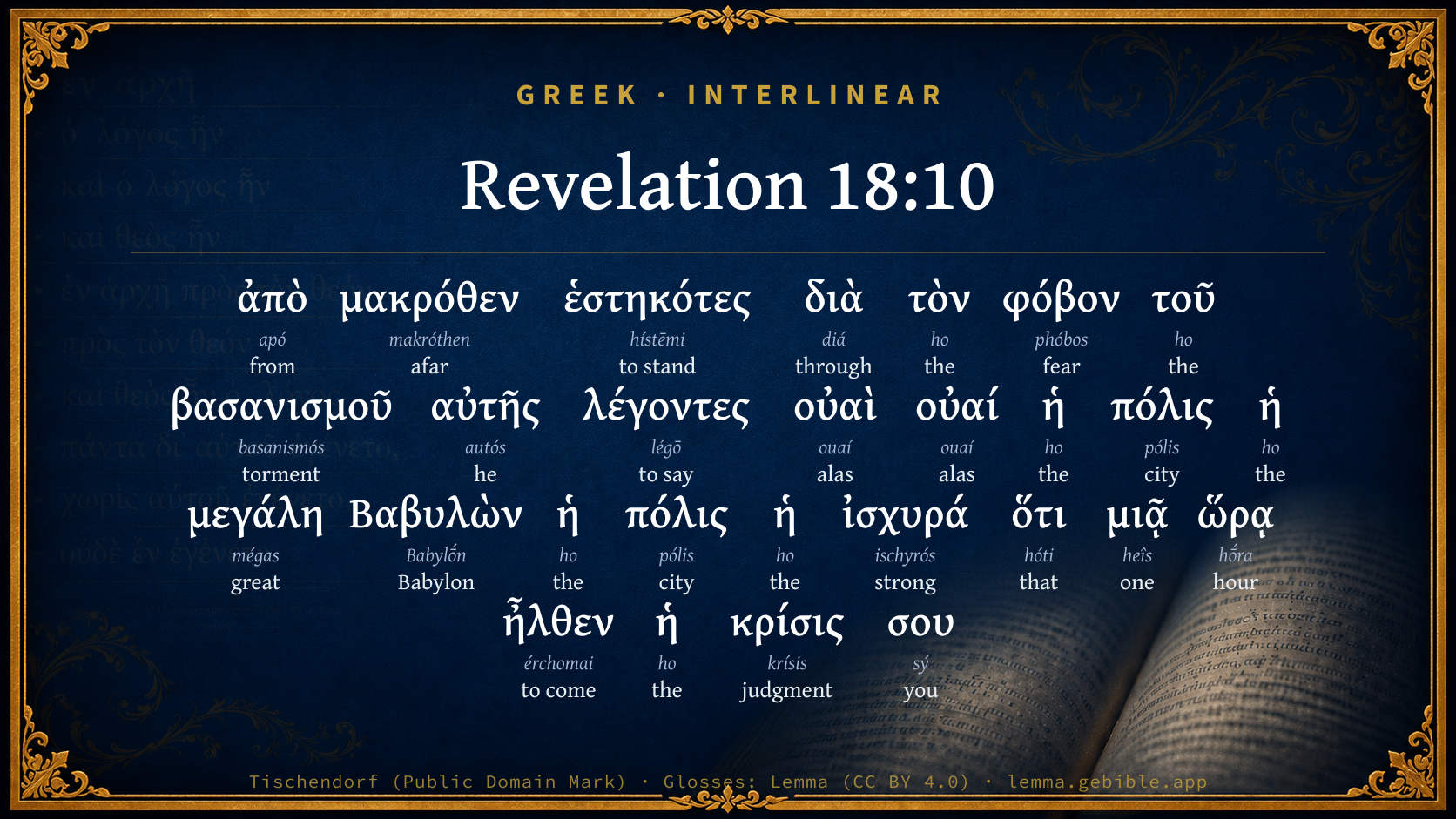
standing far away for the fear of her torment, saying, 'Woe, woe, the great city, Babylon, the strong city! For your judgment has come in one hour.'
Download a study sheet
One document with this verse’s original text, its word-by-word gloss line, the meaning frame, cross-references with their text, attributed commentary, and full source and license credits — printable, and it pastes into notes with its structure intact.
This verse Autodidact and up
A passage Seminary Student
Up to 50 verses in one chapter. A passage sheet keeps up to 6 commentary sources and 12 cross-references per verse, in the order this page ranks them, and says so on the sheet whenever that leaves anything out. Ask for a single verse and you get the Autodidact verse sheet above.
Everything on this page stays free to read, with no account — the sheet is a download of what is already on screen, not access to it.
Compare translations 3
The same verse in 3 English versions, stacked beneath the original-language interlinear above. Click any original word for its lexicon entry.
Each is an independent rendering of the whole verse — the interlinear is not word-aligned to these translations.
Highlighted words mark where these versions differ — a whole-verse word diff, not a word-by-word alignment.
-
World English Bible Public Domain
standing far away for the fear of her torment, saying, 'Woe, woe, the great city, Babylon, the strong city! For your judgment has come in one hour.'
-
King James Version Public Domain
Standing afar off for the fear of her torment, saying, Alas, alas that great city Babylon, that mighty city! for in one hour is thy judgment come.
-
unfoldingWord Literal Text CC BY-SA 4.0
standing from afar because of the fear of her torment, saying, “Woe, woe, the great city, Babylon, the mighty city! For in one hour your judgment has come.”
unfoldingWord Literal Text — © unfoldingWord, licensed CC BY-SA 4.0. Word-aligned USFM3 via Door43 (git.door43.org/unfoldingWord/en_ult).
Show all 19 translations
Every available English version of this verse, each an independent rendering of the whole verse.
-
World English Bible Public Domain
standing far away for the fear of her torment, saying, 'Woe, woe, the great city, Babylon, the strong city! For your judgment has come in one hour.'
-
Berean Standard Bible Public Domain
In fear of her torment, they will stand at a distance and cry out: “Woe, woe to the great city, the mighty city of Babylon! For in a single hour your judgment has come.”
-
Majority Standard Bible Public Domain
In fear of her torment, they will stand at a distance and cry out: “Woe, woe to the great city, the mighty city of Babylon! For in a single hour your judgment has come.”
-
King James Version Public Domain
Standing afar off for the fear of her torment, saying, Alas, alas that great city Babylon, that mighty city! for in one hour is thy judgment come.
-
American Standard Version (1901) Public Domain
standing afar off for the fear of her torment, saying, Woe, woe, the great city, Babylon, the strong city! for in one hour is thy judgment come.
-
Revised Version (1885) Public Domain
standing afar off for the fear of her torment, saying, Woe, woe, the great city, Babylon, the strong city! for in one hour is thy judgment come.
-
Geneva Bible (1599) Public Domain
And shall stand a farre off for feare of her torment, saying, Alas, alas, that great citie Babylon, that mightie citie: for in one houre is thy iudgement come.
-
Douay-Rheims (1899) Public Domain
Standing afar off for fear of her torments, saying: Alas! alas! that great city Babylon, that mighty city: for in one hour is thy judgment come.
-
Young's Literal Translation Public Domain
from afar having stood because of the fear of her torment, saying, Wo, wo, the great city! Babylon, the strong city! because in one hour did come thy judgment.
-
Literal Standard Version CC BY-SA 4.0
having stood from afar because of the fear of her torment, saying, Woe, woe, the great city! Babylon, the strong city! Because in one hour your judgment came.
-
Unlocked Literal Bible CC BY-SA 4.0
They will stand off at a distance, afraid of her torment, saying, “Woe, woe to the great city, Babylon, the powerful city! For in a single hour your punishment has come.”
-
unfoldingWord Literal Text CC BY-SA 4.0
standing from afar because of the fear of her torment, saying, “Woe, woe, the great city, Babylon, the mighty city! For in one hour your judgment has come.”
-
Darby Bible Public Domain
standing afar off, through fear of her torment, saying, Woe, woe, the great city, Babylon, the strong city! for in one hour thy judgment is come.
-
World Messianic Bible Public Domain
standing far away for the fear of her torment, saying, ‘Woe, woe, the great city, Babylon, the strong city! For your judgment has come in one hour.’
-
Webster's Bible Public Domain
Standing afar off for the fear of her torment, saying, Alas, alas, that great city Babylon, that mighty city! for in one hour is thy judgment come.
-
Free Bible Version CC BY-SA 4.0
Standing off at a distance because they are afraid they will suffer the same agony as her, they say, ‘Disaster, disaster has struck Babylon, the great city! In just one hour your sentence of doom was executed!’
-
Bible in Basic English Public Domain
Watching from far away, for fear of her punishment, saying, Sorrow, sorrow for Babylon, the great town, the strong town! for in one hour you have been judged.
-
Text-Critical English NT CC BY 4.0
In fear of her torment they will stand at a distance and say, “Alas, alas, for the great city, Babylon, the mighty city! For in a single hour yoʋr judgment has come.”
-
Tyndale New Testament (1534) Public Domain
and shall stonde a farre of for feare of her punnysshment sayinge: Alas Alas that gret cite Babilon that myghty cite: For at won houre is her iudgment come.
Literal Standard Version (2020), Covenant Press — licensed CC BY-SA 4.0. Text via the HelloAO Bible API (eBible.org). Unlocked Literal Bible (unfoldingWord) — licensed CC BY-SA 4.0. Text via the HelloAO Bible API (eBible.org). unfoldingWord Literal Text — © unfoldingWord, licensed CC BY-SA 4.0. Word-aligned USFM3 via Door43 (git.door43.org/unfoldingWord/en_ult). Free Bible Version, Dr. Jonathan Gallagher — licensed CC BY-SA 4.0. Text via the HelloAO Bible API (eBible.org).
Word by word
More ways to search: Search by grammar → Find every occurrence → Compare this word →
Practice this passage: Drill this verse → Learn its vocabulary →
- Appears 6× in the Greek New Testament
- First appears at Revelation 9:5
- Part of Speech
- Noun
- Case
- Genitive
- Number
- Singular
- Gender
- Masculine
Full Thayer's Definition
- ἀπὸ apó G575 “from” Preposition
- μακρόθεν makróthen G3113 “afar” Adverb
- ἑστηκότες hístēmi G2476 “to stand” Verb, Perfect, Active, Participle, Nominative, Plural, Masculine
- διὰ diá G1223 “through” Preposition
- τὸν ho G3588 “the” Article, Accusative, Singular, Masculine
- φόβον phóbos G5401 “fear” Noun, Accusative, Singular, Masculine
- τοῦ ho G3588 “the” Article, Genitive, Singular, Masculine
- βασανισμοῦ basanismós G929 “torment” Noun, Genitive, Singular, Masculine
- αὐτῆς autós G846 “he” Personal pronoun, Genitive, Singular, Feminine
- λέγοντες légō G3004 “to say” Verb, Present, Active, Participle, Nominative, Plural, Masculine
- οὐαὶ ouaí G3759 “alas” Interjection
- οὐαί ouaí G3759 “alas” Interjection
- ἡ ho G3588 “the” Article, Nominative, Singular, Feminine
- πόλις pólis G4172 “city” Noun, Nominative, Singular, Feminine
- ἡ ho G3588 “the” Article, Nominative, Singular, Feminine
- μεγάλη mégas G3173 “great” Adjective, Nominative, Singular, Feminine
- Βαβυλὼν Babylṓn G897 “Babylon” Noun, Nominative, Singular, Feminine
- ἡ ho G3588 “the” Article, Nominative, Singular, Feminine
- πόλις pólis G4172 “city” Noun, Nominative, Singular, Feminine
- ἡ ho G3588 “the” Article, Nominative, Singular, Feminine
- ἰσχυρά ischyrós G2478 “strong” Adjective, Nominative, Singular, Feminine
- ὅτι hóti G3754 “that” Conjunction
- μιᾷ heîs G1520 “one” Adjective, Dative, Singular, Feminine
- ὥρᾳ hṓra G5610 “hour” Noun, Dative, Singular, Feminine
- ἦλθεν érchomai G2064 “to come” Verb, Aorist, Active, Indicative, 3rd person, Singular
- ἡ ho G3588 “the” Article, Nominative, Singular, Feminine
- κρίσις krísis G2920 “judgment” Noun, Nominative, Singular, Feminine
- σου sý G4771 “you” Personal pronoun, 2nd person, Genitive, Singular
About this verse
These counts appear in no published source. They are computed here, from the morphology-tagged text and Lemma’s own curated glosses. What Lemma adds →
- 28
- words
- 20
- distinct lemmas
- Revelation
- section
Cross-references
11Topical passages linked to Revelation 18:10 in the Treasury of Scripture Knowledge — connected by theme and wording, ordered by reader-vote popularity; previews shown in the World English Bible.
- Revelation 18:19 They cast dust on their heads, and cried, weeping and mourning, saying, 'Woe, woe, the great city, in which all who had their ships in the sea were made rich by reason of her great wealth!' For in one hour is she made desolate.
- Revelation 18:8 Therefore in one day her plagues will come: death, mourning, and famine; and she will be utterly burned with fire; for the Lord God who has judged her is strong.
- Revelation 18:15–17 The merchants of these things, who were made rich by her, will stand far away for the fear of her torment, weeping and mourning;
- Revelation 14:8 Another, a second angel, followed, saying, "Babylon the great has fallen, which has made all the nations to drink of the wine of the wrath of her sexual immorality."
- Joel 1:15 Alas for the day! For the day of Yahweh is at hand, And it will come as destruction from the Almighty.
- Amos 5:16 Therefore thus says Yahweh, the God of hosts, the Lord: "Wailing will be in all the broad ways; And they will say in all the streets, 'Alas! Alas!' And they will call the farmer to mourning, And those who are skillful in lamentation to wailing.
- Jeremiah 30:7 Alas! for that day is great, so that none is like it: it is even the time of Jacob's trouble; but he shall be saved out of it.
- Jeremiah 51:8–9 Babylon is suddenly fallen and destroyed: wail for her; take balm for her pain, if so be she may be healed.
- Revelation 17:12 The ten horns that you saw are ten kings who have received no kingdom as yet, but they receive authority as kings, with the beast, for one hour.
- Numbers 16:34 All Israel that were round about them fled at the cry of them; for they said, Lest the earth swallow us up.
- Isaiah 21:9 and, behold, here comes a troop of men, horsemen in pairs. He answered, Fallen, fallen is Babylon; and all the engraved images of her gods are broken to the ground.
Cross-references courtesy of OpenBible.info (CC BY 4.0).
Lesson kit
Teaching starters — assembled from the data on this page, not authored interpretation. Every prompt links to the verse data it draws on. Edit before teaching.
Revelation, in the Revelation, opens this verse with 28 words (20 distinct Greek lemmas). Its most distinctive word is basanismós (“torment”). A historical commentator’s framing appears above. Read the whole chapter for the surrounding context.
Discussion questions
- The word basanismós carries the sense “torment.” How does it shape the verse?
- How does Revelation 9:5, which shares the word «torment», read alongside this verse?
- What does the repetition of “alas” (2× in this one verse) do in this verse?
- The translations on this page render this verse differently — a whole-verse word diff, not a word-by-word alignment. What might account for the different wordings?
- Compare how Tyndale Open Study Notes and Bengel's Gnomon read this verse. Where do they agree or differ?
Things to notice
- These translations choose different wording for 10 words in this verse.
- “alas” occurs 2× in this single verse.
- 20 distinct Greek lemmas span 28 words in this verse.
Commentary
Notes on Revelation 18:10 from classic Christian and Jewish commentators (each source and its license shown beneath its notes). The classic Christian expositions comment on the surrounding passage and are grouped to its opening verse, so a note may address several verses; the Jewish commentaries on the Tanakh (Rashi and others) are per-verse, so they appear only where the commentator wrote on this verse.
Lemma curates 59 commentaries, every one of them public domain or Creative Commons licensed, each selected and text-cleaned for this edition rather than reprinted as found. About our sources →
Tyndale Open Study Notes
Tyndale Open Resources
Tyndale Open Study Notes — © Tyndale Open Resources, licensed CC BY-SA 4.0. Text via the HelloAO Bible API.
Bengel's Gnomon
Johann Albrecht Bengel
Bengel's Gnomon of the New Testament — English translation (T&T Clark, Edinburgh, 1860) — public domain. Text from a community e-Sword module.
Jamieson, Fausset & Brown
Robert Jamieson, A. R. Fausset & David Brown
Jamieson, Fausset & Brown — Commentary Critical and Explanatory on the Whole Bible (1871) — public domain (CC PDM 1.0). Text via the HelloAO Bible API.
Adam Clarke's Commentary
Adam Clarke's Commentary on the Bible (1810–1826) — public domain. Text from a community e-Sword/MySword module.
The Cambridge Bible for Schools and Colleges
gen. ed. J. J. S. Perowne
The Cambridge Bible for Schools and Colleges (gen. ed. J. J. S. Perowne; Cambridge University Press, 1878–1918) — public domain. Text from a community e-Sword module.
John Gill's Exposition
John Gill's Exposition of the Whole Bible (1746–1763) — public domain (CC PDM 1.0). Text via the HelloAO Bible API.
Trapp's Complete Commentary
John Trapp
John Trapp, A Commentary or Exposition upon All the Books of the Old and New Testament (1647–1656) — public domain. Text from a community e-Sword module.
Albert Barnes' Notes on the Bible
Albert Barnes' Notes on the Bible (1834–1885) — public domain. Text from a community e-Sword/MySword module.
Haydock's Catholic Bible Commentary
George Leo Haydock (1774–1849), Haydock's Catholic Family Bible and Commentary, 1859 edition — public domain. Excludes Psalms (Douay-Rheims chapter numbering differs from Protestant) and Deuterocanonical books (Catholic canon only).
Matthew Poole's English Annotations
Matthew Poole's English Annotations on the Holy Bible (1683–1685) — public domain. Text from a community e-Sword/MySword module.
The Pulpit Commentary
The Pulpit Commentary (1880–1919), ed. H.D.M. Spence-Jones & Joseph S. Exell — public domain. Text from a community e-Sword module.
John Wesley's Explanatory Notes
John Wesley, Explanatory Notes Upon the Whole Bible (1754–1765) — public domain. Text via the GEBible commentary corpus.
Scofield Reference Notes
C. I. Scofield
The Scofield Reference Bible (1917 edition), notes by C. I. Scofield — public domain. Text from a community e-Sword module.
The People's New Testament
B. W. Johnson
B. W. Johnson's The People's New Testament with Notes (1889–1891) — public domain. Electronic text from the Christian Classics Ethereal Library (CCEL) ThML edition.
Cambridge Greek Testament for Schools and Colleges
Cambridge Greek Testament for Schools and Colleges (Cambridge University Press, 1896; 21 vols, various authors incl. Carr, Maclear, Plummer, Farrar, Lumby, Moule, M. R. James, Simcox) — public domain. Text from a community e-Sword module.