

Job 15:32

Hebrew (Westminster Leningrad Codex) Job 15:32 appears in the Hebrew Old Testament. The text above is from the Westminster Leningrad Codex. Each word links to its Strong’s number, a concise gloss, and parsing drawn from the Open Scriptures Hebrew Bible morphology. Click any word for its full Brown-Driver-Briggs (BDB) entry.
Download image
Cite this verse

Job 15:32 (World English Bible). Public Domain. Lemma interlinear Bible study tool, https://lemma.gebible.app/v/job/15/32.

Show BibTeX & RIS
BibTeX
RIS
English Translation
It shall be accomplished before his time. His branch shall not be green.
World English Bible · Public Domain
Highlights
  • 1 first appearance in the Hebrew Bible
Full analysis ↓
Download a study sheet

One document with this verse’s original text, its word-by-word gloss line, the meaning frame, cross-references with their text, attributed commentary, and full source and license credits — printable, and it pastes into notes with its structure intact.

This verse Autodidact and up

Study sheet (.html) Plain text (.txt)

A passage Seminary Student

Up to 50 verses in one chapter. A passage sheet keeps up to 6 commentary sources and 12 cross-references per verse, in the order this page ranks them, and says so on the sheet whenever that leaves anything out. Ask for a single verse and you get the Autodidact verse sheet above.

Everything on this page stays free to read, with no account — the sheet is a download of what is already on screen, not access to it.

Want to remove ads? Support Godless Engineer
Compare translations 3

The same verse in 3 English versions, stacked beneath the original-language interlinear above. Click any original word for its lexicon entry.

Each is an independent rendering of the whole verse — the interlinear is not word-aligned to these translations.

Highlighted words mark where these versions differ — a whole-verse word diff, not a word-by-word alignment.

  • World English Bible Public Domain
    It shall be accomplished before his time. His branch shall not be green.
  • King James Version Public Domain
    It shall be accomplished before his time, and his branch shall not be green.
  • unfoldingWord Literal Text CC BY-SA 4.0
    When not his day, it will be fulfilled, and his branch will not be green.

unfoldingWord Literal Text — © unfoldingWord, licensed CC BY-SA 4.0. Word-aligned USFM3 via Door43 (git.door43.org/unfoldingWord/en_ult).

Versions to compare (up to 4)

3 of 4 selected

Show all 18 translations

Every available English version of this verse, each an independent rendering of the whole verse.

  • World English Bible Public Domain
    It shall be accomplished before his time. His branch shall not be green.
  • Berean Standard Bible Public Domain
    It will be paid in full before his time, and his branch will not flourish.
  • Majority Standard Bible Public Domain
    It will be paid in full before his time, and his branch will not flourish.
  • King James Version Public Domain
    It shall be accomplished before his time, and his branch shall not be green.
  • American Standard Version (1901) Public Domain
    It shall be accomplished before his time, And his branch shall not be green.
  • Revised Version (1885) Public Domain
    It shall be accomplished before his time, and his branch shall not be green.
  • Geneva Bible (1599) Public Domain
    His branch shall not be greene, but shall be cut off before his day.
  • Douay-Rheims (1899) Public Domain
    Before his days be full he shall perish: and his hands shall wither away.
  • Young's Literal Translation Public Domain
    Not in his day is it completed, And his bending branch is not green.
  • Literal Standard Version CC BY-SA 4.0
    It is not completed in his day, || And his bending branch is not green.
  • Unlocked Literal Bible CC BY-SA 4.0
    It will happen before his time should come to die; his branch will not be green.
  • unfoldingWord Literal Text CC BY-SA 4.0
    When not his day, it will be fulfilled, and his branch will not be green.
  • Darby Bible Public Domain
    It shall be complete before his day, and his branch shall not be green.
  • World Messianic Bible Public Domain
    It will be accomplished before his time. His branch will not be green.
  • Webster's Bible Public Domain
    It shall be accomplished before his time, and his branch shall not be green.
  • Free Bible Version CC BY-SA 4.0
    This will be paid in full before their time has come. They are like tree branches that wither,
  • Bible in Basic English Public Domain
    His branch is cut off before its time, and his leaf is no longer green.
  • JPS Tanakh (1917) Public Domain
    It shall be accomplished before his time, and his branch shall not be leafy.

Literal Standard Version (2020), Covenant Press — licensed CC BY-SA 4.0. Text via the HelloAO Bible API (eBible.org). Unlocked Literal Bible (unfoldingWord) — licensed CC BY-SA 4.0. Text via the HelloAO Bible API (eBible.org). unfoldingWord Literal Text — © unfoldingWord, licensed CC BY-SA 4.0. Word-aligned USFM3 via Door43 (git.door43.org/unfoldingWord/en_ult). Free Bible Version, Dr. Jonathan Gallagher — licensed CC BY-SA 4.0. Text via the HelloAO Bible API (eBible.org).

Word by word

More ways to search: Search by grammar → Find every occurrence → Compare this word →

Practice this passage: Drill this verse → Learn its vocabulary →

About this verse

These counts appear in no published source. They are computed here, from the morphology-tagged text and Lemma’s own curated glosses. What Lemma adds →

6
words
5
distinct lemmas
Wisdom
section

Notable vocabulary

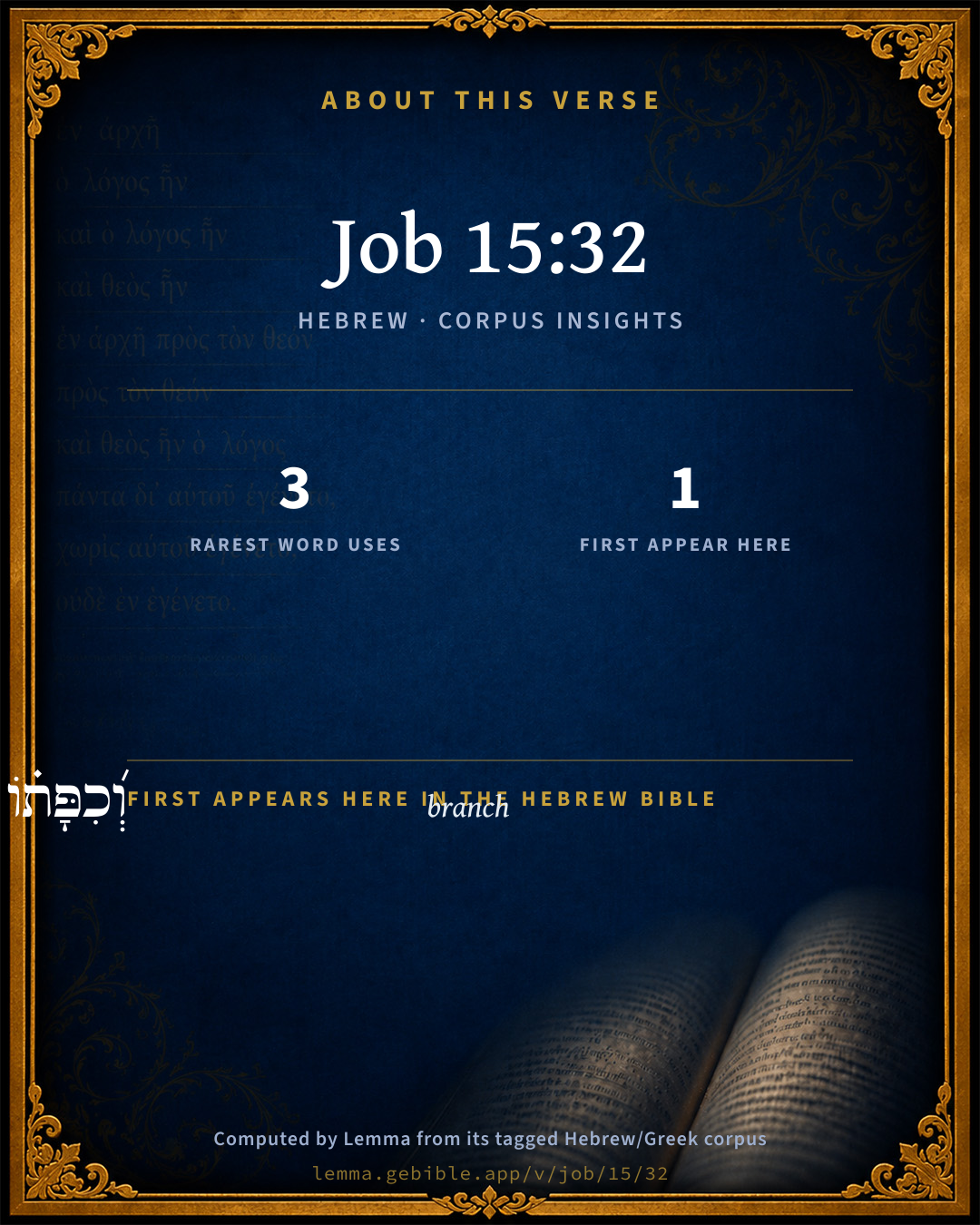
The rarest word here is וְ֝כִפָּת֗וֹ branch H3712 — appearing just 3 times in the whole Hebrew Bible.

First appearance in Scripture

This word makes its first canonical appearance in the Hebrew Bible here:

  • וְ֝כִפָּת֗וֹ branch H3712

Shared distinctive vocabulary

וְ֝כִפָּת֗וֹ branch H3712 occurs in 3 verses of the Hebrew Bible. Also found in:

Grammatical profile

  • 2 verbs
  • 2 nouns
  • 2 particles

Verb forms

  • תִּמָּלֵ֑א Niphal · Imperfect
  • רַעֲנָֽנָה Palel · Perfect

Repetition

A word recurs within this verse — often emphatic in Hebrew:

  • בְּֽלֹא not H3808 ×2

Hebrew & Septuagint length

In English translation the verse runs 13 words from the Hebrew and 13 from the Septuagint (LXX English) — the same length.

A rough comparison of the two English renderings, which tokenize alike — not a word-level alignment.

Word counts can differ between the Hebrew and the Greek without any difference in meaning — e.g. the Hebrew direct-object marker אֵת has no separate Greek word, and Greek often adds the article ὁ.

Cross-references

12

Topical passages linked to Job 15:32 in the Treasury of Scripture Knowledge — connected by theme and wording, ordered by reader-vote popularity; previews shown in the World English Bible.

  • Ecclesiastes 7:17 Don't be too wicked, neither be foolish. Why should you die before your time?
  • Psalms 55:23 But you, God, will bring them down into the pit of destruction. Bloodthirsty and deceitful men shall not live out half their days, But I will trust in you.
  • Job 22:16 Who were snatched away before their time, Whose foundation was poured out as a stream,
  • Hosea 9:16 Ephraim is struck. Their root has dried up. They will bear no fruit. Even though they bring forth, yet I will kill the beloved ones of their womb."
  • Job 8:16–19 He is green before the sun, His shoots go forth over his garden.
  • Job 14:7–9 "For there is hope for a tree, If it is cut down, that it will sprout again, That the tender branch of it will not cease.
  • Job 18:16–17 His roots shall be dried up beneath, Above shall his branch be cut off.
  • Psalms 52:5–8 God will likewise destroy you forever. He will take you up, and pluck you out of your tent, And root you out of the land of the living. Selah.
  • Isaiah 27:11 When the boughs of it are withered, they shall be broken off; the women shall come, and set them on fire; for it is a people of no understanding: therefore he who made them will not have compassion on them, and he who formed them will show them no favor.
  • Ezekiel 17:8–10 It was planted in a good soil by many waters, that it might bring forth branches, and that it might bear fruit, that it might be a goodly vine.
  • Hosea 14:5–7 I will be like the dew to Israel. He will blossom like the lily, And send down his roots like Lebanon.
  • John 15:6 If a man doesn't remain in me, he is thrown out as a branch, and is withered; and they gather them, throw them into the fire, and they are burned.

Cross-references courtesy of OpenBible.info (CC BY 4.0).

Hebrew and Greek witnesses Masoretic Hebrew ↔ Greek Septuagint

The same verse in the two great witnesses to the Old Testament, shown verse-for-verse.

These are two independent witnesses, not word-aligned to each other, and the Septuagint is shown in lemma (dictionary) form.

Hebrew Job 15:32 Masoretic · Westminster Leningrad Codex

בְּֽלֹא י֭וֹמוֹ תִּמָּלֵ֑א וְ֝כִפָּת֗וֹ לֹ֣א רַעֲנָֽנָה

It shall be accomplished before his time. His branch shall not be green.

World English Bible · Public Domain

Greek LXX Job 15:32 Septuagint · lemma form

ὁ τομή αὐτός πρό ὥρα φθείρω καί ὁ ῥάδαμνος αὐτός οὐ μή πυκάζω

His harvest shall perish before the time, and his branch shall not flourish.

LXX2012 (modern English Septuagint) · Public Domain

On this verse, Haydock's Catholic Bible Commentary discusses the Septuagint’s reading. Read the note in Commentary ↓

Hebrew: Westminster Leningrad Codex (CC BY 4.0). Greek: Septuagint (public domain); English from LXX2012 (modern English Septuagint) (Public Domain). How the Septuagint differs from the Hebrew →

Commentary

Notes on Job 15:32 from classic Christian and Jewish commentators (each source and its license shown beneath its notes). The classic Christian expositions comment on the surrounding passage and are grouped to its opening verse, so a note may address several verses; the Jewish commentaries on the Tanakh (Rashi and others) are per-verse, so they appear only where the commentator wrote on this verse.

Lemma curates 59 commentaries, every one of them public domain or Creative Commons licensed, each selected and text-cleaned for this edition rather than reprinted as found. About our sources →

Trapp's Complete Commentary

John Trapp

Job 15:32 It shall be accomplished before his time, and his branch shall not be green.

Ver. 32. It shall be accomplished before his time] Heb. In not his day. That recompense before mentioned of calamity and death shall be hastened, so that they shall not live out half their days, Psa 55:22, but die tempore non suo, Ecc 7:15, then when it were better for them to do anything rather than to die, since they perish in their corruptions, they are killed with death, Rev 2:23; see Pro 7:27. Death ever taketh a wicked man unprovided, Haec enim vena nobis ab Adam agnata est, ut nullam arborem ad suspendium aptam invenire possimus: neque unquam caro mortem eligit, nisi pressa iudicio (Brent. in loc.). We naturally dream of an immortality here, neither yield we to die till there be a necessity, Miserandum est autem, saith Lavater; but it is a pitiful thing, that, being all so desirous of life, we should so little care for those things that would lengthen our lives, such as are piety, justice, temperance, &c.; we forget that short way to long life, Psa 34:12.

His branch shall not be green] Heb. His crooked or bowed down branch; this is his full estate or numerous issue, those boughs of his, laden and bowed down with fruit, shall not be green, but blasted and dried up; ramificans eius non virescet. It is a misery to be the branch of a wicked stock, for such, as they leave the rest of their substance to their little ones, Psa 17:14, so they leave them God’s curse, as Joab’s legacy, 2Sa 3:29, or as Gehazi’s leprosy, 2Ki 5:27, a wretched bequeath.

John Trapp, A Commentary or Exposition upon All the Books of the Old and New Testament (1647–1656) — public domain. Text from a community e-Sword module.

Joseph Benson's Commentary

Job 15:32-33. It shall be accomplished — Namely, that which was last mentioned, that vanity should be his recompense: before his time — When, by the course of nature, and common providence, he might have continued and flourished much longer. And his branch — His glory and prosperity, or his children; shall not be green — Shall not continue to flourish as heretofore. He shall shake off his unripe grapes — The wicked man, who, by his sins, is the author of his own ruin, shall be deprived of his fruit, of his children, and other comforts, before their time; as the vine — Which either of itself drops its tender grapes, or loses them when they are plucked off by a violent hand; and shall cast off his flower as the olive — Which flourishes much about the same time with the vine, and commonly suffers similar injuries.

Joseph Benson's Commentary on the Old and New Testaments (1811–1818) — public domain. Text from a community e-Sword module.

Jamieson, Fausset & Brown

Robert Jamieson, A. R. Fausset & David Brown

Literally, "it (the tree to which he is compared, Job 15:30, or else his life) shall not be filled up in its time"; that is, "he shall be ended before his time."

shall not be green--image from a withered tree; the childless extinction of the wicked.

Jamieson, Fausset & Brown — Commentary Critical and Explanatory on the Whole Bible (1871) — public domain (CC PDM 1.0). Text via the HelloAO Bible API.

Adam Clarke's Commentary

Verse 32. It shall be accomplished before his time] I believe the Vulgate gives the true sense: Antequam dies ejus impleantur, peribit; "He shall perish before his time; before his days are completed."

8. He shall be removed by a violent death, and not live out half his days.

9. And his branch shall not be green - there shall be no scion from his roots; all his posterity shall fail.

Adam Clarke's Commentary on the Bible (1810–1826) — public domain. Text from a community e-Sword/MySword module.

Ellicott's Commentary for English Readers

(32) It shall be accomplished.—That is, paid in full before its time.

The remainder of this chapter calls for little explanation. In it the speaker only repeats the orthodox and familiar saw that the wicked are punished in life, and therefore, by implication, the good rewarded: a maxim which fails utterly in the face of afflictions like those of Job, unless, as his friends insinuated, he was one of the wicked. After stating the doom of the ungodly, Eliphaz, in the last verse, sums up the character of those he has been denouncing. Not only are they evil in themselves, but they hatch evil; but it is evil that recoils on themselves.

A Bible Commentary for English Readers, edited by Charles John Ellicott (1878–1897) — public domain. Text from a community e-Sword module.

The Cambridge Bible for Schools and Colleges

gen. ed. J. J. S. Perowne

32. Before his time] lit. before his day, that is, the natural day of his death, cf. ch. Job_22:16; and the clause means, in the midst of his years (Psa_55:23) his recompence, or exchange, is fulfilled and goes into accomplishment—he is cut off. The words might also mean that his recompence accrues to him in its fulness. In the second clause “branch” is the palm-branch, or crowning tuft (Isa_9:14), and the figure is that of such a tree withered and dead.

The Cambridge Bible for Schools and Colleges (gen. ed. J. J. S. Perowne; Cambridge University Press, 1878–1918) — public domain. Text from a community e-Sword module.

John Gill's Exposition

He shall shake off his unripe grape as the vine,.... Either the wicked man himself shall shake off or lose his substance; or God shall shake off from him all that was dear and valuable to him; or he shall be shaken by one providence or another, just as a vine is shaken by a violent wind and tempest, and its unripe grapes are battered off by an hailstorm, or plucked off by the hand, or drop off through rottenness; so it is signified by this metaphor, that a wicked man should be stripped of his wealth and riches in a sudden manner; or his children should be snatched from him in their youth, before they were well grown up to maturity, and so like the unripe grape; perhaps respect is had to Job's case, both with regard to his substance and his family:

and shall cast off his flower, as the olive: which tree, when shaken in a violent manner, drops its flower, and so brings forth no fruit; it is observed by naturalists (h), that these two trees, the vine and the olive, flourish much about the same time, and suffer much by storms and tempests, which destroy their fruits, and especially when rain falls in the time of their flowering; the some thing is intended in this clause as in the former.

(h) Plin. Nat. Hist. l. 16. c. 25. l. 17. c. 2. 24.

John Gill's Exposition of the Whole Bible (1746–1763) — public domain (CC PDM 1.0). Text via the HelloAO Bible API.

Albert Barnes' Notes on the Bible

It shall be accomplished before his time - Margin, “cut off.” The image here is that of a tree, which had been suggested in Job 15:30. Here it is followed up by various illustrations drawn from the flower, the fruit, etc., all of which are designed to denote the same thing - that a wicked man will not be permanently prosperous; he will not live and flourish as he would if he were righteous. He will be like a tree that is cut down before its proper time, or that casts its flowers and fruits and brings nothing to perfection. The phrase here literally is, “It shall not be filled up in its time;” that is, a wicked man will be cut off before he has filled up the measure of his days, like a tree that decays and falls before its proper time. A similar idea occurs in Psa 55:23. “Bloody and deceitful men shall not live out half their days.” As a general fact this is all true, and the observation of the ancient Idumeans was correct. The temperate live longer than the intemperate; the chaste longer than the licentious; he that controls and governs his passions longer than he who gives the reins to them; and he who leads a life of honesty and virtue longer than he who lives for crime. Pure religion makes a man temperate, sober, chaste, calm, dispassionate, and equable in his temper; saves from broils, contentions, and strifes; subdues the angry passions, and thus tends to lengthen out life.

His branch shall not be green - It shall be dried up and withered away - retaining the image of a tree.

Albert Barnes' Notes on the Bible (1834–1885) — public domain. Text from a community e-Sword/MySword module.

Haydock's Catholic Bible Commentary

Hands; strength and prosperity. (Calmet) --- Septuagint, "his branch shall not grow thick." (Haydock)

George Leo Haydock (1774–1849), Haydock's Catholic Family Bible and Commentary, 1859 edition — public domain. Excludes Psalms (Douay-Rheims chapter numbering differs from Protestant) and Deuterocanonical books (Catholic canon only).

Matthew Poole's English Annotations

It shall be accomplished, to wit, that which was last mentioned, that vanity should be his recompence. Or, it, i.e. his branch, mentioned in the next clause of the verse, from which it is understood in this former clause, as is very usual in the Holy Scripture, shall be consumed, or cut off.

Before his time, i.e. when by the course of nature and common providence it might have continued and flourished much longer.

His branch; either,

1. His glory and prosperity. Or rather,

2. His children, by comparing Job 15:34, where the desolation is said to fall upon all the congregation and tabernacles of these men; and so he reflects upon Job, who lost his children.

Shall not be green, i.e. shall not continue to flourish, as it had done.

Matthew Poole's English Annotations on the Holy Bible (1683–1685) — public domain. Text from a community e-Sword/MySword module.

Whedon's Commentary on the Bible

Daniel D. Whedon

32. Accomplished before his time — Literally, In not his day it (the exchange) is fulfilled. The wicked man dies prematurely. The day he dies “is not his appointed day.” — Dillmann, Hirtzel. See note, Job_14:5. Compare Psa_55:23. Branch — The top branch (of the palm.)

Daniel D. Whedon (gen. ed.), Commentary on the Old and New Testaments (1874–1909) — public domain. Text from a community e-Sword module.

The Pulpit Commentary

It shall be accomplished before his time. "It i.e. the recompense shall be accomplished or, "paid in full before its time i.e. before payment is due." A vague threat, probably intended to signify that death will come upon the wicked man prematurely, before he has lived out halt the days of his natural life. And his branch shall not be green; i.e. he shall wither and fade, like a tree not planted by the waterside. (Psa_1:3)

The Pulpit Commentary (1880–1919), ed. H.D.M. Spence-Jones & Joseph S. Exell — public domain. Text from a community e-Sword module.

John Wesley's Explanatory Notes

Accomplished - That vanity should be his recompence. Before - When by the course of nature, and common providence he might have continued much longer.

John Wesley, Explanatory Notes Upon the Whole Bible (1754–1765) — public domain. Text via the GEBible commentary corpus.

Rashi

Rabbi Shlomo Yitzchaki (Rashi)

Before his time his recompense will be complete [and will cease] from growing and prospering anymore, like (Gen. 50:3), “were fulfilled for him,” i.e., they were completed.

and his branches His bent-over branches. All branches of a tree resemble a dome.

Rashi on the Tanakh — English translations: “The Judaica Press complete Tanach with Rashi, translated by A. J. Rosenberg” (CC BY 4.0); “Pentateuch with Rashi's commentary by M. Rosenbaum and A.M. Silbermann, 1929-1934” (public domain); “The Metsudah Tanach series, Lakewood, N.J” (CC BY 4.0); and “The Book of Joshua, Metsudah Publications, 1997” (CC BY 4.0). Text via Sefaria.

Lesson kit

Teaching starters — assembled from the data on this page, not authored interpretation. Every prompt links to the verse data it draws on. Edit before teaching.

Job, in the Wisdom, opens this verse with 6 words (5 distinct Hebrew lemmas). Its most distinctive word is kippâh (“branch”). A historical commentator’s framing appears above. Read the whole chapter for the surrounding context.

Discussion questions

  1. What does “branch” (kippâh) contribute to the verse as a whole?
  2. The word “branch” first appears here in Scripture. What is being introduced at this debut?
  3. Isaiah 9:14 shares the word «branch» with this verse. How do the two illuminate each other?
  4. “not” occurs 2× in this one verse. What is the effect of the repetition?
  5. The translations on this page render this verse differently — a whole-verse word diff, not a word-by-word alignment. What might account for the different wordings?
  6. The verb «תִּמָּלֵ֑א» is Niphal Imperfect. How does its form color the action?
  7. Reading how Trapp's Complete Commentary and Joseph Benson's Commentary read this verse, where do the two commentators agree and where do they part?

Things to notice

  • 1 word makes its first canonical appearance in Scripture here.
  • These translations choose different wording for 8 words in this verse.
  • “not” occurs 2× in this single verse.
  • 5 distinct Hebrew lemmas span 6 words in this verse.

Reading settings

Reading text

Shown beneath each verse's original-language words.

Old Testament
Old Testament edition

Read the OT as the Masoretic Hebrew (MT) or the Greek Septuagint (LXX).

English shown for the Greek Septuagint (in the Hebrew ↔ Greek comparison).

Comparing translations? Open the Compare panel on any verse page to stack up to four side by side.