
Deuteronomy 33:16

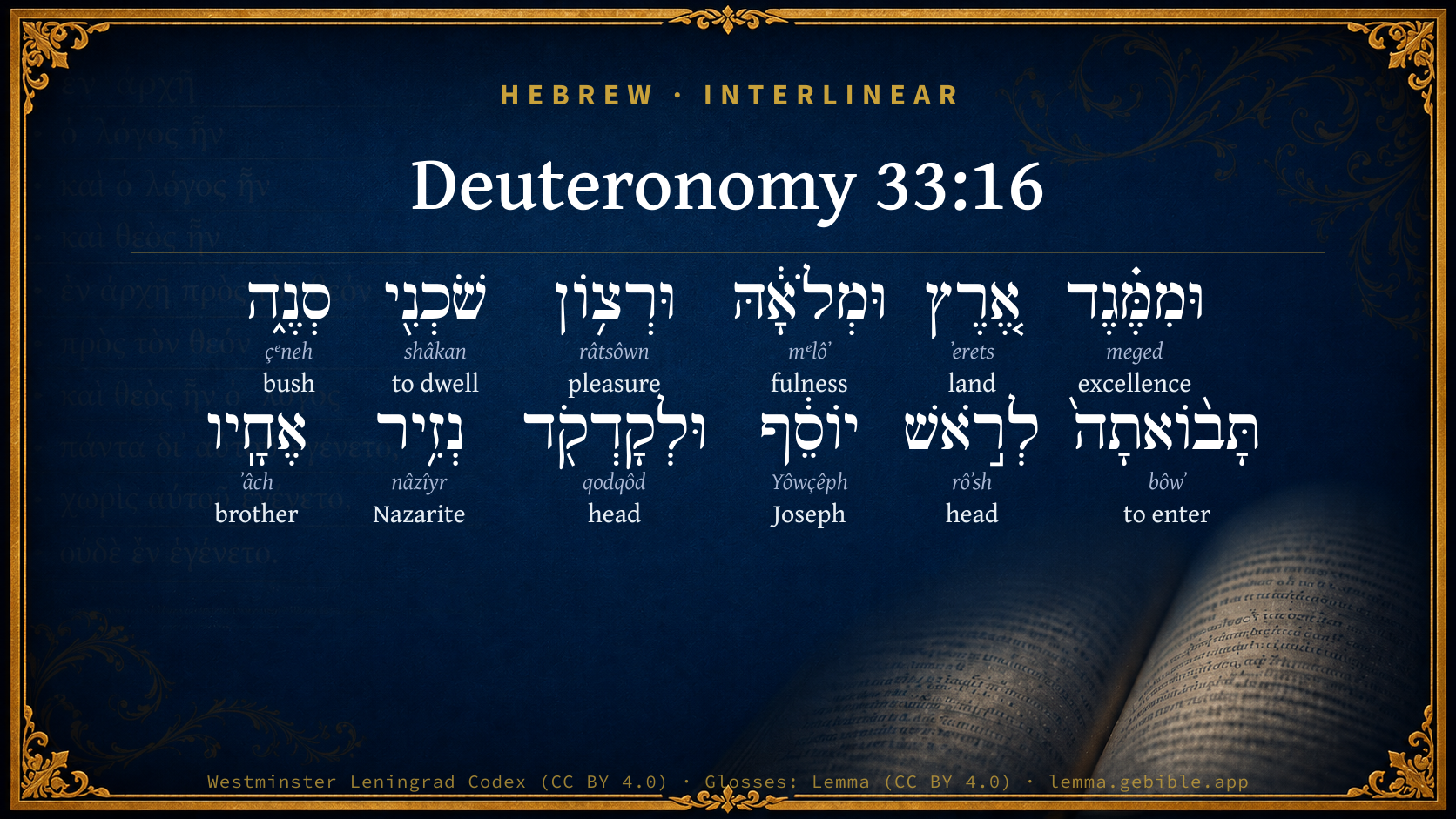
Hebrew (Westminster Leningrad Codex) Deuteronomy 33:16 appears in the Hebrew Old Testament. The text above is from the Westminster Leningrad Codex. Each word links to its Strong’s number, a concise gloss, and parsing drawn from the Open Scriptures Hebrew Bible morphology. Click any word for its full Brown-Driver-Briggs (BDB) entry.
Download image
Cite this verse

Deuteronomy 33:16 (World English Bible). Public Domain. Lemma interlinear Bible study tool, https://lemma.gebible.app/v/deuteronomy/33/16.

Show BibTeX & RIS
BibTeX
RIS
English Translation
For the precious things of the earth and the fullness of it, The good will of him who lived in the bush. Let [the blessing] come on the head of Joseph, On the crown of the head of him who was separate from his brothers.
World English Bible · Public Domain
Download a study sheet

One document with this verse’s original text, its word-by-word gloss line, the meaning frame, cross-references with their text, attributed commentary, and full source and license credits — printable, and it pastes into notes with its structure intact.

This verse Autodidact and up

Study sheet (.html) Plain text (.txt)

A passage Seminary Student

Up to 50 verses in one chapter. A passage sheet keeps up to 6 commentary sources and 12 cross-references per verse, in the order this page ranks them, and says so on the sheet whenever that leaves anything out. Ask for a single verse and you get the Autodidact verse sheet above.

Everything on this page stays free to read, with no account — the sheet is a download of what is already on screen, not access to it.

Want to remove ads? Support Godless Engineer
Compare translations 3

The same verse in 3 English versions, stacked beneath the original-language interlinear above. Click any original word for its lexicon entry.

Each is an independent rendering of the whole verse — the interlinear is not word-aligned to these translations.

Highlighted words mark where these versions differ — a whole-verse word diff, not a word-by-word alignment.

  • World English Bible Public Domain
    For the precious things of the earth and the fullness of it, The good will of him who lived in the bush. Let [the blessing] come on the head of Joseph, On the crown of the head of him who was separate from his brothers.
  • King James Version Public Domain
    And for the precious things of the earth and fulness thereof, and for the good will of him that dwelt in the bush: let the blessing come upon the head of Joseph, and upon the top of the head of him that was separated from his brethren.
  • unfoldingWord Literal Text CC BY-SA 4.0
    and from the bounty of earth and from its fullness, and the favor of the bush-dweller. Let them come on the head of Joseph, and on the top of the head of the prince of his brothers.

unfoldingWord Literal Text — © unfoldingWord, licensed CC BY-SA 4.0. Word-aligned USFM3 via Door43 (git.door43.org/unfoldingWord/en_ult).

Versions to compare (up to 4)

3 of 4 selected

Show all 18 translations

Every available English version of this verse, each an independent rendering of the whole verse.

  • World English Bible Public Domain
    For the precious things of the earth and the fullness of it, The good will of him who lived in the bush. Let [the blessing] come on the head of Joseph, On the crown of the head of him who was separate from his brothers.
  • Berean Standard Bible Public Domain
    with the choice gifts of the land and everything in it, and with the favor of Him who dwelt in the burning bush. May these rest on the head of Joseph and crown the brow of the prince of his brothers.
  • Majority Standard Bible Public Domain
    with the choice gifts of the land and everything in it, and with the favor of Him who dwelt in the burning bush. May these rest on the head of Joseph and crown the brow of the prince of his brothers.
  • King James Version Public Domain
    And for the precious things of the earth and fulness thereof, and for the good will of him that dwelt in the bush: let the blessing come upon the head of Joseph, and upon the top of the head of him that was separated from his brethren.
  • American Standard Version (1901) Public Domain
    And for the precious things of the earth and the fulness thereof, And the good will of him that dwelt in the bush. Let `the blessing' come upon the head of Joseph, And upon the crown of the head of him that was separate from his brethren.
  • Revised Version (1885) Public Domain
    And for the precious things of the earth and the fulness thereof, And the good will of him that dwelt in the bush: Let the blessing come upon the head of Joseph, And upon the crown of the head of him that was separate from his brethren.
  • Geneva Bible (1599) Public Domain
    And for the sweetenesse of the earth, and abundance thereof: and the good will of him that dwelt in the bushe, shall come vpon the head of Ioseph, and vpon the toppe of the head of him that was separated from his brethren.
  • Douay-Rheims (1899) Public Domain
    And of the fruits of the earth, and of the fulness thereof. The blessing of him that appeared in the bush, come upon the head of Joseph, and upon the crown of the Nazarite among his brethren.
  • Young's Literal Translation Public Domain
    And by precious things -- of earth and its fulness, And the good pleasure Of Him who is dwelling in the bush, -- Let it come for the head of Joseph, And for the crown of him Who is separate from his brethren.
  • Literal Standard Version CC BY-SA 4.0
    And by a precious thing—of earth and its fullness, || And the good pleasure of Him who is dwelling in the bush; Let it come for the head of Joseph, || And for the crown of him [who is] separate from his brothers.
  • Unlocked Literal Bible CC BY-SA 4.0
    May his land be blessed with the precious things of the earth and its abundance, and with the good will of him who was in the bush. Let the blessing come on the head of Joseph, and on the top of the head of him who was prince over his brothers.
  • unfoldingWord Literal Text CC BY-SA 4.0
    and from the bounty of earth and from its fullness, and the favor of the bush-dweller. Let them come on the head of Joseph, and on the top of the head of the prince of his brothers.
  • Darby Bible Public Domain
    And by the precious things of the earth and the fulness thereof. And let the good will of him that dwelt in the bush Come upon the head of Joseph, Upon the top of the head of him that was separated from his brethren.
  • World Messianic Bible Public Domain
    for the precious things of the earth and its fullness, the good will of him who lived in the bush. Let this come on the head of Joseph, on the crown of the head of him who was separated from his brothers.
  • Webster's Bible Public Domain
    And for the precious things of the earth and fullness of it, and for the good will of him that dwelt in the bush; let the blessing come upon the head of Joseph, and upon the top of the head of him that was separated from his brethren.
  • Free Bible Version CC BY-SA 4.0
    with the best gifts of the land and everything in it, along with the appreciation of the one who was in the burning bush. May these blessings rest on the head of Joseph like a crown for this prince among his brothers.
  • Bible in Basic English Public Domain
    The good things of the earth and all its wealth, the good pleasure of him who was seen in the burning tree: may they come on the head of Joseph, on the head of him who was prince among his brothers.
  • JPS Tanakh (1917) Public Domain
    And for the precious things of the earth and the fulness thereof, and the good will of Him that dwelt in the bush; let the blessing come upon the head of Joseph, and upon the crown of the head of him that is prince among his brethren.

Literal Standard Version (2020), Covenant Press — licensed CC BY-SA 4.0. Text via the HelloAO Bible API (eBible.org). Unlocked Literal Bible (unfoldingWord) — licensed CC BY-SA 4.0. Text via the HelloAO Bible API (eBible.org). unfoldingWord Literal Text — © unfoldingWord, licensed CC BY-SA 4.0. Word-aligned USFM3 via Door43 (git.door43.org/unfoldingWord/en_ult). Free Bible Version, Dr. Jonathan Gallagher — licensed CC BY-SA 4.0. Text via the HelloAO Bible API (eBible.org).

Word by word

More ways to search: Search by grammar → Find every occurrence → Compare this word →

Practice this passage: Drill this verse → Learn its vocabulary →

סְנֶ֑ה
çᵉneh
H5572
“bush”
Noun, Common, Masculine, Singular, Absolute
Part of Speech
Noun
Type
Common
Gender
Masculine
Number
Singular
State
Absolute
Full BDB Definition

Origin: from an unused root meaning to prick

TWOT: 1520

a bush, thorny bush - the burning bush of Moses - perhaps a blackberry bush
  1. וּמִמֶּ֗גֶד meged H4022 “and · from · excellence of” Conjunction + Preposition + Noun, Common, Masculine, Singular, Construct
  2. אֶ֚רֶץ ʼerets H776 “land” Noun, Common, Both, Singular, Absolute
  3. וּמְלֹאָ֔הּ mᵉlôʼ H4393 “and · fulness · her” Conjunction + Noun, Common, Masculine, Singular, Construct + Suffix, Personal, 3rd Person, Feminine, Singular
  4. וּרְצ֥וֹן râtsôwn H7522 “and · pleasure of” Conjunction + Noun, Common, Masculine, Singular, Construct
  5. שֹׁכְנִ֖י shâkan H7931 “dwelling” Verb, Qal, Participle Active, Masculine, Singular, Construct
  6. תָּב֨וֹאתָה֙ bôwʼ H935 “to enter” Verb, Qal, Imperfect, 3rd Person, Feminine, Singular + Suffix, h
  7. לְרֹ֣אשׁ rôʼsh H7218 “to/for · head of” Preposition + Noun, Common, Masculine, Singular, Construct
  8. יוֹסֵ֔ף Yôwçêph H3130 “Joseph” Noun, Proper
  9. וּלְקָדְקֹ֖ד qodqôd H6936 “and · to/for · head of” Conjunction + Preposition + Noun, Common, Masculine, Singular, Construct
  10. נְזִ֥יר nâzîyr H5139 “Nazarite of” Noun, Common, Masculine, Singular, Construct
  11. אֶחָֽיו ʼâch H251 “brothers · his” Noun, Common, Masculine, Plural, Construct + Suffix, Personal, 3rd Person, Masculine, Singular

About this verse

These counts appear in no published source. They are computed here, from the morphology-tagged text and Lemma’s own curated glosses. What Lemma adds →

12
words
12
distinct lemmas
Pentateuch
section

Notable vocabulary

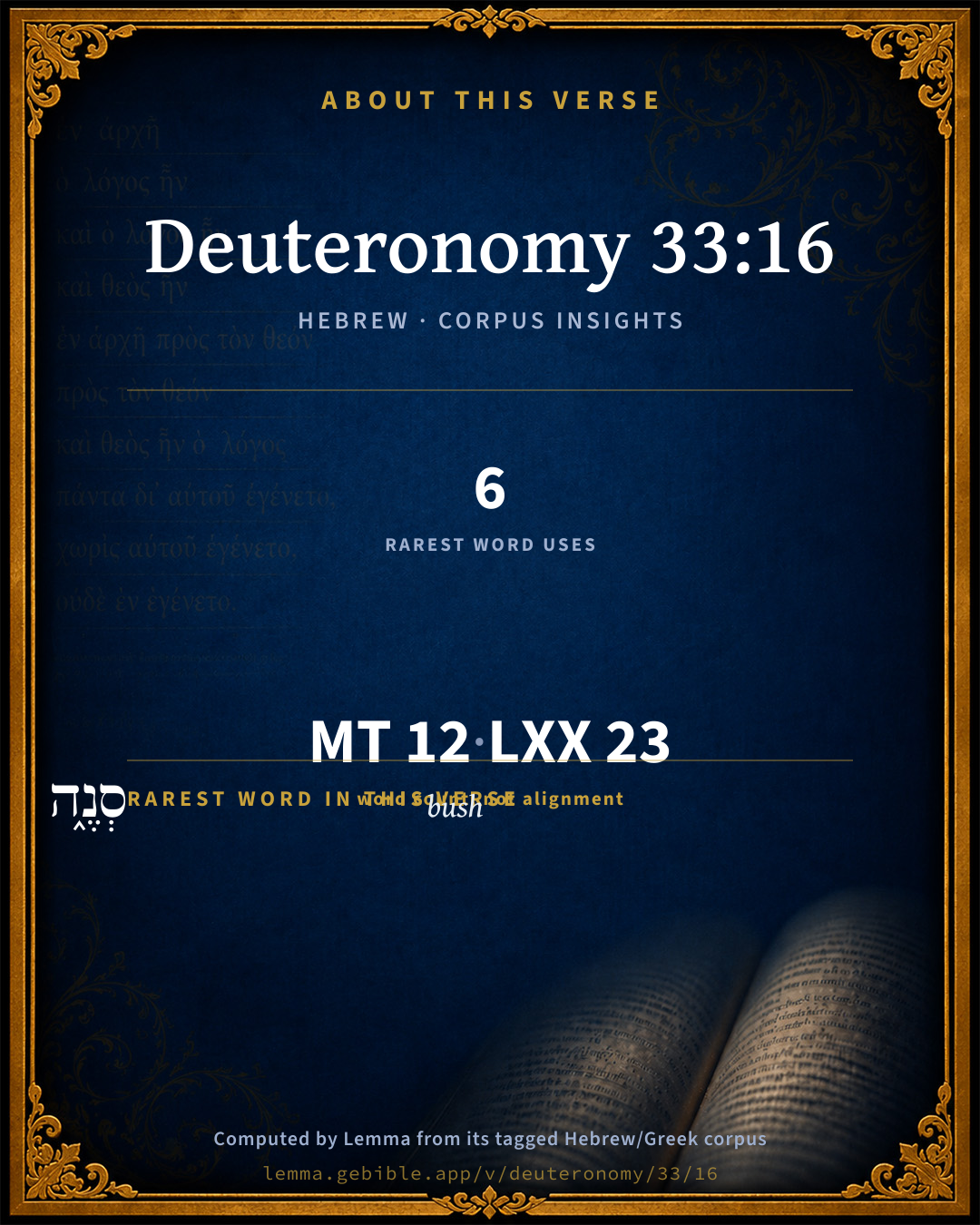
The rarest word here is סְנֶ֑ה bush H5572 — appearing just 6 times in the whole Hebrew Bible.

Shared distinctive vocabulary

סְנֶ֑ה bush H5572 occurs in 4 verses of the Hebrew Bible. Also found in:

Grammatical profile

  • 2 verbs
  • 10 nouns

Verb forms

  • שֹׁכְנִ֖י Qal · Participle Active
  • תָּב֨וֹאתָה֙ Qal · Imperfect

Hebrew & Septuagint length

In English translation the verse runs 45 words from the Hebrew and 39 from the Septuagint (LXX English) — closely comparable.

A rough comparison of the two English renderings, which tokenize alike — not a word-level alignment.

Word counts can differ between the Hebrew and the Greek without any difference in meaning — e.g. the Hebrew direct-object marker אֵת has no separate Greek word, and Greek often adds the article ὁ.

In the original languages it is 12 Hebrew tokens and 23 Greek tokens — but the two are counted differently (Hebrew bundles its prefixes and suffixes into one token; the Greek is in lemma form), so that isn’t a like-for-like length.

Cross-references

19

Topical passages linked to Deuteronomy 33:16 in the Treasury of Scripture Knowledge — connected by theme and wording, ordered by reader-vote popularity; previews shown in the World English Bible.

  • Acts 7:35 "This Moses, whom they refused, saying, 'Who made you a ruler and a judge?'--God has sent him as both a ruler and a deliverer by the hand of the angel who appeared to him in the bush.
  • Exodus 3:2–4 The angel of Yahweh appeared to him in a flame of fire out of the midst of a bush. He looked, and behold, the bush burned with fire, and the bush was not consumed.
  • Psalms 24:1 The earth is Yahweh's, with its fullness; The world, and those who dwell therein.
  • Genesis 37:28 Midianites who were merchants passed by, and they drew and lifted up Joseph out of the pit, and sold Joseph to the Ishmaelites for twenty pieces of silver. They brought Joseph into Egypt.
  • Genesis 37:36 The Midianites sold him into Egypt to Potiphar, an officer of Pharaoh's, the captain of the guard.
  • Genesis 39:2–3 Yahweh was with Joseph, and he was a prosperous man. He was in the house of his master the Egyptian.
  • Genesis 43:32 They served him by himself, and them by themselves, and the Egyptians, that ate with him, by themselves, because the Egyptians don't eat bread with the Hebrews, for that is an abomination to the Egyptians.
  • Genesis 45:9–11 Hurry, and go up to my father, and tell him, 'This is what your son Joseph says, "God has made me lord of all Egypt. Come down to me. Don't wait.
  • Genesis 49:26 The blessings of your father Have prevailed above the blessings of the ancient mountains, Above the bounty of the age-old hills. They will be on the head of Joseph, On the crown of the head of him who is separated from his brothers.
  • Psalms 50:12 If I were hungry, I would not tell you, For the world is mine, and all that is in it.
  • Psalms 89:11 The heavens are yours. The earth also is yours; The world and its fullness. You have founded them.
  • Jeremiah 8:16 The snorting of his horses is heard from Dan: at the sound of the neighing of his strong ones the whole land trembles; for they are come, and have devoured the land and all that is in it; the city and those who dwell therein.
  • Mark 12:26 But about the dead, that they are raised; haven't you read in the book of Moses, about the Bush, how God spoke to him, saying, 'I am the God of Abraham, the God of Isaac, and the God of Jacob?'
  • Acts 7:30–33 "When forty years were fulfilled, an angel of the Lord appeared to him in the wilderness of Mount Sinai, in a flame of fire in a bush.
  • 2 Corinthians 12:7–10 By reason of the exceeding greatness of the revelations, that I should not be exalted excessively, there was given to me a thorn in the flesh, a messenger of Satan to buffet me, that I should not be exalted excessively.
  • Luke 2:14 "Glory to God in the highest, On earth peace, good will toward men."
  • 1 Corinthians 10:26 for "the earth is the Lord's, and its fullness."
  • 1 Corinthians 10:28 But if anyone says to you, "This was offered to idols," don't eat it for the sake of the one who told you, and for the sake of conscience. For "the earth is the Lord's, and all its fullness."
  • Hebrews 7:26 For such a high priest was fitting for us: holy, guiltless, undefiled, separated from sinners, and made higher than the heavens;

Cross-references courtesy of OpenBible.info (CC BY 4.0).

Hebrew and Greek witnesses Masoretic Hebrew ↔ Greek Septuagint

The same verse in the two great witnesses to the Old Testament, shown verse-for-verse.

These are two independent witnesses, not word-aligned to each other, and the Septuagint is shown in lemma (dictionary) form.

Hebrew Deuteronomy 33:16 Masoretic · Westminster Leningrad Codex

וּמִמֶּ֗גֶד אֶ֚רֶץ וּמְלֹאָ֔הּ וּרְצ֥וֹן שֹׁכְנִ֖י סְנֶ֑ה תָּב֨וֹאתָה֙ לְרֹ֣אשׁ יוֹסֵ֔ף וּלְקָדְקֹ֖ד נְזִ֥יר אֶחָֽיו

For the precious things of the earth and the fullness of it, The good will of him who lived in the bush. Let [the blessing] come on the head of Joseph, On the crown of the head of him who was separate from his brothers.

World English Bible · Public Domain

Greek LXX Deuteronomy 33:16 Septuagint · lemma form

καί κατά ὥρα γῆ πλήρωσις καί ὁ δεκτός ὁ ὁράω ἐν ὁ βάτος ἔρχομαι ἐπί κεφαλή ιωσηφ καί ἐπί κορυφή δοξάζω ἐν ἀδελφός

and of the fullness of the land in season: and let the things pleasing to him that lived in the bush come on the head of Joseph, and on the crown of him who was glorified above his brethren.

LXX2012 (modern English Septuagint) · Public Domain

On this verse, The Cambridge Bible for Schools and Colleges discusses the Septuagint’s reading. Read the note in Commentary ↓

Hebrew: Westminster Leningrad Codex (CC BY 4.0). Greek: Septuagint (public domain); English from LXX2012 (modern English Septuagint) (Public Domain). How the Septuagint differs from the Hebrew →

Targum (Aramaic paraphrase)

2

The Targum is the ancient Jewish Aramaic paraphrase of the Hebrew Scriptures — an interpretive translation, not the Hebrew text itself. Onkelos (literal) and Pseudo-Jonathan (expansive) render the Torah, and Jonathan the Prophets. Coverage is partial: where no permissively-licensed English translation exists for a verse, only the Aramaic is shown. This is verse-level text, not a word-by-word alignment to the Hebrew.

  1. Targum Onkelos Torah (Genesis–Deuteronomy)
    וּמִטוּב אַרְעָא וּמָלָאַהּ וְרָעֵי לֵהּ דִשְׁכִנְתֵּהּ בִּשְׁמַיָא וְעַל מֹשֶׁה אִתְגְלִי בַאֲסָנָא יֵיתוּן כָּל אִלֵין לְרֵישָׁא דְיוֹסֵף וּלְגַבְרָא פָּרִישָׁא דַאֲחוֹהִי

    (no public-domain English translation for this verse)

    Targum Onkelos — Aramaic: “Onkelos Genesis” (public domain); “Onkelos Exodus” (public domain); “Onkelos Leviticus” (public domain); “Onkelos Numbers” (public domain); “Onkelos Deuteronomy” (public domain). English: “Sefaria Community Translation” (CC0 1.0 (public-domain dedication)); “J.W. Etheridge. The Targums of Onkelos and Jonathan Ben Uzziel on the Pentateuch. London: Longmans, Green, 1862” (public domain). Text via Sefaria.

  2. Targum Pseudo-Jonathan Torah (Genesis–Deuteronomy)
    וּמִטוּב שְׁבַח פֵּירֵי אַרְעָא וּמַלְיָהּ רְעֵי לֵיהּ אֱלָהָא דְאִתְגְלֵי בְּאִיקַר שְׁכִינְתֵּיהּ עַל משֶׁה בִּסְנַיָא יִתְכַּנְשָׁן כֻּלְהוֹן בִּרְכָתָא אִלֵין וְיִתְעַבְדָן כְּלִיל דִרְבוּ לְרֵישֵׁיהּ דְיוֹסֵף וּלְקָדְקָדֵיהּ דְגַבְרָא דַהֲוָה רַב וְשַׁלִיט בְּאַרְעָא דְמִצְרַיִם וַהֲוָה זָהִיר בְּאִיקְרָא דְאָחוֹי

    and with the goodness of the excel- lent fruits of the earth and its fulness and the favour towards him of Eloah who revealed Himself to Mosheh at the bush in the glory of His Shekinah: let all these blessings be combined, and be made a diadem of grandeur for the head of Joseph, and for the brow of the man who was chief and ruler in the land of Mizraim, and was the glory and honour of his brethren.

    Targum Pseudo-Jonathan — Aramaic: “Targum Jonathan on Genesis” (public domain); “Targum Jonathan on Exodus” (public domain); “Targum Jonathan on Leviticus” (public domain); “Targum Jonathan on Numbers” (public domain); “Targum Jonathan on Deuteronomy” (public domain). English: “The Targum of Jonathan ben Uzziel, trans. J. W. Etheridge, London, 1862” (public domain). Text via Sefaria.

Commentary

Notes on Deuteronomy 33:16 from classic Christian and Jewish commentators (each source and its license shown beneath its notes). The classic Christian expositions comment on the surrounding passage and are grouped to its opening verse, so a note may address several verses; the Jewish commentaries on the Tanakh (Rashi and others) are per-verse, so they appear only where the commentator wrote on this verse.

Lemma curates 59 commentaries, every one of them public domain or Creative Commons licensed, each selected and text-cleaned for this edition rather than reprinted as found. About our sources →

Ellicott's Commentary for English Readers

(16) The good will of him that dwelt in the bush—is a blessing peculiar to Moses. It contains an exquisite piece of interpretation. From the fact that Jehovah revealed Himself to Moses in a flame of fire in a bush, the man of God drew the thought that He presented Himself as dwelling in it; and thus he has furnished God’s Church with this comfort for all ages, that His human temple, although it burn with fire, can never be consumed.

The last part of Deu_33:16 is taken direct from Gen_49:26.

Separated from his brethren.—Heb., nâzîr. Is it altogether unreasonable to suppose that this particular feature in Joseph’s history, when he was “sold into Egypt,” and “separated from his brethren,” may be part of the meaning of “Nazarene” when applied to our Lord in Mat_2:23?

A Bible Commentary for English Readers, edited by Charles John Ellicott (1878–1897) — public domain. Text from a community e-Sword module.

Trapp's Complete Commentary

John Trapp

Deu 33:16 And for the precious things of the earth and fulness thereof, and [for] the good will of him that dwelt in the bush: let [the blessing] come upon the head of Joseph, and upon the top of the head of him [that was] separated from his brethren.

Ver. 16. And for the good will of him, &c.] {See Trapp on "Exo 33:2"} The burning bush - the persecuted Church - was not consumed, because the good will of God, whereof David speaks, {Psa 106:4} was in the bush. So it is still with his in the fiery trial, in any affliction. {Isa 43:1}

That was separated from his brethren.] To be a choice and chief man amongst them. Nobilis fuit inter fratres, saith Augustine, {a} vel in malis quae pendit, vel in bonis quae rependit.

{a} De Doct. Christ., lib. iv. cap. 6.

John Trapp, A Commentary or Exposition upon All the Books of the Old and New Testament (1647–1656) — public domain. Text from a community e-Sword module.

Joseph Benson's Commentary

Deu 33:16. And for the precious things of the earth — And in general for all the choice fruits which the land produceth in all parts of it, whether hills or valleys. Fulness thereof — That is, the plants, and cattle, and all creatures that grow, increase, and flourish in it. The good-will — For all other effects of the good-will and kindness of God, who not long since did for a time dwell or appear in the bush to me, in order to the relief of his people, Exo 3:2. Of Joseph — That is, of Joseph’s posterity. Him that was separated from his brethren — His brethren separated him from them by making him a slave, and God distinguished him from them by making him a prince. The preceding words might be rendered, My dweller in the bush. That was an appearance of the divine majesty to Moses only, in token of his particular favour. Many a time had God appeared to Moses; but now he is just dying, he seems to have the most pleasing remembrance of the first time that he saw the visions of the Almighty. It was here God declared himself the God of Abraham, Isaac, and Jacob, and so confirmed the promise made to the fathers, that promise which our Lord shows reaches as far as the resurrection and eternal life.

Joseph Benson's Commentary on the Old and New Testaments (1811–1818) — public domain. Text from a community e-Sword module.

MacLaren's Expositions of Holy Scripture

Alexander MacLaren

Deuteronomy

‘AT THE BUSH’

Deu 33:16

I Think this is the only reference in the Old Testament to that great vision which underlay Moses’ call and Israel’s deliverance. It occurs in what is called ‘the blessing wherewith Moses, the man of God, blessed the children of Israel before his death,’ although modern opinion tends to decide that this hymn is indeed much more recent than the days of Moses. There seems a peculiar appropriateness in this reference being put into the mouth of the ancient Lawgiver, for to him even Sinai, with all its glories, cannot have been so impressive and so formative of his character as was the vision granted to him when solitary in the wilderness. It is to be noticed that the characteristic by which God is designated here never occurs elsewhere than in this one place. It is intended to intensify the conception of the greatness, and preciousness, and all-sufficiency of that ‘goodwill.’ If it is that ‘of Him that dwelt in the bush,’ it is sure to be all that a man can need. I need not remind you that the words occur in the blessing pronounced on ‘Joseph’-that is, the two tribes which represented Joseph-in which all the greatest material gifts that could be desired by a pastoral people are first called down upon them, and then the ground of all these is laid in ‘the goodwill of Him that dwelt in the bush.’ ‘The blessing-let it come on the head of Joseph.’

So then here, first, is a great thought as to what for us all is the blessing of blessings-God’s ‘goodwill.’ ‘Goodwill’-the word, perhaps, might bear a little stronger rendering. ‘Goodwill’ is somewhat tepid. A man may have a good enough will, and yet no very strong emotion of favour or delight, and may do nothing to carry his goodwill into action. But the word that is employed here, and is a common enough one in Scripture, always carries with it a certain intensity and warmth of feeling. It is more than ‘goodwill’; it is more than ‘favour’; perhaps ‘delight’ would be nearer the meaning. It implies, too, not only the inward sentiment of complacency, but also the active purpose of action in conformity with it, on God’s part. Now it needs few words to show that these two things, which are inseparable, do make the blessing of blessings for every one of us-the delight, the complacency, of God in us, and the active purpose of good in God for us. These are the things that will make a man happy wherever he is.

If I might dwell for a moment upon other scriptural passages, I would just recall to you, as bringing up very strongly and beautifully the all-sufficiency and the blessed effects of having this delight and loving purpose directed towards us like a sunbeam, the various great things that a chorus of psalmists say that it will do for a man. Here is one of their triumphant utterances: ‘Thou wilt bless the righteous; with favour wilt Thou compass him as with a shield.’ That crystal battlement, if I may so vary the figure, is round a man, keeping far away from him all manner of real evil, and filling his quiet heart as he stands erect behind the rampart, with the sense of absolute security. That is one of the blessings that God’s favour or goodwill will secure for us. Again, we read: ‘By Thy favour Thou hast made my mountain to stand strong.’ He that knows himself to be the object of the divine delight, and who by faith knows himself to be the object of the divine activity in protection, stands firm, and his purposes will be carried through, because they will be purposes in accordance with the divine mind, and nothing has power to shake him. So he that grasps the hand of God can say, not because of his grasp, but because of the Hand that he holds, ‘The Lord is at my right hand; I shall not be greatly moved. By Thy favour Thou hast made our mountain to stand strong.’ And again, in another analogous but yet diversified representation, we read: ‘In Thee shall we rejoice all the day, and in Thy favour shall our horn be exalted.’ That is the emblem, not only of victory, but of joyful confidence, and so he who knows himself to have God for his friend and his helper, can go through the world keeping a sunny face, whatever the clouds may be, erect and secure, light of heart and buoyant, holding up his chin above the stormiest waters, and breasting all difficulties and dangers with a confidence far away from presumption, because it is the consequence of the realisation of God’s presence. So the goodwill of God is the chiefest good.

Now, if we turn to the remarkable designation of the divine nature which is here, consider what rivers of strength and of blessedness flow out of the thought that for each of us ‘the goodwill of Him that dwelt in the bush’ may be our possession.

What does that pregnant designation of God say? That was a strange shrine for God, that poor, ragged, dry desert bush, with apparently no sap in its gray stem, prickly with thorns, with ‘no beauty that we should desire it,’ fragile and insignificant, yet it was ‘God’s house.’ Not in the cedars of Lebanon, not in the great monarchs of the forest, but in the forlorn child of the desert did He abide. ‘The goodwill of Him that dwelt in the bush’ may dwell in you and me. Never mind how small, never mind how sapless, never mind how lightly esteemed among men, never mind though we make a very poor show by the side of the ‘oaks of Bashan’ or the ‘cedars of Lebanon.’ It is all right; the Fire does not dwell in them. ‘Unto this man will I look, and with him will I dwell, who is of a humble and a contrite heart, and who trembleth at My word.’ Let no sense of poverty, weakness, unworthiness, ever draw the faintest film of fear across our confidence, for even with us He will sojourn. For it is ‘the goodwill of Him that dwelt in the bush’ that we evoke for ours.

Again, what more does that name say? He ‘that dwelt in the bush’ filled it with fire, and it ‘burned and was not consumed.’ Now there is good ground to object to the ordinary interpretation, as if the burning of the bush which yet remains unconsumed was meant to symbolise Israel, or, in the New Testament application, the Church which, notwithstanding all persecution, still remains undestroyed. Our brethren of the Presbyterian churches have taken the Latin form of the words in the context for their motto-Nec Tamen Consumebatur. But I venture to think that that is a mistake; and that what is meant by the symbol is just what is expressed by the verbal revelation which accompanied it, and that was this: ‘I AM THAT I AM.’ The fire that did not burn out is the emblem of the divine nature which does not tend to death because it lives, nor to exhaustion because it energises, nor to emptiness because it bestows, but after all times is the same; lives by its own energy and is independent. ‘I am that I have become,’-that is what men have to say. ‘I am that I once was not, and again once shall not be,’ is what men have to say. ‘I am that I am’ is God’s name. And this eternal, ever-living, self-sufficing, absolute, independent, unwearied, inexhaustible God is the God whose favour is as inexhaustible as Himself, and eternal as His own being. ‘Therefore the sons of men shall put their trust beneath the shadow of Thy wings,’ and, if they have ‘the goodwill of Him that dwelt in the bush,’ will be able to say, ‘Because Thou livest we shall live also.’

What more does the name say? He ‘that dwelt in the bush’ dwelt there in order to deliver; and, dwelling there, declared ‘I have seen the affliction of My people, and am come down to deliver them.’ So, then, if the goodwill of that eternal, delivering God is with us, we, too, may feel that our trivial troubles and our heavy burdens, all the needs of our prisoned wills and captive souls, are known to Him, and that we shall have deliverance from them by Him. Brethren, in that name, with its historical associations, with its deep revelations of the divine nature, with its large promises of the divine sympathy and help, there lie surely abundant strengths and consolations for us all. The goodwill, the delight, of God, and the active help of God, may be ours, and if these be ours we shall be blessed and strong.

Do not let us forget the place in this blessing on the head of Joseph which my text holds. It is preceded by an invoking of the precious things of Heaven, and ‘the precious fruits brought forth by the sun. . . of the chief things of the ancient mountains, and the precious things of the lasting hills, and the precious things of the earth and the fulness thereof.’ They are all heaped together in one great mass for the beloved Joseph. And then, like the golden spire that tops some of those campaniles in Italian cities, and completes their beauty, above them all there is set, as the shining apex of all, ‘the goodwill of Him that dwelt in the bush.’ That is more precious than all other precious things; set last because it is to be sought first; set last as in building some great structure the top stone is put on last of all; set last because it gathers all others into itself, secures that all others shall be ours in the measure in which we need them, and arms us against all possibilities of evil. So the blessing of blessings is the ‘goodwill of Him that dwelt in the bush.’

In my text this is an invocation only; but we can go further than that. You and I can make sure that we have it, if we will. How to secure it? One of the texts which I have already quoted helps us a little way along t he road in answer to that question, for it says, ‘Thou, Lord, wilt bless the righteous. With favour wilt thou compass him as with a shield.’ But it is of little use to tell me that if I am ‘righteous’ God will ‘bless me,’ and ‘compass me with favour.’ If you will tell me how to become righteous, you will do me more good. And we have been told how to be righteous-’If a man keep My commandments My Father will love him, and we will come to him and make our abode with him.’ If we knit ourselves to Jesus Christ, and we can all do that if we like, by faith that trusts Him, and by love, the child of faith, that obeys Him, and grows daily more like Him-then, without a doubt, that delight of God in us, and that active purpose of good in God’s mind towards us, will assuredly be ours; and on no other terms.

So, dear brethren, the upshot of my homily is just this-Men may strive and scheme, and wear their finger-nails down to the quick, to get some lesser good, and fail after all. The greatest good is certainly ours by that easy road which, however hard it may be otherwise, is made easy because it is so certain to bring us to what we want. Holiness is the condition of God’s delight in us, and a genuine faith in Christ, and the love which faith evokes, are the conditions. So it is a very simple matter You never can be sure of getting the lower good You can be quite sure of getting the highest. You never can be certain that the precious things of the earth and the fulness thereof will be yours, or that if they were, they would be so very precious; but you can be quite sure that the ‘goodwill of Him that dwelt in the bush’ may lie like light upon your hearts, and be strength to your limbs.

And so I commend to you the words of the Apostle, ‘Wherefore we labour that, whether present or absent, we may be well-pleasing to Him.’ To minister to God’s delight is the highest glory of man. To have the favour of Him that dwelt in the bush resting upon us is the highest blessing for man. He will say ‘Well done! good and faithful servant.’ ‘The Lord taketh pleasure’-wonderful as it sounds-’in them that fear Him, in them that hope in His mercy,’ and that, hoping in His mercy, live as He would have them live.

Alexander MacLaren, Expositions of Holy Scripture (1904–1910) — public domain. Text from a community e-Sword module.

Tyndale Open Study Notes

Tyndale Open Resources

33:16 the one who appeared in the burning bush: See Exod 3:2-4. The same Lord who favored Israel by rescuing them from bondage blessed the tribes of Joseph. • the prince among his brothers: Joseph’s dream that he would rule over his siblings was fulfilled when they submitted to him in Egypt (Gen 37:5-11; 42:6).

Tyndale Open Study Notes — © Tyndale Open Resources, licensed CC BY-SA 4.0. Text via the HelloAO Bible API.

Geneva Bible (1599)

Geneva Bible translators

Which was God appearing unto Moses, Exod. 3:2.

Geneva Bible (1599) marginal notes — public domain. Text via Bolls.life.

Adam Clarke's Commentary

Verse 16. The good will of him that dwelt in the bush] The favour of him who appeared in the burning bush on Mount Sinai, who there, in his good will - mere love and compassion, took Israel to be his people; and who has preserved and will preserve, in tribulation and distress, all those who trust in him, so that they shall as surely escape unhurt, as the bush, though enveloped with fire, was unburnt.

The top of the head, &c.] The same words are used by Jacob in blessing this tribe, Ge 49:26. The meaning appears to be that God should distinguish this tribe in a particular way, as Joseph himself was separated, נזיר nazir, a Nazarite, a consecrated prince to God, from among and in preference to all his brethren. See Clarke on Ge 49:25, &c.

Adam Clarke's Commentary on the Bible (1810–1826) — public domain. Text from a community e-Sword/MySword module.

The Cambridge Bible for Schools and Colleges

gen. ed. J. J. S. Perowne

16. With thee shall he dwell] So the emphatic Heb. order. In the midst of thee, omitted by some LXX codd. and redundant, is probably a gloss. So also within one of thy gates where, etc., omitted by LXX.

oppress] in D only here, in Exo_22:21 (20) ‘wrong,’ Lev_19:33 ‘oppress’ (both of the gçr).

17, 18 (18, 19). Against Hierodules. No Israelite, woman or man, shall be such. Nor shall Israel bring the hire of a harlot or the wage of a keleb to pay a vow. Both are abominations.—As the direct address is only in Deu_33:18, Deu_33:17 may be an earlier law (Asa is said to have abolished the ḳedeshim from Judah, 1Ki_15:12) to which D in his own phraseology has added Deu_33:18.

On ḳedeshim in Babylon see Herod. i. 199, Bar_6:43; the name and institution probably arose in the worship of Ishtar (Zimmern, KAT3[146], 423, 427); in Phoenicia, Mövers, i. 678 ff.; elsewhere, Strabo, xii. 3, 36, Lucian, Lucius, 38; in Israel, Gen_38:21 f., 1Ki_14:24; 1Ki_22:46 (47), 2Ki_23:7, Hos_4:14, and possibly also the idolatrous worship described in Jeremiah 3 as harlotry and adultery, cp. Amo_2:7 b.

[146] Die Keilinschriften und das AIte Testament, 3rd edition (1903), by H. Zimmern and H. Winckler.

16. good will] Or favour, from same root as accept in Deu_33:11.

that dwelt in the bush] See Exo_3:2-4. As there bush is seneh, tempting some to read instead Sinai (Wellh., Steuern.). The name Sinai used to be derived from seneh, LXX βάτος, a blackberry or bramble bush, according to some the rubus fructuosus, which however is not found in Sinai, cp. Palest. under the Moslems, 73. More probably thorn-bush as in Aram. apparently from a root signifying to sharpen. ‘the thing with points, spines or teeth.’ This bush God does not merely let Himself be seen in as in Exo_3:2, but He inhabits it. The LXX τῷ ὀφθέντι does not accept this, but harks back to Exo_3:2.

The next two lines are as in Gen_49:26, except that for let them be we have let … come(?) an impossible form, which we may emend to let them come, i.e. the blessings stated in the previous lines.

that was separate] Heb. nazîr, set apart solemnly as a Nazarite or as a Prince (Lam_4:7 R.V. nobles). So Sam. nesek or nasîk, devoted (to God). More probably the crowned one, from nezer, crown (Zec_9:16). But see Skinner’s and Ryle’s notes on Gen_49:26. LXX there ὦν ἡγήσατο ἀδελφῶν, but here Δοξασθεὶς ἐπʼ (or ἐν) ἀδελφοῖς.

The Cambridge Bible for Schools and Colleges (gen. ed. J. J. S. Perowne; Cambridge University Press, 1878–1918) — public domain. Text from a community e-Sword module.

John Gill's Exposition

His glory is like the firstling of his bullock,.... Such as were in Bashan, a country possessed by the posterity of Joseph, see Psa 22:12; and so might be called "his" bullock, or a young bull, was reckoned both comely and majestic; so Menis or Mnevis, king of Egypt, preferred a bull above all animals to be worshipped, because the most beautiful of all, as Aelianus (w) relates; and Astarte, according to Sanchoniatho (x), put a bull's head upon her own, as a sign of royalty or kingly power. The Targums of Jonathan and Jerusalem refer this to the birthright which belonged to Reuben, and was taken from him, and given to Joseph, see Ch1 5:2. Some will have Joshua intended by the firstling of his bullock, so Jarchi; who was of the tribe of Ephraim, and so famous for his strength and courage, his warlike exploits and victories, and the glory, honour, and renown he obtained; and who was a type of Christ, the first and only begotten Son of God, the brightness of his Father's glory, and the express image of his person; this is applied to the Messiah in some ancient Jewish writings (y):

and his horns are like the horns of unicorns; of the monoceros or rhinoceros; and as the strength of these creatures, as of others, lies in their horns, these are figures of the power and strength of the tribes of Ephraim and Manasseh, the sons of Joseph; see Num 23:22,

with them he shall push the people together to the ends of the earth; not to the ends of the world, as if the posterity of Joseph should carry their conquests and spread their dominion over all people to the ends of the world, as the Targum of Jonathan suggests; but to the ends of the land of Canaan, which was done by Joshua, when he smote the thirty one kings of that country. The word "push" is used in allusion to the horns of creatures, with which they push, drive away from them, or hurt and destroy those that annoy them:

and they are the ten thousands of Ephraim, and they are the thousands of Manasseh; though Manasseh was the eldest son of Joseph, fewer are ascribed to him than to Ephraim the younger, according to Jacob's prediction, Gen 48:19. This has been in a spiritual sense verified in Christ, the antitype of Joseph, the horn of salvation, who by his great strength has vanquished all his, and the enemies of his people, and even spoiled principalities and powers.

(w) Hist. Animal. l. 11. c. 10. (x) Apud Euseb. Evangel. Praepar. l. 1. p. 38. (y) Zohar in Numb. fol. 103. 4. & in Deut. fol. 117. 3. & 118. 3. Bereshit Rabba, fol. 66. 2.

John Gill's Exposition of the Whole Bible (1746–1763) — public domain (CC PDM 1.0). Text via the HelloAO Bible API.

Haydock's Catholic Bible Commentary

Thereof, whatever the earth can produce, particularly wheat, &c. The fruits of heaven, (ver. 13,) may denote such as grew on trees. (Calmet) --- Bush; God, who appeared to Moses. (Haydock) --- Nazarite. See the note on Genesis xlix. 26. (Challoner) --- Joseph was distinguished by God, by his father, and by the king of Egypt, in a particular manner. The high priest was the Nasir in the house of God, (Leviticus xxi. 12,) as Joseph ws the chief officer, at the court of Pharao. The eastern kings still give this title to their prime minister. (Chardin. Perse. T. ii. 5, p. 136.)

George Leo Haydock (1774–1849), Haydock's Catholic Family Bible and Commentary, 1859 edition — public domain. Excludes Psalms (Douay-Rheims chapter numbering differs from Protestant) and Deuterocanonical books (Catholic canon only).

Matthew Poole's English Annotations

For the precious things of the earth; and in general for all the choice fruits which the land produceth in all the parts of it, whether hills or valleys.

Fulness thereof, i.e. the plants and cattle, and all creatures that grow, increase, and flourish in it.

For the good will of him that dwelt in the bush; for all other effects of the good will and kindness of God, who not long since did for a time dwell or appear in the bush to me in order to the relief of his people, Exo 3:2.

Of Joseph, i.e. of Joseph’s posterity.

Matthew Poole's English Annotations on the Holy Bible (1683–1685) — public domain. Text from a community e-Sword/MySword module.

Whedon's Commentary on the Bible

Daniel D. Whedon

16. The good will — The special favour.

Of him that dwelt in the bush — Of Jehovah himself. A reference to the manifestation of Jehovah (Exo_3:2) to Moses. Then Jehovah revealed himself as the God who was to have peculiar relations to his people.

Daniel D. Whedon (gen. ed.), Commentary on the Old and New Testaments (1874–1909) — public domain. Text from a community e-Sword module.

The Pulpit Commentary

The good will of him that dwelt in the bush.

God chose a bush of the desert as the medium of his appearance to Moses, (Exo_3:2) which, burning, was not consumed. A symbol:

1. Of Divine condescension. God stooping to dwell with men, (1Ki_8:27) using humble and despised instruments (1Co 2; 2Co_4:7) The bush, "a neglected manifestation of God.

2. Of indwelling presence. A symbol of the Church, and of the individual believer, indwelt in by God. Inconspicuous and contemned, yet the seat of the Divine presence a medium of the Divine manifestation.

1. Of miraculous preservation.

1. God"s presence is a fire in the midst of his Church flaming out upon the adversaries.

2. God"s presence preserves the Church amidst fires of persecution and affliction. J.O.

The Pulpit Commentary (1880–1919), ed. H.D.M. Spence-Jones & Joseph S. Exell — public domain. Text from a community e-Sword module.

John Wesley's Explanatory Notes

And for - And in general for all the choice fruits which the land produceth in all the parts of it, whither hills or valleys. Fulness thereof - That is, the plants and cattle and all creatures that grow, increase, and flourish in it. The good will - For all other effects of the good will and kindness of God who not long since did for a time dwell or appear in the bush to me in order to the relief of his people, Exod. iii, 2. Of Joseph - That is, of Joseph's posterity. Him that was separated from his brethren -- his brethren separated him from them by making him a slave, and God distinguished him from them by making him a prince. The preceeding words might be rendered, My dweller in the bush. That was an appearance of the divine majesty to Moses only, in token of his particular favour. Many a time had God appeared to Moses; but now he is just dying, he seems to have the most pleasing remembrance, of the first time that he saw the visions of the Almighty. It was here God declared himself the God of Abraham, Isaac and Jacob, and so confirmed the promise made to the father, that promise which our Lord shews, reaches as far as the resurrection and eternal life.

John Wesley, Explanatory Notes Upon the Whole Bible (1754–1765) — public domain. Text via the GEBible commentary corpus.

unfoldingWord translationNotes

Door43 World Missions Community

General Information:

Moses continues to bless the tribes of Israel; the blessings are short poems. He continues to describe the tribe of Joseph, which he began to do in Deuteronomy 33:13. (See: Parallelism)

May his land be blessed

This can be stated in active form. See how you translated this in Deuteronomy 33:13. AT: "May Yahweh bless his land" (See: Active or Passive)

its abundance

The abstract noun "abundance" can be translated as a verb phrase. AT: "what it produces in large amounts"

him who was in the bush

The full meaning of this statement can be made clear. AT: "Yahweh, who spoke to Moses from the burning bush" (See: Assumed Knowledge and Implicit Information)

Let the blessing come on the head of Joseph

This metaphor is of a man putting his hand on the head of a son and asking God to bless the son. The man here is Yahweh. AT: "May Yahweh bless Joseph as a father blesses his son" (See: Metaphor)

come on the head of Joseph, and on the top of the head of him

Here "head" and "top of the head" represent the whole person. Also, Joseph represents his descendants. AT: "be upon the descendants of Joseph" (See: Synecdoche and Metonymy)

top of the head

Another possible meaning is "brow" or "forehead."

translationWords

precious

earth

bless

head

Joseph (OT)

prince

brother

unfoldingWord translationNotes — © Distant Shores Media and the Door43 World Missions Community, licensed CC BY-SA 4.0. Source: git.door43.org/Door43/en_tn.

Rashi

Rabbi Shlomo Yitzchaki (Rashi)

ורצון שכני סנה — the last two words are the equivalent of שוכן סנה (the י being the suffix that that sometimes appears in participles, for the most part in poetry). The-meaning is: And may his land further be blessed through the favour (רצון) and satisfaction of the Holy One, blessed be He, who first revealed himself to me in the thorn-bush (סנה‎).

רצון means satisfaction and appeasement, and similar is the meaning wherever רצון occurs in scripture.

תבואתה LET IT COME — i.e. let this blessing come לראש יוסף ON JOSEPH'S HEAD.

נזיר אחיו means THE ONE WHO WAS SEPARATED FROM HIS BRETHREN through his being sold.

Rashi on the Tanakh — English translations: “The Judaica Press complete Tanach with Rashi, translated by A. J. Rosenberg” (CC BY 4.0); “Pentateuch with Rashi's commentary by M. Rosenbaum and A.M. Silbermann, 1929-1934” (public domain); “The Metsudah Tanach series, Lakewood, N.J” (CC BY 4.0); and “The Book of Joshua, Metsudah Publications, 1997” (CC BY 4.0). Text via Sefaria.

Ramban (Nachmanides)

Rabbi Moshe ben Nachman (Ramban / Nachmanides)

AND FOR THE PRECIOUS THINGS OF THE EARTH ‘U’MLO’OH’ (AND THE FULNESS THEREOF). This means: “for the precious things of the land of the plains and of which it is full,” (and the fulness thereof) as meaning u’mimlo’oh (and “of” the fulness thereof, or “and of which it is full”). for he mentioned the mountains and the hills previously and now he speaks of the valley and the plains, according to the words of Rabbi Abraham ibn Ezra. In my opinion, the precious things of the earth and the fulness thereof is identical with the blessings of the breasts, and of the womb, for all humans and all creeping things that are alive are called “the fulness of the earth.” Similarly, let the sea roar, and the fulness thereof; Surely I will fill thee with men, as with the locust. This blessing is thus like Blessed shall be the fruit of thy body, and the fruit of thy land, and the fruit of thy cattle.

URTZON’ (AND THE WILL OF) HIM THAT DWELT IN THE BUSH. This is connected with above [i.e., with the word umimeged at the beginning of this verse, where the prefix mem means “from.” Here, too, the word urtzon is equivalent to] u’mirtzon — “and from the Will of Him that dwelt in the bush.” Now the Glorious Name, Verse 58. is called “Him that dwelt in the bush” because it was there that He first appeared to Moses, and He dwelt many days on Mount Sinai which is a place of bushes, Verse 5 (Vol. II, p. 27). and from Sinai He came and dwelt in Israel. And the sense of the verse is that Joseph’s land be blessed from the Will of G-d, similar in meaning to these expressions: ‘ratzitha’ (Thou hast been favorable) unto Thy land; ‘v’ertzeh’ (and I will take pleasure) in it, and I will be glorified.

TAVOTHAH’ (SHE SHALL COME) UPON THE HEAD OF JOSEPH. The meaning of tavothah [in the feminine form] is that this brachah [“blessing” — a feminine noun] shall come upon the head of Joseph, and upon the crown of the head of him that is prince among the brethren. Or the meaning thereof may be: “Let the Will of Him that dwelt in the bush come upon the head of Joseph” [the feminine tavothah referring to the masculine ratzon]. Now, do not wonder that [the masculine ratzon] “will” is described with the feminine [tavothah — she shall come], for it [“will”], in the Aramaic language is indeed so [feminine, as it is said] ‘ure’uth’ (and the pleasure of) the king. or re’utha, the Aramaic term for the Hebrew cheifetz (will), is feminine. See Jastrow, re’utha. And in the language of the Sages — all ‘the desire of his soul.” we find the expression “cheftzath (the desire) of his soul” [again a feminine usage].And by way of the Truth, [the mystic teachings of the Cabala], the verse states that the Will which thus far has been understood as being in the construct form (“and the Will of”) is now interpreted as an independent noun: “and the Will,” and is in apposition with the phrase Him that dwelt in the bush. Ramban will later comment that it is common in the Scriptures to use the construct form of a noun where the independent form is meant. — that is, the Divine manifestation that dwelt in the bush — shall come upon the head of Joseph, for with Her he will raise up the head. It mentions the Will in the construct form [saying urtzon — “and the Will of”] in place of the independent form of the noun [i.e., v’ratzon — “and the Will”]. There are many such cases [in Scripture]. Or it may be that the word urtzon is in construct with the aforementioned Glorious Name [Blessed of ‘the Eternal’ is his land]. Thus this verse means: “and the Will of the Eternal that dwelt in the bush shall come upon the head of Joseph.” This is like the blessing of Jacob who said From the G-d of thy father, Who shall help thee, and the Almighty, Who shall bless thee.

Ramban (Nachmanides) on the Tanakh — English translation: “Commentary on the Torah by Ramban (Nachmanides). Translated and annotated by Charles B. Chavel. New York, Shilo Pub. House, 1971-1976” (CC BY 4.0). Text via Sefaria.

Lesson kit

Teaching starters — assembled from the data on this page, not authored interpretation. Every prompt links to the verse data it draws on. Edit before teaching.

Deuteronomy, in the Pentateuch, opens this verse with 12 words (12 distinct Hebrew lemmas). Its most distinctive word is çᵉneh (“bush”). A historical commentator’s framing appears above. Read the whole chapter for the surrounding context.

Discussion questions

  1. The word çᵉneh carries the sense “bush.” How does it shape the verse?
  2. Exodus 3:2 shares the word «bush» with this verse. How do the two illuminate each other?
  3. These translations render this verse differently; the difference is in the English rendering, not the original. What questions does that raise?
  4. The verb «שֹׁכְנִ֖י» is Qal Participle Active. How does its form color the action?
  5. Reading how Ellicott's Commentary for English Readers and Trapp's Complete Commentary read this verse, where do the two commentators agree and where do they part?

Things to notice

Reading settings

Reading text

Shown beneath each verse's original-language words.

Old Testament
Old Testament edition

Read the OT as the Masoretic Hebrew (MT) or the Greek Septuagint (LXX).

English shown for the Greek Septuagint (in the Hebrew ↔ Greek comparison).

Comparing translations? Open the Compare panel on any verse page to stack up to four side by side.