Hebrews 11:40

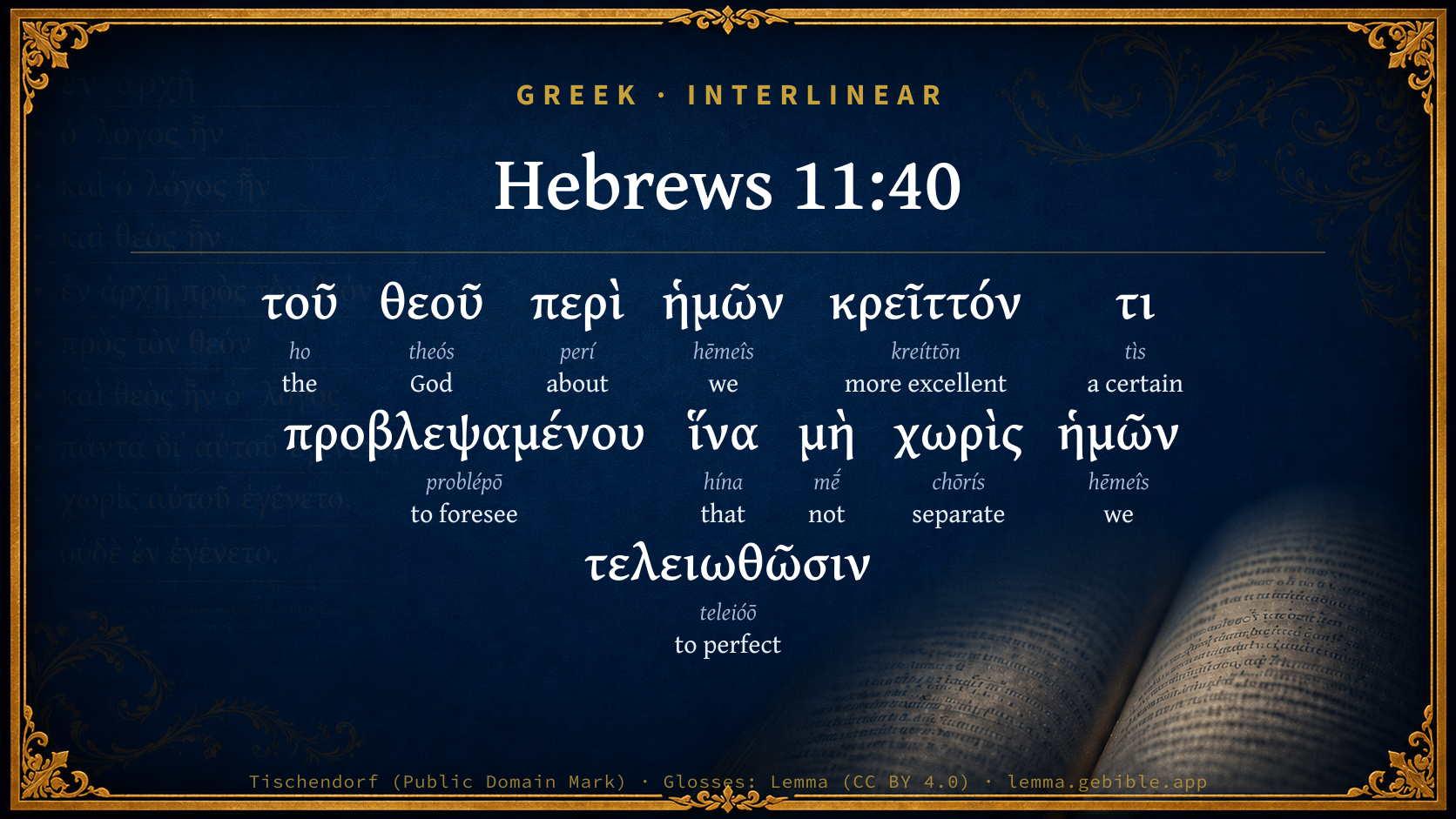
Greek (Tischendorf 8th ed.) Hebrews 11:40 appears in the Greek New Testament. The text above is from the Tischendorf 8th edition. Each word links to its Strong’s number and a concise gloss. Click any word for its full Thayer’s Greek Lexicon entry.
Download image
Cite this verse

Hebrews 11:40 (World English Bible). Public Domain. Lemma interlinear Bible study tool, https://lemma.gebible.app/v/hebrews/11/40.

Show BibTeX & RIS
BibTeX
RIS
English Translation
God having provided some better thing concerning us, so that apart from us they should not be made perfect.
World English Bible · Public Domain
Highlights
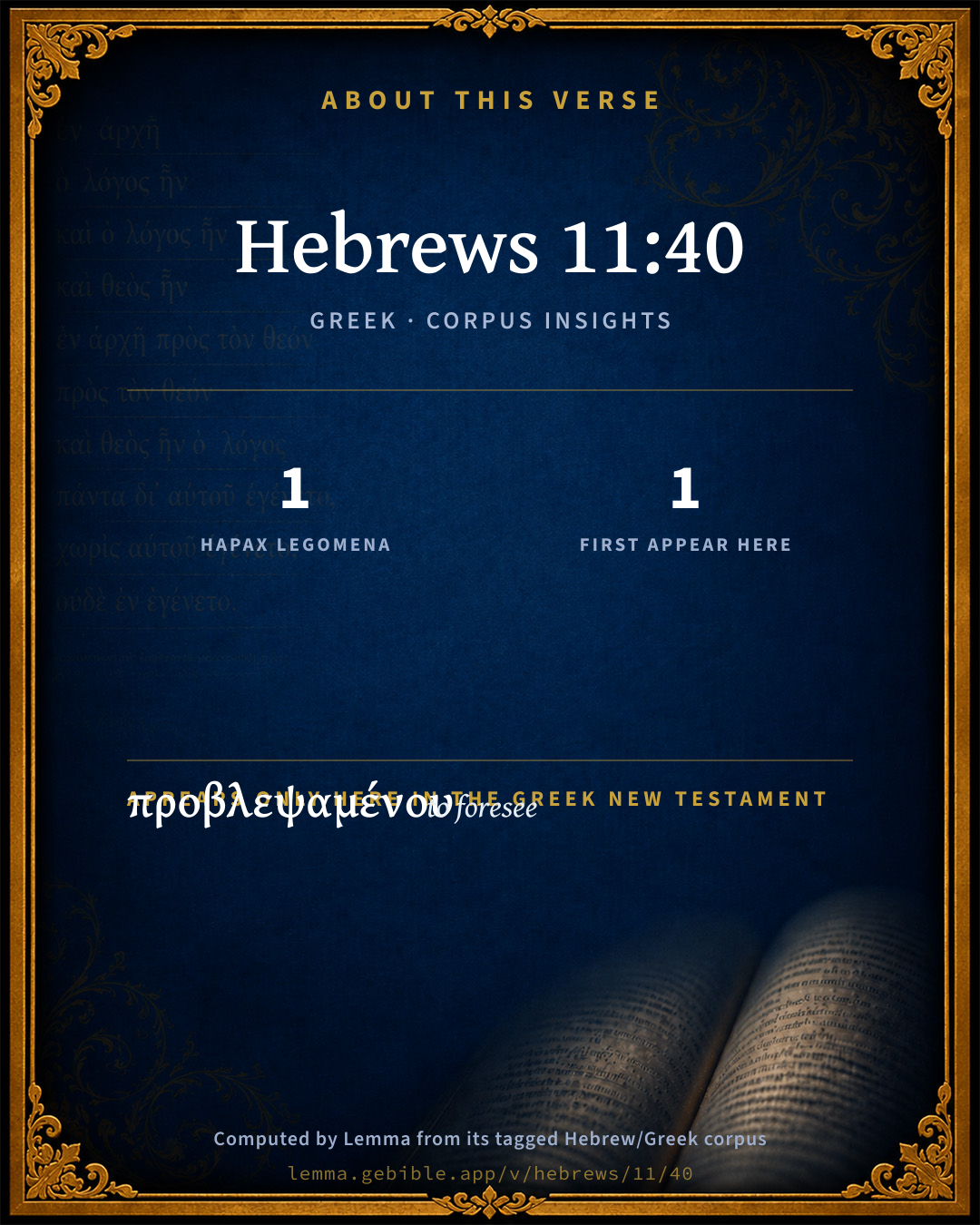
  • 1 hapax legomenon — only here in the Greek New Testament
  • 1 first appearance in the Greek New Testament
Full analysis ↓
Download a study sheet

One document with this verse’s original text, its word-by-word gloss line, the meaning frame, cross-references with their text, attributed commentary, and full source and license credits — printable, and it pastes into notes with its structure intact.

This verse Autodidact and up

Study sheet (.html) Plain text (.txt)

A passage Seminary Student

Up to 50 verses in one chapter. A passage sheet keeps up to 6 commentary sources and 12 cross-references per verse, in the order this page ranks them, and says so on the sheet whenever that leaves anything out. Ask for a single verse and you get the Autodidact verse sheet above.

Everything on this page stays free to read, with no account — the sheet is a download of what is already on screen, not access to it.

Want to remove ads? Support Godless Engineer
Compare translations 3

The same verse in 3 English versions, stacked beneath the original-language interlinear above. Click any original word for its lexicon entry.

Each is an independent rendering of the whole verse — the interlinear is not word-aligned to these translations.

Highlighted words mark where these versions differ — a whole-verse word diff, not a word-by-word alignment.

  • World English Bible Public Domain
    God having provided some better thing concerning us, so that apart from us they should not be made perfect.
  • King James Version Public Domain
    God having provided some better thing for us, that they without us should not be made perfect.
  • unfoldingWord Literal Text CC BY-SA 4.0
    God having provided something better concerning us, so that without us, they would not be made perfect.

unfoldingWord Literal Text — © unfoldingWord, licensed CC BY-SA 4.0. Word-aligned USFM3 via Door43 (git.door43.org/unfoldingWord/en_ult).

Versions to compare (up to 4)

3 of 4 selected

Show all 19 translations

Every available English version of this verse, each an independent rendering of the whole verse.

  • World English Bible Public Domain
    God having provided some better thing concerning us, so that apart from us they should not be made perfect.
  • Berean Standard Bible Public Domain
    God had planned something better for us, so that together with us they would be made perfect.
  • Majority Standard Bible Public Domain
    God had planned something better for us, so that together with us they would be made perfect.
  • King James Version Public Domain
    God having provided some better thing for us, that they without us should not be made perfect.
  • American Standard Version (1901) Public Domain
    God having provided some better thing concerning us, that apart from us they should not be made perfect.
  • Revised Version (1885) Public Domain
    God having provided some better thing concerning us, that apart from us they should not be made perfect.
  • Geneva Bible (1599) Public Domain
    God prouiding a better thing for vs, that they without vs should not be made perfite.
  • Douay-Rheims (1899) Public Domain
    God providing some better thing for us, that they should not be perfected without us.
  • Young's Literal Translation Public Domain
    God for us something better having provided, that apart from us they might not be made perfect.
  • Literal Standard Version CC BY-SA 4.0
    God, having provided something better for us, that apart from us they might not be made perfect.
  • Unlocked Literal Bible CC BY-SA 4.0
    God planned something better for us, so that without us, they would not be made perfect.
  • unfoldingWord Literal Text CC BY-SA 4.0
    God having provided something better concerning us, so that without us, they would not be made perfect.
  • Darby Bible Public Domain
    God having foreseen some better thing for us, that they should not be made perfect without us.
  • World Messianic Bible Public Domain
    God having provided some better thing concerning us, so that apart from us they should not be made perfect.
  • Webster's Bible Public Domain
    God having provided some better thing for us, that they without us should not be made perfect.
  • Free Bible Version CC BY-SA 4.0
    God has given us something even better, so that they can't be complete without us.
  • Bible in Basic English Public Domain
    Because God had kept some better thing for us, so that it was not possible for them to become complete without us.
  • Text-Critical English NT CC BY 4.0
    For God had planned something better for us, so that they would not be made perfect without us.
  • Tyndale New Testament (1534) Public Domain
    God provydinge a better thinge for vs that they with out vs shuld not be made parfecte.

Literal Standard Version (2020), Covenant Press — licensed CC BY-SA 4.0. Text via the HelloAO Bible API (eBible.org). Unlocked Literal Bible (unfoldingWord) — licensed CC BY-SA 4.0. Text via the HelloAO Bible API (eBible.org). unfoldingWord Literal Text — © unfoldingWord, licensed CC BY-SA 4.0. Word-aligned USFM3 via Door43 (git.door43.org/unfoldingWord/en_ult). Free Bible Version, Dr. Jonathan Gallagher — licensed CC BY-SA 4.0. Text via the HelloAO Bible API (eBible.org).

Word by word

More ways to search: Search by grammar → Find every occurrence → Compare this word →

Practice this passage: Drill this verse → Learn its vocabulary →

About this verse

These counts appear in no published source. They are computed here, from the morphology-tagged text and Lemma’s own curated glosses. What Lemma adds →

12
words
11
distinct lemmas
General Epistles
section

Notable vocabulary

1 hapax legomenon — a word that appears only here in the entire Greek New Testament:

  • προβλεψαμένου to foresee G4265

First appearance in Scripture

This word makes its first canonical appearance in the Greek New Testament here:

  • προβλεψαμένου to foresee G4265

Shared distinctive vocabulary

κρεῖττόν more excellent G2909 occurs in 12 verses of the Greek New Testament. Also found in:

Repetition

A word recurs within this verse:

  • ἡμῶν we G2249 ×2

Cross-references

10

Topical passages linked to Hebrews 11:40 in the Treasury of Scripture Knowledge — connected by theme and wording, ordered by reader-vote popularity; previews shown in the World English Bible.

  • Revelation 6:11 A long white robe was given to each of them. They were told that they should rest yet for a while, until their fellow servants and their brothers, who would also be killed even as they were, should complete their course.
  • Hebrews 8:6 But now he has obtained a more excellent ministry, by so much as he is also the mediator of a better covenant, which has been enacted on better promises.
  • Hebrews 10:11–14 Every priest indeed stands day by day ministering and often offering the same sacrifices, which can never take away sins,
  • Hebrews 7:19 (for the law made nothing perfect), and a bringing in thereupon of a better hope, through which we draw near to God.
  • Hebrews 5:9 Having been made perfect, he became to all of those who obey him the author of eternal salvation,
  • Hebrews 9:8–15 The Holy Spirit is indicating this, that the way into the Holy Place wasn't yet revealed while the first tabernacle was still standing;
  • Hebrews 9:23 It was necessary therefore that the copies of the things in the heavens should be cleansed with these; but the heavenly things themselves with better sacrifices than these.
  • Romans 3:25–26 whom God set forth to be an atoning sacrifice, through faith in his blood, for a demonstration of his righteousness through the passing over of prior sins, in God's forbearance;
  • Hebrews 7:22 By so much has Jesus become the collateral of a better covenant.
  • Hebrews 12:23–24 to the general assembly and assembly of the firstborn who are enrolled in heaven, to God the Judge of all, to the spirits of just men made perfect,

Cross-references courtesy of OpenBible.info (CC BY 4.0).

Commentary

Notes on Hebrews 11:40 from classic Christian and Jewish commentators (each source and its license shown beneath its notes). The classic Christian expositions comment on the surrounding passage and are grouped to its opening verse, so a note may address several verses; the Jewish commentaries on the Tanakh (Rashi and others) are per-verse, so they appear only where the commentator wrote on this verse.

Lemma curates 59 commentaries, every one of them public domain or Creative Commons licensed, each selected and text-cleaned for this edition rather than reprinted as found. About our sources →

Joseph Benson's Commentary

Heb 11:40. God having provided some better thing for us — Believers under the gospel, than any bestowed upon them, which better thing is Christ himself manifest in the flesh, with the various privileges and blessings of the gospel dispensation, far exceeding those of the two dispensations that preceded it. For, as the divine last quoted further observes, “It ought to be put out of question with all Christians, that it is the actual exhibition of the Son of God in the flesh, the coming of the promised seed, with his accomplishment of the work of redemption, and all the privileges of the church, in light, grace, liberty, spiritual worship, with the boldness of access to God that ensued thereon, which is intended. For were not these the things which they received not under the Old Testament? Were not these the things which were promised from the beginning; which were expected, longed for, and desired by all believers of old, who yet saw them only afar off, though through faith they were saved by virtue of them? And are not these the things whereby the church state of the gospel was perfected; the things alone wherein our state is better than theirs? For, as to outward appearances of things, they had more glory, costly ceremonies, and splendour in their worship, than is appointed in the Christian Church; and their worldly prosperity was, for a long season, very great, much exceeding any thing that the Christian Church enjoyed in the apostle’s days. To deny, therefore, these to be the better things that God provided for us, is to overthrow the faith of the Old Testament and the New.” That they without us should not be made perfect — The expression without us, is the same as without the things which are actually exhibited to us, the things provided for us, and our participation of them. They and we, that is, the believers under the old dispensations, and those under the new, though distributed by divine appointment into distinct states, yet, with respect to the first promise, and the renewal of it to Abraham, are but one church, built on the same foundation, and enlivened by the same Spirit of grace. Wherefore until we, that is, Christian believers, with our privileges and blessings, were added to the church, it could not be said to be made perfect, or to have attained that perfect state which God had designed and prepared for it in the fulness of times, and which the believers in those ages foresaw should be granted to others, but not to themselves. See 1Pe 1:11-13. “I cannot but marvel,” says Dr. Owen, “that so many have stumbled in the exposition of these words, and involved themselves in difficulties of their own devising; for they are a plain epitome of the whole doctrinal part of the epistle; so as that no intelligent judicious person can avoid the sense which the words tender, unless he divert his mind from the whole scope and design of the apostle.”

Joseph Benson's Commentary on the Old and New Testaments (1811–1818) — public domain. Text from a community e-Sword module.

Bengel's Gnomon

Johann Albrecht Bengel

Heb 11:40. Κρεῖττόν τι, some better thing) This better thing is the clearer revelation of the promised salvation; its confirmation on higher testimony; a nearer expectation, by Christ having been exhibited to us; and at last salvation itself and glory.—προβλεψαμένου, having provided) A word of exquisite meaning. GOD provides (foresees) what faith does not yet see; Gen 22:8; Gen 22:14; Joh 6:6. From this provision (foresight) flowed the whole economy of ages, and the testimony of GOD to the men of old.—χωρὶς ἡμῶν, without us) Meiosis: not only not without us were they perfected, but they are rather perfected with us, than we with them. He does not say, that we not without them, but that they not without us. We should carefully hold this fast; for not merely is our being gathered to them intimated, but our condition superior to theirs, who were waiting for His appearance.

Bengel's Gnomon of the New Testament — English translation (T&T Clark, Edinburgh, 1860) — public domain. Text from a community e-Sword module.

Meyer's Critical & Exegetical Commentary

Heinrich August Wilhelm Meyer

Heb_11:40. The ground for the οὐκ ἐκομίσαντο τὴν ἐπαγγελίαν lay in the decree of God, that those believers should not apart from us attain to the consummation.

τοῦ θεοῦ περὶ ἡμῶν κρεῖττόν τι προβλεψαμένον] God having, with regard to us, foreseen (predetermined) something better.

προβλέπειν] in the N. T. only here.

On account of the emphatically preposed περὶ ἡμῶν, which forms the contrast to οὗτοι πάντες, Heb_11:39, κρεῖττόν τι cannot be placed absolutely: Something better than would otherwise have been our portion (Schlichting, Seb. Schmidt, Huët). With this thought, moreover, ἵνα μὴ χωρὶς ἡμῶν τελειωθῶσιν would not have been in keeping, since, instead thereof, ἵνα σὺν αὐτοῖς τελειωθῶμεν must have been written. The sense can only be: in regard to us something better than in regard to them. In regard to us something better, inasmuch as when they lived the appearing of the Redeemer as yet belonged to the distant future, and was an object of longing desire (Mat_13:16 f.; Luk_10:23 f.); but now Christ has in reality appeared, has accomplished the redemption, and presently after a brief interval will return, to bring to full realization the Messianic kingdom with all its blessings of salvation. Comp. Heb_10:25; Heb_10:36 f.

ἵνα μὴ χωρὶς ἡμῶν τελειωθῶσιν] Declaration of the divine design: that they not without us should attain to the consummation. Without us, i.e. without our having entered into the joint participation in the consummation, they would have attained to the consummation, if Christ had already appeared in their time, and so they had already attained during their lifetime to the possession of the promised Messianic bliss. For then we should not have been born at all; since, according to the declaration of the Lord (Mat_22:30; Mar_12:25; Luk_20:35 f.), in the consummated kingdom of God a marrying and being given in marriage will no longer take place.

Meyer — Critical and Exegetical Commentary on the New Testament — English translation by Peter Christie, edited by Frederick Crombie (T&T Clark, 1880) — public domain. Text from a community e-Sword module.

Geneva Bible (1599)

Geneva Bible translators

For their salvation did hang upon Christ, who was exhibited in our days.

Geneva Bible (1599) marginal notes — public domain. Text via Bolls.life.

Jamieson, Fausset & Brown

Robert Jamieson, A. R. Fausset & David Brown

provided--with divine forethought from eternity (compare Gen 22:8, Gen 22:14).

some better thing for us-- (Heb 7:19); than they had here. They had not in this world, "apart from us" (so the Greek is for "without us," that is, they had to wait for us for), the clear revelation of the promised salvation actually accomplished, as we now have it in Christ; in their state, beyond the grave their souls also seem to have attained an increase of heavenly bliss on the death and ascension of Christ; and they shall not attain the full and final glory in body and soul (the regeneration of the creature), until the full number of the elect (including us with them) is completed. The Fathers, CHRYSOSTOM, &c., restricted the meaning of Heb 11:39-40 to this last truth, and I incline to this view. "The connection is, You, Hebrews, may far more easily exercise patience than Old Testament believers; for they had much longer to wait, and are still waiting until the elect are all gathered in; you, on the contrary, have not to wait for them" [ESTIUS]. I think his object in these verses (Heb 11:39-40) is to warn Hebrew Christians against their tendency to relapse into Judaism. "Though the Old Testament worthies attained such eminence by faith, they are not above us in privileges, but the reverse." It is not we who are perfected with them, but rather they with us. They waited for His coming; we enjoy Him as having come (Heb 1:1; Heb 2:3). Christ's death, the means of perfecting what the Jewish law could not perfect, was reserved for our time. Compare Heb 12:2, "perfecter (Greek) of our faith." Now that Christ is come, they in soul share our blessedness, being "the spirits of the just made perfect" (Heb 12:23); so ALFORD; however, see on Heb 12:23. Heb 9:12 shows that the blood of Christ, brought into the heavenly holy place by Him, first opened an entrance into heaven (compare Joh 3:13). Still, the fathers were in blessedness by faith in the Saviour to come, at death (Heb 6:15; Luk 16:22).

Next: Hebrews Chapter 12

Jamieson, Fausset & Brown — Commentary Critical and Explanatory on the Whole Bible (1871) — public domain (CC PDM 1.0). Text via the HelloAO Bible API.

Adam Clarke's Commentary

Verse 40. God having provided some better thing for us] This is the dispensation of the Gospel, with all the privileges and advantages it confers.

That they without us should not be made perfect.] Believers before the flood, after the flood, under the law, and since the law, make but one Church. The Gospel dispensation is the last, and the Church cannot be considered as complete till the believers under all dispensations are gathered together. As the Gospel is the last dispensation, the preceding believers cannot be consummated even in glory till the Gospel Church arrive in the heaven of heavens.

There are a great variety of meanings put on this place, but the above seems the most simple and consistent. See Re 6:11. "White robes were given unto every one of them; and it was said unto them, that they should rest yet for a little season, until their fellow servants also, and their brethren, that should be killed as they were, should be fulfilled." This time, and its blessings, are now upon the wing.

OBSERVATIONS ON THE BEING OF A GOD

DEDUCED FROM A CONSIDERATION of Heb 11:6:

He that cometh unto God must believe that he is, and

that he is the rewarder of them who diligently seek him.

I. METAPHYSICIANS and philosophers, in order to prove the existence of God, have used two modes of argumentation:-

1. A priori, proofs drawn from the necessity that such a being as God is, must exist: arguments of this kind do not produce any thing in evidence which is derived from his works.

2. A posteriori, proofs of the being and perfections of God, drawn from his own works.

PROPOSITIONS A PRIORI.

Adam Clarke's Commentary on the Bible (1810–1826) — public domain. Text from a community e-Sword/MySword module.

Ellicott's Commentary for English Readers

(40) For us.—Rather, concerning us, that without (or, apart from) us they should not be made perfect. “Some better thing”—better than they had received (Mat_13:17; 1Pe_1:10-11). The design of God was that they and we may be perfected together; first in the joint reception of mature knowledge and privilege through the High-priestly work of the Lord Jesus (comp. Eph_3:10; 1Pe_1:12); and then that we with them may, when the end shall come, “have our perfect consummation and bliss both in body and soul, in the eternal and everlasting glory of God.” See further the Note on Heb_12:23.

A Bible Commentary for English Readers, edited by Charles John Ellicott (1878–1897) — public domain. Text from a community e-Sword module.

The Cambridge Bible for Schools and Colleges

gen. ed. J. J. S. Perowne

40. God having provided some better thing for us] Lit., “Since God provided” (or “foresaw”) “some better thing concerning us.” In one sense Abraham, and therefore other patriarchs “rejoiced to see Christ’s day,” and yet they did but see it in such dim shadow that “many prophets and kings desired to see what ye see, and saw not, and hear the things which ye hear, and did not hear them” (Mat_13:17), though all their earnest seekings and searchings tended in this direction (1Pe_1:10-11).

that they without us should not be made perfect] “Not unto themselves but unto us they did minister” (1Pe_1:12). Since in their days “the fulness of the times” had not yet come (Eph_1:10) the saints could not be brought to their completion—the end and consummation of their privileges—apart from us. The “just” had not been, and could not be, “perfected” (Heb_12:23) until Christ had died (Heb_7:19, Heb_8:6). The implied thought is that if Christ had come in their days—if the “close of the ages” had fallen in the times of the Patriarchs or Prophets—the world would long ago have ended, and we should never have been born. Our present privileges are, as he has been proving all through the Epistle, incomparably better than those of the fathers. It was necessary in the economy of God that their “perfectionment” should be delayed until ours could be accomplished; in the future world we and they shall equally enjoy the benefits of Christ’s redemption.

The Cambridge Bible for Schools and Colleges (gen. ed. J. J. S. Perowne; Cambridge University Press, 1878–1918) — public domain. Text from a community e-Sword module.

Trapp's Complete Commentary

John Trapp

40 God having provided some better thing for us, that they without us should not be made perfect.

Ver. 40. Some better thing] i. e. Christ, that great mystery, as 1Ti 3:16; that chief of ten thousand, &c.; that gift, Joh 4:10; that benefit, 1Ti 6:2.

John Trapp, A Commentary or Exposition upon All the Books of the Old and New Testament (1647–1656) — public domain. Text from a community e-Sword module.

Albert Barnes' Notes on the Bible

God having provided some better thing for us - Margin, “foreseen.” That is, “God having provided, or determined on giving some better thing than any of them realized, and which we are now permitted to enjoy.” That is, God gave them promises; but they were not allowed to see their fulfillment. We are permitted now to see what they referred to, and in part, at least, to witness their completion; and though the promise was made to them, the fulfillment more particularly pertains to us.

That they without us should not be made perfect - That is, complete. The whole system of revelation was not complete at once, or in one generation. It required successive ages to make the system complete, so that it might be said that it was finished, or perfect. Our existence, therefore, and the developments in our times, were as necessary to the perfection of the system, as the promise made to the patriarchs. And as the system would not have been complete if the blessings had been simply conferred on us without the previous arrangements, and the long scheme of introductory measures, so it would not have been complete if the promises had been merely given to them without the corresponding fulfillment in our times. They are like the two parts of a tally. The fathers had one part in the promises, and we the other in the fulfullment, and neither would have been complete without the other. The “better things” then referred to here as possessed by Christians, are the privilege of seeing those promises fulfilled in the Messiah; the blessings resulting from the atonement; the more expanded views which they have under the gospel; the brighter hopes of heaven itself, and the clearer apprehension of what heaven will be, which they are permitted to enjoy. This, therefore, accords entirely with the argument which the apostle is pursuing - which is, to show that the Christians whom he addressed should not apostatize from their religion. The argument is, that in numerous instances, as specified, the saints of ancient times, even under fiery trials, were sustained by faith in God, and that too when they had not seen the fulfillment of the promises, and when they had much more obscure views than we are permitted to enjoy. If they, under the influence of the mere promise of future blessings, were enabled thus to persevere, how much more reason is there for us to persevere who have been permitted, by the coming of the Messiah, to wittess the perfection of the system!

There is no part of the New Testament of more value than this chapter; none which deserves to be more patiently studied, or which may be more frequently applied to the circumstances of Christians. These invaluable records are adapted to sustain us in times of trial, temptation, and persecution; to show us what faith has done in days that are past, and what it may do still in similar circumstances. Nothing can better show the value and the power of faith, or of true religion, than the records in this chapter. It has done what nothing else could do. It has enabled people to endure what nothing else would enable them to bear, and it has shown its power in inducing them to give up, at the command of God, what the human heart holds most dear. And among the lessons which we may derive from the study of this portion of divine truth, let us learn from the example of Abel to continue to offer to God the sacrifice of true piety which he requires, though we may be taunted or opposed by our nearest kindred; from that of Enoch to walk with God, though surrounded by a wicked world, and to look to the blessed translation to heaven which awaits all the righteous; from that of Noah to comply with all the directions of God, and to make all needful preparations for the future events which he has predicted, in which we are to be interested - as death, judgment, and eternity - though the events may seem to be remote, and though there may be no visible indications of their coming, and though the world may deride our faith and our fears; from that of Abraham to leave country, and home, and kindred, if God calls us to, and to go just where he commands, through deserts and wilds, and among strange people, and like him also to be ready to give up the dearest objects of our earthly affection, even when attended with all that can try or torture our feelings of affection - feeling that God who gave has a right to require their removal in his own way, and that however much we may fix our hopes on a dear child, he can fulfil all his purposes and promises to us though such a child should be removed by death; from that of Abraham, Isaac, and Jacob, to regard ourselves as strangers and pilgrims on earth, having here no permanent home. and seeking a better country; from that of Moses to be willing to leave all the pomp and splendour of the world, all our brilliant prospects and hopes, and to welcome poverty, reproach, and suffering, that we may identify ourselves with the people of God; by the remembrance of the host of worthies who met danger, and encountered mighty foes, aud vanquished them, let us learn to go forth in our spiritual conflicts against the enemies of our souls and of the church, assured of victory; and from the example of those who were driven from the abodes of human beings, and exposed to the storms of persecution, let us learn to bear every trial, and to be ready at any moment to lay down our lives in the cause of truth and of God. Of all those holy men who made these sacrifices, which of them ever regretted it, when he came calmly to look over his life, and to review it on the borders of the eternal world?

None. Not one of them ever expressed regret that he had given up the world; or that he had obeyed the Lord too early, too faithfully, or too long. Not Abraham who left his country and kindred; not Moses who abandoned his brilliant prospects in Egypt; not Noah who subjected himself to ridicule and scorn for an hundred and twenty years; and not one of those who were exposed to lions, to fire, to the edge of the sword, or who were driven away from society as outcasts to wander in pathless deserts or to take up their abodes in caverns, ever regretted the course which they had chosen. And who of them all now regrets it? Who, of these worthies, now looks from heaven and feels that he suffered one privation too much, or that he has not had an ample recompense for all the ills he experienced in the cause of religion? So we shall feel when from the bed of death we look over the present life, and look out on eternity.

Whatever our religion may have cost us, we shall not feel that we began to serve God too early, or served him too faithfully. Whatever pleasure, gain, or splendid prospects we gave up in order to become Christians, we shall feel that it was the way of wisdom, and shall rejoice that we were able to do it. Whatever sacrifices, trials, persecution, and pain, we may meet with, we shall feel that there has been more than a compensation in the consolations of religion, and in the hope of heaven, and that by every sacrifice we have been the gainers. When we reach heaven, we shall see that we have not endured one pain too much, and that through whatever trials we may have passed, the result is worth all which it has cost. Strengthened then in our trials by the remembrance of what faith has done in times that are past; recalling the example of those who through faith and patience have inherited the promises, let us go cheerfully on our way. Soon the journey of trials will be ended, and soon what are now objects of faith will become objects of fruition, and in their enjoyment, how trifling and brief will seem all the sorrows of our pilgrimage below!

Albert Barnes' Notes on the Bible (1834–1885) — public domain. Text from a community e-Sword/MySword module.

Matthew Poole's English Annotations

God having provided some better thing for us: the causes of their not receiving the promise, are summed up in this verse; the efficient of it is God’s providence unto believers before and after the incarnation of the Messiah. God having from eternity foreknowledge of those who would believe in God the Son incarnate, Rom 8:29, predestinated them to be called to the faith in him, and provided better for New Testament believers than for the Old ones, that what they had of Christ in types and veils, these should have in truth; what they had in promise, these should have in sight and possession; what they had in hope, as to his first coming, these should have it past, and as an earnest of his second coming; what they had by measure of his Spirit and grace, these should have in fulness, Luk 10:23,24; Joh 1:14,16; 7:39; 2Co 3:8; Eph 3:8-11; Tit 2:13; 1Pe 1:12.

That they without us should not be made perfect; the final cause of this gracious providence was, that the former aud later believers might be completed together; they shall not reach that perfect state of grace and glory by a re-union of their bodies and souls until the general resurrection, when they shall not prevent us, nor we them; but as soon as the trumpet alarms the dead to rise, in the same moment, and twinkling of an eye, shall the living be changed, and all be caught up together in the clouds, to meet the Lord in the air; and so shall be ever with the Lord, 1Th 4:15-17. The ground of which perfection of all believers in all ages being in the last time, is from his choosing them all to be but one body of Christ, and him their Head; so as one member cannot be perfected but in the perfection of the whole, Mat 8:11; Eph 4:4. In which perfection of it, God is resolved to be all in all; not in one, or in some, but when Christ hath subdued all his enemies, and gathered all his members, then shall his body and kingdom be perfected, and God be all in all, 1Co 15:28.

Matthew Poole's English Annotations on the Holy Bible (1683–1685) — public domain. Text from a community e-Sword/MySword module.

Whedon's Commentary on the Bible

Daniel D. Whedon

40. Better thing for us—To the question, What better thing? the remaining words of the verse furnish the answer. We and these worthies form one Church, which is to be perfected in one resurrectional glory. As there was one crucifixion, so by the divine order there is to be one final inauguration of the glorified Church. And that must wait for us; which is better for us than to be left out, or to happen in sporadically, as so many afterthoughts. We are on an equality with the worthies of old. In fact, our perfecting is the divine condition of their perfecting. They cannot attain the consummation without us.

Daniel D. Whedon (gen. ed.), Commentary on the Old and New Testaments (1874–1909) — public domain. Text from a community e-Sword module.

John Wesley's Explanatory Notes

God having provided some better thing for us - Namely, everlasting glory. That they might not be perfected without us - That is, that we might all be perfected together in heaven.

John Wesley, Explanatory Notes Upon the Whole Bible (1754–1765) — public domain. Text via the GEBible commentary corpus.

Scofield Reference Notes

C. I. Scofield

perfect

(See Scofield "Mat 5:48").

The Scofield Reference Bible (1917 edition), notes by C. I. Scofield — public domain. Text from a community e-Sword module.

Burkitt's Expository Notes on the New Testament

William Burkitt

The better thing here spoken of is the coming of Christ in the flesh. Lord! what were we, and how are we better than they, that this better thing should be reserved for us? They saw the promise afar off, we enjoy it at hand, "Jucundius est spectare, quam expectare bonum." That they without us should not be made perfect; without us, is as much as, without the things which are actually exhibited unto us.

God never intended or designed that the infant condition of the church should be made perfect before the exhibition of Christ; that is, that they should be justified and saved by any sacrifices and satisfaction of Christ, whereby both they and we are perfected.

Learn hence, That it is Christ alone who was to give perfection and consummation to his church; all the outward glorious worship of the Old Testament, though it pleased God, yet had no perfection in it; this God reserved for our times, that they without us should be made perfect.

William Burkitt's Expository Notes on the New Testament (1700–1703) — public domain. Text from a community e-Sword module.

The People's New Testament

B. W. Johnson

40. God having provided some better thing for us. The new and better covenant, the gospel, the realization of the promise made to Abraham. That they without us should not be made perfect. That they and we together might be made complete in the city whose builder and maker is God. The full fruition, the being made complete (perfect) belongs to the heavenly state. All these ancient heroes, who died not having received the promise, needed the realization of the promise in Christ to make them perfect; by that promise we also are saved.

B. W. Johnson's The People's New Testament with Notes (1889–1891) — public domain. Electronic text from the Christian Classics Ethereal Library (CCEL) ThML edition.

Cambridge Greek Testament for Schools and Colleges

40. τοῦ θεοῦ … προβλεψαμένου. Lit., “since God provided” (or “foresaw”) “some better thing concerning us.” The middle voice is used because it differs from the active by expressing a mental act; so too προορᾶσθαι, προϊδέσθαι. In one sense Abraham, and therefore other patriarchs, “rejoiced to see Christ’s day,” and yet they did but see it in such dim shadow that “many prophets and kings desired to see what ye see, and saw them not, and to hear the things which ye hear, and did not hear them” (Mat 13:17), though all their earnest seekings and searchings tended in this direction (1Pe 1:10-11).

ἵνα μὴ χωρὶς ἡμῶν τελειωθῶσιν. “Not unto themselves but unto us they did minister” (1Pe 1:12). Since in their days “the fulness of the times” had not yet come (Eph 1:10) the saints could not be brought to their completion—the end and consummation of their privileges—apart from us. The “just” had not been, and could not be, “perfected” (Heb 12:23) until Christ had died (Heb 7:19, Heb 8:6). The implied thought is that if Christ had come in their days—if the “close of the ages” had fallen in the times of the Patriarchs or Prophets—the world would long ago have ended, and we should never have been born. Our present privileges are, as he has been proving all through the Epistle, incomparably better than those of the fathers. It was necessary in the economy of God that their “perfectionment” should be delayed until ours could be accomplished; in the future world we and they shall equally enjoy the benefits of Christ’s redemption.

Cambridge Greek Testament for Schools and Colleges (Cambridge University Press, 1896; 21 vols, various authors incl. Carr, Maclear, Plummer, Farrar, Lumby, Moule, M. R. James, Simcox) — public domain. Text from a community e-Sword module.

Alford’s Greek Testament

Henry Alford

40.] God (Clem.-alex. Strom. iv. § 16, p. 609 P., cites this with τοῦ θεοῦ joined to τὴν ἐπαγγελίαν, and so does the liturgy of Chrysostom in some manuscripts. In that case προβλεψαμένου would be in apposition with θεοῦ. But such a connexion is not likely) having provided (foreseen from far (ref.): προορᾶν, προϊδεῖν, προϊδέσθαι are more usual words) concerning us (περὶ ἡμῶν has the emphasis, as contrasted with οὗτοι πάντες, us, viz. the Writer and his readers, as belonging to the N. T. church) something better (what is this κρεῖττόν τι? The Fathers generally interpret it of the ultimate state of glorious perfection, which shall only then come in, when all the number of the elect shall be accomplished. So Chrys., ἐννοήσατε.… τί ἐστι, καὶ ὅσον ἐστὶ τὸν Ἀβραὰμ καθῆσθαι, καὶ τὸν ἀπόστολον Παῦλον, περιμένοντας πότε σὺ τελειωθῇς, ἵνα δυνηθῶσι τότε λαβεῖν τὸν μισθόν. On this view, as Delitzsch says, the κρεῖττόν τι would consist in this, that the history of mankind has not been cut short as it would have been if the ancients had received the promise in this sense, but has been continued for us to partake of our present privileges under the N. T. But, he continues, this eschatological narrow acceptation of the promise, has against it not only what is said of Abraham in ch. 6:15, viz. ἐπέτυχεν τῆς ἐπαγγελίας, but also the whole spirit of the Epistle, which regards final salvation as brought in with the propitiation of Christ, and τὸ ἔσχατον τῶν ἡμερῶν as begun with His first Advent. The Writer cannot be ignoring this all-inclusive beginning of the N. T. fulfilment of the promises, in attributing to us κρεῖττόν τι than the O. T. believers had. And consequently we must understand by the expression, something better than they had, viz. the enjoyment, here, of the fulfilment of the promise, which they never had here, and only have there since Christ’s descent into Hades and ascension into heaven. It is that κρεῖττόν τι for which the Lord felicitates his disciples, Mat 13:17, the revelation of the Son of God, ch. 1:1, the σωτηρία of ch. 2:3), that they should not apart from us be made perfect (the design of God in this provision of something better for us was, that they, the O. T. saints, should not be perfected without us, i. e. independently of the N. T. salvation of which we are partakers,—cut off from Christ’s universal Church of which we are members. But we read, ch. 12:23, of them as τετελειωμένοι now. And therefore the Writer implies, as indeed ch. 10:14 seems to testify, that the Advent and work of Christ has changed the estate of the O. T. fathers and saints into greater and perfect bliss; an inference which is forced on us by many other places in Scripture. So that their perfection was dependent on our perfection: their and our perfection was all brought in at the same time, when Christ μιᾷ προσφορᾷ ἐτελείωσεν εἰς τὸ διηνεκὲς τοὺς ἁγιαζομένους. So that the result with regard to them is, that their spirits, from the time when Christ descended into Hades and ascended up into heaven, enjoy heavenly blessedness, and are waiting, with all who have followed their glorified High Priest within the veil, for the resurrection of their bodies, the Regeneration, the renovation of all things. This thought naturally leads on to the opening verses of the next chapter).

Henry Alford, The Greek Testament (1849–1861) — public domain. Text from a community e-Sword module.

Lesson kit

Teaching starters — assembled from the data on this page, not authored interpretation. Every prompt links to the verse data it draws on. Edit before teaching.

Hebrews, in the General Epistles, opens this verse with 12 words (11 distinct Greek lemmas). Its most distinctive word is problépō (“to foresee”). A historical commentator’s framing appears above. Read the whole chapter for the surrounding context.

Discussion questions

  1. The word problépō carries the sense “to foresee.” How does it shape the verse?
  2. This verse holds 1 word here found nowhere else in the Greek New Testament. What might the rare word draw attention to?
  3. The word “to foresee” first appears here in Scripture. What is being introduced at this debut?
  4. 1 Corinthians 7:9 shares the word «more excellent» with this verse. How do the two illuminate each other?
  5. “we” occurs 2× in this one verse. What is the effect of the repetition?
  6. These translations render this verse differently. What is at stake in choosing one wording over another?
  7. Reading how Joseph Benson's Commentary and Bengel's Gnomon read this verse, where do the two commentators agree and where do they part?

Things to notice

  • 1 word in this verse appears nowhere else in the Greek New Testament.
  • 1 word makes its first canonical appearance in Scripture here.
  • These translations choose different wording for 8 words in this verse.
  • “we” occurs 2× in this single verse.
  • 11 distinct Greek lemmas span 12 words in this verse.

Reading settings

Reading text

Shown beneath each verse's original-language words.

Old Testament
Old Testament edition

Read the OT as the Masoretic Hebrew (MT) or the Greek Septuagint (LXX).

English shown for the Greek Septuagint (in the Hebrew ↔ Greek comparison).

Comparing translations? Open the Compare panel on any verse page to stack up to four side by side.