

Hebrews 12:3
Greek (Tischendorf 8th ed.) Hebrews 12:3 appears in the Greek New Testament. The text above is from the Tischendorf 8th edition. Each word links to its Strong’s number and a concise gloss. Click any word for its full Thayer’s Greek Lexicon entry.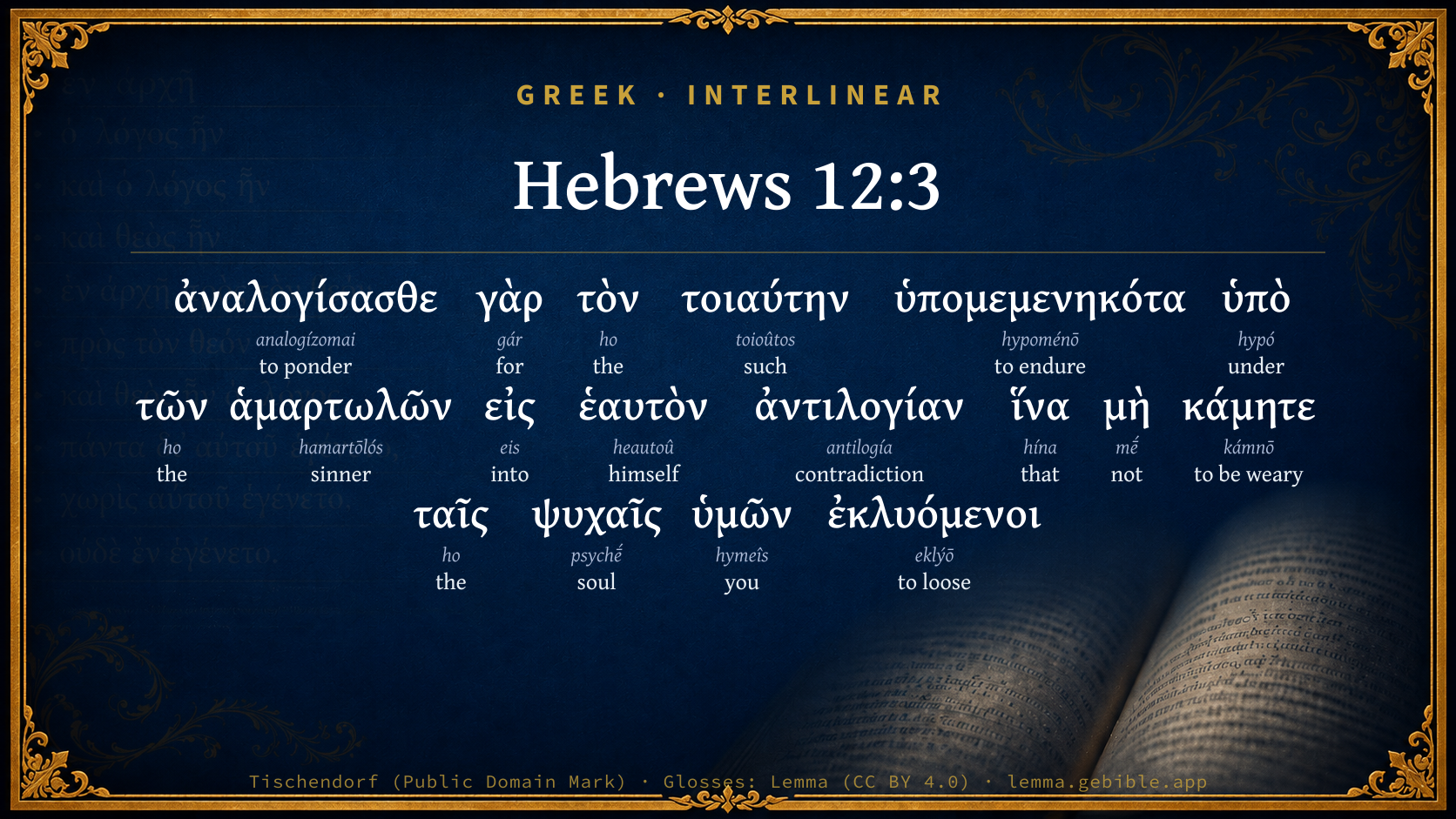
For consider him who has endured such contradiction of sinners against himself, that you don't grow weary, fainting in your souls.
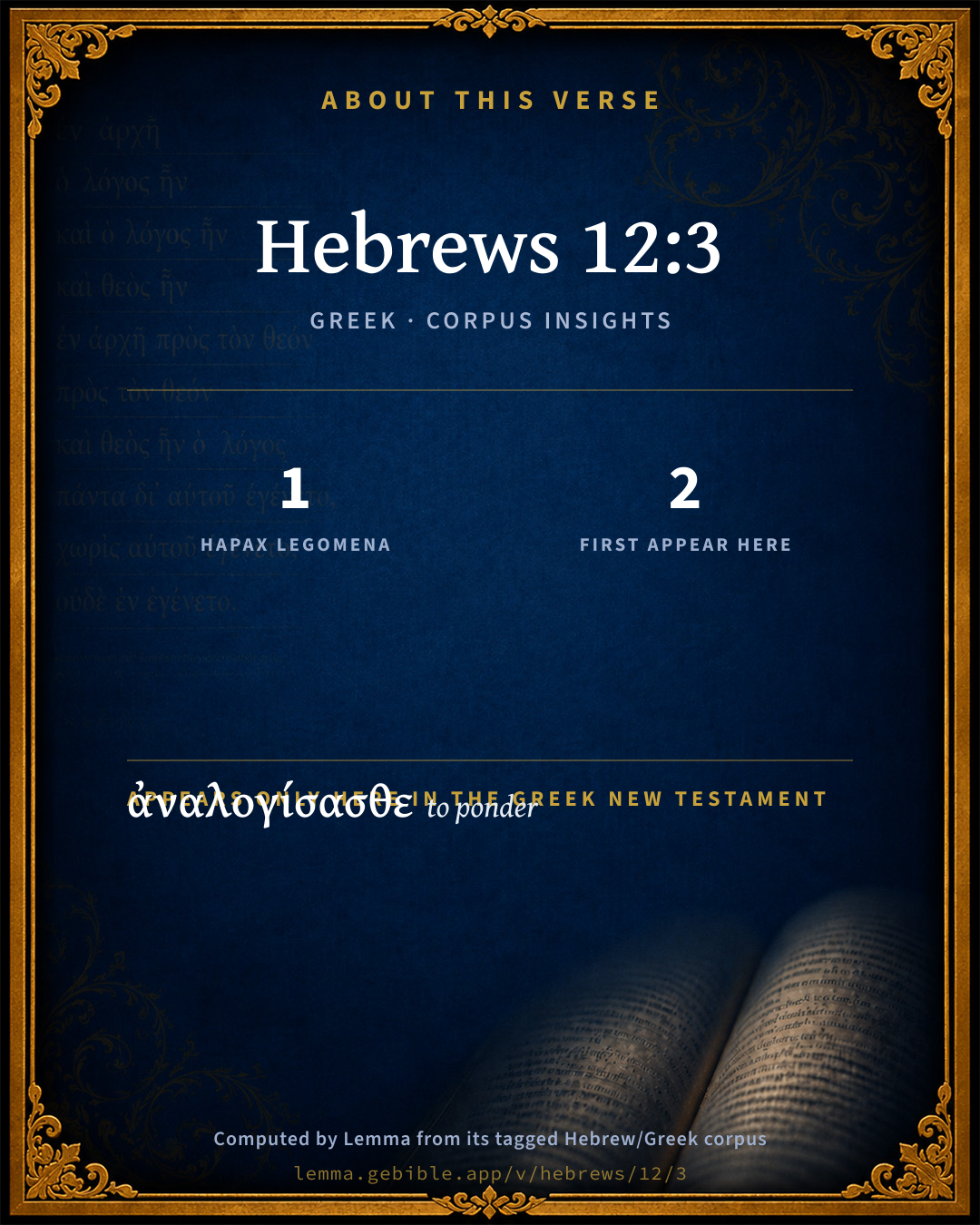
- 1 hapax legomenon — only here in the Greek New Testament
- 2 first appearances in the Greek New Testament
Download a study sheet
One document with this verse’s original text, its word-by-word gloss line, the meaning frame, cross-references with their text, attributed commentary, and full source and license credits — printable, and it pastes into notes with its structure intact.
This verse Autodidact and up
A passage Seminary Student
Up to 50 verses in one chapter. A passage sheet keeps up to 6 commentary sources and 12 cross-references per verse, in the order this page ranks them, and says so on the sheet whenever that leaves anything out. Ask for a single verse and you get the Autodidact verse sheet above.
Everything on this page stays free to read, with no account — the sheet is a download of what is already on screen, not access to it.
Compare translations 3
The same verse in 3 English versions, stacked beneath the original-language interlinear above. Click any original word for its lexicon entry.
Each is an independent rendering of the whole verse — the interlinear is not word-aligned to these translations.
Highlighted words mark where these versions differ — a whole-verse word diff, not a word-by-word alignment.
-
World English Bible Public Domain
For consider him who has endured such contradiction of sinners against himself, that you don't grow weary, fainting in your souls.
-
King James Version Public Domain
For consider him that endured such contradiction of sinners against himself, lest ye be wearied and faint in your minds.
-
unfoldingWord Literal Text CC BY-SA 4.0
For consider the one that has endured such opposition by sinners against themselves, so that you might not become weary in your souls, giving up.
unfoldingWord Literal Text — © unfoldingWord, licensed CC BY-SA 4.0. Word-aligned USFM3 via Door43 (git.door43.org/unfoldingWord/en_ult).
Show all 19 translations
Every available English version of this verse, each an independent rendering of the whole verse.
-
World English Bible Public Domain
For consider him who has endured such contradiction of sinners against himself, that you don't grow weary, fainting in your souls.
-
Berean Standard Bible Public Domain
Consider Him who endured such hostility from sinners, so that you will not grow weary and lose heart.
-
Majority Standard Bible Public Domain
Consider Him who endured such hostility from sinners, so that you will not grow weary and lose heart.
-
King James Version Public Domain
For consider him that endured such contradiction of sinners against himself, lest ye be wearied and faint in your minds.
-
American Standard Version (1901) Public Domain
For consider him that hath endured such gainsaying of sinners against himself, that ye wax not weary, fainting in your souls.
-
Revised Version (1885) Public Domain
For consider him that hath endured such gainsaying of sinners against themselves, that ye wax not weary, fainting in your souls.
-
Geneva Bible (1599) Public Domain
Consider therefore him that endured such speaking against of sinners, lest ye should be wearied and faint in your mindes.
-
Douay-Rheims (1899) Public Domain
For think diligently upon him that endured such opposition from sinners against himself; that you be not wearied, fainting in your minds.
-
Young's Literal Translation Public Domain
for consider again him who endured such gainsaying from the sinners to himself, that ye may not be wearied in your souls -- being faint.
-
Literal Standard Version CC BY-SA 4.0
for again consider Him who endured such contradiction from the sinners to Himself, that you may not be wearied in your souls—being faint.
-
Unlocked Literal Bible CC BY-SA 4.0
So think about him, the one who has endured such opposition from sinners against himself, so that you do not become weary in your hearts and give up.
-
unfoldingWord Literal Text CC BY-SA 4.0
For consider the one that has endured such opposition by sinners against themselves, so that you might not become weary in your souls, giving up.
-
Darby Bible Public Domain
For consider well him who endured so great contradiction from sinners against himself, that ye be not weary, fainting in your minds.
-
World Messianic Bible Public Domain
For consider him who has endured such contradiction of sinners against himself, that you don’t grow weary, fainting in your souls.
-
Webster's Bible Public Domain
For consider him that endured such contradiction of sinners against himself, lest ye be wearied and faint in your minds.
-
Free Bible Version CC BY-SA 4.0
Think about Jesus who endured such hostility from sinful people so you don't grow tired and become discouraged.
-
Bible in Basic English Public Domain
Give thought to him who has undergone so much of the hate of sinners against himself, so that you may not be tired and feeble of purpose.
-
Text-Critical English NT CC BY 4.0
Consider him who endured such opposition from sinners against himself, so that you will not grow weary or lose heart.
-
Tyndale New Testament (1534) Public Domain
Consider therfore how that he endured suche speakinge agaynst him of synners lest ye shuld be weried and faynte in youre myndes.
Literal Standard Version (2020), Covenant Press — licensed CC BY-SA 4.0. Text via the HelloAO Bible API (eBible.org). Unlocked Literal Bible (unfoldingWord) — licensed CC BY-SA 4.0. Text via the HelloAO Bible API (eBible.org). unfoldingWord Literal Text — © unfoldingWord, licensed CC BY-SA 4.0. Word-aligned USFM3 via Door43 (git.door43.org/unfoldingWord/en_ult). Free Bible Version, Dr. Jonathan Gallagher — licensed CC BY-SA 4.0. Text via the HelloAO Bible API (eBible.org).
Word by word
More ways to search: Search by grammar → Find every occurrence → Compare this word →
Practice this passage: Drill this verse → Learn its vocabulary →
- Appears 1× in the Greek New Testament
- First appears here
- Part of Speech
- Verb
- Tense
- Aorist
- Voice
- Middle deponent
- Mood
- Imperative
- Person
- 2nd person
- Number
- Plural
Full Thayer's Definition
- ἀναλογίσασθε analogízomai G357 “to ponder” Verb, Aorist, Middle deponent, Imperative, 2nd person, Plural
- γὰρ gár G1063 “for” Conjunction
- τὸν ho G3588 “the” Article, Accusative, Singular, Masculine
- τοιαύτην toioûtos G5108 “such” Demonstrative pronoun, Accusative, Singular, Feminine
- ὑπομεμενηκότα hypoménō G5278 “to endure” Verb, Perfect, Active, Participle, Accusative, Singular, Masculine
- ὑπὸ hypó G5259 “under” Preposition
- τῶν ho G3588 “the” Article, Genitive, Plural, Masculine
- ἁμαρτωλῶν hamartōlós G268 “sinner” Adjective, Genitive, Plural, Masculine
- εἰς eis G1519 “into” Preposition
- ἑαυτὸν heautoû G1438 “himself” Reflexive pronoun, 3rd person, Accusative, Singular, Masculine
- ἀντιλογίαν antilogía G485 “contradiction” Noun, Accusative, Singular, Feminine
- ἵνα hína G2443 “that” Conjunction
- μὴ mḗ G3361 “not” Particle, Negative
- κάμητε kámnō G2577 “to be weary” Verb, Aorist, Active, Subjunctive, 2nd person, Plural
- ταῖς ho G3588 “the” Article, Dative, Plural, Feminine
- ψυχαῖς psychḗ G5590 “soul” Noun, Dative, Plural, Feminine
- ὑμῶν hymeîs G5210 “you” Personal pronoun, 2nd person, Genitive, Plural
- ἐκλυόμενοι eklýō G1590 “to loose” Verb, Present, Passive, Participle, Nominative, Plural, Masculine
About this verse
These counts appear in no published source. They are computed here, from the morphology-tagged text and Lemma’s own curated glosses. What Lemma adds →
- 18
- words
- 16
- distinct lemmas
- General Epistles
- section
Notable vocabulary
1 hapax legomenon — a word that appears only here in the entire Greek New Testament:
- ἀναλογίσασθε to ponder G357
First appearance in Scripture
These words make their first canonical appearance in the Greek New Testament here:
Shared distinctive vocabulary
κάμητε to be weary G2577 occurs in 2 verses of the Greek New Testament. Also found in:
Repetition
A word recurs within this verse:
- τὸν the G3588 ×3
Cross-references
44Topical passages linked to Hebrews 12:3 in the Treasury of Scripture Knowledge — connected by theme and wording, ordered by reader-vote popularity; previews shown in the World English Bible.
- Galatians 6:9 Let us not be weary in doing good, for we will reap in due season, if we don't give up.
- 2 Corinthians 4:16 Therefore we don't faint, but though our outward man is decaying, yet our inward man is renewed day by day.
- Revelation 2:3 You have perseverance and have endured for my name's sake, and have not grown weary.
- 1 Corinthians 15:58 Therefore, my beloved brothers, be steadfast, immovable, always abounding in the Lord's work, because you know that your labor is not in vain in the Lord.
- Hebrews 12:2 looking to Jesus, the author and perfecter of faith, who for the joy that was set before him endured the cross, despising shame, and has sat down at the right hand of the throne of God.
- Hebrews 3:1 Therefore, holy brothers, partakers of a heavenly calling, consider the Apostle and High Priest of our confession, Jesus;
- John 15:18–24 If the world hates you, you know that it has hated me before it hated you.
- 2 Corinthians 4:1 Therefore seeing we have this ministry, even as we obtained mercy, we don't faint.
- John 5:16 For this cause the Jews persecuted Jesus, and sought to kill him, because he did these things on the Sabbath.
- 1 Samuel 12:24 Only fear Yahweh, and serve him in truth with all your heart; for consider how great things he has done for you.
- Matthew 10:24–25 "A disciple is not above his teacher, nor a servant above his lord.
- 2 Thessalonians 3:13 But you, brothers, don't be weary in doing well.
- Hebrews 12:5 and you have forgotten the exhortation which reasons with you as with children, "My son, don't take lightly the chastening of the Lord, Nor faint when you are reproved by him;
- Deuteronomy 20:3 and shall tell them, Hear, Israel, you draw near this day to battle against your enemies: don't let your heart faint; don't be afraid, nor tremble, neither be scared of them;
- Luke 14:1 It happened, when he went into the house of one of the rulers of the Pharisees on a Sabbath to eat bread, that they were watching him.
- John 8:52 Then the Jews said to him, "Now we know that you have a demon. Abraham died, and the prophets; and you say, 'If a man keeps my word, he will never taste of death.'
- 2 Timothy 2:7–8 Consider what I say, and may the Lord give you understanding in all things.
- Proverbs 24:10 If you falter in the time of trouble, Your strength is small.
- Isaiah 40:30–31 Even the youths shall faint and be weary, and the young men shall utterly fall:
- Isaiah 50:4 The Lord Yahweh has given me the tongue of those who are taught, that I may know how to sustain with words him who is weary: he wakens morning by morning, he wakens my ear to hear as those who are taught.
- Matthew 21:15–16 But when the chief priests and the scribes saw the wonderful things that he did, and the children who were crying in the temple and saying, "Hosanna to the son of David!" they were indignant,
- Luke 19:39–40 Some of the Pharisees from the multitude said to him, "Teacher, rebuke your disciples!"
- John 18:22 When he had said this, one of the officers standing by slapped Jesus with his hand, saying, "Do you answer the high priest like that?"
- Matthew 11:19 The Son of Man came eating and drinking, and they say, 'Behold, a gluttonous man and a drunkard, a friend of tax collectors and sinners!' But wisdom is justified by her children."
- Matthew 12:24 But when the Pharisees heard it, they said, "This man does not cast out demons, except by Beelzebul, the prince of the demons."
- Matthew 15:2 "Why do your disciples disobey the tradition of the elders? For they don't wash their hands when they eat bread."
- Matthew 21:23 When he had come into the temple, the chief priests and the elders of the people came to him as he was teaching, and said, "By what authority do you do these things? Who gave you this authority?"
- Matthew 21:46 When they sought to seize him, they feared the multitudes, because they considered him to be a prophet.
- Matthew 22:15 Then the Pharisees went and took counsel how they might entrap him in his talk.
- Luke 2:34 and Simeon blessed them, and said to Mary, his mother, "Behold, this child is set for the falling and the rising of many in Israel, and for a sign which is spoken against.
- Luke 4:28–29 They were all filled with wrath in the synagogue, as they heard these things.
- Luke 5:21 The scribes and the Pharisees began to reason, saying, "Who is this that speaks blasphemies? Who can forgive sins, but God alone?"
- Luke 11:15–16 But some of them said, "He casts out demons by Beelzebul, the prince of the demons."
- Luke 11:53–54 As he said these things to them, the scribes and the Pharisees began to be terribly angry, and to draw many things out of him;
- Luke 13:13–14 He laid his hands on her, and immediately she stood up straight, and glorified God.
- Luke 15:2 The Pharisees and the scribes murmured, saying, "This man welcomes sinners, and eats with them."
- Luke 16:14 The Pharisees, who were lovers of money, also heard all these things, and they scoffed at him.
- John 7:12 There was much murmuring among the multitudes concerning him. Some said, "He is a good man." Others said, "Not so, but he leads the multitude astray."
- John 8:13 The Pharisees therefore said to him, "You testify about yourself. Your testimony is not valid."
- John 8:48–49 Then the Jews answered him, "Don't we say well that you are a Samaritan, and have a demon?"
- John 8:59 Therefore they took up stones to throw at him, but Jesus was hidden, and went out of the temple, having gone through the midst of them, and so passed by.
- John 9:40 Those of the Pharisees who were with him heard these things, and said to him, "Are we also blind?"
- John 10:31–39 Therefore Jews took up stones again to stone him.
- John 12:9–10 A large crowd therefore of the Jews learned that he was there, and they came, not for Jesus' sake only, but that they might see Lazarus also, whom he had raised from the dead.
Cross-references courtesy of OpenBible.info (CC BY 4.0).
Lesson kit
Teaching starters — assembled from the data on this page, not authored interpretation. Every prompt links to the verse data it draws on. Edit before teaching.
Hebrews, in the General Epistles, opens this verse with 18 words (16 distinct Greek lemmas). Its most distinctive word is analogízomai (“to ponder”). A historical commentator’s framing appears above. Read the whole chapter for the surrounding context.
Discussion questions
- How does “to ponder” (analogízomai) shape what this verse is saying?
- This verse holds 1 word here found nowhere else in the Greek New Testament. What might the rare word draw attention to?
- 2 words here appear for the first time in Scripture. What is being introduced at this debut?
- James 5:15 shares the word «to be weary» with this verse. How do the two illuminate each other?
- “the” occurs 3× in this one verse. What is the effect of the repetition?
- The translations on this page render this verse differently — a whole-verse word diff, not a word-by-word alignment. What might account for the different wordings?
- Reading how The Biblical Illustrator and Joseph Benson's Commentary read this verse, where do the two commentators agree and where do they part?
Things to notice
- 1 word in this verse appears nowhere else in the Greek New Testament.
- 2 words make their first canonical appearance in Scripture here.
- These translations choose different wording for 22 words in this verse.
- “the” occurs 3× in this single verse.
- 16 distinct Greek lemmas span 18 words in this verse.
Commentary
Notes on Hebrews 12:3 from classic Christian and Jewish commentators (each source and its license shown beneath its notes). The classic Christian expositions comment on the surrounding passage and are grouped to its opening verse, so a note may address several verses; the Jewish commentaries on the Tanakh (Rashi and others) are per-verse, so they appear only where the commentator wrote on this verse.
Lemma curates 59 commentaries, every one of them public domain or Creative Commons licensed, each selected and text-cleaned for this edition rather than reprinted as found. About our sources →
The Biblical Illustrator
Joseph S. Exell
The Biblical Illustrator, edited by Joseph S. Exell (c. 1880s–1900s) — public domain. Text from a community e-Sword module.
Joseph Benson's Commentary
Joseph Benson's Commentary on the Old and New Testaments (1811–1818) — public domain. Text from a community e-Sword module.
Whedon's Commentary on the Bible
Daniel D. Whedon
Daniel D. Whedon (gen. ed.), Commentary on the Old and New Testaments (1874–1909) — public domain. Text from a community e-Sword module.
The Preacher's Complete Homiletical Commentary
Joseph S. Exell (gen. ed.)
The Preacher's Complete Homiletical Commentary (gen. ed. Joseph S. Exell; Funk & Wagnalls, c. 1892) — public domain (pre-1929). A full-Bible homiletical/sermon-outline anthology covering 65 of 66 books (2 John is absent from the source module). Text from a community e-Sword module.
Tyndale Open Study Notes
Tyndale Open Resources
Tyndale Open Study Notes — © Tyndale Open Resources, licensed CC BY-SA 4.0. Text via the HelloAO Bible API.
Bengel's Gnomon
Johann Albrecht Bengel
Bengel's Gnomon of the New Testament — English translation (T&T Clark, Edinburgh, 1860) — public domain. Text from a community e-Sword module.
Meyer's Critical & Exegetical Commentary
Heinrich August Wilhelm Meyer
Meyer — Critical and Exegetical Commentary on the New Testament — English translation by Peter Christie, edited by Frederick Crombie (T&T Clark, 1880) — public domain. Text from a community e-Sword module.
Expositor's Greek Testament
ed. W. Robertson Nicoll
The Expositor's Greek Testament, edited by W. Robertson Nicoll (1897–1910) — public domain. Text from a community e-Sword module.
Geneva Bible (1599)
Geneva Bible translators
Geneva Bible (1599) marginal notes — public domain. Text via Bolls.life.
Jamieson, Fausset & Brown
Robert Jamieson, A. R. Fausset & David Brown
Jamieson, Fausset & Brown — Commentary Critical and Explanatory on the Whole Bible (1871) — public domain (CC PDM 1.0). Text via the HelloAO Bible API.
Adam Clarke's Commentary
Adam Clarke's Commentary on the Bible (1810–1826) — public domain. Text from a community e-Sword/MySword module.
John Calvin's Commentaries
John Calvin's Commentaries (1540-1563) — public domain. Text from the Calvin Translation Society English edition (1840s-50s) via the Christian Classics Ethereal Library (ccel.org). Calvin's coverage is partial (roughly two-thirds of the Bible); uncommented books and verses are honest gaps, never fabricated. The 19th-century editor's footnotes and remarks are omitted so the notes are faithfully Calvin's own voice.
Ellicott's Commentary for English Readers
A Bible Commentary for English Readers, edited by Charles John Ellicott (1878–1897) — public domain. Text from a community e-Sword module.
The Cambridge Bible for Schools and Colleges
gen. ed. J. J. S. Perowne
The Cambridge Bible for Schools and Colleges (gen. ed. J. J. S. Perowne; Cambridge University Press, 1878–1918) — public domain. Text from a community e-Sword module.
John Gill's Exposition
John Gill's Exposition of the Whole Bible (1746–1763) — public domain (CC PDM 1.0). Text via the HelloAO Bible API.
Trapp's Complete Commentary
John Trapp
John Trapp, A Commentary or Exposition upon All the Books of the Old and New Testament (1647–1656) — public domain. Text from a community e-Sword module.
Albert Barnes' Notes on the Bible
Albert Barnes' Notes on the Bible (1834–1885) — public domain. Text from a community e-Sword/MySword module.
Matthew Poole's English Annotations
Matthew Poole's English Annotations on the Holy Bible (1683–1685) — public domain. Text from a community e-Sword/MySword module.
The Pulpit Commentary
The Pulpit Commentary (1880–1919), ed. H.D.M. Spence-Jones & Joseph S. Exell — public domain. Text from a community e-Sword module.
John Wesley's Explanatory Notes
John Wesley, Explanatory Notes Upon the Whole Bible (1754–1765) — public domain. Text via the GEBible commentary corpus.
Scofield Reference Notes
C. I. Scofield
The Scofield Reference Bible (1917 edition), notes by C. I. Scofield — public domain. Text from a community e-Sword module.
The People's New Testament
B. W. Johnson
B. W. Johnson's The People's New Testament with Notes (1889–1891) — public domain. Electronic text from the Christian Classics Ethereal Library (CCEL) ThML edition.
Cambridge Greek Testament for Schools and Colleges
Cambridge Greek Testament for Schools and Colleges (Cambridge University Press, 1896; 21 vols, various authors incl. Carr, Maclear, Plummer, Farrar, Lumby, Moule, M. R. James, Simcox) — public domain. Text from a community e-Sword module.
Alford’s Greek Testament
Henry Alford
Henry Alford, The Greek Testament (1849–1861) — public domain. Text from a community e-Sword module.
Vincent's Word Studies in the New Testament
Marvin R. Vincent
Marvin R. Vincent, Word Studies in the New Testament (1887–1900) — public domain. Text from a community e-Sword/MySword module.
Westcott on Hebrews & the Epistles of John
Brooke Foss Westcott
Brooke Foss Westcott (1825–1901), The Epistle to the Hebrews (1889) and The Epistles of St John (1883) — public domain (pre-1929). Text recovered from Internet Archive / Google Books OCR scans. Westcott’s Gospel of John commentary is not included (its OCR lost the chapter running-heads required for reliable verse-keying). Some Greek quoted in the Hebrews volume is imperfectly rendered by the OCR.