
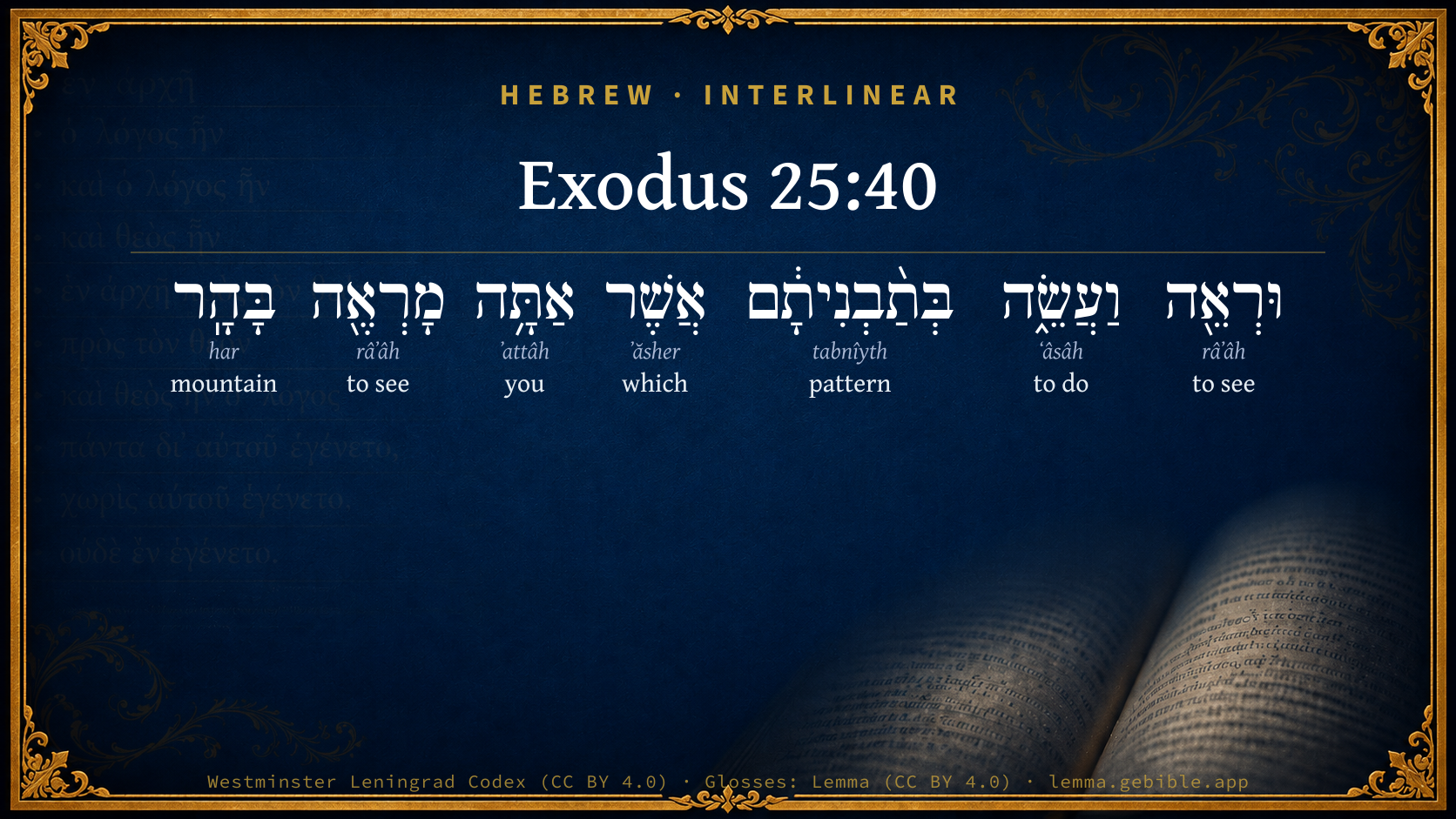
Exodus 25:40

Hebrew (Westminster Leningrad Codex) Exodus 25:40 appears in the Hebrew Old Testament. The text above is from the Westminster Leningrad Codex. Each word links to its Strong’s number, a concise gloss, and parsing drawn from the Open Scriptures Hebrew Bible morphology. Click any word for its full Brown-Driver-Briggs (BDB) entry.
Download image
Cite this verse

Exodus 25:40 (World English Bible). Public Domain. Lemma interlinear Bible study tool, https://lemma.gebible.app/v/exodus/25/40.

Show BibTeX & RIS
BibTeX
RIS
English Translation
See that you make them after their pattern, which has been shown to you on the mountain.
World English Bible · Public Domain
Download a study sheet

One document with this verse’s original text, its word-by-word gloss line, the meaning frame, cross-references with their text, attributed commentary, and full source and license credits — printable, and it pastes into notes with its structure intact.

This verse Autodidact and up

Study sheet (.html) Plain text (.txt)

A passage Seminary Student

Up to 50 verses in one chapter. A passage sheet keeps up to 6 commentary sources and 12 cross-references per verse, in the order this page ranks them, and says so on the sheet whenever that leaves anything out. Ask for a single verse and you get the Autodidact verse sheet above.

Everything on this page stays free to read, with no account — the sheet is a download of what is already on screen, not access to it.

Want to remove ads? Support Godless Engineer
Compare translations 3

The same verse in 3 English versions, stacked beneath the original-language interlinear above. Click any original word for its lexicon entry.

Each is an independent rendering of the whole verse — the interlinear is not word-aligned to these translations.

Highlighted words mark where these versions differ — a whole-verse word diff, not a word-by-word alignment.

  • World English Bible Public Domain
    See that you make them after their pattern, which has been shown to you on the mountain.
  • King James Version Public Domain
    And look that thou make them after their pattern, which was showed thee in the mount.
  • unfoldingWord Literal Text CC BY-SA 4.0
    See and make by the pattern that you are being shown on the mountain.

unfoldingWord Literal Text — © unfoldingWord, licensed CC BY-SA 4.0. Word-aligned USFM3 via Door43 (git.door43.org/unfoldingWord/en_ult).

Versions to compare (up to 4)

3 of 4 selected

Show all 18 translations

Every available English version of this verse, each an independent rendering of the whole verse.

  • World English Bible Public Domain
    See that you make them after their pattern, which has been shown to you on the mountain.
  • Berean Standard Bible Public Domain
    See to it that you make everything according to the pattern shown you on the mountain.
  • Majority Standard Bible Public Domain
    See to it that you make everything according to the pattern shown you on the mountain.
  • King James Version Public Domain
    And look that thou make them after their pattern, which was showed thee in the mount.
  • American Standard Version (1901) Public Domain
    And see that thou make them after their pattern, which hath been showed thee in the mount.
  • Revised Version (1885) Public Domain
    And see that thou make them after their pattern, which hath been shewed thee in the mount.
  • Geneva Bible (1599) Public Domain
    Looke therefore that thou make them after their facion, that was shewed thee in the mountaine.
  • Douay-Rheims (1899) Public Domain
    Look and make it according to the pattern, that was shewn thee in the mount.
  • Young's Literal Translation Public Domain
    And see thou and do `them' by their pattern which thou art shewn in the mount.
  • Literal Standard Version CC BY-SA 4.0
    Now see and make [them] by their pattern which you are shown on the mountain.”
  • Unlocked Literal Bible CC BY-SA 4.0
    Be sure to make them after the pattern that you are being shown on the mountain.
  • unfoldingWord Literal Text CC BY-SA 4.0
    See and make by the pattern that you are being shown on the mountain.
  • Darby Bible Public Domain
    And see that thou make [them] according to their pattern, which hath been shewn to thee in the mountain.
  • World Messianic Bible Public Domain
    See that you make them after their pattern, which has been shown to you on the mountain.
  • Webster's Bible Public Domain
    And look that thou make them after their pattern, which was shown thee on the mount.
  • Free Bible Version CC BY-SA 4.0
    Be sure to make everything according to the design you were shown on the mountain.”
  • Bible in Basic English Public Domain
    And see that you make them from the design which you saw on the mountain.
  • JPS Tanakh (1917) Public Domain
    And see that thou make them after their pattern, which is being shown thee in the mount.

Literal Standard Version (2020), Covenant Press — licensed CC BY-SA 4.0. Text via the HelloAO Bible API (eBible.org). Unlocked Literal Bible (unfoldingWord) — licensed CC BY-SA 4.0. Text via the HelloAO Bible API (eBible.org). unfoldingWord Literal Text — © unfoldingWord, licensed CC BY-SA 4.0. Word-aligned USFM3 via Door43 (git.door43.org/unfoldingWord/en_ult). Free Bible Version, Dr. Jonathan Gallagher — licensed CC BY-SA 4.0. Text via the HelloAO Bible API (eBible.org).

Word by word

More ways to search: Search by grammar → Find every occurrence → Compare this word →

Practice this passage: Drill this verse → Learn its vocabulary →

בְּתַ֨בְנִיתָ֔ם
tabnîyth
H8403
“in/at · pattern · their”
Preposition + Noun, Common, Feminine, Singular, Construct + Suffix, Personal, 3rd Person, Masculine, Plural
Part of Speech
Preposition + Noun
Type
Common
Gender
Feminine
Number
Singular
State
Construct
Full BDB Definition

Origin: from H1129

TWOT: 255d

pattern, plan, form, construction, figure - construction, structure - meaning dubious - pattern - figure, image (of idols)
  1. וּרְאֵ֖ה râʼâh H7200 “and · see” Conjunction + Verb, Qal, Imperative, 2nd Person, Masculine, Singular
  2. וַעֲשֵׂ֑ה ʻâsâh H6213 “and · do” Conjunction + Verb, Qal, Imperative, 2nd Person, Masculine, Singular
  3. אֲשֶׁר ʼăsher H834 “which” Particle, Relative
  4. אַתָּ֥ה ʼattâh H859 “you” Pronoun, Personal, 2nd Person, Masculine, Singular
  5. מָרְאֶ֖ה râʼâh H7200 “seen” Verb, Hophal, Participle Passive, Masculine, Singular, Absolute
  6. בָּהָֽר har H2022 “in/at the · mountain” Preposition, Determined + Noun, Common, Masculine, Singular, Absolute

About this verse

These counts appear in no published source. They are computed here, from the morphology-tagged text and Lemma’s own curated glosses. What Lemma adds →

7
words
6
distinct lemmas
Pentateuch
section

Notable vocabulary

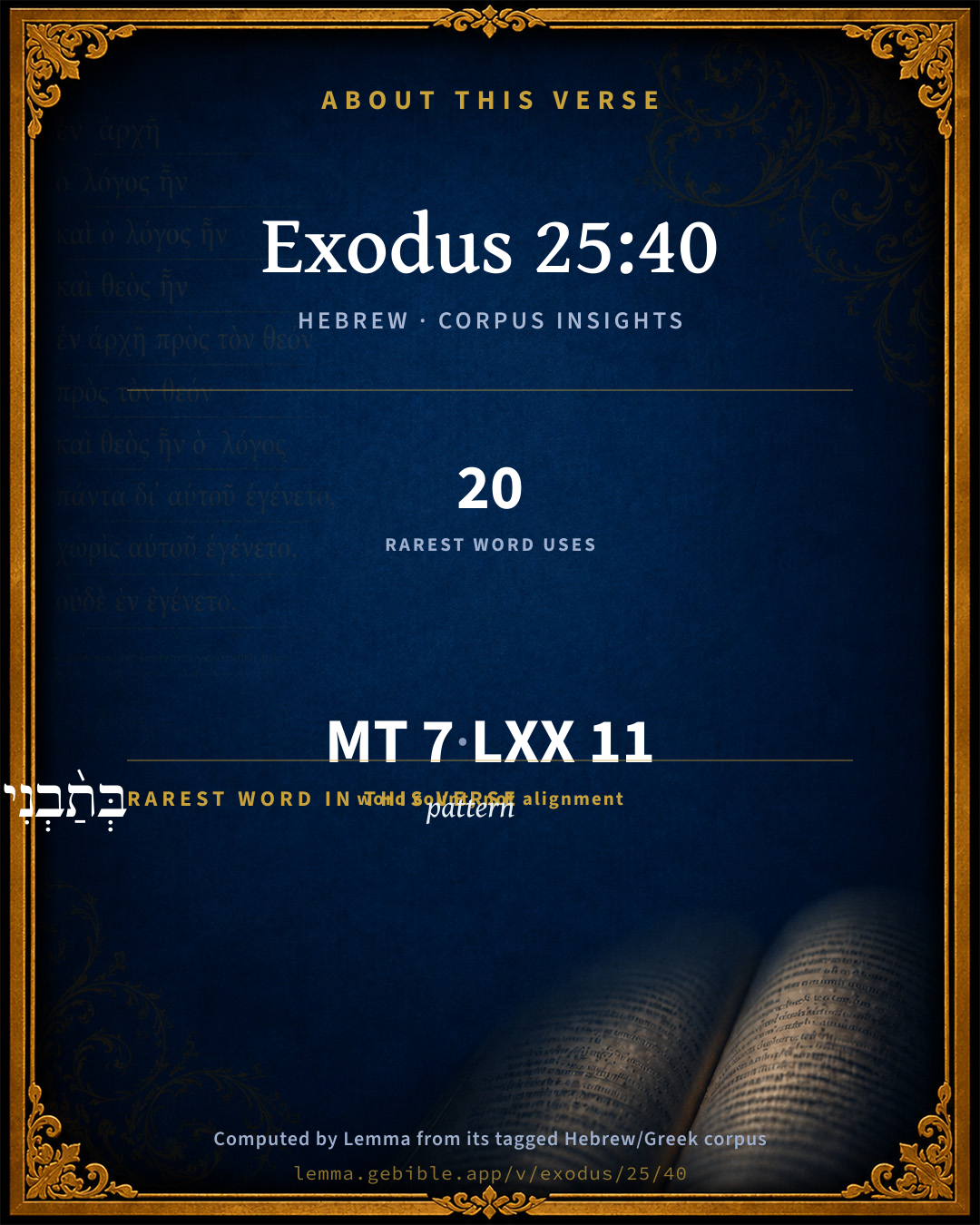
The rarest word here is בְּתַ֨בְנִיתָ֔ם pattern H8403 — appearing just 20 times in the whole Hebrew Bible.

Shared distinctive vocabulary

בְּתַ֨בְנִיתָ֔ם pattern H8403 occurs in 17 verses of the Hebrew Bible. Also found in:

Grammatical profile

  • 3 verbs
  • 2 nouns
  • 1 pronoun
  • 1 particle

Verb forms

  • וּרְאֵ֖ה Qal · Imperative
  • וַעֲשֵׂ֑ה Qal · Imperative
  • מָרְאֶ֖ה Hophal · Participle Passive

Repetition

A word recurs within this verse — often emphatic in Hebrew:

  • וּרְאֵ֖ה to see H7200 ×2

Hebrew & Septuagint length

In English translation the verse runs 17 words from the Hebrew and 14 from the Septuagint (LXX English) — closely comparable.

A rough comparison of the two English renderings, which tokenize alike — not a word-level alignment.

Word counts can differ between the Hebrew and the Greek without any difference in meaning — e.g. the Hebrew direct-object marker אֵת has no separate Greek word, and Greek often adds the article ὁ.

In the original languages it is 7 Hebrew tokens and 11 Greek tokens — but the two are counted differently (Hebrew bundles its prefixes and suffixes into one token; the Greek is in lemma form), so that isn’t a like-for-like length.

Cross-references

9

Topical passages linked to Exodus 25:40 in the Treasury of Scripture Knowledge — connected by theme and wording, ordered by reader-vote popularity; previews shown in the World English Bible.

  • Exodus 26:30 You shall set up the tent according to the way that it was shown to you on the mountain.
  • Acts 7:44 "Our fathers had the tent of the testimony in the wilderness, even as he who spoke to Moses commanded him to make it according to the pattern that he had seen;
  • Hebrews 8:5 who serve a copy and shadow of the heavenly things, even as Moses was warned by God when he was about to make the tabernacle, for he said, "See, you shall make everything according to the pattern that was shown to you on the mountain."
  • Exodus 25:9 According to all that I show you, the pattern of the tent, and the pattern of all of its furniture, even so you shall make it.
  • Numbers 8:4 This was the workmanship of the lampstand, beaten work of gold. From its base to its flowers, it was beaten work: according to the pattern which Yahweh had shown Moses, so he made the lampstand.
  • 1 Chronicles 28:19 All this, [said David], have I been made to understand in writing from the hand of Yahweh, even all the works of this pattern.
  • Exodus 39:42–43 According to all that Yahweh commanded Moses, so the children of Israel did all the work.
  • 1 Chronicles 28:11 Then David gave to Solomon his son the pattern of the porch [of the temple], and of the houses of it, and of the treasuries of it, and of the upper rooms of it, and of the inner chambers of it, and of the place of the mercy seat;
  • Ezekiel 43:11–12 If they be ashamed of all that they have done, make known to them the form of the house, and the fashion of it, and the exits of it, and the entrances of it, and all the forms of it, and all the ordinances of it, and all the forms of it, and all the laws of it; and write it in their sight; that they may keep the whole form of it, and all the ordinances of it, and do them.

Cross-references courtesy of OpenBible.info (CC BY 4.0).

Hebrew and Greek witnesses Masoretic Hebrew ↔ Greek Septuagint

The same verse in the two great witnesses to the Old Testament, shown verse-for-verse.

These are two independent witnesses, not word-aligned to each other, and the Septuagint is shown in lemma (dictionary) form.

Hebrew Exodus 25:40 Masoretic · Westminster Leningrad Codex

וּרְאֵ֖ה וַעֲשֵׂ֑ה בְּתַ֨בְנִיתָ֔ם אֲשֶׁר אַתָּ֥ה מָרְאֶ֖ה בָּהָֽר

See that you make them after their pattern, which has been shown to you on the mountain.

World English Bible · Public Domain

Greek LXX Exodus 25:40 Septuagint · lemma form

ὁράω ποιέω κατά ὁ τύπος ὁ δεικνύω σύ ἐν ὁ ὄρος

See, you shall make them according to the pattern showed you in the mount.

LXX2012 (modern English Septuagint) · Public Domain

On this verse, Adam Clarke's Commentary discusses the Septuagint’s reading. Read the note in Commentary ↓

Hebrew: Westminster Leningrad Codex (CC BY 4.0). Greek: Septuagint (public domain); English from LXX2012 (modern English Septuagint) (Public Domain). How the Septuagint differs from the Hebrew →

Targum (Aramaic paraphrase)

2

The Targum is the ancient Jewish Aramaic paraphrase of the Hebrew Scriptures — an interpretive translation, not the Hebrew text itself. Onkelos (literal) and Pseudo-Jonathan (expansive) render the Torah, and Jonathan the Prophets. Coverage is partial: where no permissively-licensed English translation exists for a verse, only the Aramaic is shown. This is verse-level text, not a word-by-word alignment to the Hebrew.

  1. Targum Onkelos Torah (Genesis–Deuteronomy)
    וַחֲזֵי וַעֲבֵיד כִּדְמוּתְהוֹן דִאַתְּ מִתְחֲזִי בְּטוּרָא:

    (no public-domain English translation for this verse)

    Targum Onkelos — Aramaic: “Onkelos Genesis” (public domain); “Onkelos Exodus” (public domain); “Onkelos Leviticus” (public domain); “Onkelos Numbers” (public domain); “Onkelos Deuteronomy” (public domain). English: “Sefaria Community Translation” (CC0 1.0 (public-domain dedication)); “J.W. Etheridge. The Targums of Onkelos and Jonathan Ben Uzziel on the Pentateuch. London: Longmans, Green, 1862” (public domain). Text via Sefaria.

  2. Targum Pseudo-Jonathan Torah (Genesis–Deuteronomy)
    וַחֲמֵי וַעֲבַד בְּצִיּוּרֵיהוֹן דְּאַנְתְּ מִתְחֲמֵי בְּטַוְורָא

    And look thou, and make according to their forms which thou hast seen in the mount.

    Targum Pseudo-Jonathan — Aramaic: “Targum Jonathan on Genesis” (public domain); “Targum Jonathan on Exodus” (public domain); “Targum Jonathan on Leviticus” (public domain); “Targum Jonathan on Numbers” (public domain); “Targum Jonathan on Deuteronomy” (public domain). English: “The Targum of Jonathan ben Uzziel, trans. J. W. Etheridge, London, 1862” (public domain). Text via Sefaria.

Commentary

Notes on Exodus 25:40 from classic Christian and Jewish commentators (each source and its license shown beneath its notes). The classic Christian expositions comment on the surrounding passage and are grouped to its opening verse, so a note may address several verses; the Jewish commentaries on the Tanakh (Rashi and others) are per-verse, so they appear only where the commentator wrote on this verse.

Lemma curates 59 commentaries, every one of them public domain or Creative Commons licensed, each selected and text-cleaned for this edition rather than reprinted as found. About our sources →

Trapp's Complete Commentary

John Trapp

Exo 25:40 And look that thou make [them] after their pattern, which was shewed thee in the mount.

Ver. 40. After their pattern, &c.] The like also was afterwards given in writing, for the building of the temple. {1Ch 28:19 Heb 8:5}

John Trapp, A Commentary or Exposition upon All the Books of the Old and New Testament (1647–1656) — public domain. Text from a community e-Sword module.

The Biblical Illustrator

Joseph S. Exell

Exo_25:40

Their pattern, which was shewed thee in the mount.

Heavens teaching on earths duties

I. That nothing is too trivial for God to notice.

II. That we should speak to God about ordinary work, even in our seasons of highest spiritual communion.

III. That even slight deviations from Gods directions are forbidden.

IV. That what we are called upon to do has far more depending upon it than we suppose. (A. Rowland, LL. B.)

Purpose in life; a lesson to the young

I. The necessity of a deliberate purpose in life. When an architect, or builder, or engineer, undertakes the construction of a house, the first thing he does is to get perfect his plans, and to be sure they are correct, so that he knows well what the future house, or bridge, or railway, will be like. If he went at his work in a haphazard manner, it would end in failure and disappointment. So with life.

II. This purpose of life should be formed on the model shown us by God.

1. The highest life is the holiest life, for it is nearest to the model set us by God.

2. The plan by which we are to mould our temporal concerns is already given us. Look at Mount Sinai for laws to obey; at the Mount of Olives for loving directions: at the Mount of Transfiguration for anticipation, hope of glory; at Mount Calvary for forgiven sin. (Homilist.)

The pattern in the mount

I. Moses did his work from a plan, and did not get his plan from his work. Reality is prior to the show of itself. There are no planless seeds. A far-reaching plan is the best one. Calculation is better than caprice. We are wiser in the long reach of thought than in the short reach. We are lost in the woods because we have no room for a long look. You say life is short. Better live on the short arc of a long circle than describe a little circle with the same line. Immediate results are meagre results. Plan solidifies. Power is measurable by purpose. Shiftlessness is a name for aimlessness. To-morrow depends on to-day, but to-day depends on to-morrow also. Past and present sustain each other. Plan gives moral safeguard. Adam fell because he had nothing to do, and the first act in the redemptive scheme was to set him to work. Satan recruits his ranks from the vagrants. The apostles were working men. The drifting boat drifts down stream. Young aimlessness is the beginning of old iniquity. Employment is a subsidiary means of conversion. Character, purpose and apprenticeship are not far apart.

II. Moses brought down his pattern from the mount. There is a celestial way of doing earthly things. Earthly success is a quotation from overhead. Our ideals are from patterns in the mount. There is something in them we never put into them. Whence are our ideals? We have never seen a perfect thing. What do we mean by using the word? We must go with Moses to the mount for the answer. In nothing do men have so much faith as in their ideals, and there is nothing which it is so hard to explain. We do not make laws, but find them. We cannot enact truth any more than gravity. There may be a myth about Sinai, but it is one we were bound to invent if it never was reality. The problem of life is to make the ideal real. Once it was done in Galilee. The two meet in Jesus. (C. H. Parkhurst, D. D.)

.

The Biblical Illustrator, edited by Joseph S. Exell (c. 1880s–1900s) — public domain. Text from a community e-Sword module.

Jamieson, Fausset & Brown

Robert Jamieson, A. R. Fausset & David Brown

look that thou make them after their pattern--This caution, which is repeated with no small frequency in other parts of the narrative, is an evidence of the deep interest taken by the Divine King in the erection of His palace or sanctuary; and it is impossible to account for the circumstance of God's condescending to such minute details, except on the assumption that this tabernacle was to be of a typical character, and eminently subservient to the religious instruction and benefit of mankind, by shadowing forth in its leading features the grand truths of the Christian Church.

Next: Exodus Chapter 26

Jamieson, Fausset & Brown — Commentary Critical and Explanatory on the Whole Bible (1871) — public domain (CC PDM 1.0). Text via the HelloAO Bible API.

Adam Clarke's Commentary

Verse 40. And look that thou make, c.] This verse should be understood as an order to Moses after the tabernacle, c., had been described to him as if he had said: "When thou comest to make all the things that I have already described to thee, with the other matters of which I shall afterwards treat, see that thou make every thing according to the pattern which thou didst see in the mount." The Septuagint have it, κατα τον τυτον τον δεδειγμενον σοι· according to the TYPE-form or fashion, which was shown thee. It appears to me that St. Paul had this command particularly in view when he gave that to his son Timothy which we find in the second epistle, 2Ti 1:13: Ὑποτυπωσιν εχε ὑγιαινοντων λογων, ὡν παρ' εμου ηκουσας. "Hold fast the FORM of sound words which thou hast heard of me." The tabernacle was a type of the Church of God; that Church is built upon the foundation of the prophets and apostles, Jesus Christ being the chief cornerstone, Eph 2:20-22: the doctrines, therefore, delivered by the prophets, Jesus Christ, and his apostles, are essential to the constitution of this church. As God, therefore, gave the plan or form according to which the tabernacle must be constructed, so he gives the doctrines according to which the Christian Church is to be modelled; and apostles, and subordinate builders, are to have and hold fast that FORM of sound words, and construct this heavenly building according to that form or pattern which has come through the express revelation of God.

IN different parts of this work we have had occasion to remark that the heathens borrowed their best things from Divine revelation, both as it refers to what was pure in their doctrines, and significant in their religious rites. Indeed, they seem in many cases to have studied the closest imitation possible, consistent with the adaptation of all to their preposterous and idolatrous worship. They had their IAO or JOVE, in imitation of the true JEHOVAH; and from different attributes of the Divine Nature they formed an innumerable group of gods and goddesses. They had also their temples in imitation of the temple of God; and in these they had their holy and more holy places, in imitation of the courts of the Lord's house. The heathen temples consisted of several parts or divisions:

1. The area or porch;

2. The ναος or temple, similar to the nave of our churches;

3. The adytum or holy place, called also penetrale and sacrarium; and,

4. The οπισθοδομος or the inner temple, the most secret recess, where they had their mysteria, and which answered to the holy of holies in the tabernacle.

And as there is no evidence whatever that there was any temple among the heathens prior to the tabernacle, it is reasonable to conclude that it served as a model for all that they afterwards built. They had even their portable temples, to imitate the tabernacle; and the shrines for Diana, mentioned Ac 19:24, were of this kind. They had even their arks or sacred coffers, where they kept their most holy things, and the mysterious emblems of their religion; together with candlesticks or lamps, to illuminate their temples, which had few windows, to imitate the golden candlestick in the Mosaic tabernacle. They had even their processions, in imitation of the carrying about of the ark in the wilderness, accompanied by such ceremonies as sufficiently show, to an unprejudiced mind, that they borrowed them from this sacred original. Dr. Dodd has a good note on this subject, which I shall take the liberty to extract.

Speaking of the ark, he says, "We meet with imitations of this Divinely instituted emblem among several heathen nations. Thus Tacitus, De Moribus Germanorum, cap. 40, informs us that the inhabitants of the north of Germany, our Saxon ancestors, in general worshipped Herthum or Hertham, i.e., the mother earth: Hertham being plainly derived from ארץ arets, earth, and אם am, mother: and they believed her to interpose in the affairs of men, and to visit nations: that to her, in a sacred grove in a certain island of the ocean, a vehicle covered with a vestment was consecrated, and allowed to be touched by the priests only, (compare 2Sa 6:6-7; 1Ch 13:9-10), who perceived when the goddess entered into her secret place, penetrale, and with profound veneration attended her vehicle, which was drawn by cows; see 1Sa 6:7-10. While the goddess was on her progress, days of rejoicing were kept in every place which she vouchsafed to visit; they engaged in no war, they handled no weapons; peace and quietness were then only known, only relished, till the same priest reconducted the goddess to her temple. Then the vehicle and vestment, and, if you can believe it, the goddess herself, were washed in a sacred lake."

Apuleius, De Aur. Asin., lib. ii., describing a solemn idolatrous procession, after the Egyptian mode, says, "A chest, or ark, was carried by another, containing their secret things, entirely concealing the mysteries of religion."

And Plutarch, in his treatise De Iside, c., describing the rites of Osiris, says, "On the tenth day of the month, at night, they go down to the sea and the stolists, together with the priest, carry forth the sacred chest, in which is a small boat or vessel of gold."

Pausanius likewise testifies, lib. vii., c. 19, that the ancient Trojans had a sacred ark, wherein was the image of BACCHUS, made by Vulcan, which had been given to Dardanus by Jupiter. As the ark was deposited in the holy of holies, so the heathens had in the inmost part of their temples an adytum or penetrale, to which none had access but the priests. And it is remarkable that, among the Mexicans, Vitzliputzli, their supreme god, was represented under a human shape, sitting on a throne, supported by an azure globe which they called heaven; four poles or sticks came out from two sides of this globe, at the end of which serpents' heads were carved, the whole making a litter which the priests carried on their shoulders whenever the idol was shown in public.-Religious Ceremonies, vol. iii., p. 146.

Calmet remarks that the ancients used to dedicate candlesticks in the temples of their gods, bearing a great number of lamps.

Pliny, Hist. Nat., lib. xxxiv., c. 3, mentions one made in the form of a tree, with lamps in the likeness of apples, which Alexander the Great consecrated in the temple of Apollo.

And Athenaeus, lib. xv., c. 19, 20, mentions one that supported three hundred and sixty-five lamps, which Dionysius the younger, king of Syracuse, dedicated in the Prytaneum at Athens. As the Egyptians, according to the testimony of Clemens Alexandrinus, Strom., lib. i., were the first who used lamps in their temples, they probably borrowed the use from the golden candlestick in the tabernacle and temple.

From the solemn and very particular charge, Look that thou make them after their pattern, which was showed thee in the mount, it appears plainly that God showed Moses a model of the tabernacle and all its furniture; and to receive instructions relative to this was one part of his employment while on the mount forty days with God. As God designed that this building, and all that belonged to it, should be patterns or representations of good things to come, it was indispensably necessary that Moses should receive a model and specification of the whole, according to which he might direct the different artificers in their constructing the work.

1. We may observe that the whole tabernacle and its furniture resembled a dwelling-house and its furniture.

2. That this tabernacle was the house of God, not merely for the performance of his worship, but for his residence.

3. That God had promised to dwell among this people, and this was the habitation which he appointed for his glory.

4. That the tabernacle, as well as the temple, was a type of the incarnation of Jesus Christ. See Joh 1:14, and Joh 2:19; Joh 2:21.

5. That as the glory of God was manifested between the cherubim, above the mercy-seat, in this tabernacle, so God was in Christ, and in him dwelt all the fulness of the Godhead bodily.

6. As in the tabernacle were found bread, light, &c., probably all these were emblematical of the ample provision made in Christ for the direction, support, and salvation of the soul of man. Of these, and many other things in the law and the prophets, we shall know more when mortality is swallowed up of life.

Adam Clarke's Commentary on the Bible (1810–1826) — public domain. Text from a community e-Sword/MySword module.

Ellicott's Commentary for English Readers

(40) After their pattern.—Comp, Exo_25:9.

A Bible Commentary for English Readers, edited by Charles John Ellicott (1878–1897) — public domain. Text from a community e-Sword module.

The Cambridge Bible for Schools and Colleges

gen. ed. J. J. S. Perowne

40. Cf. v. 9: also Num_8:4; and Act_7:44.

In Solomon’s Temple there were ten golden candlesticks, five standing on each side of the Holy place, in front of the adyton (1Ki_7:49; cf. Jer_52:19): in the post-exilic Temple there was only a single candlestick (1Ma_1:21; 1Ma_4:49). It is this which was taken from the Herodian Temple by the Romans, and is represented on the famous Arch of Titus. In the Temple at Shiloh there was only a single lamp (1Sa_3:3).

The Ark

It is impossible to give here a history of the Ark; but a few words may be permitted, respecting the religious ideas associated with it, and opinions as to its possible origin.

The oldest name of the ark was the ‘ark of Jehovah,’ Jos_3:13 &c. (or ‘of God,’ 1Sa_3:3 &c.), or, less frequently, ‘the ark’ alone (Num_10:35 al.): the Deut. expression (see p. 193) is ‘the ark of the covenant’ (with or without ‘of Jehovah’ added): P’s characteristic expression is the ‘ark of the testimony’ (13 times: see on Exo_25:16; Exo_25:22). Both these latter terms are used with allusion to the tables inscribed with the Decalogue, which,—as in our extant sources (see however on Exo_34:3) we first learn from Deu_10:2; Deu_10:5,—were contained in it. In itself the ‘ark’ is similar in principle to the sacred chests in which many other ancient nations, as the Egyptians, Etruscans, Greeks, kept images, or other sacred objects, and sometimes also carried them in processions. Now it is noticeable that in nearly all the pre-Deuteronomic references, the ark—which in these passages ‘must be thought of as a simple chest, very different from the gold-covered shrine of P, with its’ massive golden ‘mercy-seat, and over-arching cherubim’ (Kennedy)—appears as much more than a mere receptacle of two inscribed stones; it is, in fact, in a very special sense, a symbol and pledge of Jehovah’s presence; and it is even spoken of as if He were actually present in it, so that wherever the ark was, Jehovah was there with it. Especially in war is it thus regarded as the material vehicle or accompaniment of Jehovah’s presence. In the ancient verses preserved in Num_10:35 f.—originally, to judge from the terms used, the prayer with which the Ark was sent forth to battle, and the welcome with which its return was greeted,—‘Arise, O Jehovah, and let thine enemies be scattered, Let them that hate thee flee before thee,’ and ‘Return, O Jehovah, to the myriads of Israel’s clans,’ Jehovah is addressed as though He were present in the ark, and moved with it. The case is similar in 1Sa_4:3, where the Hebrew sheikhs say, ‘Let us fetch the ark of Jehovah … from Shiloh, that it may come … and save us,’ and when it arrives, the Philistines exclaim (v. 7), ‘God is come into the camp’; and in Exo_6:19, where, after the ark has been brought back, and some of the men of Bethshemesh are smitten, the others exclaim, ‘Who is able to stand before Jehovah this holy God?’ So in 2Sa_6:5 ff. David and the Israelites, accompanying the ark with dancing and music, are described as playing ‘before Jehovah’ (vv. 5, 21); and in Jos_7:6-9 the Israelites fall down before the ark and pray to Him. It is also evidently as the pledge of Jehovah’s presence and effectual help, that in 2Sa_11:11 the ark is taken with the host on a campaign, and that in 2Sa_15:24 f. Zadok takes it with David, when he leaves Jerusalem (though the king magnanimously sends it back): in Num_14:44, on the contrary, its absence from the host (which is tantamount to Jehovah’s absence, v. 42) is the cause of defeat. Other ancient nations took images of their gods into battle (2Sa_5:21 : Rel. Sem. 37, citing Polyb. vii. 9, Diod. xx. 65 [the Carthaginians’ ‘sacred tent’]): the Israelites had a custom which was the same in principle; but their palladium was the image-less ark.

These passages, which shew that in early Israel the ark was, in a very real sense, identified with the presence of Jehovah, are not adequately explained if the only purpose of the ark was to form a receptacle for the two tables of stone. How the former conception of the ark arose, the extant narratives do not state: they describe the ark as made purely to receive the tables of stone; and in P Jehovah speaks not from the ark itself, but from between the cherubim upon it. We are therefore reduced to conjecture. When we remember that Jacob speaks of the stone at Bethel as being itself the ‘house,’ or abode, of God (Gen_28:22), one supposition that suggests itself is that in very remote times the ark may have sheltered a sacred stone, regarded by the primitive Israelites as the abode of a deity (so Benz. Arch.1 369 [2312 a very different view]; Bä.; in greater detail, Cheyne, EB. i. 307 f.), but ‘transformed’ ultimately, ‘in reverent Hebrew thought “into a perfect written embodiment of the fundamental demands of Israel’s righteous God” ’ (McNeile, p. 163, without, however, definitely accepting this view). Such conjectures are not illegitimate: for our accounts of the beginnings of Israel’s religion, it must be borne in mind, are both imperfect in themselves, and spring from a time when higher and more spiritual ideas were current than had once been the case. Another view, which admits of being more easily accommodated to Exo_33:1-7, is that the ark contained a stone, or stones, taken from the sacred ‘mount of God,’ Horeb, which was regarded as an assurance of the protecting presence of Jehovah (whose abode was on Sinai, Exo_19:4) after they left it (Moore, EB. i. 2155): and there are independent reasons for thinking (see on Exo_33:6) that the ark was originally conceived as supplying some kind of visible substitute for Jehovah’s personal presence. Or, thirdly, Kennedy may be right (Samuel, in the Century Bible, p. 324) in seeing in the ark an embodiment of that ‘Presence of Jehovah,’ which it is promised shall accompany Israel to Canaan (Exo_33:14), as, not indeed Jehovah Himself, but His sufficient representative (cf. DB. i. 150 f.).

It is common to all these theories to regard the ark as not originally intended to receive the tables of the Decalogue: it is not probable, it is argued, that laws of fundamental importance, intended to be observed by all, should be placed where they could not be seen. The question cannot be here pursued further; and it must suffice to refer the reader, for fuller discussion, to Kennedy, DB. i. s.v., and Samuel, p. 321 ff.; Kautzsch, DB. v. 628 f., and McNeile, p. 161 ff. Jehovah’s presence, it is clear, was regarded as in some way ‘objectively attached to the ark’: but the historical origin of this idea our extant data do not enable us certainly to determine. And this is why we are driven to conjecture. It may only be worth while to add that in Jer_3:16 the time is looked forward to, by the spiritually-minded prophet, when no such material symbol of Jehovah’s presence will be needed; and the ark, having served its purpose through many centuries, will be neither ‘remembered, nor missed (RVm.), nor made again.’

The Cambridge Bible for Schools and Colleges (gen. ed. J. J. S. Perowne; Cambridge University Press, 1878–1918) — public domain. Text from a community e-Sword module.

The Pulpit Commentary

Their pattern, which was shewed thee in the mount. Compare ver. 9, and the comment ad loc. It would seem from this passage that the "patterns" were shown to Moses first, and the directions as to the making given afterwards.

The Pulpit Commentary (1880–1919), ed. H.D.M. Spence-Jones & Joseph S. Exell — public domain. Text from a community e-Sword module.

Rashi

Rabbi Shlomo Yitzchaki (Rashi)

וראה ועשה AND SEE AND MAKE — See here, in the mountain, the pattern which I shew thee. This teaches you that Moses was puzzled about the workmanship of the Menorah until the Holy One, blessed be He, showed him the pattern of it in a candlestick of fire (Menachot 29a).

אשר אתה מראה WHICH WAS SHOWN THEE — Translate as the Targum does: דאת מתחזי בטורא which thou hast been shown on the mountain. If it were punctuated with Patach (מַרְאֶה) it would mean which you show to others,” now, however, that it is punctuated with חטף קמץ (our קמץ חטוף, short Kametz) it signifies, “which thou hast been shown” — i. e. which others show thee [for the punctuation distinguishes between the words denoting “one who does something” and “one who has something done to him” (i. e. between the active participle מַרְאֶה and the passive participle מָרְאֶה).]

Rashi on the Tanakh — English translations: “The Judaica Press complete Tanach with Rashi, translated by A. J. Rosenberg” (CC BY 4.0); “Pentateuch with Rashi's commentary by M. Rosenbaum and A.M. Silbermann, 1929-1934” (public domain); “The Metsudah Tanach series, Lakewood, N.J” (CC BY 4.0); and “The Book of Joshua, Metsudah Publications, 1997” (CC BY 4.0). Text via Sefaria.

Lesson kit

Teaching starters — assembled from the data on this page, not authored interpretation. Every prompt links to the verse data it draws on. Edit before teaching.

Exodus, in the Pentateuch, opens this verse with 7 words (6 distinct Hebrew lemmas). Its most distinctive word is tabnîyth (“pattern”). A historical commentator’s framing appears above. Read the whole chapter for the surrounding context.

Discussion questions

  1. The word tabnîyth carries the sense “pattern.” How does it shape the verse?
  2. How does Exodus 25:9, which shares the word «pattern», read alongside this verse?
  3. What does the repetition of “to see” (2× in this one verse) do in this verse?
  4. The translations on this page render this verse differently — a whole-verse word diff, not a word-by-word alignment. What might account for the different wordings?
  5. «וּרְאֵ֖ה» is a Qal Imperative verb. How does that grammatical form shape the action described?
  6. Compare how Trapp's Complete Commentary and The Biblical Illustrator read this verse. Where do they agree or differ?

Things to notice

Reading settings

Reading text

Shown beneath each verse's original-language words.

Old Testament
Old Testament edition

Read the OT as the Masoretic Hebrew (MT) or the Greek Septuagint (LXX).

English shown for the Greek Septuagint (in the Hebrew ↔ Greek comparison).

Comparing translations? Open the Compare panel on any verse page to stack up to four side by side.