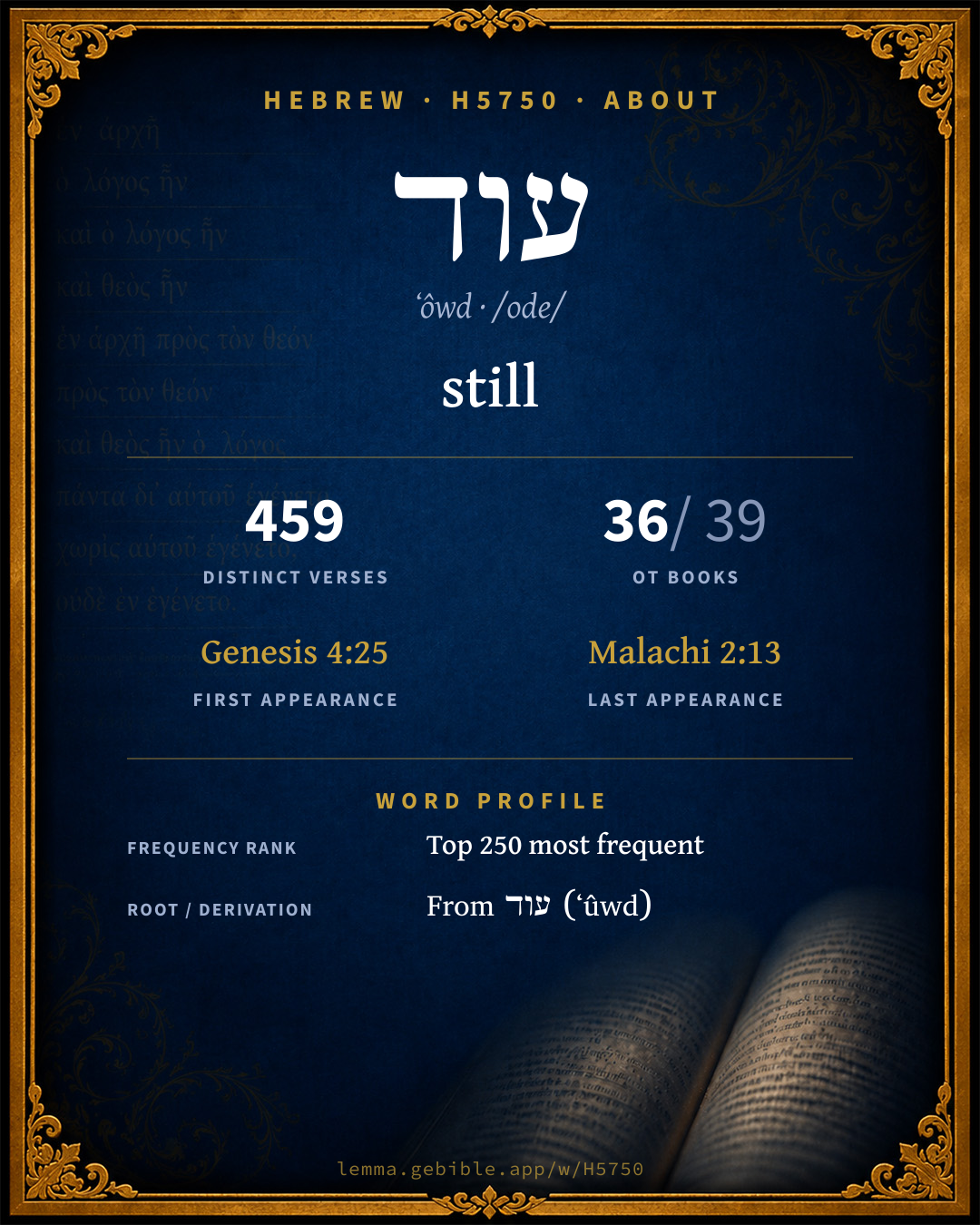
עוֹד
still
‘still’ is one of 2 main senses fuller range ↓
Full lexicon entry — Brown-Driver-Briggs (BDB)
From Brown-Driver-Briggs (BDB)
Where this word appears
Grammar key — what these labels mean
Part of speech
- Adverb
- A word that modifies a verb, adjective, or other adverb.
Every verse where H5750 appears in the Book of 2 Samuel — 30 distinct verses. Click any verse to open its interlinear word-by-word view. Verse text shown in the World English Bible for context — . Each verse’s Hebrew form is shown with its reference; the English is not keyword-highlighted, since the data carries no word-level English alignment. Use “Compare translations” on any verse to read it across multiple English versions. This concordance covers the Hebrew Bible; Septuagint (Greek Old Testament) occurrences are not indexed here.
2 Samuel
- 2 Samuel 1:9 ע֥וֹד adv He said to me, Stand, I pray you, beside me, and kill me; for anguish has taken hold of me, because my life is yet whole in me.
- 2 Samuel 2:22 ע֣וֹד adv Abner said again to Asahel, Turn you aside from following me: why should I strike you to the ground? how then should I hold up my face to Joab your brother?
- 2 Samuel 2:28 ע֖וֹד ע֖וֹד adv adv So Joab blew the trumpet; and all the people stood still, and pursued after Israel no more, neither fought they any more.
- 2 Samuel 3:11 ע֔וֹד adv He could not answer Abner another word, because he feared him.
- 2 Samuel 3:35 בְּ/ע֣וֹד prep + adv All the people came to cause David to eat bread while it was yet day; but David swore, saying, God do so to me, and more also, if I taste bread, or anything else, until the sun be down.
- 2 Samuel 5:13 ע֜וֹד ע֛וֹד adv adv David took him more concubines and wives out of Jerusalem, after he was come from Hebron; and there were yet sons and daughters born to David.
- 2 Samuel 5:22 ע֛וֹד adv The Philistines came up yet again, and spread themselves in the valley of Rephaim.
- 2 Samuel 6:1 ע֥וֹד adv David again gathered together all the chosen men of Israel, thirty thousand.
- 2 Samuel 6:22 עוֹד֙ adv I will be yet more vile than this, and will be base in my own sight: but of the handmaids of whom you have spoken, they shall honor me.
- 2 Samuel 7:10 ע֑וֹד adv I will appoint a place for my people Israel, and will plant them, that they may dwell in their own place, and be moved no more; neither shall the children of wickedness afflict them any more, as at the first,
- 2 Samuel 7:19 ע֨וֹד adv This was yet a small thing in your eyes, Lord Yahweh; but you have spoken also of your servant's house for a great while to come; and this [too] after the manner of men, Lord Yahweh!
- 2 Samuel 7:20 ע֖וֹד adv What can David say more to you? for you know your servant, Lord Yahweh.
- 2 Samuel 9:1 ע֔וֹד adv David said, Is there yet any who is left of the house of Saul, that I may show him kindness for Jonathan's sake?
- 2 Samuel 9:3 ע֥וֹד ע֛וֹד adv adv The king said, Is there not yet any of the house of Saul, that I may show the kindness of God to him? Ziba said to the king, Jonathan has yet a son, who is lame of his feet.
- 2 Samuel 10:19 ע֖וֹד adv When all the kings who were servants to Hadarezer saw that they were put to the worse before Israel, they made peace with Israel, and served them. So the Syrians feared to help the children of Ammon any more.
- 2 Samuel 12:22 בְּ/עוֹד֙ prep + adv He said, While the child was yet alive, I fasted and wept: for I said, Who knows whether Yahweh will not be gracious to me, that the child may live?
- 2 Samuel 12:23 ע֑וֹד adv But now he is dead, why should I fast? can I bring him back again? I shall go to him, but he will not return to me.
- 2 Samuel 14:10 ע֖וֹד adv The king said, Whoever says anything to you, bring him to me, and he shall not touch you any more.
- 2 Samuel 14:29 עוֹד֙ adv Then Absalom sent for Joab, to send him to the king; but he would not come to him: and he sent again a second time, but he would not come.
- 2 Samuel 14:32 עֹ֣ד adv Absalom answered Joab, Behold, I sent to you, saying, Come here, that I may send you to the king, to say, Why am I come from Geshur? it were better for me to be there still. Now therefore let me see the king's face; and if there be iniquity in me, let him kill me.
- 2 Samuel 18:14 עוֹדֶ֥/נּוּ adv + sfx pers 3ms Then said Joab, I may not wait thus with you. He took three darts in his hand, and thrust them through the heart of Absalom, while he was yet alive in the midst of the oak.
- 2 Samuel 18:22 ע֜וֹד adv Then said Ahimaaz the son of Zadok yet again to Joab, But come what may, Please let me also run after the Cushite. Joab said, Why will you run, my son, seeing that you will have no reward for the news?
- 2 Samuel 19:28 עוֹד֙ ע֖וֹד adv adv For all my father's house were but dead men before my lord the king; yet you set your servant among those who ate at your own table. What right therefore have I yet that I should cry any more to the king?
- 2 Samuel 19:29 ע֖וֹד adv The king said to him, Why speak you any more of your matters? I say, You and Ziba divide the land.
- 2 Samuel 19:35 ע֔וֹד עוֹד֙ adv adv I am this day eighty years old: can I discern between good and bad? can your servant taste what I eat or what I drink? can I hear any more the voice of singing men and singing women? why then should your servant be yet a burden to my lord the king?
- 2 Samuel 21:15 ע֧וֹד adv The Philistines had war again with Israel; and David went down, and his servants with him, and fought against the Philistines. David grew faint;
- 2 Samuel 21:17 ע֤וֹד adv But Abishai the son of Zeruiah helped him, and struck the Philistine, and killed him. Then the men of David swore to him, saying, You shall go no more out with us to battle, that you don't quench the lamp of Israel.
- 2 Samuel 21:18 ע֧וֹד adv It came to pass after this, that there was again war with the Philistines at Gob: then Sibbecai the Hushathite killed Saph, who was of the sons of the giant.
- 2 Samuel 21:19 ע֧וֹד adv There was again war with the Philistines at Gob; and Elhanan the son of Jaareoregim the Bethlehemite killed Goliath the Gittite's brother, the staff of whose spear was like a weaver's beam.
- 2 Samuel 21:20 ע֥וֹד adv There was again war at Gath, where was a man of great stature, who had on every hand six fingers, and on every foot six toes, four and twenty in number; and he also was born to the giant.
About this entry
At a glance — auto-summarized from this page’s data, not written by a person. Every figure links to its source below. This summary describes the numbers; it doesn’t interpret them.
At its core, עוד (ʻôwd) means “still.” Scripture first uses it in Genesis 4:25. With 459 verses in 36 books, it is a common word in the Hebrew Bible. Not a single-sense word: explore its full sense range. Sharing its root, it stands alongside עוד, עד and תעודה. Dig into 459-verse concordance and the renderings breakdown below.
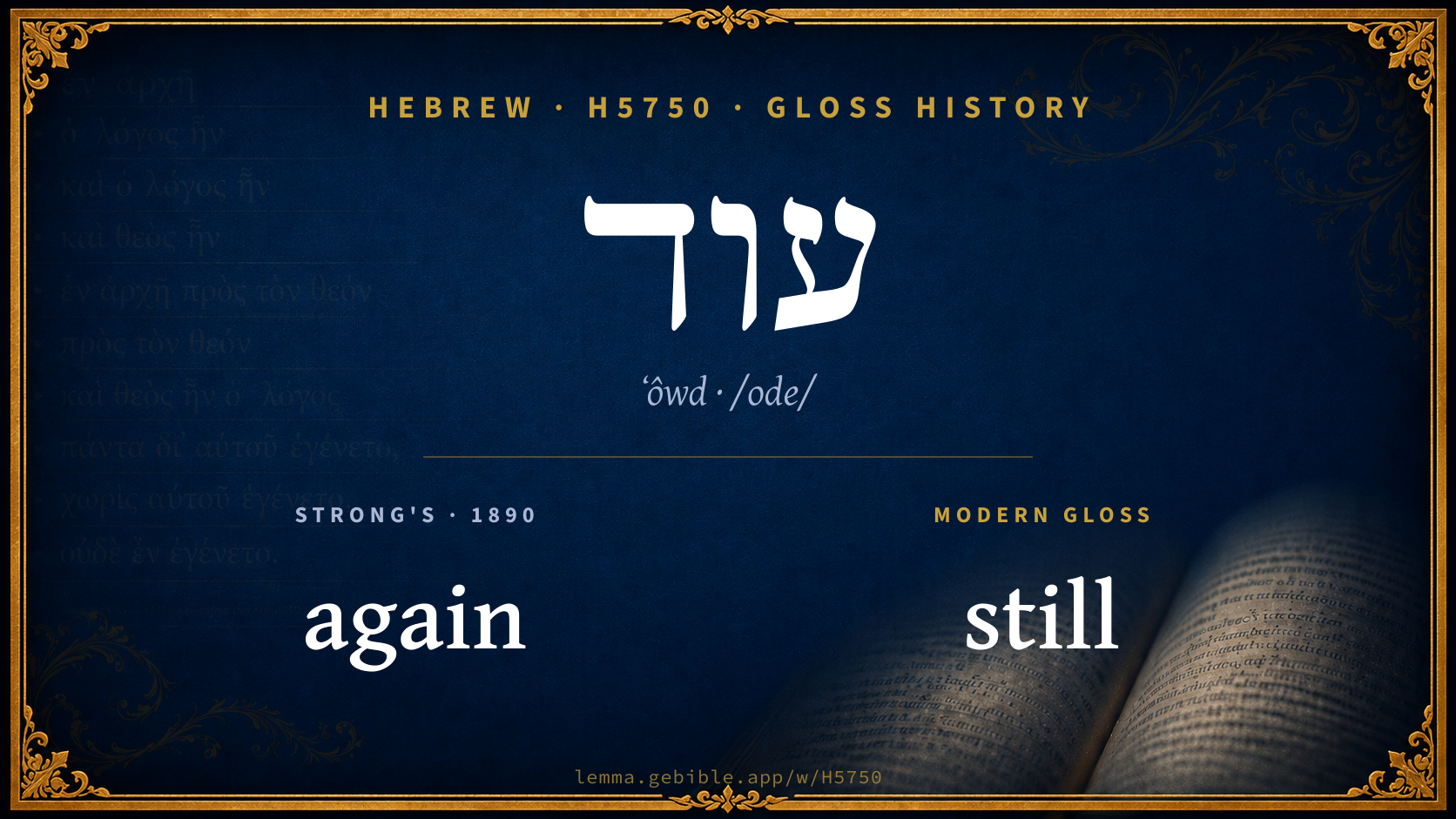
Gloss history
Strong's 1890 vs modern scholarship
About this word
Strong's H5750 catalogs a Hebrew word from the Hebrew Old Testament.
These counts are not copied from any lexicon or concordance. They are computed here, from the morphology-tagged Hebrew Old Testament. What Lemma adds →
- 459
- distinct verses
- The word appears in 459 distinct verses.
- 36 / 39
- OT books
- The word appears in 36 of 39 Old Testament books.
- #104
- by frequency
- Top 250 most frequent Hebrew words (rank 104 of 8,640 Hebrew words by occurrence).
View all 459 occurrences in the concordance →
By section of the Old Testament
By traditional corpus
Conventional, traditional groupings — biblical authorship is debated, so this is a traditional corpus grouping, not an authorship claim. Each share is this word’s portion of its verses in that division of the Hebrew canon. Each figure is a share of the word’s 459 distinct verses.
- Prophets (Nevi'im) 281 verses · 61%
- Torah (Pentateuch) 91 verses · 20%
- Writings (Ketuvim) 87 verses · 19%
How translations render this word
Counts come from each version’s own published word-to-Strong’s tagging or interlinear alignment — an approximate guide to how each version renders this word, not a word-level alignment the data otherwise carries. Because each total is that version’s own tagged count, the per-version totals vary from one another and need not match the appearance or distinct-verse counts above. These counts may also differ from a printed concordance because Lemma counts each distinctly tagged rendering and does not collapse phrase taggings into a single head-word total. This is a fixed set of word-tagged versions (KJV, ASV, BSB, ULT) and does not change with the reading translation you choose elsewhere. Each version’s license is shown beside its name below (and on Sources).
- King James Version: Yet 4×
- American Standard Version: Still 2×, Yet 2×
- Berean Standard Bible: Longer 75×, Again 53×, More 37×
- unfoldingWord Literal Text: Again 107×, Still 71×, Longer 65×
King James Version Public Domain
Renders H5750 across 30 tagged occurrences — most commonly:
Plus 26 renderings that appear only once — usually multi-word phrases or single function words the recovered tagging swept in, not distinct renderings.
American Standard Version Public Domain
Renders H5750 across 30 tagged occurrences — most commonly:
Plus 26 renderings that appear only once — usually multi-word phrases or single function words the recovered tagging swept in, not distinct renderings.
Berean Standard Bible Public Domain
Renders H5750 across 390 tagged occurrences — most commonly:
Plus other, less common renderings. Plus 72 renderings that appear only once — usually multi-word phrases or single function words the recovered tagging swept in, not distinct renderings. Not rendered by a distinct English word in 97 further occurrences.
unfoldingWord Literal Text CC BY-SA 4.0
Renders H5750 across 503 tagged occurrences — most commonly:
Plus other, less common renderings. Plus 57 renderings that appear only once — usually multi-word phrases or single function words the recovered tagging swept in, not distinct renderings.
7 senses and sub-senses in the full BDB
What do BDB’s symbols mean?
BDB uses these scholarly abbreviations:
| Symbol | Meaning |
|---|---|
| 𝔊 | the Septuagint (the ancient Greek translation, LXX) |
| 𝔙 | the Vulgate (the Latin translation) |
| 𝔖 | the Syriac version (the Peshitta) |
| 𝔗 | the Targum (the Aramaic translation) |
| ψ | the Psalms |
| √ | root (the underlying root or stem) |
| ‖ | parallel passage (a synonymous or contrasted parallel) |
| † | the dagger: every passage where the word occurs is cited |
The 7 senses and sub-senses the full Brown-Driver-Briggs lexicon distinguishes for this word, in lexicon order (not ranked by frequency), with BDB’s own verbatim wording and sub-sense lettering. Shown in Hebrew script with BDB’s own scholarly abbreviations. The condensed entry is in the Lexicon Entry tab. See also the Forms in the corpus table below.
- 1. as adv.:
- a. (a) expressing continuance, persistence, usually of the past or present, still, yet, Gn 18:22 ואברהם עודנו עֹמֵד and A., he was still standing before י׳ (note often so עוֹדֶנּוּ after cas. pend., 44:14 1 S 13:7; 1 K 12:2; Je 33:1; 2 Ch 34:3), 29:7 הן עוד היום גדול the day is still high, 31:14; 43:7 הַעוֹד אֲבִיכֶם חַי, v 27; 45:3; Ex 4:18; 9:2; Nu 19:13; Ju 6:24; 8:20; 1 K 20:32 הַעוֹדֶנּוּ חַי; 2 S 14:32 (but Köiii. 558 עַד), 18:14; Is 5:25 ועוד יָדוֹ נְטוּיָה; 10:32 עוֹד הַיּוֹם בְּנֹב לַעֲמֹד still to-day (such is his haste) will he tarry in Nob; 1 K 22:44 עוד העם מְזַבְּחִים the people were still sacrificing, etc. (so 2 K 12:4 +); 2 S 1:9 כי־כל־עוד נפשׁי בי, Jb 27:3 (v. כֹּל 1 f); Mi 6:10 (v. הֲ 1 b end, and Ke; but also We Now); La 4:17 the sf. is anticipatory, either of eyes (Kt) or our (Qr 𝔊), poet. for עוֹד עֵינֵינוּ בָּלוֹת; but Dys Löhr al. read עַד מָה for ע׳, Bi 1 Wild simply עוֹד. 2 Ch 14:6 read either עוֹדֵנוּ (sf. 1 pl. antic. of לפנינו), or עוֹד. Twice, peculiarly, עוֹד לֹא still not (Germ. noch nicht) i.e. not yet (in class. Heb. טֶרֶם), Je 40:5 עוֹדֶנּוּ לא ישׁוב, 2 Ch 20:33 ועוד העם לא הֵכִינוּ לבבם (the vb. fin. on acc. of לֹא). Sq. וְ, Nu 11:33 הבשׂר עודנו בין שׁנּיהם … ואף י׳ חרה בעם the flesh was still between their teeth …, and (= when) etc., (cf. ψ 78:30 f. Jb 8:12); and often in the phr. (מְדַבְּרִים) מְדַבֵּר (עוֹדָם וגו׳) עוֹדֶנּוּ he (they, etc.) was (were) still speaking, and (= when) etc., Gn 29:9 עודנו מְדַבֵּר עמם ורחל באה, 1 K 1:22, 42; 2 K 6:33; Est 6:14; Dn 9:20, 21, so עוֹד זֶה … Jb 1:16, 17 (+ v 18 for עַד): and of the future, 1 K 1:14; Is 65:24 (עוֹד הֵם מְדַבְּרִים ואני אשׁמע); cf. Ex 9:17. (b) Expressing addition or repetition, still, yet, more, Gn 7:4 כי לימים עוד שׁבעה after yet seven days, 8:10, 12; 29:27, 30 עוד שׁבע שׁנים אחרות, 45:6; 2 K 6:33; Is 1:5; Hb 2:3 כִּי עוֹד חָזוֹן לַמּוֹעֵד (cf. Dn 10:14; 11:2, 27, 35), Je 13:27 אַחֲרֵי מָתַי עוֹד after how long still? with stress on the idea of continuance, Gn 46:29 וַיֵּבְךְ עַל צַוָּארָיו עוֹד still going on (AV. a good while), Ru 1:14, ψ 84:5 עוד יהללוך they will be still praising thee, Jb 34:23; with עוֹד prefixed for emph., Ex 11:1 עוד נגע אחד אביא על פ׳, Is 49:20; 56:8 עוֹד אֲקַבֵּץ וגו׳, Ez 8:13, 15 ψ 42:6; 92:15 +; in the phr. עוֹד מְעַט וְ sq. pf. consec., †Ex 17:4 עוד מעט וּסְקָלֻנִי yet a little, and they will stone me, Ho 1:4; Je 51:33, cf. ψ 37:10, Is 10:25; 29:17; simil. Jon 3:4 (cf. בְּעוֹד Is 21:16), 2 Ch 10:5 (but see 𝔊 and ‖ 1 K 12:5); עוד … לא no more, both of the past, as Ex 2:3; Jos 5:1, 12; 1 K 10:5, and of the fut., as Gn 17:5 לא יִקָּרֵא עוד שׁמך א׳, 32:29; Dt 31:2; Is 2:4; 30:20; 62:4; Je 3:16 + often, לא … עוד Gn 8:22; so with אֵין Is 23:10; Je 10:20; 48:2 ψ 74:9 al. e.g. Genesis 18:22
- b. When the continuance is limited by its nature to a single occurrence, עוֹד becomes = again, Gn 4:25; 9:11 לא יִכָּרֵת כל בשׂר עוד, 18:29 וַיֹּסֶף עוֹד לְדַבֵּר and he added still to speak, i.e. he spake yet again (so often with יָסַף; v. √), 24:20 וַתָּ֫רָץ עוֹד and she ran again, 29:33 וַתַּ֫הַר עוֹד, 35:9; 37:9; Ex 3:15; 4:6; Dt 3:26; 1 S 10:22 + often; with עוֹד prefixed, Ho 12:10; Je 31:4, 5, 23; 32:15; 33:12, 13; לא … עוֹד not again, no more, Dt 13:17; 34:10. e.g. Genesis 4:25
- c. Still, moreover, besides (not in temporal sense); Gn 19:12 עֹד מי לך פה whom hast thou here besides? 43:6 הַעוֹד לָכֶם אָח Am 6:10; 1 S 10:22 הֲבָא עוֹד הֲלֹם אִישׁ is there still a man come hither? (sc. besides ourselves: but 𝔊 We al. הֲבָא הֲלֹם הָאִישׁ), 16:11 עוֹד שָׁאַר הַקָּטָן, 18:8 ועוד לו אך המלוכה, 1 K 22:7, 8; 2 K 4:6 אֵין עוֹד כֶּ֑לִי, Is 5:4; Je 36:32; Ez 20:27; 23:38; 36:37; Pr 9:9; Ec 12:9; 1 Ch 29:3; 2 Ch 17:6 +; וְאֵין עוֹד and there is none besides, †Dt 4:39 (cf. v 35), 1 K 8:60; Is 45:5, 6, 14, 18, 22 (cf. v 21), 46:9; Jo 2:27; אֲנִי וְאַפְסִי עוֹד †Is 47:8, 10; Zp 2:15. e.g. Genesis 19:12
- 2. With prefixes:—
- a. בְּעוֹד, lit. in the continuance of …, i.e. (a) while yet: Gn 25:6 בְּעוֹדֶנּוּ חַי while he was yet alive, Dt 31:27; 2 S 12:22 בְּעוֹד הַיֶּלֶד חַי, Is 28:4 ψ 39:2; Jb 29:5; בְּעוֹדִי alone, = so long as I live, ψ 104:33; 146:2 (‖ בְּחַיַּי); 2 S 3:35 בעוד היום, Je 15:9 בעוד יומם, Pr 31:15. (b) within yet, usually of time, Gn 40:13 בְּעוֹד שְׁלשֶׁת יָמִים יִשָּׂא ונו׳ within yet three days, etc., v 19; Jos 1:11; Is 7:8; 21:16 בְּעוֹד שָׁנָה (sq. pf. cons.), Je 28:3, 11; Am 4:7; but also of distance, Gn 48:7 בְּעוֹד כִּבְרַת ארץ לבוא אפרתה (cf. 35:16 ויהי עוד וגו׳); cf. SI 2 ובעוד שׁלשׁ אמה לה[נָּקֵב]. e.g. Genesis 25:6
- b. †מֵעוֹד, lit. from the continuance of …, only in the phr. (מֵעוֹדְךָ) מֵעוֹדִי עד היום הזה ever since I was (thou wast) unto this day, Gn 48:15; Nu 22:30. e.g. Genesis 48:15
Senses from the full Brown-Driver-Briggs lexicon (Brown, Driver, Briggs; Oxford 1906 — public domain), digitized via Sefaria, supplemented by the OpenScriptures HebrewLexicon (CC BY 4.0). Full attribution on Sources.
Word origin
and (14 times: FrMM 256) עֹד, subst. a going round, continuance, but used mostly as adv. acc. still, yet, again, besides: with sf. עוֹדֶנִּי (with appar. verbal form, like אֵינֶנִּי: Ol§ 222 g Sta§ 352 b Köii. 444, iii. 360 Ges§ 100. 5), †Dt 31:27; Jos 14:11; 1 S 20:14, עוֹדִי †Gn 48:15 ψ 104:33; 139:18; 146:2; עוֹדְךָ Gn 46:30 + 4 times, f. עוֹדָךְ †1 K 1:14; עוֹדֶנּוּ Gn 18:22 + 20 times (never עוֹדוֹ), עוֹדֶנָּה †1 K 1:22, עוֹדָהּ †Is 28:4; עוֹדָם †Ex 4:18 Est 6:14, 3 fpl. עוֹדֶינָה †La 4:17 Kt (Qr 1 pl. עוֹדֵינוּ); there occur also עוֹר אֲנִי †2 S 14:32; Dn 9:20, 21, and עוֹד הֵם †Is 65:24:—
— Brown-Driver-Briggs (Oxford 1906, public domain), digitized via Sefaria, supplemented by the OpenScriptures HebrewLexicon (CC BY 4.0). See Sources.
Derived from עוד (ʻûwd) (H5749) — to testify.
Jastrow Dictionary
A second Hebrew/Aramaic lexicon for comparison, covering Aramaic and post-biblical (Talmudic, Targumic, Midrashic) usage that the biblical-Hebrew BDB does not. Matched by lemma rather than by Strong’s number, so a lemma may carry more than one Jastrow headword (shown separately below), and the entries cover usage well beyond the Bible.
עוּד
- to turn, return, occur; to continue, endure, exist (v. Ges. Thes. s. v.).—Denom. עַד, עוֹד, עֵת &c.
- to straighten, erect, help up. Midr. Till. to Ps. CXLVI, 9 וכי כל … מְעוֹדֵד does the Lord uphold all widows and orphans?—*Part. pass. מְעוֹדָד; pl. מְעוֹדָדִים, מְעוֹדָדִין. Tosef. Makhsh. I, 3 שק אחד מע׳ (ed. Zuck. מעודר, Var. מועדר; R. S. to Makhsh. I, 4 מעורר; Makhsh. l. c. מלא פירות) one bag standing upright (closely packed); ib. שני שקין מע׳ (ed. Zuck. מעודרון, Var. מעודדי, R. S. מעוררין).
- (denom. of עֵד)
- 1. to declare one’s presence at a certain occurrence, esp. to establish a law from a witnessed precedent or traditional knowledge. Eduy. II, 1 ר׳ חנינא … ה׳ וכ׳ R. H. … related four things which he knew by tradition. Ib. 3 אף הוא ה׳ על וכ׳ he also reported as a precedent the case of a small village &c.; a. fr.
- 2. to testify before court. Ib. IV, 11 מי שהיו … מְעִידוֹת אותו he concerning whom there were two sets of witnesses testifying; אלו מְעִידִים וכ׳ the ones testifying that &c. Macc. I, 1 מעידין אנו באיש … שגירש וכ׳ (Bab. ed. 3ᵃ … את איש) we testify about this man that he divorced &c. Ib. 2, sq.; a. v. fr.—Ḥag. 5ᵃ וממהר להָעִידוֹ and is quick to testify against him; Yalk. Mal. 589 ומֵעִיד בו.
- 3. to call upon as witness. Lev. R. s. 2 מְעִידֵנִי עלי וכ׳ I call upon heaven and earth as my witnesses &c.; Arakh. 16ᵇ מעיד אני וכ׳; a. fr.
- 4. to forewarn, exhort. Lev. R. l. c. שבעה נביאים … והן מעידין וכ׳ seven prophets stood up for the nations exhorting them; לא הֵעִידוּ בנו they have not warned us; גירי הדור מעידין בדור the proselytes of every generation are an exhortation to their respective generation; a. e.—Esp. to forewarn the owner of a noxious animal; to declare an animal noxious (v. מוּעָד). B. Kam. II, 4 כל שהֵעִידוּ בו וכ׳, v. מוּעָד. Ib. 24ᵃ עד שיָעִידוּ בו וכ׳ unless he be declared noxious (testimony be deposited stating the facts on which the declaration is based) in the presence of the owner and in court. Ib. הֵעִידוּהוּ שנים וכ׳ if the first case has been ascertained by two witnesses &c.; a. fr.—Part. pass. מוּעָד q. v.
עוֹד
- preced.) existence, strength; (adv.) still, yet, more. Pirké d’R. El. ch. XXXII עד שאני בעוֹדִי אברכך while I am yet in my strength (of mind, able to dispose), I will bless thee. Ib. עד שהוא בעוֹדוֹ.—Y. Kil. IX, 32ᶜ top ואין ע׳ and none more (shall be buried here). Y. Erub. VI, 23ᶜ ע׳ היא דבית שמאי this is still in agreement with the opinion of Beth Sh. Y. Peah III, 17ᵈ bot. ולא ע׳ הוא בריא when he is no longer well; ולא עוֹדֵהוּ וכ׳ when he is no longer ill. Tosef. Mikv. V, 12 עודהו הראשון וכ׳ (not עדיהו) while the first bather is yet in the water; [במים] … עוֹדֵיהוּ רגלו while the first is still with one foot in the water; Ḥag. 19ᵃ. Tosef. Kel. B. Mets. V, 5 מפני שעודיהו כלי וכ׳ (not שענדיהו) because it is still a utensil, the girls sitting therein &c. Sabb. 151ᵇ ועוֹדְךָ בידך (Ms. M. ועדיין) and while thou art yet in thy own power (while thou canst still dispose of thyself, s. supra). Ib. 43ᵃ בעוֹדָן עליו when they are yet on it; שאין עודן עליו when they are no longer on it; a. fr.—ולא ע׳ אלא and no more? But (also this), and not only this, but even more. Ber. 4ᵃ. Ib. 7ᵇ; Meg. 6ᵇ; a. fr.—מִבְּעוֹד while there is yet, during. Sabb. I, 5 כדי שישורו מ׳ יום in time to be soaked through during day-time (before sunset). Ib. 6. Yoma 81ᵇ מתחיל ומתענה מ׳ יום he must begin the fast in day-time; a. fr.—[Targ. Y. Deut. XIII, 7 בעודך, read: בעוּבָּךְ, v. עוּבָּא.]
A Dictionary of the Targumim, the Talmud Babli and Yerushalmi, and the Midrashic Literature (Marcus Jastrow; London, Luzac, 1903) — Public Domain. Digitized via Sefaria. Digitized via Sefaria. Full attribution on Sources.
Forms in the corpus
The 78 distinct written forms H5750 takes in the Hebrew Bible, most frequent first — each parse links to that state’s occurrences in the concordance. Hebrew forms include their vowel points and cantillation, so a single lemma takes many written forms.
| Form | Parsing | Example | Uses |
|---|---|---|---|
| ע֖וֹד | Adverb | Amos 7:8 | 74 |
| עֽוֹד | Adverb | Amos 8:14 | 43 |
| עוֹד֙ | Adverb | Deuteronomy 19:9 | 41 |
| ע֛וֹד | Adverb | Deuteronomy 34:10 | 36 |
| ע֑וֹד | Adverb | Ezekiel 5:9 | 35 |
| ע֔וֹד | Adverb | Exodus 9:29 | 26 |
| ע֥וֹד | Adverb | Daniel 10:14 | 26 |
| ע֣וֹד | Adverb | Exodus 11:1 | 25 |
| ע֗וֹד | Adverb | Amos 9:15 | 19 |
| ע֜וֹד | Adverb | Ezekiel 28:24 | 16 |
| ע֤וֹד | Adverb | Ecclesiastes 9:5 | 16 |
| ע֚וֹד | Adverb | Genesis 45:26 | 7 |
| עוֹד֮ | Adverb | Exodus 2:3 | 7 |
| עוֹדֶ֣/נּוּ | Adverb | Genesis 43:28 | 7 |
| בְּ/ע֣וֹד | Adverb | Genesis 40:13 | 6 |
| וְ/ע֥וֹד | Adverb | Ecclesiastes 3:16 | 6 |
| וְ/ע֖וֹד | Adverb | Isaiah 5:25 | 5 |
| ע֧וֹד | Adverb | 2 Chronicles 34:16 | 5 |
| ע֨וֹד | Adverb | Exodus 3:15 | 5 |
| הַ/ע֥וֹד | Adverb | Amos 6:10 | 4 |
| וְ/ע֣וֹד | Adverb | Job 14:7 | 3 |
| וְ/עוֹד֙ | Adverb | Ezekiel 8:6 | 3 |
| ע֝֗וֹד | Adverb | Job 20:9 | 3 |
| עֹ֛ד | Adverb | Hosea 12:9 | 3 |
| בְּ/עוֹד֙ | Adverb | 2 Samuel 12:22 | 2 |
| בְּ/עוֹדִֽ/י | Adverb | Psalms 104:33 | 2 |
| וְ/ע֗וֹד | Adverb | 1 Chronicles 29:3 | 2 |
| וְ/ע֨וֹד | Adverb | Daniel 9:20 | 2 |
| ע֭וֹד | Adverb | Psalms 78:17 | 2 |
| עֹ֚ד | Adverb | Genesis 19:12 | 2 |
| עֹ֣ד | Adverb | 2 Samuel 14:32 | 2 |
| עוֹד | Adverb | Ecclesiastes 7:28 | 2 |
| עוֹד֩ | Adverb | Daniel 11:2 | 2 |
| עוֹדְ/ךָ֖ | Adverb | Exodus 9:17 | 2 |
| עוֹדֶ֖/נּוּ | Adverb | Genesis 29:9 | 2 |
| עוֹדֶ֥/נּוּ | Adverb | Genesis 18:22 | 2 |
| עוֹדֶ֨/נּוּ֙ | Adverb | 2 Kings 6:33 | 2 |
| בְּ/ע֤וֹד | Adverb | Isaiah 21:16 | 1 |
| בְּ/ע֥וֹד | Adverb | Genesis 48:7 | 1 |
| בְּ/ע֨וֹד | Adverb | Amos 4:7 | 1 |
| בְּ/ע֬וֹד | Adverb | Proverbs 31:15 | 1 |
| בְּ/עֹ֥ד | Adverb | Jeremiah 15:9 | 1 |
| בְּ/עוֹדֶ/נִּי֩ | Adverb | Deuteronomy 31:27 | 1 |
| בְּ/עוֹדֶ֣/נּוּ | Adverb | Genesis 25:6 | 1 |
| בְּ/עוֹדָ֥/הּ | Adverb | Isaiah 28:4 | 1 |
| הַ/ע֤וֹד | Adverb | Haggai 2:19 | 1 |
| הַ/ע֨וֹד | Adverb | Genesis 43:7 | 1 |
| הַ/עוֹדֶ֖/נּוּ | Adverb | Genesis 43:27 | 1 |
| הַ/עוֹדֶ֥/נּוּ | Adverb | 1 Kings 20:32 | 1 |
| הַ/עוֹדָ֣/ם | Adverb | Exodus 4:18 | 1 |
| הַֽ/עֽוֹד | Adverb | Ruth 1:11 | 1 |
| וְ/ע֛וֹד | Adverb | Daniel 9:21 | 1 |
| וְ/ע֤וֹד | Adverb | 2 Chronicles 20:33 | 1 |
| וְ/עֹדֶ֨/נּוּ֙ | Adverb | Job 2:3 | 1 |
| וְ/עוֹדְ/ךָ֖ | Adverb | Exodus 9:2 | 1 |
| וְ/עוֹדִ֥/י | Adverb | Psalms 139:18 | 1 |
| וְ/עוֹדֶ֣/נּוּ | Adverb | Jeremiah 40:5 | 1 |
| מֵ/עֽוֹדְ/ךָ֙ | Adverb | Numbers 22:30 | 1 |
| מֵ/עוֹדִ֖/י | Adverb | Genesis 48:15 | 1 |
| ע֝וֹד | Adverb | Job 6:29 | 1 |
The 60 most common forms are shown; 18 rarer forms follow in the full concordance.
Same root — word family
Other BDB entries built from the same root as H5750, grouped by Strong’s listed origin. These share a root / origin per the lexicon — not necessarily a shared meaning. Each links to that word’s own entry.
Derives from
Shares the same root
Derived from this word
Proper names from this root
People and places named from this root — a name, not an additional meaning of the word.
Compare all same-root words → Showing 4 of 6 — not the complete family. 1 of the same-root words is a proper name (a person or place). They share a root, not necessarily a meaning.
Septuagint verse parallels
This word appears in 439 verses that also exist in the Greek Old Testament (Septuagint), out of the 459 Hebrew verses it occurs in. You can read those verses in Greek by switching the Old Testament edition to the Septuagint.
Read these verses in the Septuagint
- Genesis 4:25
- Exodus 2:3
- Leviticus 13:57
- Numbers 8:25
- Deuteronomy 3:26
- Joshua 1:11
- Judges 2:14
- Ruth 1:11
- 1 Samuel 1:18
- 2 Samuel 1:9
- 1 Kings 1:14
- 2 Kings 2:12
This is a verse-level parallel only — the same verses exist in both the Hebrew and Greek Old Testaments. No word-level Hebrew↔Greek correspondence is claimed: the data carries no such alignment, so no Greek word is shown as this Hebrew word’s translation. Coverage is not total — the Septuagint omits the deuterocanon and renumbers the Psalms, so some Hebrew verses have no direct Greek parallel.