
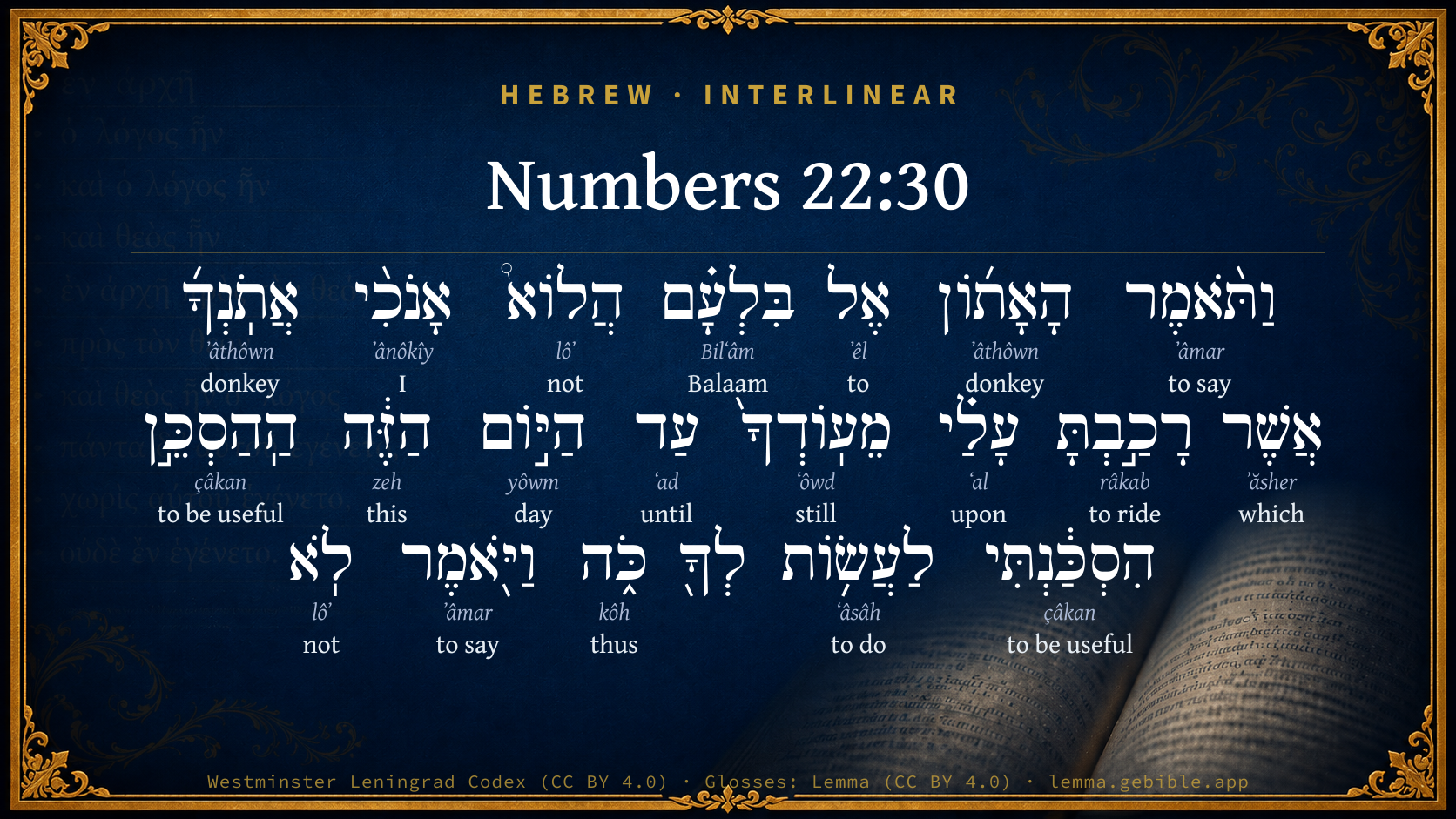
Numbers 22:30

Hebrew (Westminster Leningrad Codex) Numbers 22:30 appears in the Hebrew Old Testament. The text above is from the Westminster Leningrad Codex. Each word links to its Strong’s number, a concise gloss, and parsing drawn from the Open Scriptures Hebrew Bible morphology. Click any word for its full Brown-Driver-Briggs (BDB) entry.
Download image
Cite this verse

Numbers 22:30 (World English Bible). Public Domain. Lemma interlinear Bible study tool, https://lemma.gebible.app/v/numbers/22/30.

Show BibTeX & RIS
BibTeX
RIS
English Translation
The donkey said to Balaam, Am I not your donkey, on which you have ridden all your life long to this day? was I ever wont to do so to you? and he said, No.
World English Bible · Public Domain
Highlights
  • 1 first appearance in the Hebrew Bible
Full analysis ↓
Download a study sheet

One document with this verse’s original text, its word-by-word gloss line, the meaning frame, cross-references with their text, attributed commentary, and full source and license credits — printable, and it pastes into notes with its structure intact.

This verse Autodidact and up

Study sheet (.html) Plain text (.txt)

A passage Seminary Student

Up to 50 verses in one chapter. A passage sheet keeps up to 6 commentary sources and 12 cross-references per verse, in the order this page ranks them, and says so on the sheet whenever that leaves anything out. Ask for a single verse and you get the Autodidact verse sheet above.

Everything on this page stays free to read, with no account — the sheet is a download of what is already on screen, not access to it.

Want to remove ads? Support Godless Engineer
Compare translations 3

The same verse in 3 English versions, stacked beneath the original-language interlinear above. Click any original word for its lexicon entry.

Each is an independent rendering of the whole verse — the interlinear is not word-aligned to these translations.

Highlighted words mark where these versions differ — a whole-verse word diff, not a word-by-word alignment.

  • World English Bible Public Domain
    The donkey said to Balaam, Am I not your donkey, on which you have ridden all your life long to this day? was I ever wont to do so to you? and he said, No.
  • King James Version Public Domain
    And the ass said unto Balaam, Am not I thine ass, upon which thou hast ridden ever since I was thine unto this day? was I ever wont to do so unto thee? And he said, Nay.
  • unfoldingWord Literal Text CC BY-SA 4.0
    And the female donkey said to Balaam, “Am I not your female donkey on which you have ridden from your beginning until this day? Have I ever been accustomed to doing thus to you?” And he said, “No.”

unfoldingWord Literal Text — © unfoldingWord, licensed CC BY-SA 4.0. Word-aligned USFM3 via Door43 (git.door43.org/unfoldingWord/en_ult).

Versions to compare (up to 4)

3 of 4 selected

Show all 18 translations

Every available English version of this verse, each an independent rendering of the whole verse.

  • World English Bible Public Domain
    The donkey said to Balaam, Am I not your donkey, on which you have ridden all your life long to this day? was I ever wont to do so to you? and he said, No.
  • Berean Standard Bible Public Domain
    But the donkey said to Balaam, “Am I not the donkey you have ridden all your life until today? Have I ever treated you this way before?” “No,” he replied.
  • Majority Standard Bible Public Domain
    But the donkey said to Balaam, “Am I not the donkey you have ridden all your life until today? Have I ever treated you this way before?” “No,” he replied.
  • King James Version Public Domain
    And the ass said unto Balaam, Am not I thine ass, upon which thou hast ridden ever since I was thine unto this day? was I ever wont to do so unto thee? And he said, Nay.
  • American Standard Version (1901) Public Domain
    And the ass said unto Balaam, Am not I thine ass, upon which thou hast ridden all thy life long unto this day? was I ever wont to do so unto thee? and he said, Nay.
  • Revised Version (1885) Public Domain
    And the ass said unto Balaam, Am not I thine ass, upon which thou hast ridden all thy life long unto this day? was I ever wont to do so unto thee? And he said, Nay.
  • Geneva Bible (1599) Public Domain
    And the asse saide vnto Balaam, Am not I thine asse, which thou hast ridden vpon since thy first time vnto this day? haue I vsed at any time to doe thus vnto thee? Who said, Nay.
  • Douay-Rheims (1899) Public Domain
    The ass said: Am not I thy beast, on which thou hast been always accustomed to ride until this present day? tell me if I ever did the like thing to thee. But he said: Never.
  • Young's Literal Translation Public Domain
    and the ass saith unto Balaam, `Am not I thine ass, upon which thou hast ridden since `I was' thine unto this day? have I at all been accustomed to do to thee thus?' and he saith, `No.'
  • Literal Standard Version CC BY-SA 4.0
    and the donkey says to Balaam, “Am I not your donkey on which you have ridden since [I became] yours, even to this day? Have I at all been accustomed to do thus to you?” And he says, “No.”
  • Unlocked Literal Bible CC BY-SA 4.0
    The donkey said to Balaam, “Am not I your donkey on which you have ridden all your life long to this present day? Have I ever been in the habit of doing such things to you before?” Balaam said, “No.”
  • unfoldingWord Literal Text CC BY-SA 4.0
    And the female donkey said to Balaam, “Am I not your female donkey on which you have ridden from your beginning until this day? Have I ever been accustomed to doing thus to you?” And he said, “No.”
  • Darby Bible Public Domain
    And the ass said to Balaam, Am not I thine ass, upon which thou hast ridden ever since I was thine to this day? was I ever wont to do so to thee? And he said, No.
  • World Messianic Bible Public Domain
    The donkey said to Balaam, “Am I not your donkey, on which you have ridden all your life long until today? Was I ever in the habit of doing so to you?” He said, “No.”
  • Webster's Bible Public Domain
    And the ass said to Balaam, Am not I thy ass, upon which thou hast rid ever since I was thine to this day? was I ever wont to do so to thee? And he said, Nay.
  • Free Bible Version CC BY-SA 4.0
    But the donkey asked Balaam, “Aren't I the donkey you've ridden all your life right up to today? Have I ever treated you this way before?” “No,” he admitted.
  • Bible in Basic English Public Domain
    And the ass said to Balaam, Am I not your ass upon which you have gone all your life till this day? and have I ever done this to you before? And he said, No.
  • JPS Tanakh (1917) Public Domain
    And the ass said unto Balaam: 'Am not I thine ass, upon which thou hast ridden all thy life long unto this day? was I ever wont to do so unto thee?' And he said: 'Nay.'

Literal Standard Version (2020), Covenant Press — licensed CC BY-SA 4.0. Text via the HelloAO Bible API (eBible.org). Unlocked Literal Bible (unfoldingWord) — licensed CC BY-SA 4.0. Text via the HelloAO Bible API (eBible.org). unfoldingWord Literal Text — © unfoldingWord, licensed CC BY-SA 4.0. Word-aligned USFM3 via Door43 (git.door43.org/unfoldingWord/en_ult). Free Bible Version, Dr. Jonathan Gallagher — licensed CC BY-SA 4.0. Text via the HelloAO Bible API (eBible.org).

Word by word

More ways to search: Search by grammar → Find every occurrence → Compare this word →

Practice this passage: Drill this verse → Learn its vocabulary →

הַֽהַסְכֵּ֣ן
çâkan
H5532
“to be useful”
Particle, Interrogative + Verb, Hiphil, Infinitive Absolute
Part of Speech
Particle + Verb
Stem
Hiphil
Form
Infinitive Absolute
Full BDB Definition

Origin: a primitive root

TWOT: 1494

to be of use or service or profit or benefit - (Qal) - to be of use or service - servitor, steward (participle) - to benefit, profit - (Hiphil) to be used, be wont, exhibit use or habit, show harmony
  1. וַתֹּ֨אמֶר ʼâmar H559 “and · to say” Conjunction + Verb, Qal, Sequential Imperfect, 3rd Person, Feminine, Singular
  2. הָאָת֜וֹן ʼâthôwn H860 “the · donkey” Particle, Definite Article + Noun, Common, Feminine, Singular, Absolute
  3. אֶל ʼêl H413 “to” Preposition
  4. בִּלְעָ֗ם Bilʻâm H1109 “Balaam” Noun, Proper
  5. הֲלוֹא֩ lôʼ H3808 “not” Particle, Interrogative + Particle, Negative
  6. אָנֹכִ֨י ʼânôkîy H595 “I” Pronoun, Personal, 1st Person, Common, Singular
  7. אֲתֹֽנְךָ֜ ʼâthôwn H860 “donkey · your” Noun, Common, Feminine, Singular, Construct + Suffix, Personal, 2nd Person, Masculine, Singular
  8. אֲשֶׁר ʼăsher H834 “which” Particle, Relative
  9. רָכַ֣בְתָּ râkab H7392 “to ride” Verb, Qal, Perfect, 2nd Person, Masculine, Singular
  10. עָלַ֗י ʻal H5921 “upon · me” Preposition + Suffix, Personal, 1st Person, Common, Singular
  11. מֵעֽוֹדְךָ֙ ʻôwd H5750 “from · still · your” Preposition + Adverb + Suffix, Personal, 2nd Person, Masculine, Singular
  12. עַד ʻad H5704 “until” Preposition
  13. הַיּ֣וֹם yôwm H3117 “the · day” Particle, Definite Article + Noun, Common, Masculine, Singular, Absolute
  14. הַזֶּ֔ה zeh H2088 “the · this” Particle, Definite Article + Pronoun, Demonstrative, Masculine, Singular
  15. הִסְכַּ֔נְתִּי çâkan H5532 “to be useful” Verb, Hiphil, Perfect, 1st Person, Common, Singular
  16. לַעֲשׂ֥וֹת ʻâsâh H6213 “to do” Preposition + Verb, Qal, Infinitive Construct
  17. כֹּ֑ה kôh H3541 “thus” Adverb
  18. וַיֹּ֖אמֶר ʼâmar H559 “and · to say” Conjunction + Verb, Qal, Sequential Imperfect, 3rd Person, Masculine, Singular
  19. לֹֽא lôʼ H3808 “not” Particle, Negative

About this verse

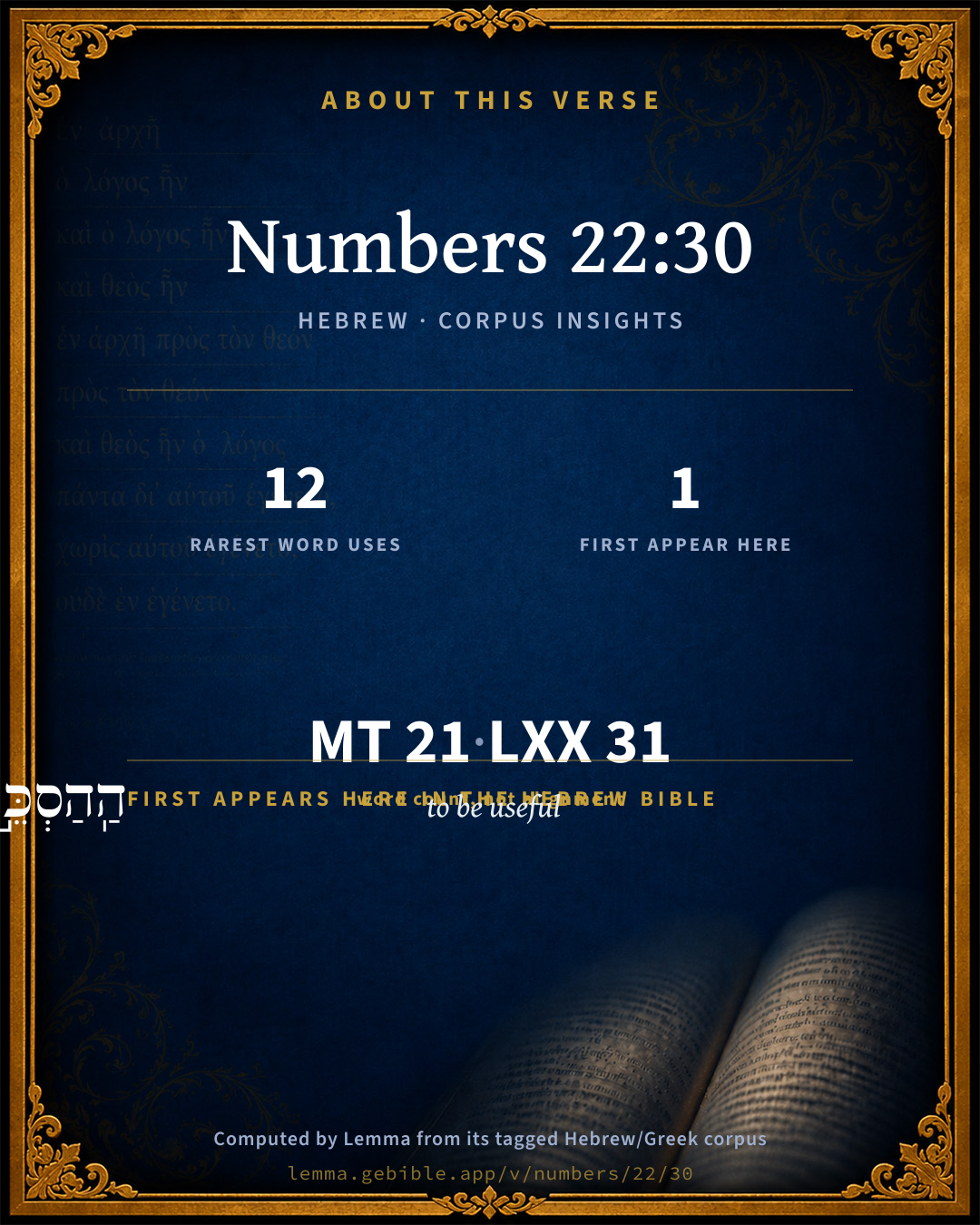
These counts appear in no published source. They are computed here, from the morphology-tagged text and Lemma’s own curated glosses. What Lemma adds →

21
words
16
distinct lemmas
Pentateuch
section

Notable vocabulary

The rarest word here is הַֽהַסְכֵּ֣ן to be useful H5532 — appearing just 12 times in the whole Hebrew Bible.

First appearance in Scripture

This word makes its first canonical appearance in the Hebrew Bible here:

  • הַֽהַסְכֵּ֣ן to be useful H5532

Shared distinctive vocabulary

הַֽהַסְכֵּ֣ן to be useful H5532 occurs in 10 verses of the Hebrew Bible. Also found in:

Grammatical profile

  • 6 verbs
  • 4 nouns
  • 2 pronouns
  • 4 prepositions
  • 2 adverbs
  • 3 particles

Verb forms

  • וַתֹּ֨אמֶר Qal · Sequential Imperfect
  • רָכַ֣בְתָּ Qal · Perfect
  • הַֽהַסְכֵּ֣ן Hiphil · Infinitive Absolute
  • הִסְכַּ֔נְתִּי Hiphil · Perfect
  • לַעֲשׂ֥וֹת Qal · Infinitive Construct
  • וַיֹּ֖אמֶר Qal · Sequential Imperfect

Repetition

Words recur within this verse — often emphatic in Hebrew:

  • וַתֹּ֨אמֶר to say H559 ×2
  • הָאָת֜וֹן donkey H860 ×2
  • הַֽהַסְכֵּ֣ן to be useful H5532 ×2
  • הֲלוֹא֩ not H3808 ×2

Hebrew & Septuagint length

In English translation the verse runs 35 words from the Hebrew and 36 from the Septuagint (LXX English) — closely comparable.

A rough comparison of the two English renderings, which tokenize alike — not a word-level alignment.

Word counts can differ between the Hebrew and the Greek without any difference in meaning — e.g. the Hebrew direct-object marker אֵת has no separate Greek word, and Greek often adds the article ὁ.

In the original languages it is 21 Hebrew tokens and 31 Greek tokens — but the two are counted differently (Hebrew bundles its prefixes and suffixes into one token; the Greek is in lemma form), so that isn’t a like-for-like length.

Cross-references

2

Topical passages linked to Numbers 22:30 in the Treasury of Scripture Knowledge — connected by theme and wording, ordered by reader-vote popularity; previews shown in the World English Bible.

  • 2 Peter 2:16 but he was rebuked for his own disobedience. A mute donkey spoke with man's voice and stopped the madness of the prophet.
  • 1 Corinthians 1:27–28 but God chose the foolish things of the world that he might put to shame those who are wise. God chose the weak things of the world, that he might put to shame the things that are strong;

Cross-references courtesy of OpenBible.info (CC BY 4.0).

Hebrew and Greek witnesses Masoretic Hebrew ↔ Greek Septuagint

The same verse in the two great witnesses to the Old Testament, shown verse-for-verse.

These are two independent witnesses, not word-aligned to each other, and the Septuagint is shown in lemma (dictionary) form.

Hebrew Numbers 22:30 Masoretic · Westminster Leningrad Codex

וַתֹּ֨אמֶר הָאָת֜וֹן אֶל בִּלְעָ֗ם הֲלוֹא֩ אָנֹכִ֨י אֲתֹֽנְךָ֜ אֲשֶׁר רָכַ֣בְתָּ עָלַ֗י מֵעֽוֹדְךָ֙ עַד הַיּ֣וֹם הַזֶּ֔ה הַֽהַסְכֵּ֣ן הִסְכַּ֔נְתִּי לַעֲשׂ֥וֹת לְךָ֖ כֹּ֑ה וַיֹּ֖אמֶר לֹֽא

The donkey said to Balaam, Am I not your donkey, on which you have ridden all your life long to this day? was I ever wont to do so to you? and he said, No.

World English Bible · Public Domain

Greek LXX Numbers 22:30 Septuagint · lemma form

καί λέγω ὁ ὄνος ὁ βαλααμ οὐ ἐγώ ὁ ὄνος σύ ἐπί ὅς ἐπιβαίνω ἀπό νεότης σύ ἕως ὁ σήμερον ἡμέρα μή ὑπερόρασις ὑπερὁράω ποιέω σύ οὕτως ὁ δέ εἶπον οὐ

And the ass says to Balaam, Am not I your ass on which you have ridden since your youth till this day? did I ever do thus to you, utterly disregarding you? and he said, No.

LXX2012 (modern English Septuagint) · Public Domain

Hebrew: Westminster Leningrad Codex (CC BY 4.0). Greek: Septuagint (public domain); English from LXX2012 (modern English Septuagint) (Public Domain). How the Septuagint differs from the Hebrew →

Targum (Aramaic paraphrase)

2

The Targum is the ancient Jewish Aramaic paraphrase of the Hebrew Scriptures — an interpretive translation, not the Hebrew text itself. Onkelos (literal) and Pseudo-Jonathan (expansive) render the Torah, and Jonathan the Prophets. Coverage is partial: where no permissively-licensed English translation exists for a verse, only the Aramaic is shown. This is verse-level text, not a word-by-word alignment to the Hebrew.

  1. Targum Onkelos Torah (Genesis–Deuteronomy)
    וַאֲמָרַת אֲתָּנָא לְבִלְעָם הֲלָא אֲנָא אֲתָּנָךְ דְרָכַבְתְּ עֲלַי מִדְאִיתָךְ עַד יוֹמָא הָדֵין הֲמֵילַף אַלִפְנָא לְמֶעֱבַּד לָךְ כְּדֵין וַאֲמַר לָא

    (no public-domain English translation for this verse)

    Targum Onkelos — Aramaic: “Onkelos Genesis” (public domain); “Onkelos Exodus” (public domain); “Onkelos Leviticus” (public domain); “Onkelos Numbers” (public domain); “Onkelos Deuteronomy” (public domain). English: “Sefaria Community Translation” (CC0 1.0 (public-domain dedication)); “J.W. Etheridge. The Targums of Onkelos and Jonathan Ben Uzziel on the Pentateuch. London: Longmans, Green, 1862” (public domain). Text via Sefaria.

  2. Targum Pseudo-Jonathan Torah (Genesis–Deuteronomy)
    וַאֲמָרַת אַתְנָא לְבִלְעָם וַי לָךְ בִּלְעָם חֲסִיר דַעְתָּא אַנְתְּ דַאֲנָא בְעִירָא מְסָאֲבָא מִיתָא בְּעַלְמָא הָדֵין וְלָא אַתְיָא לְעָלְמָא דְאָתִי לָא יְכִילַת לְמֵילוֹט יָתִי כָּל דְכֵן בְּנוֹי דְאַבְרָהָם יִצְחָק וְיַעֲקב דְבִזְכוּתְהוֹן אִתְבְּרֵי עַלְמָא וְאַנְתְּ אָזִיל לְמֵילַט יַתְהוֹן וְדִי גָנַבְתְּ דַעְתְּהוֹן דְעַמָא הָאִלֵין וַאֲמָרַת לֵיהּ הֲדָא אַתְנָא דִידִי שְׁאִילָא הִיא בִּידִי וְסוּסְיָא דִידִי שַׁדִי בִּרְטִיבָא הֲלָא אֲנָא אַתְנָךְ דְרָכַבְתָּ עָלַי מִן טַלְיוּתָךְ עַד זְמַן יוֹמָא הָדֵין הָא מִתְהַנְיֵתִי מִינָךְ בְּמַשְׁכְּבָא וְלָא אִתְכַּוָונִית לְמֶעֱבַד לָךְ הֵיכְדֵין וַאֲמַר לָא

    And the ass said to Bileam, Woe to thee, Bileam, thou wanting-in-mind when me, an unclean beast, who am to die in this world, and not to enter the world to come, thou art not able to curse; how much less (canst thou harm) the children of Abraham, Izhak, and Jakob, on account of whom the world hath been created, but whom thou art going to curse! So hast thou deceived these people, and hast said, This is not my ass, she is a loan in, my hand, and my horses remain in the pasture. But am I not thine ass upon whom thou hast ridden from thy youth unto this day? and have I been used to do thus with thee? And he said, No.

    Targum Pseudo-Jonathan — Aramaic: “Targum Jonathan on Genesis” (public domain); “Targum Jonathan on Exodus” (public domain); “Targum Jonathan on Leviticus” (public domain); “Targum Jonathan on Numbers” (public domain); “Targum Jonathan on Deuteronomy” (public domain). English: “The Targum of Jonathan ben Uzziel, trans. J. W. Etheridge, London, 1862” (public domain). Text via Sefaria.

Commentary

Notes on Numbers 22:30 from classic Christian and Jewish commentators (each source and its license shown beneath its notes). The classic Christian expositions comment on the surrounding passage and are grouped to its opening verse, so a note may address several verses; the Jewish commentaries on the Tanakh (Rashi and others) are per-verse, so they appear only where the commentator wrote on this verse.

Lemma curates 59 commentaries, every one of them public domain or Creative Commons licensed, each selected and text-cleaned for this edition rather than reprinted as found. About our sources →

Geneva Bible (1599)

Geneva Bible translators

Since thou hast been my master.

Geneva Bible (1599) marginal notes — public domain. Text via Bolls.life.

Ellicott's Commentary for English Readers

(30) Ever since I was thine.—Literally, ever since thou livedst,—i.e., all thy life long. The Targums of Jonathan and of Jerusalem paraphrase thus—“upon which thou hast ridden from thy youth unto this day.” “An Arabic writer,” says Dr. Gill, in his Commentary, in loc., “makes mention of an ass that the owner rode on forty years.”

Unto this day.—The use of these words in this place serves to throw light upon such passages as Deu_3:14, “called them after his own name . . . unto this day,” and shows that they do not necessarily denote that the events to which reference is made were separated by any very long interval.

A Bible Commentary for English Readers, edited by Charles John Ellicott (1878–1897) — public domain. Text from a community e-Sword module.

The Cambridge Bible for Schools and Colleges

gen. ed. J. J. S. Perowne

30. The ass is not represented as uttering any deep teaching or giving him a message from God. She merely defends herself against the charge of making sport of him; had he ever known her do such a thing during all the years he had owned her?

The Cambridge Bible for Schools and Colleges (gen. ed. J. J. S. Perowne; Cambridge University Press, 1878–1918) — public domain. Text from a community e-Sword module.

John Gill's Exposition

And the ass saw me, and turned from me these three times,.... The ass saw the angel when Balaam did not, and that was the reason of its turning aside; and it was well for him it did, and therefore he should not have smote it:

unless she had turned from me; if she had pushed on, endeavouring to make her way:

surely now also I had slain thee, and saved her alive; had certainly and only slain him, and not the ass; and from hence the Jewish writers (t) gather, that the ass was now slain, lest it should be said, this is the ass that spoke, and so be made an idol of.

(t) Bemidbar Rabba, sect. 20. fol. 227. 4. Aben Ezra in loc.

John Gill's Exposition of the Whole Bible (1746–1763) — public domain (CC PDM 1.0). Text via the HelloAO Bible API.

Whedon's Commentary on the Bible

Daniel D. Whedon

30. Unto this day — Several versions add, from thy boyhood.

Daniel D. Whedon (gen. ed.), Commentary on the Old and New Testaments (1874–1909) — public domain. Text from a community e-Sword module.

Rashi

Rabbi Shlomo Yitzchaki (Rashi)

ההסכן הסכנתי — Understand this as the Targum does — HAVE I EVER LEARNT? Similar is, (Job 22:2) “Does a man learn (יסכן) for God’s benefit” (see Rashi on this verse). And our Rabbis have explained this verse in the Talmud: They said to him, “What is the reason you are not riding on a horse?” He replied to them: “I have left it in the meadow grass” (i.e., I have put it out to graze). Whereupon the ass exclaimed: Am I not your ass upon whom thou hast ridden from my very youth unto this day?!” (so you see, you have never possessed a horse) — as it is related in Treatise Avodah Zarah 4b.

Rashi on the Tanakh — English translations: “The Judaica Press complete Tanach with Rashi, translated by A. J. Rosenberg” (CC BY 4.0); “Pentateuch with Rashi's commentary by M. Rosenbaum and A.M. Silbermann, 1929-1934” (public domain); “The Metsudah Tanach series, Lakewood, N.J” (CC BY 4.0); and “The Book of Joshua, Metsudah Publications, 1997” (CC BY 4.0). Text via Sefaria.

Lesson kit

Teaching starters — assembled from the data on this page, not authored interpretation. Every prompt links to the verse data it draws on. Edit before teaching.

Numbers, in the Pentateuch, opens this verse with 21 words (16 distinct Hebrew lemmas). Its most distinctive word is çâkan (“to be useful”). A historical commentator’s framing appears above. Read the whole chapter for the surrounding context.

Discussion questions

  1. What does “to be useful” (çâkan) contribute to the verse as a whole?
  2. This is the first place “to be useful” appears in Scripture (first appears here). What does its debut here establish?
  3. How does 1 Kings 1:2, which shares the word «to be useful», read alongside this verse?
  4. What does the repetition of “to say” (2× in this one verse) do in this verse?
  5. These translations render this verse differently. What is at stake in choosing one wording over another?
  6. «וַתֹּ֨אמֶר» is a Qal Sequential Imperfect verb. How does that grammatical form shape the action described?
  7. Compare how Geneva Bible (1599) and Ellicott's Commentary for English Readers read this verse. Where do they agree or differ?

Things to notice

Reading settings

Reading text

Shown beneath each verse's original-language words.

Old Testament
Old Testament edition

Read the OT as the Masoretic Hebrew (MT) or the Greek Septuagint (LXX).

English shown for the Greek Septuagint (in the Hebrew ↔ Greek comparison).

Comparing translations? Open the Compare panel on any verse page to stack up to four side by side.