
2 Samuel 21:19

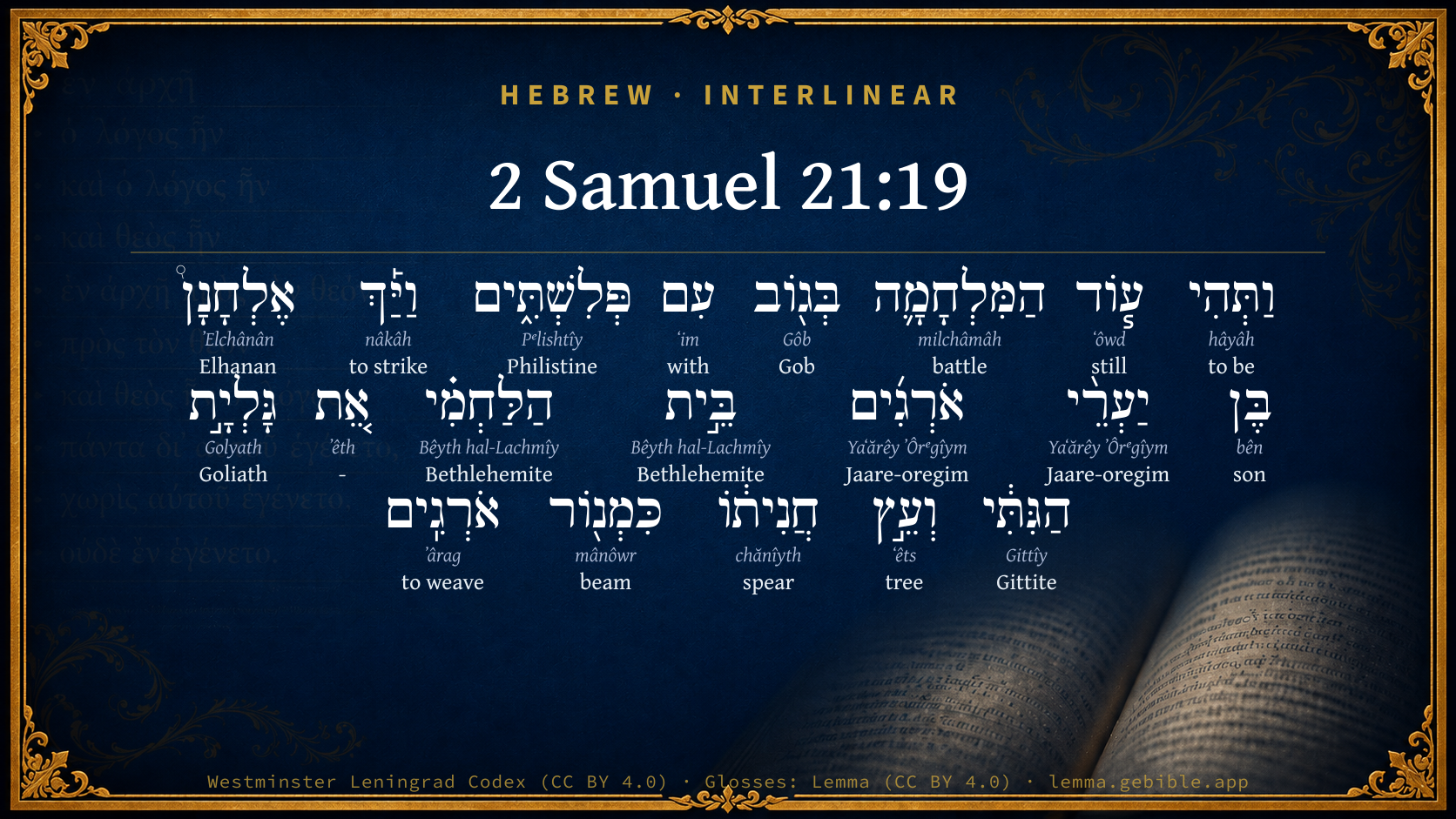
Hebrew (Westminster Leningrad Codex) 2 Samuel 21:19 appears in the Hebrew Old Testament. The text above is from the Westminster Leningrad Codex. Each word links to its Strong’s number, a concise gloss, and parsing drawn from the Open Scriptures Hebrew Bible morphology. Click any word for its full Brown-Driver-Briggs (BDB) entry.
Download image
Cite this verse

2 Samuel 21:19 (World English Bible). Public Domain. Lemma interlinear Bible study tool, https://lemma.gebible.app/v/2-samuel/21/19.

Show BibTeX & RIS
BibTeX
RIS
English Translation
There was again war with the Philistines at Gob; and Elhanan the son of Jaareoregim the Bethlehemite killed Goliath the Gittite's brother, the staff of whose spear was like a weaver's beam.
World English Bible · Public Domain
Highlights
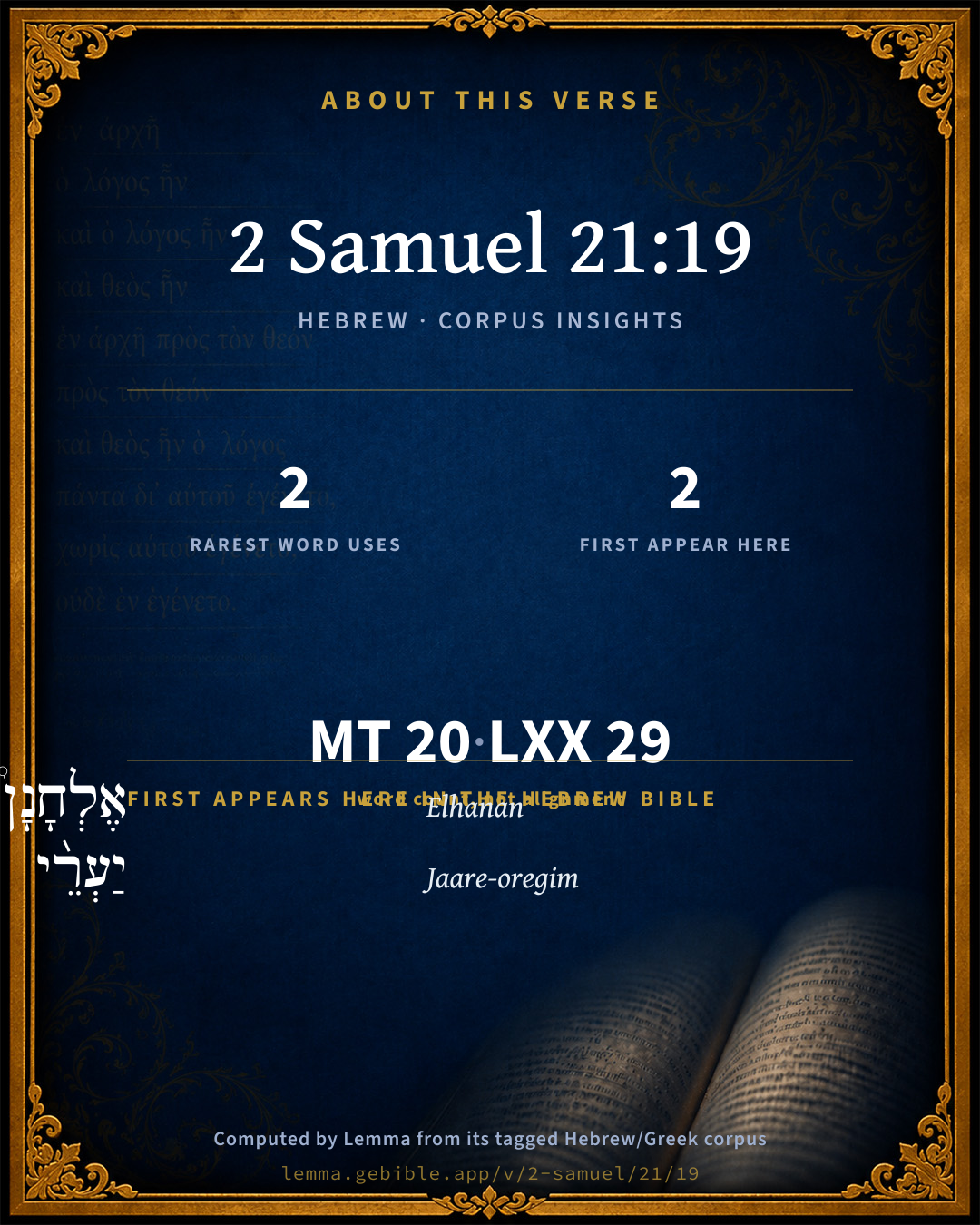
  • 2 first appearances in the Hebrew Bible
Full analysis ↓
Download a study sheet

One document with this verse’s original text, its word-by-word gloss line, the meaning frame, cross-references with their text, attributed commentary, and full source and license credits — printable, and it pastes into notes with its structure intact.

This verse Autodidact and up

Study sheet (.html) Plain text (.txt)

A passage Seminary Student

Up to 50 verses in one chapter. A passage sheet keeps up to 6 commentary sources and 12 cross-references per verse, in the order this page ranks them, and says so on the sheet whenever that leaves anything out. Ask for a single verse and you get the Autodidact verse sheet above.

Everything on this page stays free to read, with no account — the sheet is a download of what is already on screen, not access to it.

Want to remove ads? Support Godless Engineer
Compare translations 3

The same verse in 3 English versions, stacked beneath the original-language interlinear above. Click any original word for its lexicon entry.

Each is an independent rendering of the whole verse — the interlinear is not word-aligned to these translations.

Highlighted words mark where these versions differ — a whole-verse word diff, not a word-by-word alignment.

  • World English Bible Public Domain
    There was again war with the Philistines at Gob; and Elhanan the son of Jaareoregim the Bethlehemite killed Goliath the Gittite's brother, the staff of whose spear was like a weaver's beam.
  • King James Version Public Domain
    And there was again a battle in Gob with the Philistines, where Elhanan the son of Jaareoregim, a Bethlehemite, slew the brother of Goliath the Gittite, the staff of whose spear was like a weaver's beam.
  • unfoldingWord Literal Text CC BY-SA 4.0
    And was battle again with the Philistines at Gob. And Elhanan, the son of Jaare Oregim the Bethlehemite, struck Goliath the Gittite, and the wood of his spear like the beam of weavers.

unfoldingWord Literal Text — © unfoldingWord, licensed CC BY-SA 4.0. Word-aligned USFM3 via Door43 (git.door43.org/unfoldingWord/en_ult).

Versions to compare (up to 4)

3 of 4 selected

Show all 18 translations

Every available English version of this verse, each an independent rendering of the whole verse.

  • World English Bible Public Domain
    There was again war with the Philistines at Gob; and Elhanan the son of Jaareoregim the Bethlehemite killed Goliath the Gittite's brother, the staff of whose spear was like a weaver's beam.
  • Berean Standard Bible Public Domain
    Once again there was a battle with the Philistines at Gob, and Elhanan son of Jair the Bethlehemite killed the brother of Goliath the Gittite, the shaft of whose spear was like a weaver’s beam.
  • Majority Standard Bible Public Domain
    Once again there was a battle with the Philistines at Gob, and Elhanan son of Jair the Bethlehemite killed the brother of Goliath the Gittite, the shaft of whose spear was like a weaver’s beam.
  • King James Version Public Domain
    And there was again a battle in Gob with the Philistines, where Elhanan the son of Jaareoregim, a Bethlehemite, slew the brother of Goliath the Gittite, the staff of whose spear was like a weaver's beam.
  • American Standard Version (1901) Public Domain
    And there was again war with the Philistines at Gob; and Elhanan the son of Jaareoregim the Beth-lehemite slew Goliath the Gittite, the staff of whose spear was like a weaver's beam.
  • Revised Version (1885) Public Domain
    And there was again war with the Philistines at Gob; and Elhanan the son of Jaare-oregim the Beth-lehemite slew Goliath the Gittite, the staff of whose spear was like a weaver’s beam.
  • Geneva Bible (1599) Public Domain
    And there was yet another battel in Gob with the Philistims, where Elhanah the sonne of Iaare-oregim, a Bethlehemite slewe Goliath the Gittite: the staffe of whose speare was like a weauers beame.
  • Douay-Rheims (1899) Public Domain
    And there was a third battle in Gob against the Philistines, in which Adeodatus the son of the Forrest an embroiderer of Bethlehem slew Goliath the Gethite, the shaft of whose spear was like a weaver's beam.
  • Young's Literal Translation Public Domain
    And the battle is again in Gob with the Philistines, and Elhanan son of Jaare-Oregim, the Beth-Lehemite, smiteth `a brother of' Goliath the Gittite, and the wood of his spear `is' like a beam of weavers.
  • Literal Standard Version CC BY-SA 4.0
    And the battle is again in Gob with the Philistines, and Elhanan son of Jaare-Oregim, the Beth-Lehemite, strikes [a brother of] Goliath the Gittite, and the wood of his spear [is] like a weavers’ beam.
  • Unlocked Literal Bible CC BY-SA 4.0
    It came about again in a battle with the Philistines at Gob, that Elhanan son of Jair the Bethlehemite killed Goliath the Gittite, the staff of whose spear was like a weaver's beam.
  • unfoldingWord Literal Text CC BY-SA 4.0
    And was battle again with the Philistines at Gob. And Elhanan, the son of Jaare Oregim the Bethlehemite, struck Goliath the Gittite, and the wood of his spear like the beam of weavers.
  • Darby Bible Public Domain
    And there was again a battle at Gob with the Philistines; and Elhanan the son of Jaare-oregim, a Bethlehemite, smote Goliath the Gittite; now the shaft of his spear was like a weaver's beam.
  • World Messianic Bible Public Domain
    There was again war with the Philistines at Gob, and Elhanan the son of Jaare-Oregim the Bethlehemite killed Goliath the Gittite’s brother, the staff of whose spear was like a weaver’s beam.
  • Webster's Bible Public Domain
    And there was again a battle in Gob with the Philistines, where Elhanan the son of Jaareoregim, a Beth-lehemite, slew the brother of Goliath the Gittite, the staff of whose spear was like a weaver's beam.
  • Free Bible Version CC BY-SA 4.0
    In another battle with the Philistines at Gob, Elhanan, son of Jair, from Bethlehem, killed the brother of Goliath the Gittite. The shaft of his spear was as thick as a weaver's rod.
  • Bible in Basic English Public Domain
    And again there was war with the Philistines at Gob, and Elhanan, the son of Jair the Beth-lehemite, put to death Goliath the Gittite, the stem of whose spear was like a cloth-worker's rod.
  • JPS Tanakh (1917) Public Domain
    And there was again war with the Philistines at Gob; and Elhanan the son of Jaare-oregim the Beth-lehemite slew Goliath the Gittite, the staff of whose spear was like a weaver's beam.

Literal Standard Version (2020), Covenant Press — licensed CC BY-SA 4.0. Text via the HelloAO Bible API (eBible.org). Unlocked Literal Bible (unfoldingWord) — licensed CC BY-SA 4.0. Text via the HelloAO Bible API (eBible.org). unfoldingWord Literal Text — © unfoldingWord, licensed CC BY-SA 4.0. Word-aligned USFM3 via Door43 (git.door43.org/unfoldingWord/en_ult). Free Bible Version, Dr. Jonathan Gallagher — licensed CC BY-SA 4.0. Text via the HelloAO Bible API (eBible.org).

Word by word

More ways to search: Search by grammar → Find every occurrence → Compare this word →

Practice this passage: Drill this verse → Learn its vocabulary →

בְּג֖וֹב
Gôb
H1359
“in/at · Gob”
Preposition + Noun, Proper
Part of Speech
Preposition + Noun
Type
Proper
Full BDB Definition

Origin: from H1461

TWOT: None

Gob = "cistern" - a place which was the scene of two encounters between David's warriors and the Philistines (also 'Gezer')
  1. וַתְּהִי hâyâh H1961 “and · to be” Conjunction + Verb, Qal, Sequential Imperfect, 3rd Person, Feminine, Singular
  2. ע֧וֹד ʻôwd H5750 “still” Adverb
  3. הַמִּלְחָמָ֛ה milchâmâh H4421 “the · battle” Particle, Definite Article + Noun, Common, Feminine, Singular, Absolute
  4. עִם ʻim H5973 “with” Preposition
  5. פְּלִשְׁתִּ֑ים Pᵉlishtîy H6430 “Philistines” Noun, Gentilic, Masculine, Plural, Absolute
  6. וַיַּ֡ךְ nâkâh H5221 “and · to strike” Conjunction + Verb, Hiphil, Sequential Imperfect, 3rd Person, Masculine, Singular
  7. אֶלְחָנָן֩ ʼElchânân H445 “Elhanan” Noun, Proper
  8. בֶּן bên H1121 “son of” Noun, Common, Masculine, Singular, Construct
  9. יַעְרֵ֨י Yaʻărêy ʼÔrᵉgîym H3296 “Jaare-oregim” Noun, Proper
  10. אֹרְגִ֜ים Yaʻărêy ʼÔrᵉgîym H3296 “Jaare-oregim” Noun, Proper
  11. בֵּ֣ית Bêyth hal-Lachmîy H1022 “Bethlehemite” Noun, Gentilic, Masculine, Singular, Construct
  12. הַלַּחְמִ֗י Bêyth hal-Lachmîy H1022 “Bethlehemite” Noun, Gentilic, Masculine, Singular, Absolute
  13. אֵ֚ת ʼêth H853 “-” Particle, Direct Object
  14. גָּלְיָ֣ת Golyath H1555 “Goliath” Noun, Proper
  15. הַגִּתִּ֔י Gittîy H1663 “the · Gittite” Particle, Definite Article + Noun, Gentilic, Masculine, Singular, Absolute
  16. וְעֵ֣ץ ʻêts H6086 “and · tree of” Conjunction + Noun, Common, Masculine, Singular, Construct
  17. חֲנִית֔וֹ chănîyth H2595 “spear · his” Noun, Common, Feminine, Singular, Construct + Suffix, Personal, 3rd Person, Masculine, Singular
  18. כִּמְנ֖וֹר mânôwr H4500 “like/as · beam of” Preposition + Noun, Common, Masculine, Singular, Construct
  19. אֹרְגִֽים ʼârag H707 “weaving” Verb, Qal, Participle Active, Masculine, Plural, Absolute

About this verse

These counts appear in no published source. They are computed here, from the morphology-tagged text and Lemma’s own curated glosses. What Lemma adds →

20
words
18
distinct lemmas
Historical
section

Notable vocabulary

The rarest word here is בְּג֖וֹב Gob H1359 — appearing just 2 times in the whole Hebrew Bible.

First appearance in Scripture

These words make their first canonical appearance in the Hebrew Bible here:

  • אֶלְחָנָן֩ Elhanan H445
  • יַעְרֵ֨י Jaare-oregim H3296

Shared distinctive vocabulary

בְּג֖וֹב Gob H1359 occurs in 2 verses of the Hebrew Bible. Also found in:

Grammatical profile

  • 3 verbs
  • 14 nouns
  • 1 preposition
  • 1 adverb
  • 1 particle

Verb forms

  • וַתְּהִי Qal · Sequential Imperfect
  • וַיַּ֡ךְ Hiphil · Sequential Imperfect
  • אֹרְגִֽים Qal · Participle Active

Repetition

Words recur within this verse — often emphatic in Hebrew:

  • יַעְרֵ֨י Jaare-oregim H3296 ×2
  • בֵּ֣ית Bethlehemite H1022 ×2

Hebrew & Septuagint length

In English translation the verse runs 32 words from the Hebrew and 32 from the Septuagint (LXX English) — the same length.

A rough comparison of the two English renderings, which tokenize alike — not a word-level alignment.

Word counts can differ between the Hebrew and the Greek without any difference in meaning — e.g. the Hebrew direct-object marker אֵת has no separate Greek word, and Greek often adds the article ὁ.

In the original languages it is 20 Hebrew tokens and 29 Greek tokens — but the two are counted differently (Hebrew bundles its prefixes and suffixes into one token; the Greek is in lemma form), so that isn’t a like-for-like length.

Cross-references

3

Topical passages linked to 2 Samuel 21:19 in the Treasury of Scripture Knowledge — connected by theme and wording, ordered by reader-vote popularity; previews shown in the World English Bible.

  • 1 Chronicles 20:5 There was again war with the Philistines; and Elhanan the son of Jair killed Lahmi the brother of Goliath the Gittite, the staff of whose spear was like a weaver's beam.
  • 1 Samuel 17:4–11 There went out a champion out of the camp of the Philistines, named Goliath, of Gath, whose height was six cubits and a span.
  • 1 Chronicles 11:26 Also the mighty men of the armies: Asahel the brother of Joab, Elhanan the son of Dodo of Bethlehem,

Cross-references courtesy of OpenBible.info (CC BY 4.0).

Hebrew and Greek witnesses Masoretic Hebrew ↔ Greek Septuagint

The same verse in the two great witnesses to the Old Testament, shown verse-for-verse.

These are two independent witnesses, not word-aligned to each other, and the Septuagint is shown in lemma (dictionary) form.

Hebrew 2 Samuel 21:19 Masoretic · Westminster Leningrad Codex

וַתְּהִי ע֧וֹד הַמִּלְחָמָ֛ה בְּג֖וֹב עִם פְּלִשְׁתִּ֑ים וַיַּ֡ךְ אֶלְחָנָן֩ בֶּן יַעְרֵ֨י אֹרְגִ֜ים בֵּ֣ית הַלַּחְמִ֗י אֵ֚ת גָּלְיָ֣ת הַגִּתִּ֔י וְעֵ֣ץ חֲנִית֔וֹ כִּמְנ֖וֹר אֹרְגִֽים

There was again war with the Philistines at Gob; and Elhanan the son of Jaareoregim the Bethlehemite killed Goliath the Gittite's brother, the staff of whose spear was like a weaver's beam.

World English Bible · Public Domain

Greek LXX 2 Samuel 21:19 Septuagint · lemma form

καί γίγνομαι ὁ πόλεμος ἐν γοβ μετά ὁ ἀλλόφυλος καί πατάσσω ελεαναν υἱός αριωργιμ ὁ βαιθλεεμίτης ὁ γολιαθ ὁ γεθθαῖος καί ὁ ξύλον ὁ δόρυ αὐτός ὡς ἀντίον ὑφαίνω

And there was a battle in Rom with the Philistines; and Eleanan son of Ariorgim the Bethleemite killed Goliath the Gittite; and the staff of his spear was as a weaver's beam.

LXX2012 (modern English Septuagint) · Public Domain

On this verse, Haydock's Catholic Bible Commentary discusses the Septuagint’s reading. Read the note in Commentary ↓

Hebrew: Westminster Leningrad Codex (CC BY 4.0). Greek: Septuagint (public domain); English from LXX2012 (modern English Septuagint) (Public Domain). How the Septuagint differs from the Hebrew →

Targum (Aramaic paraphrase)

1

The Targum is the ancient Jewish Aramaic paraphrase of the Hebrew Scriptures — an interpretive translation, not the Hebrew text itself. Onkelos (literal) and Pseudo-Jonathan (expansive) render the Torah, and Jonathan the Prophets. Coverage is partial: where no permissively-licensed English translation exists for a verse, only the Aramaic is shown. This is verse-level text, not a word-by-word alignment to the Hebrew.

  1. Targum Jonathan Prophets (Joshua–Malachi)
    וַהֲוַת עוֹד קְרָבָא בְּגוֹב עִם פְּלִשְׁתָּאֵי וּקְטַל דָוִד בַּר יִשַׁי מְחֵי פָּרוֹכֶת בֵּית מַקְדְשָׁא דְמִבֵּית לֶחֶם יַת גָלְיַת גִתָּאָה וְאָעָא דְמוּרְנִיתֵיהּ כְאַכְסַן דְגַרְדָאִין:

    (no public-domain English translation for this verse)

    Targum Jonathan — Aramaic: “Mikraot Gedolot” (public domain). English: “Sefaria Community Translation” (CC0 1.0 (public-domain dedication)); “London "Chaldee Paraphrase," 1871” (public domain). Text via Sefaria.

Commentary

Notes on 2 Samuel 21:19 from classic Christian and Jewish commentators (each source and its license shown beneath its notes). The classic Christian expositions comment on the surrounding passage and are grouped to its opening verse, so a note may address several verses; the Jewish commentaries on the Tanakh (Rashi and others) are per-verse, so they appear only where the commentator wrote on this verse.

Lemma curates 59 commentaries, every one of them public domain or Creative Commons licensed, each selected and text-cleaned for this edition rather than reprinted as found. About our sources →

Trapp's Complete Commentary

John Trapp

2Sa 21:19 And there was again a battle in Gob with the Philistines, where Elhanan the son of Jaareoregim, a Bethlehemite, slew [the brother of] Goliath the Gittite, the staff of whose spear [was] like a weaver’s beam.

Ver. 19. Slew the brother of Goliath.] The name of this monster was Lahmi, {1Ch 20:5} but it may be, that after his brother’s death, he took and bore his name, or that he was called Goliath, as we say of a very huge or strong man, that he is another Hercules, a second Samson. Albert, Marquis of Brandenburg was called Achilles Teutonicus.

John Trapp, A Commentary or Exposition upon All the Books of the Old and New Testament (1647–1656) — public domain. Text from a community e-Sword module.

Joseph Benson's Commentary

2Sa 21:19. Elhanan, a Beth-lehemite — Another of David’s worthy and valiant commanders. Slew the brother of Goliath — The relative word, brother, is not in the Hebrew text, but is properly supplied out of the parallel place. 1Ch 20:5, where it is expressed. The staff of whose spear was like a weaver’s beam — For thickness; that is, like the large roller on which the cloth is fastened in weaving.

Joseph Benson's Commentary on the Old and New Testaments (1811–1818) — public domain. Text from a community e-Sword module.

Tyndale Open Study Notes

Tyndale Open Resources

21:19 Some traditions identify Elhanan as David, principally because Elhanan was also from Bethlehem and because David killed Goliath (1 Sam 17:48-51). But it is more likely that the words brother of were omitted from the Masoretic Text by scribal error.

Tyndale Open Study Notes — © Tyndale Open Resources, licensed CC BY-SA 4.0. Text via the HelloAO Bible API.

Geneva Bible (1599)

Geneva Bible translators

That is, Lahmi the brother of Goliath, whom David slew, 1 Chron. 20:5.

Geneva Bible (1599) marginal notes — public domain. Text via Bolls.life.

Adam Clarke's Commentary

Verse 19. Elhanan the son of Jaare-oregim - slew - Goliath the Gittite] Here is a most manifest corruption of the text, or gross mistake of the transcriber; David, not Elhanan, slew Goliath. In 1Ch 20:5, the parallel place, it stands thus: "Elhanan, the son of Jair, slew Lahmi, the brother of Goliath the Gittite, whose spear-staff was like a weaver's beam." This is plain; and our translators have borrowed some words from Chronicles to make both texts agree. The corruption may be easily accounted for by considering that ארגים oregim, which signifies weavers, has slipped out of one line into the other; and that בית הלחמי beith hallachmi, the Beth-lehemite, is corrupted from את לחמי eth Lachmi; then the reading will be the same as in Chronicles. Dr. Kennicott has made this appear very plain in his First Dissertation on the Hebrew Text, p. 78, &c.

Adam Clarke's Commentary on the Bible (1810–1826) — public domain. Text from a community e-Sword/MySword module.

Ellicott's Commentary for English Readers

(19) Jaare-oregim.—The parallel place, 1Ch_20:5, reads simply “Jair.” It is generally supposed that “oregim(= weavers) has accidentally crept into the text from the line below, and “Jai” and “Jaare” are the same with a slight transposition of the letters. Another name for the same person must have been “Dodo,” if this Elhanan, as seems altogether probable, is the same with “Elhanan the son of Dodo of Bethlehem,” one of the thirty-seven heroes, in 2Sa_23:24.

The brother of.—These words, not found in the Hebrew here, are taken from Chronicles, where also the name of the giant, “Lahmi,” is given. It is quite possible, however, that the word “Beth-lemite,” which is wanting in Chronicles, is a corruption of “Lahmi the brother of.” There is a curious Jewish tradition that this Elhanan was David himself, and this has been preserved in the paraphrase of the Chaldee, “and David the son of Jesse, the weaver of veils for the sanctuary, who was of Bethlehem, slew Goliath the Gittite.”

A Bible Commentary for English Readers, edited by Charles John Ellicott (1878–1897) — public domain. Text from a community e-Sword module.

The Cambridge Bible for Schools and Colleges

gen. ed. J. J. S. Perowne

19. in Gob] The Sept. reads Rom (B) or Gob (A), and Chron. omits the name of the place altogether.

where Elhanan, &c.] Lit. and Elhanan the son of Jaare-oregim, the Bethlehemite, slew Goliath the Gittite. The words the brother of are conjecturally inserted in the E. V. from 1 Chron. They are not found here in the Hebrew text, or in any of the ancient versions. The parallel passage in 1Ch_20:5 reads and Elhanan the son of Jair slew Lahmi the brother of Goliath the Gittite. Now (1) the reading Jair is certainly preferable to Jaare-oregim. Oregim, the word for weavers in the line below, was inserted by a careless scribe, and the Hebrew letters of Jair (יעיר) transposed so as to read Jaare (יערי). (2) The letters of the words Beth-lehemite, Goliath, which stand together in the Heb. text, so closely resemble those of Lahmi the brother of Goliath, that it is almost certain that one reading is an accidental corruption of the other. But which is the original it is not easy to decide. There is no difficulty in supposing that another giant, beside the one slain by David, bore the name of Goliath. Another Elhanan of Beth-lehem is mentioned in ch. 2Sa_23:24.

There is a curious Jewish tradition, preserved in the Targum and by Jerome (Quaest. Hebr. in libros Regum), identifying Elhanan with David. The Targum here paraphrases thus: “And David, the son of Jesse the weaver of veils for the sanctuary, who was of Beth-lehem, slew Goliath the Gittite.” But there is no evidence whatever in support of this idea.

the staff of whose spear, &c.] Cp. 1Sa_17:7; 1Ch_11:23. The shaft of his spear, short, but extraordinarily stout and heavy, was popularly compared to the “beam” to which the web is fastened in a loom.

The Cambridge Bible for Schools and Colleges (gen. ed. J. J. S. Perowne; Cambridge University Press, 1878–1918) — public domain. Text from a community e-Sword module.

John Gill's Exposition

And there was yet a battle in Gath,.... Besides the battles in the above place or places; for this does not necessarily suppose that one of the said battles had been there, only that this, which was another battle, had been there:

where was a man of great stature; for so the sense of the word appears to be from Ch1 20:6; though here it signifies a man of strife and contention, a man of war, and both were true of him:

that had on every hand six fingers, and on every foot six toes, four and twenty in number; twelve fingers on his two hands, and twelve toes on his two feet. Pliny (a) speaks of one M. Curiatius, a patrician, who had two daughters that had six fingers on an hand, and were called "Sedigitae", six-fingered; and of Volcatius, a famous poet, called "Sedigitus", or six-fingered, for the same reason; and elsewhere, from other writers (b) he makes mention of a people that had eight toes each foot; so Ctesias (c) speaks of a people in the mountains of India, which have eight fingers on each hand, and eight toes on each foot, both men and women:

and he also was born to the giant; a son of a giant.

(a) Nat. Hist. l. 11. c. 43. (b) Megasthenes apud ib. l. 7. c. 2. (c) In Indicis, c. 31.

John Gill's Exposition of the Whole Bible (1746–1763) — public domain (CC PDM 1.0). Text via the HelloAO Bible API.

Albert Barnes' Notes on the Bible

The Hebrew text is manifestly very corrupt. First, for “Jaare-oregim,” 1Ch 20:5 gives us the reading Jair. “Oregim” has evidently got in by a transcriber’s error from the line below, where “oregim” is the Hebrew for “weavers.” Again, the word the “Bethlehemite” is very doubtful. It is supported by 2Sa 23:24, but it is not found in the far purer text of 1Ch 20:5, but instead of it we find the name of the Philistine slain by Elhanan, “Lahmi the brother of Goliath the Gittite.” It is probable, therefore, that either the words “the Bethlehemite,” are a corruption of “Lahmi,” or that the recurrence of “Lahmi,” and the termination of “Beth-lehemite” has confused the transcriber, and led to the omission of one of the words in each text.

Albert Barnes' Notes on the Bible (1834–1885) — public domain. Text from a community e-Sword/MySword module.

Haydock's Catholic Bible Commentary

Adeodatus, the son of Forrest. So it is rendered in the Latin Vulgate, by giving the interpretation of the Hebrew names, which are Elhanan, the son of Jaare. (Challoner) --- We should translate all the proper names, or none; as the present mode is extremely perplexing. Adeodatus might therefore be rendered, "God given;" (Dieudonne, as the French have it, though they will not translate Saltus, but leave Jaare) or, if Adeodatus must remain, as it is sometimes a proper name, why may not Saltus? A mere English reader might suppose that Forrest was a Hebrew name, and , with Swift in jest, maintain the high antiquity of our language. (Haydock) --- Regularly proper names should be retained. (Calmet) --- But the learned have often chosen to give the import of foreign names, in the language in which they have been writing. See Du Thou’s History. Thus Dubois is styled Sylvius; Newman, Neander; &c. --- An embroiderer. Protestants make this a part of the man’s name, "Jaare-oregim." Septuagint, "the son of Ariorgeim." In 1 Paralipomenon xx, no notice is taken of his profession. (Haydock) --- That passage will evince that Elhanan is not the same with David, as some would infer from the mention of Goliath’s death, but the son of Jair, uncle of Joab, (chap. xxxiii. 24.) who was born at Bethlehem, though the verse in Paralipomenon would insinuate less correctly, that the giant’s name was Lechem, thus, "Elehanan....slew Lechem, the brother," &c., as the copyist had written ath instead of bith. (Calmet) --- Our version has not this mistake: "Adeodatus, the son of Saltus, a Bethlehemite, slew the brother of Goliath, the Gethite," &c., 1 Paralipomenon xx. 5. (Haydock) --- "It would be difficult to find a passage more disfigured than the present; and, without the help of the Paralipomenon, it would be impossible to make it out." (Calmet) --- Kennicott makes a similar remark. (Diss. i. and ii.) But he believes that the Book of Chronicles, though the latest, and usually the most corrupt, of the Old Testament, is here perfectly correct; and that the passage before us is strangely corrupted, "Jaare Oregim, a Bethlehemite," being placed instead of , ..."Jaor slew Lahmi," as he thinks that oregim, "weavers," has been inserted from the line below, p. 79. Josephus ([Antiquities?] vii. 10.) relates this transaction as follows, "When the king had sent a fresh army against them, Nephan, his relation, displayed the greatest valour. for engaging in a single combat with the bravest man of the Philistines, and killing his antagonist, he caused the rest to turn their backs, and many of the enemy fell in that battle." Thus he evades all the difficulty, adding much out of his own head; and by Nephan, designating Elehanan, the son of his (Joab’s) uncle, (chap. xxiii. 24.) or Dodo, a word which the Vulgate renders patrui ejus, "his paternal uncle," though it hat a wider signification, and denotes other relations. Hence, as Joab was the nephew of David, this brave man might be in the same degree, and born of one of the children of Isai; or, perhaps, Josephus infers that he was a kinsman of David, because he was of the same city. (Haydock) --- Goliath. He might have the same name as his brother, who had been slain by David forty-three years before; (Salien) or the title of brother may only signify, that this giant resembled the former in size and strength, Proverbs xviii. 9. --- Beam. See 1 Kings xvii. 7. (Calmet)

George Leo Haydock (1774–1849), Haydock's Catholic Family Bible and Commentary, 1859 edition — public domain. Excludes Psalms (Douay-Rheims chapter numbering differs from Protestant) and Deuterocanonical books (Catholic canon only).

Matthew Poole's English Annotations

Elhanan. The brother of Goliath the Gittite: the relative word brother is not in the Hebrew text, but is fitly supplied out of the parallel place, 1Ch 20:5, where it is expressed. And such defects of relatives are not unusual in Scripture. Thus the word wife is understood, Mat 1:6; Joh 19:25; and father or mother, Mar 15:40,47, compared with Mar 16:1; Luk 24:10; and son, Mat 4:21; Mar 2:14; Joh 21:15; and brother, Luk 6:16, compared with Jud 1:1. And such ellipses do also frequently occur in profane authors. Although the place may be and is otherwise rendered, Elhanan, the son of Jaare-oregiro, slew Beth-halachmi, or Lahmi, (as he is called by way of abbreviation, 1Ch 20:5, which is very frequent in the Hebrew tongue,) who was (which words are frequently understood in the Hebrew text) with (so eth is oft rendered, as hath been noted before) Goliath the Gittite, i.e. in his company, bred up with him to the war, and related to him as his brother. Or, he slew Beth-halachmi, a Goliath (or another Goliath) of Gath, or the Gittite. So the name of the giant was Beth-halachmi, who may be here called Goliath, not only for his near relation to him, being his brother, but for his exact resemblance of him in feature, or in stature and strength, or in courage and military skill; as John the Baptist was called Elias for the like reason. Peradventure also, after the death of the first and famous Goliath the Gittite, 1Sa 17, that name was either given to him by others, or taken by himself.

Like a weaver’s beam, in thickness. See 1Sa 17:7.

Matthew Poole's English Annotations on the Holy Bible (1683–1685) — public domain. Text from a community e-Sword/MySword module.

Whedon's Commentary on the Bible

Daniel D. Whedon

19. Elhanan the son of Jaare-oregim — This text, in the Hebrew, is certainly corrupt. Our translators have partially emended it by inserting the brother of, from 1Ch_20:5. The word oregim is transferred from the end of the verse, מנור ארגים, menor oregim, beam of weavers, בית הלחמי, beth hallachmi, the Beth-lehemite, is a corruption of את לחמי, eth lachmi, the name of Goliath’s brother, called Lahmi in Chronicles. We consider the text in Chronicles as the correct one, and this passage as corrupted by some early transcribers.

Daniel D. Whedon (gen. ed.), Commentary on the Old and New Testaments (1874–1909) — public domain. Text from a community e-Sword module.

The Pulpit Commentary

Elhanan the son of Jaare-oregim, a Beth-lehemite, slew Goliath the Gittite. The words "the brother of" are inserted by the Authorized Version in order to bring this place into verbal agreement with 1Ch_20:5, where we read that "Elhanan the son of Jair slew Lahmi the brother of Goliath the Gittite." The Jewish Targum had the same reading as that still found in the text, but regards Elhanan, "God is gracious," as another name for David, and, instead of Jair or Jaare, reads Jesse. Its translation is as follows: "And David the son of Jesse, the weaver of veils for the sanctuary, who was of Bethlehem, slew Goliath the Gittite." Possibly the Authorized Version is right in concluding that the present text is a corruption of that in 1Ch_20:5. For, first, the repetition of oregim, "weavers," is suspicious, the Hebrew being, not "weaver"s beam," but the plural "weavers" beam," menor oregim. Next, Jaare is a transposition of the letters of Jair (in the Hebrew) made probably in order that the compound Jaare-oregim may obey the rules of Hebrew grammar. More important is it to notice that Lahmi is part of the word "Bethlehemite" (Hebrew, Beth-hallahmi), and might thus easily suggest to the eye of a scribe the completion of so well known a word. We must add that among the thirty Gibborim is "Elhanan the son of Dodo of Bethlehem." Whoever slew Goliath"s brother would certainly attain to high rank among the heroes, but if the name Jair is right, the Elhanan there spoken of is not the person who slew Lahmi.

The Pulpit Commentary (1880–1919), ed. H.D.M. Spence-Jones & Joseph S. Exell — public domain. Text from a community e-Sword module.

Rashi

Rabbi Shlomo Yitzchaki (Rashi)

Elchonon. Dovid.

The son of Yari [whose family] were weavers. His family weaved the partition curtain of the Beis Hamikdosh that is [also] called a forest.

Like that of the weaver's rod. [Yonoson translates:] "Like the weaver's rod," that is called "ensouple" in O.F. Let a weaver come and stand up against a weaver['s instrument].

Rashi on the Tanakh — English translations: “The Judaica Press complete Tanach with Rashi, translated by A. J. Rosenberg” (CC BY 4.0); “Pentateuch with Rashi's commentary by M. Rosenbaum and A.M. Silbermann, 1929-1934” (public domain); “The Metsudah Tanach series, Lakewood, N.J” (CC BY 4.0); and “The Book of Joshua, Metsudah Publications, 1997” (CC BY 4.0). Text via Sefaria.

Lesson kit

Teaching starters — assembled from the data on this page, not authored interpretation. Every prompt links to the verse data it draws on. Edit before teaching.

2 Samuel, in the Historical, opens this verse with 20 words (18 distinct Hebrew lemmas). Its most distinctive word is Gôb (“Gob”). A historical commentator’s framing appears above. Read the whole chapter for the surrounding context.

Discussion questions

  1. The word Gôb carries the sense “Gob.” How does it shape the verse?
  2. 2 words here appear for the first time in Scripture. What is being introduced at this debut?
  3. 2 Samuel 21:18 shares the word «Gob» with this verse. How do the two illuminate each other?
  4. “Jaare-oregim” occurs 2× in this one verse. What is the effect of the repetition?
  5. These translations render this verse differently; the difference is in the English rendering, not the original. What questions does that raise?
  6. The verb «וַתְּהִי» is Qal Sequential Imperfect. How does its form color the action?
  7. Reading how Trapp's Complete Commentary and Joseph Benson's Commentary read this verse, where do the two commentators agree and where do they part?

Things to notice

Reading settings

Reading text

Shown beneath each verse's original-language words.

Old Testament
Old Testament edition

Read the OT as the Masoretic Hebrew (MT) or the Greek Septuagint (LXX).

English shown for the Greek Septuagint (in the Hebrew ↔ Greek comparison).

Comparing translations? Open the Compare panel on any verse page to stack up to four side by side.