
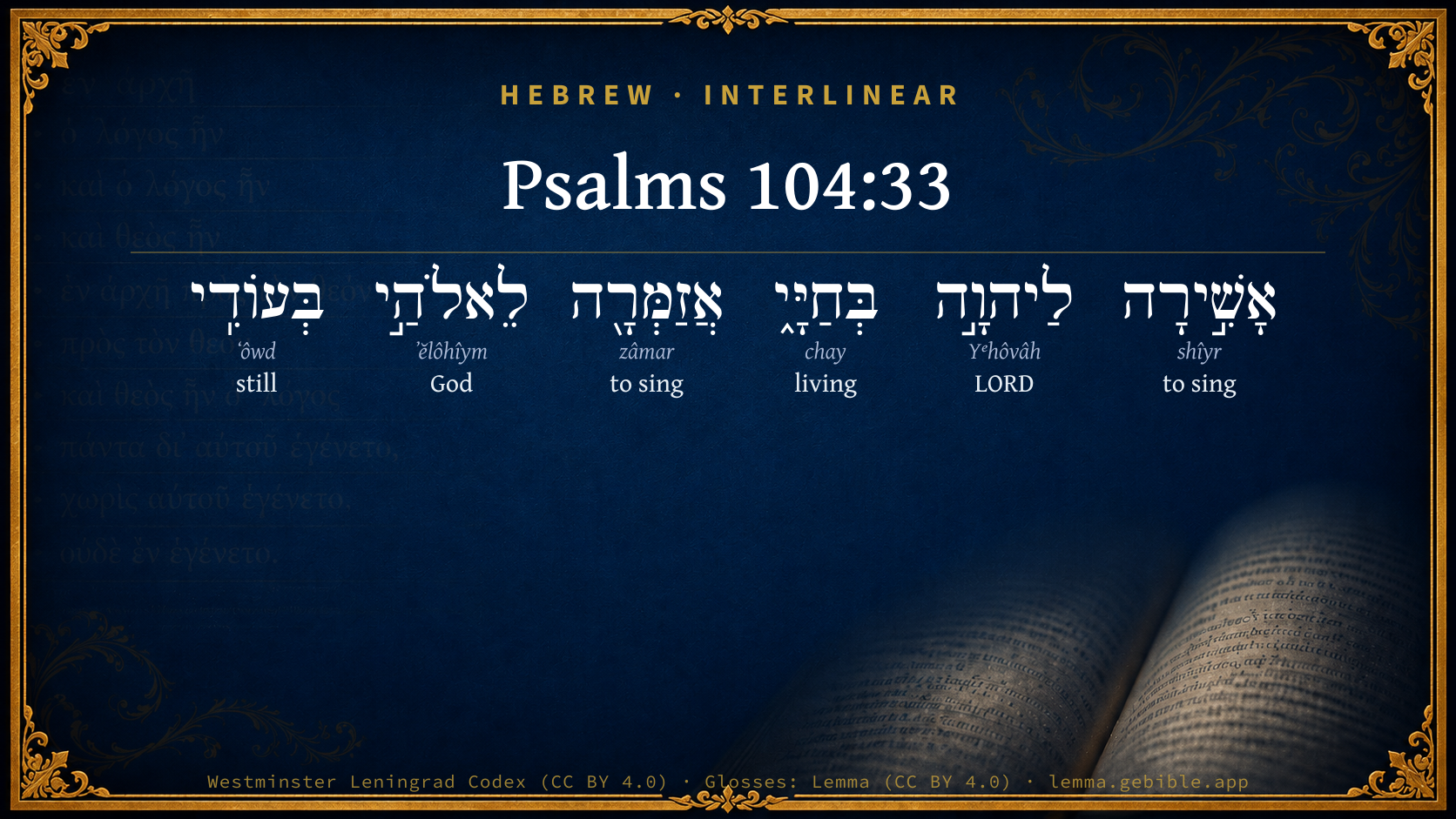
Psalms 104:33

Hebrew (Westminster Leningrad Codex) Psalms 104:33 appears in the Hebrew Old Testament. The text above is from the Westminster Leningrad Codex. Each word links to its Strong’s number, a concise gloss, and parsing drawn from the Open Scriptures Hebrew Bible morphology. Click any word for its full Brown-Driver-Briggs (BDB) entry.
Download image
Cite this verse

Psalms 104:33 (World English Bible). Public Domain. Lemma interlinear Bible study tool, https://lemma.gebible.app/v/psalms/104/33.

Show BibTeX & RIS
BibTeX
RIS
English Translation
I will sing to Yahweh as long as I live. I will sing praise to my God while I have any being.
World English Bible · Public Domain
Download a study sheet

One document with this verse’s original text, its word-by-word gloss line, the meaning frame, cross-references with their text, attributed commentary, and full source and license credits — printable, and it pastes into notes with its structure intact.

This verse Autodidact and up

Study sheet (.html) Plain text (.txt)

A passage Seminary Student

Up to 50 verses in one chapter. A passage sheet keeps up to 6 commentary sources and 12 cross-references per verse, in the order this page ranks them, and says so on the sheet whenever that leaves anything out. Ask for a single verse and you get the Autodidact verse sheet above.

Everything on this page stays free to read, with no account — the sheet is a download of what is already on screen, not access to it.

Want to remove ads? Support Godless Engineer
Compare translations 3

The same verse in 3 English versions, stacked beneath the original-language interlinear above. Click any original word for its lexicon entry.

Each is an independent rendering of the whole verse — the interlinear is not word-aligned to these translations.

Highlighted words mark where these versions differ — a whole-verse word diff, not a word-by-word alignment.

  • World English Bible Public Domain
    I will sing to Yahweh as long as I live. I will sing praise to my God while I have any being.
  • King James Version Public Domain
    I will sing unto the LORD as long as I live: I will sing praise to my God while I have my being.
  • unfoldingWord Literal Text CC BY-SA 4.0
    I shall sing to Yahweh in my life; I shall sing praise to my God during my existence.

unfoldingWord Literal Text — © unfoldingWord, licensed CC BY-SA 4.0. Word-aligned USFM3 via Door43 (git.door43.org/unfoldingWord/en_ult).

Versions to compare (up to 4)

3 of 4 selected

Show all 18 translations

Every available English version of this verse, each an independent rendering of the whole verse.

  • World English Bible Public Domain
    I will sing to Yahweh as long as I live. I will sing praise to my God while I have any being.
  • Berean Standard Bible Public Domain
    I will sing to the LORD all my life; I will sing praise to my God while I have my being.
  • Majority Standard Bible Public Domain
    I will sing to the LORD all my life; I will sing praise to my God while I have my being.
  • King James Version Public Domain
    I will sing unto the LORD as long as I live: I will sing praise to my God while I have my being.
  • American Standard Version (1901) Public Domain
    I will sing unto Jehovah as long as I live: I will sing praise to my God while I have any being.
  • Revised Version (1885) Public Domain
    I will sing unto the LORD as long as I live: I will sing praise to my God while I have any being.
  • Geneva Bible (1599) Public Domain
    I will sing vnto the Lord all my life: I will prayse my God, while I liue.
  • Douay-Rheims (1899) Public Domain
    I will sing to the Lord as long as I live: I will sing praise to my God while I have my being.
  • Young's Literal Translation Public Domain
    I sing to Jehovah during my life, I sing praise to my God while I exist.
  • Literal Standard Version CC BY-SA 4.0
    I sing to YHWH during my life, || I sing praise to my God while I exist.
  • Unlocked Literal Bible CC BY-SA 4.0
    I will sing to Yahweh all my life; I will sing praise to my God as long as I live.
  • unfoldingWord Literal Text CC BY-SA 4.0
    I shall sing to Yahweh in my life; I shall sing praise to my God during my existence.
  • Darby Bible Public Domain
    I will sing unto Jehovah as long as I live; I will sing psalms to my God while I have my being.
  • World Messianic Bible Public Domain
    I will sing to the LORD as long as I live. I will sing praise to my God while I have any being.
  • Webster's Bible Public Domain
    I will sing to the LORD as long as I live: I will sing praise to my God while I have my being.
  • Free Bible Version CC BY-SA 4.0
    I will sing to the Lord for as long as I live; I will sing praises to my God my whole life.
  • Bible in Basic English Public Domain
    I will make songs to the Lord all my life; I will make melody to my God while I have my being.
  • JPS Tanakh (1917) Public Domain
    I will sing unto the LORD as long as I live; I will sing praise to my God while I have any being.

Literal Standard Version (2020), Covenant Press — licensed CC BY-SA 4.0. Text via the HelloAO Bible API (eBible.org). Unlocked Literal Bible (unfoldingWord) — licensed CC BY-SA 4.0. Text via the HelloAO Bible API (eBible.org). unfoldingWord Literal Text — © unfoldingWord, licensed CC BY-SA 4.0. Word-aligned USFM3 via Door43 (git.door43.org/unfoldingWord/en_ult). Free Bible Version, Dr. Jonathan Gallagher — licensed CC BY-SA 4.0. Text via the HelloAO Bible API (eBible.org).

Word by word

More ways to search: Search by grammar → Find every occurrence → Compare this word →

Practice this passage: Drill this verse → Learn its vocabulary →

About this verse

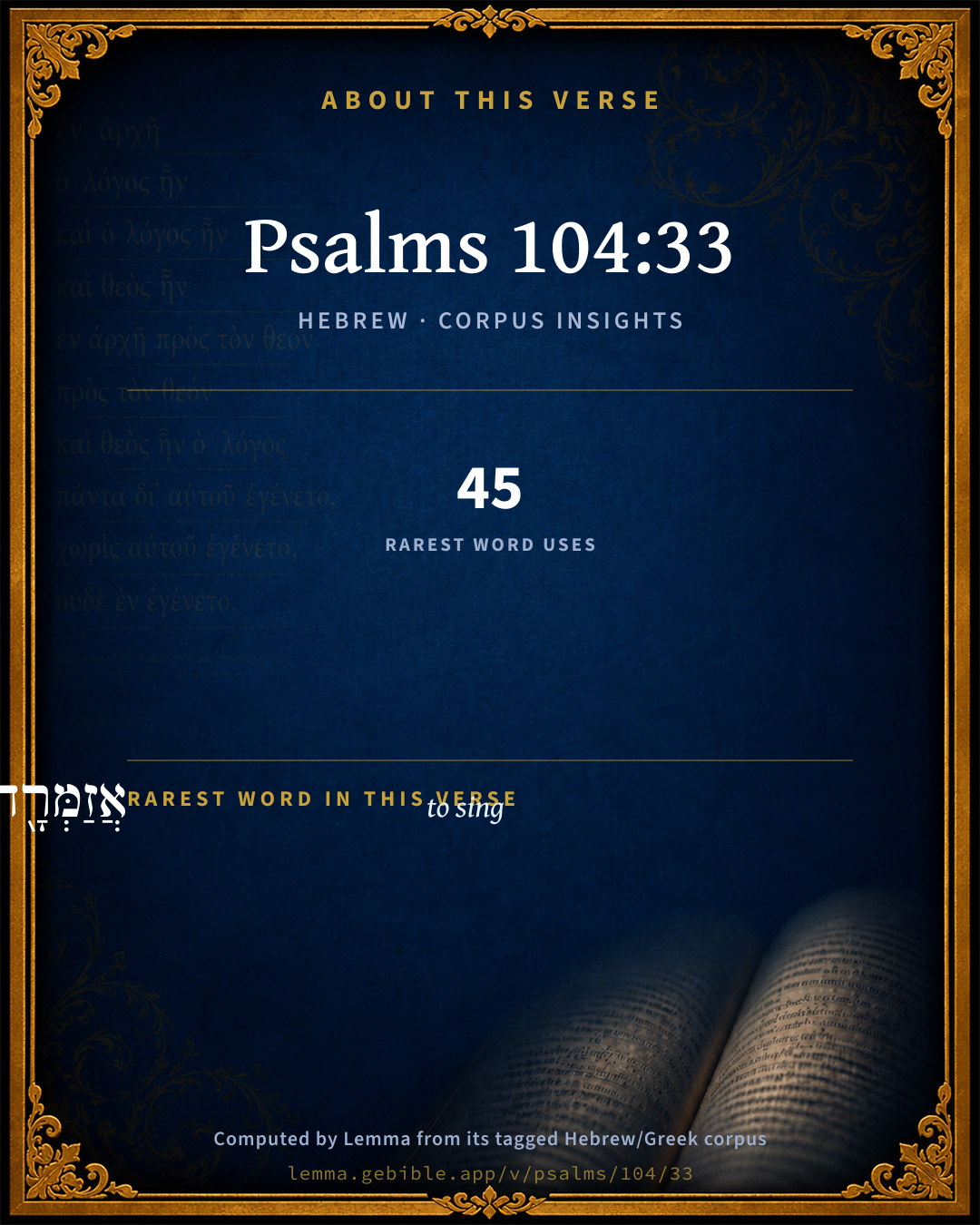
These counts appear in no published source. They are computed here, from the morphology-tagged text and Lemma’s own curated glosses. What Lemma adds →

6
words
6
distinct lemmas
Wisdom
section

Shared distinctive vocabulary

אֲזַמְּרָ֖ה to sing H2167 occurs in 41 verses of the Hebrew Bible. Also found in:

Grammatical profile

  • 2 verbs
  • 3 nouns
  • 1 adverb

Verb forms

  • אָשִׁ֣ירָה Qal · Cohortative
  • אֲזַמְּרָ֖ה Piel · Cohortative

Hebrew & Septuagint length

In English translation the verse runs 22 words from the Hebrew and 19 from the Septuagint (LXX English) — closely comparable.

A rough comparison of the two English renderings, which tokenize alike — not a word-level alignment.

Word counts can differ between the Hebrew and the Greek without any difference in meaning — e.g. the Hebrew direct-object marker אֵת has no separate Greek word, and Greek often adds the article ὁ.

Cross-references

3

Topical passages linked to Psalms 104:33 in the Treasury of Scripture Knowledge — connected by theme and wording, ordered by reader-vote popularity; previews shown in the World English Bible.

  • Psalms 63:4 So I will bless you while I live. I will lift up my hands in your name.
  • Psalms 146:2 While I live, I will praise Yahweh. I will sing praises to my God as long as I exist.
  • Psalms 145:1–2 I will exalt you, my God, the King. I will praise your name forever and ever.

Cross-references courtesy of OpenBible.info (CC BY 4.0).

Hebrew and Greek witnesses Masoretic Hebrew ↔ Greek Septuagint

The same verse in the two great witnesses to the Old Testament, shown verse-for-verse.

You’re reading Greek Psalm 103 (Hebrew Psalm 104). The Septuagint counts the superscription, so verse numbers can differ from the Hebrew — chapter-level alignment, not verse-by-verse. Numbering follows Rahlfs.

These are two independent witnesses, not word-aligned to each other, and the Septuagint is shown in lemma (dictionary) form.

Hebrew Psalms 104:33 Masoretic · Westminster Leningrad Codex

אָשִׁ֣ירָה לַיהוָ֣ה בְּחַיָּ֑י אֲזַמְּרָ֖ה לֵאלֹהַ֣י בְּעוֹדִֽי

I will sing to Yahweh as long as I live. I will sing praise to my God while I have any being.

World English Bible · Public Domain

Greek LXX Greek Psalm 103:33 Septuagint · lemma form

ᾄδω ὁ κύριος ἐν ὁ ζωή ἐγώ ψάλλω ὁ θεός ἐγώ ἕως ὑποἄρχω

I will sing to the Lord while I live; I will sing praise to my God while I exist.

LXX2012 (modern English Septuagint) · Public Domain

Hebrew: Westminster Leningrad Codex (CC BY 4.0). Greek: Septuagint (public domain); English from LXX2012 (modern English Septuagint) (Public Domain). How the Septuagint differs from the Hebrew →

Commentary

Notes on Psalms 104:33 from classic Christian and Jewish commentators (each source and its license shown beneath its notes). The classic Christian expositions comment on the surrounding passage and are grouped to its opening verse, so a note may address several verses; the Jewish commentaries on the Tanakh (Rashi and others) are per-verse, so they appear only where the commentator wrote on this verse.

Lemma curates 59 commentaries, every one of them public domain or Creative Commons licensed, each selected and text-cleaned for this edition rather than reprinted as found. About our sources →

Trapp's Complete Commentary

John Trapp

Psa 104:33 I will sing unto the LORD as long as I live: I will sing praise to my God while I have my being.

Ver. 33. I will siny unto the Lord] Though others be slack to do God this right, to help him to his own, to give him the glory due to his name, yet I will do it, and do it constantly, so long as I have a breath to draw.

John Trapp, A Commentary or Exposition upon All the Books of the Old and New Testament (1647–1656) — public domain. Text from a community e-Sword module.

The Biblical Illustrator

Joseph S. Exell

Psa_104:33

I will sing unto the Lord as long as I live.

A joyous faith

The Oriental life differed in a very marked degree from our modern life. For one thing, it was spent more in the open air than is possible in these colder climates; it was a simpler life, coming into contact with nature, open to the influences which nature is sure to have upon the sensitive mind. We gain something, possibly, by living in great cities, but we certainly forfeit something also; we know man better, we are brought more into contact with our fellow-men, but we lose sight of a great deal which might speak, and which does speak to us of the wonderful works of God the frame of mind in which we live habitually, as well as our surroundings, will have much to do with the spirit of our worship. We may be in the condition of men who are overwhelmed by the thought of man and his works, or of money and its influences, immersed in the noise and smoke until the very heavens themselves are hidden from us, and then the charm of creation is gone, or we may do, what some men never seem to do, possess our souls in the midst of it all. It is something to have seen the works of God, to have taken note of them, even if it be only a glance on a starry night at the wonders of the firmament above. And when we look at the world and at life in this way, with eyes of devotion, and see the Lord there, realized as having a personal existence and share in it all, having to do with its being and its well-being, then it becomes impossible to be silent in His praise. The psalmist has not to reason himself into a right feeling about God; the right feeling is there, and so the psalm begins with an outburst of praise. He is a singer because he is a seer. And because he sees, he is full of devoutness and adoration, and sings as easily and naturally as birds sing when they have entered into the gladness and joy of coming spring. When I think of God, said Haydn, my heart is full of joy, the notes dance and leap. I write according to the thoughts I feel. And Handel, when he wrote his Hallelujah Chorus, said he almost saw heaven opening before him. Devout and joyous worship, then, can only arise from a conception of a world and of a Deity like this. Absence of it in men is fatal; to them, as Hazlitt once expressed it, the heavens have gone farther off, and become astronomical. The ladder that linked heaven and earth has disappeared; they are not likely to say with David, The earth is satisfied with the fruit of Thy works, or, with Jacob, How wonderful, how dreadful is this place! And yet the duty of man remains. If he understands his true position he will worship, he must worship. But only in right thoughts and devout meditations will be found the secret of a lifelong praise such as the psalmist promises. Even so, Father, for so it seemeth good in Thy sight. A spirit like that may rejoice even in a world like this, and He rejoiced in spirit, for it is the soul which makes the music of life; and therefore fitly and properly this psalm begins and ends, as many another psalm, with: Bless the Lord, O my soul! (W. Baxendale.)

Singing to the Lord

I. The psalmists determination.

1. That he will sing. He felt that God had given him a voice capable of singing as well as of speaking; that the power to utter sweet sounds in song, and the ear to delight in sweet sounds in song, was a noble faculty of his nature, and that this faculty was to be used in the Divine service.

2. That he will sing to the Lord--not for his own gratification and pleasure merely, nor to amuse his friends. He believed God heard his voice in song as much as He heard his voice in prayer.

3. That he will sing to the Lord as long as he lives.

II. It is instructive to observe how often, and in how many different ways singing is mentioned and enjoined in the Scriptures.

1. It is enjoined by Scripture command and precept. Moses and Miriam, David and Asaph, all unite in similar precepts,--Sing unto the Lord all the earth, sing unto Him, sing psalms unto Him, is the burden of their frequent utterance. Gospel precept accords with Old Testament command. The apostles are careful to exhort to the practice (Col_3:16; Eph_5:19).

2. Singing is enforced by Scripture argument. We always find this duty of singing to the Lord linked to and connected with other moral duties. The psalmist unites singing and prayer together. In the same psalm we read, O come, let us sing unto the Lord, O come, let us worship and bow down, let us kneel before the Lord our Maker. Here singing and prayer are conjoined (Jam_5:13).

3. Singing is enjoined by Scripture example. Moses both pens a psalm, viz. the 90th, and sings a holy song. Miriam led a number of Israelitish women in a joyful song of triumph to the Lord. David earned for himself the title of the Sweet Psalmist of Israel, alike for the psalms he composed and sung. Asaph and Heman, Jeduthun and Ethan, were eminent for the service they rendered to the psalmody of the Temple-worship. Turning to the New Testament, we find the singing of sacred hymns enjoined by the highest example of all (Mat_26:30). The apostles were addicted to the same practice (Act_16:25). (J. Shillito.)

Singing

1. Singing is the music of nature. The Scriptures tell us the mountains sing, the valleys sing, the trees of the wood sing before the Lord. The air of summer is filled with melody of birds.

2. Singing is the music of the Ancient Church. Pliny makes mention in a letter he wrote to the Emperor Trajan, that the Christians of those times being gathered together before day, sang hymns and praises to Christ as God. Paulinus testifies that this practice overspread every province of the Western Church. Justin Martyr tells us that in his time they sang and sent up prayers to God. Beza confesses that at his first entrance into the congregation, hearing them sing the 91st Psalm, he felt himself exceedingly comforted, and did retain the sound of it afterwards upon his heart. St. Augustine reports of himself, that when he came to Milan and heard the people sing, it was the occasion of his conversion. His words in his Confessions are, When I remember my tears at my conversion under the melody of Thy Church.

3. Coming to more modern times, we find the same practice not only in vogue, but also of greater practical advantage. The reformation in Germany, under Martin Luther, was greatly promoted by singing. Luther taught the children to sing hymns, expressing the great truths of the Gospel. The children went about the streets singing these Gospel hymns, and thus conveying the truth on every hand. The Romanists said Luther has done us more harm by his songs than by his sermons. The followers of Wickliffe and Huss were named psalm-singers. In later times the great religious movements and revivals, which have greatly aided the spread of religion, have been more or less connected with singing to the Lord.

4. Singing is the music of heaven. The glorious saints and angels express their praises in this way, and make one harmony in their state of blessedness. This is set forth in many passages of the Book of Revelation. (J. Shillito. )

The soul on the wing

Birds are seldom taken in their flight; the more we are upon the wing of heavenly thoughts the more we escape snares. (T. Manton.)

Chiming Christians

Clocks converted to chiming--such were the words that caught the writers eye in an advertisement of a watchmakers wares. Conversion to chiming is precisely what many need now-a-days. In the midst of gloom and worry, what a call there is for bright Christians who can advertise the grace of God, which is able to dispel all sorrow and care! Many are converted who yet are far from chiming, and they require the change which can fill their lives with a music never dying, ever singing. Then there is a thought in the chime which may stimulate us. Chimes are striking constantly--often every quarter of an hour, always every hour. How about our testimony for Christ? Is that as frequent as it ought to be? Are we not often silent instead of chiming Christians? (Signal.)

The Biblical Illustrator, edited by Joseph S. Exell (c. 1880s–1900s) — public domain. Text from a community e-Sword module.

Joseph Benson's Commentary

Psa 104:33-34. I will sing unto the Lord, &c. — Whatever others do, I will not fail to give to God his glory and due praises. My meditation of him — My praising of God concerning the glory of his works; shall be sweet — Either, 1st, To God; he will graciously accept it; praise being his most acceptable sacrifice, Psa 69:30-31. Or rather, 2d, To myself. I will not only do this work of praising God, but I will do it cheerfully and with delight: it shall be a pleasure to me to praise him, and I shall find comfort in so doing.

Joseph Benson's Commentary on the Old and New Testaments (1811–1818) — public domain. Text from a community e-Sword module.

J. A. Alexander on Psalms

Joseph Addison Alexander

33. (Psa 104:33) I will sing to Jehovah while I live, I will make music to my God while I still (exist). This is the Psalmist's conclusion from the view which he has taken, with respect to his own interest and duty. If the Lord be such a God to all his creatures, then I can do no better than expend the remainder of my life in praising him. The two verbs are those continually joined to denote vocal and instrumental praise. The closing words of each clause, and especially the second, have a highly idiomatic character. The phrase translated while I live means literally in my life or lives. The corresponding one can scarcely be translated, as it is composed of the preposition in, the adverb yet or still, and the pronoun of the first person, in my yet, i.e. in my (being) yet, while I still am, or continue to exist.

Joseph Addison Alexander, The Psalms Translated and Explained (1850) — public domain. Text from a community e-Sword module.

Adam Clarke's Commentary

Verse 33. I will sing unto the Lord] The psalmist exulting in the glorious prospect of the renovation of all things, breaks out in triumphant anticipation of the great event, and says, I will sing unto the Lord בחיי bechaiyai, with my lives, the life that I now have, and the life that I shall have hereafter.

I will sing praise to my God] בעודי beodi, "in my eternity;" my going on, my endless progression. What astonishing ideas! But then, how shall this great work be brought about? and how shall the new earth be inhabited with righteous spirits only? The answer is,

Adam Clarke's Commentary on the Bible (1810–1826) — public domain. Text from a community e-Sword/MySword module.

John Calvin's Commentaries

33. I will sing to Jehovah whilst I live Here the Psalmist points out to others their duty by his own example, declaring, that throughout the whole course of his life he will proclaim the praises of God without ever growing weary of that exercise. The only boundary which he fixes to the celebration of God’s praises is death; not that the saints, when they pass from this world into another state of existence, desist from this religious duty, but because the end for which we are created is, that the divine name may be celebrated by us on the earth. Conscious of his unworthiness to offer to God so precious a sacrifice, he humbly prays, (verse 34,) that the praises which he will sing to God may be acceptable to him, although they proceed from polluted lips. It is true, that there is nothing more acceptable to God, nor any thing of which he more approves, than the publication of his praises, even as there is no service which he more peculiarly requires us to perform. But as our uncleanness defiles that which in its own nature is most holy, the prophet with good reason betakes himself to the goodness of God, and on this ground alone pleads that He would accept of his song of praise. Accordingly, the Apostle, in Hebrews 13:15 teaches that our sacrifices of thanksgiving are well pleasing to God, when they are offered to him through Christ. It being however the case, that whilst all men indiscriminately enjoy the benefits of God, there are yet very few who look to the author of them, the prophet subjoins the clause, I will rejoice in the Lord; intimating, that this is a rare virtue; for nothing is more difficult than to call home the mind from those wild and erratic joys, which disperse themselves through heaven and earth in which they evanish, that it may keep itself fixed on God alone.

John Calvin's Commentaries (1540-1563) — public domain. Text from the Calvin Translation Society English edition (1840s-50s) via the Christian Classics Ethereal Library (ccel.org). Calvin's coverage is partial (roughly two-thirds of the Bible); uncommented books and verses are honest gaps, never fabricated. The 19th-century editor's footnotes and remarks are omitted so the notes are faithfully Calvin's own voice.

John Gill's Exposition

I will sing unto the Lord as long as I live,.... Or, "in my life or lives (w)", throughout the whole of it. This was what the psalmist determined to do, let others do what they would; even sing songs of praise to the Lord; since he was the God of his life, who had fed him all his life long; from whom he had all the mercies of life, and by whom he had been followed with goodness and mercy all his days, and on whom his life and the comforts of it depended.

I will sing praise unto my God while I have my being: because he lived, and moved, and had his being in him; and it was continued to him, and he was upheld in it; and not only for his being, but for his well being; as for his temporal, so for his spiritual mercies, which he had from him as his God, as his covenant God; such as peace, pardon, righteousness, and eternal life: a view of God as our own God, such a view as Thomas had of Christ, when he said, "my Lord, and my God", is enough to make a man sing; and when the psalmist says he would do this as long as he lived and had a being, this is not to be understood as if this work would end with his life, or that he had no thought of praising him hereafter; but it signifies his constancy in this employment, while in the land of the living; knowing that in the grave he could not praise the Lord with his bodily organs as now; though he knew that this would be his eternal employ in the world of spirits, in his soul, during its separate state, and in soul and body after the resurrection.

(w) "in vita mea", V. L. Pagninus; "in vitis meis", Montanus.

John Gill's Exposition of the Whole Bible (1746–1763) — public domain (CC PDM 1.0). Text via the HelloAO Bible API.

Albert Barnes' Notes on the Bible

I will sing unto the Lord as long as I live - That is, I will continue to praise him; I will never cease to adore him. The result of the psalmist’s meditations on the wonderful works of God is to awaken in his mind a desire to praise God forever. He is so filled with a sense of his greatness and glory that he sees that there would be occasion for eternal praise; or that the reason for praise could never be exhausted. He who has any proper sense of the greatness, the majesty, and the glory of God “intends” to praise him forever. He sees that there is enough in the character of God to demand eternal praise, and he does not anticipate that a period can ever occur in all the future when he will feel that the causes for praise have come to an end, or when his heart will be indisposed to celebrate that praise.

Albert Barnes' Notes on the Bible (1834–1885) — public domain. Text from a community e-Sword/MySword module.

Matthew Poole's English Annotations

But whatsoever others do, I will not fail to give God his glory and due praises.

Matthew Poole's English Annotations on the Holy Bible (1683–1685) — public domain. Text from a community e-Sword/MySword module.

The Treasury of David

Charles H. Spurgeon

Ver. 33. I will sing unto the LORD as long as I live, or, literally, in my lives. Here and hereafter the psalmist would continue to praise the Lord, for the theme is an endless one, and remains for ever fresh and new. The birds sang God's praises before men were created, but redeemed men will sing his glories when the birds are no more. Jehovah, who ever lives and makes us to live shall be for ever exalted, and extolled in the songs of redeemed men.

I will sing praise to my God while I have my being. A resolve both happy for himself and glorifying to the Lord. Note the sweet title my God. We never sing so well as when we know that we have an interest in the good things of which we sing, and a relationship to the God whom we praise.

Ver. 33. I will sing unto the Lord. The Psalmist, exulting in the glorious prospect of the renovation of all things, breaks out in triumphant anticipation of the great event, and says, "I will sing unto the Lord", ywxb bechaiyai, "with my lives, "the life that I now have, and the life that I shall have hereafter.

"I will sing praise to my God, "ydweb beodi, "in my eternity; " my going on, my endless progression. What astonishing ideas! But then, how shall this great work be brought about? and how shall the new earth be inhabited with righteous spirits only? The answer is Ps 104:35, "Let the sinners be consumed out of the earth, and let the wicked be no more." Adam Clarke.

Ver. 33 All having been admonished to glorify God, he discloses what he himself is about to do; with his voice he will declare his praises, "I will sing unto the Lord as long as I live:" with his hand he will write psalms, and set them to music, "I will sing psalms to my God while I have my being:" with his mind he will make sweet meditations, "My meditation of him shall be sweet:" with will and affection he will seek after God alone, "I will be glad in the Lord:" he predicts and desires the destruction of all sinners who think not of praising God, but dishonour him in their words and works, "Let the sinners be consumed out of the earth, and let the wicked be no more:" lastly, with his whole soul and all his powers he will bless God, "Bless thou the Lord, O my soul." Le Blanc.

Ver. 33.

1. The singer"I."

2. The song"praises."

3. The audience"The Lord, ""My God."

4. The length of the song"long as I live; while I have my being." A.G.B.

Ver. 33. Two "I wills."

1. Because he made me live.

2. Because he has made me to live in him.

3. Because he is Jehovah and "my God."

4. Because I shall live for ever, in the best sense.

Psalms 104:34*

Charles H. Spurgeon's The Treasury of David (1869–1885) — public domain. Psalms only. Text from a community e-Sword/MySword module.

The Pulpit Commentary

Vers. 33-35. The peroration (like the opening) is simple praise of God himself, considered in himself. All his life the psalmist will praise God (ver. 33) his soul shall praise him (ver. 35), he will be glad in him (ver. 34); finally, he calls upon all men to join in his praise (ver. 35, last clause).

I will sing unto the Lord as long as I live: (comp. Psa_63:4 Psa_146:2) I will sing praise to my God while I have my being. An echo of the preceding hemistich.

The Pulpit Commentary (1880–1919), ed. H.D.M. Spence-Jones & Joseph S. Exell — public domain. Text from a community e-Sword module.

unfoldingWord translationNotes

Door43 World Missions Community

my thoughts be sweet

He is comparing his thoughts to something that tastes sweet. AT: "my thoughts be pleasing" (See: Metaphor)

translationWords

life

praise

joy

unfoldingWord translationNotes — © Distant Shores Media and the Door43 World Missions Community, licensed CC BY-SA 4.0. Source: git.door43.org/Door43/en_tn.

Rashi

Rabbi Shlomo Yitzchaki (Rashi)

as long as I exist Heb. בעדי, like (Deut. 31:27): “When I am still (בעודני) alive.”

Rashi on the Tanakh — English translations: “The Judaica Press complete Tanach with Rashi, translated by A. J. Rosenberg” (CC BY 4.0); “Pentateuch with Rashi's commentary by M. Rosenbaum and A.M. Silbermann, 1929-1934” (public domain); “The Metsudah Tanach series, Lakewood, N.J” (CC BY 4.0); and “The Book of Joshua, Metsudah Publications, 1997” (CC BY 4.0). Text via Sefaria.

Lesson kit

Teaching starters — assembled from the data on this page, not authored interpretation. Every prompt links to the verse data it draws on. Edit before teaching.

Psalms, in the Wisdom, opens this verse with 6 words (6 distinct Hebrew lemmas). Its most distinctive word is zâmar (“to sing”). A historical commentator’s framing appears above. Read the whole chapter for the surrounding context.

Discussion questions

  1. How does “to sing” (zâmar) shape what this verse is saying?
  2. How does Judges 5:3, which shares the word «to sing», read alongside this verse?
  3. The translations on this page render this verse differently — a whole-verse word diff, not a word-by-word alignment. What might account for the different wordings?
  4. «אָשִׁ֣ירָה» is a Qal Cohortative verb. How does that grammatical form shape the action described?
  5. Compare how Trapp's Complete Commentary and The Biblical Illustrator read this verse. Where do they agree or differ?

Things to notice

Reading settings

Reading text

Shown beneath each verse's original-language words.

Old Testament
Old Testament edition

Read the OT as the Masoretic Hebrew (MT) or the Greek Septuagint (LXX).

English shown for the Greek Septuagint (in the Hebrew ↔ Greek comparison).

Comparing translations? Open the Compare panel on any verse page to stack up to four side by side.