2 Samuel 12:22

Hebrew (Westminster Leningrad Codex) 2 Samuel 12:22 appears in the Hebrew Old Testament. The text above is from the Westminster Leningrad Codex. Each word links to its Strong’s number, a concise gloss, and parsing drawn from the Open Scriptures Hebrew Bible morphology. Click any word for its full Brown-Driver-Briggs (BDB) entry.
Download image
Cite this verse

2 Samuel 12:22 (World English Bible). Public Domain. Lemma interlinear Bible study tool, https://lemma.gebible.app/v/2-samuel/12/22.

Show BibTeX & RIS
BibTeX
RIS
English Translation
He said, While the child was yet alive, I fasted and wept: for I said, Who knows whether Yahweh will not be gracious to me, that the child may live?
World English Bible · Public Domain
Download a study sheet

One document with this verse’s original text, its word-by-word gloss line, the meaning frame, cross-references with their text, attributed commentary, and full source and license credits — printable, and it pastes into notes with its structure intact.

This verse Autodidact and up

Study sheet (.html) Plain text (.txt)

A passage Seminary Student

Up to 50 verses in one chapter. A passage sheet keeps up to 6 commentary sources and 12 cross-references per verse, in the order this page ranks them, and says so on the sheet whenever that leaves anything out. Ask for a single verse and you get the Autodidact verse sheet above.

Everything on this page stays free to read, with no account — the sheet is a download of what is already on screen, not access to it.

Want to remove ads? Support Godless Engineer
Compare translations 3

The same verse in 3 English versions, stacked beneath the original-language interlinear above. Click any original word for its lexicon entry.

Each is an independent rendering of the whole verse — the interlinear is not word-aligned to these translations.

Highlighted words mark where these versions differ — a whole-verse word diff, not a word-by-word alignment.

  • World English Bible Public Domain
    He said, While the child was yet alive, I fasted and wept: for I said, Who knows whether Yahweh will not be gracious to me, that the child may live?
  • King James Version Public Domain
    And he said, While the child was yet alive, I fasted and wept: for I said, Who can tell whether GOD will be gracious to me, that the child may live?
  • unfoldingWord Literal Text CC BY-SA 4.0
    And he said, “When yet the child alive, I fasted and wept, for I said, ‘Who knows? Yahweh may be gracious to me, and the child may live.’

unfoldingWord Literal Text — © unfoldingWord, licensed CC BY-SA 4.0. Word-aligned USFM3 via Door43 (git.door43.org/unfoldingWord/en_ult).

Versions to compare (up to 4)

3 of 4 selected

Show all 18 translations

Every available English version of this verse, each an independent rendering of the whole verse.

  • World English Bible Public Domain
    He said, While the child was yet alive, I fasted and wept: for I said, Who knows whether Yahweh will not be gracious to me, that the child may live?
  • Berean Standard Bible Public Domain
    David answered, “While the child was alive, I fasted and wept, for I said, ‘Who knows? The LORD may be gracious to me and let him live.’
  • Majority Standard Bible Public Domain
    David answered, “While the child was alive, I fasted and wept, for I said, ‘Who knows? The LORD may be gracious to me and let him live.’
  • King James Version Public Domain
    And he said, While the child was yet alive, I fasted and wept: for I said, Who can tell whether GOD will be gracious to me, that the child may live?
  • American Standard Version (1901) Public Domain
    And he said, While the child was yet alive, I fasted and wept: for I said, Who knoweth whether Jehovah will not be gracious to me, that the child may live?
  • Revised Version (1885) Public Domain
    And he said, While the child was yet alive, I fasted and wept: for I said, Who knoweth whether the LORD will not be gracious to me, that the child may live?
  • Geneva Bible (1599) Public Domain
    And he sayde, While the childe was yet aliue, I fasted, and wept: for I sayde, Who can tell whether God will haue mercy on me, that the childe may liue?
  • Douay-Rheims (1899) Public Domain
    And he said: While the child was yet alive, I fasted and wept for him: for I said: Who knoweth whether the Lord may not give him to me, and the child may live?
  • Young's Literal Translation Public Domain
    And he saith, `While the lad is alive I have fasted, and weep, for I said, Who knoweth? -- Jehovah doth pity me, and the lad hath lived;
  • Literal Standard Version CC BY-SA 4.0
    And he says, “While the boy is alive I have fasted and I weep, for I said, Who knows [if] YHWH pities me and the boy has lived?
  • Unlocked Literal Bible CC BY-SA 4.0
    David answered, “While the child was still alive I fasted and wept. I said, 'Who knows whether or not Yahweh will be gracious to me, that the child may live?'
  • unfoldingWord Literal Text CC BY-SA 4.0
    And he said, “When yet the child alive, I fasted and wept, for I said, ‘Who knows? Yahweh may be gracious to me, and the child may live.’
  • Darby Bible Public Domain
    And he said, While the child was yet alive, I fasted and wept; for I thought, Who knows? [perhaps] Jehovah will be gracious to me, that the child may live.
  • World Messianic Bible Public Domain
    He said, “While the child was yet alive, I fasted and wept; for I said, ‘Who knows whether the LORD will not be gracious to me, that the child may live?’
  • Webster's Bible Public Domain
    And he said, While the child was yet alive, I fasted, and wept: for I said, Who can tell whether GOD will be gracious to me, that the child may live?
  • Free Bible Version CC BY-SA 4.0
    David replied, “While the child was still alive, I fasted and cried aloud, for I thought to myself, ‘Who knows? Maybe the Lord will be gracious to me and let him live.’
  • Bible in Basic English Public Domain
    And he said, While the child was still living I went without food and gave myself up to weeping: for I said, Who is able to say that the Lord will not have mercy on me and give the child life?
  • JPS Tanakh (1917) Public Domain
    And he said: 'While the child was yet alive, I fasted and wept; for I said: Who knoweth whether the LORD will not be gracious to me, that the child may live?

Literal Standard Version (2020), Covenant Press — licensed CC BY-SA 4.0. Text via the HelloAO Bible API (eBible.org). Unlocked Literal Bible (unfoldingWord) — licensed CC BY-SA 4.0. Text via the HelloAO Bible API (eBible.org). unfoldingWord Literal Text — © unfoldingWord, licensed CC BY-SA 4.0. Word-aligned USFM3 via Door43 (git.door43.org/unfoldingWord/en_ult). Free Bible Version, Dr. Jonathan Gallagher — licensed CC BY-SA 4.0. Text via the HelloAO Bible API (eBible.org).

Word by word

More ways to search: Search by grammar → Find every occurrence → Compare this word →

Practice this passage: Drill this verse → Learn its vocabulary →

צַ֖מְתִּי
tsûwm
H6684
“to fast”
Verb, Qal, Perfect, 1st Person, Common, Singular
Part of Speech
Verb
Stem
Qal
Form
Perfect
Person
1st Person
Gender
Common
Number
Singular
Full BDB Definition

Origin: a primitive root

TWOT: 1890

(Qal) to abstain from food, fast
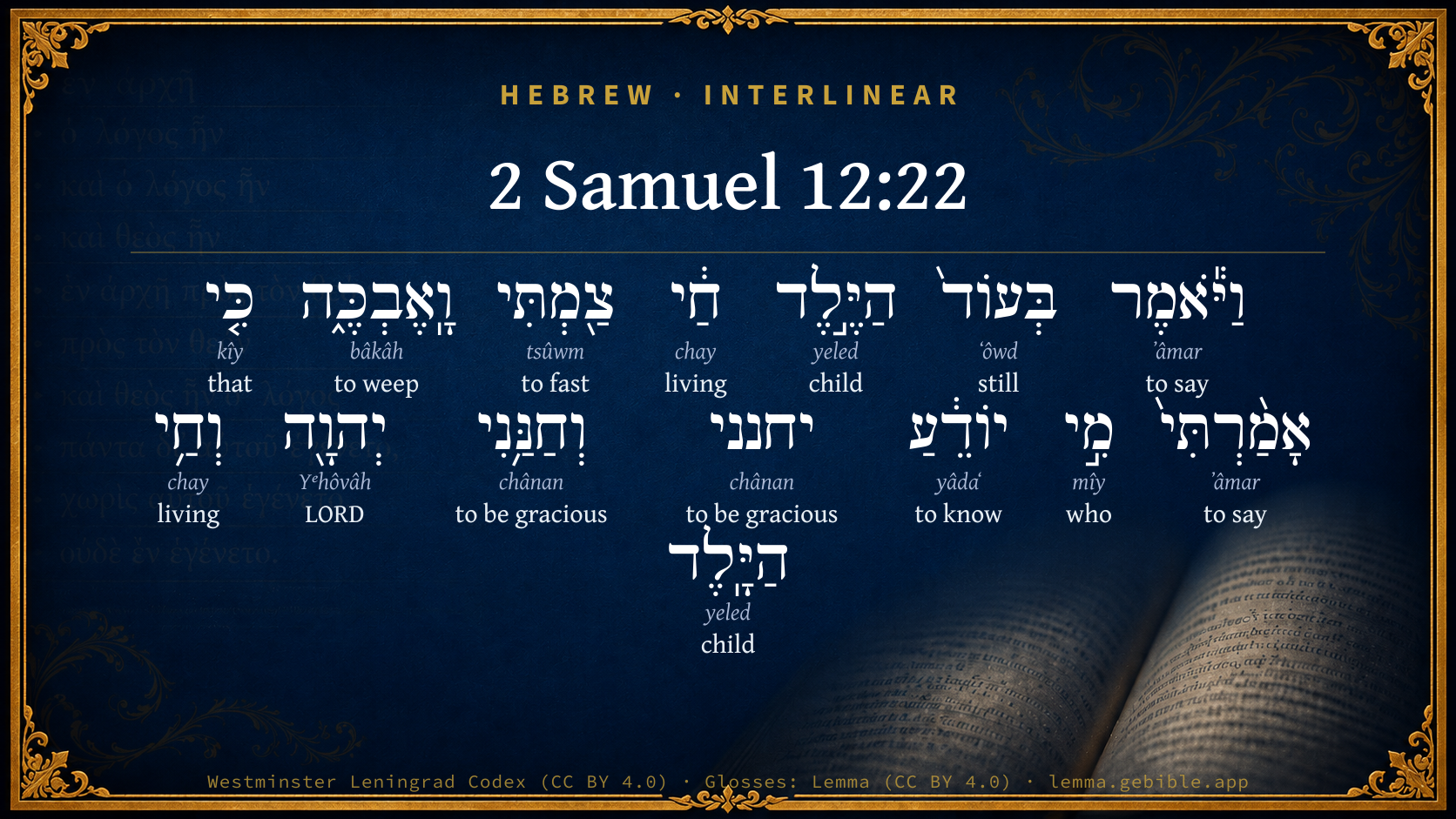
  1. וַיֹּ֕אמֶר ʼâmar H559 “and · to say” Conjunction + Verb, Qal, Sequential Imperfect, 3rd Person, Masculine, Singular
  2. בְּעוֹד֙ ʻôwd H5750 “in/at · still” Preposition + Adverb
  3. הַיֶּ֣לֶד yeled H3206 “the · child” Particle, Definite Article + Noun, Common, Masculine, Singular, Absolute
  4. חַ֔י chay H2416 “living” Adjective, Adjective, Masculine, Singular, Absolute
  5. וָֽאֶבְכֶּ֑ה bâkâh H1058 “and · to weep” Conjunction + Verb, Qal, Sequential Imperfect, 1st Person, Common, Singular
  6. כִּ֤י kîy H3588 “that” Conjunction
  7. אָמַ֨רְתִּי֙ ʼâmar H559 “to say” Verb, Qal, Perfect, 1st Person, Common, Singular
  8. מִ֣י mîy H4310 “who” Particle, Interrogative
  9. יוֹדֵ֔עַ yâdaʻ H3045 “knowing” Verb, Qal, Participle Active, Masculine, Singular, Absolute
  10. יחנני chânan H2603 “to be gracious · me” Verb, Qal, Imperfect, 3rd Person, Masculine, Singular + Suffix, Personal, 1st Person, Common, Singular
  11. וְחַנַּ֥נִי chânan H2603 “and · to be gracious · me” Conjunction + Verb, Qal, Sequential Perfect, 3rd Person, Masculine, Singular + Suffix, Personal, 1st Person, Common, Singular
  12. יְהוָ֖ה Yᵉhôvâh H3068 “LORD” Noun, Proper
  13. וְחַ֥י chay H2416 “and · living” Conjunction + Verb, Qal, Sequential Perfect, 3rd Person, Masculine, Singular
  14. הַיָּֽלֶד yeled H3206 “the · child” Particle, Definite Article + Noun, Common, Masculine, Singular, Absolute

About this verse

These counts appear in no published source. They are computed here, from the morphology-tagged text and Lemma’s own curated glosses. What Lemma adds →

15
words
11
distinct lemmas
Historical
section

Notable vocabulary

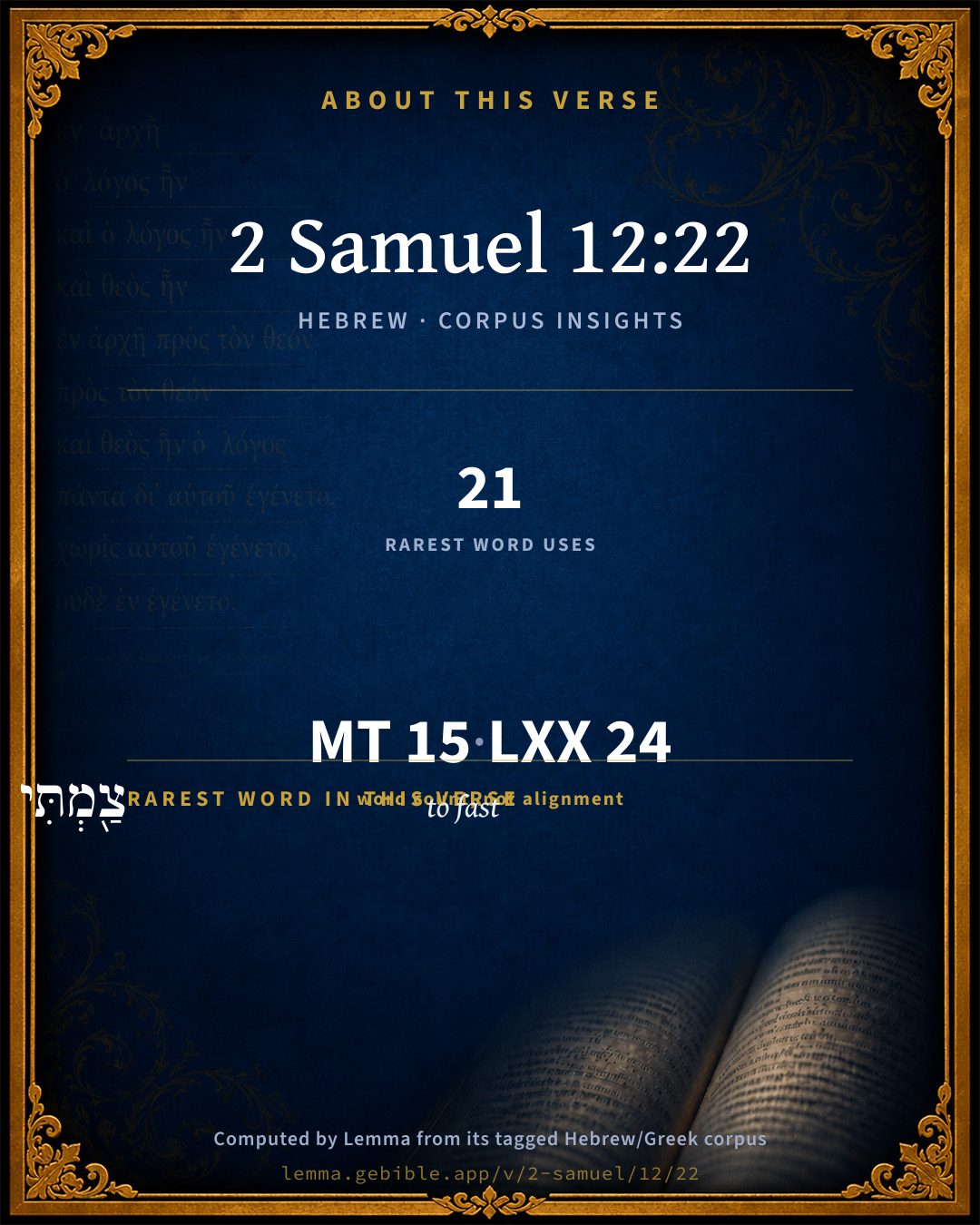
The rarest word here is צַ֖מְתִּי to fast H6684 — appearing just 21 times in the whole Hebrew Bible.

Shared distinctive vocabulary

צַ֖מְתִּי to fast H6684 occurs in 17 verses of the Hebrew Bible. Also found in:

Grammatical profile

  • 8 verbs
  • 3 nouns
  • 1 adjective
  • 1 conjunction
  • 1 adverb
  • 1 particle

Verb forms

  • וַיֹּ֕אמֶר Qal · Sequential Imperfect
  • צַ֖מְתִּי Qal · Perfect
  • וָֽאֶבְכֶּ֑ה Qal · Sequential Imperfect
  • אָמַ֨רְתִּי֙ Qal · Perfect
  • יוֹדֵ֔עַ Qal · Participle Active
  • יחנני Qal · Imperfect
  • וְחַנַּ֥נִי Qal · Sequential Perfect
  • וְחַ֥י Qal · Sequential Perfect

Repetition

Words recur within this verse — often emphatic in Hebrew:

  • וַיֹּ֕אמֶר to say H559 ×2
  • הַיֶּ֣לֶד child H3206 ×2
  • חַ֔י living H2416 ×2
  • יחנני to be gracious H2603 ×2

Hebrew & Septuagint length

In English translation the verse runs 30 words from the Hebrew and 27 from the Septuagint (LXX English) — closely comparable.

A rough comparison of the two English renderings, which tokenize alike — not a word-level alignment.

Word counts can differ between the Hebrew and the Greek without any difference in meaning — e.g. the Hebrew direct-object marker אֵת has no separate Greek word, and Greek often adds the article ὁ.

In the original languages it is 15 Hebrew tokens and 24 Greek tokens — but the two are counted differently (Hebrew bundles its prefixes and suffixes into one token; the Greek is in lemma form), so that isn’t a like-for-like length.

Cross-references

8

Topical passages linked to 2 Samuel 12:22 in the Treasury of Scripture Knowledge — connected by theme and wording, ordered by reader-vote popularity; previews shown in the World English Bible.

  • Isaiah 38:1–3 In those days was Hezekiah sick to death. Isaiah the prophet the son of Amoz came to him, and said to him, Thus says Yahweh, Set your house in order; for you shall die, and not live.
  • Isaiah 38:5 Go, and tell Hezekiah, Thus says Yahweh, the God of David your father, I have heard your prayer, I have seen your tears: behold, I will add to your days fifteen years.
  • Jonah 3:9–10 Who knows whether God will not turn and repent, and turn away from his fierce anger, so that we might not perish?"
  • Joel 1:14 Sanctify a fast. Call a solemn assembly. Gather the elders, And all the inhabitants of the land, to the house of Yahweh, your God, And cry to Yahweh.
  • Joel 2:14 Who knows? He may turn and relent, And leave a blessing behind him, Even a meal offering and a drink offering to Yahweh, your God.
  • Jonah 1:6 So the shipmaster came to him, and said to him, "What do you mean, sleeper? Arise, call on your gods! Maybe the gods will notice us, so that we won't perish."
  • Amos 5:15 Hate evil, love good, And establish justice in the courts. It may be that Yahweh, the God of hosts, will be gracious to the remnant of Joseph."
  • James 4:9–10 Lament, mourn, and weep. Let your laughter be turned to mourning, and your joy to gloom.

Cross-references courtesy of OpenBible.info (CC BY 4.0).

Hebrew and Greek witnesses Masoretic Hebrew ↔ Greek Septuagint

The same verse in the two great witnesses to the Old Testament, shown verse-for-verse.

These are two independent witnesses, not word-aligned to each other, and the Septuagint is shown in lemma (dictionary) form.

Hebrew 2 Samuel 12:22 Masoretic · Westminster Leningrad Codex

וַיֹּ֕אמֶר בְּעוֹד֙ הַיֶּ֣לֶד חַ֔י צַ֖מְתִּי וָֽאֶבְכֶּ֑ה כִּ֤י אָמַ֨רְתִּי֙ מִ֣י יוֹדֵ֔עַ יחנני וְחַנַּ֥נִי יְהוָ֖ה וְחַ֥י הַיָּֽלֶד

He said, While the child was yet alive, I fasted and wept: for I said, Who knows whether Yahweh will not be gracious to me, that the child may live?

World English Bible · Public Domain

Greek LXX 2 Samuel 12:22 Septuagint · lemma form

καί εἶπον δαυίδ ἐν ὁ ὁ παιδάριον ἔτι ζάω νηστεύω καί κλαίω ὅτι εἶπον τίς οἶδα εἰ ἐλεέω ἐγώ κύριος καί ζάω ὁ παιδάριον

And David said, While the child yet lived, I fasted and wept; for I said, Who knows if the Lord will pity me, and the child live?

LXX2012 (modern English Septuagint) · Public Domain

Hebrew: Westminster Leningrad Codex (CC BY 4.0). Greek: Septuagint (public domain); English from LXX2012 (modern English Septuagint) (Public Domain). How the Septuagint differs from the Hebrew →

Targum (Aramaic paraphrase)

1

The Targum is the ancient Jewish Aramaic paraphrase of the Hebrew Scriptures — an interpretive translation, not the Hebrew text itself. Onkelos (literal) and Pseudo-Jonathan (expansive) render the Torah, and Jonathan the Prophets. Coverage is partial: where no permissively-licensed English translation exists for a verse, only the Aramaic is shown. This is verse-level text, not a word-by-word alignment to the Hebrew.

  1. Targum Jonathan Prophets (Joshua–Malachi)
    וַאֲמַר עַד דְרַבְיָא קַיָם צָמֵית וּבְכֵיתִי אֲרֵי אֲמַרִית מַן יְדַע דִלְמָא יִתְרְחֵים עֲלַי מִן קֳדָם יְיָ וְיֵחִי רַבְיָא:

    (no public-domain English translation for this verse)

    Targum Jonathan — Aramaic: “Mikraot Gedolot” (public domain). English: “Sefaria Community Translation” (CC0 1.0 (public-domain dedication)); “London "Chaldee Paraphrase," 1871” (public domain). Text via Sefaria.

Commentary

Notes on 2 Samuel 12:22 from classic Christian and Jewish commentators (each source and its license shown beneath its notes). The classic Christian expositions comment on the surrounding passage and are grouped to its opening verse, so a note may address several verses; the Jewish commentaries on the Tanakh (Rashi and others) are per-verse, so they appear only where the commentator wrote on this verse.

Lemma curates 59 commentaries, every one of them public domain or Creative Commons licensed, each selected and text-cleaned for this edition rather than reprinted as found. About our sources →

Trapp's Complete Commentary

John Trapp

2Sa 12:22 And he said, While the child was yet alive, I fasted and wept: for I said, Who can tell [whether] GOD will be gracious to me, that the child may live?

Ver. 22. Whether God will be gracious to me, that the child may live?] God was gracious to him in that the child did not live. See on 2Sa 12:14. How oft do God’s children find themselves crossed with a blessing! and on the contrary.

John Trapp, A Commentary or Exposition upon All the Books of the Old and New Testament (1647–1656) — public domain. Text from a community e-Sword module.

The Biblical Illustrator

Joseph S. Exell

2Sa_12:22-23

While the child was yet alive I fasted and wept.

The loss of children

I. His affliction was the death of his child. The death of a child is by no means an uncommon event. If our offspring are spared, and appear like olive plants around our table, we ought to be thankful, and to rejoice; yet to rejoice with trembling. When we reflect on the tenderness of their frame, and consider to how many accidents and diseases they are liable; and that many of their earliest, complaints cannot be perfectly ascertained, and may be injured by the very means employed for their relief--the wonder is that they ever reach maturity. The death of Davids child was predicted by Nathan, and was the consequence of the fathers sin. The landlord, says an old writer, may distrain on any part of the premises he chooses. We would rather say that there are many cases in which he requires us to walk by faith, and not by sight: that he does all things well, even when clouds and darkness are round about him; we would say that he indemnified this child by taking it to himself--while the father was punished, and suffered more relatively than if he had died himself.

II. The behaviour of David with regard to the affliction.

1. It takes in prayer He besought God for the child. Prayer is always proper: but how seasonable, how soothing, how sanctifying, in the day of trouble! Blessed resource and refuge! may we always make use of thee.

2. He also humbled himself: He fasted, and went in, and lay all night upon the earth. Much of Davids distress arose from reflection on his sin: his grief was the grief not only of affliction but of penitence.

III. He deemed the event uncertain. It is obvious that he did not consider the threatening as absolute and irreversible. He knew that many things had been denounced conditionally; and he knew also that the goodness of God was beyond all his thoughts. But what led him to assuage his grief?

1. Continued grief was unavailing. Now he is dead, wherefore should I fast? Can I bring him back again?

2. He contemplates his own death as certain: I shall go to him. By this he intends the grave: and this part of our subject is common to all mankind.

3. He expects to follow his child not only into the grave, but into glory; and anticipates a renewed union with him in heaven. This was unquestionably Davids case.

(1) First, as to the dead. We cannot join those in heaven who are not gone there; and all do not go there when they die.

(2) The second limitation regards the living. You cannot join those who are gone to heaven if you do not go there yourselves. Remember they are not separated from you for ever--you are going to them. They are waiting to receive you into everlasting habitations. On your arrival there you will know them, and they will know you; even they will know you there who never knew you here. (W. Jay.)

The philosophy of death

A most beautiful picture, and representation of parental sorrow and of rational, manly piety.

I. A little child suffering on account of the sin of its father. Now, I do not mean to say that the cause of every little infants suffering is the same as this. This is a peculiar case. But that little children do suffer as a consequence of their parents sin is a simple matter of fact. By immorality and sin some parents ruin their health, and their constitution, and thus plant those seeds of disease and death which manifest themselves in their children: their offspring may suffer, agonize, and die in their infancy because of their parents sin. In a great many other ways also, parents may so modify the condition under which their children live as to cause them much suffering and premature death. The sin of the father is visited upon the child. The Bible does not make that fact. If there was no Bible the fact would be the same. It is affirmed by the Bible of Nature. If you get rid of the Book, you have the world, and you must read and interpret it. You must just do the best you can with the mystery. I do not know what you will do with it, but there it is. Sin introduced death, and death passed upon all men. But, observe, while the Bible thus associates death as a general fact with sin, it is not with the sin of an individual, not with the sin of the immediate parent of the child, but because of the sin of the first progenitor, because of that transgression which occurred at the commencement of the race.

II. The picture of a father deeply affected through the suffering and illness of his child; and in this case parental grief was aggravated and increased by the consciousness which David must have felt that the stroke had fallen upon the child directly from the hand of God on his account. Children may, and do die, as we know on account of the sins of their parents, but in the great majority of cases this is not the fact; you have net your deep sorrow aggravated by the thought that the stroke has fallen upon your child directly and immediately as a punishment for your sin. David, with that large heart of his, with that paternal temperament,--it is always a temperament of sensibility--and his devotion and love to God, experienced an aggravated sense of remorse on account of his sin. He would, doubtless, feel the most acute suffering.

III. An afflicted, good man, earnestly praying to God, but praying in vain. The circumstances were desperate. The sentence had gone forth--the prophet had spoken the word, that the child should die on account of the sin of its father--but he thought that his sin would be forgiven, and that the child might possibly live. We may pray earnestly unto God for a certain blessing, or to be saved from some special suffering, but our prayer may not be answered because God sees it to be necessary to inflict that against which we cry to be delivered. But we have authority here for pleading earnestly under the most hopeless circumstance, that affliction may be removed; but we are to remember that God has reasons for His conduct.

IV. The conduct of David; his behaviour after the matter was determined. There are two or three points in this explanation of David which we shall do well to look at.

1. In the first place yon see how he distinguished between the possible and the certain. While the child lived he fasted and prayed, because he thought that God would possibly have mercy and spare the child. But when God had determined the matter, then it was inevitable; another class of feelings was then to be brought into play; another class of duties was then to be fulfilled.

2. But David distinguished the next place between means and ends. He fasted and prayed, and his tears flowed as lie laid upon the earth, he washed not his face, anointed not his head, and changed not his garments. His condition was becoming more and more sordid, because his grief was was so intense. His fasting was continued in order that it might agree with the inward state of his mind, and sustain his devotion.

3. David distinguished between the proper time for prayer, and the proper world to which it has application, This idea is suggested to us--that he did not pray for the child after it was dead--for the repose of the soul of the child--that he did not follow the soul into the next world to make it a subject of prayer.

4. David distinguished between miracle and mercy. He distinguished between irrational expectations and religious hope. He could not pray for the child after it was dead, because he did not expect God to work a miracle and give him the child back again. No; He will not come back to me; but he did indulge a religious hope; a hope of mercy--I shall go to him, but he shall not return to me. (T. Binney.)

On the death of children

I. The grounds of Davids resignation. Can I bring him back again? I shall go to him, but he shall not return to me. The good Psalmist had bowed himself before the Most High God, and besought Him right humbly for his child. Death had signified it to be the Divine pleasure, that the child should be taken to another state of existence. To resist would be vain; to repine would be fruitless. It is true it would be a melancholy fortitude which these reflections produce if it were not strengthened and cheered by another consideration. Though fate forbade David to call back to his embrace his departed child, was lie separated from him for ever? Verily, to the tender heart of the affectionate king, the thought had been insupportable, But he was consoled with far other expectations. The spark of being which the Almighty had kindled in his child was kindled to burn for ever. The Messiah had consecrated it to immortality. I shall go to him, though he shall not return to me. Even in the prospect of being joined to our departed friends in the noiseless tomb, nature finds a solace, suited to the gloomy state of her feelings in the hour of her bereavement.

II. The manner in which it manifested itself. Behold, he, who careless of attire lay weeping on the earth, arises and washes himself, and changes his apparel. He, whom no consideration could draw from the place, where his child lay sick, goes forth spontaneously into the house of the Lord, and worships. He, whom the elders of his house had entreated in vain to receive some sustenance, himself gives orders to set on bread. He, whom his servants feared to tell that the child was dead, leaves their astonished minds below his fortitude, and discourses with them on the reasonableness and propriety of submission. How majestic in his affliction! What greatness and peace in resignation like this! It is worthy of particular observation that the first step of the Psalmist in the day of his sorrow is to the house of the Lord. It is in the holiness of the sanctuary that that beauty is found, which the Prophet was to give instead of ashes, to those who mourned in Zion. It is in the sacred vessels of the temple that the oil of joy is kept, which Gods people are to have for mourning. And here, we trust, when we are assembled in His name, Immanuel is in the midst of us, who furnishes from the wardrobe of heaven the garment of praise for the spirit of heaviness. (Bishop Dehon.)

Parental sorrow and parental submission

Those who distinguish themselves by sin God will distinguish by suffering. David would not have been so conspicuous a mourner if he had not been so conspicuous in his rebellion against the Lord. His chastisement was therefore just and compassionate, and though the form it took was common, it was to him one of the most painful he could have endured.

I. The grief of a pious parent over his dying child. Parental grief suggests to us:--

1. The considerations which lead us to desire the lives of our children. Among these are

(1) Our comfort and help. Great as are the cares they bring, still greater are the comforts; nor do we fail to anticipate the time, when sinking into infirmities, we shall receive from them tokens of attachment in return for all our anxieties.

(2) For the perpetuation of our name to posterity we desire the lives of our children; denied alike to those who are written childless and to those who are called to bury their offspring.

(3) To succeed us in our possessions and pursuits, we are anxious our children may be spared.

2. His faith in the power and mercy of God. He was assured that power belonged to God, and that if he would he could recover the child.

3. His confidence in the efficacy of prayer is also exhibited, for prayer was the chief employment when he withdrew--David, therefore, besought God for the child; and David fasted, and went in and lay all night upon the earth. Fasting was united to prayer, and probably sackcloth. If in such eases the good effects of prayer have been seen, though the main object may have been denied; how are we encouraged in all those instances in which no declaration of discouragement or of absolute denial has been expressed! Is any among you afflicted? let him pray. You cannot lose, but you may, you must gain.

II. A pious parents submission, now that his child was dead. But now he is dead, wherefore should I fast? Can I bring him back again? I shall go to him, but he shall not return to me. This submission is still more significantly expressed in the narrative. So great was Davids grief during the illness of the child that the servants feared to inform him of its death; but when he ascertained that he was dead he arose from the earth and washed, and changed his apparel, and came into the house of the Lord and worshipped; then he came to his own house, and when he required they set bread before him, and he did eat. When the servants expressed their surprise at this conduct, he condescended to explain it, as in the text. His submission would be promoted by the fact.

1. That the providence was of God. What can be better than the will of God; so wise, gracious, and holy? Let our hopes perish, but let His will be supreme.

2. That the child is taken away from the evil to come is calculated to promote the submission of a bereaved parent.

3. The inutility of grief is another consideration. But now he is dead, wherefore should I fast? Can I bring him back again? I shall go to him, but he shall not return to me. He had besought the Lord to spare him; but he had now taken him, and neither prayer nor grief would avail, for the life that was taken away could not be recovered.

4. The future happiness of his child tends greatly to promote the submission of a pious parent when bereaved. And of this David appears to have had assurance. I shall go to him. This, first of all, implies Davids belief that the child still existed; consequently, that, the soul of infants are immortal; and, as we know, he expected to be happy himself, and go to his child, he already considered it as possessing a happy immortality.

5. The thought of going to his child at death tended also to quiet the mind of David. I shall go to him, but he shall not return to me. Heaven is presented ill a variety of attractive aspects. To be with Christ, to behold His glory, and be like Him, constitute an idea of blessedness sufficient to enrapture the most exalted piety; but it is sometimes invested with associations suited to our earthly predilections. Hence we are told of the things which are above; the spirits of just men made perfect; and of sitting down with Abraham, Isaac, and Jacob. The exposure of children to death should prevent our cherishing toward them an overfond attachment, and should exercise a just influence over our affections. We may and must Jove them, but only as creatures. They must not be idols; must not rival in our regard that God who must ever be its supreme object. The same consideration should lead us, at the earliest dawn of reason, to attempt to instruct our children piously. Oh! had we known how soon that infant mind would have opened to the light and glory of the upper world, how would our assiduity in this respect have been quickened! We cannot too early fit them either for earth or heaven. How adapted to promote the eternal welfare of parents is the loss of children! Our earthly affections may, through the sanctifying grace of God, aid us in cultivating spirituality of mind. Set your affection on things above is an exhortation which powerfully recommends itself to such. Lord, by these things men live, and these things are the life of our spirits. Young children should be made to consider their liability to death, whatever their health or strength, for it often happens that diseases incident to childhood act more powerfully on a robust than a slender frame. Little children, you are young and healthy, but you may soon die. Do not too certainly calculate on a long life. (S. Hillyard.)

Davids conduct in affliction

The point of transition from the state of awful impenitence in which David had for so long a period continued, to a consciousness of his true position and to contrition for his crime, resembled the crisis of some perilous malady. The sovereign mercy and free grace of a faithful God brought him safely through the trial; and the result was life from the dead. A well known, but not a less marvellous phenomenon of the natural world may serve to shadow forth the further stage of experience involved in Davids complete restoration to a state of grace. When the blasts of winter have set in, and the sound of its unkindly storms sweeps over the listening ear--when mist and fog cloud the cheering light, and intercept the genial warmth of heaven--who has not felt it a sad and sickening task, to trace the change which even the fairest earthly paradise will present, as compared with its blooming spring, its fragrant summer, or its fruitful autumn? We walk amidst the drear and silent scene, like lingering mourners in natures cemetery. The melody of the woods is hushed; the woods themselves are dressed in funeral garb; the streams hurry black and moodily through the bare and blighted scene--or else, arrested in their course, are held frost-bound in the chain of winter. Days, weeks, months pass on, and still the landscape frowns in sackcloth, amidst the gloom and chill and death which seems unalterable and fixed. At length there comes a wondrous and more than magic transformation. The sun walks forth in glory from his heavenly tabernacle, as a bridegroom coming out of his chamber, and rejoiceth as a strong man to run a race. His going forth is from the end of the heaven, and his circuit unto the ends of it: and there is nothing hid from the heat thereof. Such and so great--yea, rather, greater and far more blessed--was the revival wrought in the soul of David, after the beams of Divine grace had once more visited it with light, and love. The streams of godly sorrow were unloosed, and the waters flowed: the fruits of the Spirit, which seem to have sprung from a ground nigh unto cursing, appear in all their former beauty; the Word of the Lord had gone forth with power. The passage immediately before us contains the penitent monarchs own account of that which, in the eyes of his sympathising servants, appeared mysterious and paradoxical. The explanation relates to two distinct periods; and accordingly, our consideration of it will lead us to notice Davids conduct and the ground thereof.

I. During the sickness.

1. In the first place, we read in the sixteenth verse that David besought God for the child. He carried the burden which oppressed him, the grief which consumed him, to that merciful God who had so often heard the voice of his weeping. Instead of seeking many physicians, he repaired at once to the all-wise and all-powerful Physician; so that in his case was anticipated the apostolic prescription--Is any afflicted? let him pray.

2. It is further related that he accompanied his supplications with deep humiliation: he fasted, and went in, and lay all night upon the earth. Regarding his trial as a chastisement for his transgression, he humbled himself under the mighty hand of God. Was there anything surprising in all this? King though he was, yet as a sinner we feel that the posture he assumed became him. It was meet to lay aside the crown of pure gold which God had put upon his head, and to exchange his soft raiment for sackcloth. One of the most painful and mischievous consequences of wilful sin is the difficulty it occasions in even the awakened and anxious soul to realise the love and trust in the confidence of our compassionate God. A sense of ill desert awakens the suspicion that He is altogether such an one as ourselves; and, by checking the hope of success, too often silences the voice of prayer. If David thus clung to hope, and persevered in wrestling with God for a temporal blessing, on a mere peradventure of success, how much rather should you, when you would trove the pardon of your guilt, the conversion of your heart, or the victory over your be, setting sins, cast yourselves upon His mercy, plead His promises, and resolve that you will not let Him go, except He bless you! In suing for these things you know that you are asking according to His will, and that He is far more ready to hear than you to pray; you honour Him most when you crave the most; you please Him best when you are most importunate.

II. His conduct, and the grounds of it, after the child was dead. It is a genuine touch of nature, which represents that when David saw that his servants whispered, David perceived that the child was dead. His parental fears and tender solicitude anticipated the tidings which their silence communicated. And now begins the seeming paradox, which caused his servants so much perplexity. Though our immediate object in dwelling upon this passage is to present the portraiture of a genuine penitent, yet it seems profitable, in passing, to gather lessons of counsel and encouragement for that spirit which is almost sure to form a part in every audience--the spirit of the mourner. The Lords children are often robbed of a noble opportunity of glorifying Him, and of much previous advantage to themselves, by the tyranny of that cruel custom which would have it believed that there is something indelicate when the bereaved is immediately seen in the Lords house. The case, I admit, is quite conceivable in which, from weakness of body, tenderness of spirit, or want of self-control, the mourner may be really unfit to take part in the outward communion of saint. Nothing would be gained by any external violence done to the over-wrought system; but I refer to that artificial code of pharisaic decency which renders it incumbent on the bereaved mourner to abstain from the comfort and the consolation with which his Fathers house abounds. I do think it an affectation of delicacy of sentiment which sound reason and genuine piety should force us to discountenance. (C. F. Childe, M. A.)

Salvation of infants

Millions of the descendants of Adam expire in infancy. They just open their eyes upon the world, excite the hopes and affections of their parents, and then are convulsed, and in agonies sink into the tomb. While fastening our eyes on their little corpses, or hanging over their graves, there are two questions which we naturally ask: Why did these infants die? and, what is their present state? Unassisted reason is equally unable to decide what is the state in which the spirits of infants enter at their death. The universality of the salvation has been denied, not only by individuals of distinguished reputation, but also by whole churches. And, besides, in those who embrace the doctrine that I am about to establish, I have generally found that their belief was rather the expression of their wishes and their hopes than the result of a cool examination of the testimony of God. And nothing is more common than to hear even Christian parents defending infant salvation on grounds inconsistent with the Scriptures; on principles that oppose not only the doctrine of original sin which is so plainly taught in the word of of God, but that also overtook the absolute necessity of the atonement and sacrifice of Jesus for the salvation of every child of Adam. It is in perfect consistence with both these doctrines that we maintain that God has ordained to confer eternal life on all whom he has ordained to remove from this world before they arrived at the years of discretion. The following are the chief sources of argument in defence of this doctrine:--

1. The interesting history of which our text forms a part.

2. The conduct and discourses of the Saviour with regard to infants.

3. The attributes of God and His relation to infants.

4. The declarations that He has made concerning them.

5. The nature and extent of redemption through Christ.

6. The nature and design of the ordinance of baptism.

7. The mode of procedure at the final judgment.

8. The nature of the torments of hell.

9. The nature of the heavenly felicity, and the grounds of its conferment upon men.

I must present to you a few inferences from this subject.

1. Learn from it the preciousness of the Word of God.

2. Praise God for His unutterable grace. This is the occupation of these departed infants.

3. Bereaved parent, rejoice in the dignity and elevation of thy, child. To have this child in heaven is greater cause of triumph than if he swayed the sceptre over prostrate nations.

4. Bereaved: parent, art thou ready to meet this child? In thy name he has taken possession of heaven? Art thou following the Redeemer, and living devoted to him?

5. And: you who have passed through the period of infancy, remember, that to your salvation are required explicit acts of faith in Jesus, and lives devoted to him. (H. Kollock, D. D.)

Uselessness of unavailing regret

One of Kants biographers dilates upon what he considers a singular feature in the Konigsberg philosophers; way of expressing his sympathy with his friends in sickness. So long as the danger was imminent he is said to have testified a restless anxiety, making perpetual inquiries, waiting with impatience for the crisis, and sometimes unable to pursue his customary labours from agitation of mind. But no sooner was the patients death announced than he recovered his composure and assumed an air of stern tranquillity, almost of indifference. (Francis Jacox.)

The Biblical Illustrator, edited by Joseph S. Exell (c. 1880s–1900s) — public domain. Text from a community e-Sword module.

Adam Clarke's Commentary

Verse 22. Who can tell] David, and indeed all others under the Mosaic dispensation, were so satisfied that all God's threatenings and promises were conditional, that even in the most positive assertions relative to judgments, &c., they sought for a change of purpose. And notwithstanding the positive declaration of Nathan, relative to the death of the child, David sought for its life, not knowing but that might depend on some unexpressed condition, such as earnest prayer, fasting, humiliation, &c., and in these he continued while there was hope. When the child died, he ceased to grieve, as he now saw that this must be fruitless. This appears to be the sole reason of David's importunity.

Adam Clarke's Commentary on the Bible (1810–1826) — public domain. Text from a community e-Sword/MySword module.

The Cambridge Bible for Schools and Colleges

gen. ed. J. J. S. Perowne

22. GOD] The Lord. The Heb. is Jehovah, not Elohim, as is indicated by the capital letters. Cp. Gen_6:5.

The Cambridge Bible for Schools and Colleges (gen. ed. J. J. S. Perowne; Cambridge University Press, 1878–1918) — public domain. Text from a community e-Sword module.

John Gill's Exposition

But now he is dead, wherefore should I fast?.... And pray; it is to no purpose, no end can be thought to be answered by it:

can I bring him back again? from the state of the dead, bring him to life by fasting, and praying, and weeping; that is not to e expected:

I shall go to him; to the state of the dead, to the grave, where his body was, or would be; to heaven and eternal happiness, where his soul was, as he comfortably hoped and believed: from whence it appears, that the Old Testament saints did not suppose an annihilation at death; but believed the immortality of the soul, a future state after death of eternal life and bliss:

but he shall not return to me; in the present mortal state, though at the resurrection they should meet again.

John Gill's Exposition of the Whole Bible (1746–1763) — public domain (CC PDM 1.0). Text via the HelloAO Bible API.

Matthew Poole's English Annotations

For God’s threatening of the child’s death might be conditional, as that was of Nineveh’s destruction, Jon 3:4.

Matthew Poole's English Annotations on the Holy Bible (1683–1685) — public domain. Text from a community e-Sword/MySword module.

The Pulpit Commentary

God; Hebrew, Jehovah, usually rendered "Lord." Similarly in Gen_6:5 in the Authorized Version we find God in capital letters, as here, for the Hebrew Jehovah.

Vers. 22, 23.

An infant"s illness and death.

This part of the narrative introduces us to a spectacle which, in its main features, is common enough. A child sickening and dying, a parent striving with God in prayer and fasting for its life, but striving in vain. But there are peculiar circumstances here which give the scene a special interest.

I THE CHILD"S FATAL SICKNESS.

1. The cause of it. The sufferings and deaths of little children are painful to witness, and awaken many questionings. Why should these innocent lambs suffer? Why should the sinless die? To which we may reply, Why should they not, seeing that to them death is an escape from a world of sin and misery, with its awful possibilities of evil, into the world of perfect and eternal purity, safety, and bliss? Resides, he who gave life may take it at his pleasure. Holy Scripture throws some further light upon the mystery. It teaches us in general, that, death came into the world through sin. Children die because they belong to a sinful, dying race. Their deaths are part of the penalty of the sins of men. In them the innocent suffer for the guilty, because of their guilt, and to promote their deliverance from sin. Amongst the forces at work to promote repentance and holiness, not the least powerful are the deaths of little children. God thus finds a way to the hearts of parents and their surviving children. In the case of David we have express Divine explanation of the death of the babe (ver. 14). It was inflicted on account of the sin to which it owed its existence, and to vindicate the justice of God as against the blasphemies of his enemies. And not unfrequently now the child"s death is the direct consequence and penalty of the sins of its father or mother. But in such cases, as in David"s, love is revealed as well as righteousness. "The Lord struck" David"s child,

2. not only to show his displeasure at David"s sin, but to deepen his penitence, and promote his godliness and holiness.

3. Its effect on David. It might have seemed probable that, when the babe was taken ill, the father, while not actually desiring its death, would at least not have been much grieved at the prospect of it. For it was a child of shame, and as long as it lived would be a perpetual reminder of the dreadful past, and would keep alive the memory of it in the court and nation. And it is a striking proof of the tenderness and strength of the monarch"s affections that the prospect of the death of his little boy was so distressing to him. Partly, however, his intense longing that the child"s life should be spared sprang probably from the feeling that this would be a fresh assurance to him that his sins were forgiven. In his distress he resorted to prayer for the child"s restoration. How could he do this, seeing Nathan had expressly told.him that it should certainly die? It seems that Divine announcements of punishments were not regarded as irrevocable, however positive their terms. Compare the eases of Hezekiah (2Ki_20:1-6) and of Nineveh. (Jon_3:4-10) So David said, "Who can tell whether God will be gracious to me, that the child may live?" and he persevered in prayer and fasting and self-humiliation until the death of the child extinguished all hope. He "went in" to a retired part of his palace, and east himself on the ground, beseeching God for the child, and fasting (ver. 16); and in these exercises he continued day and night, until on the seventh day the child died (ver. 18). Doubtless, during that period of solitary communion with God, not only (lid he pray for the child"s life, but reflected much on his sins, indulged anew his peuitential grief, prayed for forgiveness and a cleansed heart, surrendered himself and his babe to the Divine will, sought strength to endure whatever might be before him, and grace to derive lasting profit from all that he was passing through, whatever the issue might be. In all which we do well to take him as an example.

II THE CHILD"S DEATH. The prayers offered for the restoration of the child were sincere, importunate, persevering; but they were offered in vain. "The child died." Yet not in vain. No. true. prayer is in vain. It brings blessing to him who offers it greater than that which is denied to him. God gives "more than we ask," better than we ask. The effect of his child"s death on David astonished his servants. He "arose from the earth, and washed, and anointed himself, and changed his apparel, and came into the house of the Lord, and worshipped," etc. (ver. 20).

1. He laid aside all signs of mourning.

2. He went into the holy tent, and worshipped. His worship would now be of a different character from that which he had offered in his own privacy. No longer entreaties for the life of the child, but expressions of submission to the will of God at length made plain; acknowledgment of God"s righteousness and loving kindness in what he had done; prayers for support and consolation and sanctifying grace, for himself and the sorrowing mother, and that God would, through this painful stroke, glorify his own Name.

3. He explained and justified his conduct to his astonished servants. They expressed their perplexity. He explains by reminding them of the utter uselessness of further fasting and weeping. The dead cannot be recalled to life. The living will go to the dead; the dead will not come back to the living. It is true that this consideration has often a terrible effect in increasing the anguish of bereavement. It adds despair to sorrow. The feeling that it is impossible to recall the departed; that no more will the loved one be seen, or heard, or embraced; that the rest of life must be spent without the society that was so dear and seemed so essential to happiness, is overpowering. Nevertheless, the sense of the unalterableness of the fact, and the utter uselessness of prolonged sorrow, has ultimately a calming effect. Men come at length to reconcile themselves to the unchangeable. But there is greater peace and consolation in the truth that the unchangeable is the expression of the will of the infinitely Wise and Good. Believing this, we reconcile our minds, not to a mere hard, stern fact, but to the will of our Father in heaven, who loves us, and pains us because he loves us. The second expression employed by David in reference to the impossibility of regaining his child is worthy of notice. "He shall not return to me." It reminds us that when our friends are dead all opportunity, not only of enjoying their presence and society, but of benefiting them, and otherwise doing our duty to them, is gone. A cause for regret and penitential sorrow if we have failed in our duty to them; and a reason for greater care in doing our duty to those that remain, and for seeking their forgiveness while we may for any wrong we have done to them. There is consolation, too, in reference to those who have been taken from us, that they cannot return, when we have good assurance that they are in heaven. We cannot wish them to return from heaven to earth. We thank God for their complete deliverance from sin and sorrow, and all liability to those evils.

4. He expressed his own expectations as to the future. "I shall go to him" (ver. 23). Whither? To the grave? to Sheol (equivalent to Hades)? or to heaven? The precise thought of David in these words is hardly ascertainable. He may have intended to say only that he must join the child in the region of death. Probably, however, he expressed a hope of conscious reunion in the future world; and the Christian, taking up the words, can express by them a fuller and more confident hope of rejoining his little children and Christian relatives and friends in a state of blessedness than was possible to Old Testament believers, though glimpses of the glorious future were at times enjoyed by them. "Not lost, but gone before" is a thought that is daily comforting thousands. And it is felt how much better it is that the desire for reunion should be fulfilled yonder rather than here that we should go to our departed friends into that world of perfection and joy, not they come back to us into this world of imperfection and trouble. Only let us take care so to live that such hopes may be reasonable. Think how terrible the thought, "I shall go to him," as cherished by one impenitent sinner in respect to another who has gone to his doom! How dreadful the reunions hereafter of those who have lived together in ungodliness and sin here, and encouraged and helped each other in the practice of them! Better to have died in infancy! Better not to have been born! G.W.

The Pulpit Commentary (1880–1919), ed. H.D.M. Spence-Jones & Joseph S. Exell — public domain. Text from a community e-Sword module.

Lesson kit

Teaching starters — assembled from the data on this page, not authored interpretation. Every prompt links to the verse data it draws on. Edit before teaching.

2 Samuel, in the Historical, opens this verse with 15 words (11 distinct Hebrew lemmas). Its most distinctive word is tsûwm (“to fast”). A historical commentator’s framing appears above. Read the whole chapter for the surrounding context.

Discussion questions

  1. How does “to fast” (tsûwm) shape what this verse is saying?
  2. Judges 20:26 shares the word «to fast» with this verse. How do the two illuminate each other?
  3. “to say” occurs 2× in this one verse. What is the effect of the repetition?
  4. The translations on this page render this verse differently — a whole-verse word diff, not a word-by-word alignment. What might account for the different wordings?
  5. The verb «וַיֹּ֕אמֶר» is Qal Sequential Imperfect. How does its form color the action?
  6. Reading how Trapp's Complete Commentary and The Biblical Illustrator read this verse, where do the two commentators agree and where do they part?

Things to notice

Reading settings

Reading text

Shown beneath each verse's original-language words.

Old Testament
Old Testament edition

Read the OT as the Masoretic Hebrew (MT) or the Greek Septuagint (LXX).

English shown for the Greek Septuagint (in the Hebrew ↔ Greek comparison).

Comparing translations? Open the Compare panel on any verse page to stack up to four side by side.