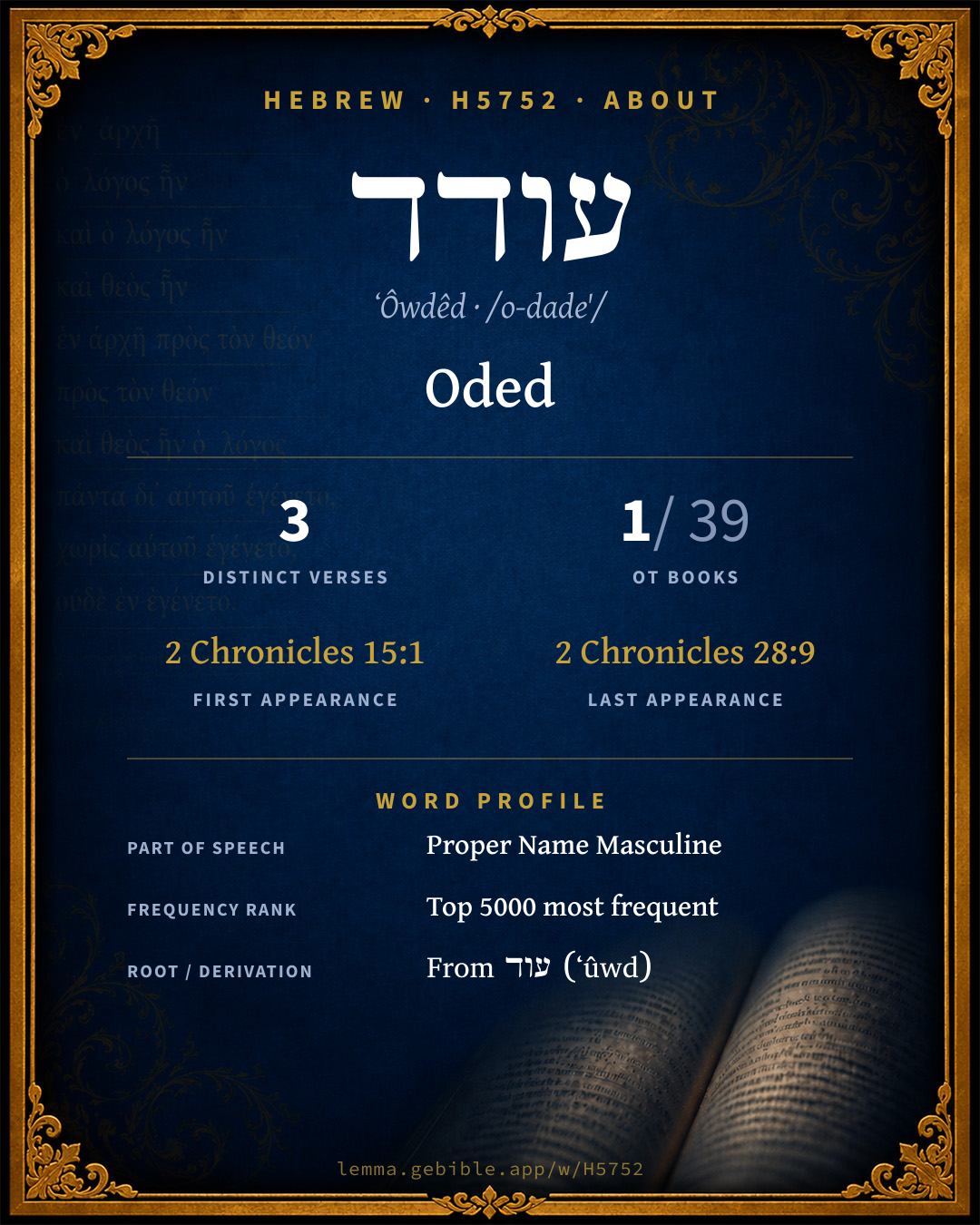
עֹדֵד
Oded
BDB lists 3 entries for ‘Oded’ fuller range ↓
Full lexicon entry — Brown-Driver-Briggs (BDB)
From Brown-Driver-Briggs (BDB)
Where this word appears
Grammar key — what these labels mean
Part of speech
- Noun
- A naming word — a person, place, thing, or idea.
Noun type
- Proper
- A name of a specific person, place, or people (e.g. Abraham, Zion, Israel).
Every verse where H5752 appears — 3 distinct verses across 1 book. Click any verse to open its interlinear word-by-word view. Verse text shown in the World English Bible for context — . Each verse’s Hebrew form is shown with its reference; the English is not keyword-highlighted, since the data carries no word-level English alignment. Use “Compare translations” on any verse to read it across multiple English versions. This concordance covers the Hebrew Bible; Septuagint (Greek Old Testament) occurrences are not indexed here.
2 Chronicles 3 verses
- 2 Chronicles 15:1 עוֹדֵ֔ד n Proper The Spirit of God came on Azariah the son of Oded:
- 2 Chronicles 15:8 עֹדֵ֣ד n Proper When Asa heard these words, and the prophecy of Oded the prophet, he took courage, and put away the abominations out of all the land of Judah and Benjamin, and out of the cities which he had taken from the hill-country of Ephraim; and he renewed the altar of Yahweh, that was before the porch of Yahweh.
- 2 Chronicles 28:9 עֹדֵ֣ד n Proper But a prophet of Yahweh was there, whose name was Oded: and he went out to meet the host that came to Samaria, and said to them, Behold, because Yahweh, the God of your fathers, was angry with Judah, he has delivered them into your hand, and you have slain them in a rage which has reached up to heaven.
About this entry
At a glance — auto-summarized from this page’s data, not written by a person. Every figure links to its source below. This summary describes the numbers; it doesn’t interpret them.
עודד — transliterated ʻÔwdêd — is a Hebrew name carrying the sense “Oded.” With only 3 verses it sits in the long tail of Hebrew Bible vocabulary. Its uses cluster heavily in 2 Chronicles (100% of all occurrences). Debuting at 2 Chronicles 15:1, it then recurs through the corpus. See 3-verse concordance and the renderings breakdown below.
Gloss history
Strong's 1890 vs modern scholarship
About this word
Strong's H5752 catalogs a Hebrew word from the Hebrew Old Testament.
These counts are not copied from any lexicon or concordance. They are computed here, from the morphology-tagged Hebrew Old Testament. What Lemma adds →
- 3
- distinct verses
- The word appears in 3 distinct verses.
- 1 / 39
- OT books
- The word appears in 1 of 39 Old Testament books.
- #4,179
- by frequency
- Top 5000 most frequent Hebrew words (rank 4,179 of 8,640 Hebrew words by occurrence).
View all 3 occurrences in the concordance →
Most concentrated in
- 2 Chronicles 3 verses 100%
By section of the Old Testament
By traditional corpus
Conventional, traditional groupings — biblical authorship is debated, so this is a traditional corpus grouping, not an authorship claim. Each share is this word’s portion of its verses in that division of the Hebrew canon. Each figure is a share of the word’s 3 distinct verses.
- Writings (Ketuvim) 3 verses · 100%
How translations render this word
Counts come from each version’s own published word-to-Strong’s tagging or interlinear alignment — an approximate guide to how each version renders this word, not a word-level alignment the data otherwise carries. Because each total is that version’s own tagged count, the per-version totals vary from one another and need not match the appearance or distinct-verse counts above. These counts may also differ from a printed concordance because Lemma counts each distinctly tagged rendering and does not collapse phrase taggings into a single head-word total. This is a fixed set of word-tagged versions (KJV, ASV, BSB, ULT) and does not change with the reading translation you choose elsewhere. Each version’s license is shown beside its name below (and on Sources).
- King James Version: Oded 2×
- American Standard Version: Oded 2×
- Berean Standard Bible: Oded 3×
- unfoldingWord Literal Text: Oded 3×
King James Version Public Domain
Renders H5752 across 3 tagged occurrences — most commonly:
Plus 1 rendering that appears only once — usually multi-word phrases or single function words the recovered tagging swept in, not distinct renderings.
American Standard Version Public Domain
Renders H5752 across 3 tagged occurrences — most commonly:
Plus 1 rendering that appears only once — usually multi-word phrases or single function words the recovered tagging swept in, not distinct renderings.
Berean Standard Bible Public Domain
Renders H5752 across 3 tagged occurrences — most commonly:
unfoldingWord Literal Text CC BY-SA 4.0
Renders H5752 across 3 tagged occurrences — most commonly:
Senses in the full BDB
What do BDB’s symbols mean?
BDB uses these scholarly abbreviations:
| Symbol | Meaning |
|---|---|
| 𝔊 | the Septuagint (the ancient Greek translation, LXX) |
| 𝔙 | the Vulgate (the Latin translation) |
| 𝔖 | the Syriac version (the Peshitta) |
| 𝔗 | the Targum (the Aramaic translation) |
| ψ | the Psalms |
| √ | root (the underlying root or stem) |
| ‖ | parallel passage (a synonymous or contrasted parallel) |
| † | the dagger: every passage where the word occurs is cited |
The 2 senses and sub-senses the full Brown-Driver-Briggs lexicon distinguishes for this word, in lexicon order (not ranked by frequency), with BDB’s own verbatim wording and sub-sense lettering. Shown in Hebrew script with BDB’s own scholarly abbreviations. The condensed entry is in the Lexicon Entry tab. See also the Forms in the corpus table below.
- 1. עֲזַרְיָהוּ בֶן־עו׳ 2 Ch 15:1, so read also v 8 (MT עֹדֵד alone). e.g. 2 Chronicles 15:1
- 2. עֹדֵד a prophet 2 Ch 28:9. e.g. 2 Chronicles 28:9
Senses from the full Brown-Driver-Briggs lexicon (Brown, Driver, Briggs; Oxford 1906 — public domain), digitized via Sefaria, supplemented by the OpenScriptures HebrewLexicon (CC BY 4.0). Full attribution on Sources.
Word origin
n.pr.m. (restorer);—𝔊 Ωδηδ, Αδαδ:
— Brown-Driver-Briggs (Oxford 1906, public domain), digitized via Sefaria, supplemented by the OpenScriptures HebrewLexicon (CC BY 4.0). See Sources.
Derived from עוד (ʻûwd) (H5749) — to testify.
Jastrow Dictionary
A second Hebrew/Aramaic lexicon for comparison, covering Aramaic and post-biblical (Talmudic, Targumic, Midrashic) usage that the biblical-Hebrew BDB does not. Matched by lemma rather than by Strong’s number, so a lemma may carry more than one Jastrow headword (shown separately below), and the entries cover usage well beyond the Bible.
עוּד
- to turn, return, occur; to continue, endure, exist (v. Ges. Thes. s. v.).—Denom. עַד, עוֹד, עֵת &c.
- to straighten, erect, help up. Midr. Till. to Ps. CXLVI, 9 וכי כל … מְעוֹדֵד does the Lord uphold all widows and orphans?—*Part. pass. מְעוֹדָד; pl. מְעוֹדָדִים, מְעוֹדָדִין. Tosef. Makhsh. I, 3 שק אחד מע׳ (ed. Zuck. מעודר, Var. מועדר; R. S. to Makhsh. I, 4 מעורר; Makhsh. l. c. מלא פירות) one bag standing upright (closely packed); ib. שני שקין מע׳ (ed. Zuck. מעודרון, Var. מעודדי, R. S. מעוררין).
- (denom. of עֵד)
- 1. to declare one’s presence at a certain occurrence, esp. to establish a law from a witnessed precedent or traditional knowledge. Eduy. II, 1 ר׳ חנינא … ה׳ וכ׳ R. H. … related four things which he knew by tradition. Ib. 3 אף הוא ה׳ על וכ׳ he also reported as a precedent the case of a small village &c.; a. fr.
- 2. to testify before court. Ib. IV, 11 מי שהיו … מְעִידוֹת אותו he concerning whom there were two sets of witnesses testifying; אלו מְעִידִים וכ׳ the ones testifying that &c. Macc. I, 1 מעידין אנו באיש … שגירש וכ׳ (Bab. ed. 3ᵃ … את איש) we testify about this man that he divorced &c. Ib. 2, sq.; a. v. fr.—Ḥag. 5ᵃ וממהר להָעִידוֹ and is quick to testify against him; Yalk. Mal. 589 ומֵעִיד בו.
- 3. to call upon as witness. Lev. R. s. 2 מְעִידֵנִי עלי וכ׳ I call upon heaven and earth as my witnesses &c.; Arakh. 16ᵇ מעיד אני וכ׳; a. fr.
- 4. to forewarn, exhort. Lev. R. l. c. שבעה נביאים … והן מעידין וכ׳ seven prophets stood up for the nations exhorting them; לא הֵעִידוּ בנו they have not warned us; גירי הדור מעידין בדור the proselytes of every generation are an exhortation to their respective generation; a. e.—Esp. to forewarn the owner of a noxious animal; to declare an animal noxious (v. מוּעָד). B. Kam. II, 4 כל שהֵעִידוּ בו וכ׳, v. מוּעָד. Ib. 24ᵃ עד שיָעִידוּ בו וכ׳ unless he be declared noxious (testimony be deposited stating the facts on which the declaration is based) in the presence of the owner and in court. Ib. הֵעִידוּהוּ שנים וכ׳ if the first case has been ascertained by two witnesses &c.; a. fr.—Part. pass. מוּעָד q. v.
A Dictionary of the Targumim, the Talmud Babli and Yerushalmi, and the Midrashic Literature (Marcus Jastrow; London, Luzac, 1903) — Public Domain. Digitized via Sefaria. Digitized via Sefaria. Full attribution on Sources.
Forms in the corpus
The 2 distinct written forms H5752 takes in the Hebrew Bible, most frequent first — each parse links to that state’s occurrences in the concordance. Hebrew forms include their vowel points and cantillation, so a single lemma takes many written forms.
| Form | Parsing | Example | Uses |
|---|---|---|---|
| עֹדֵ֣ד | Noun, Proper | 2 Chronicles 15:8 | 2 |
| עוֹדֵ֔ד | Noun, Proper | 2 Chronicles 15:1 | 1 |
Same root — word family
Other BDB entries built from the same root as H5752, grouped by Strong’s listed origin. These share a root / origin per the lexicon — not necessarily a shared meaning. Each links to that word’s own entry.
Derives from
Shares the same root
Compare all same-root words → Showing 4 of 5 — not the complete family. They share a root, not necessarily a meaning.
Bible dictionary
Public-domain dictionary articles matched to this entry by name (Oded). A biblical name can be shared by more than one person or place, so an article may treat several.
Easton's Bible Dictionary · M. G. Easton, 1897
Restoring, or setting up. (1.) Father of the prophet Azariah (2 Chr. 15:1, 8).
(2.) A prophet in the time of Ahaz and Pekah (2 Chr. 28:9-15).
Smith's Bible Dictionary · William Smith, 1863
(restoring).
+ The father of Azariah the prophet, in the reign of Asa. (2 Chronicles 15:1) (B.C. before 953.) + A prophet of Jehovah in Samaria, at the time of Pekah's invasion of Judah. (2 Chronicles 28:9) (B.C. 739.)
Hitchcock's Bible Names Dictionary · Roswell D. Hitchcock, 1869
to sustain, hold or lift up
Classic public-domain reference works; full attribution on Sources.
Septuagint verse parallels
This word appears in 3 verses that also exist in the Greek Old Testament (Septuagint), out of the 3 Hebrew verses it occurs in. You can read those verses in Greek by switching the Old Testament edition to the Septuagint.
Read these verses in the Septuagint
This is a verse-level parallel only — the same verses exist in both the Hebrew and Greek Old Testaments. No word-level Hebrew↔Greek correspondence is claimed: the data carries no such alignment, so no Greek word is shown as this Hebrew word’s translation. Coverage is not total — the Septuagint omits the deuterocanon and renumbers the Psalms, so some Hebrew verses have no direct Greek parallel.