
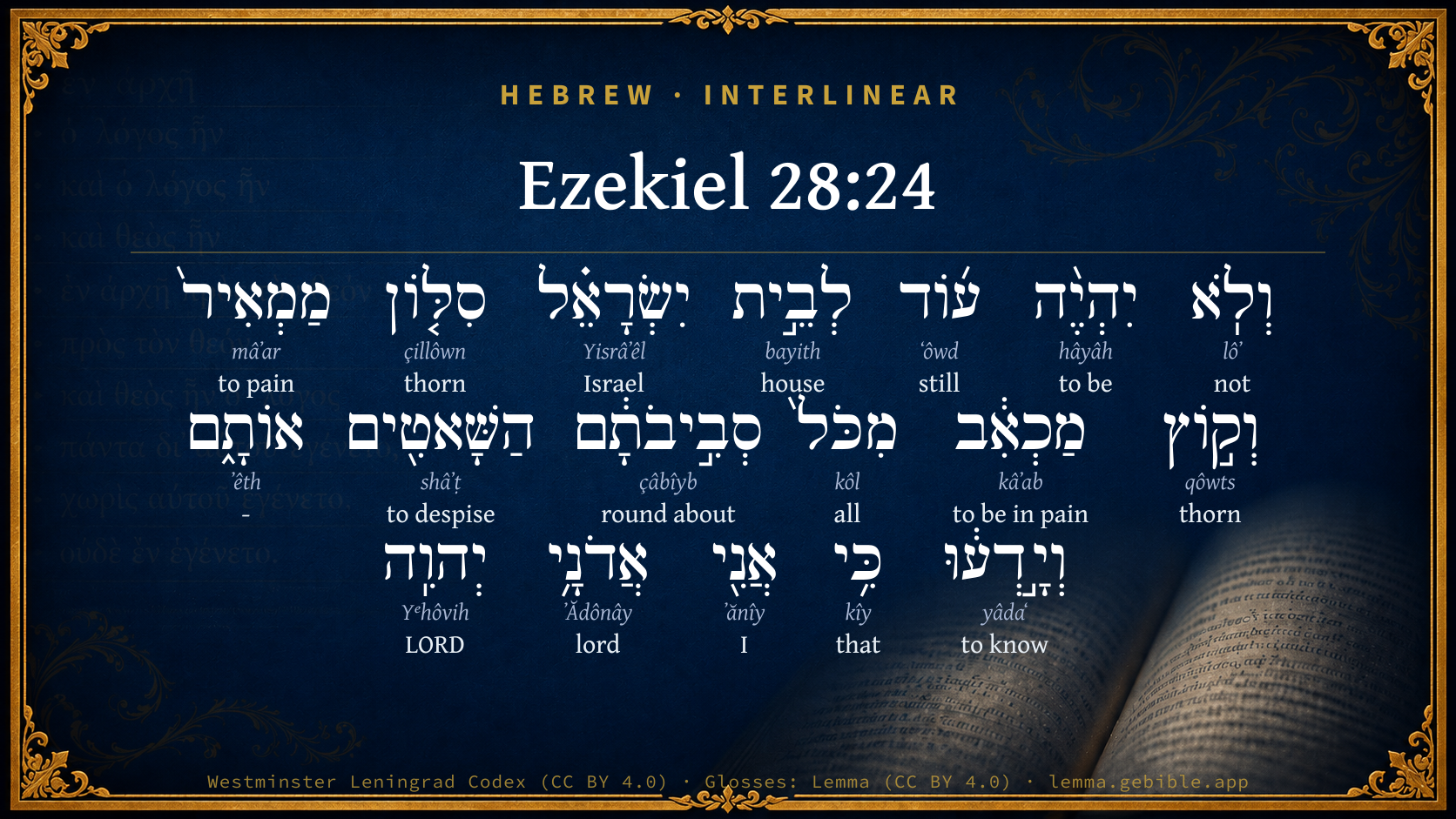
Ezekiel 28:24

Hebrew (Westminster Leningrad Codex) Ezekiel 28:24 appears in the Hebrew Old Testament. The text above is from the Westminster Leningrad Codex. Each word links to its Strong’s number, a concise gloss, and parsing drawn from the Open Scriptures Hebrew Bible morphology. Click any word for its full Brown-Driver-Briggs (BDB) entry.
Download image
Cite this verse

Ezekiel 28:24 (World English Bible). Public Domain. Lemma interlinear Bible study tool, https://lemma.gebible.app/v/ezekiel/28/24.

Show BibTeX & RIS
BibTeX
RIS
English Translation
There shall be no more a pricking brier to the house of Israel, nor a hurting thorn of any that are round about them, that did despite to them; and they shall know that I am the Lord Yahweh.
World English Bible · Public Domain
Download a study sheet

One document with this verse’s original text, its word-by-word gloss line, the meaning frame, cross-references with their text, attributed commentary, and full source and license credits — printable, and it pastes into notes with its structure intact.

This verse Autodidact and up

Study sheet (.html) Plain text (.txt)

A passage Seminary Student

Up to 50 verses in one chapter. A passage sheet keeps up to 6 commentary sources and 12 cross-references per verse, in the order this page ranks them, and says so on the sheet whenever that leaves anything out. Ask for a single verse and you get the Autodidact verse sheet above.

Everything on this page stays free to read, with no account — the sheet is a download of what is already on screen, not access to it.

Want to remove ads? Support Godless Engineer
Compare translations 3

The same verse in 3 English versions, stacked beneath the original-language interlinear above. Click any original word for its lexicon entry.

Each is an independent rendering of the whole verse — the interlinear is not word-aligned to these translations.

Highlighted words mark where these versions differ — a whole-verse word diff, not a word-by-word alignment.

  • World English Bible Public Domain
    There shall be no more a pricking brier to the house of Israel, nor a hurting thorn of any that are round about them, that did despite to them; and they shall know that I am the Lord Yahweh.
  • King James Version Public Domain
    And there shall be no more a pricking brier unto the house of Israel, nor any grieving thorn of all that are round about them, that despised them; and they shall know that I am the Lord GOD.
  • unfoldingWord Literal Text CC BY-SA 4.0
    Then there will no longer be pricking briars and painful thorns for the house of Israel from all those around her who despise her people, so they will know that I am the Lord Yahweh!’

unfoldingWord Literal Text — © unfoldingWord, licensed CC BY-SA 4.0. Word-aligned USFM3 via Door43 (git.door43.org/unfoldingWord/en_ult).

Versions to compare (up to 4)

3 of 4 selected

Show all 18 translations

Every available English version of this verse, each an independent rendering of the whole verse.

  • World English Bible Public Domain
    There shall be no more a pricking brier to the house of Israel, nor a hurting thorn of any that are round about them, that did despite to them; and they shall know that I am the Lord Yahweh.
  • Berean Standard Bible Public Domain
    For the people of Israel will no longer face a pricking brier or a painful thorn from all around them who treat them with contempt. Then they will know that I am the Lord GOD.’
  • Majority Standard Bible Public Domain
    For the people of Israel will no longer face a pricking brier or a painful thorn from all around them who treat them with contempt. Then they will know that I am the Lord GOD.’
  • King James Version Public Domain
    And there shall be no more a pricking brier unto the house of Israel, nor any grieving thorn of all that are round about them, that despised them; and they shall know that I am the Lord GOD.
  • American Standard Version (1901) Public Domain
    And there shall be no more a pricking brier unto the house of Israel, nor a hurting thorn of any that are round about them, that did despite unto them; and they shall know that I am the Lord Jehovah.
  • Revised Version (1885) Public Domain
    And there shall be no more a pricking brier unto the house of Israel, nor a grieving thorn of any that are round about them, that did despite unto them; and they shall know that I am the Lord GOD.
  • Geneva Bible (1599) Public Domain
    And they shalbe no more a pricking thorne vnto the house of Israel, nor any grieuous thorne of all that are round about them, and despised them, and they shall knowe that I am the Lord God.
  • Douay-Rheims (1899) Public Domain
    And the house of Israel shall have no more a stumblingblock of bitterness, nor a thorn causing pain on every side round about them, of them that are against them: and they shall know that I am the Lord God.
  • Young's Literal Translation Public Domain
    And there is no more to the house of Israel A pricking brier, and paining thorn, Of all round about them -- despising them, And they have known that I `am' the Lord Jehovah.
  • Literal Standard Version CC BY-SA 4.0
    And there is no more pricking brier and paining thorn || For the house of Israel, || Of all around them—despising them, || And they have known that I [am] Lord YHWH.
  • Unlocked Literal Bible CC BY-SA 4.0
    Then there will no longer be pricking briars and painful thorns for the house of Israel from all those around her who despise her people, so they will know that I am the Lord Yahweh!'
  • unfoldingWord Literal Text CC BY-SA 4.0
    Then there will no longer be pricking briars and painful thorns for the house of Israel from all those around her who despise her people, so they will know that I am the Lord Yahweh!’
  • Darby Bible Public Domain
    And there shall be no more a wounding sting for the house of Israel, nor any grieving thorn, among all that were round about them, that despised them: and they shall know that I [am] the Lord Jehovah.
  • World Messianic Bible Public Domain
    “‘“There will no longer be a pricking brier to the house of Israel, nor a hurting thorn of any that are around them that scorned them. Then they will know that I am the Lord GOD.”
  • Webster's Bible Public Domain
    And there shall be no more a pricking brier to the house of Israel, nor any grieving thorn of all that are around them, that despised them; and they shall know that I am the Lord GOD.
  • Free Bible Version CC BY-SA 4.0
    The people of Israel will no longer have to put up with these people who are thorns in their side, painful brambles and sharp thorns who treat Israel with contempt. Then they will know that I am the Lord God.
  • Bible in Basic English Public Domain
    And there will no longer be a plant with sharp points wounding the children of Israel, or a thorn troubling them among any who are round about them, who put shame on them; and they will be certain that I am the Lord.
  • JPS Tanakh (1917) Public Domain
    And there shall be no more a pricking brier unto the house of Israel, nor a piercing thorn of any that are round about them, that did have them in disdain; and they shall know that I am the Lord GOD.

Literal Standard Version (2020), Covenant Press — licensed CC BY-SA 4.0. Text via the HelloAO Bible API (eBible.org). Unlocked Literal Bible (unfoldingWord) — licensed CC BY-SA 4.0. Text via the HelloAO Bible API (eBible.org). unfoldingWord Literal Text — © unfoldingWord, licensed CC BY-SA 4.0. Word-aligned USFM3 via Door43 (git.door43.org/unfoldingWord/en_ult). Free Bible Version, Dr. Jonathan Gallagher — licensed CC BY-SA 4.0. Text via the HelloAO Bible API (eBible.org).

Word by word

More ways to search: Search by grammar → Find every occurrence → Compare this word →

Practice this passage: Drill this verse → Learn its vocabulary →

סִלּ֤וֹן
çillôwn
H5544
“thorn”
Noun, Common, Masculine, Singular, Absolute
Part of Speech
Noun
Type
Common
Gender
Masculine
Number
Singular
State
Absolute
Full BDB Definition

Origin: from H5541

TWOT: 1504

brier, thorn
  1. וְלֹֽא lôʼ H3808 “and · not” Conjunction + Particle, Negative
  2. יִהְיֶ֨ה hâyâh H1961 “to be” Verb, Qal, Imperfect, 3rd Person, Masculine, Singular
  3. ע֜וֹד ʻôwd H5750 “still” Adverb
  4. לְבֵ֣ית bayith H1004 “to/for · house of” Preposition + Noun, Common, Masculine, Singular, Construct
  5. יִשְׂרָאֵ֗ל Yisrâʼêl H3478 “Israel” Noun, Proper
  6. מַמְאִיר֙ mâʼar H3992 “paining” Verb, Hiphil, Participle Active, Masculine, Singular, Absolute
  7. וְק֣וֹץ qôwts H6975 “and · thorn” Conjunction + Noun, Common, Masculine, Singular, Absolute
  8. מַכְאִ֔ב kâʼab H3510 “being in pain” Verb, Hiphil, Participle Active, Masculine, Singular, Absolute
  9. מִכֹּל֙ kôl H3605 “from · all of” Preposition + Noun, Common, Masculine, Singular, Construct
  10. סְבִ֣יבֹתָ֔ם çâbîyb H5439 “surroundings · their” Noun, Common, Both, Plural, Construct + Suffix, Personal, 3rd Person, Masculine, Plural
  11. הַשָּׁאטִ֖ים shâʼṭ H7590 “the · despising” Particle, Definite Article + Verb, Qal, Participle Active, Masculine, Plural, Absolute
  12. אוֹתָ֑ם ʼêth H853 “- · them” Particle, Direct Object + Suffix, Personal, 3rd Person, Masculine, Plural
  13. וְיָ֣דְע֔וּ yâdaʻ H3045 “and · to know” Conjunction + Verb, Qal, Sequential Perfect, 3rd Person, Common, Plural
  14. כִּ֥י kîy H3588 “that” Conjunction
  15. אֲנִ֖י ʼănîy H589 “I” Pronoun, Personal, 1st Person, Common, Singular
  16. אֲדֹנָ֥י ʼĂdônây H136 “Lord · my” Noun, Common, Masculine, Plural, Construct + Suffix, Personal, 1st Person, Common, Singular
  17. יְהוִֽה Yᵉhôvih H3069 “LORD” Noun, Proper

About this verse

These counts appear in no published source. They are computed here, from the morphology-tagged text and Lemma’s own curated glosses. What Lemma adds →

18
words
18
distinct lemmas
Prophets
section

Notable vocabulary

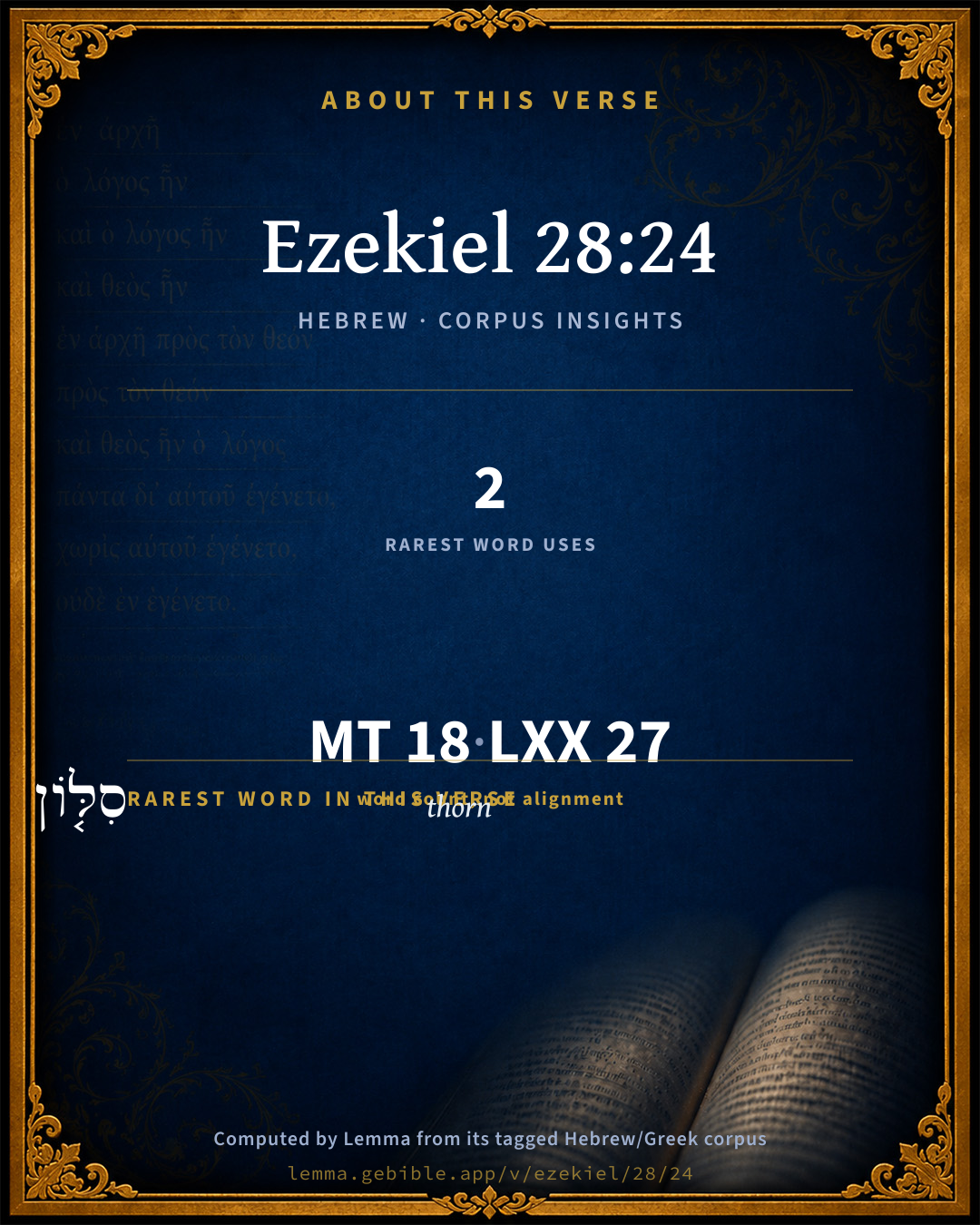
The rarest word here is סִלּ֤וֹן thorn H5544 — appearing just 2 times in the whole Hebrew Bible.

Shared distinctive vocabulary

סִלּ֤וֹן thorn H5544 occurs in 2 verses of the Hebrew Bible. Also found in:

Grammatical profile

  • 5 verbs
  • 8 nouns
  • 1 pronoun
  • 1 conjunction
  • 1 adverb
  • 2 particles

Verb forms

  • יִהְיֶ֨ה Qal · Imperfect
  • מַמְאִיר֙ Hiphil · Participle Active
  • מַכְאִ֔ב Hiphil · Participle Active
  • הַשָּׁאטִ֖ים Qal · Participle Active
  • וְיָ֣דְע֔וּ Qal · Sequential Perfect

Hebrew & Septuagint length

In English translation the verse runs 39 words from the Hebrew and 39 from the Septuagint (LXX English) — the same length.

A rough comparison of the two English renderings, which tokenize alike — not a word-level alignment.

Word counts can differ between the Hebrew and the Greek without any difference in meaning — e.g. the Hebrew direct-object marker אֵת has no separate Greek word, and Greek often adds the article ὁ.

In the original languages it is 18 Hebrew tokens and 27 Greek tokens — but the two are counted differently (Hebrew bundles its prefixes and suffixes into one token; the Greek is in lemma form), so that isn’t a like-for-like length.

Cross-references

14

Topical passages linked to Ezekiel 28:24 in the Treasury of Scripture Knowledge — connected by theme and wording, ordered by reader-vote popularity; previews shown in the World English Bible.

  • Numbers 33:55 But if you will not drive out the inhabitants of the land from before you, then shall those who you let remain of them be as pricks in your eyes, and as thorns in your sides, and they shall vex you in the land in which you dwell.
  • Joshua 23:13 know for a certainty that Yahweh your God will no more drive these nations from out of your sight; but they shall be a snare and a trap to you, and a scourge in your sides, and thorns in your eyes, until you perish from off this good land which Yahweh your God has given you.
  • 2 Corinthians 12:7 By reason of the exceeding greatness of the revelations, that I should not be exalted excessively, there was given to me a thorn in the flesh, a messenger of Satan to buffet me, that I should not be exalted excessively.
  • Isaiah 55:13 Instead of the thorn shall come up the fir tree; and instead of the brier shall come up the myrtle tree: and it shall be to Yahweh for a name, for an everlasting sign that shall not be cut off.
  • Ezekiel 2:6 You, son of man, don't be afraid of them, neither be afraid of their words, though briers and thorns are with you, and you do dwell among scorpions: don't be afraid of their words, nor be dismayed at their looks, though they are a rebellious house.
  • Judges 2:3 Therefore I also said, I will not drive them out from before you; but they shall be [as thorns] in your sides, and their gods shall be a snare to you.
  • Isaiah 35:9 No lion shall be there, nor shall any ravenous animal go up thereon; they shall not be found there; but the redeemed shall walk [there]:
  • Jeremiah 12:14 Thus says Yahweh against all my evil neighbors, who touch the inheritance which I have caused my people Israel to inherit: behold, I will pluck them up from off their land, and will pluck up the house of Judah from among them.
  • Ezekiel 28:23 For I will send pestilence into her, and blood into her streets; and the wounded shall fall in the midst of her, with the sword on her on every side; and they shall know that I am Yahweh.
  • Ezekiel 28:26 They shall dwell securely therein; yes, they shall build houses, and plant vineyards, and shall dwell securely, when I have executed judgments on all those who do them despite round about them; and they shall know that I am Yahweh their God.
  • Ezekiel 36:36–38 Then the nations that are left round about you shall know that I, Yahweh, have built the ruined places, and planted that which was desolate: I, Yahweh, have spoken it, and I will do it.
  • Ezekiel 39:28 They shall know that I am Yahweh their God, in that I caused them to go into captivity among the nations, and have gathered them to their own land; and I will leave none of them any more there;
  • Micah 7:4 The best of them is like a brier. The most upright is worse than a thorn hedge. The day of your watchmen, Even your visitation, has come; Now is the time of their confusion.
  • Revelation 21:4 He will wipe away from them every tear from their eyes. Death will be no more; neither will there be mourning, nor crying, nor pain, any more. The first things have passed away."

Cross-references courtesy of OpenBible.info (CC BY 4.0).

Hebrew and Greek witnesses Masoretic Hebrew ↔ Greek Septuagint

The same verse in the two great witnesses to the Old Testament, shown verse-for-verse.

These are two independent witnesses, not word-aligned to each other, and the Septuagint is shown in lemma (dictionary) form.

Hebrew Ezekiel 28:24 Masoretic · Westminster Leningrad Codex

וְלֹֽא יִהְיֶ֨ה ע֜וֹד לְבֵ֣ית יִשְׂרָאֵ֗ל סִלּ֤וֹן מַמְאִיר֙ וְק֣וֹץ מַכְאִ֔ב מִכֹּל֙ סְבִ֣יבֹתָ֔ם הַשָּׁאטִ֖ים אוֹתָ֑ם וְיָ֣דְע֔וּ כִּ֥י אֲנִ֖י אֲדֹנָ֥י יְהוִֽה

There shall be no more a pricking brier to the house of Israel, nor a hurting thorn of any that are round about them, that did despite to them; and they shall know that I am the Lord Yahweh.

World English Bible · Public Domain

Greek LXX Ezekiel 28:24 Septuagint · lemma form

καί οὐ εἰμί οὐκέτι ὁ οἶκος ὁ ἰσραήλ σκόλοψ πικρία καί ἄκανθα ὀδύνη ἀπό πᾶς ὁ περικύκλῳ αὐτός ὁ ἀτιμάζω αὐτός καί γιγνώσκω ὅτι ἐγώ εἰμί κύριος

And there shall no more be in the house of Israel a thorn of bitterness and a pricking briar proceeding from them that are round about them, who dishonored them; and they shall know that I am the Lord.

LXX2012 (modern English Septuagint) · Public Domain

Hebrew: Westminster Leningrad Codex (CC BY 4.0). Greek: Septuagint (public domain); English from LXX2012 (modern English Septuagint) (Public Domain). How the Septuagint differs from the Hebrew →

Targum (Aramaic paraphrase)

1

The Targum is the ancient Jewish Aramaic paraphrase of the Hebrew Scriptures — an interpretive translation, not the Hebrew text itself. Onkelos (literal) and Pseudo-Jonathan (expansive) render the Torah, and Jonathan the Prophets. Coverage is partial: where no permissively-licensed English translation exists for a verse, only the Aramaic is shown. This is verse-level text, not a word-by-word alignment to the Hebrew.

  1. Targum Jonathan Prophets (Joshua–Malachi)
    וְלָא יְהֵי עוֹד לְבֵית יִשְׂרָאֵל מְלַךְ מַבְאִישׁ וְשִׁלְטוֹן מָעֵיק מִכָּל סָחֳרָנֵיהוֹן דְבָזְזִין יַתְהוֹן וְיֵדְעוּן אֲרֵי אֲנָא יְיָ אֱלֹהִים:

    (no public-domain English translation for this verse)

    Targum Jonathan — Aramaic: “Mikraot Gedolot” (public domain). English: “Sefaria Community Translation” (CC0 1.0 (public-domain dedication)); “London "Chaldee Paraphrase," 1871” (public domain). Text via Sefaria.

Commentary

Notes on Ezekiel 28:24 from classic Christian and Jewish commentators (each source and its license shown beneath its notes). The classic Christian expositions comment on the surrounding passage and are grouped to its opening verse, so a note may address several verses; the Jewish commentaries on the Tanakh (Rashi and others) are per-verse, so they appear only where the commentator wrote on this verse.

Lemma curates 59 commentaries, every one of them public domain or Creative Commons licensed, each selected and text-cleaned for this edition rather than reprinted as found. About our sources →

Trapp's Complete Commentary

John Trapp

Eze 28:24 And there shall be no more a pricking brier unto the house of Israel, nor [any] grieving thorn of all [that are] round about them, that despised them; and they shall know that I [am] the Lord GOD.

Ver. 24. And there shall be no more a pricking brier.] For God will take away the Canaanite out of the land, {Zec 14:21} omnem spinum dolorificum: he will by his judgments provide for his own glory, and for his people’s comfort.

John Trapp, A Commentary or Exposition upon All the Books of the Old and New Testament (1647–1656) — public domain. Text from a community e-Sword module.

Joseph Benson's Commentary

Eze 28:24-26. There shall be no more a pricking brier — There shall no more be any nation that shall injure, and be a vexation to the house of Israel; for all their troublesome neighbours, who had been as so many thorns in their sides, shall be destroyed or repressed, and in consequence thereof they shall dwell quietly and securely in their own land. This promise was in part fulfilled after their return from their captivity in Babylon; but the following verse shows that it chiefly relates to the general restoration of the Jews, when all the enemies of God’s church and truth shall be vanquished and subdued, often denoted in the prophetical writings by the name of Edom, Moab, and other neighbouring nations, who, upon all occasions, were wont to show their spite and ill-will against God’s ancient people. When I shall have gathered the house of Israel, &c. — This seems to be a plain prophecy of the restoration of the Jews to their own land, as will appear to any one who will compare the words with the parallel texts referred to in the margin; and the rules laid down concerning the division of the land among the twelve tribes (chap. 47., 48.) do very much favour this interpretation: see note on Isa 11:12. And shall be sanctified in them — See on Eze 28:22. And they shall dwell safely therein — In comparison of what they have done formerly: they shall have peace, and freedom from the annoyance of enemies. And shall build houses, and plant vineyards — Building and planting are commonly joined together. When I shall have executed judgments — The prophets commonly conclude their threatenings against infidels with gracious promises to God’s people, implying that he will not make an utter destruction of them, as of other people, but preserve a remnant, to whom he may fulfil his promises made to their fathers.

Joseph Benson's Commentary on the Old and New Testaments (1811–1818) — public domain. Text from a community e-Sword module.

Jamieson, Fausset & Brown

Robert Jamieson, A. R. Fausset & David Brown

no more . . . brier . . . unto . . . Israel--as the idolatrous nations left in Canaan (among which Zidon is expressly specified in the limits of Asher, Jdg 1:31) had been (Num 33:55; Jos 23:13). "A brier," first ensnaring the Israelites in sin, and then being made the instrument of punishing them.

pricking--literally, "causing bitterness." The same Hebrew is translated "fretting" (Lev 13:51-52). The wicked are often called "thorns" (Sa2 23:6).

Jamieson, Fausset & Brown — Commentary Critical and Explanatory on the Whole Bible (1871) — public domain (CC PDM 1.0). Text via the HelloAO Bible API.

Adam Clarke's Commentary

Verse 24. There shall be no more a pricking brier] Nothing to excite Israel to idolatry when restored from their captivity. Perhaps there is an allusion to Jezebel, daughter of Ethbaal, king of Sidon, and wife to Ahab, king of Israel, who was the greatest curse to Israel, and the universal restorer of idolatry in the land, see 1Kg 16:31. Sidon being destroyed, there would come no encourager of idolatry from that quarter.

Adam Clarke's Commentary on the Bible (1810–1826) — public domain. Text from a community e-Sword/MySword module.

Ellicott's Commentary for English Readers

(24) A pricking brier.—The language refers back to the threat of Num_33:55, of the reality of which Israel had long had such bitter experience. Nothing is said of the special sins of Zidon, and very little of the detail of her overthrow; these were already sufficiently known, or else included in what has been said of Tyre. It is noticeable that no such utter desolation is foretold as in the former case.

A Bible Commentary for English Readers, edited by Charles John Ellicott (1878–1897) — public domain. Text from a community e-Sword module.

The Cambridge Bible for Schools and Colleges

gen. ed. J. J. S. Perowne

24. “Brier” is “thorn” ch. Eze_2:6 (slightly different form). The term “pricking” is used of the leprosy (Lev_13:51, fretting).

The Cambridge Bible for Schools and Colleges (gen. ed. J. J. S. Perowne; Cambridge University Press, 1878–1918) — public domain. Text from a community e-Sword module.

John Gill's Exposition

And there shall be no more a pricking brier to the house of Israel,.... To the church of God, Jews or Gentiles, particularly to the Jews, who will now be converted; all the enemies of Christ and his people will now be destroyed, who have been very grievous and distressing to them by their furious persecutions; the pope and Turk will be no more, nor any of the antichristian powers; the beast and false prophet will be taken and cast into the lake of fire; and there will be none to hurt and destroy in all the holy mountain, Rev 19:20,

nor any grieving thorn of all that are round about them that despised them; the same thing in other words as before; wicked men, especially tyrannical princes, furious persecutors of the saints, are like thorns and briers, not only unfruitful, useless, and unprofitable, but pricking, grieving, and hurtful to good men, by their persecutions, revilings, and reproaches, and whose end is to be burned. The Targum of the whole is,

"and there shall be no more to the house of Israel a king that doth evil (or hurt), or a governor that oppresses all round about them that spoil them:''

and they shall know that I am the Lord; the house of Israel, the Jews now converted, they shall know the Lord Christ, and acknowledge him to be their Lord and King.

John Gill's Exposition of the Whole Bible (1746–1763) — public domain (CC PDM 1.0). Text via the HelloAO Bible API.

Haydock's Catholic Bible Commentary

Bitterness. Jezabel came hence; (4 Kings xvi. 31.) and the Phœnicians hemmed in the Israelites as much as possible, and fought against them. (Calmet) --- Sidon was near Tyre, and imitating her crimes was also punished.

George Leo Haydock (1774–1849), Haydock's Catholic Family Bible and Commentary, 1859 edition — public domain. Excludes Psalms (Douay-Rheims chapter numbering differs from Protestant) and Deuterocanonical books (Catholic canon only).

Matthew Poole's English Annotations

No more; the time intended here is, when, after seventy years’ captivity, loathing themselves for their iniquities, and repenting, they return and settle in their own land. Pricking brier, grieving thorn: by these two metaphors the prophet points out the troublesome neighbours of the Jews.

Of all that are round about them; such as Moab, Ammon, Edom, Tyre, and this Zidon, which on all occasions did grieve, wound, and reproach the Jews, and triumph in the fall of the Jews, and were ever ready, being near.

That despised them; contemning both in word and carriage the Jews, their religion, manners, laws, and their God. They shall know that I am the Lord: see Eze 28:22.

Matthew Poole's English Annotations on the Holy Bible (1683–1685) — public domain. Text from a community e-Sword/MySword module.

Whedon's Commentary on the Bible

Daniel D. Whedon

24. A pricking brier — Rather, fretting thorn (Eze_2:6; Lev_13:51, compare Num_33:55).

Daniel D. Whedon (gen. ed.), Commentary on the Old and New Testaments (1874–1909) — public domain. Text from a community e-Sword module.

The Pulpit Commentary

There shall be no more a pricking brier. There is a special appropriateness in Ezekiel"s imagery. The words had been used in Num_33:55 of the Canaanites at large. (comp. Jos_22:13) Ezekiel applies them to the cities which were the most conspicuous survivors of the old Canaanite races. Israel, he implies, had been wounded with those thorns and briers, had caught (as e.g. in the case of Jezebel) the taint of evil life and evil worship from those races; but for her there is, as in Ver. 25, the future of restoration, and when that future comes, the Canaanite cities, with their idolatries and vices, should have passed away forever.

The Pulpit Commentary (1880–1919), ed. H.D.M. Spence-Jones & Joseph S. Exell — public domain. Text from a community e-Sword module.

John Wesley's Explanatory Notes

A pricking briar - By these two metaphors the prophet points out the troublesome neighbours of the Jews, such as Moab, Ammon, Edom, Tyre, and Zidon. This never had a full accomplishment yet. But it will, for the scripture cannot be broken.

John Wesley, Explanatory Notes Upon the Whole Bible (1754–1765) — public domain. Text via the GEBible commentary corpus.

Rashi

Rabbi Shlomo Yitzchaki (Rashi)

And there will no longer be to the house of Israel, etc. Since he prophesied about Ammon, Moab, the Philistines, Edom, Tyre, and Zidon, who are the neighbors of the land of Israel, that they would be destroyed. Since they all will be destroyed, there will not be a briar or a thorn to [the people of Israel, in all their surroundings, to pain or harm them.

briars [Heb. סִילוֹן,] a species of thistles and thorns.

pricking [Heb. מַמְאִיר,] a matter of hurting, like (Lev. 13:51): “painful (מַמְאֶרֶת) zaarath,” poignante in French, stinging, pricking.

who plunder them [Heb. הַשָּׁאטִים,] who plunder them.

Rashi on the Tanakh — English translations: “The Judaica Press complete Tanach with Rashi, translated by A. J. Rosenberg” (CC BY 4.0); “Pentateuch with Rashi's commentary by M. Rosenbaum and A.M. Silbermann, 1929-1934” (public domain); “The Metsudah Tanach series, Lakewood, N.J” (CC BY 4.0); and “The Book of Joshua, Metsudah Publications, 1997” (CC BY 4.0). Text via Sefaria.

Lesson kit

Teaching starters — assembled from the data on this page, not authored interpretation. Every prompt links to the verse data it draws on. Edit before teaching.

Ezekiel, in the Prophets, opens this verse with 18 words (18 distinct Hebrew lemmas). Its most distinctive word is çillôwn (“thorn”). A historical commentator’s framing appears above. Read the whole chapter for the surrounding context.

Discussion questions

  1. How does “thorn” (çillôwn) shape what this verse is saying?
  2. How does Ezekiel 2:6, which shares the word «thorn», read alongside this verse?
  3. These translations render this verse differently; the difference is in the English rendering, not the original. What questions does that raise?
  4. «יִהְיֶ֨ה» is a Qal Imperfect verb. How does that grammatical form shape the action described?
  5. Compare how Trapp's Complete Commentary and Joseph Benson's Commentary read this verse. Where do they agree or differ?

Things to notice

Reading settings

Reading text

Shown beneath each verse's original-language words.

Old Testament
Old Testament edition

Read the OT as the Masoretic Hebrew (MT) or the Greek Septuagint (LXX).

English shown for the Greek Septuagint (in the Hebrew ↔ Greek comparison).

Comparing translations? Open the Compare panel on any verse page to stack up to four side by side.