2 Samuel 6:22

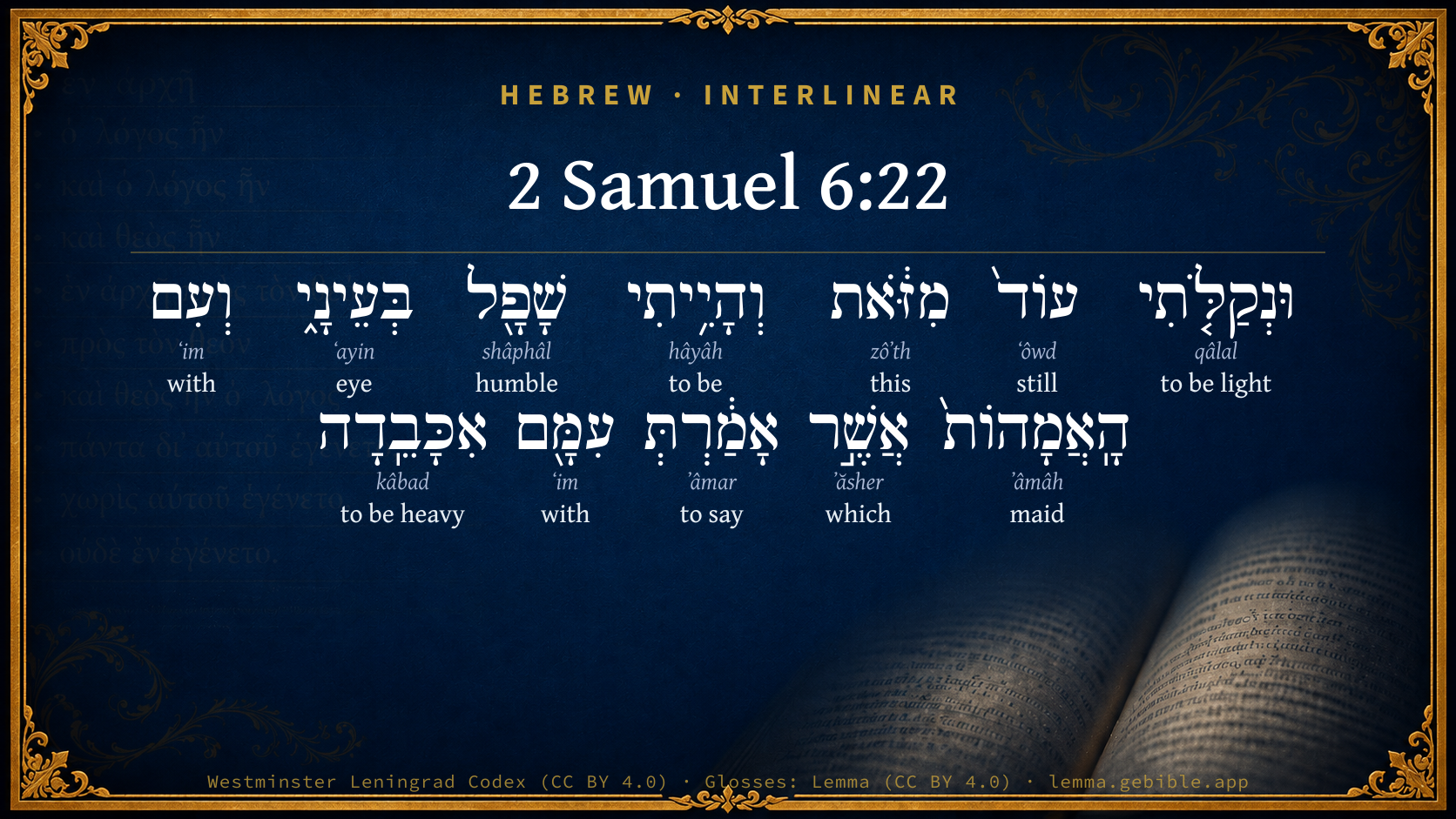
Hebrew (Westminster Leningrad Codex) 2 Samuel 6:22 appears in the Hebrew Old Testament. The text above is from the Westminster Leningrad Codex. Each word links to its Strong’s number, a concise gloss, and parsing drawn from the Open Scriptures Hebrew Bible morphology. Click any word for its full Brown-Driver-Briggs (BDB) entry.
Download image
Cite this verse

2 Samuel 6:22 (World English Bible). Public Domain. Lemma interlinear Bible study tool, https://lemma.gebible.app/v/2-samuel/6/22.

Show BibTeX & RIS
BibTeX
RIS
English Translation
I will be yet more vile than this, and will be base in my own sight: but of the handmaids of whom you have spoken, they shall honor me.
World English Bible · Public Domain
Download a study sheet

One document with this verse’s original text, its word-by-word gloss line, the meaning frame, cross-references with their text, attributed commentary, and full source and license credits — printable, and it pastes into notes with its structure intact.

This verse Autodidact and up

Study sheet (.html) Plain text (.txt)

A passage Seminary Student

Up to 50 verses in one chapter. A passage sheet keeps up to 6 commentary sources and 12 cross-references per verse, in the order this page ranks them, and says so on the sheet whenever that leaves anything out. Ask for a single verse and you get the Autodidact verse sheet above.

Everything on this page stays free to read, with no account — the sheet is a download of what is already on screen, not access to it.

Want to remove ads? Support Godless Engineer
Compare translations 3

The same verse in 3 English versions, stacked beneath the original-language interlinear above. Click any original word for its lexicon entry.

Each is an independent rendering of the whole verse — the interlinear is not word-aligned to these translations.

Highlighted words mark where these versions differ — a whole-verse word diff, not a word-by-word alignment.

  • World English Bible Public Domain
    I will be yet more vile than this, and will be base in my own sight: but of the handmaids of whom you have spoken, they shall honor me.
  • King James Version Public Domain
    And I will yet be more vile than thus, and will be base in mine own sight: and of the maidservants which thou hast spoken of, of them shall I be had in honor.
  • unfoldingWord Literal Text CC BY-SA 4.0
    And I will humble myself more than this, and I will be lowly in my eyes. But with the female servants whom you spoke, with them, I will be honored.”

unfoldingWord Literal Text — © unfoldingWord, licensed CC BY-SA 4.0. Word-aligned USFM3 via Door43 (git.door43.org/unfoldingWord/en_ult).

Versions to compare (up to 4)

3 of 4 selected

Show all 18 translations

Every available English version of this verse, each an independent rendering of the whole verse.

  • World English Bible Public Domain
    I will be yet more vile than this, and will be base in my own sight: but of the handmaids of whom you have spoken, they shall honor me.
  • Berean Standard Bible Public Domain
    and I will humiliate and humble myself even more than this. Yet I will be honored by the maidservants of whom you have spoken.”
  • Majority Standard Bible Public Domain
    and I will humiliate and humble myself even more than this. Yet I will be honored by the maidservants of whom you have spoken.”
  • King James Version Public Domain
    And I will yet be more vile than thus, and will be base in mine own sight: and of the maidservants which thou hast spoken of, of them shall I be had in honor.
  • American Standard Version (1901) Public Domain
    And I will be yet more vile than this, and will be base in mine own sight: but of the handmaids of whom thou hast spoken, of them shall I be had in honor.
  • Revised Version (1885) Public Domain
    And I will be yet more vile than thus, and will be base in mine own sight: but of the handmaids which thou hast spoken of, of them shall I be had in honour.
  • Geneva Bible (1599) Public Domain
    And will yet be more vile then thus, and will be low in mine owne sight, and of the verie same maidseruants, which thou hast spoken of, shall I be had in honour.
  • Douay-Rheims (1899) Public Domain
    I will both play and make myself meaner than I have done: and I will be little in my own eyes: and with the handmaid of whom thou speakest, I shall appear more glorious.
  • Young's Literal Translation Public Domain
    and I have been more vile than this, and have been low in mine eyes, and with the handmaids whom thou hast spoken of, with them I am honoured.'
  • Literal Standard Version CC BY-SA 4.0
    and I have been more vile than this, and have been low in my eyes, and with the handmaids whom you have spoken of, I am honored with them.”
  • Unlocked Literal Bible CC BY-SA 4.0
    I will be even more undignified than this, and I will be humiliated in my own eyes. But by these slave girls you have spoken about, I will be honored.”
  • unfoldingWord Literal Text CC BY-SA 4.0
    And I will humble myself more than this, and I will be lowly in my eyes. But with the female servants whom you spoke, with them, I will be honored.”
  • Darby Bible Public Domain
    And I will make myself yet more vile than thus, and will be base in mine own sight; and of the handmaids that thou hast spoken of, of them shall I be had in honour.
  • World Messianic Bible Public Domain
    I will be yet more undignified than this, and will be worthless in my own sight. But the maids of whom you have spoken will honor me.”
  • Webster's Bible Public Domain
    And I shall yet be more vile than thus, and shall be base in my own sight: and by the maid-servants which thou hast spoken of, by them shall I be had in honor.
  • Free Bible Version CC BY-SA 4.0
    in fact I'm going to make myself even less distinguished, become even more humble. However, I will be respected by those servant girls you spoke about.”
  • Bible in Basic English Public Domain
    And I will do even worse than this, and make myself even lower in your eyes: but the servant-girls of whom you were talking will give me honour.
  • JPS Tanakh (1917) Public Domain
    And I will be yet more vile than thus, and will be base in mine own sight; and with the handmaids whom thou hast spoken of, with them will I get me honour.'

Literal Standard Version (2020), Covenant Press — licensed CC BY-SA 4.0. Text via the HelloAO Bible API (eBible.org). Unlocked Literal Bible (unfoldingWord) — licensed CC BY-SA 4.0. Text via the HelloAO Bible API (eBible.org). unfoldingWord Literal Text — © unfoldingWord, licensed CC BY-SA 4.0. Word-aligned USFM3 via Door43 (git.door43.org/unfoldingWord/en_ult). Free Bible Version, Dr. Jonathan Gallagher — licensed CC BY-SA 4.0. Text via the HelloAO Bible API (eBible.org).

Word by word

More ways to search: Search by grammar → Find every occurrence → Compare this word →

Practice this passage: Drill this verse → Learn its vocabulary →

שָׁפָ֖ל
shâphâl
H8217
“humble”
Adjective, Adjective, Masculine, Singular, Absolute
Part of Speech
Adjective
Type
Adjective
Gender
Masculine
Number
Singular
State
Absolute
Full BDB Definition

Origin: from H8213

TWOT: 2445c

low, humble - low (in height) - low (in station), humble (of condition or spirit) - humiliated - lowly (as subst)
  1. וּנְקַלֹּ֤תִי qâlal H7043 “and · to be light” Conjunction + Verb, Niphal, Sequential Perfect, 1st Person, Common, Singular
  2. עוֹד֙ ʻôwd H5750 “still” Adverb
  3. מִזֹּ֔את zôʼth H2063 “from · this” Preposition + Pronoun, Demonstrative, Feminine, Singular
  4. וְהָיִ֥יתִי hâyâh H1961 “and · to be” Conjunction + Verb, Qal, Sequential Perfect, 1st Person, Common, Singular
  5. בְּעֵינָ֑י ʻayin H5869 “in/at · eyes · my” Preposition + Noun, Common, Both, Dual, Construct + Suffix, Personal, 1st Person, Common, Singular
  6. וְעִם ʻim H5973 “and · with” Conjunction + Preposition
  7. הָֽאֲמָהוֹת֙ ʼâmâh H519 “the · maids” Particle, Definite Article + Noun, Common, Feminine, Plural, Absolute
  8. אֲשֶׁ֣ר ʼăsher H834 “which” Particle, Relative
  9. אָמַ֔רְתְּ ʼâmar H559 “to say” Verb, Qal, Perfect, 2nd Person, Feminine, Singular
  10. עִמָּ֖ם ʻim H5973 “with · them” Preposition + Suffix, Personal, 3rd Person, Masculine, Plural
  11. אִכָּבֵֽדָה kâbad H3513 “to be heavy” Verb, Niphal, Cohortative, 1st Person, Common, Singular

About this verse

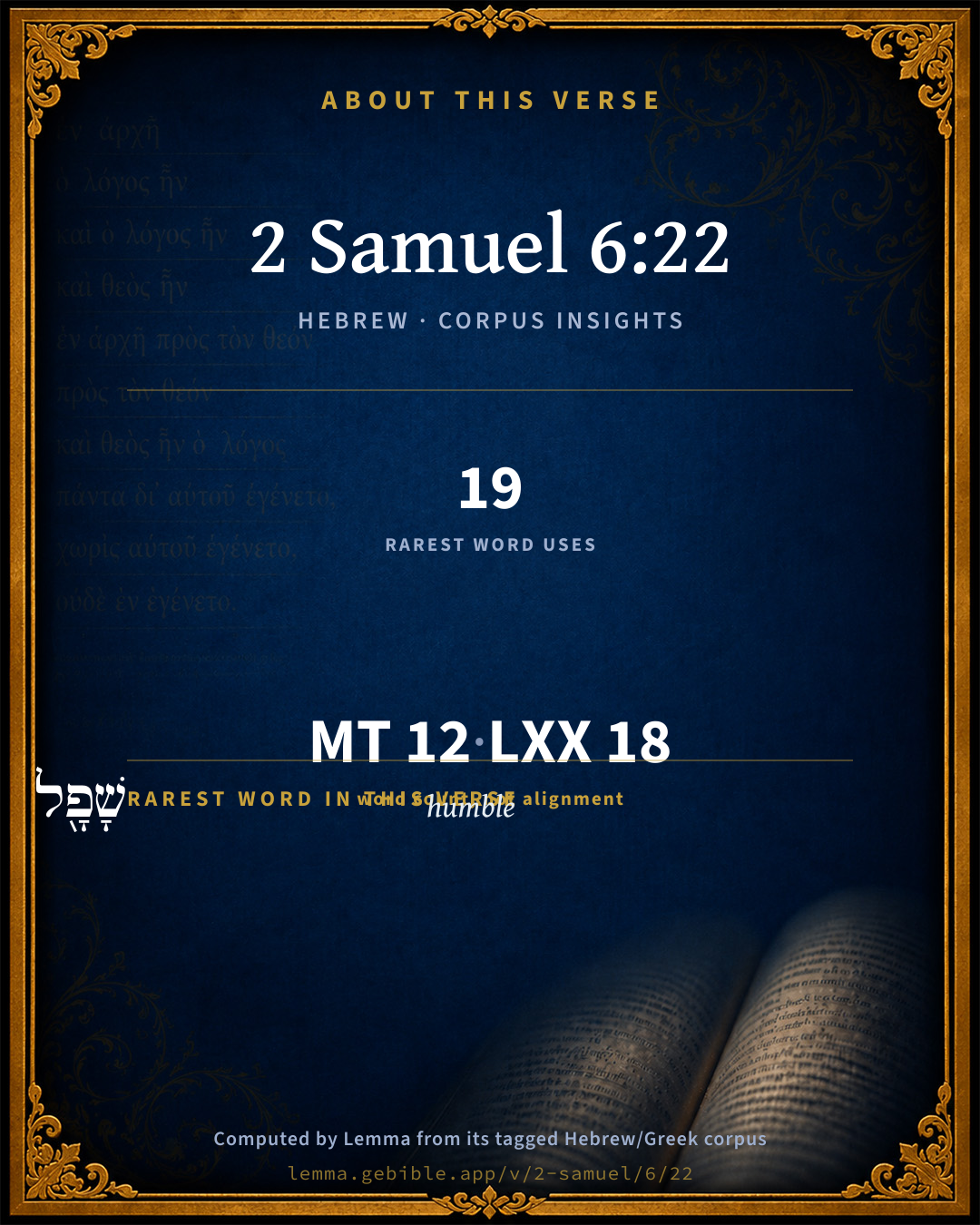
These counts appear in no published source. They are computed here, from the morphology-tagged text and Lemma’s own curated glosses. What Lemma adds →

12
words
11
distinct lemmas
Historical
section

Notable vocabulary

The rarest word here is שָׁפָ֖ל humble H8217 — appearing just 19 times in the whole Hebrew Bible.

Shared distinctive vocabulary

שָׁפָ֖ל humble H8217 occurs in 18 verses of the Hebrew Bible. Also found in:

Grammatical profile

  • 4 verbs
  • 2 nouns
  • 1 adjective
  • 1 pronoun
  • 2 prepositions
  • 1 adverb
  • 1 particle

Verb forms

  • וּנְקַלֹּ֤תִי Niphal · Sequential Perfect
  • וְהָיִ֥יתִי Qal · Sequential Perfect
  • אָמַ֔רְתְּ Qal · Perfect
  • אִכָּבֵֽדָה Niphal · Cohortative

Repetition

A word recurs within this verse — often emphatic in Hebrew:

  • וְעִם with H5973 ×2

Hebrew & Septuagint length

In English translation the verse runs 29 words from the Hebrew and 30 from the Septuagint (LXX English) — closely comparable.

A rough comparison of the two English renderings, which tokenize alike — not a word-level alignment.

Word counts can differ between the Hebrew and the Greek without any difference in meaning — e.g. the Hebrew direct-object marker אֵת has no separate Greek word, and Greek often adds the article ὁ.

In the original languages it is 12 Hebrew tokens and 18 Greek tokens — but the two are counted differently (Hebrew bundles its prefixes and suffixes into one token; the Greek is in lemma form), so that isn’t a like-for-like length.

Cross-references

12

Topical passages linked to 2 Samuel 6:22 in the Treasury of Scripture Knowledge — connected by theme and wording, ordered by reader-vote popularity; previews shown in the World English Bible.

  • 1 Peter 4:14 If you are insulted for the name of Christ, blessed are you; because the Spirit of glory and of God rests on you. On their part he is blasphemed, but on your part he is glorified.
  • Isaiah 51:7 Listen to me, you who know righteousness, the people in whose heart is my law; don't you fear the reproach of men, neither be you dismayed at their insults.
  • Hebrews 12:2 looking to Jesus, the author and perfecter of faith, who for the joy that was set before him endured the cross, despising shame, and has sat down at the right hand of the throne of God.
  • Genesis 32:10 I am not worthy of the least of all the loving kindnesses, and of all the truth, which you have shown to your servant; for with just my staff I passed over this Jordan; and now I have become two companies.
  • Job 40:4 "Behold, I am of small account. What shall I answer you? I lay my hand on my mouth.
  • Job 42:6 Therefore I abhor myself, And repent in dust and ashes."
  • Isaiah 50:6 I gave my back to the strikers, and my cheeks to those who plucked off the hair; I didn't hide my face from shame and spitting.
  • Matthew 5:11–12 "Blessed are you when people reproach you, persecute you, and say all kinds of evil against you falsely, for my sake.
  • Acts 5:41–42 They therefore departed from the presence of the council, rejoicing that they were counted worthy to suffer dishonor for Jesus' name.
  • 1 Timothy 1:15 The saying is faithful and worthy of all acceptance, that Christ Jesus came into the world to save sinners; of whom I am chief.
  • 1 Samuel 2:30 Therefore Yahweh, the God of Israel, says, I said indeed that your house, and the house of your father, should walk before me forever: but now Yahweh says, Be it far from me; for those who honor me I will honor, and those who despise me shall be lightly esteemed.
  • 1 Peter 5:6 Humble yourselves therefore under the mighty hand of God, that he may exalt you in due time;

Cross-references courtesy of OpenBible.info (CC BY 4.0).

Hebrew and Greek witnesses Masoretic Hebrew ↔ Greek Septuagint

The same verse in the two great witnesses to the Old Testament, shown verse-for-verse.

These are two independent witnesses, not word-aligned to each other, and the Septuagint is shown in lemma (dictionary) form.

Hebrew 2 Samuel 6:22 Masoretic · Westminster Leningrad Codex

וּנְקַלֹּ֤תִי עוֹד֙ מִזֹּ֔את וְהָיִ֥יתִי שָׁפָ֖ל בְּעֵינָ֑י וְעִם הָֽאֲמָהוֹת֙ אֲשֶׁ֣ר אָמַ֔רְתְּ עִמָּ֖ם אִכָּבֵֽדָה

I will be yet more vile than this, and will be base in my own sight: but of the handmaids of whom you have spoken, they shall honor me.

World English Bible · Public Domain

Greek LXX 2 Samuel 6:22 Septuagint · lemma form

καί ἀποκαλύπτω ἔτι οὕτως καί εἰμί ἀχρεῖος ἐν ὀφθαλμός σύ καί μετά ὁ παιδίσκος ὅς εἶπον ἐγώ δοξάζω

And I will again uncover myself thus, and I will be vile in your eyes, and with the maidservants by whom you said that I was not had in honor.

LXX2012 (modern English Septuagint) · Public Domain

On this verse, Ellicott's Commentary for English Readers discusses the Septuagint’s reading. Read the note in Commentary ↓

Hebrew: Westminster Leningrad Codex (CC BY 4.0). Greek: Septuagint (public domain); English from LXX2012 (modern English Septuagint) (Public Domain). How the Septuagint differs from the Hebrew →

Targum (Aramaic paraphrase)

1

The Targum is the ancient Jewish Aramaic paraphrase of the Hebrew Scriptures — an interpretive translation, not the Hebrew text itself. Onkelos (literal) and Pseudo-Jonathan (expansive) render the Torah, and Jonathan the Prophets. Coverage is partial: where no permissively-licensed English translation exists for a verse, only the Aramaic is shown. This is verse-level text, not a word-by-word alignment to the Hebrew.

  1. Targum Jonathan Prophets (Joshua–Malachi)
    וְזָעֵירְנָא עוֹד מִדָא וָאֶהִי מַכִּיךְ בְּעֵינֵי נַפְשִׁי מִבְּכֵן וְעִם אַמְהָתָא דִי אַתְּ אֲמַרְתְּ בְּעֵינֵיהוֹן אֱהֵי יַקִיר:

    (no public-domain English translation for this verse)

    Targum Jonathan — Aramaic: “Mikraot Gedolot” (public domain). English: “Sefaria Community Translation” (CC0 1.0 (public-domain dedication)); “London "Chaldee Paraphrase," 1871” (public domain). Text via Sefaria.

Commentary

Notes on 2 Samuel 6:22 from classic Christian and Jewish commentators (each source and its license shown beneath its notes). The classic Christian expositions comment on the surrounding passage and are grouped to its opening verse, so a note may address several verses; the Jewish commentaries on the Tanakh (Rashi and others) are per-verse, so they appear only where the commentator wrote on this verse.

Lemma curates 59 commentaries, every one of them public domain or Creative Commons licensed, each selected and text-cleaned for this edition rather than reprinted as found. About our sources →

Trapp's Complete Commentary

John Trapp

2Sa 6:22 And I will yet be more vile than thus, and will be base in mine own sight: and of the maidservants which thou hast spoken of, of them shall I be had in honour.

Ver. 22. And I will yet be more vile.] This was bravely resolved. So when the proud prefect told Basil that he was mad, he answered, I wish to be mad in this manner always. {a}

{a} Opto me in aeternum sic delirare.

John Trapp, A Commentary or Exposition upon All the Books of the Old and New Testament (1647–1656) — public domain. Text from a community e-Sword module.

Tyndale Open Study Notes

Tyndale Open Resources

6:22 David would not restrain his enthusiasm in celebrating before the Lord. In fact, he would exceed the enthusiasm he had shown thus far.

Tyndale Open Study Notes — © Tyndale Open Resources, licensed CC BY-SA 4.0. Text via the HelloAO Bible API.

Adam Clarke's Commentary

Verse 22. I will yet be more vile] The plain meaning of these words appears to be this: "I am not ashamed of humbling myself before that God who rejected thy father because of his obstinacy and pride, and chose me in his stead to rule his people; and even those maid-servants, when they come to know the motive of my conduct, shall acknowledge its propriety, and treat me with additional respect; and as for thee, thou shalt find that thy conduct is as little pleasing to God as it is to me." Then it is said, Michal had no child till the day of her death: probably David never more took her to his bed; or God, in his providence, might have subjected her to barrenness which in Palestine was considered both a misfortune and a reproach. Michal formed her judgment without reason, and meddled with that which she did not understand. We should be careful how we attribute actions, the reasons of which we cannot comprehend, to motives which may appear to us unjustifiable or absurd. Rash judgments are doubly pernicious; they hurt those who form them, and those of whom they are formed.

Adam Clarke's Commentary on the Bible (1810–1826) — public domain. Text from a community e-Sword/MySword module.

Ellicott's Commentary for English Readers

(22) Base in mine own sight.—The LXX., not understanding this expression, has changed it to “in thine eyes.” But the meaning is, that while Michal had charged him with making himself base in the eyes of the maidservants (who were no fit judges of such matters), he was ready to abase himself in his own eyes, to do anything, however humbling it might seem even to himself, which should be for the honour and glory of God.

A Bible Commentary for English Readers, edited by Charles John Ellicott (1878–1897) — public domain. Text from a community e-Sword module.

The Cambridge Bible for Schools and Colleges

gen. ed. J. J. S. Perowne

22. And I will yet, &c.] And I will make myself yet more contemptible than this, and will be humble in mine own eyes. Michal had taunted David with degrading himself in the eyes of the meanest servants. He replies that even if he humbled himself yet more deeply, instead of priding himself on his royal dignity, they would continue to honour him.

The Cambridge Bible for Schools and Colleges (gen. ed. J. J. S. Perowne; Cambridge University Press, 1878–1918) — public domain. Text from a community e-Sword module.

John Gill's Exposition

Therefore Michal the daughter of Saul had no child until the day of her death. The children she brought up for Adriel were not her own, but adopted ones, or Adriel's by another woman, Sa2 21:8; however, she had none after this time, whatever she had before, and it does not appear that she had any, though the Jews say she was Eglah, and Ithream her son; see Gill on Sa2 3:5. And thus she that vilified David brought a reproach upon herself, as barrenness was always reckoned, and no one descending from her arrived to royal dignity, and sat on the throne of David; and so it was ordered in Providence, as Abarbinel observes, that the seed of David and of Saul might not be mixed.

Next: 2 Samuel Chapter 7

John Gill's Exposition of the Whole Bible (1746–1763) — public domain (CC PDM 1.0). Text via the HelloAO Bible API.

Haydock's Catholic Bible Commentary

Eyes. Humility in a king is truly noble. --- Glorious. He accepts the compliment of Michol, though she had spoken ironically. (Haydock)

George Leo Haydock (1774–1849), Haydock's Catholic Family Bible and Commentary, 1859 edition — public domain. Excludes Psalms (Douay-Rheims chapter numbering differs from Protestant) and Deuterocanonical books (Catholic canon only).

Matthew Poole's English Annotations

I will be base in mine own sight; I will always be ready to humble and abase myself before God.

Of them shall I be had in honour; I shall rather choose to get honour from the meanest of my people, in serving and praising God, than to gain esteem from thee by my lukewarmness in God’s service.

Matthew Poole's English Annotations on the Holy Bible (1683–1685) — public domain. Text from a community e-Sword/MySword module.

Whedon's Commentary on the Bible

Daniel D. Whedon

22. I will yet be more vile — I am ready to be still more despised, if I may thereby honour Jehovah. How unlike the spirit of Michal, who seems to have had little interest in the God of Israel.

Daniel D. Whedon (gen. ed.), Commentary on the Old and New Testaments (1874–1909) — public domain. Text from a community e-Sword module.

The Pulpit Commentary

And of the maidservants which thou hast spoken of, of them shall I be had in honour. These words have been variously interpreted, but their simplest meaning is also the best; that even the most uneducated women, though surprised at first at David"s want of stateliness, would, on reflection, be led to a right understanding of the greatness of God; and would then feel that even a king was right in owning himself to be nothing in God"s presence.

The Pulpit Commentary (1880–1919), ed. H.D.M. Spence-Jones & Joseph S. Exell — public domain. Text from a community e-Sword module.

John Wesley's Explanatory Notes

More vile than thus - The more we are vilified for well doing, the more resolute therein we should be, binding our religion the closer to us, for the endeavours of Satan's agents to shame us out of it. Be base - I will always be ready to abase myself before God, and think nothing to mean to stoop to for his honour. Be had in honour - So far will they be from despising me on this account, that they will honour me the more.

John Wesley, Explanatory Notes Upon the Whole Bible (1754–1765) — public domain. Text via the GEBible commentary corpus.

Rashi

Rabbi Shlomo Yitzchaki (Rashi)

[Had] I made light even more. Before Him [even] more then this [that] I made light of myself now.

I would be more honoured among them. They do not ridicule me but I am important in their eyes becasue of this.

Rashi on the Tanakh — English translations: “The Judaica Press complete Tanach with Rashi, translated by A. J. Rosenberg” (CC BY 4.0); “Pentateuch with Rashi's commentary by M. Rosenbaum and A.M. Silbermann, 1929-1934” (public domain); “The Metsudah Tanach series, Lakewood, N.J” (CC BY 4.0); and “The Book of Joshua, Metsudah Publications, 1997” (CC BY 4.0). Text via Sefaria.

Lesson kit

Teaching starters — assembled from the data on this page, not authored interpretation. Every prompt links to the verse data it draws on. Edit before teaching.

2 Samuel, in the Historical, opens this verse with 12 words (11 distinct Hebrew lemmas). Its most distinctive word is shâphâl (“humble”). A historical commentator’s framing appears above. Read the whole chapter for the surrounding context.

Discussion questions

  1. How does “humble” (shâphâl) shape what this verse is saying?
  2. How does Leviticus 13:20, which shares the word «humble», read alongside this verse?
  3. What does the repetition of “with” (2× in this one verse) do in this verse?
  4. The translations on this page render this verse differently — a whole-verse word diff, not a word-by-word alignment. What might account for the different wordings?
  5. «וּנְקַלֹּ֤תִי» is a Niphal Sequential Perfect verb. How does that grammatical form shape the action described?
  6. Compare how Trapp's Complete Commentary and Tyndale Open Study Notes read this verse. Where do they agree or differ?

Things to notice

Reading settings

Reading text

Shown beneath each verse's original-language words.

Old Testament
Old Testament edition

Read the OT as the Masoretic Hebrew (MT) or the Greek Septuagint (LXX).

English shown for the Greek Septuagint (in the Hebrew ↔ Greek comparison).

Comparing translations? Open the Compare panel on any verse page to stack up to four side by side.