
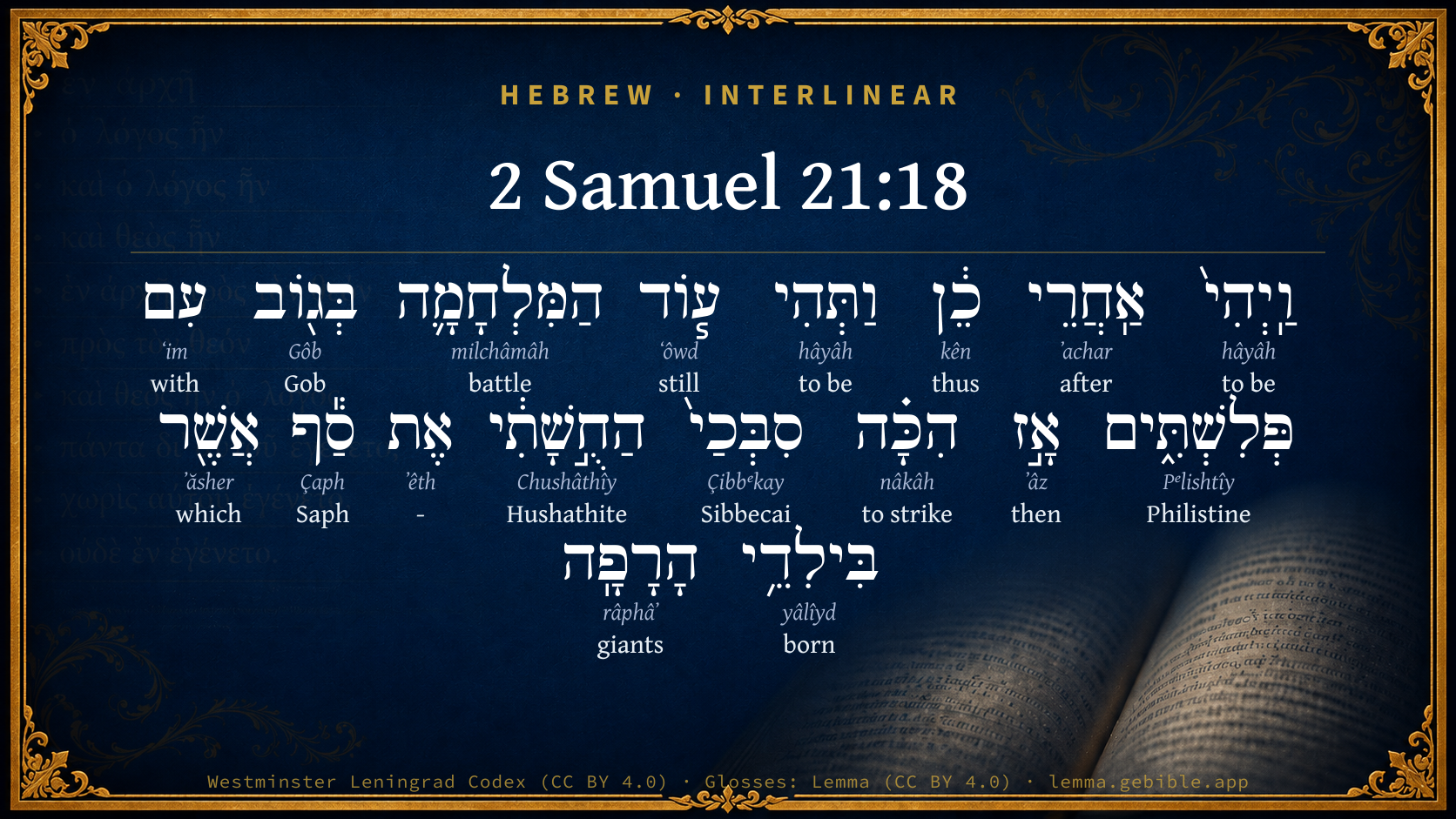
2 Samuel 21:18

Hebrew (Westminster Leningrad Codex) 2 Samuel 21:18 appears in the Hebrew Old Testament. The text above is from the Westminster Leningrad Codex. Each word links to its Strong’s number, a concise gloss, and parsing drawn from the Open Scriptures Hebrew Bible morphology. Click any word for its full Brown-Driver-Briggs (BDB) entry.
Download image
Cite this verse

2 Samuel 21:18 (World English Bible). Public Domain. Lemma interlinear Bible study tool, https://lemma.gebible.app/v/2-samuel/21/18.

Show BibTeX & RIS
BibTeX
RIS
English Translation
It came to pass after this, that there was again war with the Philistines at Gob: then Sibbecai the Hushathite killed Saph, who was of the sons of the giant.
World English Bible · Public Domain
Highlights
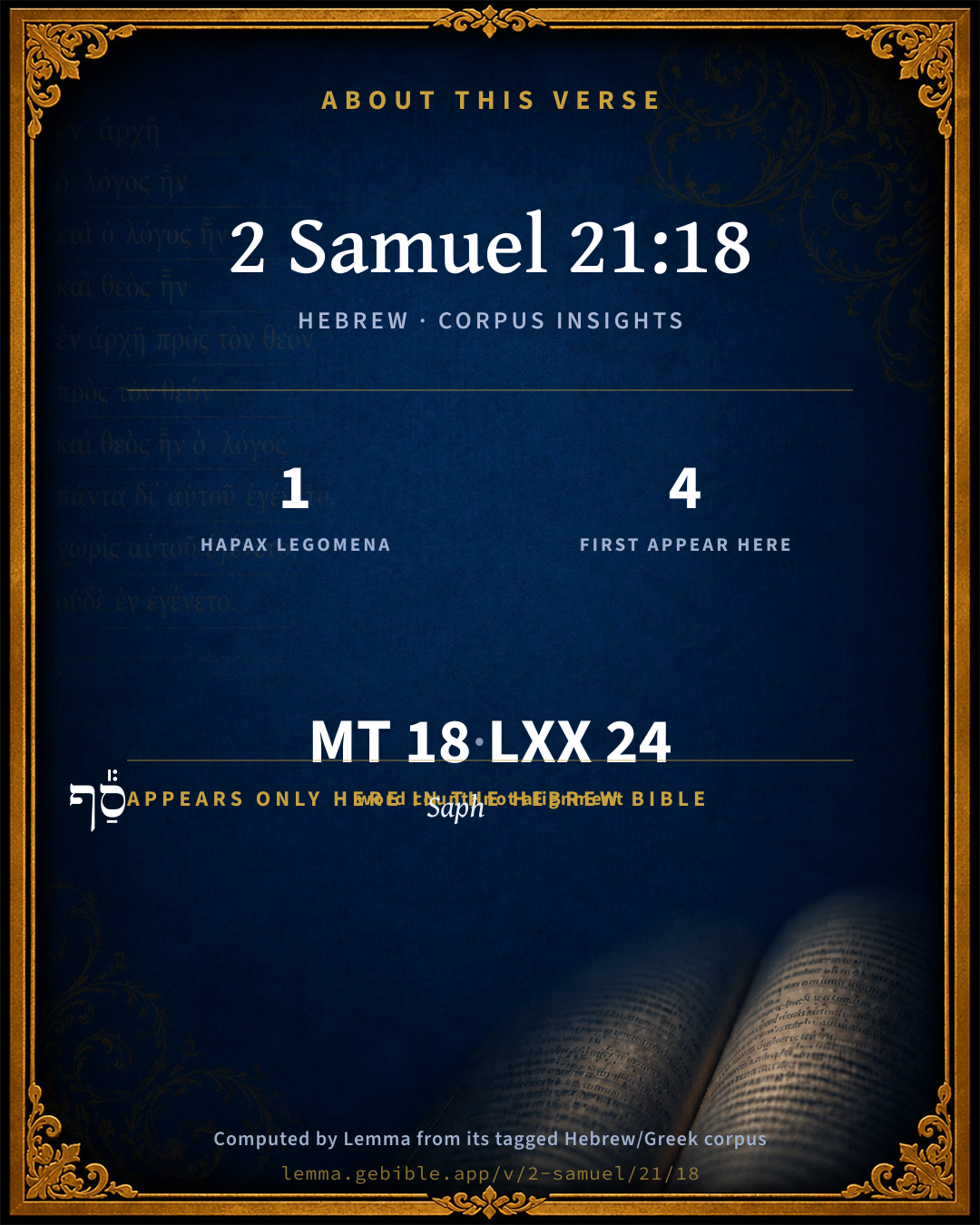
  • 1 hapax legomenon — only here in the Hebrew Bible
  • 4 first appearances in the Hebrew Bible
Full analysis ↓
Download a study sheet

One document with this verse’s original text, its word-by-word gloss line, the meaning frame, cross-references with their text, attributed commentary, and full source and license credits — printable, and it pastes into notes with its structure intact.

This verse Autodidact and up

Study sheet (.html) Plain text (.txt)

A passage Seminary Student

Up to 50 verses in one chapter. A passage sheet keeps up to 6 commentary sources and 12 cross-references per verse, in the order this page ranks them, and says so on the sheet whenever that leaves anything out. Ask for a single verse and you get the Autodidact verse sheet above.

Everything on this page stays free to read, with no account — the sheet is a download of what is already on screen, not access to it.

Want to remove ads? Support Godless Engineer
Compare translations 3

The same verse in 3 English versions, stacked beneath the original-language interlinear above. Click any original word for its lexicon entry.

Each is an independent rendering of the whole verse — the interlinear is not word-aligned to these translations.

Highlighted words mark where these versions differ — a whole-verse word diff, not a word-by-word alignment.

  • World English Bible Public Domain
    It came to pass after this, that there was again war with the Philistines at Gob: then Sibbecai the Hushathite killed Saph, who was of the sons of the giant.
  • King James Version Public Domain
    And it came to pass after this, that there was again a battle with the Philistines at Gob: then Sibbechai the Hushathite slew Saph, which was of the sons of the giant.
  • unfoldingWord Literal Text CC BY-SA 4.0
    And it happened after this that was a battle again with the Philistines, at Gob. Then Sibbecai the Hushathite struck Saph, who among the children of Rapha.

unfoldingWord Literal Text — © unfoldingWord, licensed CC BY-SA 4.0. Word-aligned USFM3 via Door43 (git.door43.org/unfoldingWord/en_ult).

Versions to compare (up to 4)

3 of 4 selected

Show all 18 translations

Every available English version of this verse, each an independent rendering of the whole verse.

  • World English Bible Public Domain
    It came to pass after this, that there was again war with the Philistines at Gob: then Sibbecai the Hushathite killed Saph, who was of the sons of the giant.
  • Berean Standard Bible Public Domain
    Some time later at Gob, there was another battle with the Philistines. At that time Sibbecai the Hushathite killed Saph, one of the descendants of Rapha.
  • Majority Standard Bible Public Domain
    Some time later at Gob, there was another battle with the Philistines. At that time Sibbecai the Hushathite killed Saph, a descendant of Rapha.
  • King James Version Public Domain
    And it came to pass after this, that there was again a battle with the Philistines at Gob: then Sibbechai the Hushathite slew Saph, which was of the sons of the giant.
  • American Standard Version (1901) Public Domain
    And it came to pass after this, that there was again war with the Philistines at Gob: then Sibbecai the Hushathite slew Saph, who was of the sons of the giant.
  • Revised Version (1885) Public Domain
    And it came to pass after this, that there was again war with the Philistines at Gob: then Sibbecai the Hushathite slew Saph, which was of the sons of the giant.
  • Geneva Bible (1599) Public Domain
    And after this also there was a battell with the Philistims at Gob, then Sibbechai the Hushathite slewe Saph, which was one of ye sonnes of Haraphah.
  • Douay-Rheims (1899) Public Domain
    There was also a second battle in Gob against the Philistines: then Sobochai of Husathi slew Saph of the race of Arapha of the family of the giants.
  • Young's Literal Translation Public Domain
    And it cometh to pass afterwards, that the battle is again in Gob with the Philistines, then hath Sibbechai the Hushathite smitten Saph, who `is' among the children of the giant.
  • Literal Standard Version CC BY-SA 4.0
    And it comes to pass afterward that the battle is again in Gob with the Philistines. Then Sibbechai the Hushathite has struck Saph, who [is] among the children of the giant.
  • Unlocked Literal Bible CC BY-SA 4.0
    It came about after this that there was again a battle with the Philistines at Gob, when Sibbekai the Hushathite killed Saph, who was one of the descendants of the Rephaim.
  • unfoldingWord Literal Text CC BY-SA 4.0
    And it happened after this that was a battle again with the Philistines, at Gob. Then Sibbecai the Hushathite struck Saph, who among the children of Rapha.
  • Darby Bible Public Domain
    And it came to pass after this, that there was again a battle with the Philistines, at Gob; then Sibbechai the Hushathite smote Saph, who was of the children of Raphah.
  • World Messianic Bible Public Domain
    After this, there was again war with the Philistines at Gob. Then Sibbecai the Hushathite killed Saph, who was of the sons of the giant.
  • Webster's Bible Public Domain
    And it came to pass after this, that there was again a battle with the Philistines at Gob: then Sibbechai the Hushathite slew Saph, who was of the sons of the giant.
  • Free Bible Version CC BY-SA 4.0
    Some time after this there was another battle with the Philistines at Gob. But then Sibbecai the Hushathite killed Saph, one of the descendants of Repha.
  • Bible in Basic English Public Domain
    Now after this there was war with the Philistines again at Gob, and Sibbecai the Hushathite put to death Saph, one of the offspring of the Rephaim.
  • JPS Tanakh (1917) Public Domain
    And it came to pass after this, that there was again war with the Philistines at Gob; then Sibbecai the Hushathite slew Saph, who was of the sons of the giant.

Literal Standard Version (2020), Covenant Press — licensed CC BY-SA 4.0. Text via the HelloAO Bible API (eBible.org). Unlocked Literal Bible (unfoldingWord) — licensed CC BY-SA 4.0. Text via the HelloAO Bible API (eBible.org). unfoldingWord Literal Text — © unfoldingWord, licensed CC BY-SA 4.0. Word-aligned USFM3 via Door43 (git.door43.org/unfoldingWord/en_ult). Free Bible Version, Dr. Jonathan Gallagher — licensed CC BY-SA 4.0. Text via the HelloAO Bible API (eBible.org).

Word by word

More ways to search: Search by grammar → Find every occurrence → Compare this word →

Practice this passage: Drill this verse → Learn its vocabulary →

סַ֕ף
Çaph
H5593
“Saph”
Noun, Proper
Part of Speech
Noun
Type
Proper
Full BDB Definition

Origin: the same as H5592

TWOT: None

Saph = "tall" - one of the sons of the Philistine giant slain by Sibbechai the Hushathite
  1. וַֽיְהִי֙ hâyâh H1961 “and · to be” Conjunction + Verb, Qal, Sequential Imperfect, 3rd Person, Masculine, Singular
  2. אַֽחֲרֵי ʼachar H310 “after” Preposition
  3. כֵ֔ן kên H3651 “thus” Adverb
  4. וַתְּהִי hâyâh H1961 “and · to be” Conjunction + Verb, Qal, Sequential Imperfect, 3rd Person, Feminine, Singular
  5. ע֧וֹד ʻôwd H5750 “still” Adverb
  6. הַמִּלְחָמָ֛ה milchâmâh H4421 “the · battle” Particle, Definite Article + Noun, Common, Feminine, Singular, Absolute
  7. בְּג֖וֹב Gôb H1359 “in/at · Gob” Preposition + Noun, Proper
  8. עִם ʻim H5973 “with” Preposition
  9. פְּלִשְׁתִּ֑ים Pᵉlishtîy H6430 “Philistines” Noun, Gentilic, Masculine, Plural, Absolute
  10. אָ֣ז ʼâz H227 “then” Adverb
  11. הִכָּ֗ה nâkâh H5221 “to strike” Verb, Hiphil, Perfect, 3rd Person, Masculine, Singular
  12. סִבְּכַי֙ Çibbᵉkay H5444 “Sibbecai” Noun, Proper
  13. הַחֻ֣שָׁתִ֔י Chushâthîy H2843 “the · Hushathite” Particle, Definite Article + Noun, Gentilic, Masculine, Singular, Absolute
  14. אֶת ʼêth H853 “-” Particle, Direct Object
  15. אֲשֶׁ֖ר ʼăsher H834 “which” Particle, Relative
  16. בִּילִדֵ֥י yâlîyd H3211 “in/at · those born of” Preposition + Noun, Common, Masculine, Plural, Construct
  17. הָרָפָֽה râphâʼ H7497 “the · giants” Particle, Definite Article + Noun, Gentilic, Masculine, Singular, Absolute

About this verse

These counts appear in no published source. They are computed here, from the morphology-tagged text and Lemma’s own curated glosses. What Lemma adds →

18
words
17
distinct lemmas
Historical
section

Notable vocabulary

1 hapax legomenon — a word that appears only here in the entire Hebrew Bible:

First appearance in Scripture

These words make their first canonical appearance in the Hebrew Bible here:

  • בְּג֖וֹב Gob H1359
  • סִבְּכַי֙ Sibbecai H5444
  • הַחֻ֣שָׁתִ֔י Hushathite H2843
  • סַ֕ף Saph H5593

Shared distinctive vocabulary

בְּג֖וֹב Gob H1359 occurs in 2 verses of the Hebrew Bible. Also found in:

Grammatical profile

  • 3 verbs
  • 8 nouns
  • 2 prepositions
  • 3 adverbs
  • 2 particles

Verb forms

  • וַֽיְהִי֙ Qal · Sequential Imperfect
  • וַתְּהִי Qal · Sequential Imperfect
  • הִכָּ֗ה Hiphil · Perfect

Repetition

A word recurs within this verse — often emphatic in Hebrew:

  • וַֽיְהִי֙ to be H1961 ×2

Hebrew & Septuagint length

In English translation the verse runs 30 words from the Hebrew and 24 from the Septuagint (LXX English) — closely comparable.

A rough comparison of the two English renderings, which tokenize alike — not a word-level alignment.

Word counts can differ between the Hebrew and the Greek without any difference in meaning — e.g. the Hebrew direct-object marker אֵת has no separate Greek word, and Greek often adds the article ὁ.

In the original languages it is 18 Hebrew tokens and 24 Greek tokens — but the two are counted differently (Hebrew bundles its prefixes and suffixes into one token; the Greek is in lemma form), so that isn’t a like-for-like length.

Cross-references

6

Topical passages linked to 2 Samuel 21:18 in the Treasury of Scripture Knowledge — connected by theme and wording, ordered by reader-vote popularity; previews shown in the World English Bible.

  • 1 Chronicles 11:29 Sibbecai the Hushathite, Ilai the Ahohite,
  • 2 Samuel 21:20 There was again war at Gath, where was a man of great stature, who had on every hand six fingers, and on every foot six toes, four and twenty in number; and he also was born to the giant.
  • 2 Samuel 21:16 and Ishbibenob, who was of the sons of the giant, the weight of whose spear was three hundred [shekels] of brass in weight, he being girded with a new [sword], thought to have slain David.
  • 1 Chronicles 27:11 The eighth [captain] for the eighth month was Sibbecai the Hushathite, of the Zerahites: and in his division were twenty-four thousand.
  • 2 Samuel 21:22 These four were born to the giant in Gath; and they fell by the hand of David, and by the hand of his servants.
  • 1 Chronicles 20:4–8 It happened after this, that there arose war at Gezer with the Philistines: then Sibbecai the Hushathite killed Sippai, of the sons of the giant; and they were subdued.

Cross-references courtesy of OpenBible.info (CC BY 4.0).

Hebrew and Greek witnesses Masoretic Hebrew ↔ Greek Septuagint

The same verse in the two great witnesses to the Old Testament, shown verse-for-verse.

These are two independent witnesses, not word-aligned to each other, and the Septuagint is shown in lemma (dictionary) form.

Hebrew 2 Samuel 21:18 Masoretic · Westminster Leningrad Codex

וַֽיְהִי֙ אַֽחֲרֵי כֵ֔ן וַתְּהִי ע֧וֹד הַמִּלְחָמָ֛ה בְּג֖וֹב עִם פְּלִשְׁתִּ֑ים אָ֣ז הִכָּ֗ה סִבְּכַי֙ הַחֻ֣שָׁתִ֔י אֶת סַ֕ף אֲשֶׁ֖ר בִּילִדֵ֥י הָרָפָֽה

It came to pass after this, that there was again war with the Philistines at Gob: then Sibbecai the Hushathite killed Saph, who was of the sons of the giant.

World English Bible · Public Domain

Greek LXX 2 Samuel 21:18 Septuagint · lemma form

καί γίγνομαι μετά οὗτος ἔτι πόλεμος ἐν γεθ μετά ὁ ἀλλόφυλος τότε πατάσσω σεβοχα ὁ αστατωθι ὁ σεφ ὁ ἐν ὁ ἔκγονος ὁ ραφα

And after this there was a battle again with the Philistines in Geth: then Sebocha the Astatothite killed Seph of the progeny of Rapha.

LXX2012 (modern English Septuagint) · Public Domain

On this verse, Ellicott's Commentary for English Readers discusses the Septuagint’s reading. Read the note in Commentary ↓

Hebrew: Westminster Leningrad Codex (CC BY 4.0). Greek: Septuagint (public domain); English from LXX2012 (modern English Septuagint) (Public Domain). How the Septuagint differs from the Hebrew →

Targum (Aramaic paraphrase)

1

The Targum is the ancient Jewish Aramaic paraphrase of the Hebrew Scriptures — an interpretive translation, not the Hebrew text itself. Onkelos (literal) and Pseudo-Jonathan (expansive) render the Torah, and Jonathan the Prophets. Coverage is partial: where no permissively-licensed English translation exists for a verse, only the Aramaic is shown. This is verse-level text, not a word-by-word alignment to the Hebrew.

  1. Targum Jonathan Prophets (Joshua–Malachi)
    וַהֲוָה בָּתַר כֵּן וַהֲוַת עוֹד קְרָבָא בְּגוֹב עִם פְּלִשְׁתָּאֵי בְּכֵן קְטַל סִבְכֵי דְמִן חוּשַׁת יַת סַף דְבִבְנֵי גִבָּרָא:

    (no public-domain English translation for this verse)

    Targum Jonathan — Aramaic: “Mikraot Gedolot” (public domain). English: “Sefaria Community Translation” (CC0 1.0 (public-domain dedication)); “London "Chaldee Paraphrase," 1871” (public domain). Text via Sefaria.

Commentary

Notes on 2 Samuel 21:18 from classic Christian and Jewish commentators (each source and its license shown beneath its notes). The classic Christian expositions comment on the surrounding passage and are grouped to its opening verse, so a note may address several verses; the Jewish commentaries on the Tanakh (Rashi and others) are per-verse, so they appear only where the commentator wrote on this verse.

Lemma curates 59 commentaries, every one of them public domain or Creative Commons licensed, each selected and text-cleaned for this edition rather than reprinted as found. About our sources →

Trapp's Complete Commentary

John Trapp

2Sa 21:18 And it came to pass after this, that there was again a battle with the Philistines at Gob: then Sibbechai the Hushathite slew Saph, which [was] of the sons of the giant.

Ver. 18. There was again a battle.]

“ Nunquam bella bonis, nunquam discrimina desunt:

Et quicum certet, mens pia semper habet. ”

At Gob.] Which was near unto Gezar. See 1Ch 20:4. Some {a} for Gob read Nob, but that is not right.

{a} Sept. Vat. Osiander.

John Trapp, A Commentary or Exposition upon All the Books of the Old and New Testament (1647–1656) — public domain. Text from a community e-Sword module.

The Biblical Illustrator

Joseph S. Exell

2Sa_21:18-22

Sibbechai the Hushathite slew Saph, which was of the sons of the giant.

On doing valiantly

If his master bids him perform exploits too hard for him, he draws upon the resources of omnipotence, and achieves impossibilities. Wellington sent word to his troops one night: Cindad Rodrigo must be taken to-night. And what do you think was the commentary of the British soldiers appointed for attack? Then, said they all, we will do it. So, when our great Captain sends round, as He doth to us, the word of command, Go ye into all the world, and preach the Gospel to every creature, if we were all good soldiers of the Cross, we should say at once, We will do it. However hard the task, since God Himself is with us to be our Captain, and Jesus the Priest of the Most High is with us to sound the trumpet, we will do it in Jehovahs name. (C. H. Spurgeon.)

Deeds

When a man dies they who survive him ask, what property Ire has left behind; the angel who bends over the dying one asks what good deeds he has sent before him. (H. W. Beecher.)

What one can do

In one of the Napoleonic wars a young soldier complained to his commanding officer that his sword was too short. Then add a step to it, was the curt and significant reply. When I hear, says the Rev. W. L. Watkinson, a man say, You know you cannot do more than you can do, I am always still for a moment. It is such a philosophic sentence that it can only be taken in slowly. But you never know what you can do until you put your soul into it--until you add a step. Says Paul to Timothy: Stir up the gift that is in thee. And it is not so much a question of environment as it is a question of soul; it is not a question of opportunity, because it is in thee.

Action more than knowledge

It is not the man who knows most, but the one that does best, that wins the victory, Grant, and Meade, and Sheridan could have been taught many lessons by our learned professors of military tactics and strategy, but none of these could have guided his forces to victory as Grant did at Chatanooga, Meade at Gettysberg, or have hurled his masses as Sheridan did at Winchester. Action guided by knowledge, if you will, but better action without knowledge than much knowledge and feeble action. (General Sherman.)

.

The Biblical Illustrator, edited by Joseph S. Exell (c. 1880s–1900s) — public domain. Text from a community e-Sword module.

Joseph Benson's Commentary

2Sa 21:18. After this — After the battle last mentioned. There was again a battle at Gob — Or in Gezer, as in 1Ch 20:4, whereby it seems Gob and Gezer were neighbouring places, and the battle was fought in the confines of both. Sibbechai the Hushathite — One of David’s worthies, 1Ch 11:29; slew Saph — One of the same race of Rephaims, descended from the Anakims.

Joseph Benson's Commentary on the Old and New Testaments (1811–1818) — public domain. Text from a community e-Sword module.

Tyndale Open Study Notes

Tyndale Open Resources

21:18 The location of Gob is uncertain.

Tyndale Open Study Notes — © Tyndale Open Resources, licensed CC BY-SA 4.0. Text via the HelloAO Bible API.

Geneva Bible (1599)

Geneva Bible translators

Called Gezer, and Saph is called Sippai, 1 Chron. 20:4.

Geneva Bible (1599) marginal notes — public domain. Text via Bolls.life.

Adam Clarke's Commentary

Verse 18. A battle - at Gob] Instead of Gob, several editions, and about forty of Kennicott's and De Rossi's MSS., have nob; but Gezer is the name in the parallel place, 1Ch 20:4.

Adam Clarke's Commentary on the Bible (1810–1826) — public domain. Text from a community e-Sword/MySword module.

Ellicott's Commentary for English Readers

(18) At Gob.—Comp. 2Sa_21:19. The place is otherwise unknown. 1Ch_20:4 reads “Gezer,” and the LXX. substitutes “Gath.” (Comp. 2Sa_21:20.) It is not at all remarkable that the names of many small places should be lost after the lapse of three thousand years, nor that the locality of the hamlet should be marked in the later chronicles by the better known neighbouring town of Gezer.

Sibbechai the Hushathite.—Comp. 1Ch_20:4. He is also mentioned in the list of heroes (1Ch_11:29); but in 2Sa_23:27 the name is changed into “Mebunnai the Hushathite by a slight alteration in the letters of the original. He was captain of the eighth division of the army (1Ch_26:11). The giant whom he slew is called “Sippai” in the parallel place in Chronicles, and it is there said that the Philistines were subdued.

A Bible Commentary for English Readers, edited by Charles John Ellicott (1878–1897) — public domain. Text from a community e-Sword module.

The Cambridge Bible for Schools and Colleges

gen. ed. J. J. S. Perowne

18. at Gob] A place mentioned only here and in 2Sa_21:19. The Sept. reads Gath, the parallel passage in Chron. Gezer; and we must suppose that Gob is either a corruption of the text, or some otherwise unknown place perhaps in the neighbourhood of Gezer, for which see note on ch. 2Sa_5:25.

Sibbechai the Hushathite] One of David’s heroes (1Ch_11:29), general of the eighth division of the army (1Ch_27:11). See note on ch. 2Sa_23:27.

Saph] Written Sippai in Chron., where it is added that the Philistines were subdued.

The Cambridge Bible for Schools and Colleges (gen. ed. J. J. S. Perowne; Cambridge University Press, 1878–1918) — public domain. Text from a community e-Sword module.

John Gill's Exposition

And there was again a battle in Gob with the Philistines,.... Another battle with them in the same place:

where Elhanan the son of Jaareoregim, a Bethlehemite, slew the brother of Goliath the Gittite; the word "brother" is rightly supplied from Ch1 20:5; where his name is said to be Lahmi, for not Goliath himself was slain, though some so interpret it, and take Elhanan to be David; so Jarchi, and with which agrees the Targum; but he was slain not at Gob, but in the valley of Elah, nor had David any such name as Elhanan; he was one of David's worthies, Sa2 23:24; where he is called the son of Dodo, and in Ch1 20:5, the son of Jair; and Lahmi there may not be the name of Goliath's brother, but, as here, the country name of Elhanan; for the words (z) there may be rendered,"and Elhanan the son of Jair, the Lehemite (i.e. the Bethlehemite), slew the brother of Goliath the Gittite,''and so perfectly agrees, with this:

the staff of whose spear was like a weaver's beam; not of Goliath's brother, but of Goliath himself, Sa1 17:7.

(z) Vid. Buxtorf. Anticritic. par. 2. c. 2. p. 421.

John Gill's Exposition of the Whole Bible (1746–1763) — public domain (CC PDM 1.0). Text via the HelloAO Bible API.

Albert Barnes' Notes on the Bible

A battle in Gob - In the parallel passage (marginal reference), “Gezer” is named as the field of this battle. However, Gath is named 2Sa 21:20, 2Sa 21:22 in a way to make it probable that Gath was the scene of all the battles. The Septuagint in this verse has “Gath.”

Albert Barnes' Notes on the Bible (1834–1885) — public domain. Text from a community e-Sword/MySword module.

Haydock's Catholic Bible Commentary

Gob, as Gazer was called by the Philistines; (1 Paralipomenon xx. 4.; Salien) unless (Haydock) the former word be a mistake of the transcriber. (Calmet) --- Septuagint (Alexandrian) reads, Geth. (Haydock) --- Sobochai, one of David’s valiant men, 1 Paralipomenon xi. 29. --- Saphai is added in 1 Chron. xx.

George Leo Haydock (1774–1849), Haydock's Catholic Family Bible and Commentary, 1859 edition — public domain. Excludes Psalms (Douay-Rheims chapter numbering differs from Protestant) and Deuterocanonical books (Catholic canon only).

Matthew Poole's English Annotations

After this; after the battle last mentioned.

At Gob, or, in Gezer, as it is 1Ch 20:4; whereby it seems Gob and Gezer were neighbouring places, and the battle fought in the confines of both.

Sibbechai the Hushathite; one of David’s worthies, 1Ch 11:29.

Matthew Poole's English Annotations on the Holy Bible (1683–1685) — public domain. Text from a community e-Sword/MySword module.

Whedon's Commentary on the Bible

Daniel D. Whedon

18. Gob — According to the parallel passage in 1Ch_20:4, the place of this battle was Gezer, on the situation of which see Jos_10:33. The site of Gob is not known, but it was probably close by Gezer.

Sibbechai — Probably identical with the Mebunnar of 2Sa_23:27, and one of David’s mighty men. 1Ch_27:11.

Hushathite — So called from Hushah, his native town.

Daniel D. Whedon (gen. ed.), Commentary on the Old and New Testaments (1874–1909) — public domain. Text from a community e-Sword module.

The Pulpit Commentary

Gob. In the parallel passage (1Ch_20:4) this place is called Gezer, and the Septuagint has Gath. It was probably some unimportant spot, except as being the site of this battle, and the scribes, knowing nothing about it, made corrections at their fancy. Sibbechai the Hushathite. The name is spelt in the same way in 1Ch_11:29 and 1Ch_20:4, but in the list of the mighties he is called Mebunnai. (2Sa_23:27) In 1Ch_27:11 we find that he had the command of the eighth division of the army, consisting of twenty-four thousand men. He is called "the Hushathite," as being a descendant of Hushah, of the family of Judah, in 1Ch_4:4. Saph, which was of the sons of the giant; Hebrew, of the Raphah: He is called Sippai in 1Ch_20:4.

The Pulpit Commentary (1880–1919), ed. H.D.M. Spence-Jones & Joseph S. Exell — public domain. Text from a community e-Sword module.

John Wesley's Explanatory Notes

After this - After the battle last mentioned.

John Wesley, Explanatory Notes Upon the Whole Bible (1754–1765) — public domain. Text via the GEBible commentary corpus.

unfoldingWord translationNotes

Door43 World Missions Community

It came about after this that

This phrase marks the beginning of a new part of the story. If your language has a way for doing this, you could consider using it here.

Gob

This is the name of a town. (See: How to Translate Names)

Sibbekai ... Saph ... Elhanan son of Jair ... Goliath

These are names of men. (See: How to Translate Names)

Hushathite ... Rephaim ... Bethlehemite ... Gittite

These are names of people groups. (See: How to Translate Names)

Rephaim

This people group was known for its giant warriors. (See: How to Translate Names)

whose spear was like a weaver's beam

When a person was weaving a cloth he would run the threads through hooks attached to large sticks called a "weaver's beam." This means Goliath's spear was larger than a normal spear. (See: Simile)

translationWords

Philistines

spear

unfoldingWord translationNotes — © Distant Shores Media and the Door43 World Missions Community, licensed CC BY-SA 4.0. Source: git.door43.org/Door43/en_tn.

Rashi

Rabbi Shlomo Yitzchaki (Rashi)

There was more war. This [war] came before all [those mentioned here] and is only recounted here to combine the deaths of the four sons of Orpoh.

Rashi on the Tanakh — English translations: “The Judaica Press complete Tanach with Rashi, translated by A. J. Rosenberg” (CC BY 4.0); “Pentateuch with Rashi's commentary by M. Rosenbaum and A.M. Silbermann, 1929-1934” (public domain); “The Metsudah Tanach series, Lakewood, N.J” (CC BY 4.0); and “The Book of Joshua, Metsudah Publications, 1997” (CC BY 4.0). Text via Sefaria.

Lesson kit

Teaching starters — assembled from the data on this page, not authored interpretation. Every prompt links to the verse data it draws on. Edit before teaching.

2 Samuel, in the Historical, opens this verse with 18 words (17 distinct Hebrew lemmas). Its most distinctive word is Çaph (“Saph”). A historical commentator’s framing appears above. Read the whole chapter for the surrounding context.

Discussion questions

  1. How does “Saph” (Çaph) shape what this verse is saying?
  2. 1 word here appears nowhere else in the Hebrew Bible. Why might the author reach for such rare wording?
  3. 4 words make their first appearance in Scripture here. What does this debut establish?
  4. How does 2 Samuel 21:19, which shares the word «Gob», read alongside this verse?
  5. What does the repetition of “to be” (2× in this one verse) do in this verse?
  6. These translations render this verse differently; the difference is in the English rendering, not the original. What questions does that raise?
  7. «וַֽיְהִי֙» is a Qal Sequential Imperfect verb. How does that grammatical form shape the action described?
  8. Compare how Trapp's Complete Commentary and The Biblical Illustrator read this verse. Where do they agree or differ?

Things to notice

  • 1 word in this verse appears nowhere else in the Hebrew Bible.
  • 4 words make their first canonical appearance in Scripture here.
  • This verse counts 18 Hebrew ↔ 24 Greek words.
  • These translations choose different wording for 18 words in this verse.
  • “to be” occurs 2× in this single verse.

Reading settings

Reading text

Shown beneath each verse's original-language words.

Old Testament
Old Testament edition

Read the OT as the Masoretic Hebrew (MT) or the Greek Septuagint (LXX).

English shown for the Greek Septuagint (in the Hebrew ↔ Greek comparison).

Comparing translations? Open the Compare panel on any verse page to stack up to four side by side.