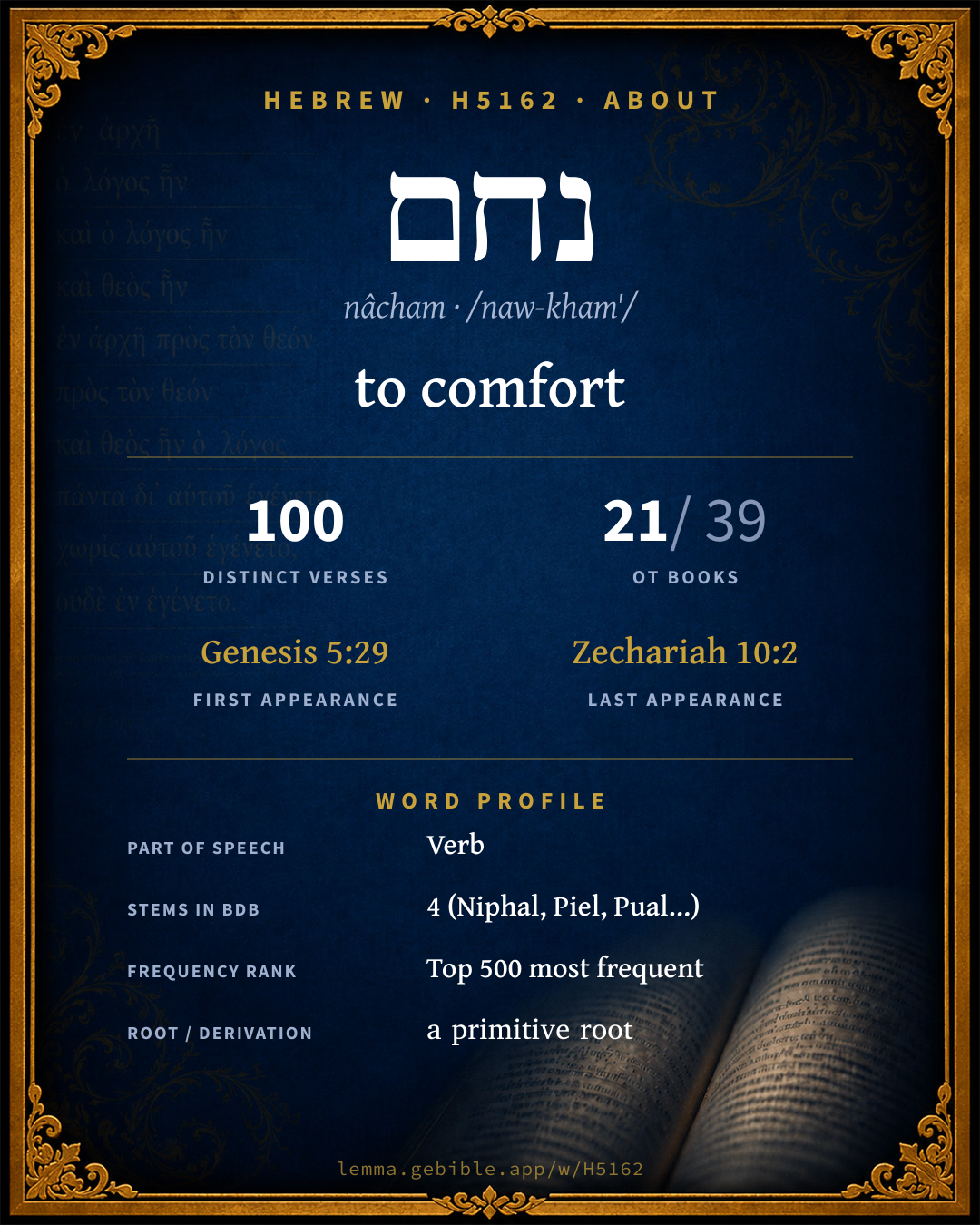
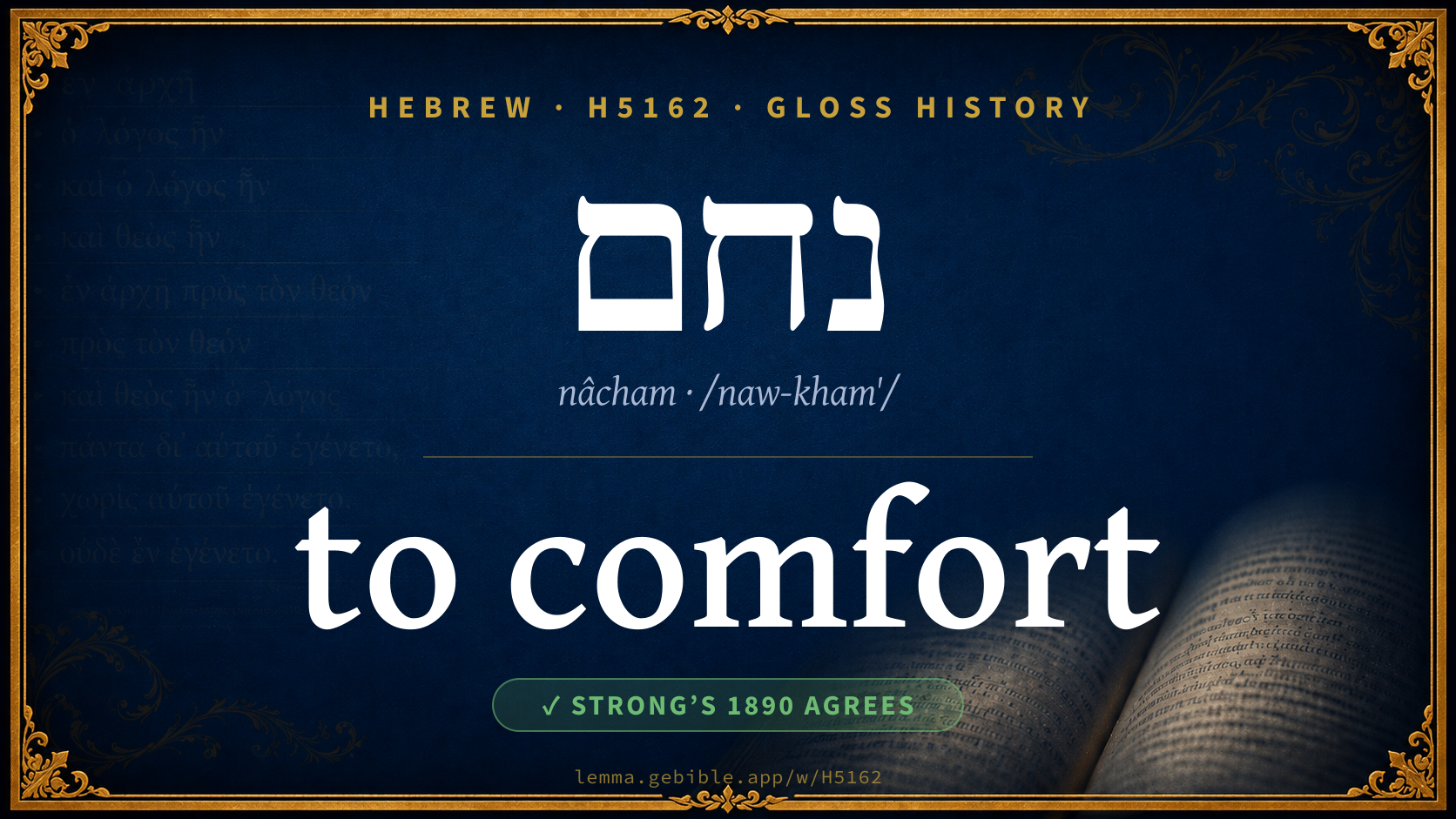
נָחַם
to comfort
‘to comfort’ is one of 3 main senses fuller range ↓
Full lexicon entry — Brown-Driver-Briggs (BDB)
From Brown-Driver-Briggs (BDB)
Where this word appears
See every Niphal verb in the Hebrew Bible →
Grammar key — what these labels mean
Part of speech
- Verb
- An action or state-of-being word.
Stem
- Niphal
- Usually the simple passive or reflexive of the Qal (“he was written”). Here: ‘be sorry’
- Piel
- An intensive or resultative active stem. Here: ‘comfort’
- Hithpael
- The reflexive or reciprocal stem (the subject acts on itself).
- Pual
- The passive counterpart of the Piel.
Form
- Sequential Imperfect
- An imperfect with prefixed waw — the standard past-narrative form (waw-consecutive imperfect).
- Participle Active
- A verbal adjective expressing ongoing or characteristic action (“writing / one who writes”).
- Infinitive Construct
- A bound verbal noun, frequently with prepositions (“to write / in writing”).
- Perfect
- A completed action or state — Hebrew marks aspect (completeness) more than strict tense (“he wrote”).
- Sequential Perfect
- A perfect with prefixed waw continuing a preceding imperfect or command (waw-consecutive perfect).
- Imperfect
- An incomplete, ongoing, or future action (“he will / would write”).
- Imperative
- A direct command (“write!”).
- Participle Passive
- A verbal adjective expressing action received (“written”).
State
- Absolute
- The independent form of a noun, not bound to a following word.
- Construct
- A noun bound to a following noun in a possessive / “of” relationship (the construct chain).
Person
- 3rd Person
- The one spoken about (“he / she / it / they”).
- 1st Person
- The speaker (“I / we”).
- 2nd Person
- The one addressed (“you”).
Gender
- Masculine
- Grammatically masculine.
- Common
- Either gender — not distinguished for this form.
- Feminine
- Grammatically feminine.
Number
- Singular
- One.
- Plural
- More than one (in Hebrew, generally three or more).
Grammatical forms 39 distinct
- Verb, Piel, Infinitive Construct 11 times (10%)
- Verb, Niphal, Sequential Imperfect, 3rd Person, Masculine, Singular 9 times (8%)
- Verb, Piel, Participle Active, Masculine, Singular, Absolute 7 times (6%)
- Verb, Niphal, Perfect, 1st Person, Common, Singular 6 times (6%)
- Verb, Niphal, Perfect, 3rd Person, Masculine, Singular 5 times (5%)
- Verb, Niphal, Imperfect, 3rd Person, Masculine, Singular 5 times (5%)
- Verb, Niphal, Sequential Perfect, 1st Person, Common, Singular 4 times (4%)
- Verb, Piel, Perfect, 3rd Person, Masculine, Singular 4 times (4%)
+31 more forms (57 occurrences)
Parsed forms decoded from the imported morphology (morphhb / Westminster Leningrad Codex — WLC text public domain, morphhb tagging CC BY 4.0), counted across 108 parsed occurrences — not distinct verses.
Every verse where H5162 appears — 100 distinct verses across 21 books. Click any verse to open its interlinear word-by-word view. Verse text shown in the World English Bible for context — . Each verse’s Hebrew form is shown with its reference; the English is not keyword-highlighted, since the data carries no word-level English alignment. Use “Compare translations” on any verse to read it across multiple English versions. This concordance covers the Hebrew Bible; Septuagint (Greek Old Testament) occurrences are not indexed here.
Genesis 8 verses
- Genesis 5:29 יְנַחֲמֵ֤/נוּ Piel impf 3ms + sfx pers 1cp and he named him Noah, saying, "This same will comfort us in our work and in the toil of our hands, because of the ground which Yahweh has cursed."
- Genesis 6:6 וַ/יִּנָּ֣חֶם conj + Niphal wimpf 3ms Yahweh was sorry that he had made man on the earth, and it grieved him in his heart.
- Genesis 6:7 נִחַ֖מְתִּי Niphal pf 1cs Yahweh said, "I will destroy man whom I have created from the surface of the ground; man, along with animals, creeping things, and birds of the sky; for I am sorry that I have made them."
- Genesis 24:67 וַ/יִּנָּחֵ֥ם conj + Niphal wimpf 3ms Isaac brought her into his mother Sarah's tent, and took Rebekah, and she became his wife. He loved her. Isaac was comforted after his mother's death.
- Genesis 27:42 מִתְנַחֵ֥ם Hithpael ptcp.act ms The words of Esau, her elder son, were told to Rebekah. She sent and called Jacob her younger son, and said to him, "Behold, your brother Esau comforts himself about you by planning to kill you.
- Genesis 37:35 לְ/נַחֲמ֗/וֹ לְ/הִתְנַחֵ֔ם prep + Piel inf.cs + sfx pers 3ms prep + Hithpael inf.cs All his sons and all his daughters rose up to comfort him; but he refused to be comforted. He said, "For I will go down to Sheol to my son mourning." His father wept for him.
- Genesis 38:12 וַ/יִּנָּ֣חֶם conj + Niphal wimpf 3ms After many days, Shua's daughter, the wife of Judah, died. Judah was comforted, and went up to his sheep-shearers to Timnah, he and his friend Hirah, the Adullamite.
- Genesis 50:21 וַ/יְנַחֵ֣ם conj + Piel wimpf 3ms Now therefore don't be afraid. I will nourish you and your little ones." He comforted them, and spoke kindly to them.
Exodus 3 verses
- Exodus 13:17 יִנָּחֵ֥ם Niphal impf 3ms It happened, when Pharaoh had let the people go, that God didn't lead them by the way of the land of the Philistines, although that was near; for God said, "Lest perhaps the people change their minds when they see war, and they return to Egypt;"
- Exodus 32:12 וְ/הִנָּחֵ֥ם conj + Niphal impv 2ms Why should the Egyptians speak, saying, 'He brought them forth for evil, to kill them in the mountains, and to consume them from the surface of the earth?' Turn from your fierce wrath, and repent of this evil against your people.
- Exodus 32:14 וַ/יִּנָּ֖חֶם conj + Niphal wimpf 3ms Yahweh repented of the evil which he said he would do to his people.
Numbers 1 verse
Deuteronomy 1 verse
Judges 3 verses
- Judges 2:18 יִנָּחֵ֤ם Niphal impf 3ms When Yahweh raised them up judges, then Yahweh was with the judge, and saved them out of the hand of their enemies all the days of the judge: for it repented Yahweh because of their groaning by reason of those who oppressed them and vexed them.
- Judges 21:6 וַ/יִּנָּֽחֲמוּ֙ conj + Niphal wimpf 3mp The children of Israel repented them for Benjamin their brother, and said, There is one tribe cut off from Israel this day.
- Judges 21:15 נִחָ֖ם Niphal ptcp.act ms The people repented them for Benjamin, because that Yahweh had made a breach in the tribes of Israel.
Ruth 1 verse
1 Samuel 3 verses
- 1 Samuel 15:11 נִחַ֗מְתִּי Niphal pf 1cs It repents me that I have set up Saul to be king; for he is turned back from following me, and has not performed my commandments. Samuel was angry; and he cried to Yahweh all night.
- 1 Samuel 15:29 יִנָּחֵ֑ם לְ/הִנָּחֵֽם Niphal impf 3ms prep + Niphal inf.cs Also the Strength of Israel will not lie nor repent; for he is not a man, that he should repent.
- 1 Samuel 15:35 נִחָ֔ם Niphal pf 3ms Samuel came no more to see Saul until the day of his death; for Samuel mourned for Saul: and Yahweh repented that he had made Saul king over Israel.
2 Samuel 5 verses
- 2 Samuel 10:2 לְ/נַחֲמ֛/וֹ prep + Piel inf.cs + sfx pers 3ms David said, I will show kindness to Hanun the son of Nahash, as his father shown kindness to me. So David sent by his servants to comfort him concerning his father. David's servants came into the land of the children of Ammon.
- 2 Samuel 10:3 מְנַֽחֲמִ֑ים Piel ptcp.act mp But the princes of the children of Ammon said to Hanun their lord, Do you think that David honors your father, in that he has sent comforters to you? Hasn't David sent his servants to you to search the city, and to spy it out, and to overthrow it?
- 2 Samuel 12:24 וַ/יְנַחֵ֣ם conj + Piel wimpf 3ms David comforted Bathsheba his wife, and went in to her, and lay with her: and she bore a son, and he called his name Solomon. Yahweh loved him;
- 2 Samuel 13:39 נִחַ֥ם Niphal pf 3ms [the soul of] king David longed to go forth to Absalom: for he was comforted concerning Amnon, seeing he was dead.
- 2 Samuel 24:16 וַ/יִּנָּ֤חֶם conj + Niphal wimpf 3ms When the angel stretched out his hand toward Jerusalem to destroy it, Yahweh repented him of the evil, and said to the angel who destroyed the people, It is enough; now stay your hand. The angel of Yahweh was by the threshing floor of Araunah the Jebusite.
1 Chronicles 4 verses
- 1 Chronicles 7:22 לְ/נַחֲמֽ/וֹ prep + Piel inf.cs + sfx pers 3ms Ephraim their father mourned many days, and his brothers came to comfort him.
- 1 Chronicles 19:2 לְ/נַחֲמ֣/וֹ לְ/נַחֲמֽ/וֹ prep + Piel inf.cs + sfx pers 3ms prep + Piel inf.cs + sfx pers 3ms David said, I will show kindness to Hanun the son of Nahash, because his father shown kindness to me. So David sent messengers to comfort him concerning his father. David's servants came into the land of the children of Ammon to Hanun, to comfort him.
- 1 Chronicles 19:3 מְנַחֲמִ֑ים Piel ptcp.act mp But the princes of the children of Ammon said to Hanun, Think you that David does honor your father, in that he has sent comforters to you? Aren't his servants come to you to search, and to overthrow, and to spy out the land?
- 1 Chronicles 21:15 וַ/יִּנָּ֣חֶם conj + Niphal wimpf 3ms God sent an angel to Jerusalem to destroy it: and as he was about to destroy, Yahweh saw, and he repented him of the evil, and said to the destroying angel, It is enough; now stay your hand. The angel of Yahweh was standing by the threshing floor of Ornan the Jebusite.
Job 7 verses
- Job 2:11 וּֽ/לְ/נַחֲמֽ/וֹ conj + prep + Piel inf.cs + sfx pers 3ms Now when Job's three friends heard of all this evil that had come on him, they each came from his own place: Eliphaz the Temanite, Bildad the Shuhite, and Zophar the Naamathite, and they made an appointment together to come to sympathize with him and to comfort him.
- Job 7:13 תְּנַחֲמֵ֣/נִי Piel impf 3fs + sfx pers 1cs When I say, 'My bed shall comfort me, My couch shall ease my complaint;'
- Job 16:2 מְנַחֲמֵ֖י Piel ptcp.act mp cs "I have heard many such things. Miserable comforters are you all!
- Job 21:34 תְּנַחֲמ֣וּ/נִי Piel impf 2mp + sfx pers 1cs So how can you comfort me with nonsense, Seeing that in your answers there remains only falsehood?"
- Job 29:25 יְנַחֵֽם Piel impf 3ms I chose out their way, and sat as chief. I lived as a king in the army, As one who comforts the mourners.
- Job 42:6 וְ/נִחַ֑מְתִּי conj + Niphal wpf 1cs Therefore I abhor myself, And repent in dust and ashes."
- Job 42:11 וַ/יְנַחֲמ֣וּ conj + Piel wimpf 3mp Then came there to him all his brothers, and all his sisters, and all those who had been of his acquaintance before, and ate bread with him in his house. They comforted him, and consoled him concerning all the evil that Yahweh had brought on him. Everyone also gave him a piece of money, and everyone a ring of gold.
Psalms 12 verses
- Psalms 23:4 יְנַֽחֲמֻֽ/נִי Piel impf 3mp + sfx pers 1cs Even though I walk through the valley of the shadow of death, I will fear no evil, for you are with me. Your rod and your staff, they comfort me.
- Psalms 69:20 וְ֝/לַ/מְנַחֲמִ֗ים conj + prep det + Piel ptcp.act mp Reproach has broken my heart, and I am full of heaviness. I looked for some to take pity, but there was none; For comforters, but I found none.
- Psalms 71:21 תְּֽנַחֲמֵֽ/נִי Piel impf 2ms + sfx pers 1cs Increase my honor, And comfort me again.
- Psalms 77:2 הִנָּחֵ֣ם Niphal inf.cs In the day of my trouble I sought the Lord. My hand was stretched out in the night, and didn't get tired. My soul refused to be comforted.
- Psalms 86:17 וְ/נִחַמְתָּֽ/נִי conj + Piel pf 2ms + sfx pers 1cs Show me a sign of your goodness, That those who hate me may see it, and be shamed, Because you, Yahweh, have helped me, and comforted me.
- Psalms 90:13 וְ֝/הִנָּחֵ֗ם conj + Niphal impv 2ms Relent, Yahweh! How long? Have compassion on your servants!
- Psalms 106:45 וַ֝/יִּנָּחֵ֗ם conj + Niphal wimpf 3ms He remembered for them his covenant, And repented according to the multitude of his loving kindnesses.
- Psalms 110:4 יִנָּחֵ֗ם Niphal impf 3ms Yahweh has sworn, and will not change his mind: "You are a priest forever in the order of Melchizedek."
- Psalms 119:52 וָֽ/אֶתְנֶחָֽם conj + Hithpael wimpf 1cs I remember your ordinances of old, Yahweh, And have comforted myself.
- Psalms 119:76 לְ/נַחֲמֵ֑/נִי prep + Piel inf.cs + sfx pers 1cs Please let your loving kindness be for my comfort, According to your word to your servant.
- Psalms 119:82 תְּֽנַחֲמֵֽ/נִי Piel impf 2ms + sfx pers 1cs My eyes fail for your word. I say, "When will you comfort me?"
- Psalms 135:14 יִתְנֶחָֽם Hithpael impf 3ms For Yahweh will judge his people, And have compassion on his servants.
Ecclesiastes 1 verse
Isaiah 13 verses
- Isaiah 1:24 אֶנָּחֵ֣ם Niphal impf 1cs Therefore the Lord, Yahweh of Hosts, The Mighty One of Israel, says: "Ah, I will get relief from my adversaries, And avenge myself of my enemies;
- Isaiah 12:1 וּֽ/תְנַחֲמֵֽ/נִי conj + Piel impf 2ms + sfx pers 1cs In that day you will say, "I will give thanks to you, Yahweh; for though you were angry with me, your anger has turned away and you comfort me.
- Isaiah 22:4 לְ/נַֽחֲמֵ֔/נִי prep + Piel inf.cs + sfx pers 1cs Therefore said I, Look away from me, I will weep bitterly; don't labor to comfort me for the destruction of the daughter of my people.
- Isaiah 40:1 נַחֲמ֥וּ נַחֲמ֖וּ Piel impv 2mp Piel impv 2mp Comfort you, comfort you my people, says your God.
- Isaiah 49:13 נִחַ֤ם Piel pf 3ms Sing, heavens; and be joyful, earth; and break forth into singing, mountains: for Yahweh has comforted his people, and will have compassion on his afflicted.
- Isaiah 51:3 נִחַ֨ם נִחַם֙ Piel pf 3ms Piel pf 3ms For Yahweh has comforted Zion; he has comforted all her waste places, and has made her wilderness like Eden, and her desert like the garden of Yahweh; joy and gladness shall be found therein, thanksgiving, and the voice of melody.
- Isaiah 51:12 מְנַחֶמְ/כֶ֑ם Piel ptcp.act ms cs + sfx pers 2mp I, even I, am he who comforts you: who are you, that you are afraid of man who shall die, and of the son of man who shall be made as grass;
- Isaiah 51:19 אֲנַחֲמֵֽ/ךְ Piel impf 1cs + sfx pers 2fs These two things have happened to you. Who will bemoan you? Desolation and destruction, and the famine and the sword; how shall I comfort you?
- Isaiah 52:9 נִחַ֤ם Piel pf 3ms Break forth into joy, sing together, you waste places of Jerusalem; for Yahweh has comforted his people, he has redeemed Jerusalem.
- Isaiah 54:11 נֻחָ֑מָה Pual pf 3fs you afflicted, tossed with tempest, and not comforted, behold, I will set your stones in beautiful colors, and lay your foundations with sapphires.
- Isaiah 57:6 אֶנָּחֵֽם Niphal impf 1cs Among the smooth [stones] of the valley is your portion; they, they are your lot; even to them have you poured a drink-offering, you have offered an offering. Shall I be appeased for these things?
- Isaiah 61:2 לְ/נַחֵ֖ם prep + Piel inf.cs to proclaim the year of Yahweh's favor, and the day of vengeance of our God; to comfort all who mourn;
- Isaiah 66:13 תְּנַחֲמֶ֑/נּוּ אֲנַ֣חֶמְ/כֶ֔ם תְּנֻחָֽמוּ Piel impf 3fs + sfx pers 3ms Piel impf 1cs + sfx pers 2mp Pual impf 2mp As one whom his mother comforts, so will I comfort you; and you shall be comforted in Jerusalem.
Jeremiah 14 verses
- Jeremiah 4:28 נִחַ֖מְתִּי Niphal pf 1cs For this shall the earth mourn, and the heavens above be black; because I have spoken it, I have purposed it, and I have not repented, neither will I turn back from it.
- Jeremiah 8:6 נִחָם֙ Niphal ptcp.pass ms I listened and heard, but they didn't speak aright: no man repents him of his wickedness, saying, What have I done? everyone turns to his course, as a horse that rushes headlong in the battle.
- Jeremiah 15:6 הִנָּחֵֽם Niphal inf.cs You have rejected me, says Yahweh, you are gone backward: therefore have I stretched out my hand against you, and destroyed you; I am weary with repenting.
- Jeremiah 16:7 לְ/נַחֲמ֣/וֹ prep + Piel inf.cs + sfx pers 3ms neither shall men break [bread] for them in mourning, to comfort them for the dead; neither shall men give them the cup of consolation to drink for their father or for their mother.
- Jeremiah 18:8 וְ/נִֽחַמְתִּי֙ conj + Niphal wpf 1cs if that nation, concerning which I have spoken, turn from their evil, I will repent of the evil that I thought to do to them.
- Jeremiah 18:10 וְ/נִֽחַמְתִּי֙ conj + Niphal wpf 1cs if they do that which is evil in my sight, that they not obey my voice, then I will repent of the good, with which I said I would benefit them.
- Jeremiah 20:16 נִחָ֑ם Niphal pf 3ms Let that man be as the cities which Yahweh overthrew, and didn't repent: and let him hear a cry in the morning, and shouting at noontime;
- Jeremiah 26:3 וְ/נִחַמְתִּ֣י conj + Niphal wpf 1cs It may be they will listen, and turn every man from his evil way; that I may repent me of the evil which I purpose to do to them because of the evil of their doings.
- Jeremiah 26:13 וְ/יִנָּחֵ֣ם conj + Niphal impf 3ms Now therefore amend your ways and your doings, and obey the voice of Yahweh your God; and Yahweh will repent him of the evil that he has pronounced against you.
- Jeremiah 26:19 וַ/יִּנָּ֣חֶם conj + Niphal wimpf 3ms Did Hezekiah king of Judah and all Judah put him to death? Didn't he fear Yahweh, and entreat the favor of Yahweh, and Yahweh repented him of the evil which he had pronounced against them? Thus should we commit great evil against our own souls.
- Jeremiah 31:13 וְ/נִ֣חַמְתִּ֔י/ם conj + Piel wpf 1cs + sfx pers 3mp Then shall the virgin rejoice in the dance, and the young men and the old together; for I will turn their mourning into joy, and will comfort them, and make them rejoice from their sorrow.
- Jeremiah 31:15 לְ/הִנָּחֵ֥ם prep + Niphal inf.cs Thus says Yahweh: A voice is heard in Ramah, lamentation, and bitter weeping, Rachel weeping for her children; she refuses to be comforted for her children, because they are no more.
- Jeremiah 31:19 נִחַ֔מְתִּי Niphal pf 1cs Surely after that I was turned, I repented; and after that I was instructed, I struck on my thigh: I was ashamed, yes, even confounded, because I did bear the reproach of my youth.
- Jeremiah 42:10 נִחַ֨מְתִּי֙ Niphal pf 1cs If you will still abide in this land, then will I build you, and not pull you down, and I will plant you, and not pluck you up; for I repent me of the evil that I have done to you.
Lamentations 6 verses
- Lamentations 1:2 מְנַחֵ֖ם Piel ptcp.act ms She weeps sore in the night, and her tears are on her cheeks; Among all her lovers she has none to comfort her: All her friends have dealt treacherously with her; they are become her enemies.
- Lamentations 1:9 מְנַחֵ֖ם Piel ptcp.act ms Her filthiness was in her skirts; she didn't remember her latter end; Therefore is she come down wonderfully; she has no comforter: See, Yahweh, my affliction; for the enemy has magnified himself.
- Lamentations 1:16 מְנַחֵ֖ם Piel ptcp.act ms For these things I weep; my eye, my eye runs down with water; Because the comforter who should refresh my soul is far from me: My children are desolate, because the enemy has prevailed.
- Lamentations 1:17 מְנַחֵם֙ Piel ptcp.act ms Zion spreads forth her hands; there is none to comfort her; Yahweh has commanded concerning Jacob, that those who are round about him should be his adversaries: Jerusalem is among them as an unclean thing.
- Lamentations 1:21 מְנַחֵם֙ Piel ptcp.act ms They have heard that I sigh; there is none to comfort me; All my enemies have heard of my trouble; they are glad that you have done it: You will bring the day that you have proclaimed, and they shall be like me.
- Lamentations 2:13 וַ/אֲנַֽחֲמֵ֔/ךְ conj + Piel impf 1cs + sfx pers 2fs What shall I testify to you? what shall I liken to you, daughter of Jerusalem? What shall I compare to you, that I may comfort you, virgin daughter of Zion? For your breach is great like the sea: who can heal you?
Ezekiel 7 verses
- Ezekiel 5:13 וְ/הִנֶּחָ֑מְתִּי conj + Hithpael wpf 1cs Thus shall my anger be accomplished, and I will cause my wrath toward them to rest, and I shall be comforted; and they shall know that I, Yahweh, have spoken in my zeal, when I have accomplished my wrath on them.
- Ezekiel 14:22 וְ/נִחַמְתֶּ֗ם conj + Niphal wpf 2mp Yet, behold, therein shall be left a remnant that shall be carried forth, both sons and daughters: behold, they shall come forth to you, and you shall see their way and their doings; and you shall be comforted concerning the evil that I have brought on Jerusalem, even concerning all that I have brought on it.
- Ezekiel 14:23 וְ/נִחֲמ֣וּ conj + Piel wpf 3cp They shall comfort you, when you see their way and their doings; and you shall know that I have not done without cause all that I have done in it, says the Lord Yahweh.
- Ezekiel 16:54 בְּ/נַחֲמֵ֖/ךְ prep + Piel inf.cs + sfx pers 2fs that you may bear your own shame, and may be ashamed because of all that you have done, in that you are a comfort to them.
- Ezekiel 24:14 אֶנָּחֵ֑ם Niphal impf 1cs I, Yahweh, have spoken it: it shall happen, and I will do it: I will not go back, neither will I spare, neither will I repent; according to your ways, and according to your doings, shall they judge you, says the Lord Yahweh.
- Ezekiel 31:16 וַ/יִּנָּ֨חֲמ֜וּ conj + Niphal wimpf 3mp I made the nations to shake at the sound of his fall, when I cast him down to Sheol with those who descend into the pit; and all the trees of Eden, the choice and best of Lebanon, all that drink water, were comforted in the lower parts of the earth.
- Ezekiel 32:31 וְ/נִחַ֖ם conj + Niphal wpf 3ms Pharaoh shall see them, and shall be comforted over all his multitude, even Pharaoh and all his army, slain by the sword, says the Lord Yahweh.
Joel 2 verses
- Joel 2:13 וְ/נִחָ֖ם conj + Niphal ptcp.act ms Tear your heart, and not your garments, And turn to Yahweh, your God; For he is gracious and merciful, Slow to anger, and abundant in loving kindness, And relents from sending calamity.
- Joel 2:14 וְ/נִחָ֑ם conj + Niphal wpf 3ms Who knows? He may turn and relent, And leave a blessing behind him, Even a meal offering and a drink offering to Yahweh, your God.
Amos 2 verses
Jonah 3 verses
- Jonah 3:9 וְ/נִחַ֖ם conj + Niphal wpf 3ms Who knows whether God will not turn and repent, and turn away from his fierce anger, so that we might not perish?"
- Jonah 3:10 וַ/יִּנָּ֣חֶם conj + Niphal wimpf 3ms God saw their works, that they turned from their evil way. God repented of the evil which he said he would do to them, and he didn't do it.
- Jonah 4:2 וְ/נִחָ֖ם conj + Niphal ptcp.act ms He prayed to Yahweh, and said, "Please, Yahweh, wasn't this what I said when I was still in my own country? Therefore I hurried to flee to Tarshish, for I knew that you are a gracious God, and merciful, slow to anger, and abundant in loving kindness, and you repent of the evil.
Nahum 1 verse
Zechariah 3 verses
- Zechariah 1:17 וְ/נִחַ֨ם conj + Piel wpf 3ms "Proclaim further, saying, 'Thus says Yahweh of Hosts: "My cities will again overflow with prosperity, and Yahweh will again comfort Zion, and will again choose Jerusalem."'"
- Zechariah 8:14 נִחָֽמְתִּי Niphal pf 1cs For thus says Yahweh of hosts: "As I thought to do evil to you, when your fathers provoked me to wrath," says Yahweh of Hosts, "and I didn't repent;
- Zechariah 10:2 יְנַֽחֵמ֑וּ/ן Piel impf 3mp + sfx n For the teraphim have spoken vanity, and the diviners have seen a lie; And they have told false dreams. They comfort in vain. Therefore they go their way like sheep. They are oppressed, because there is no shepherd.
About this entry
At a glance — auto-summarized from this page’s data, not written by a person. Every figure links to its source below. This summary describes the numbers; it doesn’t interpret them.
נחם (nâcham) is a Hebrew verb most often rendered “to comfort.” Its English rendering has broadened — “repented” classically, “and” (unfoldingWord Literal Text) in modern versions; see the renderings breakdown. The Hebrew Bible uses it across 100 verses — moderately common. It first appears in Genesis 5:29. As a verb its force shifts by stem, across 4 stems (Niphal, Piel, and more). The sections below give every sense, occurrence, and version rendering.
Gloss history
Strong's 1890 vs modern scholarship
About this word
Strong's H5162 catalogs a Hebrew word from the Hebrew Old Testament.
These counts are not copied from any lexicon or concordance. They are computed here, from the morphology-tagged Hebrew Old Testament. What Lemma adds →
- 100
- distinct verses
- The word appears in 100 distinct verses.
- 21 / 39
- OT books
- The word appears in 21 of 39 Old Testament books.
- #401
- by frequency
- Top 500 most frequent Hebrew words (rank 401 of 8,640 Hebrew words by occurrence).
View all 100 occurrences in the concordance →
By section of the Old Testament
By traditional corpus
Conventional, traditional groupings — biblical authorship is debated, so this is a traditional corpus grouping, not an authorship claim. Each share is this word’s portion of its verses in that division of the Hebrew canon. Each figure is a share of the word’s 100 distinct verses.
- Prophets (Nevi'im) 56 verses · 56%
- Writings (Ketuvim) 31 verses · 31%
- Torah (Pentateuch) 13 verses · 13%
How translations render this word
Counts come from each version’s own published word-to-Strong’s tagging or interlinear alignment — an approximate guide to how each version renders this word, not a word-level alignment the data otherwise carries. Because each total is that version’s own tagged count, the per-version totals vary from one another and need not match the appearance or distinct-verse counts above. These counts may also differ from a printed concordance because Lemma counts each distinctly tagged rendering and does not collapse phrase taggings into a single head-word total. This is a fixed set of word-tagged versions (KJV, ASV, BSB, ULT) and does not change with the reading translation you choose elsewhere. Each version’s license is shown beside its name below (and on Sources).
- King James Version: Repented 14×, Comfort 11×, Repent 6×
- American Standard Version: Repented 12×, Comfort 7×, Repent 7×
- Berean Standard Bible: Comfort 8×, Relented 7×, Relent 6×
- unfoldingWord Literal Text: And 6×, Relented 6×, Comfort 5×
King James Version Public Domain
Renders H5162 across 108 tagged occurrences — most commonly:
Plus other, less common renderings. Plus 41 renderings that appear only once — usually multi-word phrases or single function words the recovered tagging swept in, not distinct renderings.
American Standard Version Public Domain
Renders H5162 across 108 tagged occurrences — most commonly:
Plus other, less common renderings. Plus 58 renderings that appear only once — usually multi-word phrases or single function words the recovered tagging swept in, not distinct renderings.
Berean Standard Bible Public Domain
Renders H5162 across 107 tagged occurrences — most commonly:
Plus other, less common renderings. Plus 50 renderings that appear only once — usually multi-word phrases or single function words the recovered tagging swept in, not distinct renderings. Not rendered by a distinct English word in 1 further occurrence.
unfoldingWord Literal Text CC BY-SA 4.0
Renders H5162 across 122 tagged occurrences — most commonly:
Plus other, less common renderings. Plus 51 renderings that appear only once — usually multi-word phrases or single function words the recovered tagging swept in, not distinct renderings.
10 senses and sub-senses in the full BDB
Hebrew verbs can shift meaning by stem (binyan): Qal is the basic action, Niphal is often passive or reflexive, Piel often intensifies or makes it factitive, and Hiphil is typically causative. The senses below are grouped under the stem BDB assigns to each. This entry also uses Pual (the passive of Piel) and Hithpaal (the reflexive or passive Aramaic stem).
What do BDB’s symbols mean?
BDB uses these scholarly abbreviations:
| Symbol | Meaning |
|---|---|
| 𝔊 | the Septuagint (the ancient Greek translation, LXX) |
| 𝔙 | the Vulgate (the Latin translation) |
| 𝔖 | the Syriac version (the Peshitta) |
| 𝔗 | the Targum (the Aramaic translation) |
| ψ | the Psalms |
| √ | root (the underlying root or stem) |
| ‖ | parallel passage (a synonymous or contrasted parallel) |
| † | the dagger: every passage where the word occurs is cited |
The 10 senses and sub-senses the full Brown-Driver-Briggs lexicon distinguishes for this word, in lexicon order (not ranked by frequency), with BDB’s own verbatim wording and sub-sense lettering. Shown in Hebrew script with BDB’s own scholarly abbreviations. The condensed entry is in the Lexicon Entry tab. See also the Forms in the corpus table below.
Niphal
- 1. be sorry, moved to pity, have compassion, for others
- 2. be sorry, rue, suffer grief, repent, of one’s own doings
- 3. comfort oneself, be comforted
- 4. comfort oneself, ease oneself, by taking vengeance
Piel
- —comfort, console
Pual
- ; be comforted, consoled
Hithpaal
- 1. be sorry, have compassion
- 2. rue, repent of
- 3. comfort oneself, be comforted
- 4. ease oneself, by taking vengeance
Senses from the full Brown-Driver-Briggs lexicon (Brown, Driver, Briggs; Oxford 1906 — public domain), digitized via Sefaria, supplemented by the OpenScriptures HebrewLexicon (CC BY 4.0). Full attribution on Sources.
Word origin
[ נחם ] vb. Niph. be sorry, console oneself, etc.
— Brown-Driver-Briggs (Oxford 1906, public domain), digitized via Sefaria, supplemented by the OpenScriptures HebrewLexicon (CC BY 4.0). See Sources.
Origin: a primitive root
Jastrow Dictionary
A second Hebrew/Aramaic lexicon for comparison, covering Aramaic and post-biblical (Talmudic, Targumic, Midrashic) usage that the biblical-Hebrew BDB does not. Matched by lemma rather than by Strong’s number, so a lemma may carry more than one Jastrow headword (shown separately below), and the entries cover usage well beyond the Bible.
חָמַם
- (b. h.) to be warm, hot; [(of color) to be dark, red; (of taste) to be pungent, sour, bitter]. Part. חָם, q. v.
- to heat, warm, boil. Y. Ned. IV, 38ᶜ bot. לחַמֵּם בו את ידיו to warm his hands against it (the bread). Gen. R. s. 14, end מְחַמֶּמֶת הגוף keeps the body warm. Sabb. 40ᵇ ומְחַמַּמְתָּהּ וכ׳ and warms it (her hand) before the fire; a. fr.
- same. Bets. II, 5 לא יֵחֵם וכ׳ one must not prepare warm water for &c. Sabb. 40ᵃ התחילו … להָחֵם בשבת the bathers began to heat (the water) on the Sabbath; a. fr.—Part. מֵיחֵם, מֵחֵם, pl. מְחַמִּין. Ib.ᵇ; Tosef. ib. III (IV), 7 מיחם אדם וכ׳ (ed. Zuck. מייחם, read: מֵיחֵים), v. אְלוּנְטִית I; [Y. ib. XIX, 17ᵃ bot. מחמין הוא אדם (read as ib. IX, 12ᵃ bot. מְחַמֵּם הוא וכ׳].—Ib. אם מפני הסכנה מְחַמִּין לו וכ׳ if it is for the sake of averting danger to life, may we not even boil water on the Sabbath?—Bets. 22ᵃ; a. v. fr.
- to be warmed. Sabb. III, 5 (41ᵃ) בשביל שיֵחַמּוּ that they become warm; Sabb. 41ᵇ שיֵחוֹמּוּ; Tosef. ib. III (IV), 5 שׁיֵיחַמּוּ; a. e.
- same. Sabb. 134ᵇ שהוּחַמּוּ, v. חָם II. Y. Bets. II, 61ᶜ; a. fr.—B. Mets. VI, 3 הוּחַמָּה the animal was overtaken by the heat.
- to warm one’s self; to become heated. Bets. II, 5; Tosef. Sabb. l. c. Tam. I, 1. Ab. II, 10 הוי מִתְחַמֵּם וכ׳ warm thyself by the fire of the scholars (try to associate with them); a. fr.—Y. Sot. I, 16ᶜ bot. נתח׳ was heated (had pollution). Gen. R. s. 24 מִתְחַמְּמִים, מִתְחַמְּמוֹת conceived
נָחַם
- to be at ease. Ex. R. s. 20 (homiletic interpret. of נָחָם, Ex. XIII, 17) אמר הקב"ה איני מתנחם וכ׳ the Lord said, I shall not be contented, until &c., for we read ולא נָחַם (perhaps meant for נִחַם Nif.). e.g. Exodus 13:17
- to comfort, console. Pesik. Naḥ., p. 128ᵃ א"ל הקב"ה אני ואתם נלך ונְנַחֲמֶנָּה the Lord said to them (the prophets), Myself and you, let us go and comfort her (Jerusalem); ib. נַחֲמוּהָ עמי וכ׳ comfort her, O my people; comfort her, you on high (angels) &c. Ib. הקב"ה שלחני אצלך לנַחֲמֵךְ the Lord sent me to thee (Jerusalem) to comfort thee. Ib.ᵇ נַחֲמוּנִי נחמוני עמי comfort me, comfort me, O my people. Pesik. R. s. 30 ונכנסו חביריו לנַחֲמוֹ and his friends came in to comfort him; אם על אשתו מְנַחֲמִים לו וכ׳ if it is for the loss of his wife that they seek to console him, and he refuses to be consoled &c. Midd. II, 2 השוכן בבית הזה יְנַחֶמְךָ may He who resides in this house console thee. Y. Gitt. V, 47ᶜ top; Y. Dem. IV, 24ᵃ bot. ומְנַחֲמִין אבילי וכ׳ and you must comfort the gentile mourners (of your place) as well as the Jewish mourners; Y. Ab. Zar. I, 39ᶜ bot. ניחמים (corr. acc.); Tosef. Gitt. V (III), 5; a. fr.—מְנַחֵם the consoling friend of the mourner. Yalk. Prov. 947 בבית האבל בחול פריס מנ׳ ויהיב לאבל … יש לה מנ׳ פריס מנ׳ וכ׳ in the house of the mourner, on week days, the comforter breaks the bread and gives it to the mourner, as it is written (Lam. I, 17), ‘Zion breaks (the bread) with her own hands, she has no comforter’, but if she had a comforter, the comforter would break it &c.—Pl. מְנַחֲמִים, מְנַחֲמִין. M. Kat. 27ᵃ בית המנ׳ the room where the comforters meet. Ib. 27ᵇ כיון שניענע … אין מנ׳ וכ׳ as soon as the mourner nods with his head (indicating that he accepts their consolations), the friends are no longer permitted to sit with him; a. fr.—Sabb. 152ᵃ מת שאין לו מנ׳ a deceased person that leaves no direct relations to be comforted. e.g. Lamentations 1:17
- , Nithpa. נִתְנַחֵם
- 1. to be comforted, accept consolation. Pesik. l. c. מי צריך להִנָּחֵם which of them is in need of being comforted?; ib. להִתְנַחֵם. Snh. 19ᵃ תִּתְנֶחָמוּ be comforted. Ib. מִתְנַחֵם מאחרים receiving consolations from others. Pesik. R. l. c. ואינו מתנחם, v. supra. Gen. R. s. 84 מִתְנַחֲמִים על המתים וכ׳ people accept consolation for dead persons but not for living ones (that have disappeared); a. fr.—Gen. R. s. 27 (expl. וינחם, Gen. VI, 6) מתנ׳ אני שבראתי וכ׳ I have that consolation that I created him (man) to live on earth below &c. e.g. Genesis 6:6
- 2. to seek comfort; to be sorry, regret, reconsider. Ib. מתנ׳ אני שעשיתו וכ׳ I regret that I made him, and that he was placed on earth. Ex. R. s. 45, beg. ואני מתנ׳ עליו and I am sorry for him (reconsider my judgment). Num. R. s. 23 (ref. to Num. XXIII, 19) לא בן עמרם עשה אותו להִנָּחֵם did not the son of Amram cause him (God) to reconsider (Ex. XXXII, 14); ib. להִתְנַחֵם; Y. Taan. I, 65ᵇ bot. שעשה לאל שיִתְנֶחָם; a. fr. e.g. Numbers 23:19
נְחַם
- [Targ. Y. II, Gen. XXXV, 9 נְחִימַת some ed., read: נַחֵימַת Pa.; v. גְּרַם II.]
- to comfort. Targ. Gen. L, 21 נָחַם ed. Berl. (v. Berl. Targ. O. II, p. 18). Targ. Is. LXI, 2; a. fr.—Targ. Job II, 11 לנַחֲמוּתֵיה to comfort him.—Part. מְנַחֵם, pl. מְנַחֲמִין, v. preced. Targ. II Sam. X, 3.—Keth. 8ᵇ אתא לנַחוּמֵי צעורי וכ׳ he came to console, and he grieved him? Y. Shek. V, 48ᵈ bot., a. e. בעי מְנַחַמְתֵּיה desired to comfort him. Snh. 19ᵃ כי מְנַחֲמֵי אחריני וכ׳ when others comfort him; a. fr.
- as preced. Nif. Targ. Job XLII, 6; a. fr.—Y. l. c. ולא קביל עלוי מִתְנַחֲמָה and would not allow himself to be comforted; a. e.
A Dictionary of the Targumim, the Talmud Babli and Yerushalmi, and the Midrashic Literature (Marcus Jastrow; London, Luzac, 1903) — Public Domain. Digitized via Sefaria. Digitized via Sefaria. Full attribution on Sources.
Forms in the corpus
The 90 distinct written forms H5162 takes in the Hebrew Bible, most frequent first — each parse links to that stem’s occurrences in the concordance. Hebrew forms include their vowel points and cantillation, so a single lemma takes many written forms.
The 60 most common forms are shown; 30 rarer forms follow in the full concordance.
Same root — word family
Other BDB entries built from the same root as H5162, grouped by Strong’s listed origin. These share a root / origin per the lexicon — not necessarily a shared meaning. Each links to that word’s own entry.
Derived from this word
- נחום nichûwm H5150 comfort
- נחם nôcham H5164 repentance
- נחמה nechâmâh H5165 comfort
- תנחום tanchûwm H8575 consolation
Proper names from this root
People and places named from this root — a name, not an additional meaning of the word.
- מנחם Mᵉnachêm H4505 Menahem
- נחום Nᵉchûwm H5149 Nehum
- נחום Nachûwm H5151 Nahum
- נחם Nacham H5163 Naham
- נחמיה Nᵉchemyâh H5166 Nehemiah
- נחמני Nachămânîy H5167 Nahamani
Compare all same-root words → Showing 4 of 11 — not the complete family. 6 of the same-root words are proper names (people or places). They share a root, not necessarily a meaning.
Septuagint verse parallels
This word appears in 92 verses that also exist in the Greek Old Testament (Septuagint), out of the 100 Hebrew verses it occurs in. You can read those verses in Greek by switching the Old Testament edition to the Septuagint.
Read these verses in the Septuagint
- Genesis 5:29
- Exodus 13:17
- Numbers 23:19
- Deuteronomy 32:36
- Judges 2:18
- Ruth 2:13
- 1 Samuel 15:11
- 2 Samuel 10:2
- 1 Chronicles 7:22
- Job 2:11
- Psalms 23:4
- Ecclesiastes 4:1
This is a verse-level parallel only — the same verses exist in both the Hebrew and Greek Old Testaments. No word-level Hebrew↔Greek correspondence is claimed: the data carries no such alignment, so no Greek word is shown as this Hebrew word’s translation. Coverage is not total — the Septuagint omits the deuterocanon and renumbers the Psalms, so some Hebrew verses have no direct Greek parallel.