
Jeremiah 18:10

Hebrew (Westminster Leningrad Codex) Jeremiah 18:10 appears in the Hebrew Old Testament. The text above is from the Westminster Leningrad Codex. Each word links to its Strong’s number, a concise gloss, and parsing drawn from the Open Scriptures Hebrew Bible morphology. Click any word for its full Brown-Driver-Briggs (BDB) entry.
Download image
Cite this verse

Jeremiah 18:10 (World English Bible). Public Domain. Lemma interlinear Bible study tool, https://lemma.gebible.app/v/jeremiah/18/10.

Show BibTeX & RIS
BibTeX
RIS
English Translation
if they do that which is evil in my sight, that they not obey my voice, then I will repent of the good, with which I said I would benefit them.
World English Bible · Public Domain
Download a study sheet

One document with this verse’s original text, its word-by-word gloss line, the meaning frame, cross-references with their text, attributed commentary, and full source and license credits — printable, and it pastes into notes with its structure intact.

This verse Autodidact and up

Study sheet (.html) Plain text (.txt)

A passage Seminary Student

Up to 50 verses in one chapter. A passage sheet keeps up to 6 commentary sources and 12 cross-references per verse, in the order this page ranks them, and says so on the sheet whenever that leaves anything out. Ask for a single verse and you get the Autodidact verse sheet above.

Everything on this page stays free to read, with no account — the sheet is a download of what is already on screen, not access to it.

Want to remove ads? Support Godless Engineer
Compare translations 3

The same verse in 3 English versions, stacked beneath the original-language interlinear above. Click any original word for its lexicon entry.

Each is an independent rendering of the whole verse — the interlinear is not word-aligned to these translations.

Highlighted words mark where these versions differ — a whole-verse word diff, not a word-by-word alignment.

  • World English Bible Public Domain
    if they do that which is evil in my sight, that they not obey my voice, then I will repent of the good, with which I said I would benefit them.
  • King James Version Public Domain
    If it do evil in my sight, that it obey not my voice, then I will repent of the good, wherewith I said I would benefit them.
  • unfoldingWord Literal Text CC BY-SA 4.0
    And it does the evil in my eyes, not listening to my voice, then I will relent concerning the good that I said to do good to it.

unfoldingWord Literal Text — © unfoldingWord, licensed CC BY-SA 4.0. Word-aligned USFM3 via Door43 (git.door43.org/unfoldingWord/en_ult).

Versions to compare (up to 4)

3 of 4 selected

Show all 18 translations

Every available English version of this verse, each an independent rendering of the whole verse.

  • World English Bible Public Domain
    if they do that which is evil in my sight, that they not obey my voice, then I will repent of the good, with which I said I would benefit them.
  • Berean Standard Bible Public Domain
    and if it does evil in My sight and does not listen to My voice, then I will relent of the good I had intended for it.
  • Majority Standard Bible Public Domain
    and if it does evil in My sight and does not listen to My voice, then I will relent of the good I had intended for it.
  • King James Version Public Domain
    If it do evil in my sight, that it obey not my voice, then I will repent of the good, wherewith I said I would benefit them.
  • American Standard Version (1901) Public Domain
    if they do that which is evil in my sight, that they obey not my voice, then I will repent of the good, wherewith I said I would benefit them.
  • Revised Version (1885) Public Domain
    if it do evil in my sight, that it obey not my voice, then I will repent of the good, wherewith I said I would benefit them.
  • Geneva Bible (1599) Public Domain
    But if it do euill in my sight and heare not my voyce, I will repent of ye good that I thought to do for them.
  • Douay-Rheims (1899) Public Domain
    If it shall do evil in my sight, that it obey not my voice: I will repent of the good that I have spoken to do unto it.
  • Young's Literal Translation Public Domain
    And it hath done the evil thing in Mine eyes, So as not to hearken to My voice, Then I have repented of the good That I have spoken of doing to it.
  • Literal Standard Version CC BY-SA 4.0
    And it has done evil in My eyes, || So as not to listen to My voice, || Then I have relented of the good || That I have spoken of doing to it.
  • Unlocked Literal Bible CC BY-SA 4.0
    But if it does evil in my eyes by not listening to my voice, then I will stop the good that I had said I would do for them.
  • unfoldingWord Literal Text CC BY-SA 4.0
    And it does the evil in my eyes, not listening to my voice, then I will relent concerning the good that I said to do good to it.
  • Darby Bible Public Domain
    if it do evil in my sight, that it hearken not unto my voice, then I will repent of the good wherewith I said I would benefit them.
  • World Messianic Bible Public Domain
    if they do that which is evil in my sight, that they not obey my voice, then I will repent of the good with which I said I would benefit them.
  • Webster's Bible Public Domain
    If it shall do evil in my sight, that it obey not my voice, then I will repent of the good, with which I said I would benefit them.
  • Free Bible Version CC BY-SA 4.0
    But if it does evil in my sight and refuses to listen to my voice, then I will change my mind regarding the good I had planned for it.
  • Bible in Basic English Public Domain
    If, in that very minute, it does evil in my eyes, going against my orders, then my good purpose, which I said I would do for them, will be changed.
  • JPS Tanakh (1917) Public Domain
    but if it do evil in My sight, that it hearken not to My voice, then I repent of the good, wherewith I said I would benefit it.

Literal Standard Version (2020), Covenant Press — licensed CC BY-SA 4.0. Text via the HelloAO Bible API (eBible.org). Unlocked Literal Bible (unfoldingWord) — licensed CC BY-SA 4.0. Text via the HelloAO Bible API (eBible.org). unfoldingWord Literal Text — © unfoldingWord, licensed CC BY-SA 4.0. Word-aligned USFM3 via Door43 (git.door43.org/unfoldingWord/en_ult). Free Bible Version, Dr. Jonathan Gallagher — licensed CC BY-SA 4.0. Text via the HelloAO Bible API (eBible.org).

Word by word

More ways to search: Search by grammar → Find every occurrence → Compare this word →

Practice this passage: Drill this verse → Learn its vocabulary →

וְנִֽחַמְתִּי֙
nâcham
H5162
“and · to comfort”
Conjunction + Verb, Niphal, Sequential Perfect, 1st Person, Common, Singular
Part of Speech
Conjunction + Verb
Stem
Niphal
Form
Sequential Perfect
Person
1st Person
Gender
Common
Number
Singular
Full BDB Definition

Origin: a primitive root

TWOT: 1344

to be sorry, console oneself, repent, regret, comfort, be comforted - (Niphal) - to be sorry, be moved to pity, have compassion - to be sorry, rue, suffer grief, repent - to comfort oneself, be comforted - to comfort oneself, ease oneself - (Piel) to comfort, console - (Pual) to be comforted, be consoled - (Hithpael) - to be sorry, have compassion - to rue, repent of - to comfort oneself, be comforted - to ease oneself
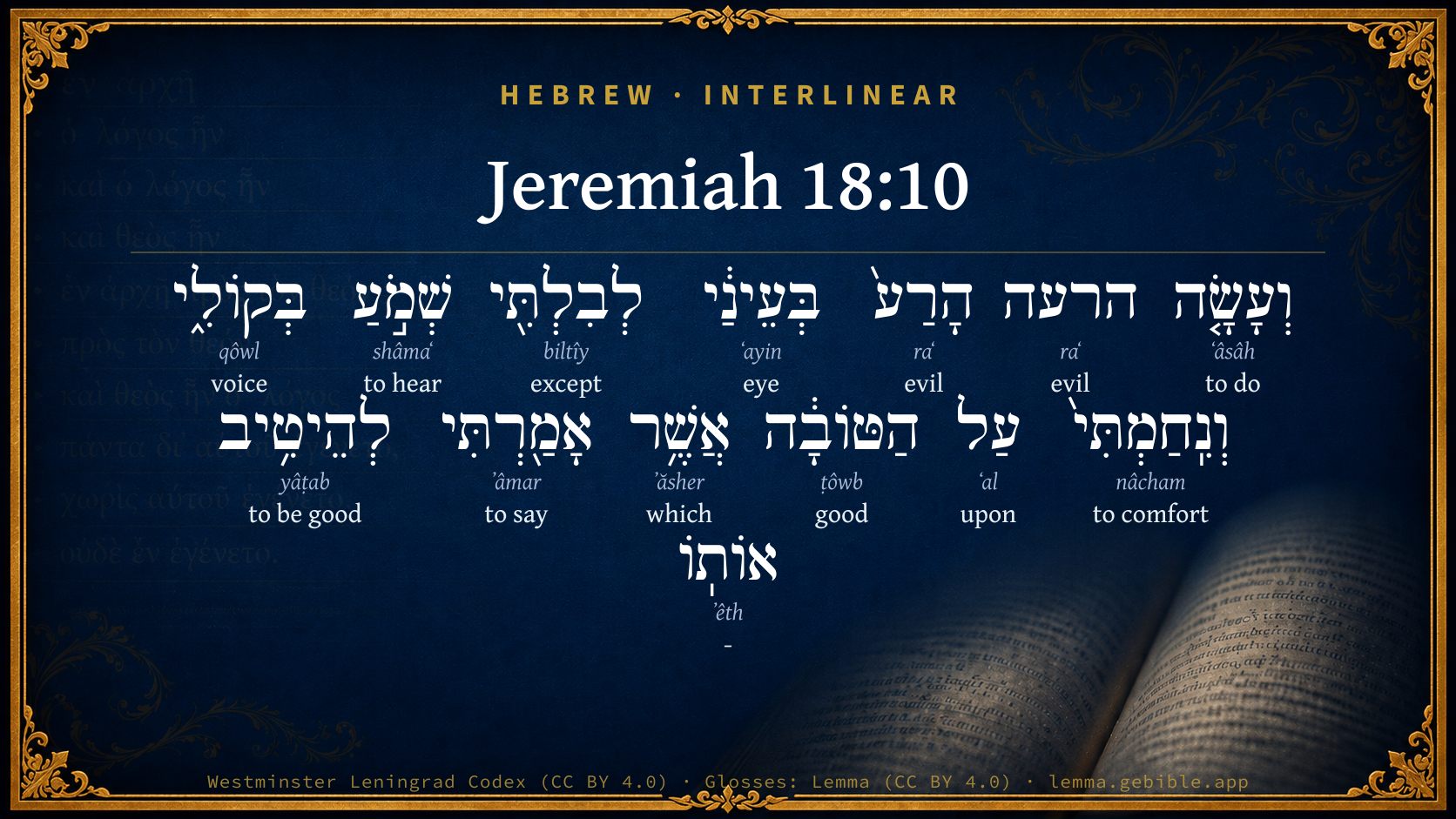
  1. וְעָשָׂ֤ה ʻâsâh H6213 “and · to do” Conjunction + Verb, Qal, Sequential Perfect, 3rd Person, Masculine, Singular
  2. הרעה raʻ H7451 “the · evil” Particle, Definite Article + Noun, Common, Feminine, Singular, Absolute
  3. הָרַע֙ raʻ H7451 “the · evil” Particle, Definite Article + Adjective, Adjective, Masculine, Singular, Absolute
  4. בְּעֵינַ֔י ʻayin H5869 “in/at · eyes · my” Preposition + Noun, Common, Both, Dual, Construct + Suffix, Personal, 1st Person, Common, Singular
  5. לְבִלְתִּ֖י biltîy H1115 “to/for · except” Preposition + Conjunction
  6. שְׁמֹ֣עַ shâmaʻ H8085 “to hear” Verb, Qal, Infinitive Construct
  7. בְּקוֹלִ֑י qôwl H6963 “in/at · voice · my” Preposition + Noun, Common, Masculine, Singular, Construct + Suffix, Personal, 1st Person, Common, Singular
  8. עַל ʻal H5921 “upon” Preposition
  9. הַטּוֹבָ֔ה ṭôwb H2896 “the · good” Particle, Definite Article + Adjective, Adjective, Feminine, Singular, Absolute
  10. אֲשֶׁ֥ר ʼăsher H834 “which” Particle, Relative
  11. אָמַ֖רְתִּי ʼâmar H559 “to say” Verb, Qal, Perfect, 1st Person, Common, Singular
  12. לְהֵיטִ֥יב yâṭab H3190 “to be good” Preposition + Verb, Hiphil, Infinitive Construct
  13. אוֹתֽוֹ ʼêth H853 “- · him” Particle, Direct Object + Suffix, Personal, 3rd Person, Masculine, Singular

About this verse

These counts appear in no published source. They are computed here, from the morphology-tagged text and Lemma’s own curated glosses. What Lemma adds →

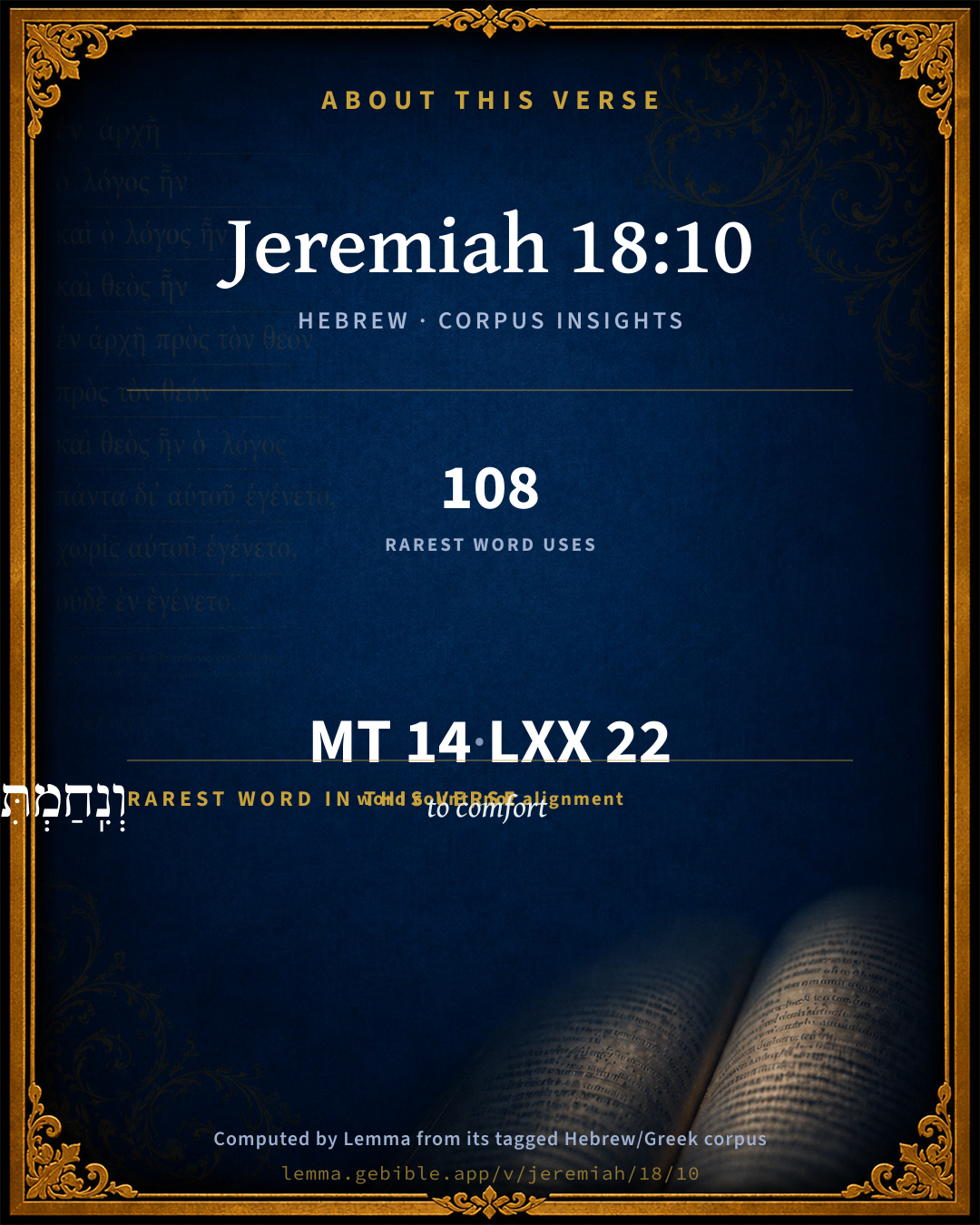
14
words
13
distinct lemmas
Prophets
section

Grammatical profile

  • 5 verbs
  • 3 nouns
  • 2 adjectives
  • 1 preposition
  • 1 conjunction
  • 2 particles

Verb forms

  • וְעָשָׂ֤ה Qal · Sequential Perfect
  • שְׁמֹ֣עַ Qal · Infinitive Construct
  • וְנִֽחַמְתִּי֙ Niphal · Sequential Perfect
  • אָמַ֖רְתִּי Qal · Perfect
  • לְהֵיטִ֥יב Hiphil · Infinitive Construct

Repetition

A word recurs within this verse — often emphatic in Hebrew:

  • הרעה evil H7451 ×2

Hebrew & Septuagint length

In the original languages it is 14 Hebrew tokens and 22 Greek tokens — but the two are counted differently (Hebrew bundles its prefixes and suffixes into one token; the Greek is in lemma form), so that isn’t a like-for-like length.

Cross-references

12

Topical passages linked to Jeremiah 18:10 in the Treasury of Scripture Knowledge — connected by theme and wording, ordered by reader-vote popularity; previews shown in the World English Bible.

  • 1 Samuel 2:30 Therefore Yahweh, the God of Israel, says, I said indeed that your house, and the house of your father, should walk before me forever: but now Yahweh says, Be it far from me; for those who honor me I will honor, and those who despise me shall be lightly esteemed.
  • Ezekiel 33:18 When the righteous turns from his righteousness, and commits iniquity, he shall even die therein.
  • 1 Samuel 13:13 Samuel said to Saul, You have done foolishly; you have not kept the commandment of Yahweh your God, which he commanded you: for now would Yahweh have established your kingdom on Israel forever.
  • Ezekiel 18:24 But when the righteous turns away from his righteousness, and commits iniquity, and does according to all the abominations that the wicked man does, shall he live? None of his righteous deeds that he has done shall be remembered: in his trespass that he has trespassed, and in his sin that he has sinned, in them shall he die.
  • 1 Samuel 15:11 It repents me that I have set up Saul to be king; for he is turned back from following me, and has not performed my commandments. Samuel was angry; and he cried to Yahweh all night.
  • Psalms 125:5 But as for those who turn aside to their crooked ways, Yahweh will lead them away with the workers of iniquity. Peace be on Israel.
  • Numbers 14:22 because all those men who have seen my glory, and my signs, which I worked in Egypt and in the wilderness, yet have tempted me these ten times, and have not listened to my voice;
  • 1 Samuel 15:35 Samuel came no more to see Saul until the day of his death; for Samuel mourned for Saul: and Yahweh repented that he had made Saul king over Israel.
  • Jeremiah 7:23–28 but this thing I commanded them, saying, Listen to my voice, and I will be your God, and you shall be my people; and walk you in all the way that I command you, that it may be well with you.
  • Zephaniah 1:6 those who have turned back from following Yahweh, and those who haven't sought Yahweh nor inquired after him.
  • Numbers 14:34 After the number of the days in which you spied out the land, even forty days, for every day a year, shall you bear your iniquities, even forty years, and you shall know my alienation.
  • Ezekiel 45:20 So you shall do on the seventh [day] of the month for everyone who errs, and for him who is simple: so shall you make atonement for the house.

Cross-references courtesy of OpenBible.info (CC BY 4.0).

Hebrew and Greek witnesses Masoretic Hebrew ↔ Greek Septuagint

The same verse in the two great witnesses to the Old Testament, shown verse-for-verse.

These are two independent witnesses, not word-aligned to each other, and the Septuagint is shown in lemma (dictionary) form.

Hebrew Jeremiah 18:10 Masoretic · Westminster Leningrad Codex

וְעָשָׂ֤ה הרעה הָרַע֙ בְּעֵינַ֔י לְבִלְתִּ֖י שְׁמֹ֣עַ בְּקוֹלִ֑י וְנִֽחַמְתִּי֙ עַל הַטּוֹבָ֔ה אֲשֶׁ֥ר אָמַ֖רְתִּי לְהֵיטִ֥יב אוֹתֽוֹ

if they do that which is evil in my sight, that they not obey my voice, then I will repent of the good, with which I said I would benefit them.

World English Bible · Public Domain

Greek LXX Structure differs

In the Septuagint, Jeremiah is about an eighth shorter than the Hebrew and arranges its material differently — the Oracles Against the Nations (Hebrew chapters 46–51) appear in the middle of the Greek book, after 25:13. Because the chapter and verse boundaries do not line up, a verse-for-verse comparison with the Hebrew is not shown.

A verse-for-verse comparison isn’t shown here because the chapters and verses don’t line up. Switch to the LXX edition with the MT / LXX toggle above to read the Greek directly.

Hebrew: Westminster Leningrad Codex (CC BY 4.0). Greek: Septuagint (public domain); English from a public-domain English Septuagint. How the Septuagint differs from the Hebrew →

Targum (Aramaic paraphrase)

1

The Targum is the ancient Jewish Aramaic paraphrase of the Hebrew Scriptures — an interpretive translation, not the Hebrew text itself. Onkelos (literal) and Pseudo-Jonathan (expansive) render the Torah, and Jonathan the Prophets. Coverage is partial: where no permissively-licensed English translation exists for a verse, only the Aramaic is shown. This is verse-level text, not a word-by-word alignment to the Hebrew.

  1. Targum Jonathan Prophets (Joshua–Malachi)
    וְיַעְבֵּיד דְבִישׁ קֳדָמֵי בְּדִיל דְלָא לְקַבָּלָא לְמֵימְרִי וְאֵיתוּב מִן טַבְתָא דַאֲמָרִית לְאֵיטָבָא לֵיהּ:

    (no public-domain English translation for this verse)

    Targum Jonathan — Aramaic: “Mikraot Gedolot” (public domain). English: “Sefaria Community Translation” (CC0 1.0 (public-domain dedication)); “London "Chaldee Paraphrase," 1871” (public domain). Text via Sefaria.

Commentary

Notes on Jeremiah 18:10 from classic Christian and Jewish commentators (each source and its license shown beneath its notes). The classic Christian expositions comment on the surrounding passage and are grouped to its opening verse, so a note may address several verses; the Jewish commentaries on the Tanakh (Rashi and others) are per-verse, so they appear only where the commentator wrote on this verse.

Lemma curates 59 commentaries, every one of them public domain or Creative Commons licensed, each selected and text-cleaned for this edition rather than reprinted as found. About our sources →

Trapp's Complete Commentary

John Trapp

Jer 18:10 If it do evil in my sight, that it obey not my voice, then I will repent of the good, wherewith I said I would benefit them.

Ver. 10. Then will I repent of the good.] I will take away mine own, and be gone; {Hos 2:9} "curse their blessings," {Mal 2:2} and "destroy them after that I have done them good"; {as Jos 24:20} and all this, whether for the better or for the worse to a nation, God usually doth on the sudden; "At what instant," &c. Mercies, the more unexpected, the more welcome; judgments, the more sudden, the more direful they are.

John Trapp, A Commentary or Exposition upon All the Books of the Old and New Testament (1647–1656) — public domain. Text from a community e-Sword module.

Matthew Poole's English Annotations

Speaking, Jer 18:9, and repenting, Jer 18:10, must be understood in the same sense as in the two former verses. The reason of this is, because in all God’s threatenings and promises of this nature there is a condition either expressed or understood. God’s threatenings of evil must be understood with this condition, Unless men and women repent and turn from their evil ways; and his promises of good must be understood with this condition. If those to whom they are made be a willing and obedient people, and keep in the way of the Lord’s statutes.

Matthew Poole's English Annotations on the Holy Bible (1683–1685) — public domain. Text from a community e-Sword/MySword module.

Adam Clarke's Commentary

Verse 10. See Clarke on Jer 18:7.

Adam Clarke's Commentary on the Bible (1810–1826) — public domain. Text from a community e-Sword/MySword module.

John Calvin's Commentaries

Now follows the opposite clause, But if it will do evil before mine eyes, so as not to hear my voice; that is, when a nation has been planted through my kindness, (for this is required by the context,) then I will repent, etc. By this denunciation is meant, that God would tread in the dust those whom he had favored with singular benefits, on account of the abuse made of them; although he had said, “When I promise bountifully and freely to a nation or a kingdom everything that can be wished, except my favor and goodness be rightly received, then I repent of the good done to it.” The meaning is, that the way of pardon is always open, when a sinner turns to God, and that it is in vain for men to boast of God’s promises, except, they in fear and obedience submit themselves to him.

Both these things were necessary; that is, that the Jews should know that God would be entreated if they repented, and that his promises could not be extended to those who were guilty of such gross abuse as a total disregard of his law and his prophets. Then the Prophet mentions here the ordinary course, — that as soon as men repented, they might safely and fully expect good things from God, for he is inclined to mercy; and then, that no nation, however it may excel in gifts, ought to indulge a foolish confidence and to use its present glory as means to despise its giver, for God can take away what he has given. The real import of the whole then is, that we cannot expect to enjoy the benefits which God bestows on us, except we persevere in faithfulness and in the fear of him. It is indeed cmtain that God’s blessings do not depend on worthiness in man; but still he will not have his bounty to be despised, as was the case with the Jews, and at this day it is a common thing in the world. It now follows,--

John Calvin's Commentaries (1540-1563) — public domain. Text from the Calvin Translation Society English edition (1840s-50s) via the Christian Classics Ethereal Library (ccel.org). Calvin's coverage is partial (roughly two-thirds of the Bible); uncommented books and verses are honest gaps, never fabricated. The 19th-century editor's footnotes and remarks are omitted so the notes are faithfully Calvin's own voice.

John Gill's Exposition

And they said, there is no hope,.... Or, "but they said" (w); not that there was no hope of the grace and mercy of God, upon their repentance and reformation, for that is before declared; but that they were so hardened in their sins, so fixed in their wicked courses, and so determined to go on in them, that there was no room for the prophet to hope of ever reclaiming them; signifying, that it was to little purpose to talk to them, or exhort them; his labour would be in vain; for they were at a point, and resolved to continue in their evil practices, let the consequences be what they would. Jarchi's note is,

"but I know that they will say to thee concerning thy words, that we do not care for them;''

no, not a rush; you may as well hold your peace and say nothing; we are in no pain about future judgments, these give us no uneasiness. The Targum is,

"we are turned from thy worship;''

and we are resolved to continue as we are, and not to return to say what you will:

but we will walk after our own devices; God may take his way, and we will take ours; he has devised evil against us, you say, and he may bring it if he pleases; we have devised sin, and we shall go on in it:

and we will do everyone the imagination of his evil heart; whatsoever our hearts suggest to us as pleasant and agreeable, that we shall do, let the issue be what it will: it is not to be thought that these people expressed themselves in so many words; but this was the language of their hearts, and of their actions, known unto the Lord, and are put into this form by him, or by the prophet, expressing the real sentiments of their minds.

(w) "sed dixerunt", Schmidt; "sed dicunt", Piscator.

John Gill's Exposition of the Whole Bible (1746–1763) — public domain (CC PDM 1.0). Text via the HelloAO Bible API.

Whedon's Commentary on the Bible

Daniel D. Whedon

10. I will repent of the good — How fearful an illustration of this did God furnish in this very place. They who bought this potter’s field with the price of innocent and holy blood, furnish by so doing an historically perpetual and most sad and impressive instance of a potter’s vessel dashed to destruction.

Daniel D. Whedon (gen. ed.), Commentary on the Old and New Testaments (1874–1909) — public domain. Text from a community e-Sword module.

Lesson kit

Teaching starters — assembled from the data on this page, not authored interpretation. Every prompt links to the verse data it draws on. Edit before teaching.

Jeremiah, in the Prophets, opens this verse with 14 words (13 distinct Hebrew lemmas). Its most distinctive word is nâcham (“to comfort”). A historical commentator’s framing appears above. Read the whole chapter for the surrounding context.

Discussion questions

  1. How does “to comfort” (nâcham) shape what this verse is saying?
  2. How does 1 Samuel 2:30, which shares this passage’s theme, read alongside this verse?
  3. What does the repetition of “evil” (2× in this one verse) do in this verse?
  4. These translations render this verse differently. What is at stake in choosing one wording over another?
  5. «וְעָשָׂ֤ה» is a Qal Sequential Perfect verb. How does that grammatical form shape the action described?
  6. Compare how Trapp's Complete Commentary and Matthew Poole's English Annotations read this verse. Where do they agree or differ?

Things to notice

Reading settings

Reading text

Shown beneath each verse's original-language words.

Old Testament
Old Testament edition

Read the OT as the Masoretic Hebrew (MT) or the Greek Septuagint (LXX).

English shown for the Greek Septuagint (in the Hebrew ↔ Greek comparison).

Comparing translations? Open the Compare panel on any verse page to stack up to four side by side.