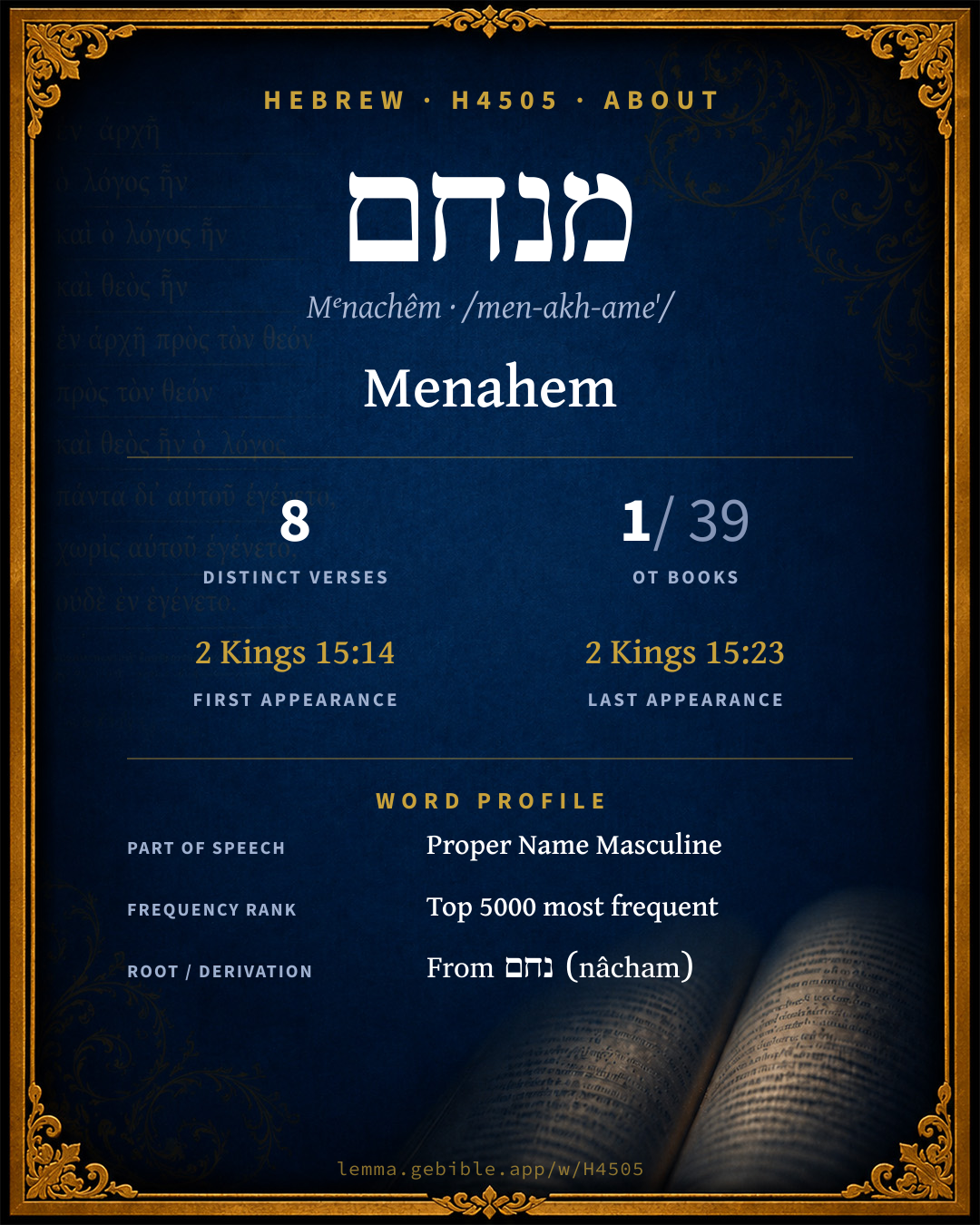
מְנַחֵם
Menahem
BDB lists 2 entries for ‘Menahem’ fuller range ↓
Full lexicon entry — Brown-Driver-Briggs (BDB)
From Brown-Driver-Briggs (BDB)
Where this word appears
Grammar key — what these labels mean
Part of speech
- Noun
- A naming word — a person, place, thing, or idea.
Noun type
- Proper
- A name of a specific person, place, or people (e.g. Abraham, Zion, Israel).
Every verse where H4505 appears — 8 distinct verses across 1 book. Click any verse to open its interlinear word-by-word view. Verse text shown in the World English Bible for context — . Each verse’s Hebrew form is shown with its reference; the English is not keyword-highlighted, since the data carries no word-level English alignment. Use “Compare translations” on any verse to read it across multiple English versions. This concordance covers the Hebrew Bible; Septuagint (Greek Old Testament) occurrences are not indexed here.
2 Kings 8 verses
- 2 Kings 15:14 מְנַחֵ֨ם n Proper Menahem the son of Gadi went up from Tirzah, and came to Samaria, and struck Shallum the son of Jabesh in Samaria, and killed him, and reigned in his place.
- 2 Kings 15:16 מְ֠נַחֵם n Proper Then Menahem struck Tiphsah, and all who were therein, and the borders of it, from Tirzah: because they didn't open to him, therefore he struck it; and all the women therein who were with child he ripped up.
- 2 Kings 15:17 מְנַחֵ֨ם n Proper In the nine and thirtieth year of Azariah king of Judah began Menahem the son of Gadi to reign over Israel, [and reigned] ten years in Samaria.
- 2 Kings 15:19 מְנַחֵם֙ n Proper There came against the land Pul the king of Assyria; and Menahem gave Pul one thousand talents of silver, that his hand might be with him to confirm the kingdom in his hand.
- 2 Kings 15:20 מְנַחֵ֨ם n Proper Menahem exacted the money of Israel, even of all the mighty men of wealth, of each man fifty shekels of silver, to give to the king of Assyria. So the king of Assyria turned back, and didn't stay there in the land.
- 2 Kings 15:21 מְנַחֵ֖ם n Proper Now the rest of the acts of Menahem, and all that he did, aren't they written in the book of the chronicles of the kings of Israel?
- 2 Kings 15:22 מְנַחֵ֖ם n Proper Menahem slept with his fathers; and Pekahiah his son reigned in his place.
- 2 Kings 15:23 מְנַחֵ֧ם n Proper In the fiftieth year of Azariah king of Judah Pekahiah the son of Menahem began to reign over Israel in Samaria, [and reigned] two years.
About this entry
At a glance — auto-summarized from this page’s data, not written by a person. Every figure links to its source below. This summary describes the numbers; it doesn’t interpret them.
The Hebrew name מנחם centers on the idea of “Menahem.” 2 Kings dominates its distribution — 8 of 8 verses. The Hebrew Bible uses it across 8 verses — uncommon. It first appears in 2 Kings 15:14. The sections below give every occurrence and version rendering.
Gloss history
Strong's 1890 vs modern scholarship
About this word
Strong's H4505 catalogs a Hebrew word from the Hebrew Old Testament.
These counts are not copied from any lexicon or concordance. They are computed here, from the morphology-tagged Hebrew Old Testament. What Lemma adds →
- 8
- distinct verses
- The word appears in 8 distinct verses.
- 1 / 39
- OT books
- The word appears in 1 of 39 Old Testament books.
- #2,625
- by frequency
- Top 5000 most frequent Hebrew words (rank 2,625 of 8,640 Hebrew words by occurrence).
View all 8 occurrences in the concordance →
Most concentrated in
- 2 Kings 8 verses 100%
By section of the Old Testament
By traditional corpus
Conventional, traditional groupings — biblical authorship is debated, so this is a traditional corpus grouping, not an authorship claim. Each share is this word’s portion of its verses in that division of the Hebrew canon. Each figure is a share of the word’s 8 distinct verses.
- Prophets (Nevi'im) 8 verses · 100%
How translations render this word
Counts come from each version’s own published word-to-Strong’s tagging or interlinear alignment — an approximate guide to how each version renders this word, not a word-level alignment the data otherwise carries. Because each total is that version’s own tagged count, the per-version totals vary from one another and need not match the appearance or distinct-verse counts above. These counts may also differ from a printed concordance because Lemma counts each distinctly tagged rendering and does not collapse phrase taggings into a single head-word total. This is a fixed set of word-tagged versions (KJV, ASV, BSB, ULT) and does not change with the reading translation you choose elsewhere. Each version’s license is shown beside its name below (and on Sources).
- King James Version: Menahem 7×
- American Standard Version: Menahem 7×
- Berean Standard Bible: Menahem 8×
- unfoldingWord Literal Text: Menahem 8×
King James Version Public Domain
Renders H4505 across 8 tagged occurrences — most commonly:
Plus 1 rendering that appears only once — usually multi-word phrases or single function words the recovered tagging swept in, not distinct renderings.
American Standard Version Public Domain
Renders H4505 across 8 tagged occurrences — most commonly:
Plus 1 rendering that appears only once — usually multi-word phrases or single function words the recovered tagging swept in, not distinct renderings.
Berean Standard Bible Public Domain
Renders H4505 across 8 tagged occurrences — most commonly:
unfoldingWord Literal Text CC BY-SA 4.0
Renders H4505 across 8 tagged occurrences — most commonly:
Senses in BDB
The 2 senses BDB distinguishes for this word, in lexicon order (not ranked by frequency or importance). The full entry — with sub-senses — is in the Lexicon Entry tab.
- Menahem = "comforter"
- son of Gadi and king of the northern kingdom of Israel…
Word origin
n.pr.m. (comforter), king of Northern Israel, 2 K 15:14, 16, 17, 19, 20, 21, 22, 23; 𝔊 Μαναημ.
— Brown-Driver-Briggs (Oxford 1906, public domain), digitized via Sefaria, supplemented by the OpenScriptures HebrewLexicon (CC BY 4.0). See Sources.
Derived from נחם (nâcham) (H5162) — to comfort.
Jastrow Dictionary
A second Hebrew/Aramaic lexicon for comparison, covering Aramaic and post-biblical (Talmudic, Targumic, Midrashic) usage that the biblical-Hebrew BDB does not. Matched by lemma rather than by Strong’s number, so a lemma may carry more than one Jastrow headword (shown separately below), and the entries cover usage well beyond the Bible.
מְנַחֵם
- (b. h.) pr. n. m. Menahem,
- 1. King of Israel. Yalk. Kings 236 (from Seder ʿOlam).—2) name of the Messiah to come. Snh. 98ᵇ. Y. Ber. III, 5ᵃ top; Lam. R. to I, 16; Pirké d’R. El. ch. XIX מ׳ בן עמיאל בן יוסף.—3) M., associate judge of Hillel. Ḥag. II, 2. Ib. 16ᵇ יצא מ׳ לעבודת המלך M. resigned from the judgeship to enter the King’s (Herod’s) service.—4) M. bar Simai, surnamed ‘the son of saints’. Pes. 104ᵃ; Ab. Zar. 50ᵃ; (Y. ib. III, 42ᶜ top נחום איש קודש קדשים).—5) name of several scholars. Y. Maasr. V, end, 52ᵃ M. bar Mabsima.—Y. Erub. VII, 24ᶜ top.—Tosef. ib. XI (VIII), 10 מ׳ איש גליא (Keth. 60ᵃ נחום). Tosef. Shebu. I, 7 מ׳ איש גם זו, v. גִּמְזוֹ.—Tosef. Keth. V, 1; a. fr.
נָחַם
- to be at ease. Ex. R. s. 20 (homiletic interpret. of נָחָם, Ex. XIII, 17) אמר הקב"ה איני מתנחם וכ׳ the Lord said, I shall not be contented, until &c., for we read ולא נָחַם (perhaps meant for נִחַם Nif.). e.g. Exodus 13:17
- to comfort, console. Pesik. Naḥ., p. 128ᵃ א"ל הקב"ה אני ואתם נלך ונְנַחֲמֶנָּה the Lord said to them (the prophets), Myself and you, let us go and comfort her (Jerusalem); ib. נַחֲמוּהָ עמי וכ׳ comfort her, O my people; comfort her, you on high (angels) &c. Ib. הקב"ה שלחני אצלך לנַחֲמֵךְ the Lord sent me to thee (Jerusalem) to comfort thee. Ib.ᵇ נַחֲמוּנִי נחמוני עמי comfort me, comfort me, O my people. Pesik. R. s. 30 ונכנסו חביריו לנַחֲמוֹ and his friends came in to comfort him; אם על אשתו מְנַחֲמִים לו וכ׳ if it is for the loss of his wife that they seek to console him, and he refuses to be consoled &c. Midd. II, 2 השוכן בבית הזה יְנַחֶמְךָ may He who resides in this house console thee. Y. Gitt. V, 47ᶜ top; Y. Dem. IV, 24ᵃ bot. ומְנַחֲמִין אבילי וכ׳ and you must comfort the gentile mourners (of your place) as well as the Jewish mourners; Y. Ab. Zar. I, 39ᶜ bot. ניחמים (corr. acc.); Tosef. Gitt. V (III), 5; a. fr.—מְנַחֵם the consoling friend of the mourner. Yalk. Prov. 947 בבית האבל בחול פריס מנ׳ ויהיב לאבל … יש לה מנ׳ פריס מנ׳ וכ׳ in the house of the mourner, on week days, the comforter breaks the bread and gives it to the mourner, as it is written (Lam. I, 17), ‘Zion breaks (the bread) with her own hands, she has no comforter’, but if she had a comforter, the comforter would break it &c.—Pl. מְנַחֲמִים, מְנַחֲמִין. M. Kat. 27ᵃ בית המנ׳ the room where the comforters meet. Ib. 27ᵇ כיון שניענע … אין מנ׳ וכ׳ as soon as the mourner nods with his head (indicating that he accepts their consolations), the friends are no longer permitted to sit with him; a. fr.—Sabb. 152ᵃ מת שאין לו מנ׳ a deceased person that leaves no direct relations to be comforted. e.g. Lamentations 1:17
- , Nithpa. נִתְנַחֵם
- 1. to be comforted, accept consolation. Pesik. l. c. מי צריך להִנָּחֵם which of them is in need of being comforted?; ib. להִתְנַחֵם. Snh. 19ᵃ תִּתְנֶחָמוּ be comforted. Ib. מִתְנַחֵם מאחרים receiving consolations from others. Pesik. R. l. c. ואינו מתנחם, v. supra. Gen. R. s. 84 מִתְנַחֲמִים על המתים וכ׳ people accept consolation for dead persons but not for living ones (that have disappeared); a. fr.—Gen. R. s. 27 (expl. וינחם, Gen. VI, 6) מתנ׳ אני שבראתי וכ׳ I have that consolation that I created him (man) to live on earth below &c. e.g. Genesis 6:6
- 2. to seek comfort; to be sorry, regret, reconsider. Ib. מתנ׳ אני שעשיתו וכ׳ I regret that I made him, and that he was placed on earth. Ex. R. s. 45, beg. ואני מתנ׳ עליו and I am sorry for him (reconsider my judgment). Num. R. s. 23 (ref. to Num. XXIII, 19) לא בן עמרם עשה אותו להִנָּחֵם did not the son of Amram cause him (God) to reconsider (Ex. XXXII, 14); ib. להִתְנַחֵם; Y. Taan. I, 65ᵇ bot. שעשה לאל שיִתְנֶחָם; a. fr. e.g. Numbers 23:19
A Dictionary of the Targumim, the Talmud Babli and Yerushalmi, and the Midrashic Literature (Marcus Jastrow; London, Luzac, 1903) — Public Domain. Digitized via Sefaria. Digitized via Sefaria. Full attribution on Sources.
Forms in the corpus
The 5 distinct written forms H4505 takes in the Hebrew Bible, most frequent first — each parse links to that state’s occurrences in the concordance. Hebrew forms include their vowel points and cantillation, so a single lemma takes many written forms.
| Form | Parsing | Example | Uses |
|---|---|---|---|
| מְנַחֵ֨ם | Noun, Proper | 2 Kings 15:14 | 3 |
| מְנַחֵ֖ם | Noun, Proper | 2 Kings 15:21 | 2 |
| מְ֠נַחֵם | Noun, Proper | 2 Kings 15:16 | 1 |
| מְנַחֵ֧ם | Noun, Proper | 2 Kings 15:23 | 1 |
| מְנַחֵם֙ | Noun, Proper | 2 Kings 15:19 | 1 |
Same root — word family
Other BDB entries built from the same root as H4505, grouped by Strong’s listed origin. These share a root / origin per the lexicon — not necessarily a shared meaning. Each links to that word’s own entry.
Derives from
Shares the same root
- נחום nichûwm H5150 comfort
- נחם nôcham H5164 repentance
- נחמה nechâmâh H5165 comfort
- תנחום tanchûwm H8575 consolation
Proper names from this root
People and places named from this root — a name, not an additional meaning of the word.
- נחום Nᵉchûwm H5149 Nehum
- נחום Nachûwm H5151 Nahum
- נחם Nacham H5163 Naham
- נחמיה Nᵉchemyâh H5166 Nehemiah
- נחמני Nachămânîy H5167 Nahamani
Compare all same-root words → Showing 4 of 11 — not the complete family. 5 of the same-root words are proper names (people or places). They share a root, not necessarily a meaning.
Bible dictionary
Public-domain dictionary articles matched to this entry by name (Menahem). A biblical name can be shared by more than one person or place, so an article may treat several.
Easton's Bible Dictionary · M. G. Easton, 1897
Conforting, the son of Gadi, and successor of Shallum, king of Israel, whom he slew. After a reign of about ten years (B.C. 771-760) he died, leaving the throne to his son Pekahiah. His reign was one of cruelty and oppression (2 Kings 15:14-22). During his reign, Pul (q.v.), king of Assyria, came with a powerful force against Israel, but was induced to retire by a gift from Menahem of 1,000 talents of silver.
Smith's Bible Dictionary · William Smith, 1863
(comforter), son of Gadi, who slew the usurper Shallum, and seized the vacant throne of Israel. B.C. 772. His reign, which lasted ten years, is briefly recorded in (2 Kings 15:14-22) He maintained the calf-worship of Jeroboam. The contemporary prophets Hosea and Amos have left a melancholy picture of the ungodliness, demoralization and feebleness of Israel. Menahem reigned B.C. 771-760.
Hitchcock's Bible Names Dictionary · Roswell D. Hitchcock, 1869
comforter; who conducts them; preparation of heat
Classic public-domain reference works; full attribution on Sources.
Septuagint verse parallels
This word appears in 8 verses that also exist in the Greek Old Testament (Septuagint), out of the 8 Hebrew verses it occurs in. You can read those verses in Greek by switching the Old Testament edition to the Septuagint.
Read these verses in the Septuagint
This is a verse-level parallel only — the same verses exist in both the Hebrew and Greek Old Testaments. No word-level Hebrew↔Greek correspondence is claimed: the data carries no such alignment, so no Greek word is shown as this Hebrew word’s translation. Coverage is not total — the Septuagint omits the deuterocanon and renumbers the Psalms, so some Hebrew verses have no direct Greek parallel.