
Jeremiah 26:3

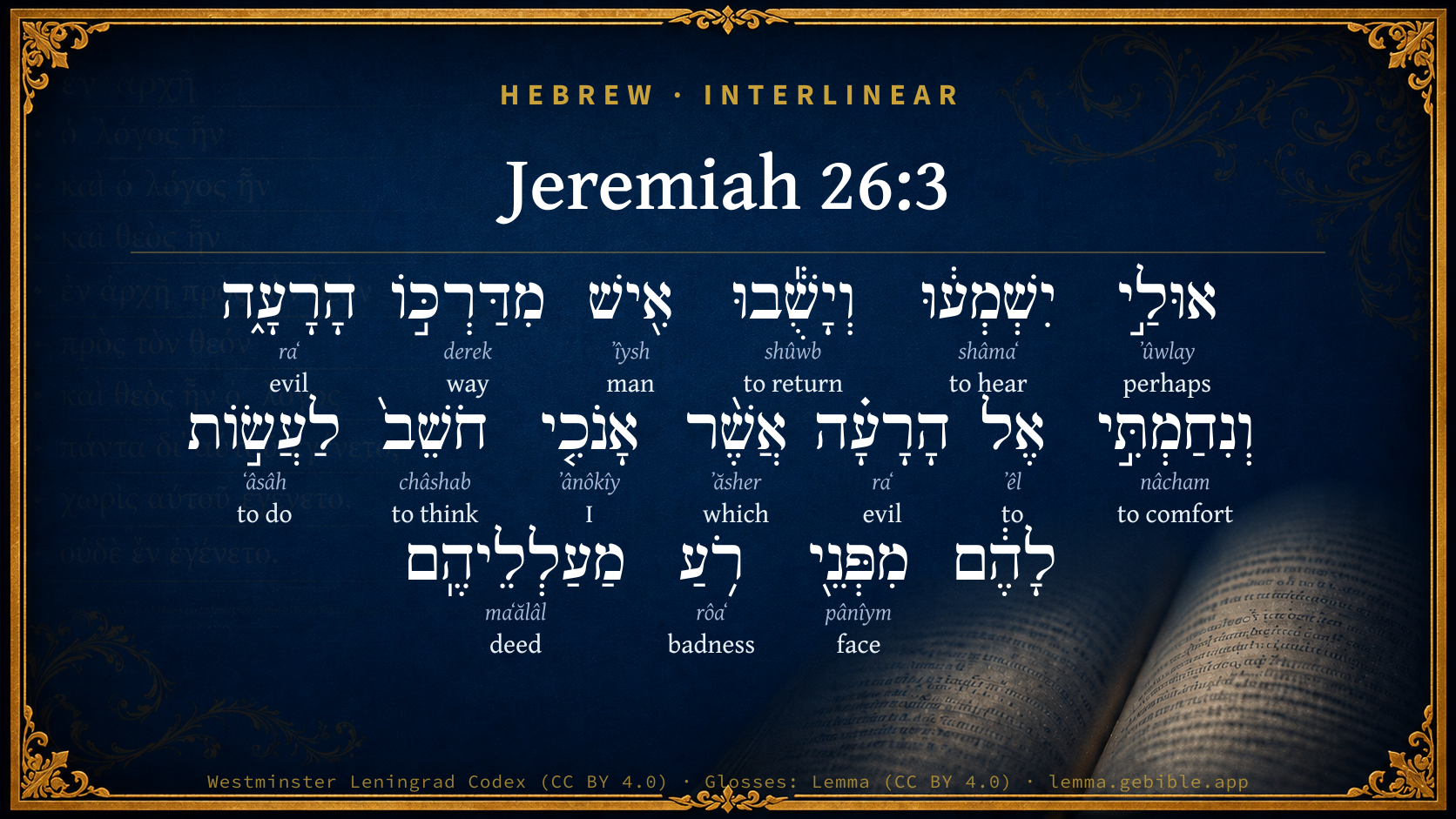
Hebrew (Westminster Leningrad Codex) Jeremiah 26:3 appears in the Hebrew Old Testament. The text above is from the Westminster Leningrad Codex. Each word links to its Strong’s number, a concise gloss, and parsing drawn from the Open Scriptures Hebrew Bible morphology. Click any word for its full Brown-Driver-Briggs (BDB) entry.
Download image
Cite this verse

Jeremiah 26:3 (World English Bible). Public Domain. Lemma interlinear Bible study tool, https://lemma.gebible.app/v/jeremiah/26/3.

Show BibTeX & RIS
BibTeX
RIS
English Translation
It may be they will listen, and turn every man from his evil way; that I may repent me of the evil which I purpose to do to them because of the evil of their doings.
World English Bible · Public Domain
Download a study sheet

One document with this verse’s original text, its word-by-word gloss line, the meaning frame, cross-references with their text, attributed commentary, and full source and license credits — printable, and it pastes into notes with its structure intact.

This verse Autodidact and up

Study sheet (.html) Plain text (.txt)

A passage Seminary Student

Up to 50 verses in one chapter. A passage sheet keeps up to 6 commentary sources and 12 cross-references per verse, in the order this page ranks them, and says so on the sheet whenever that leaves anything out. Ask for a single verse and you get the Autodidact verse sheet above.

Everything on this page stays free to read, with no account — the sheet is a download of what is already on screen, not access to it.

Want to remove ads? Support Godless Engineer
Compare translations 3

The same verse in 3 English versions, stacked beneath the original-language interlinear above. Click any original word for its lexicon entry.

Each is an independent rendering of the whole verse — the interlinear is not word-aligned to these translations.

Highlighted words mark where these versions differ — a whole-verse word diff, not a word-by-word alignment.

  • World English Bible Public Domain
    It may be they will listen, and turn every man from his evil way; that I may repent me of the evil which I purpose to do to them because of the evil of their doings.
  • King James Version Public Domain
    If so be they will hearken, and turn every man from his evil way, that I may repent me of the evil, which I purpose to do unto them because of the evil of their doings.
  • unfoldingWord Literal Text CC BY-SA 4.0
    Perhaps they will listen and turn back, a man from his evil way, then I will relent concerning the disaster that I am planning to do to them from the face of the evil of their deeds.”

unfoldingWord Literal Text — © unfoldingWord, licensed CC BY-SA 4.0. Word-aligned USFM3 via Door43 (git.door43.org/unfoldingWord/en_ult).

Versions to compare (up to 4)

3 of 4 selected

Show all 18 translations

Every available English version of this verse, each an independent rendering of the whole verse.

  • World English Bible Public Domain
    It may be they will listen, and turn every man from his evil way; that I may repent me of the evil which I purpose to do to them because of the evil of their doings.
  • Berean Standard Bible Public Domain
    Perhaps they will listen and turn—each from his evil way of life—so that I may relent of the disaster I am planning to bring upon them because of the evil of their deeds.
  • Majority Standard Bible Public Domain
    Perhaps they will listen and turn—each from his evil way of life—so that I may relent of the disaster I am planning to bring upon them because of the evil of their deeds.
  • King James Version Public Domain
    If so be they will hearken, and turn every man from his evil way, that I may repent me of the evil, which I purpose to do unto them because of the evil of their doings.
  • American Standard Version (1901) Public Domain
    It may be they will hearken, and turn every man from his evil way; that I may repent me of the evil which I purpose to do unto them because of the evil of their doings.
  • Revised Version (1885) Public Domain
    It may be they will hearken, and turn every man from his evil way; that I may repent me of the evil, which I purpose to do unto them because of the evil of their doings.
  • Geneva Bible (1599) Public Domain
    If so be they will hearken, and turne euery man from his euill way, that I may repent me of the plague, which I haue determined to bring vpon them, because of the wickednesse of their workes.
  • Douay-Rheims (1899) Public Domain
    If so be they will hearken and be converted every one from his evil way; that I may repent me of the evil that I think to do unto them for the wickedness of their doings.
  • Young's Literal Translation Public Domain
    If so be they hearken, and turn back each from his evil way, then I have repented concerning the evil that I am thinking of doing to them, because of the evil of their doings.
  • Literal Standard Version CC BY-SA 4.0
    Perhaps they listen, and each turns back from his evil way; then I have relented concerning the evil that I am thinking of doing to them, because of the evil of their doings.
  • Unlocked Literal Bible CC BY-SA 4.0
    It may be that they will listen, that each man will turn from his wicked ways, so I will relent concerning the disaster that I am planning to bring on them because of the wickedness of their practices.
  • unfoldingWord Literal Text CC BY-SA 4.0
    Perhaps they will listen and turn back, a man from his evil way, then I will relent concerning the disaster that I am planning to do to them from the face of the evil of their deeds.”
  • Darby Bible Public Domain
    Peradventure they will hearken, and turn every man from his evil way, that I may repent me of the evil which I purpose to do unto them because of the wickedness of their doings.
  • World Messianic Bible Public Domain
    It may be they will listen, and every man turn from his evil way, that I may relent from the evil which I intend to do to them because of the evil of their doings.’”
  • Webster's Bible Public Domain
    It may be they will hearken, and turn every man from his evil way, that I may repent of the evil, which I purpose to do to them because of the evil of their doings.
  • Free Bible Version CC BY-SA 4.0
    Maybe they will listen, and each of them will give up their evil ways so that I won't have to carry out the disaster I'm planning to bring down on them because of the evil things they do.
  • Bible in Basic English Public Domain
    It may be that they will give ear, and that every man will be turned from his evil way, so that my purpose of sending evil on them because of the evil of their doings may be changed.
  • JPS Tanakh (1917) Public Domain
    It may be they will hearken, and turn every man from his evil way; that I may repent Me of the evil, which I purpose to do unto them because of the evil of their doings.

Literal Standard Version (2020), Covenant Press — licensed CC BY-SA 4.0. Text via the HelloAO Bible API (eBible.org). Unlocked Literal Bible (unfoldingWord) — licensed CC BY-SA 4.0. Text via the HelloAO Bible API (eBible.org). unfoldingWord Literal Text — © unfoldingWord, licensed CC BY-SA 4.0. Word-aligned USFM3 via Door43 (git.door43.org/unfoldingWord/en_ult). Free Bible Version, Dr. Jonathan Gallagher — licensed CC BY-SA 4.0. Text via the HelloAO Bible API (eBible.org).

Word by word

More ways to search: Search by grammar → Find every occurrence → Compare this word →

Practice this passage: Drill this verse → Learn its vocabulary →

רֹ֥עַ
rôaʻ
H7455
“badness of”
Noun, Common, Masculine, Singular, Construct
Part of Speech
Noun
Type
Common
Gender
Masculine
Number
Singular
State
Construct
Full BDB Definition

Origin: from H7489

TWOT: 2191b

badness, evil - badness, bad quality - wilfulness - evil, badness (ethical) - sadness
  1. אוּלַ֣י ʼûwlay H194 “perhaps” Adverb
  2. יִשְׁמְע֔וּ shâmaʻ H8085 “to hear” Verb, Qal, Imperfect, 3rd Person, Masculine, Plural
  3. וְיָשֻׁ֕בוּ shûwb H7725 “and · to return” Conjunction + Verb, Qal, Imperfect, 3rd Person, Masculine, Plural
  4. אִ֖ישׁ ʼîysh H376 “man” Noun, Common, Masculine, Singular, Absolute
  5. מִדַּרְכּ֣וֹ derek H1870 “from · way · his” Preposition + Noun, Common, Both, Singular, Construct + Suffix, Personal, 3rd Person, Masculine, Singular
  6. הָרָעָ֑ה raʻ H7451 “the · evil” Particle, Definite Article + Adjective, Adjective, Feminine, Singular, Absolute
  7. וְנִחַמְתִּ֣י nâcham H5162 “and · to comfort” Conjunction + Verb, Niphal, Sequential Perfect, 1st Person, Common, Singular
  8. אֶל ʼêl H413 “to” Preposition
  9. הָרָעָ֗ה raʻ H7451 “the · evil” Particle, Definite Article + Noun, Common, Feminine, Singular, Absolute
  10. אֲשֶׁ֨ר ʼăsher H834 “which” Particle, Relative
  11. אָנֹכִ֤י ʼânôkîy H595 “I” Pronoun, Personal, 1st Person, Common, Singular
  12. חֹשֵׁב֙ châshab H2803 “thinking” Verb, Qal, Participle Active, Masculine, Singular, Absolute
  13. לַעֲשׂ֣וֹת ʻâsâh H6213 “to do” Preposition + Verb, Qal, Infinitive Construct
  14. מִפְּנֵ֖י pânîym H6440 “from · face(s) of” Preposition + Noun, Common, Both, Plural, Construct
  15. מַעַלְלֵיהֶֽם maʻălâl H4611 “deeds · their” Noun, Common, Masculine, Plural, Construct + Suffix, Personal, 3rd Person, Masculine, Plural

About this verse

These counts appear in no published source. They are computed here, from the morphology-tagged text and Lemma’s own curated glosses. What Lemma adds →

17
words
15
distinct lemmas
Prophets
section

Notable vocabulary

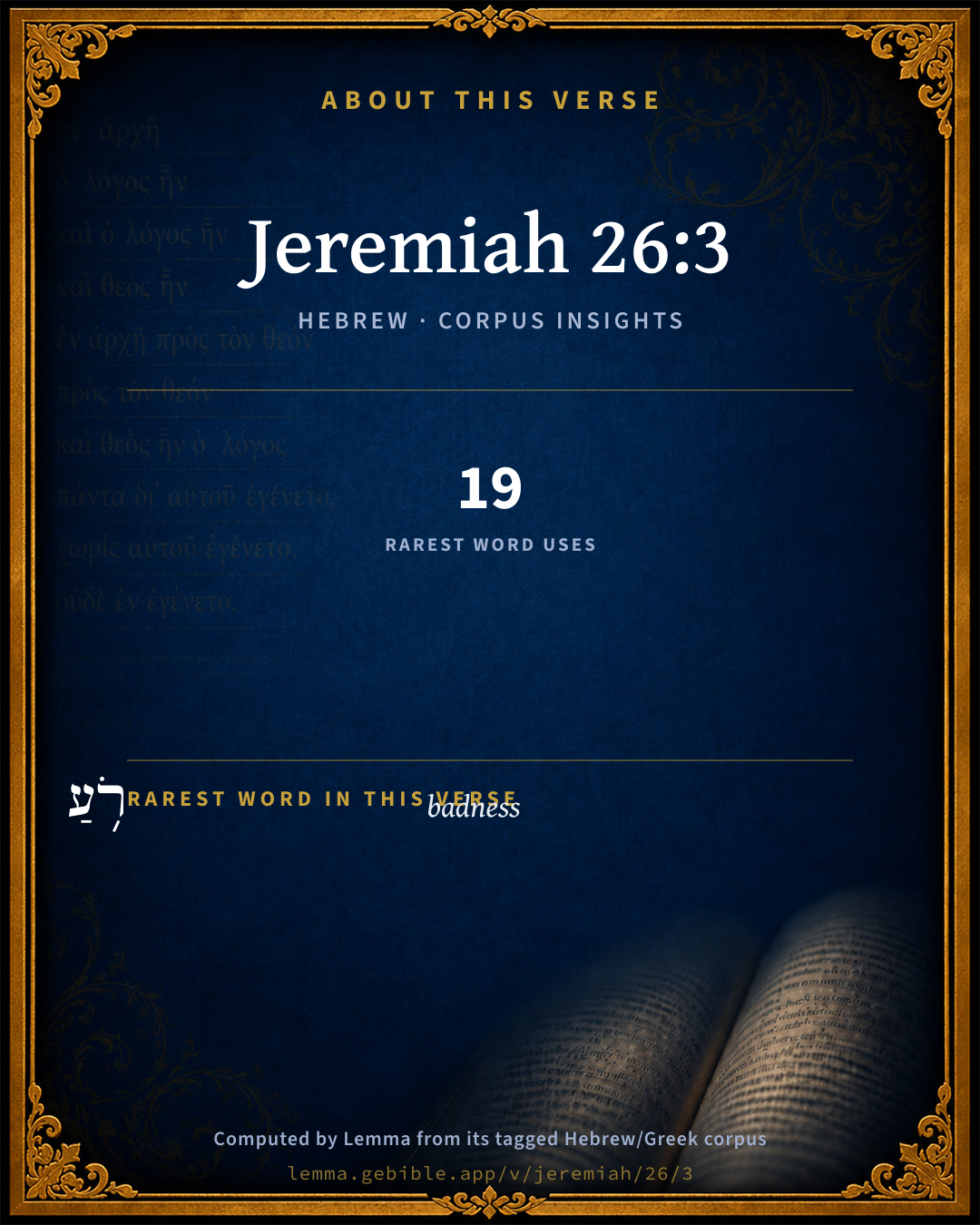
The rarest word here is רֹ֥עַ badness H7455 — appearing just 19 times in the whole Hebrew Bible.

Shared distinctive vocabulary

רֹ֥עַ badness H7455 occurs in 19 verses of the Hebrew Bible. Also found in:

Grammatical profile

  • 5 verbs
  • 6 nouns
  • 1 adjective
  • 1 pronoun
  • 2 prepositions
  • 1 adverb
  • 1 particle

Verb forms

  • יִשְׁמְע֔וּ Qal · Imperfect
  • וְיָשֻׁ֕בוּ Qal · Imperfect
  • וְנִחַמְתִּ֣י Niphal · Sequential Perfect
  • חֹשֵׁב֙ Qal · Participle Active
  • לַעֲשׂ֣וֹת Qal · Infinitive Construct

Repetition

A word recurs within this verse — often emphatic in Hebrew:

  • הָרָעָ֑ה evil H7451 ×2

Cross-references

9

Topical passages linked to Jeremiah 26:3 in the Treasury of Scripture Knowledge — connected by theme and wording, ordered by reader-vote popularity; previews shown in the World English Bible.

  • Jeremiah 36:3 It may be that the house of Judah will hear all the evil which I purpose to do to them; that they may return every man from his evil way; that I may forgive their iniquity and their sin.
  • Isaiah 1:16–19 Wash yourselves, make yourself clean. Put away the evil of your doings from before my eyes; Cease to do evil.
  • Jeremiah 18:7–10 At what instant I shall speak concerning a nation, and concerning a kingdom, to pluck up and to break down and to destroy it;
  • Jeremiah 36:7 It may be they will present their supplication before Yahweh, and will return everyone from his evil way; for great is the anger and the wrath that Yahweh has pronounced against this people.
  • Ezekiel 18:27–30 Again, when the wicked man turns away from his wickedness that he has committed, and does that which is lawful and right, he shall save his soul alive.
  • Jonah 3:8–10 but let them be covered with sackcloth, both man and animal, and let them cry mightily to God. Yes, let them turn everyone from his evil way, and from the violence that is in his hands.
  • Jonah 4:2 He prayed to Yahweh, and said, "Please, Yahweh, wasn't this what I said when I was still in my own country? Therefore I hurried to flee to Tarshish, for I knew that you are a gracious God, and merciful, slow to anger, and abundant in loving kindness, and you repent of the evil.
  • 1 Kings 21:27 It happened, when Ahab heard those words, that he tore his clothes, and put sackcloth on his flesh, and fasted, and lay in sackcloth, and went softly.
  • 1 Kings 21:29 See you how Ahab humbles himself before me? because he humbles himself before me, I will not bring the evil in his days; but in his son's days will I bring the evil on his house.

Cross-references courtesy of OpenBible.info (CC BY 4.0).

Hebrew and Greek witnesses Masoretic Hebrew ↔ Greek Septuagint

The same verse in the two great witnesses to the Old Testament, shown verse-for-verse.

These are two independent witnesses, not word-aligned to each other, and the Septuagint is shown in lemma (dictionary) form.

Hebrew Jeremiah 26:3 Masoretic · Westminster Leningrad Codex

אוּלַ֣י יִשְׁמְע֔וּ וְיָשֻׁ֕בוּ אִ֖ישׁ מִדַּרְכּ֣וֹ הָרָעָ֑ה וְנִחַמְתִּ֣י אֶל הָרָעָ֗ה אֲשֶׁ֨ר אָנֹכִ֤י חֹשֵׁב֙ לַעֲשׂ֣וֹת לָהֶ֔ם מִפְּנֵ֖י רֹ֥עַ מַעַלְלֵיהֶֽם

It may be they will listen, and turn every man from his evil way; that I may repent me of the evil which I purpose to do to them because of the evil of their doings.

World English Bible · Public Domain

Greek LXX Structure differs

In the Septuagint, Jeremiah is about an eighth shorter than the Hebrew and arranges its material differently — the Oracles Against the Nations (Hebrew chapters 46–51) appear in the middle of the Greek book, after 25:13. Because the chapter and verse boundaries do not line up, a verse-for-verse comparison with the Hebrew is not shown.

A verse-for-verse comparison isn’t shown here because the chapters and verses don’t line up. Switch to the LXX edition with the MT / LXX toggle above to read the Greek directly.

Hebrew: Westminster Leningrad Codex (CC BY 4.0). Greek: Septuagint (public domain); English from a public-domain English Septuagint. How the Septuagint differs from the Hebrew →

Targum (Aramaic paraphrase)

1

The Targum is the ancient Jewish Aramaic paraphrase of the Hebrew Scriptures — an interpretive translation, not the Hebrew text itself. Onkelos (literal) and Pseudo-Jonathan (expansive) render the Torah, and Jonathan the Prophets. Coverage is partial: where no permissively-licensed English translation exists for a verse, only the Aramaic is shown. This is verse-level text, not a word-by-word alignment to the Hebrew.

  1. Targum Jonathan Prophets (Joshua–Malachi)
    מָאִים יִשְׁמְעוּן וִיתוּבוּן גְבַר מֵאוֹרְחֵיהּ בִּישָׁא וַאֲתֵיב מִן בִּישְׁתָּא דַאֲנָא חָשֵׁיב לְמֶעְבַּד לְהוֹן מִקֳדָם בִּישׁוּת עוֹבָדֵיהוֹן:

    (no public-domain English translation for this verse)

    Targum Jonathan — Aramaic: “Mikraot Gedolot” (public domain). English: “Sefaria Community Translation” (CC0 1.0 (public-domain dedication)); “London "Chaldee Paraphrase," 1871” (public domain). Text via Sefaria.

Commentary

Notes on Jeremiah 26:3 from classic Christian and Jewish commentators (each source and its license shown beneath its notes). The classic Christian expositions comment on the surrounding passage and are grouped to its opening verse, so a note may address several verses; the Jewish commentaries on the Tanakh (Rashi and others) are per-verse, so they appear only where the commentator wrote on this verse.

Lemma curates 59 commentaries, every one of them public domain or Creative Commons licensed, each selected and text-cleaned for this edition rather than reprinted as found. About our sources →

Trapp's Complete Commentary

John Trapp

Jer 26:3 If so be they will hearken, and turn every man from his evil way, that I may repent me of the evil, which I purpose to do unto them because of the evil of their doings.

Ver. 3. That I may repent me of the evil; because of the evil.] Flagitium et flagellum sicut acus et filum; evil of sin produceth evil of pain. See Jer 4:4; Jer 4:6.

John Trapp, A Commentary or Exposition upon All the Books of the Old and New Testament (1647–1656) — public domain. Text from a community e-Sword module.

Tyndale Open Study Notes

Tyndale Open Resources

26:3 The Lord gave the people a choice about what would happen to them in the future. If they would turn from their evil ways, the Lord would change his mind. The standard of judgment was his covenant with Israel (see Deut 5:1-21; 27:1–28:68). When Israel obeyed the terms of the covenant, the Lord blessed the people. When Israel persistently and stubbornly disobeyed, the Lord eventually punished them.

Tyndale Open Study Notes — © Tyndale Open Resources, licensed CC BY-SA 4.0. Text via the HelloAO Bible API.

Geneva Bible (1599)

Geneva Bible translators

Read Jer. 18:8

Geneva Bible (1599) marginal notes — public domain. Text via Bolls.life.

Jamieson, Fausset & Brown

Robert Jamieson, A. R. Fausset & David Brown

if so be--expressed according to human conceptions; not as if God did not foreknow all contingencies, but to mark the obstinacy of the people and the difficulty of healing them; and to show His own goodness in making the offer which left them without excuse [CALVIN].

Jamieson, Fausset & Brown — Commentary Critical and Explanatory on the Whole Bible (1871) — public domain (CC PDM 1.0). Text via the HelloAO Bible API.

John Calvin's Commentaries

In this verse God briefly shows for what end he sent his Prophet. For it would not have been sufficient for him to announce what he taught, except it was known to have been the will of God. Here then God asserts that he would not be propitious to the people, except they complied with what he required, that is, to repent. Thus he testifies that what was taught would be useful to them, because it had reference to their safety; and a truth cannot be rendered more entitled to our love than when we know that it tends to promote our wellbeing. Therefore God, when he saw the people rushing headlong through blind despair into all kinds of impiety, designed to make the trial whether or not some of them were healable; as though he had said, “What are ye doing, ye miserable beings? It is not yet wholly over with you; only obey me, and the remedy for all your evils is ready at hand.” We now see what God’s design was, even that he wished to give those Jews the hope of mercy who were altogether irreclaimable, so that they might not reject what he taught on hearing that it would be for their good.

But we may hence gather a general doctrine; that when God is especially displeased with us, it is yet an evidence of his paternal kindness when he favors us with the prophetic teaching, for that will not be without its fruit, except it be through our own fault. But at the same time we are rendered more and more inexcusable, if we reject that medicine which would certainly give us life. Let us then understand that the Prophet says here, that he was sent that he might try whether the Jews would repent; for God was ready to receive them into favor.

By saying אולי, auli, “if peradventure,” he made use of a common mode of speaking. God indeed has perfect knowledge of all events, nor had he any doubt respecting what would take place, when the prophets had discharged their duties; but what is pointed out here, and also condemned, is the obstinacy of the people; as though he had said, that it was indeed difficult to heal those who had grown putrid in their evils, yet he would try to do so. And thus God manifests his unspeakable goodness, that he does not wholly cast away men who are almost past remedy, and whose diseases seem to be unhealable. He also strengthens his Prophet; for he might from long experience have been led to think that all his labor would be in vain; therefore God adds this, that he might not cease to proceed in the course of his calling; for what seemed incredible might yet take place beyond his expectation. We now see why it was said, If so be that they will hear

It is then added, and turn, etc. From the context we learn, that repentance as well as faith proceeds from the truth taught: for how is it that those alienated from God return, confess their sins, and change their character, minds, and purposes? It is the fruit of truth; not that truth in all cases is effectual, but he treats here of the elect: or were they all healable, yet God shews that the use and fruit of his truth is to turn men, as it is said also by the Prophet, (Malachi 4:6,) and repeated in the first chapter of Luke,

“He will turn many of the children of Israel.” (Luke 1:6.)

What follows is not without its weight, every one from his evil way; for God intimates that it was not enough that the whole people should ostensibly confess their sins, but that every one was required to examine himself: for when we seek God in a troop, and one follows another, it is often done with no right feeling. Repentance therefore is only true and genuine, when every one comes to search his own case; for its interior and hidden seat is in the heart. This is the reason why he says, If a man, that is, if every one turns from his evil way

As to God’s repentance, of which mention is made, there is no need of long explanation. No change belongs to God; but when God is said to turn away his wrath, it is to be understood in a sense suitable to the comprehension of men: in the same way also we are to understand the words, that he repents. (Psalm 85:5; 110:4.) It is at the same time sufficiently evident what God means here, even that he is reconcilable, as soon as men truly turn to him: and thus we see that men cannot be called to repent, until God’s mercy is presented to them. Hence also it follows, that these two things, repentance and faith, are connected together, and that it is absurd and an impious sacrilege to separate them; for God cannot be feared except the sinner perceives that he will be propitious to him: for as long as we are apprehensive of God’s wrath, we dread his judgment; and thus we storm against him, and must necessarily be driven headlong into the lowest abyss, hence under the Papacy they speak not only foolishly, but also coldly of repentance; for they leave souls doubtful and perplexed, nay, they take away every kind of certainty. Let us then understand the reason why the Holy Spirit teaches us, that repentance cannot be rightly and profitably taught, unless it be added, that God will be propitious to miserable men whenever they turn to him.

With regard to the word I think, I have already said, that God forms no contrary purposes; but this refers to those men who deserved his dreadful vengeance; it is the same as though he had said, — “Their iniquity has already ripened; I am therefore now ready to take vengeance on them: nevertheless let them return to me, and they shall find me to be a Father. There is, then, no reason for them to despair, though I have already manifested tokens of my vengeance.” This is the meaning; but he repeats the reason of his wrath, On account of the wickedness of their doings; for we know that they were proud and obstinate; it was therefore necessary to close their mouths, otherwise they would have raised a clamor, and said, that God was unjustly angry, or that he exceeded all bounds. Whatever evils then were at hand, God briefly shews that they came from themselves, that the cause was their own wickedness, It follows, —

John Calvin's Commentaries (1540-1563) — public domain. Text from the Calvin Translation Society English edition (1840s-50s) via the Christian Classics Ethereal Library (ccel.org). Calvin's coverage is partial (roughly two-thirds of the Bible); uncommented books and verses are honest gaps, never fabricated. The 19th-century editor's footnotes and remarks are omitted so the notes are faithfully Calvin's own voice.

Ellicott's Commentary for English Readers

(3) If so be they will hearken . . .—The threat that follows in Jer_26:6 is a very terrible one, but it is uttered in order that it may not be realised. So in the same spirit St. Paul warns men of his power to inflict a supernatural punishment, yet prays that he may have no occasion to use it (2Co_13:3-10).

A Bible Commentary for English Readers, edited by Charles John Ellicott (1878–1897) — public domain. Text from a community e-Sword module.

The Cambridge Bible for Schools and Colleges

gen. ed. J. J. S. Perowne

3. repent] See on Jer_18:8.

The Cambridge Bible for Schools and Colleges (gen. ed. J. J. S. Perowne; Cambridge University Press, 1878–1918) — public domain. Text from a community e-Sword module.

John Gill's Exposition

If so be they will hearken,.... And obey; which is expressive not of ignorance and conjecture in God, but of his patience and long suffering, granting space and time for repentance, and the means of it; which disregarded, leave without excuse:

and turn every man from his evil way; his series and course of life, which was evil, and was the case of everyone; so that as their sin was general, the reformation ought to be so too:

that I may repent me of the evil which I purpose to do unto them; or "am thinking", or "devising (d) to do unto them"; which repentance must be understood not of a change of mind, but of the course of his providence towards them, which, by his threatenings, and some steps taken, portended ruin and destruction; yet, in case of repentance and reformation, he would change his method of action agreeably to his will:

because of the evil of their doings; this was the reason why he had threatened them with the evil of punishment, because of the evil of their actions; which were breaches of his law, and such as provoked the eyes of his glory.

(d) "quod ego (sum) cogitans", Schmidt.

John Gill's Exposition of the Whole Bible (1746–1763) — public domain (CC PDM 1.0). Text via the HelloAO Bible API.

Haydock's Catholic Bible Commentary

If. God is not ignorant, (Calmet) but he preserves man’s free-will. (St. Jerome) --- He threatens conditionally, if people persist in evil. (Worthington)

George Leo Haydock (1774–1849), Haydock's Catholic Family Bible and Commentary, 1859 edition — public domain. Excludes Psalms (Douay-Rheims chapter numbering differs from Protestant) and Deuterocanonical books (Catholic canon only).

Matthew Poole's English Annotations

Not that God was ignorant of their obstinacy and the hardening of their hearts, which was the future event; but to let us know that their destruction would be of themselves, he would give them both a time and space, and also means, for repentance, and the prevention of the judgments of God coming on them. He did give them time, for it was after this eleven years before the captivity of Jehoiakim, and two and twenty before that of Zedekiah; and for means, God afforded them the ministry of this prophet. Repentance applied to man signifieth a change of heart and counsels, as well as of his course of actions: in the unchangeable God it only signifieth the turning of the course of his providence, not bringing that evil upon them for the evil of their doings which, supposing their progress and obstinacy in their sinful courses, he had fully resolved to bring upon them.

Matthew Poole's English Annotations on the Holy Bible (1683–1685) — public domain. Text from a community e-Sword/MySword module.

Whedon's Commentary on the Bible

Daniel D. Whedon

3. If so be they will hearken — Thus, even at the very last, comes the intimation that repentance would avert their ruin. And so their destruction, like that of all sinners, was self-procured. The worst evils cannot be thrust upon us from without. The irretrievable ruin is that which comes from within, and results from persistent and obdurate wickedness.

Daniel D. Whedon (gen. ed.), Commentary on the Old and New Testaments (1874–1909) — public domain. Text from a community e-Sword module.

The Pulpit Commentary

That I may repent; literally, and I will repent; the idea or object is derived from the context. (On the Divine repentance, see note on Jer_18:8)

The Pulpit Commentary (1880–1919), ed. H.D.M. Spence-Jones & Joseph S. Exell — public domain. Text from a community e-Sword module.

Scofield Reference Notes

C. I. Scofield

repent

(See Scofield "Zec 8:14").

The Scofield Reference Bible (1917 edition), notes by C. I. Scofield — public domain. Text from a community e-Sword module.

Lesson kit

Teaching starters — assembled from the data on this page, not authored interpretation. Every prompt links to the verse data it draws on. Edit before teaching.

Jeremiah, in the Prophets, opens this verse with 17 words (15 distinct Hebrew lemmas). Its most distinctive word is rôaʻ (“badness”). A historical commentator’s framing appears above. Read the whole chapter for the surrounding context.

Discussion questions

  1. The word rôaʻ carries the sense “badness.” How does it shape the verse?
  2. Genesis 41:19 shares the word «badness» with this verse. How do the two illuminate each other?
  3. “evil” occurs 2× in this one verse. What is the effect of the repetition?
  4. These translations render this verse differently. What is at stake in choosing one wording over another?
  5. The verb «יִשְׁמְע֔וּ» is Qal Imperfect. How does its form color the action?
  6. Reading how Trapp's Complete Commentary and Tyndale Open Study Notes read this verse, where do the two commentators agree and where do they part?

Things to notice

Reading settings

Reading text

Shown beneath each verse's original-language words.

Old Testament
Old Testament edition

Read the OT as the Masoretic Hebrew (MT) or the Greek Septuagint (LXX).

English shown for the Greek Septuagint (in the Hebrew ↔ Greek comparison).

Comparing translations? Open the Compare panel on any verse page to stack up to four side by side.