
Ezekiel 14:23

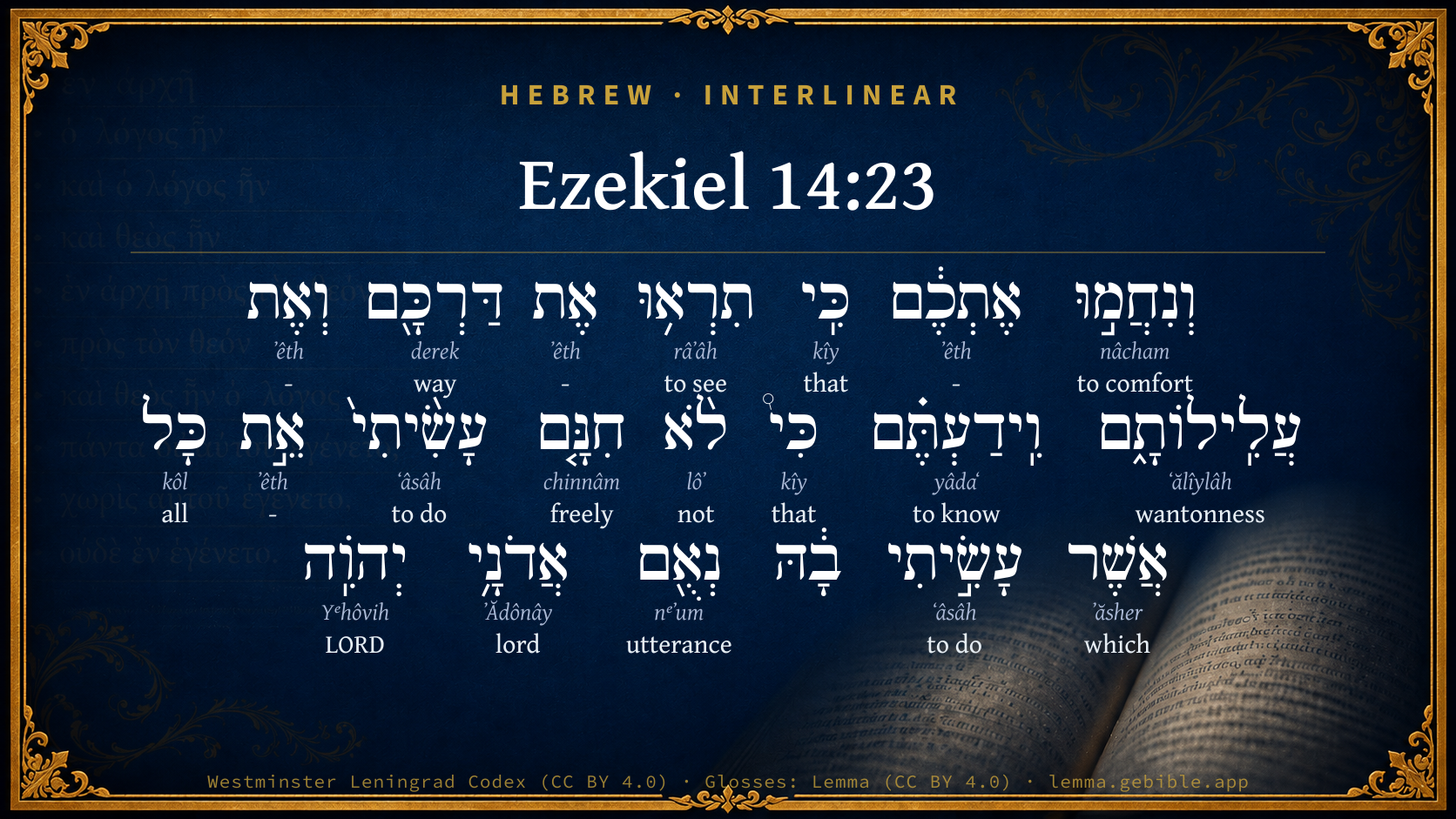
Hebrew (Westminster Leningrad Codex) Ezekiel 14:23 appears in the Hebrew Old Testament. The text above is from the Westminster Leningrad Codex. Each word links to its Strong’s number, a concise gloss, and parsing drawn from the Open Scriptures Hebrew Bible morphology. Click any word for its full Brown-Driver-Briggs (BDB) entry.
Download image
Cite this verse

Ezekiel 14:23 (World English Bible). Public Domain. Lemma interlinear Bible study tool, https://lemma.gebible.app/v/ezekiel/14/23.

Show BibTeX & RIS
BibTeX
RIS
English Translation
They shall comfort you, when you see their way and their doings; and you shall know that I have not done without cause all that I have done in it, says the Lord Yahweh.
World English Bible · Public Domain
Download a study sheet

One document with this verse’s original text, its word-by-word gloss line, the meaning frame, cross-references with their text, attributed commentary, and full source and license credits — printable, and it pastes into notes with its structure intact.

This verse Autodidact and up

Study sheet (.html) Plain text (.txt)

A passage Seminary Student

Up to 50 verses in one chapter. A passage sheet keeps up to 6 commentary sources and 12 cross-references per verse, in the order this page ranks them, and says so on the sheet whenever that leaves anything out. Ask for a single verse and you get the Autodidact verse sheet above.

Everything on this page stays free to read, with no account — the sheet is a download of what is already on screen, not access to it.

Want to remove ads? Support Godless Engineer
Compare translations 3

The same verse in 3 English versions, stacked beneath the original-language interlinear above. Click any original word for its lexicon entry.

Each is an independent rendering of the whole verse — the interlinear is not word-aligned to these translations.

Highlighted words mark where these versions differ — a whole-verse word diff, not a word-by-word alignment.

  • World English Bible Public Domain
    They shall comfort you, when you see their way and their doings; and you shall know that I have not done without cause all that I have done in it, says the Lord Yahweh.
  • King James Version Public Domain
    And they shall comfort you, when ye see their ways and their doings: and ye shall know that I have not done without cause all that I have done in it, saith the Lord GOD.
  • unfoldingWord Literal Text CC BY-SA 4.0
    The survivors will comfort you when you see their ways and their actions, so you will know all these things I have done against her, that I have not done them in vain!—this is the Lord Yahweh’s declaration.”

unfoldingWord Literal Text — © unfoldingWord, licensed CC BY-SA 4.0. Word-aligned USFM3 via Door43 (git.door43.org/unfoldingWord/en_ult).

Versions to compare (up to 4)

3 of 4 selected

Show all 18 translations

Every available English version of this verse, each an independent rendering of the whole verse.

  • World English Bible Public Domain
    They shall comfort you, when you see their way and their doings; and you shall know that I have not done without cause all that I have done in it, says the Lord Yahweh.
  • Berean Standard Bible Public Domain
    They will bring you consolation when you see their conduct and actions, and you will know that it was not without cause that I have done all these things within it,’ declares the Lord GOD.”
  • Majority Standard Bible Public Domain
    They will bring you consolation when you see their conduct and actions, and you will know that it was not without cause that I have done all these things within it,’ declares the Lord GOD.”
  • King James Version Public Domain
    And they shall comfort you, when ye see their ways and their doings: and ye shall know that I have not done without cause all that I have done in it, saith the Lord GOD.
  • American Standard Version (1901) Public Domain
    And they shall comfort you, when ye see their way and their doings; and ye shall know that I have not done without cause all that I have done in it, saith the Lord Jehovah.
  • Revised Version (1885) Public Domain
    And they shall comfort you, when ye see their way and their doings: and ye shall know that I have not done without cause all that I have done in it, saith the Lord GOD.
  • Geneva Bible (1599) Public Domain
    And they shall comfort you, when yee see their way and their enterprises: and ye shall know, that I haue not done without cause all that I haue done in it, saith the Lord God.
  • Douay-Rheims (1899) Public Domain
    And they shall comfort you, when you shall see their ways, and their doings: and you shall know that I have not done without cause all that I have done in it, saith the Lord God.
  • Young's Literal Translation Public Domain
    And they have comforted you, for ye see their way and their doings, and ye have known that not for nought have I done all that which I have done in her -- an affirmation of the Lord Jehovah.'
  • Literal Standard Version CC BY-SA 4.0
    And they have comforted you, for you see their way and their doings, and you have known that I have not done all that which I have done in her for nothing,” a declaration of Lord YHWH.
  • Unlocked Literal Bible CC BY-SA 4.0
    The survivors will comfort you when you see their ways and their actions, so you will know all these things I have done against her, that I have not done them in vain!—this is the Lord Yahweh's declaration.”
  • unfoldingWord Literal Text CC BY-SA 4.0
    The survivors will comfort you when you see their ways and their actions, so you will know all these things I have done against her, that I have not done them in vain!—this is the Lord Yahweh’s declaration.”
  • Darby Bible Public Domain
    And they shall comfort you, when ye see their way and their doings; and ye shall know that I have not done without cause all that I have done in it, saith the Lord Jehovah.
  • World Messianic Bible Public Domain
    They will comfort you, when you see their way and their doings; then you will know that I have not done all that I have done in it without cause,” says the Lord GOD.
  • Webster's Bible Public Domain
    And they shall comfort you, when ye see their ways and their doings: and ye shall know that I have not done without cause all that I have done in it, saith the Lord GOD.
  • Free Bible Version CC BY-SA 4.0
    Realizing what they did and how they acted will help you to see that I had good reasons to do everything I did to Jerusalem, declares the Lord God.”
  • Bible in Basic English Public Domain
    They will give you comfort when you see their ways and their doings: and you will be certain that not for nothing have I done all the things I have done in it, says the Lord.
  • JPS Tanakh (1917) Public Domain
    and they shall comfort you, when ye see their way and their doings, and ye shall know that I have not done without cause all that I have done in it, saith the Lord GOD.'

Literal Standard Version (2020), Covenant Press — licensed CC BY-SA 4.0. Text via the HelloAO Bible API (eBible.org). Unlocked Literal Bible (unfoldingWord) — licensed CC BY-SA 4.0. Text via the HelloAO Bible API (eBible.org). unfoldingWord Literal Text — © unfoldingWord, licensed CC BY-SA 4.0. Word-aligned USFM3 via Door43 (git.door43.org/unfoldingWord/en_ult). Free Bible Version, Dr. Jonathan Gallagher — licensed CC BY-SA 4.0. Text via the HelloAO Bible API (eBible.org).

Word by word

More ways to search: Search by grammar → Find every occurrence → Compare this word →

Practice this passage: Drill this verse → Learn its vocabulary →

עֲלִֽילוֹתָ֑ם
ʻălîylâh
H5949
“deeds · their”
Noun, Common, Feminine, Plural, Construct + Suffix, Personal, 3rd Person, Masculine, Plural
Part of Speech
Noun
Type
Common
Gender
Feminine
Number
Plural
State
Construct
Full BDB Definition

Origin: from H5953 in the sense of effecting

TWOT: 1627c

wantonness, deed, doing - wantonness - deed - practices, evil deeds
  1. וְנִחֲמ֣וּ nâcham H5162 “and · to comfort” Conjunction + Verb, Piel, Sequential Perfect, 3rd Person, Common, Plural
  2. אֶתְכֶ֔ם ʼêth H853 “- · you” Particle, Direct Object + Suffix, Personal, 2nd Person, Masculine, Plural
  3. כִּֽי kîy H3588 “that” Conjunction
  4. תִרְא֥וּ râʼâh H7200 “to see” Verb, Qal, Imperfect, 2nd Person, Masculine, Plural
  5. אֶת ʼêth H853 “-” Particle, Direct Object
  6. דַּרְכָּ֖ם derek H1870 “way · their” Noun, Common, Both, Singular, Construct + Suffix, Personal, 3rd Person, Masculine, Plural
  7. וְאֶת ʼêth H853 “and · -” Conjunction + Particle, Direct Object
  8. וִֽידַעְתֶּ֗ם yâdaʻ H3045 “and · to know” Conjunction + Verb, Qal, Sequential Perfect, 2nd Person, Masculine, Plural
  9. כִּי֩ kîy H3588 “that” Conjunction
  10. לֹ֨א lôʼ H3808 “not” Particle, Negative
  11. חִנָּ֤ם chinnâm H2600 “freely” Adverb
  12. עָשִׂ֨יתִי֙ ʻâsâh H6213 “to do” Verb, Qal, Perfect, 1st Person, Common, Singular
  13. אֵ֣ת ʼêth H853 “-” Particle, Direct Object
  14. כָּל kôl H3605 “all of” Noun, Common, Masculine, Singular, Construct
  15. אֲשֶׁר ʼăsher H834 “which” Particle, Relative
  16. עָשִׂ֣יתִי ʻâsâh H6213 “to do” Verb, Qal, Perfect, 1st Person, Common, Singular
  17. נְאֻ֖ם nᵉʼum H5002 “utterance of” Noun, Common, Masculine, Singular, Construct
  18. אֲדֹנָ֥י ʼĂdônây H136 “Lord · my” Noun, Common, Masculine, Plural, Construct + Suffix, Personal, 1st Person, Common, Singular
  19. יְהֹוִֽה Yᵉhôvih H3069 “LORD” Noun, Proper

About this verse

These counts appear in no published source. They are computed here, from the morphology-tagged text and Lemma’s own curated glosses. What Lemma adds →

21
words
15
distinct lemmas
Prophets
section

Notable vocabulary

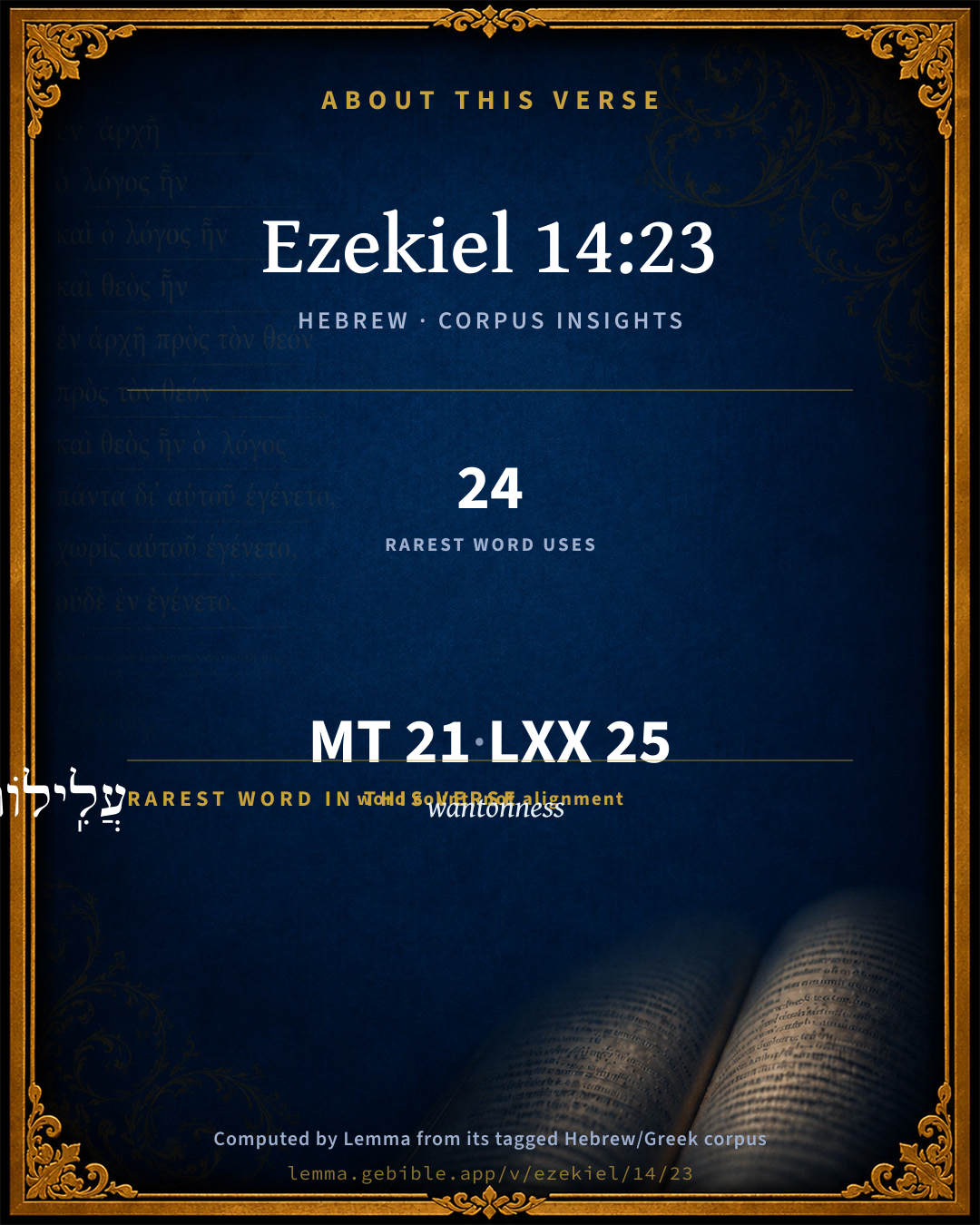
The rarest word here is עֲלִֽילוֹתָ֑ם wantonness H5949 — appearing just 24 times in the whole Hebrew Bible.

Shared distinctive vocabulary

עֲלִֽילוֹתָ֑ם wantonness H5949 occurs in 24 verses of the Hebrew Bible. Also found in:

Grammatical profile

  • 5 verbs
  • 6 nouns
  • 1 preposition
  • 2 conjunctions
  • 1 adverb
  • 6 particles

Verb forms

  • וְנִחֲמ֣וּ Piel · Sequential Perfect
  • תִרְא֥וּ Qal · Imperfect
  • וִֽידַעְתֶּ֗ם Qal · Sequential Perfect
  • עָשִׂ֨יתִי֙ Qal · Perfect
  • עָשִׂ֣יתִי Qal · Perfect

Repetition

Words recur within this verse — often emphatic in Hebrew:

  • עָשִׂ֨יתִי֙ to do H6213 ×2
  • כִּֽי that H3588 ×2

Hebrew & Septuagint length

In English translation the verse runs 34 words from the Hebrew and 35 from the Septuagint (LXX English) — closely comparable.

A rough comparison of the two English renderings, which tokenize alike — not a word-level alignment.

Word counts can differ between the Hebrew and the Greek without any difference in meaning — e.g. the Hebrew direct-object marker אֵת has no separate Greek word, and Greek often adds the article ὁ.

In the original languages it is 21 Hebrew tokens and 25 Greek tokens — but the two are counted differently (Hebrew bundles its prefixes and suffixes into one token; the Greek is in lemma form), so that isn’t a like-for-like length.

Cross-references

13

Topical passages linked to Ezekiel 14:23 in the Treasury of Scripture Knowledge — connected by theme and wording, ordered by reader-vote popularity; previews shown in the World English Bible.

  • Jeremiah 22:8–9 Many nations shall pass by this city, and they shall say every man to his neighbor, Why has Yahweh done thus to this great city?
  • Genesis 18:22–33 The men turned from there, and went toward Sodom, but Abraham stood yet before Yahweh.
  • Deuteronomy 8:2 You shall remember all the way which Yahweh your God has led you these forty years in the wilderness, that he might humble you, to prove you, to know what was in your heart, whether you would keep his commandments, or not.
  • Nehemiah 9:33 However you are just in all that is come on us; for you have dealt truly, but we have done wickedly;
  • Proverbs 26:2 Like a fluttering sparrow, Like a darting swallow, So the undeserved curse doesn't come to rest.
  • Jeremiah 7:17–28 Don't you see what they do in the cities of Judah and in the streets of Jerusalem?
  • Ezekiel 8:6–18 He said to me, Son of man, see you what they do? even the great abominations that the house of Israel do commit here, that I should go far off from my sanctuary? but you shall again see yet other great abominations.
  • Ezekiel 9:8–9 It happened, while they were smiting, and I was left, that I fell on my face, and cried, and said, Ah Lord Yahweh! will you destroy all the residue of Israel in your pouring out of your wrath on Jerusalem?
  • Daniel 9:7 Lord, righteousness belongs to you, but to us confusion of face, as at this day; to the men of Judah, and to the inhabitants of Jerusalem, and to all Israel, who are near, and who are far off, through all the countries where you have driven them, because of their trespass that they have trespassed against you.
  • Daniel 9:14 Therefore has Yahweh watched over the evil, and brought it on us; for Yahweh our God is righteous in all his works which he does, and we have not obeyed his voice.
  • Romans 2:5 But according to your hardness and unrepentant heart you are treasuring up for yourself wrath in the day of wrath, revelation, and of the righteous judgment of God;
  • Revelation 15:4 Who wouldn't fear you, Lord, And glorify your name? For you only are holy. For all the nations will come and worship before you. For your righteous acts have been revealed."
  • Revelation 16:6 For they poured out the blood of the saints and the prophets, and you have given them blood to drink. They deserve this."

Cross-references courtesy of OpenBible.info (CC BY 4.0).

Hebrew and Greek witnesses Masoretic Hebrew ↔ Greek Septuagint

The same verse in the two great witnesses to the Old Testament, shown verse-for-verse.

These are two independent witnesses, not word-aligned to each other, and the Septuagint is shown in lemma (dictionary) form.

Hebrew Ezekiel 14:23 Masoretic · Westminster Leningrad Codex

וְנִחֲמ֣וּ אֶתְכֶ֔ם כִּֽי תִרְא֥וּ אֶת דַּרְכָּ֖ם וְאֶת עֲלִֽילוֹתָ֑ם וִֽידַעְתֶּ֗ם כִּי֩ לֹ֨א חִנָּ֤ם עָשִׂ֨יתִי֙ אֵ֣ת כָּל אֲשֶׁר עָשִׂ֣יתִי בָ֔הּ נְאֻ֖ם אֲדֹנָ֥י יְהֹוִֽה

They shall comfort you, when you see their way and their doings; and you shall know that I have not done without cause all that I have done in it, says the Lord Yahweh.

World English Bible · Public Domain

Greek LXX Ezekiel 14:23 Septuagint · lemma form

καί παρακαλέω σύ διότι ὁράω ὁ ὁδός αὐτός καί ὁ ἐνθύμημα αὐτός καί ἐπιγιγνώσκω διότι οὐ μάτην ποιέω πᾶς ὅσος ποιέω ἐν αὐτός λέγω κύριος

And they shall comfort you, because you⌃ shall see their ways and their thoughts: and you⌃ shall know that I have not done in vain all that I have done in it, says the Lord.

LXX2012 (modern English Septuagint) · Public Domain

Hebrew: Westminster Leningrad Codex (CC BY 4.0). Greek: Septuagint (public domain); English from LXX2012 (modern English Septuagint) (Public Domain). How the Septuagint differs from the Hebrew →

Targum (Aramaic paraphrase)

1

The Targum is the ancient Jewish Aramaic paraphrase of the Hebrew Scriptures — an interpretive translation, not the Hebrew text itself. Onkelos (literal) and Pseudo-Jonathan (expansive) render the Torah, and Jonathan the Prophets. Coverage is partial: where no permissively-licensed English translation exists for a verse, only the Aramaic is shown. This is verse-level text, not a word-by-word alignment to the Hebrew.

  1. Targum Jonathan Prophets (Joshua–Malachi)
    וִינַחֲמוּן יַתְכוֹן אֲרֵי תֶחֱזוּן יַת אוֹרְחֵיהוֹן וְיַת עוֹבְדֵיהוֹן וְתֵידְעוּן אֲרֵי לָא לְמַגֵן עֲבָדֵית יַת כָּל דַעֲבַדֵית בָּהּ אֲמַר יְיָ אֱלֹהִים:

    (no public-domain English translation for this verse)

    Targum Jonathan — Aramaic: “Mikraot Gedolot” (public domain). English: “Sefaria Community Translation” (CC0 1.0 (public-domain dedication)); “London "Chaldee Paraphrase," 1871” (public domain). Text via Sefaria.

Commentary

Notes on Ezekiel 14:23 from classic Christian and Jewish commentators (each source and its license shown beneath its notes). The classic Christian expositions comment on the surrounding passage and are grouped to its opening verse, so a note may address several verses; the Jewish commentaries on the Tanakh (Rashi and others) are per-verse, so they appear only where the commentator wrote on this verse.

Lemma curates 59 commentaries, every one of them public domain or Creative Commons licensed, each selected and text-cleaned for this edition rather than reprinted as found. About our sources →

Trapp's Complete Commentary

John Trapp

Eze 14:23 And they shall comfort you, when ye see their ways and their doings: and ye shall know that I have not done without cause all that I have done in it, saith the Lord GOD.

Ver. 23. And they shall comfort,] i.e., Quiet and qualify your spirits.

John Trapp, A Commentary or Exposition upon All the Books of the Old and New Testament (1647–1656) — public domain. Text from a community e-Sword module.

The Biblical Illustrator

Joseph S. Exell

Eze_14:23

Ye shall know that I have not done without cause all that I have done in it, saith the Lord God.

Waiting for Gods vindication

I. The truths doubted. In all ages, as in our own, men have doubted the goodness and justice of God, and have murmured at His acts. They reject consolation, and charge Jehovah with cruelty. Speak of the sufferings of Jesus for us, and the agnostic declares that is simply another example of injustice.

II. Causes of scepticism. Ask for a reason of doubt, and the rationalist asserts that pain contradicts either the goodness or the power of the Divine Being. But reasons given are not always causes. Grief is selfish, and tears blind us. Most people in trouble are like a ship directed by a careless captain, and left with full canvas when the tempest bursts upon it. We sink because we are not prepared for gales. Men indulge false hopes, refuse all warnings, expect all things but death, and when the end comes they cry out that they have been wronged. Custom makes them regard a loan as a possession, and they call restoration robbery.

III. The futility of doubt. Of what use is doubt of the fundamental truths of Christianity? How does it work? A sinner suffering penalty is hardened by doubt of Gods justice, and discouraged from repentance by question of His mercy. A saint in agony and near to death is plunged in deeper darkness by doubt of all that remains to her. Doubt confirms a transgressor, and robs the holy of consolation. To whom, then, is it good?

IV. Comfort in Gods truth. If we could look at sin in its hideous deformity, its deep guilt, its inhuman effects, with sound vision, we mould be slow to complain. If God did not punish moral evil we could not respect Him, and if He permitted wrong to go uncorrected the holy could not hope. Haste and impatience hide truth from us. If we could see the results of suffering in character we might be consoled. History is an account of the martyrdom of man. But martyrs have not complained. They have preferred truth, beauty, goodness to the alternatives, and have not regretted the price. Can we confide in God and wait? And while you wait, be not idle. There are works meet for repentance. Gods winds are hard to face as head winds, but wondrously helpful to those who will sail with them. The Divine purpose works toward correction of evil and edification of good. Build with God, and you will have naught to tear down. (C. R. Henderson, D. D.)

.

The Biblical Illustrator, edited by Joseph S. Exell (c. 1880s–1900s) — public domain. Text from a community e-Sword module.

Jamieson, Fausset & Brown

Robert Jamieson, A. R. Fausset & David Brown

they shall comfort you--not in words, but by your recognizing in their manifest guilt, that God had not been unjustly severe to them and the city.

This chapter represents, in the way of a brief introduction, what the sixteenth chapter details minutely.

Next: Ezekiel Chapter 15

Jamieson, Fausset & Brown — Commentary Critical and Explanatory on the Whole Bible (1871) — public domain (CC PDM 1.0). Text via the HelloAO Bible API.

Adam Clarke's Commentary

Verse 23. Ye shall know that I have not done without cause] There is no part of the conduct of God towards man that is not dictated by the purest principles of justice, equity, and truth. He does nothing but what is right; and whatever is right to be done, that ought to be done. In God's justice there is no severity; in God's mercy there is no caprice. He alone doth all things well; for he is the Fountain of justice and mercy.

Adam Clarke's Commentary on the Bible (1810–1826) — public domain. Text from a community e-Sword/MySword module.

John Calvin's Commentaries

He now puts the verb for comforting in the third person, but in the same sense, because after the Jews shall have been led captive, they will bear sure and special marks of God’s justice against their sins. This, then, is the consolation, as I explained it yesterday, while the exiles acknowledge that cruelty cannot be ascribed to God, as if he had exceeded moderation in exacting punishment; for the desperate wickedness of the people demanded it. But this passage contains a useful doctrine, since we collect from it that we are never tranquil in our minds unless when the greatest equity and justice appears in God’s judgments, and become present to our minds. As long, therefore, as we do not acknowledge God to be severe in just cases, our minds must necessarily be disturbed and disarranged: hence the word “consolation” is opposed to those turbulent thoughts. But since nothing is more miserable than to be distracted and drawn hither and thither, and to be anxiously disturbed, let us learn that those profit most who acquiesce in God’s judgments, although they do not perceive the reason of them, yet modestly adore them. But when God shows why he treats either us or others so severely, this is a special favor, since he offers us material for joy and tranquillity. Let us proceed.

John Calvin's Commentaries (1540-1563) — public domain. Text from the Calvin Translation Society English edition (1840s-50s) via the Christian Classics Ethereal Library (ccel.org). Calvin's coverage is partial (roughly two-thirds of the Bible); uncommented books and verses are honest gaps, never fabricated. The 19th-century editor's footnotes and remarks are omitted so the notes are faithfully Calvin's own voice.

Matthew Poole's English Annotations

They that survive the siege, famine, and ruin of Jerusalem, and are brought to Babylon,

shall comfort you; either confessing their faults in not doing as you had done, justifying the wise course they took who yielded, condemning the folly of hardening themselves against God, his judgments, and his prophets; or be matter of comfort, affording to you just ground of comforting yourselves.

When ye see their ways: understand it in the effects of it upon the ruined Jews; or, in the relation which they will make both of their sins and sufferings in the land of Canaan.

Ye, you of the first captivity, you that obeyed my voice, and submitted to the Babylonian yoke,

shall know, be fully satisfied, that I have had but too much cause, and most just reason, for all that I have done against Jerusalem and its land, and inhabitants of both; you shall know my hand, and as you feel the weight, so you shall see the justice of it too against them, and the mercy of it towards you.

Matthew Poole's English Annotations on the Holy Bible (1683–1685) — public domain. Text from a community e-Sword/MySword module.

The Pulpit Commentary

Purpose in providence.

I GOD MAY APPEAR TO ACT WITHOUT CAUSE. We cannot discover design in all the movements of nature so easily as we may detect this in its structure. Though we may be startled at times by the aptness of the providential overruling of history, too often we are perplexed, dismayed, confounded. The wicked man flourishes like a green bay tree, and the good man is persecuted or perishes in a vain conflict with adverse circumstances. Psalmists of old noticed this familiar fact, and grieved over it. (e.g. Psa_17:10) We must be prepared to expect mystery in nature and providence, since the experience of the past pellets to the very same difficulties which puzzle and perplex us when they suddenly confront us. "Lo, these are but the outskirts of his ways: and how small a whisper do we hear of him! But the thunder of his power who can understand?". (Job_26:14)

II GOD DOES NOT ACT WITHOUT CAUSE.

1. The failure to discover a cause is no proof that it does not exist. We cannot limit the range of existence to the scope of our knowledge. There are hidden physical causes which the most searching scientific analysis has failed to trace: why may there not be also hidden final causes, deep purposes of God, which no mind of man can reach?

2. The proved purpose of God in known regions suggests the existence of a like purpose in unknown regions. We can trace more purpose in creation than in providence; but since the same God rules over both, it is to be presumed that the spirit of design which pervades the one runs through the other. We know that God has mind, and that he exercises what with us would be called forethought. Moreover, it is impossible to suppose that his principal dealings with his own children will be aimless when his less momentous works are instinct with purpose.

3. The righteousness and love of God make it certain that he does not act without a cause. Reckless action is morally defective. Ethics bears directly on motive and purpose. A just God must have a righteous object with which to act. The love of God emphasizes the assurance of purpose in providence, for no one would treat those dear to him with heedless indifference. This is especially applicable to the infliction of chastisement. A just and merciful God cannot send chastisement without adequate cause.

III THE CAUSE OF GOD"S ACTION WILL RE ULTIMATELY DECLARED. It is impossible for us to see it yet, for we cannot look beyond the grave, nor can we scale the heights of Divine thought in the infancy of our spiritual experience. The schoolboy cannot see the utility of all his lessons. But if he has been well taught in boyhood, when he is a man he will look back on the hard training with appreciative satisfaction, and will therefore order a similar process for his children. It would not be well for us to see the end yet, for we must be trained by faith. But earthly experience often throws back light on dark passages of life, and they then flash into a new meaning which calls forth gratitude as well as wonder. Beyond this world the fuller explanation will come. With the discovery of the hidden cause there will be ample consolation. The revelation of a good purpose in chastisement is its appropriate consolation. (2Co_4:17)

The Pulpit Commentary (1880–1919), ed. H.D.M. Spence-Jones & Joseph S. Exell — public domain. Text from a community e-Sword module.

John Wesley's Explanatory Notes

Comfort you - That is, you will be comforted, when you compare their case with your own: when they tell you how righteous God was, in bringing these judgments upon them. This will reconcile you to the justice of God, in thus punishing his own people, and to the goodness of God, who now appeared to have had kind intentions in all.

John Wesley, Explanatory Notes Upon the Whole Bible (1754–1765) — public domain. Text via the GEBible commentary corpus.

Lesson kit

Teaching starters — assembled from the data on this page, not authored interpretation. Every prompt links to the verse data it draws on. Edit before teaching.

Ezekiel, in the Prophets, opens this verse with 21 words (15 distinct Hebrew lemmas). Its most distinctive word is ʻălîylâh (“wantonness”). A historical commentator’s framing appears above. Read the whole chapter for the surrounding context.

Discussion questions

  1. The word ʻălîylâh carries the sense “wantonness.” How does it shape the verse?
  2. How does Deuteronomy 22:14, which shares the word «wantonness», read alongside this verse?
  3. What does the repetition of “to do” (2× in this one verse) do in this verse?
  4. The translations on this page render this verse differently — a whole-verse word diff, not a word-by-word alignment. What might account for the different wordings?
  5. «וְנִחֲמ֣וּ» is a Piel Sequential Perfect verb. How does that grammatical form shape the action described?
  6. Compare how Trapp's Complete Commentary and The Biblical Illustrator read this verse. Where do they agree or differ?

Things to notice

Reading settings

Reading text

Shown beneath each verse's original-language words.

Old Testament
Old Testament edition

Read the OT as the Masoretic Hebrew (MT) or the Greek Septuagint (LXX).

English shown for the Greek Septuagint (in the Hebrew ↔ Greek comparison).

Comparing translations? Open the Compare panel on any verse page to stack up to four side by side.