

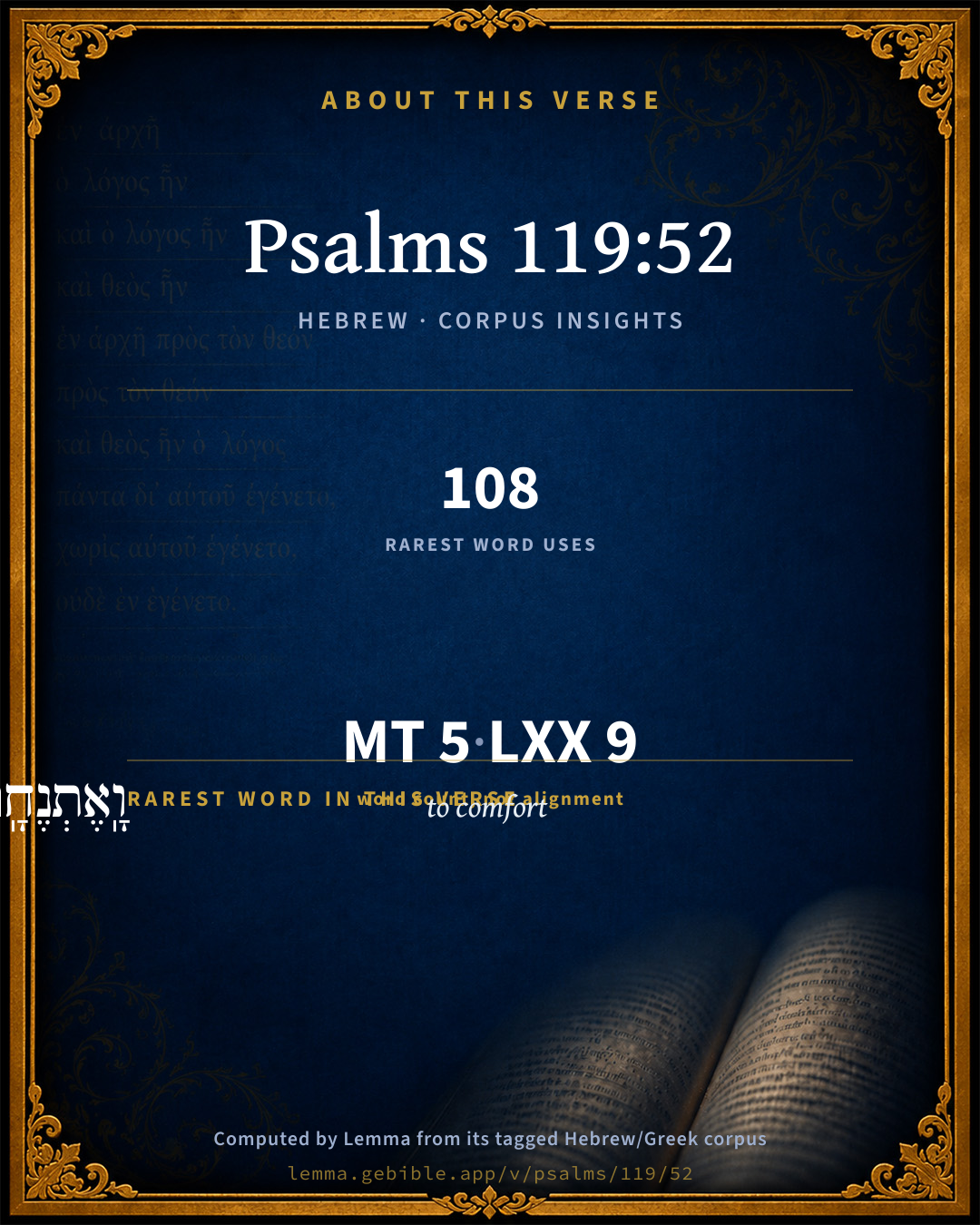
Psalms 119:52

Hebrew (Westminster Leningrad Codex) Psalms 119:52 appears in the Hebrew Old Testament. The text above is from the Westminster Leningrad Codex. Each word links to its Strong’s number, a concise gloss, and parsing drawn from the Open Scriptures Hebrew Bible morphology. Click any word for its full Brown-Driver-Briggs (BDB) entry.
Download image
Cite this verse

Psalms 119:52 (World English Bible). Public Domain. Lemma interlinear Bible study tool, https://lemma.gebible.app/v/psalms/119/52.

Show BibTeX & RIS
BibTeX
RIS
English Translation
I remember your ordinances of old, Yahweh, And have comforted myself.
World English Bible · Public Domain
Download a study sheet

One document with this verse’s original text, its word-by-word gloss line, the meaning frame, cross-references with their text, attributed commentary, and full source and license credits — printable, and it pastes into notes with its structure intact.

This verse Autodidact and up

Study sheet (.html) Plain text (.txt)

A passage Seminary Student

Up to 50 verses in one chapter. A passage sheet keeps up to 6 commentary sources and 12 cross-references per verse, in the order this page ranks them, and says so on the sheet whenever that leaves anything out. Ask for a single verse and you get the Autodidact verse sheet above.

Everything on this page stays free to read, with no account — the sheet is a download of what is already on screen, not access to it.

Want to remove ads? Support Godless Engineer
Compare translations 3

The same verse in 3 English versions, stacked beneath the original-language interlinear above. Click any original word for its lexicon entry.

Each is an independent rendering of the whole verse — the interlinear is not word-aligned to these translations.

Highlighted words mark where these versions differ — a whole-verse word diff, not a word-by-word alignment.

  • World English Bible Public Domain
    I remember your ordinances of old, Yahweh, And have comforted myself.
  • King James Version Public Domain
    I remembered thy judgments of old, O LORD; and have comforted myself.
  • unfoldingWord Literal Text CC BY-SA 4.0
    I remember your judgments from ancient times, Yahweh, and I comfort myself.

unfoldingWord Literal Text — © unfoldingWord, licensed CC BY-SA 4.0. Word-aligned USFM3 via Door43 (git.door43.org/unfoldingWord/en_ult).

Versions to compare (up to 4)

3 of 4 selected

Show all 17 translations

Every available English version of this verse, each an independent rendering of the whole verse.

  • World English Bible Public Domain
    I remember your ordinances of old, Yahweh, And have comforted myself.
  • Berean Standard Bible Public Domain
    I remember Your judgments of old, O LORD, and in them I find comfort.
  • Majority Standard Bible Public Domain
    I remember Your judgments of old, O LORD, and in them I find comfort.
  • King James Version Public Domain
    I remembered thy judgments of old, O LORD; and have comforted myself.
  • American Standard Version (1901) Public Domain
    I have remembered thine ordinances of old, O Jehovah, And have comforted myself.
  • Revised Version (1885) Public Domain
    I have remembered thy judgments of old, O LORD, and have comforted myself.
  • Geneva Bible (1599) Public Domain
    I remembred thy iudgements of olde, O Lord, and haue bene comforted.
  • Young's Literal Translation Public Domain
    I remembered Thy judgments of old, O Jehovah, And I comfort myself.
  • Literal Standard Version CC BY-SA 4.0
    I remembered Your judgments of old, O YHWH, || And I comfort myself.
  • Unlocked Literal Bible CC BY-SA 4.0
    I have thought about your righteous decrees from ancient times, Yahweh, and I comfort myself.
  • unfoldingWord Literal Text CC BY-SA 4.0
    I remember your judgments from ancient times, Yahweh, and I comfort myself.
  • Darby Bible Public Domain
    I remembered thy judgments of old, O Jehovah, and have comforted myself.
  • World Messianic Bible Public Domain
    I remember your ordinances of old, LORD, and have comforted myself.
  • Webster's Bible Public Domain
    I remembered thy judgments of old, O LORD; and have comforted myself.
  • Free Bible Version CC BY-SA 4.0
    I think about the instructions you gave long ago, Lord, and they reassure me.
  • Bible in Basic English Public Domain
    I have kept the memory of your decisions from times past, O Lord; and they have been my comfort.
  • JPS Tanakh (1917) Public Domain
    I have remembered Thine ordinances which are of old, O LORD, and have comforted myself.

Literal Standard Version (2020), Covenant Press — licensed CC BY-SA 4.0. Text via the HelloAO Bible API (eBible.org). Unlocked Literal Bible (unfoldingWord) — licensed CC BY-SA 4.0. Text via the HelloAO Bible API (eBible.org). unfoldingWord Literal Text — © unfoldingWord, licensed CC BY-SA 4.0. Word-aligned USFM3 via Door43 (git.door43.org/unfoldingWord/en_ult). Free Bible Version, Dr. Jonathan Gallagher — licensed CC BY-SA 4.0. Text via the HelloAO Bible API (eBible.org).

Word by word

More ways to search: Search by grammar → Find every occurrence → Compare this word →

Practice this passage: Drill this verse → Learn its vocabulary →

וָֽאֶתְנֶחָֽם
nâcham
H5162
“and · to comfort”
Conjunction + Verb, Hithpael, Sequential Imperfect, 1st Person, Common, Singular
Part of Speech
Conjunction + Verb
Stem
Hithpael
Form
Sequential Imperfect
Person
1st Person
Gender
Common
Number
Singular
Full BDB Definition

Origin: a primitive root

TWOT: 1344

to be sorry, console oneself, repent, regret, comfort, be comforted - (Niphal) - to be sorry, be moved to pity, have compassion - to be sorry, rue, suffer grief, repent - to comfort oneself, be comforted - to comfort oneself, ease oneself - (Piel) to comfort, console - (Pual) to be comforted, be consoled - (Hithpael) - to be sorry, have compassion - to rue, repent of - to comfort oneself, be comforted - to ease oneself
  1. זָ֘כַ֤רְתִּי zâkar H2142 “to remember” Verb, Qal, Perfect, 1st Person, Common, Singular
  2. מִשְׁפָּטֶ֖יךָ mishpâṭ H4941 “judgments · your” Noun, Common, Masculine, Plural, Construct + Suffix, Personal, 2nd Person, Masculine, Singular
  3. מֵעוֹלָ֥ם ʻôwlâm H5769 “from · forever” Preposition + Noun, Common, Masculine, Singular, Absolute
  4. יְהוָ֗ה Yᵉhôvâh H3068 “LORD” Noun, Proper

About this verse

These counts appear in no published source. They are computed here, from the morphology-tagged text and Lemma’s own curated glosses. What Lemma adds →

5
words
5
distinct lemmas
Wisdom
section

Grammatical profile

  • 2 verbs
  • 3 nouns

Verb forms

  • זָ֘כַ֤רְתִּי Qal · Perfect
  • וָֽאֶתְנֶחָֽם Hithpael · Sequential Imperfect

Hebrew & Septuagint length

In English translation the verse runs 11 words from the Hebrew and 11 from the Septuagint (LXX English) — the same length.

A rough comparison of the two English renderings, which tokenize alike — not a word-level alignment.

Word counts can differ between the Hebrew and the Greek without any difference in meaning — e.g. the Hebrew direct-object marker אֵת has no separate Greek word, and Greek often adds the article ὁ.

In the original languages it is 5 Hebrew tokens and 9 Greek tokens — but the two are counted differently (Hebrew bundles its prefixes and suffixes into one token; the Greek is in lemma form), so that isn’t a like-for-like length.

Cross-references

10

Topical passages linked to Psalms 119:52 in the Treasury of Scripture Knowledge — connected by theme and wording, ordered by reader-vote popularity; previews shown in the World English Bible.

  • Deuteronomy 4:3–4 Your eyes have seen what Yahweh did because of Baal Peor; for all the men who followed Baal Peor, Yahweh your God has destroyed them from the midst of you.
  • Psalms 77:11–12 I will remember Yah's deeds; For I will remember your wonders of old.
  • Psalms 103:18 To those who keep his covenant, To those who remember to obey his precepts.
  • Psalms 105:5 Remember his marvelous works that he has done; His wonders, and the judgments of his mouth,
  • Deuteronomy 1:35–36 Surely there shall not one of these men of this evil generation see the good land, which I swore to give to your fathers,
  • 2 Peter 2:4–9 For if God didn't spare angels when they sinned, but cast them down to Tartarus, and committed them to pits of darkness, to be reserved to judgment;
  • Exodus 14:29–30 But the children of Israel walked on dry land in the midst of the sea, and the waters were a wall to them on their right hand, and on their left.
  • Numbers 16:3–35 and they assembled themselves together against Moses and against Aaron, and said to them, You take too much on you, seeing all the congregation are holy, everyone of them, and Yahweh is among them: why then lift yourselves up above the assembly of Yahweh?
  • Psalms 77:5 I have considered the days of old, The years of ancient times.
  • Psalms 143:5 I remember the days of old. I meditate on all your doings. I contemplate the work of your hands.

Cross-references courtesy of OpenBible.info (CC BY 4.0).

Hebrew and Greek witnesses Masoretic Hebrew ↔ Greek Septuagint

The same verse in the two great witnesses to the Old Testament, shown verse-for-verse.

You’re reading Greek Psalm 118 (Hebrew Psalm 119). The Septuagint counts the superscription, so verse numbers can differ from the Hebrew — chapter-level alignment, not verse-by-verse. Numbering follows Rahlfs.

These are two independent witnesses, not word-aligned to each other, and the Septuagint is shown in lemma (dictionary) form.

Hebrew Psalms 119:52 Masoretic · Westminster Leningrad Codex

זָ֘כַ֤רְתִּי מִשְׁפָּטֶ֖יךָ מֵעוֹלָ֥ם יְהוָ֗ה וָֽאֶתְנֶחָֽם

I remember your ordinances of old, Yahweh, And have comforted myself.

World English Bible · Public Domain

Greek LXX Greek Psalm 118:52 Septuagint · lemma form

μιμνήσκω ὁ κρίμα σύ ἀπό αἰών κύριος καί παρακαλέω

I remembered your judgments of old, O Lord; and was comforted.

LXX2012 (modern English Septuagint) · Public Domain

On this verse, The Cambridge Bible for Schools and Colleges discusses the Septuagint’s reading. Read the note in Commentary ↓

Hebrew: Westminster Leningrad Codex (CC BY 4.0). Greek: Septuagint (public domain); English from LXX2012 (modern English Septuagint) (Public Domain). How the Septuagint differs from the Hebrew →

Commentary

Notes on Psalms 119:52 from classic Christian and Jewish commentators (each source and its license shown beneath its notes). The classic Christian expositions comment on the surrounding passage and are grouped to its opening verse, so a note may address several verses; the Jewish commentaries on the Tanakh (Rashi and others) are per-verse, so they appear only where the commentator wrote on this verse.

Lemma curates 59 commentaries, every one of them public domain or Creative Commons licensed, each selected and text-cleaned for this edition rather than reprinted as found. About our sources →

Trapp's Complete Commentary

John Trapp

Psa 119:52 I remembered thy judgments of old, O LORD; and have comforted myself.

Ver. 52. I remembered thy judgments of old, O Lord] This was to have a holy memory, well fraught with profitable matter, such as are examples of God’s dealing with his people and their enemies in all ages.

And was comforted] Some degree of comfort followeth every good action; as heat accompanieth fire, as beams and influences issue from the sun.

John Trapp, A Commentary or Exposition upon All the Books of the Old and New Testament (1647–1656) — public domain. Text from a community e-Sword module.

The Biblical Illustrator

Joseph S. Exell

Psa_119:52

I remembered Thy judgments of old, O Lord; and have comforted myself.

A blessed field lot memory

The Divine Word may be looked upon here--

I. As a field for memory.

1. A refreshing field. What flowers bloom, what fruit clusters, what salubrious air breathes here.

2. A large field. It goes back through eternity; it begins with the creation, it embraces the human race, it runs on through centuries into the interminable future.

3. An imperishable field.

II. As a source of comfort.

1. By the presentation of examples. Noah, Abraham, Moses, Job, Daniel, Paul, etc.; and more,--Christ, the model of all virtue, enduring affliction, overwhelming and undeserved.

2. By the revelation of principles. It teaches that the afflictions of good men are not penal but disciplinary, not sent in anger, but in fatherly love (2Co_4:17). (Homilist.)

The Divinely memorable

I. The memorable in the Divine conduct to man. Thy judgments. Whatever the Almighty does is memorable, and ought to be remembered. But there are some things in His conduct to man most strikingly memorable.

1. Some things with man generally. The deluge, the confusion of tongues, the burning of Sodom and Gomorrah, the exodus of the Jews, the destruction of Jerusalem, etc.

2. Some things with man individually. Every man is conscious of some memorable event in his life; especially,--if he is a Christian,--his conviction, conversion, etc.

II. The memorable in the Divine conduct remembered by man. I remembered. Sad to say, the memorable things in the Divine conduct to man are not generally remembered.

1. This is unnatural. How unnatural it is for a child to forget interpositions in the conduct of the loving father. But how much more unnatural go forget the wondrous works of God in His dealings with our race and with ourselves.

2. This is ungrateful. Ought we not to remember the self-sacrificing deeds of our benefactors? This indeed we generally do, we rear monuments to those whom we consider to be philanthropists. But how ungrateful to forget the wonderful mercies of God.

3. This is pernicious. Forgetfulness of God leads to moral deadness, gross carnality, black atheism.

III. The remembrance of the memorable in the Divine dispensation blest to man. And have comforted myself. The memory of what God in past times has done for His people is adapted to administer comfort under the trials of life.

1. He has always granted strength according to need (Isa_25:4).

2. He has always fulfilled His promises. (Holimist.)

The Biblical Illustrator, edited by Joseph S. Exell (c. 1880s–1900s) — public domain. Text from a community e-Sword module.

J. A. Alexander on Psalms

Joseph Addison Alexander

52. (Psa 119:52) I have remembered thy judgments from eternity, Jehovah, and consoled myself. His faith and hope under present trials are sustained by recollection of the past. Thy judgments, not merely the punishments inflicted on thy enemies, but all the exhibitions of thy righteousness in outward act, including the deliverances of thy people. From eternity, or from an indefinite antiquity, which is the primary meaning of the Hebrew word. There is no reason for discarding the reflexive form of the last verb, as some versions do, especially as it suggests the idea, not of a mere passive reception of the comfort, but of an active effort to obtain it.

Joseph Addison Alexander, The Psalms Translated and Explained (1850) — public domain. Text from a community e-Sword module.

Tyndale Open Study Notes

Tyndale Open Resources

119:52 The age-old regulations are the Torah (God’s “instructions” or “law”), a term that refers to the books of Genesis—Deuteronomy.

Tyndale Open Study Notes — © Tyndale Open Resources, licensed CC BY-SA 4.0. Text via the HelloAO Bible API.

Geneva Bible (1599)

Geneva Bible translators

That is, the examples, whereby thou declarest thyself to be judge of the world.

Geneva Bible (1599) marginal notes — public domain. Text via Bolls.life.

Matthew Henry's Commentary

When David was derided for his godliness he not only held fast his integrity, but, 1. He comforted himself. He not only bore reproach, but bore it cheerfully. It did not disturb his peace, nor break in upon the repose of his spirit in God. It was a comfort to him to think that it was for God's sake that he bore reproach, and that his worst enemies could find no occasion against him, save only in the matter of his God, Dan 6:5. Those that are derided for their adherence to God's law may comfort themselves with this, that the reproach of Christ will prove, in the end, greater riches to them than the treasures of Egypt. 2. That which he comforted himself with was the remembrance of God's judgments of old, the providences of God concerning his people formerly, both in mercy to them and in justice against their persecutors. God's judgments of old, in our own early days and in the days of our fathers, are to be remembered by us for our comfort and encouragement in the way of God, for he is still the same.

Matthew Henry's Commentary on the Whole Bible (1708–1710) — public domain (CC PDM 1.0). Text via the HelloAO Bible API.

Adam Clarke's Commentary

Verse 52. I remembered thy judgments of old] The word judgments is here taken for providential dealing; and indeed kind treatment; that which God showed to the Hebrews in bearing with and blessing them. And it was the recollection of these judgments that caused him to comfort himself.

Adam Clarke's Commentary on the Bible (1810–1826) — public domain. Text from a community e-Sword/MySword module.

John Calvin's Commentaries

52. I called to mind thy judgments of old, O Jehovah! In this psalm, the judgments of God are generally taken for his statutes and decrees, that is, his righteousness. In this place, in consequence of the qualifying phrase, of old, it is more probable that they refer to the examples by which God has made himself known as the righteous Judge of the world. Why does he say that the law of God has been from everlasting? This may to some extent be accounted for from the righteousness here mentioned not being of recent growth, but truly everlasting, because the written law is just an attestation of the law of nature, through means of which God recalls to our memory that which he has previously engraved on our hearts.

I am rather inclined to adopt another interpretation, That David remembered the judgments of God, by which he testified that he had established his law perpetually in the world, Such a settlement is very necessary for us; because, when God does not make bare his arm, his word frequently produces little impression. But when he takes vengeance upon the ungodly, he confirms what he had spoken; and this is the reason why in civil law penalties are called confirmations. The term accords better with God’s judgments, by which he establishes the authority of his law, as if a true demonstration accompanied his words. And seeing he declares that he called to mind the most ancient of God’s judgments, it becomes us to learn, that if his judgments are not displayed as frequently as we would desire, for the strengthening of our faith, this is owing to our ingratitude and apathy; for in no past age have there been wanting clear demonstrations for this very purpose; and thus it may with truth be affirmed, that God’s judgments have flowed in one continued manner from age to age, and that the reason why we have not perceived them is, our not deigning to open our eyes to behold them. If any one object, that it is contrary to the nature of his judgments to afford consolation to because they are calculated rather to strike us with terror, the answer is at handy — that the faithful are made to tremble for fear of God’s judgments, as far as is requisite for the mortification of their flesh. On the other hand, these supply them with a large source of consolation, from the fact of their learning from them, that God exercises his superintending providence over the human race. Farther, they learn, that after the wicked have reveled in licentiousness for a season, they shall at length be sisted before the judgment-seat of God; but that they themselves, after having patiently combated under such a Guardian of their welfare, can be in no doubt about their preservation.

John Calvin's Commentaries (1540-1563) — public domain. Text from the Calvin Translation Society English edition (1840s-50s) via the Christian Classics Ethereal Library (ccel.org). Calvin's coverage is partial (roughly two-thirds of the Bible); uncommented books and verses are honest gaps, never fabricated. The 19th-century editor's footnotes and remarks are omitted so the notes are faithfully Calvin's own voice.

The Cambridge Bible for Schools and Colleges

gen. ed. J. J. S. Perowne

52. I have remembered thy judgments which have been from ancient times (LXX ἀπʼ αἰῶνος, cp. Luk_1:70), either (as generally in the Psalm) the Divine ordinances or principles of right revealed from ancient times, which are true and sure in spite of all the scoffers’ ridicule: or perhaps here, the judicial acts by which those ordinances have been maintained and vindicated in the course of history, and which will in due time descend upon the scoffers of the present.

The Cambridge Bible for Schools and Colleges (gen. ed. J. J. S. Perowne; Cambridge University Press, 1878–1918) — public domain. Text from a community e-Sword module.

John Gill's Exposition

Thy statutes have been my songs in the house of my pilgrimage. Meaning either his unsettled state, fleeing from place to place before Saul; or, literally, his house of cedar, his court and palace, which he considered no other than as an inn he had put into upon his travels homeward; or rather the earthly house of his tabernacle, in which, as long as he continued, he was but a pilgrim and stranger; or, best of all, the whole course of his life; which Jacob calls the days of the years of his pilgrimage, Gen 47:9; so Hipparchus the Pythagorean (i) calls this life a sort of a pilgrimage; and Plato also. This world is not the saints house and home; this is not their rest and residence; they confess themselves pilgrims and strangers here; and that they belong to another city, and a better country, an heavenly one, which they are seeking and travelling to, Heb 11:13. And as travellers sing songs to themselves as they pass on, which makes the way the more easy and pleasant to them, so the psalmist had his songs which he sung in his pilgrimage state; and these were the statutes, or word of the Lord, and the things in it, which were as delightful to him as the songs of travellers to them. Or the songs he made and sung were composed out of the word of God; and which may serve to recommend the psalms, hymns, and spiritual songs, made by him, the sweet psalmist of Israel, to the Gospel churches, to be sung by them, Eph 5:19.

(i) De Anim. Tranquill. inter Fragm. Pythagor. p. 11. Ed. Gale.

John Gill's Exposition of the Whole Bible (1746–1763) — public domain (CC PDM 1.0). Text via the HelloAO Bible API.

Albert Barnes' Notes on the Bible

I remembered - In my troubles.

Thy judgments of old - The word “judgments” here seems to refer to the divine dealings, whether expressed in the law of God, or in the actual administration of his government over the world. The words “of old” do not seem here to refer to the “eternity past,” as the phrase sometimes does now, but to the constancy and uniformity of the principles of the divine administration. The psalmist remembered that the principles of that administration had been always the same; that the law of God was always the same; and that, therefore, he might confide in God. What God had done formerly he would do now; the favor which he had shown in times past he would continue to show now. In the trials of life, in the changes which occur, in the apparent wreck of things, in the fearful prospect of disaster and ruin at any time, it is well for us to think of the unchanging principles which mark the divine dealings. Under such an administration, all who put their trust in God must be safe.

And have comforted myself - I have found consolation in this. When all else seemed to fail, it was a comfort to reflect that an unchangeable God presided over the affairs of people. We could not put confidence in a God given to change.

Albert Barnes' Notes on the Bible (1834–1885) — public domain. Text from a community e-Sword/MySword module.

Matthew Poole's English Annotations

Thy judgments of old; thy former and ancient dispensations to the children of men in punishing the ungodly, and protecting and delivering thy faithful servants, whose experience is my encouragement.

Matthew Poole's English Annotations on the Holy Bible (1683–1685) — public domain. Text from a community e-Sword/MySword module.

The Treasury of David

Charles H. Spurgeon

Ver. 52. I remembered thy judgments of old, O Lord; and have comforted myself. He had asked the Lord to remember, and here he remembers God and his judgments. When we see no present display of the divine power it is wise to fall back upon the records of former ages, since they are just as available as if the transactions were of yesterday, seeing the Lord is always the same. Our true comfort must be found in what our God works on behalf of truth and right, and as the histories of the olden times are full of divine interpositions it is well to be thoroughly acquainted with them. Moreover, if we are advanced in years we have the providence of our early days to review, and these should by no means be forgotten or left out of our thoughts. The argument is good and solid: he who has shown himself strong on behalf of his believing people is the immutable God, and therefore we may expect deliverance at his hands. The grinning of the proud will not trouble us when we remember how the Lord dealt with their predecessors in by gone periods; he destroyed them at the deluge, he confounded them at Babel, he drowned them at the Red Sea, he drove them out of Canaan: he has in all ages bared his arm against the haughty, and broken them as potters' vessels. While in our own hearts we humbly drink of the mercy of God in quietude, we are not without comfort in seasons of turmoil and derision; for then we resort to God's justice, and remember how he scoffs at the scoffers: "He that sitteth in the heavens doth laugh, the Lord doth have them in derision."

When he was greatly derided the Psalmist did not sit down in despair, but rallied his spirits He knew that comfort is needful for strength in service, and for the endurance of persecution, and therefore he comforted himself. In doing this he resorted not so much to the sweet as to the stern side of the Lord's dealings, and dwelt upon his judgments. If we can find sweetness in the divine justice, how much more shall we perceive it in divine love and grace. How thoroughly must that man be at peace with God who dan find comfort, not only in his promises, but in his judgments. Even the terrible things of God are cheering to believers. They know that nothing is more to the advantage of all God's creatures than to be ruled by a strong hand which will deal out justice. The righteous man, has no fear of the ruler's sword, which is only a terror to evil doers. When the godly man is unjustly treated he finds comfort in the fact that there is a Judge of all the earth who will avenge his own elect, and redress the ills of these disordered times.

Ver. 52. I remember thy judgments of old. It is good to have a number of examples of God's dealings with his servants laid up in the storehouse of a sanctified memory, that thereby faith may be strengthened in the day of affliction; for so are we here taught. David Dickson.

Verse 52. I remembered thy judgments. He remembered that at the beginning Adam, because of transgression of the divine command, was cast out from dwelling in Paradise; and that Cain, condemned by the authority of the divine sentence, paid the price of his parricidal crime; that Enoch, caught up to heaven because of his devotion, escaped the poison of earthly wickedness: that Noah, because of righteousness the victor of the deluge, became the survivor of the human race; that Abraham, because of faith, diffused the seed of his posterity through the whole earth; that Israel, because of the patient bearing of troubles, consecrated a believing people by the sign of his own name; that David himself, because of gentleness, having had regal honour conferred, was preferred to his elder brothers. Ambrose.

Ver. 52. I remembered, etc. Jerome writes of that religious lady Paula, that she had got most of the Scriptures by heart. We are bid to have the "word dwell in" us: Col 3:16. The word is a jewel that adorns the hidden man; and shall we not remember it? "Can a maid forget her ornaments?" (Jer 4:32). Such as have a disease they call lienteria, in which the meat comes up as fast as they eat it, and stays not in the stomach, are not nourished by it. If the word stays not in the memory, it cannot profit. Some can better remember a piece of news than a line of Scripture: their memories are like those ponds, where frogs live, but fish die. Thomas Watson in "The Morning Exercises."

Ver. 52. I remembered thy judgments, and have comforted myself. A case of conscience may be propounded: how could David be comforted by God's judgments, for it seemeth a barbarous thing to delight in the destruction of any? it is said, "He that is glad at calamities shall not be unpunished" (Pr 17:5).

1. It must be remembered that judgment implies both parts of God's righteous dispensation, the deliverance of the godly, and the punishment of the wicked. Now, in the first sense there is no ground of scruple, for it is said, "Judgment shall return unto righteousness" (Ps 94:15); the sufferings of good men shall be turned into the greatest advantages, as the context showeth that God will not cast off his people, but judgment shall return unto righteousness.

2. Judgment, as it signifieth punishment of the wicked, may yet be a comfort, not as it imports the calamity of any, but either,

(a) When the wicked is punished, the snare and allurement to sin is taken away, which is the hope of impunity; for by their

punishment men see that it is dangerous to sin against God: "When thy judgments are in the earth, the inhabitants of the world will learn righteousness" (Isa 26:9); the snare is removed from many a soul.

(b) Their derision and mocking of godliness ceaseth, they do no longer vex and pierce the souls of the godly, saying, "Aha, aha" (Ps 40:15); it is as a wound to their heart when they say, "Where is thy God?" (Ps 42:10). Judgment slayeth this evil.

(c) The impediments and hindrances of worshipping and serving God are taken away: when the nettles are rooted up, the corn hath the more room to grow.

(c) Opportunity of molesting God's servants is taken away, and they are prevented from afflicting the church by their oppressions; and so way is made for the enlarging of Christ's kingdom.

(d) Thereby also God's justice is manifested: When it goeth well with the righteous, the city rejoiceth: "and when the wicked perish, there is shouting" (Pr 11:10); "The righteous also shall see, and fear, and shall laugh at him: lo, this is the man that made not God his strength" (Ps 52:6-7); rejoice over Babylon, "ye holy apostles and prophets, for God hath avenged you on her" (Re 18:20). When the word of God is fulfilled, surely then we may rejoice that his justice and truth are cleared.

Thomas Mardon.

Ver. 52. The word "mishphatim", "judgments, "is used in Scripture either for laws enacted, or judgments executed according to those laws. The one may be called the judgments of his mouth, as, "Remember his marvellous works that he hath done; his wonders, and the judgments of his mouth"

(Ps 105:5), the other, the judgments of his hand. As both will bear the name of judgments, so both may be said to be "of old." His decrees and statutes which have an eternal equity in them, and were graven upon the heart of man in innocency, may well be said to be of old: and because from the beginning of the world God hath been punishing the wicked, anti delivering the godly in due time, his judiciary dispensations may be said to be so also, The matter is not much, whether we interpret it of either his statutes or decrees, for they both contain matter of comfort, and we may see the ruin of the wicked in the word, if we see it not in providence. Yet I rather interpret it of those righteous acts recorded in Scripture, which God as a just judge hath executed in all ages, according to the promises and threaten this annexed to his laws. Only in that sense I must note to you, judgments imply his mercies in the deliverance of his righteous servants, as well as his punishments on the wicked: the seasonable interpositions of his relief for the one in their greatest distresses, as well as his just vengeance on the other notwithstanding their highest prosperities. Thomas Manton.

Ver. 52,55. I remembered thy judgments, "thy name in the night." Thomas Fuller thus writes in his "David's Heartie Repentance":

"For sundry duties he did dayes deride. Making exchange of worke his recreation; For prayer he set the precious morne aside. The midday he bequeathed to meditation:

Sweete sacred stories he reserved for night. To reade of Moses' meeknes, Sampson's might: These were his joy, these onely his delight."

Ver. 52. Comfort derived from a review of the ancient doings of the Lord towards the wicked and his people.

Ver. 52.

1. The dead speaking to the living.

2. The living listening to the dead. G.R.

Ver. 52. Sweet water from a dark well.

1. God's judgments are calculated to inspire terror.

2. But they prove God's superintending care over the world.

3. They are ever against sin, and for holiness.

4. In all times of judgment God delivers his people. Noah, Lot, etc.

5. Therefore God's judgments are a source of comfort to the believer. G.A.D.

Psalms 119:53*

Charles H. Spurgeon's The Treasury of David (1869–1885) — public domain. Psalms only. Text from a community e-Sword/MySword module.

The Pulpit Commentary

I remembered thy judgments of old, O Lord. Not merely thy sentences upon wicked men, but all the course of thy providential government of the world, including thy deliverances of thy servants. And have comforted myself. Have found comfort, i.e., in calling them to mind, and dwelling upon them.

The Pulpit Commentary (1880–1919), ed. H.D.M. Spence-Jones & Joseph S. Exell — public domain. Text from a community e-Sword module.

John Wesley's Explanatory Notes

Judgments - Thy ancient dispensations to the children of men in punishing the ungodly.

John Wesley, Explanatory Notes Upon the Whole Bible (1754–1765) — public domain. Text via the GEBible commentary corpus.

Rashi

Rabbi Shlomo Yitzchaki (Rashi)

Your judgments of old that You bring sufferings and You repent of your anger and forgive. Therefore, I was consoled.

Rashi on the Tanakh — English translations: “The Judaica Press complete Tanach with Rashi, translated by A. J. Rosenberg” (CC BY 4.0); “Pentateuch with Rashi's commentary by M. Rosenbaum and A.M. Silbermann, 1929-1934” (public domain); “The Metsudah Tanach series, Lakewood, N.J” (CC BY 4.0); and “The Book of Joshua, Metsudah Publications, 1997” (CC BY 4.0). Text via Sefaria.

Lesson kit

Teaching starters — assembled from the data on this page, not authored interpretation. Every prompt links to the verse data it draws on. Edit before teaching.

Psalms, in the Wisdom, opens this verse with 5 words (5 distinct Hebrew lemmas). Its most distinctive word is nâcham (“to comfort”). A historical commentator’s framing appears above. Read the whole chapter for the surrounding context.

Discussion questions

  1. How does “to comfort” (nâcham) shape what this verse is saying?
  2. Deuteronomy 4:3–4 shares this passage’s theme. How do the two illuminate each other?
  3. The translations on this page render this verse differently — a whole-verse word diff, not a word-by-word alignment. What might account for the different wordings?
  4. The verb «זָ֘כַ֤רְתִּי» is Qal Perfect. How does its form color the action?
  5. Reading how Trapp's Complete Commentary and The Biblical Illustrator read this verse, where do the two commentators agree and where do they part?

Things to notice

Reading settings

Reading text

Shown beneath each verse's original-language words.

Old Testament
Old Testament edition

Read the OT as the Masoretic Hebrew (MT) or the Greek Septuagint (LXX).

English shown for the Greek Septuagint (in the Hebrew ↔ Greek comparison).

Comparing translations? Open the Compare panel on any verse page to stack up to four side by side.