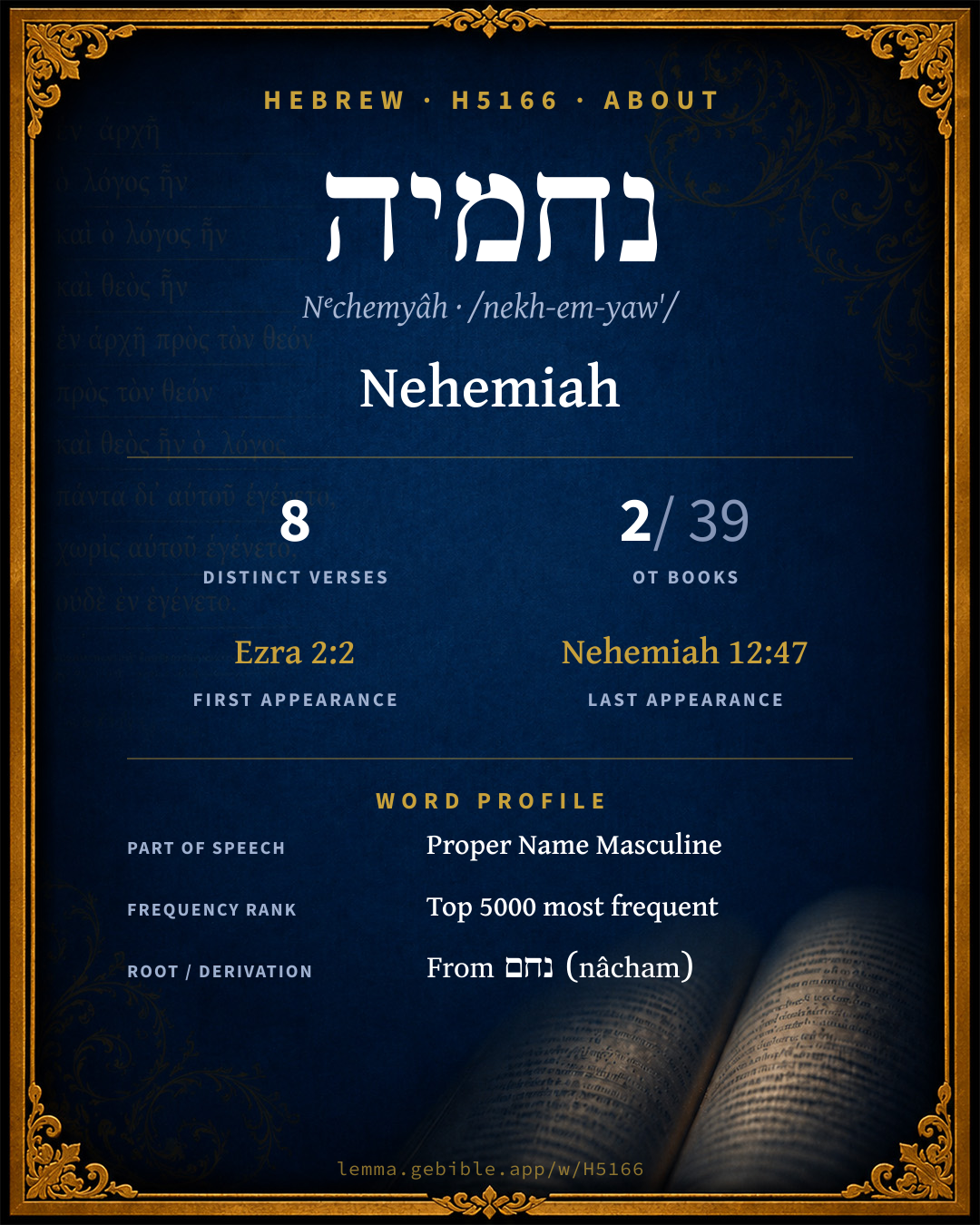
נְחֶמְיָה
Nehemiah
BDB lists 4 entries for ‘Nehemiah’ fuller range ↓
Full lexicon entry — Brown-Driver-Briggs (BDB)
From Brown-Driver-Briggs (BDB)
Where this word appears
Grammar key — what these labels mean
Part of speech
- Noun
- A naming word — a person, place, thing, or idea.
Noun type
- Proper
- A name of a specific person, place, or people (e.g. Abraham, Zion, Israel).
Every verse where H5166 appears — 8 distinct verses across 2 books. Click any verse to open its interlinear word-by-word view. Verse text shown in the World English Bible for context — . Each verse’s Hebrew form is shown with its reference; the English is not keyword-highlighted, since the data carries no word-level English alignment. Use “Compare translations” on any verse to read it across multiple English versions. This concordance covers the Hebrew Bible; Septuagint (Greek Old Testament) occurrences are not indexed here.
Ezra 1 verse
Nehemiah 7 verses
- Nehemiah 1:1 נְחֶמְיָ֖ה n Proper The words of Nehemiah the son of Hacaliah. Now it happened in the month Chislev, in the twentieth year, as I was in Shushan the palace,
- Nehemiah 3:16 נְחֶמְיָ֣ה n Proper After him repaired Nehemiah the son of Azbuk, the ruler of half the district of Beth Zur, to the place over against the tombs of David, and to the pool that was made, and to the house of the mighty men.
- Nehemiah 7:7 נְחֶמְיָ֡ה n Proper who came with Zerubbabel, Jeshua, Nehemiah, Azariah, Raamiah, Nahamani, Mordecai, Bilshan, Mispereth, Bigvai, Nehum, Baanah. The number of the men of the people of Israel:
- Nehemiah 8:9 נְחֶמְיָ֣ה n Proper Nehemiah, who was the governor, and Ezra the priest the scribe, and the Levites who taught the people, said to all the people, This day is holy to Yahweh your God; don't mourn, nor weep. For all the people wept, when they heard the words of the law.
- Nehemiah 10:1 נְחֶמְיָ֧ה n Proper Now those who sealed were: Nehemiah the governor, the son of Hacaliah, and Zedekiah,
- Nehemiah 12:26 נְחֶמְיָ֣ה n Proper These were in the days of Joiakim the son of Jeshua, the son of Jozadak, and in the days of Nehemiah the governor, and of Ezra the priest the scribe.
- Nehemiah 12:47 נְחֶמְיָ֗ה n Proper All Israel in the days of Zerubbabel, and in the days of Nehemiah, gave the portions of the singers and the porters, as every day required: and they set apart [that which was] for the Levites; and the Levites set apart [that which was] for the sons of Aaron.
About this entry
At a glance — auto-summarized from this page’s data, not written by a person. Every figure links to its source below. This summary describes the numbers; it doesn’t interpret them.
נחמיה — transliterated Nᵉchemyâh — is a Hebrew name carrying the sense “Nehemiah.” More than three-quarters of its appearances fall in Nehemiah. It appears 8 verses across 2 books of the Hebrew Bible, among its uncommon vocabulary. Its earliest occurrence is Ezra 2:2. Each statement above links to its evidence; the full detail follows below.
Gloss history
Strong's 1890 vs modern scholarship
About this word
Strong's H5166 catalogs a Hebrew word from the Hebrew Old Testament.
These counts are not copied from any lexicon or concordance. They are computed here, from the morphology-tagged Hebrew Old Testament. What Lemma adds →
- 8
- distinct verses
- The word appears in 8 distinct verses.
- 2 / 39
- OT books
- The word appears in 2 of 39 Old Testament books.
- #2,625
- by frequency
- Top 5000 most frequent Hebrew words (rank 2,625 of 8,640 Hebrew words by occurrence).
View all 8 occurrences in the concordance →
By traditional corpus
Conventional, traditional groupings — biblical authorship is debated, so this is a traditional corpus grouping, not an authorship claim. Each share is this word’s portion of its verses in that division of the Hebrew canon. Each figure is a share of the word’s 8 distinct verses.
- Writings (Ketuvim) 8 verses · 100%
How translations render this word
Counts come from each version’s own published word-to-Strong’s tagging or interlinear alignment — an approximate guide to how each version renders this word, not a word-level alignment the data otherwise carries. Because each total is that version’s own tagged count, the per-version totals vary from one another and need not match the appearance or distinct-verse counts above. These counts may also differ from a printed concordance because Lemma counts each distinctly tagged rendering and does not collapse phrase taggings into a single head-word total. This is a fixed set of word-tagged versions (KJV, ASV, BSB, ULT) and does not change with the reading translation you choose elsewhere. Each version’s license is shown beside its name below (and on Sources).
- King James Version: Nehemiah 7×
- American Standard Version: Nehemiah 7×
- Berean Standard Bible: Nehemiah 8×
- unfoldingWord Literal Text: Nehemiah 8×
King James Version Public Domain
Renders H5166 across 8 tagged occurrences — most commonly:
Plus 1 rendering that appears only once — usually multi-word phrases or single function words the recovered tagging swept in, not distinct renderings.
American Standard Version Public Domain
Renders H5166 across 8 tagged occurrences — most commonly:
Plus 1 rendering that appears only once — usually multi-word phrases or single function words the recovered tagging swept in, not distinct renderings.
Berean Standard Bible Public Domain
Renders H5166 across 8 tagged occurrences — most commonly:
unfoldingWord Literal Text CC BY-SA 4.0
Renders H5166 across 8 tagged occurrences — most commonly:
Senses in the full BDB
What do BDB’s symbols mean?
BDB uses these scholarly abbreviations:
| Symbol | Meaning |
|---|---|
| 𝔊 | the Septuagint (the ancient Greek translation, LXX) |
| 𝔙 | the Vulgate (the Latin translation) |
| 𝔖 | the Syriac version (the Peshitta) |
| 𝔗 | the Targum (the Aramaic translation) |
| ψ | the Psalms |
| √ | root (the underlying root or stem) |
| ‖ | parallel passage (a synonymous or contrasted parallel) |
| † | the dagger: every passage where the word occurs is cited |
The 3 senses and sub-senses the full Brown-Driver-Briggs lexicon distinguishes for this word, in lexicon order (not ranked by frequency), with BDB’s own verbatim wording and sub-sense lettering. Shown in Hebrew script with BDB’s own scholarly abbreviations. The condensed entry is in the Lexicon Entry tab. See also the Forms in the corpus table below.
- 1. the son of Hachaliah, governor of Judah under Artaxerxes Longimanus Ne 1:1; 8:9; 10:2; 12:26, 47. e.g. Nehemiah 1:1
- 2. ruler of half the district of Bethzur Ne 3:16. e.g. Nehemiah 3:16
- 3. one of twelve heads of people who returned with Zerubbabel Ezr 2:2 = Ne 7:7. e.g. Ezra 2:2
Senses from the full Brown-Driver-Briggs lexicon (Brown, Driver, Briggs; Oxford 1906 — public domain), digitized via Sefaria, supplemented by the OpenScriptures HebrewLexicon (CC BY 4.0). Full attribution on Sources.
Word origin
n.pr.m. (Yah comforts, 𝔊 Νεεμιας (-ου). etc.;—n.pr. נחמיה(ו) on Isr. scarab in BM, Cl GannJAs 1883, Fév.-Mars. 156 No. 42);—
— Brown-Driver-Briggs (Oxford 1906, public domain), digitized via Sefaria, supplemented by the OpenScriptures HebrewLexicon (CC BY 4.0). See Sources.
Derived from נחם (nâcham) (H5162) — to comfort.
Jastrow Dictionary
A second Hebrew/Aramaic lexicon for comparison, covering Aramaic and post-biblical (Talmudic, Targumic, Midrashic) usage that the biblical-Hebrew BDB does not. Matched by lemma rather than by Strong’s number, so a lemma may carry more than one Jastrow headword (shown separately below), and the entries cover usage well beyond the Bible.
נְחֶמְיָה
- (b. h.) Nehemiah,
- 1. N., son of Hacaliah, governor of Judea. Sabb. 123ᵇ. Snh. 93ᵇ; a. e.
- 2. name of several Tannaim and Amoraim. Yeb. XVI, 7 N. of Beth-Dŏli.—Ter. VIII, 6, a. fr. R. N.—Men. 68ᵇ Judah ben N.—Pes. 22ᵇ, a. fr. נ׳ העמסוני.—Y. Ber. III, 6ᵃ (some ed. Naḥăman נחומיה).—Y. Peah I, 16ᶜ bot. ר׳ נ׳ בר עוקבן; Y. Yeb. XIV, beg. 14ᵇ ר׳ נ׳ בר מר ע׳.—Y. Shek. V, end, 49ᵇ; a. oth.—V. Fr. Darkhé p. 137; p. 176; M’bo p. 116ᵇ
A Dictionary of the Targumim, the Talmud Babli and Yerushalmi, and the Midrashic Literature (Marcus Jastrow; London, Luzac, 1903) — Public Domain. Digitized via Sefaria. Digitized via Sefaria. Full attribution on Sources.
Forms in the corpus
The 6 distinct written forms H5166 takes in the Hebrew Bible, most frequent first — each parse links to that state’s occurrences in the concordance. Hebrew forms include their vowel points and cantillation, so a single lemma takes many written forms.
| Form | Parsing | Example | Uses |
|---|---|---|---|
| נְחֶמְיָ֣ה | Noun, Proper | Nehemiah 3:16 | 3 |
| נְ֠חֶמְיָה | Noun, Proper | Ezra 2:2 | 1 |
| נְחֶמְיָ֖ה | Noun, Proper | Nehemiah 1:1 | 1 |
| נְחֶמְיָ֗ה | Noun, Proper | Nehemiah 12:47 | 1 |
| נְחֶמְיָ֡ה | Noun, Proper | Nehemiah 7:7 | 1 |
| נְחֶמְיָ֧ה | Noun, Proper | Nehemiah 10:1 | 1 |
Same root — word family
Other BDB entries built from the same root as H5166, grouped by Strong’s listed origin. These share a root / origin per the lexicon — not necessarily a shared meaning. Each links to that word’s own entry.
Derives from
Shares the same root
- נחום nichûwm H5150 comfort
- נחם nôcham H5164 repentance
- נחמה nechâmâh H5165 comfort
- תנחום tanchûwm H8575 consolation
Proper names from this root
People and places named from this root — a name, not an additional meaning of the word.
- מנחם Mᵉnachêm H4505 Menahem
- נחום Nᵉchûwm H5149 Nehum
- נחום Nachûwm H5151 Nahum
- נחם Nacham H5163 Naham
- נחמני Nachămânîy H5167 Nahamani
Compare all same-root words → Showing 4 of 11 — not the complete family. 5 of the same-root words are proper names (people or places). They share a root, not necessarily a meaning.
Bible dictionary
Public-domain dictionary articles matched to this entry by name (Nehemiah). A biblical name can be shared by more than one person or place, so an article may treat several.
Easton's Bible Dictionary · M. G. Easton, 1897
Comforted by Jehovah. (1.) Ezra 2:2; Neh. 7:7. (2.) Neh. 3:16.
(3.) The son of Hachaliah (Neh. 1:1), and probably of the tribe of Judah. His family must have belonged to Jerusalem (Neh. 2:3). He was one of the "Jews of the dispersion," and in his youth was appointed to the important office of royal cup-bearer at the palace of Shushan. The king, Artaxerxes Longimanus, seems to have been on terms of friendly familiarity with his attendant. Through his brother Hanani, and perhaps from other sources (Neh. 1:2; 2:3), he heard of the mournful and desolate condition of the Holy City, and was filled with sadness of heart. For many days he fasted and mourned and prayed for the place of his fathers' sepulchres. At length the king observed his sadness of countenance and asked the reason of it. Nehemiah explained it all to the king, and obtained his permission to go up to Jerusalem and there to act as tirshatha, or governor of Judea. He went up in the spring of B.C. 446 (eleven years after Ezra), with a strong escort supplied by the king, and with letters to all the pashas of the provinces through which he had to pass, as also to Asaph, keeper of the royal forests, directing him to assist Nehemiah. On his arrival he set himself to survey the city, and to form a plan for its restoration; a plan which he carried out with great skill and energy, so that the whole was completed in about six months. He remained in Judea for thirteen years as governor, carrying out many reforms, notwithstanding much opposition that he encountered (Neh. 13:11). He built up the state on the old lines, "supplementing and completing the work of Ezra," and making all arrangements for the safety and good government of the city. At the close of this important period of his public life, he returned to Persia to the service of his royal master at Shushan or Ecbatana. Very soon after this the old corrupt state of things returned, showing the worthlessness to a large extent of the professions that had been made at the feast of the dedication of the walls of the city (Neh. 12. See EZRA). Malachi now appeared among the people with words of stern reproof and solemn warning; and Nehemiah again returned from Persia (after an absence of some two years), and was grieved to see the widespread moral degeneracy that had taken place during his absence. He set himself with vigour to rectify the flagrant abuses that had sprung up, and restored the orderly administration of public worship and the outward observance of the law of Moses. Of his subsequent history we know nothing. Probably he remained at his post as governor till his death (about B.C. 413) in a good old age. The place of his death and burial is, however, unknown. "He resembled Ezra in his fiery zeal, in his active spirit of enterprise, and in the piety of his life: but he was of a bluffer and a fiercer mood; he had less patience with transgressors; he was a man of action rather than a man of thought, and more inclined to use force than persuasion. His practical sagacity and high courage were very markedly shown in the arrangement with which he carried through the rebuilding of the wall and balked the cunning plans of the adversaries.' The piety of his heart, his deeply religious spirit and constant sense of communion with and absolute dependence upon God, are strikingly exhibited, first in the long prayer recorded in ch. 1:5-11, and secondly and most remarkably in what have been called his interjectional prayers', those short but moving addresses to Almighty God which occur so frequently in his writings, the instinctive outpouring of a heart deeply moved, but ever resting itself upon God, and looking to God alone for aid in trouble, for the frustration of evil designs, and for final reward and acceptance" (Rawlinson). Nehemiah was the last of the governors sent from the Persian court. Judea after this was annexed to the satrapy of Coele-Syria, and was governed by the high priest under the jurisdiction of the governor of Syria, and the internal government of the country became more and more a hierarchy.
Smith's Bible Dictionary · William Smith, 1863
(consolation of the Lord).
+ Son of Hachaliah, and apparently of the tribe of Judah. All that we know certainly concerning him is contained in the book which bears his name. We first find him at Shushan, the winter residence of the kings of Persia, in high office as the cupbearer of King Artaxerxes Longimanus. In the twentieth year of the king's reign, i.e. B.C. 445, certain Jews arrived from Judea, and gave Nehemiah a deplorable account of the state of Jerusalem. He immediately conceived the idea of going to Jerusalem to endeavor to better their state, and obtained the king's consent to his mission. Having received his appointment as governor of Judea, he started upon his journey, being under promise to return to Persia within a given time. Nehemiah's great work was rebuilding, for the first time since their destruction by Nebuzar-adan, the walls of Jerusalem, and restoring that city to its former state and dignity as a fortified town. To this great object therefore Nehemiah directed his whole energies without an hour's unnecessary delay. In a wonderfully short time the walls seemed to emerge from the heaps of burnt rubbish, end to encircle the city as in the days of old. It soon became apparent how wisely Nehemiah had acted in hastening on the work. On his very first arrival, as governor, Sanballat and Tobiah had given unequivocal proof of their mortification at his appointment; but when the restoration was seen to be rapidly progressing, their indignation knew no bounds. They made a great conspiracy to fall upon the builders with an armed force and put a stop to the undertaking. The project was defeated by the vigilance and prudence of Nehemiah. Various stratagems were then resorted to get Nehemiah away from Jerusalem and if possible to take his life; but that which most nearly succeeded was the attempt to bring him into suspicion with the king of Persia, as if he intended to set himself up as an independent king as soon as the walls were completed. The artful letter of Sanballat so-far wrought upon Artaxerxes that he issued a decree stopping the work till further orders. If is probable that at the same time he recalled Nehemiah, or perhaps his leave of absence had previously expired. But after a delay, perhaps of several years he was permitted to return to Jerusalem land to crown his work by repairing the temple and dedicating the walls. During his government Nehemiah firmly repressed the exactions of the nobles and the usury of the rich, and rescued the poor Jews from spoliation and slavery. He refused to receive his lawful allowance as governor from the people, in consideration of their poverty, during the whole twelve years that he was in office but kept at his own charge a table for 150 Jews, at which any who returned from captivity were welcome. He made most careful provision for the maintenance of the ministering priests and Levites and for the due and constant celebration of divine worship. He insisted upon the sanctity of the precincts of the temple being preserved inviolable, and peremptorily ejected the powerful Tobiah from one of the chambers which Eliashib had assigned to him. With no less firmness and impartiality he expelled from all sacred functions those of the high priest's family who had contracted heathen marriages, and rebuked and punished those of the common people who had likewise intermarried with foreigners; and lastly, he provided for keeping holy the Sabbath day, which was shamefully profaned by many both Jews and foreign merchants, and by his resolute conduct succeeded in repressing the lawless traffic on the day of rest. Beyond the thirty-second year of Artaxerxes, to which Nehemiah's own narrative leads us, we have no account of him whatever. + One of the leaders of the first expedition from Babylon to Jerusalem under Zerabbabel. (Ezra 2:2; Nehemiah 7:7) + Son of Azbuk and ruler of the half part of Beth-zur, who helped to repair the wall of Jerusalem. (Nehemiah 3:18)
Hitchcock's Bible Names Dictionary · Roswell D. Hitchcock, 1869
consolation; repentance of the Lord
Classic public-domain reference works; full attribution on Sources.
Septuagint verse parallels
This word appears in 1 verse that also exists in the Greek Old Testament (Septuagint), out of the 8 Hebrew verses it occurs in. You can read those verses in Greek by switching the Old Testament edition to the Septuagint.
Read these verses in the Septuagint
This is a verse-level parallel only — the same verses exist in both the Hebrew and Greek Old Testaments. No word-level Hebrew↔Greek correspondence is claimed: the data carries no such alignment, so no Greek word is shown as this Hebrew word’s translation. Coverage is not total — the Septuagint omits the deuterocanon and renumbers the Psalms, so some Hebrew verses have no direct Greek parallel.