
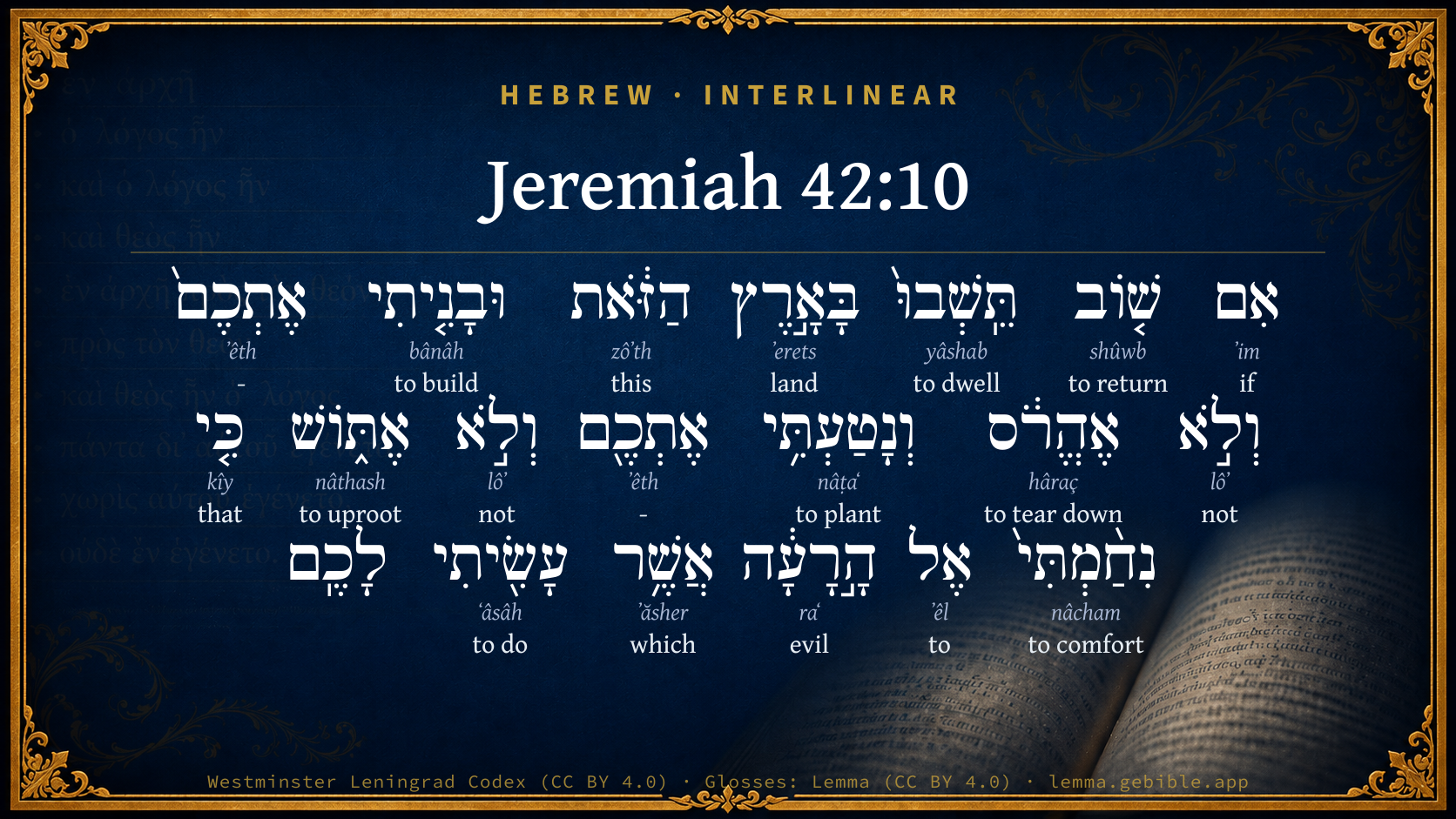
Jeremiah 42:10

Hebrew (Westminster Leningrad Codex) Jeremiah 42:10 appears in the Hebrew Old Testament. The text above is from the Westminster Leningrad Codex. Each word links to its Strong’s number, a concise gloss, and parsing drawn from the Open Scriptures Hebrew Bible morphology. Click any word for its full Brown-Driver-Briggs (BDB) entry.
Download image
Cite this verse

Jeremiah 42:10 (World English Bible). Public Domain. Lemma interlinear Bible study tool, https://lemma.gebible.app/v/jeremiah/42/10.

Show BibTeX & RIS
BibTeX
RIS
English Translation
If you will still abide in this land, then will I build you, and not pull you down, and I will plant you, and not pluck you up; for I repent me of the evil that I have done to you.
World English Bible · Public Domain
Download a study sheet

One document with this verse’s original text, its word-by-word gloss line, the meaning frame, cross-references with their text, attributed commentary, and full source and license credits — printable, and it pastes into notes with its structure intact.

This verse Autodidact and up

Study sheet (.html) Plain text (.txt)

A passage Seminary Student

Up to 50 verses in one chapter. A passage sheet keeps up to 6 commentary sources and 12 cross-references per verse, in the order this page ranks them, and says so on the sheet whenever that leaves anything out. Ask for a single verse and you get the Autodidact verse sheet above.

Everything on this page stays free to read, with no account — the sheet is a download of what is already on screen, not access to it.

Want to remove ads? Support Godless Engineer
Compare translations 3

The same verse in 3 English versions, stacked beneath the original-language interlinear above. Click any original word for its lexicon entry.

Each is an independent rendering of the whole verse — the interlinear is not word-aligned to these translations.

Highlighted words mark where these versions differ — a whole-verse word diff, not a word-by-word alignment.

  • World English Bible Public Domain
    If you will still abide in this land, then will I build you, and not pull you down, and I will plant you, and not pluck you up; for I repent me of the evil that I have done to you.
  • King James Version Public Domain
    If ye will still abide in this land, then will I build you, and not pull you down, and I will plant you, and not pluck you up: for I repent me of the evil that I have done unto you.
  • unfoldingWord Literal Text CC BY-SA 4.0
    ‘If you go back and live in this land, then I will build you and not tear you down; I will plant you and not pull you up, for I will turn back the disaster that I have brought on you.

unfoldingWord Literal Text — © unfoldingWord, licensed CC BY-SA 4.0. Word-aligned USFM3 via Door43 (git.door43.org/unfoldingWord/en_ult).

Versions to compare (up to 4)

3 of 4 selected

Show all 18 translations

Every available English version of this verse, each an independent rendering of the whole verse.

  • World English Bible Public Domain
    If you will still abide in this land, then will I build you, and not pull you down, and I will plant you, and not pluck you up; for I repent me of the evil that I have done to you.
  • Berean Standard Bible Public Domain
    ‘If you will indeed stay in this land, then I will build you up and not tear you down; I will plant you and not uproot you, for I will relent of the disaster I have brought upon you.
  • Majority Standard Bible Public Domain
    ‘If you will indeed stay in this land, then I will build you up and not tear you down; I will plant you and not uproot you, for I will relent of the disaster I have brought upon you.
  • King James Version Public Domain
    If ye will still abide in this land, then will I build you, and not pull you down, and I will plant you, and not pluck you up: for I repent me of the evil that I have done unto you.
  • American Standard Version (1901) Public Domain
    If ye will still abide in this land, then will I build you, and not pull you down, and I will plant you, and not pluck you up; for I repent me of the evil that I have done unto you.
  • Revised Version (1885) Public Domain
    If ye will still abide in this land, then will I build you, and not pull you down, and I will plant you, and not pluck you up: for I repent me of the evil that I have done unto you.
  • Geneva Bible (1599) Public Domain
    If ye will dwell in this land, then I wil build you, and not destroy you, and I will plant you, and not roote you out: for I repent me of the euill that I haue done vnto you.
  • Douay-Rheims (1899) Public Domain
    If you will be quiet and remain in this land, I will build you up, and not pull you down: I will plane you, and not pluck you up: for now I am appeased for the evil that I have done to you.
  • Young's Literal Translation Public Domain
    `If ye do certainly dwell in this land, then I have builded you up, and I throw not down; and I have planted you, and I pluck not up; for I have repented concerning the evil that I have done to you.
  • Literal Standard Version CC BY-SA 4.0
    If you certainly dwell in this land, then I have built you up, and I do not throw down; and I have planted you, and I do not pluck up; for I have relented concerning the calamity that I have done to you.
  • Unlocked Literal Bible CC BY-SA 4.0
    'If you go back and live in this land, then I will build you and not tear you down; I will plant you and not pull you up, for I will turn back the disaster that I have brought on you.
  • unfoldingWord Literal Text CC BY-SA 4.0
    ‘If you go back and live in this land, then I will build you and not tear you down; I will plant you and not pull you up, for I will turn back the disaster that I have brought on you.
  • Darby Bible Public Domain
    If ye will still abide in this land, then will I build you, and not overthrow [you], and I will plant you, and not pluck [you] up; for I repent me of the evil that I have done unto you.
  • World Messianic Bible Public Domain
    ‘If you will still live in this land, then I will build you, and not pull you down, and I will plant you, and not pluck you up; for I grieve over the distress that I have brought on you.
  • Webster's Bible Public Domain
    If ye will still abide in this land, then will I build you, and not pull you down, and I will plant you, and not pluck you up: for I repent of the evil that I have done to you.
  • Free Bible Version CC BY-SA 4.0
    If you will stay right here in this country, then I will build you up and I won't tear you down; I will plant you and I won't uproot you; because I'm very sad about the disaster I have brought down on you.
  • Bible in Basic English Public Domain
    If you still go on living in the land, then I will go on building you up and not pulling you down, planting you and not uprooting you: for my purpose of doing evil to you has been changed.
  • JPS Tanakh (1917) Public Domain
    If ye will still abide in this land, then will I build you, and not pull you down, and I will plant you, and not pluck you up; for I repent Me of the evil that I have done unto you.

Literal Standard Version (2020), Covenant Press — licensed CC BY-SA 4.0. Text via the HelloAO Bible API (eBible.org). Unlocked Literal Bible (unfoldingWord) — licensed CC BY-SA 4.0. Text via the HelloAO Bible API (eBible.org). unfoldingWord Literal Text — © unfoldingWord, licensed CC BY-SA 4.0. Word-aligned USFM3 via Door43 (git.door43.org/unfoldingWord/en_ult). Free Bible Version, Dr. Jonathan Gallagher — licensed CC BY-SA 4.0. Text via the HelloAO Bible API (eBible.org).

Word by word

More ways to search: Search by grammar → Find every occurrence → Compare this word →

Practice this passage: Drill this verse → Learn its vocabulary →

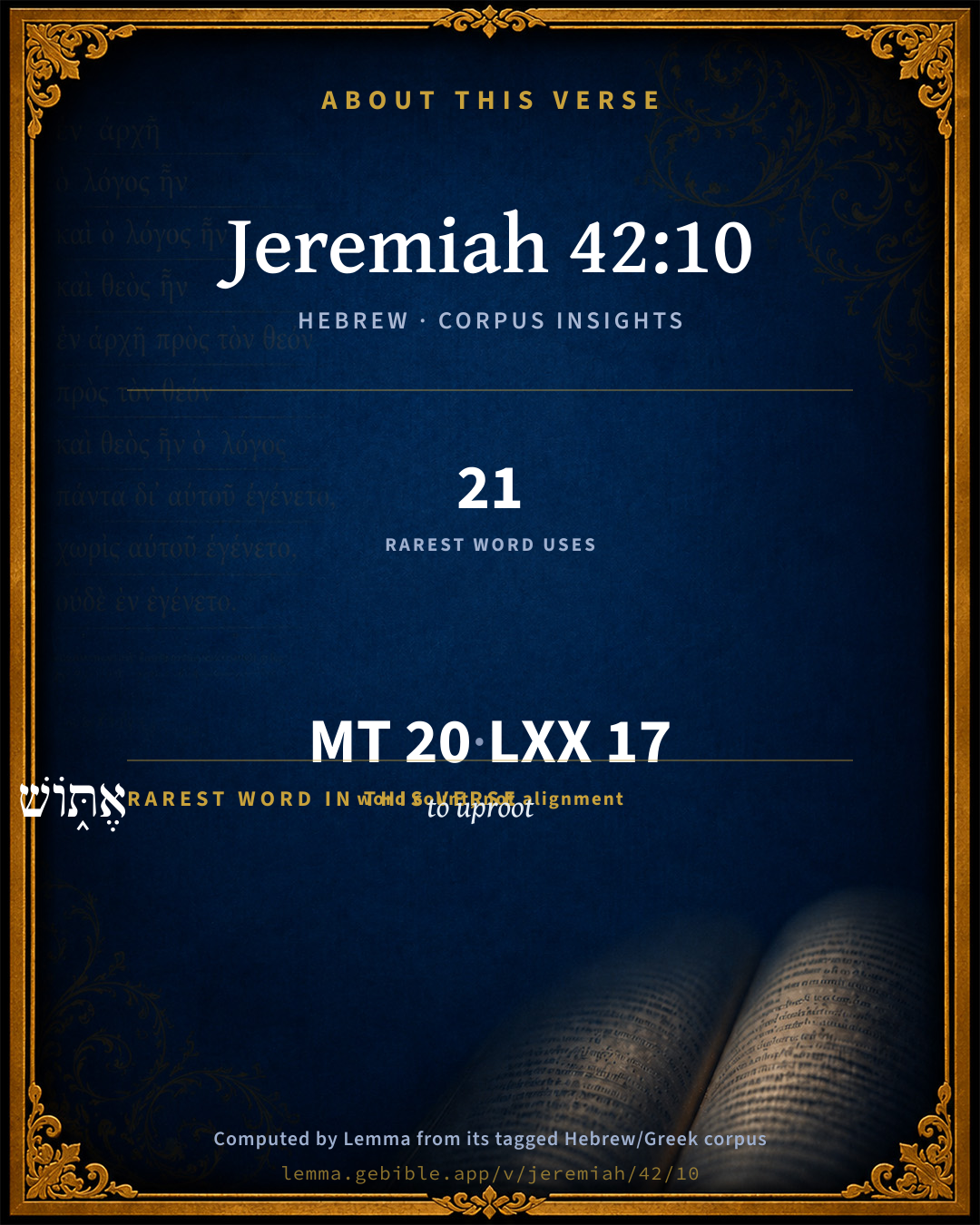
אֶתּ֑וֹשׁ
nâthash
H5428
“to uproot”
Verb, Qal, Imperfect, 1st Person, Common, Singular
Part of Speech
Verb
Stem
Qal
Form
Imperfect
Person
1st Person
Gender
Common
Number
Singular
Full BDB Definition

Origin: a primitive root

TWOT: 1451

to pull up, expel, root out, pluck up - (Qal) to pull or pluck up - (Niphal) to be plucked up - (Hophal) to be plucked up
  1. אִם ʼim H518 “if” Conjunction
  2. שׁ֤וֹב shûwb H7725 “to return” Verb, Qal, Infinitive Absolute
  3. תֵּֽשְׁבוּ֙ yâshab H3427 “to dwell” Verb, Qal, Imperfect, 2nd Person, Masculine, Plural
  4. בָּאָ֣רֶץ ʼerets H776 “in/at the · land” Preposition, Determined + Noun, Common, Both, Singular, Absolute
  5. הַזֹּ֔את zôʼth H2063 “the · this” Particle, Definite Article + Pronoun, Demonstrative, Feminine, Singular
  6. וּבָנִ֤יתִי bânâh H1129 “and · to build” Conjunction + Verb, Qal, Sequential Perfect, 1st Person, Common, Singular
  7. אֶתְכֶם֙ ʼêth H853 “- · you” Particle, Direct Object + Suffix, Personal, 2nd Person, Masculine, Plural
  8. וְלֹ֣א lôʼ H3808 “and · not” Conjunction + Particle, Negative
  9. אֶהֱרֹ֔ס hâraç H2040 “to tear down” Verb, Qal, Imperfect, 1st Person, Common, Singular
  10. וְנָטַעְתִּ֥י nâṭaʻ H5193 “and · to plant” Conjunction + Verb, Qal, Sequential Perfect, 1st Person, Common, Singular
  11. אֶתְכֶ֖ם ʼêth H853 “- · you” Particle, Direct Object + Suffix, Personal, 2nd Person, Masculine, Plural
  12. וְלֹ֣א lôʼ H3808 “and · not” Conjunction + Particle, Negative
  13. כִּ֤י kîy H3588 “that” Conjunction
  14. נִחַ֨מְתִּי֙ nâcham H5162 “to comfort” Verb, Niphal, Perfect, 1st Person, Common, Singular
  15. אֶל ʼêl H413 “to” Preposition
  16. הָ֣רָעָ֔ה raʻ H7451 “the · evil” Particle, Definite Article + Noun, Common, Feminine, Singular, Absolute
  17. אֲשֶׁ֥ר ʼăsher H834 “which” Particle, Relative
  18. עָשִׂ֖יתִי ʻâsâh H6213 “to do” Verb, Qal, Perfect, 1st Person, Common, Singular

About this verse

These counts appear in no published source. They are computed here, from the morphology-tagged text and Lemma’s own curated glosses. What Lemma adds →

20
words
17
distinct lemmas
Prophets
section

Notable vocabulary

The rarest word here is אֶתּ֑וֹשׁ to uproot H5428 — appearing just 21 times in the whole Hebrew Bible.

Shared distinctive vocabulary

אֶתּ֑וֹשׁ to uproot H5428 occurs in 19 verses of the Hebrew Bible. Also found in:

Grammatical profile

  • 8 verbs
  • 2 nouns
  • 1 pronoun
  • 2 prepositions
  • 2 conjunctions
  • 5 particles

Verb forms

  • שׁ֤וֹב Qal · Infinitive Absolute
  • תֵּֽשְׁבוּ֙ Qal · Imperfect
  • וּבָנִ֤יתִי Qal · Sequential Perfect
  • אֶהֱרֹ֔ס Qal · Imperfect
  • וְנָטַעְתִּ֥י Qal · Sequential Perfect
  • אֶתּ֑וֹשׁ Qal · Imperfect
  • נִחַ֨מְתִּי֙ Niphal · Perfect
  • עָשִׂ֖יתִי Qal · Perfect

Repetition

A word recurs within this verse — often emphatic in Hebrew:

  • וְלֹ֣א not H3808 ×2

Hebrew & Septuagint length

In the original languages it is 20 Hebrew tokens and 17 Greek tokens — but the two are counted differently (Hebrew bundles its prefixes and suffixes into one token; the Greek is in lemma form), so that isn’t a like-for-like length.

Cross-references

22

Topical passages linked to Jeremiah 42:10 in the Treasury of Scripture Knowledge — connected by theme and wording, ordered by reader-vote popularity; previews shown in the World English Bible.

  • Jeremiah 24:6 For I will set my eyes on them for good, and I will bring them again to this land: and I will build them, and not pull them down; and I will plant them, and not pluck them up.
  • Jeremiah 31:28 It shall happen that, like as I have watched over them to pluck up and to break down and to overthrow and to destroy and to afflict, so will I watch over them to build and to plant, says Yahweh.
  • Ezekiel 36:36 Then the nations that are left round about you shall know that I, Yahweh, have built the ruined places, and planted that which was desolate: I, Yahweh, have spoken it, and I will do it.
  • Joel 2:13 Tear your heart, and not your garments, And turn to Yahweh, your God; For he is gracious and merciful, Slow to anger, and abundant in loving kindness, And relents from sending calamity.
  • Jeremiah 33:7 I will cause the captivity of Judah and the captivity of Israel to return, and will build them, as at the first.
  • Amos 7:6 Yahweh relented concerning this. "This also shall not be," says the Lord Yahweh.
  • Genesis 26:2–3 Yahweh appeared to him, and said, "Don't go down into Egypt. Dwell in the land which I will tell you of.
  • Exodus 32:14 Yahweh repented of the evil which he said he would do to his people.
  • Jeremiah 18:7–10 At what instant I shall speak concerning a nation, and concerning a kingdom, to pluck up and to break down and to destroy it;
  • Hosea 11:8 "How can I give you up, Ephraim? How can I hand you over, Israel? How can I make you like Admah? How can I make you like Zeboiim? My heart is turned within me, My compassion is aroused.
  • Amos 7:3 Yahweh relented concerning this. "It shall not be," says Yahweh.
  • Jonah 3:10 God saw their works, that they turned from their evil way. God repented of the evil which he said he would do to them, and he didn't do it.
  • Jonah 4:2 He prayed to Yahweh, and said, "Please, Yahweh, wasn't this what I said when I was still in my own country? Therefore I hurried to flee to Tarshish, for I knew that you are a gracious God, and merciful, slow to anger, and abundant in loving kindness, and you repent of the evil.
  • Deuteronomy 32:36 For Yahweh will judge his people, Repent himself for his servants; When he sees that [their] power is gone, There is none [remaining], shut up or left at large.
  • Judges 2:18 When Yahweh raised them up judges, then Yahweh was with the judge, and saved them out of the hand of their enemies all the days of the judge: for it repented Yahweh because of their groaning by reason of those who oppressed them and vexed them.
  • 2 Samuel 24:16 When the angel stretched out his hand toward Jerusalem to destroy it, Yahweh repented him of the evil, and said to the angel who destroyed the people, It is enough; now stay your hand. The angel of Yahweh was by the threshing floor of Araunah the Jebusite.
  • Psalms 37:3 Trust in Yahweh, and do good. Dwell in the land, and enjoy safe pasture.
  • Psalms 69:35 For God will save Zion, and build the cities of Judah. They shall settle there, and own it.
  • Psalms 102:16 For Yahweh has built up Zion. He has appeared in his glory.
  • Psalms 106:45 He remembered for them his covenant, And repented according to the multitude of his loving kindnesses.
  • Jeremiah 26:19 Did Hezekiah king of Judah and all Judah put him to death? Didn't he fear Yahweh, and entreat the favor of Yahweh, and Yahweh repented him of the evil which he had pronounced against them? Thus should we commit great evil against our own souls.
  • Acts 15:16 'After these things I will return. I will again build the tent of David, which has fallen. I will again build its ruins. I will set it up,

Cross-references courtesy of OpenBible.info (CC BY 4.0).

Hebrew and Greek witnesses Masoretic Hebrew ↔ Greek Septuagint

The same verse in the two great witnesses to the Old Testament, shown verse-for-verse.

These are two independent witnesses, not word-aligned to each other, and the Septuagint is shown in lemma (dictionary) form.

Hebrew Jeremiah 42:10 Masoretic · Westminster Leningrad Codex

אִם שׁ֤וֹב תֵּֽשְׁבוּ֙ בָּאָ֣רֶץ הַזֹּ֔את וּבָנִ֤יתִי אֶתְכֶם֙ וְלֹ֣א אֶהֱרֹ֔ס וְנָטַעְתִּ֥י אֶתְכֶ֖ם וְלֹ֣א אֶתּ֑וֹשׁ כִּ֤י נִחַ֨מְתִּי֙ אֶל הָ֣רָעָ֔ה אֲשֶׁ֥ר עָשִׂ֖יתִי לָכֶֽם

If you will still abide in this land, then will I build you, and not pull you down, and I will plant you, and not pluck you up; for I repent me of the evil that I have done to you.

World English Bible · Public Domain

Greek LXX Structure differs

In the Septuagint, Jeremiah is about an eighth shorter than the Hebrew and arranges its material differently — the Oracles Against the Nations (Hebrew chapters 46–51) appear in the middle of the Greek book, after 25:13. Because the chapter and verse boundaries do not line up, a verse-for-verse comparison with the Hebrew is not shown.

A verse-for-verse comparison isn’t shown here because the chapters and verses don’t line up. Switch to the LXX edition with the MT / LXX toggle above to read the Greek directly.

On this verse, Haydock's Catholic Bible Commentary discusses the Septuagint’s reading. Read the note in Commentary ↓

Hebrew: Westminster Leningrad Codex (CC BY 4.0). Greek: Septuagint (public domain); English from a public-domain English Septuagint. How the Septuagint differs from the Hebrew →

Targum (Aramaic paraphrase)

1

The Targum is the ancient Jewish Aramaic paraphrase of the Hebrew Scriptures — an interpretive translation, not the Hebrew text itself. Onkelos (literal) and Pseudo-Jonathan (expansive) render the Torah, and Jonathan the Prophets. Coverage is partial: where no permissively-licensed English translation exists for a verse, only the Aramaic is shown. This is verse-level text, not a word-by-word alignment to the Hebrew.

  1. Targum Jonathan Prophets (Joshua–Malachi)
    אִם מִתַּב תֵּיתְבוּן בְּאַרְעָא הָדָא וְאָבְנֵי יַתְכוֹן וְלָא אֶפַגֵר וַאֲקַיֵם יַתְכוֹן וְלָא אֶטַלְטֵל אֲרֵי תָבִית מִן בִּישָׁתָא דַעֲבָדֵית לְכוֹן:

    (no public-domain English translation for this verse)

    Targum Jonathan — Aramaic: “Mikraot Gedolot” (public domain). English: “Sefaria Community Translation” (CC0 1.0 (public-domain dedication)); “London "Chaldee Paraphrase," 1871” (public domain). Text via Sefaria.

Commentary

Notes on Jeremiah 42:10 from classic Christian and Jewish commentators (each source and its license shown beneath its notes). The classic Christian expositions comment on the surrounding passage and are grouped to its opening verse, so a note may address several verses; the Jewish commentaries on the Tanakh (Rashi and others) are per-verse, so they appear only where the commentator wrote on this verse.

Lemma curates 59 commentaries, every one of them public domain or Creative Commons licensed, each selected and text-cleaned for this edition rather than reprinted as found. About our sources →

Trapp's Complete Commentary

John Trapp

Jer 42:10 If ye will still abide in this land, then will I build you, and not pull [you] down, and I will plant you, and not pluck [you] up: for I repent me of the evil that I have done unto you.

Ver. 10. Then will I build you.] Promittitur felicitatio; parabola ab architectura et agricultura desumpta. God promiseth to bless and settle them by a twofold similitude, used also by the apostle, {1Co 3:9} "Ye are God’s husbandry, ye are God’s building." See Jer 24:6.

For I repent me of the evil.] A term taken from men, {Gen 6:6} though repentance in men is a change of the will; but repentance in God is only the willing of a change, mutatio rei, non Dei. See Jer 18:8.

John Trapp, A Commentary or Exposition upon All the Books of the Old and New Testament (1647–1656) — public domain. Text from a community e-Sword module.

Tyndale Open Study Notes

Tyndale Open Resources

42:10-12 The Lord replied that he wanted the people to stay in Judea and settle down, and he would plant them in the land (see 1:10). Judea’s time of judgment was over. • For I am with you and will save you: The Lord was calling the remnant of Judea to trust him for protection against the king of Babylon.

Tyndale Open Study Notes — © Tyndale Open Resources, licensed CC BY-SA 4.0. Text via the HelloAO Bible API.

Geneva Bible (1599)

Geneva Bible translators

Read Jer. 18:8.

Geneva Bible (1599) marginal notes — public domain. Text via Bolls.life.

Jamieson, Fausset & Brown

Robert Jamieson, A. R. Fausset & David Brown

If ye . . . abide--namely, under the Babylonian authority, to which God hath appointed that all should be subject (Dan 2:37-38). To resist was to resist God.

build . . . plant--metaphor for, I will firmly establish you (Jer 24:6).

I repent . . . of the evil-- (Jer 18:8; Deu 32:36). I am satisfied with the punishment I have inflicted on you, if only you add not a new offense [GROTIUS]. God is said to "repent," when He alters His outward ways of dealing.

Jamieson, Fausset & Brown — Commentary Critical and Explanatory on the Whole Bible (1871) — public domain (CC PDM 1.0). Text via the HelloAO Bible API.

Adam Clarke's Commentary

Verse 10. For I repent me of the evil] The meaning is, As I have punished you only because you continued to be rebellious, I will arrest this punishment as soon as you become obedient to my word. You need not fear the king of Babylon if you have me for your helper; and I will so show mercy to you that he shall see it, and cease from afflicting you, as he shall see that I am on your side.

Adam Clarke's Commentary on the Bible (1810–1826) — public domain. Text from a community e-Sword/MySword module.

John Calvin's Commentaries

He now adds, If remaining ye will remain in this land, I will build you up and plant you, I will not pull you down nor root you up Here the Prophet testifies that the counsel he gave them in God’s name would be for their good; and what is good or useful is deemed by men, when they theorize, as they say, to be of great value. The simple authority of God ought, indeed, to be sufficient; and had God only commanded them in one word to remain, they ought to have acquiesced. But God here accommodated himself to their infirmity, and was pleased, in a manner, to let himself down in order to promote their well being, and did not require obedience according to his authority and sovereign power, as he might have justly done. We hence see how kindly God dealt with this people, as he did not demand what he might, but gave his counsel, and testified that it would be good and useful to them.

Now when orators adduce what is useful in order to persuade, they have recourse to conjectures, they state human reasons; but the Prophet here promised in God’s name, that that if they remained it would be for their good. God’s promise, then, is brought forward here instead of conjectures and reasons. Therefore the obstinacy of the people was without excuse, when they rejected the authority of God; and then despised his counsel, and also disbelieved his promise. Then to the contempt of God was added unbelief: and we know that no greater reproach can be offered to God than when men do not believe him.

The metaphors here used occur often in Scripture. God is said to build up men when he confirms them in a settled state; and in the same sense he is said to plant them. This we have already seen, and it is especially evident from Psalm 44:2, where God is said to have “planted” in the land of Canaan the people he had brought out of Egypt. He then promised that the condition of the people would be secure, and safe, and perpetual, if only they did not change their place. When he adds, I will not pull down nor pluck up, he: follows what is done commonly in Hebrew. Neither the Latins nor the Greeks speak in this manner; but negatives of this kind in Hebrew are confirmations, as though the Prophet had said, “God will so plant you that your root will remain. There will then be no danger of being plucked up when you have been planted by God’s hand; nor will he suffer you to be subverted or pulled down when he has built you up by his own hand.” What then they ought to have especially sought, God freely promised them, even to be safe and secure in the land; for this especially was what the Prophet meant.

It afterwards follows, For I repent of the evil which I have brought on you. The verb נחם, nuchem, sometimes means to repent, and often to comfort; but the former sense comports better with this passage, that God repented of the evil. If, however, we prefer this rendering, “For I have received comfort,” then the meaning would be, “I am satisfied with the punishment with which I have visited your sins;” for they to whom satisfaction is given are said to receive comfort. As then God was content with the punishment he had inflicted on the Jews, the words may be rendered thus, “For I have received satisfaction from the evil,” or, “I am satisfied with the evil,” etc. The other meaning, however, is more generally taken, that God repented of the evil. But this mode of speaking is, indeed, somewhat harsh, yet it contains nothing contrary to the truth; for we know that God often transfers to himself what peculiarly belongs to man. Then repentance in God is nothing else than that having been pacified, he does not pursue men to an extremity, so as to demand the punishment which they justly deserve. Thus, then, God repented of the evil which he had brought on the people, after having sufficiently chastised their sins, according to what we read in Isaiah, when God says, that he had exacted double for their sins. (Isaiah 40:2.) He called the punishment he had inflicted double, not that it exceeded a just measure, but he spoke according to his paternal feeling, that he had treated his people in a harder way than he wished, as a father, who is even displeased with himself when he has been very severe towards his children.

We now, then, perceive what is meant by the reason here given, that the Jews were not to fear if they dwelt in the land, because God had sufficiently chastised them, and that he was so pacified that he would not further pursue them with severity. Jeremiah at the same time reminds us, that whatever evils happen to us, they ought to be ascribed to God’s judgment, and not to adverse fortune. We hence see that by these words the people were exhorted to repent; for as they were bidden to entertain good hope, because their safety was in God’s hand, so also the Prophet shews that as to the time past they had suffered nothing by chance, but that they had been punished because they had provoked God’s wrath. It follows, —

John Calvin's Commentaries (1540-1563) — public domain. Text from the Calvin Translation Society English edition (1840s-50s) via the Christian Classics Ethereal Library (ccel.org). Calvin's coverage is partial (roughly two-thirds of the Bible); uncommented books and verses are honest gaps, never fabricated. The 19th-century editor's footnotes and remarks are omitted so the notes are faithfully Calvin's own voice.

Ellicott's Commentary for English Readers

(10) Then will I build you, and not pull you down . . .—We note the characteristic recurrence of the formulæ with which Jeremiah’s work as a prophet had begun (Jer_1:10). The word for “repent” does not imply regret for the past, as men repent of their sin, but, as in Jer_18:8; Jer_26:3, a change of purpose from what had been the mind of judgment to one of mercy. The prophet’s counsel is, as it had been all along, that the people should accept the punishment which God had inflicted on them, that they should stay where they were and as they were, and not in terror or suspicion seek safety in plans of their own devising.

A Bible Commentary for English Readers, edited by Charles John Ellicott (1878–1897) — public domain. Text from a community e-Sword module.

The Cambridge Bible for Schools and Colleges

gen. ed. J. J. S. Perowne

10. then will I build you, etc.] Cp. Jer_1:10, Jer_24:6 for these figures.

I repent me] an anthropomorphic figure. I change my conduct towards you, which with men is commonly caused by change of purpose.

The Cambridge Bible for Schools and Colleges (gen. ed. J. J. S. Perowne; Cambridge University Press, 1878–1918) — public domain. Text from a community e-Sword module.

John Gill's Exposition

Be not afraid of the king of Babylon, of whom ye are afraid,.... Lest he should revenge the death of Gedaliah upon them, which was a groundless fear; see Jer 41:18; or that they should be dealt hardly with by him, and be cruelly oppressed, and not able to live in subjection to him; see Jer 40:9;

be not afraid of him, saith the Lord: who, being omniscient, knew they were; and, being omnipotent, a greater King than the king of Babylon, the King of king?, they had no reason to fear anything from him, since they were under his protection:

for I am with you to save you, and to deliver you from his hand; from his avenging and oppressing hand; though they were not to be delivered as yet from subjection to him, or being tributaries to him; which they might be, and yet dwell in peace and safety.

John Gill's Exposition of the Whole Bible (1746–1763) — public domain (CC PDM 1.0). Text via the HelloAO Bible API.

Albert Barnes' Notes on the Bible

I repent me - As punishment had been inflicted, the divine justice was satisfied.

Albert Barnes' Notes on the Bible (1834–1885) — public domain. Text from a community e-Sword/MySword module.

Haydock's Catholic Bible Commentary

Appeased. Hebrew, "comforted." Septuagint, "at rest." I forget (Calmet) or pardon (Haydock) the past.

George Leo Haydock (1774–1849), Haydock's Catholic Family Bible and Commentary, 1859 edition — public domain. Excludes Psalms (Douay-Rheims chapter numbering differs from Protestant) and Deuterocanonical books (Catholic canon only).

Matthew Poole's English Annotations

That is, if you will not go into the land of Egypt, as you are thinking, but abide where you are, or in any part of Judah, under subjection to the king of Babylon, into whose power I have given you, then I will see to your security and prosperity, and make you a happy people. The happiness and prosperity of people is in Scripture often set out under the notion of building and planting, as on the contrary their misery or destruction is expressed under the metaphorical notions of pulling down and plucking up.

For I repent me of the evil that I have done unto you; for I am satisfied with the punishment your nation hath undergone; and as to the remainder, if they do not destroy themselves by new disobedience, I will change the course of my providence.

Matthew Poole's English Annotations on the Holy Bible (1683–1685) — public domain. Text from a community e-Sword/MySword module.

Whedon's Commentary on the Bible

Daniel D. Whedon

10. If ye will still abide — One chapter of their probation had closed, another now opens. They had proven disobedient and corrupt under Jewish rule, and the catastrophe had come; they were again to be put to trial under Babylonian rule. Though they had proven rebellious, and so had been given over into the power of their enemies, God had by no means deserted them, or become their enemy. And so this message is full of assurances of his continued interest in their behalf: “I repent me,” “I will build you,” “save you,” “deliver you,” “show mercies unto you.”

Daniel D. Whedon (gen. ed.), Commentary on the Old and New Testaments (1874–1909) — public domain. Text from a community e-Sword module.

The Pulpit Commentary

Build you, and not pull you down, etc. Some of Jeremiah"s favourite phrases. (see on Jer_24:6) I repent me. And yet in 1Sa_15:29 we read that "Israel"s Trust... is not a man that he should repent." The key to the discrepancy may be found in Psa_18:25, Psa_18:26, "With the pious thou showest thyself pious... and with the froward thou showest thyself froward." There is no change in the nature or purpose of God, but only in his conduct towards man. The term "repent" is, therefore, only used analogically.

The Pulpit Commentary (1880–1919), ed. H.D.M. Spence-Jones & Joseph S. Exell — public domain. Text from a community e-Sword module.

John Wesley's Explanatory Notes

I repent - I am satisfied with the punishment your nation hath undergone, and as to the remainder, will change the course of my providence.

John Wesley, Explanatory Notes Upon the Whole Bible (1754–1765) — public domain. Text via the GEBible commentary corpus.

Scofield Reference Notes

C. I. Scofield

repent

(See Scofield "Zec 8:14").

The Scofield Reference Bible (1917 edition), notes by C. I. Scofield — public domain. Text from a community e-Sword module.

Lesson kit

Teaching starters — assembled from the data on this page, not authored interpretation. Every prompt links to the verse data it draws on. Edit before teaching.

Jeremiah, in the Prophets, opens this verse with 20 words (17 distinct Hebrew lemmas). Its most distinctive word is nâthash (“to uproot”). A historical commentator’s framing appears above. Read the whole chapter for the surrounding context.

Discussion questions

  1. How does “to uproot” (nâthash) shape what this verse is saying?
  2. Deuteronomy 29:28 shares the word «to uproot» with this verse. How do the two illuminate each other?
  3. “not” occurs 2× in this one verse. What is the effect of the repetition?
  4. The translations on this page render this verse differently — a whole-verse word diff, not a word-by-word alignment. What might account for the different wordings?
  5. The verb «שׁ֤וֹב» is Qal Infinitive Absolute. How does its form color the action?
  6. Reading how Trapp's Complete Commentary and Tyndale Open Study Notes read this verse, where do the two commentators agree and where do they part?

Things to notice

Reading settings

Reading text

Shown beneath each verse's original-language words.

Old Testament
Old Testament edition

Read the OT as the Masoretic Hebrew (MT) or the Greek Septuagint (LXX).

English shown for the Greek Septuagint (in the Hebrew ↔ Greek comparison).

Comparing translations? Open the Compare panel on any verse page to stack up to four side by side.