
Zechariah 8:14

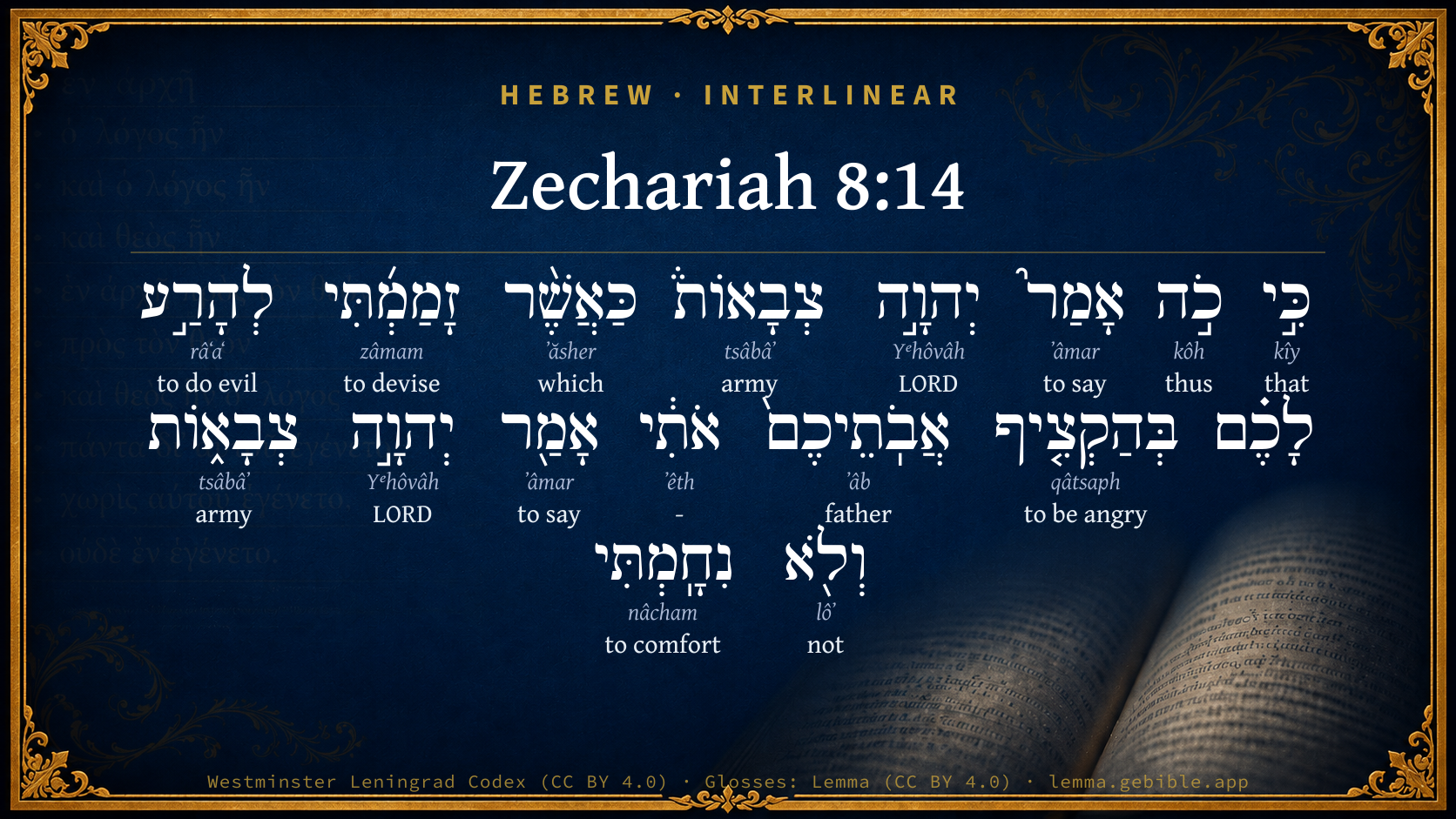
Hebrew (Westminster Leningrad Codex) Zechariah 8:14 appears in the Hebrew Old Testament. The text above is from the Westminster Leningrad Codex. Each word links to its Strong’s number, a concise gloss, and parsing drawn from the Open Scriptures Hebrew Bible morphology. Click any word for its full Brown-Driver-Briggs (BDB) entry.
Download image
Cite this verse

Zechariah 8:14 (World English Bible). Public Domain. Lemma interlinear Bible study tool, https://lemma.gebible.app/v/zechariah/8/14.

Show BibTeX & RIS
BibTeX
RIS
English Translation
For thus says Yahweh of hosts: "As I thought to do evil to you, when your fathers provoked me to wrath," says Yahweh of Hosts, "and I didn't repent;
World English Bible · Public Domain
Download a study sheet

One document with this verse’s original text, its word-by-word gloss line, the meaning frame, cross-references with their text, attributed commentary, and full source and license credits — printable, and it pastes into notes with its structure intact.

This verse Autodidact and up

Study sheet (.html) Plain text (.txt)

A passage Seminary Student

Up to 50 verses in one chapter. A passage sheet keeps up to 6 commentary sources and 12 cross-references per verse, in the order this page ranks them, and says so on the sheet whenever that leaves anything out. Ask for a single verse and you get the Autodidact verse sheet above.

Everything on this page stays free to read, with no account — the sheet is a download of what is already on screen, not access to it.

Want to remove ads? Support Godless Engineer
Compare translations 3

The same verse in 3 English versions, stacked beneath the original-language interlinear above. Click any original word for its lexicon entry.

Each is an independent rendering of the whole verse — the interlinear is not word-aligned to these translations.

Highlighted words mark where these versions differ — a whole-verse word diff, not a word-by-word alignment.

  • World English Bible Public Domain
    For thus says Yahweh of hosts: "As I thought to do evil to you, when your fathers provoked me to wrath," says Yahweh of Hosts, "and I didn't repent;
  • King James Version Public Domain
    For thus saith the LORD of hosts; As I thought to punish you, when your fathers provoked me to wrath, saith the LORD of hosts, and I repented not:
  • unfoldingWord Literal Text CC BY-SA 4.0
    For Yahweh of hosts says this: Just as I planned to do harm to you when your ancestors provoked my anger— says Yahweh of hosts—and did not relent,

unfoldingWord Literal Text — © unfoldingWord, licensed CC BY-SA 4.0. Word-aligned USFM3 via Door43 (git.door43.org/unfoldingWord/en_ult).

Versions to compare (up to 4)

3 of 4 selected

Show all 18 translations

Every available English version of this verse, each an independent rendering of the whole verse.

  • World English Bible Public Domain
    For thus says Yahweh of hosts: "As I thought to do evil to you, when your fathers provoked me to wrath," says Yahweh of Hosts, "and I didn't repent;
  • Berean Standard Bible Public Domain
    For this is what the LORD of Hosts says: “Just as I resolved to bring disaster upon you when your fathers provoked Me to anger, and I did not relent,” says the LORD of Hosts,
  • Majority Standard Bible Public Domain
    For this is what the LORD of Hosts says: “Just as I resolved to bring disaster upon you when your fathers provoked Me to anger, and I did not relent,” says the LORD of Hosts,
  • King James Version Public Domain
    For thus saith the LORD of hosts; As I thought to punish you, when your fathers provoked me to wrath, saith the LORD of hosts, and I repented not:
  • American Standard Version (1901) Public Domain
    For thus saith Jehovah of hosts: As I thought to do evil unto you, when your fathers provoked me to wrath, saith Jehovah of hosts, and I repented not;
  • Revised Version (1885) Public Domain
    For thus saith the LORD of hosts: As I thought to do evil unto you, when your fathers provoked me to wrath, saith the LORD of hosts, and I repented not;
  • Geneva Bible (1599) Public Domain
    For thus sayth the Lord of hostes, As I thought to punish you, when your fathers prouoked me vnto wrath, sayth the Lord of hostes, and repented not,
  • Douay-Rheims (1899) Public Domain
    For thus saith the Lord of hosts: As I purposed to afflict you, when your fathers had provoked me to wrath, saith the Lord,
  • Young's Literal Translation Public Domain
    For, thus said Jehovah of Hosts, As I did purpose to do evil to you, When your fathers made Me wroth, Said Jehovah of Hosts, and I did not repent,
  • Literal Standard Version CC BY-SA 4.0
    For thus said YHWH of Hosts: As I purposed to do evil to you, || When your fathers made Me angry—said YHWH of Hosts—And I did not relent,
  • Unlocked Literal Bible CC BY-SA 4.0
    For Yahweh of hosts says this: Just as I planned to do harm to you when your ancestors provoked my anger —says Yahweh of hosts—and did not relent,
  • unfoldingWord Literal Text CC BY-SA 4.0
    For Yahweh of hosts says this: Just as I planned to do harm to you when your ancestors provoked my anger— says Yahweh of hosts—and did not relent,
  • Darby Bible Public Domain
    For thus saith Jehovah of hosts: Like as I thought to do you evil when your fathers provoked me to wrath, saith Jehovah of hosts, and I repented not;
  • World Messianic Bible Public Domain
    For the LORD of Hosts says: “As I thought to do evil to you when your fathers provoked me to wrath,” says the LORD of Hosts, “and I didn’t repent,
  • Webster's Bible Public Domain
    For thus saith the LORD of hosts; As I thought to punish you, when your fathers provoked me to wrath, saith the LORD of hosts, and I repented not;
  • Free Bible Version CC BY-SA 4.0
    For this is what the Lord Almighty says: I decided to bring disaster on you when your forefathers angered me and I did not change my mind.
  • Bible in Basic English Public Domain
    For this is what the Lord of armies has said: As it was my purpose to do evil to you when your fathers made me angry, says the Lord of armies, and my purpose was not changed:
  • JPS Tanakh (1917) Public Domain
    For thus saith the LORD of host: As I purposed to do evil unto you, when your fathers provoked Me, saith the LORD of hosts, and I repented not;

Literal Standard Version (2020), Covenant Press — licensed CC BY-SA 4.0. Text via the HelloAO Bible API (eBible.org). Unlocked Literal Bible (unfoldingWord) — licensed CC BY-SA 4.0. Text via the HelloAO Bible API (eBible.org). unfoldingWord Literal Text — © unfoldingWord, licensed CC BY-SA 4.0. Word-aligned USFM3 via Door43 (git.door43.org/unfoldingWord/en_ult). Free Bible Version, Dr. Jonathan Gallagher — licensed CC BY-SA 4.0. Text via the HelloAO Bible API (eBible.org).

Word by word

More ways to search: Search by grammar → Find every occurrence → Compare this word →

Practice this passage: Drill this verse → Learn its vocabulary →

זָמַמְ֜תִּי
zâmam
H2161
“to devise”
Verb, Qal, Perfect, 1st Person, Common, Singular
Part of Speech
Verb
Stem
Qal
Form
Perfect
Person
1st Person
Gender
Common
Number
Singular
Full BDB Definition

Origin: a primitive root

TWOT: 556

to have a thought, devise, plan, consider, purpose - (Qal) - to consider, fix thought upon - to purpose, devise - to plot (of evil intent)
  1. כִּ֣י kîy H3588 “that” Conjunction
  2. כֹ֣ה kôh H3541 “thus” Adverb
  3. אָמַר֮ ʼâmar H559 “to say” Verb, Qal, Perfect, 3rd Person, Masculine, Singular
  4. יְהוָ֣ה Yᵉhôvâh H3068 “LORD” Noun, Proper
  5. צְבָאוֹת֒ tsâbâʼ H6635 “armies” Noun, Common, Both, Plural, Absolute
  6. כַּאֲשֶׁ֨ר ʼăsher H834 “like/as · which” Preposition + Particle, Relative
  7. לְהָרַ֣ע râʻaʻ H7489 “to do evil” Preposition + Verb, Hiphil, Infinitive Construct
  8. בְּהַקְצִ֤יף qâtsaph H7107 “in/at · to be angry” Preposition + Verb, Hiphil, Infinitive Construct
  9. אֲבֹֽתֵיכֶם֙ ʼâb H1 “fathers · your” Noun, Common, Masculine, Plural, Construct + Suffix, Personal, 2nd Person, Masculine, Plural
  10. אֹתִ֔י ʼêth H853 “- · me” Particle, Direct Object + Suffix, Personal, 1st Person, Common, Singular
  11. אָמַ֖ר ʼâmar H559 “to say” Verb, Qal, Perfect, 3rd Person, Masculine, Singular
  12. יְהוָ֣ה Yᵉhôvâh H3068 “LORD” Noun, Proper
  13. צְבָא֑וֹת tsâbâʼ H6635 “armies” Noun, Common, Both, Plural, Absolute
  14. וְלֹ֖א lôʼ H3808 “and · not” Conjunction + Particle, Negative
  15. נִחָֽמְתִּי nâcham H5162 “to comfort” Verb, Niphal, Perfect, 1st Person, Common, Singular

About this verse

These counts appear in no published source. They are computed here, from the morphology-tagged text and Lemma’s own curated glosses. What Lemma adds →

17
words
13
distinct lemmas
Prophets
section

Notable vocabulary

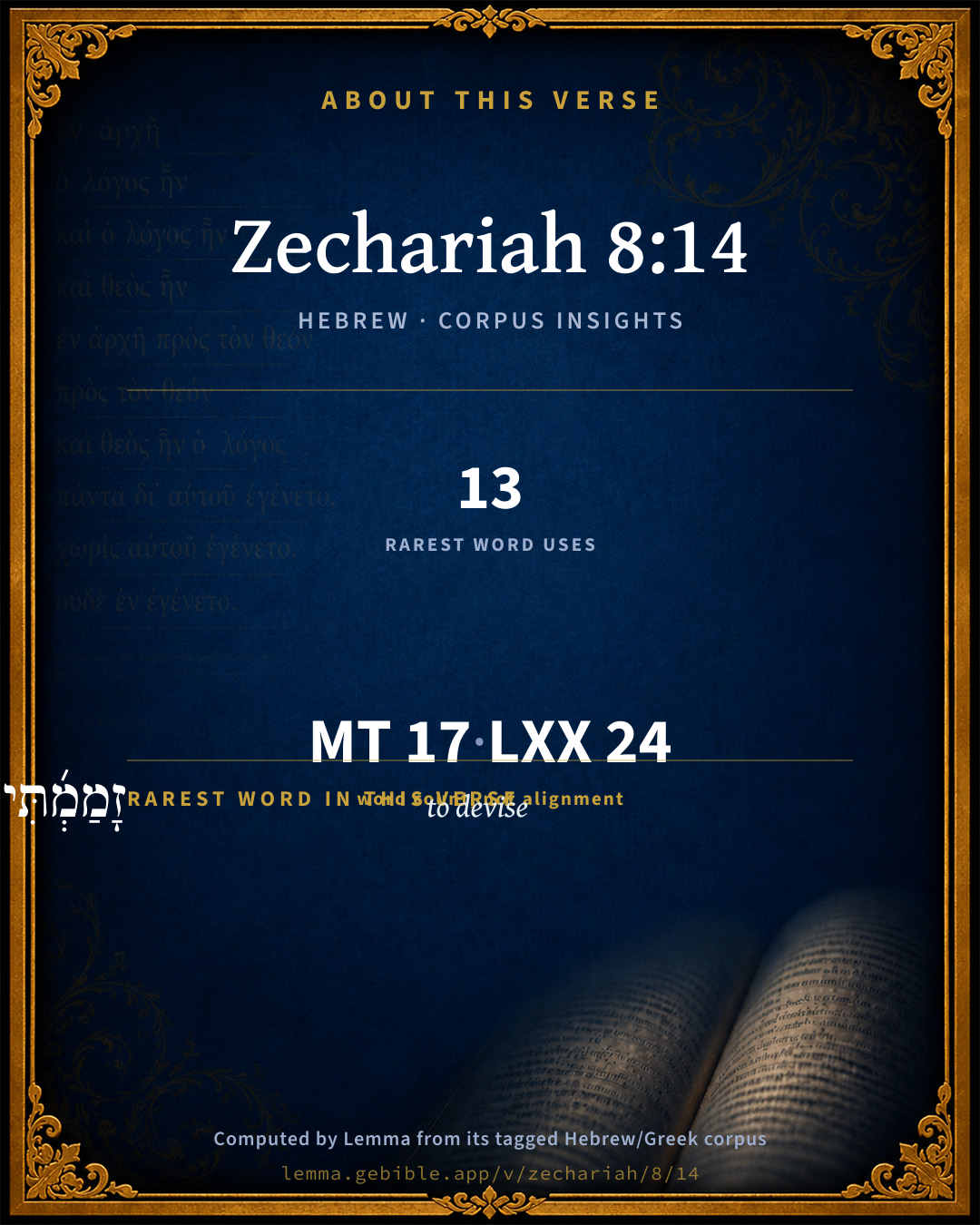
The rarest word here is זָמַמְ֜תִּי to devise H2161 — appearing just 13 times in the whole Hebrew Bible.

Shared distinctive vocabulary

זָמַמְ֜תִּי to devise H2161 occurs in 13 verses of the Hebrew Bible. Also found in:

Grammatical profile

  • 6 verbs
  • 5 nouns
  • 1 preposition
  • 1 conjunction
  • 1 adverb
  • 3 particles

Verb forms

  • אָמַר֮ Qal · Perfect
  • זָמַמְ֜תִּי Qal · Perfect
  • לְהָרַ֣ע Hiphil · Infinitive Construct
  • בְּהַקְצִ֤יף Hiphil · Infinitive Construct
  • אָמַ֖ר Qal · Perfect
  • נִחָֽמְתִּי Niphal · Perfect

Repetition

Words recur within this verse — often emphatic in Hebrew:

  • אָמַר֮ to say H559 ×2
  • יְהוָ֣ה LORD H3068 ×2
  • צְבָאוֹת֒ army H6635 ×2

Hebrew & Septuagint length

In English translation the verse runs 29 words from the Hebrew and 26 from the Septuagint (LXX English) — closely comparable.

A rough comparison of the two English renderings, which tokenize alike — not a word-level alignment.

Word counts can differ between the Hebrew and the Greek without any difference in meaning — e.g. the Hebrew direct-object marker אֵת has no separate Greek word, and Greek often adds the article ὁ.

In the original languages it is 17 Hebrew tokens and 24 Greek tokens — but the two are counted differently (Hebrew bundles its prefixes and suffixes into one token; the Greek is in lemma form), so that isn’t a like-for-like length.

Cross-references

9

Topical passages linked to Zechariah 8:14 in the Treasury of Scripture Knowledge — connected by theme and wording, ordered by reader-vote popularity; previews shown in the World English Bible.

  • Ezekiel 24:14 I, Yahweh, have spoken it: it shall happen, and I will do it: I will not go back, neither will I spare, neither will I repent; according to your ways, and according to your doings, shall they judge you, says the Lord Yahweh.
  • Jeremiah 31:28 It shall happen that, like as I have watched over them to pluck up and to break down and to overthrow and to destroy and to afflict, so will I watch over them to build and to plant, says Yahweh.
  • Jeremiah 4:28 For this shall the earth mourn, and the heavens above be black; because I have spoken it, I have purposed it, and I have not repented, neither will I turn back from it.
  • 2 Chronicles 36:16 but they mocked the messengers of God, and despised his words, and scoffed at his prophets, until the wrath of Yahweh arose against his people, until there was no remedy.
  • Psalms 33:11 The counsel of Yahweh stands fast forever, The thoughts of his heart to all generations.
  • Isaiah 14:24 Yahweh of Hosts has sworn, saying, Surely, as I have thought, so shall it happen; and as I have purposed, so shall it stand:
  • Jeremiah 15:1–6 Then said Yahweh to me, Though Moses and Samuel stood before me, yet my mind would not be toward this people: cast them out of my sight, and let them go forth.
  • Jeremiah 20:16 Let that man be as the cities which Yahweh overthrew, and didn't repent: and let him hear a cry in the morning, and shouting at noontime;
  • Zechariah 1:6 But my words and my decrees, which I commanded my servants the prophets, didn't they overtake your fathers? "Then they repented and said, 'Just as Yahweh of Hosts determined to do to us, according to our ways, and according to our practices, so he has dealt with us.'"

Cross-references courtesy of OpenBible.info (CC BY 4.0).

Hebrew and Greek witnesses Masoretic Hebrew ↔ Greek Septuagint

The same verse in the two great witnesses to the Old Testament, shown verse-for-verse.

These are two independent witnesses, not word-aligned to each other, and the Septuagint is shown in lemma (dictionary) form.

Hebrew Zechariah 8:14 Masoretic · Westminster Leningrad Codex

כִּ֣י כֹ֣ה אָמַר֮ יְהוָ֣ה צְבָאוֹת֒ כַּאֲשֶׁ֨ר זָמַמְ֜תִּי לְהָרַ֣ע לָכֶ֗ם בְּהַקְצִ֤יף אֲבֹֽתֵיכֶם֙ אֹתִ֔י אָמַ֖ר יְהוָ֣ה צְבָא֑וֹת וְלֹ֖א נִחָֽמְתִּי

For thus says Yahweh of hosts: "As I thought to do evil to you, when your fathers provoked me to wrath," says Yahweh of Hosts, "and I didn't repent;

World English Bible · Public Domain

Greek LXX Zechariah 8:14 Septuagint · lemma form

διότι ὅδε λέγω κύριος παντοκράτωρ ὅς τρόπος διανοέομαι ὁ κακόω σύ ἐν ὁ παραὀργίζω ἐγώ ὁ πατήρ σύ λέγω κύριος παντοκράτωρ καί οὐ μετανοέω

For thus says the Lord Almighty; As I took counsel to afflict you when your fathers provoked me, says the Lord Almighty, and I repented not:

LXX2012 (modern English Septuagint) · Public Domain

Hebrew: Westminster Leningrad Codex (CC BY 4.0). Greek: Septuagint (public domain); English from LXX2012 (modern English Septuagint) (Public Domain). How the Septuagint differs from the Hebrew →

Targum (Aramaic paraphrase)

1

The Targum is the ancient Jewish Aramaic paraphrase of the Hebrew Scriptures — an interpretive translation, not the Hebrew text itself. Onkelos (literal) and Pseudo-Jonathan (expansive) render the Torah, and Jonathan the Prophets. Coverage is partial: where no permissively-licensed English translation exists for a verse, only the Aramaic is shown. This is verse-level text, not a word-by-word alignment to the Hebrew.

  1. Targum Jonathan Prophets (Joshua–Malachi)
    אֲרֵי כִדְנַן אֲמַר יְיָ צְבָאוֹת כְּמָא דַדַחֲשִׁיבֵית לְאַבְאָשָׁא לְכוֹן כַּד אַרְגִיזוּ אֲבָהָתְכוֹן קָדָמַי אֲמַר יְיָ צְבָאוֹת וְלָא תָבֵית מִמֵימְרִי:

    (no public-domain English translation for this verse)

    Targum Jonathan — Aramaic: “Mikraot Gedolot” (public domain). English: “Sefaria Community Translation” (CC0 1.0 (public-domain dedication)); “London "Chaldee Paraphrase," 1871” (public domain). Text via Sefaria.

Commentary

Notes on Zechariah 8:14 from classic Christian and Jewish commentators (each source and its license shown beneath its notes). The classic Christian expositions comment on the surrounding passage and are grouped to its opening verse, so a note may address several verses; the Jewish commentaries on the Tanakh (Rashi and others) are per-verse, so they appear only where the commentator wrote on this verse.

Lemma curates 59 commentaries, every one of them public domain or Creative Commons licensed, each selected and text-cleaned for this edition rather than reprinted as found. About our sources →

The Cambridge Bible for Schools and Colleges

gen. ed. J. J. S. Perowne

14–17. “The ground upon which the promise rests is given in Zec_8:14-15, and it is closed in Zec_8:16-17, by the addition of the condition on which it is to be fulfilled.” Keil.

The Cambridge Bible for Schools and Colleges (gen. ed. J. J. S. Perowne; Cambridge University Press, 1878–1918) — public domain. Text from a community e-Sword module.

Trapp's Complete Commentary

John Trapp

Zec 8:14 For thus saith the LORD of hosts; As I thought to punish you, when your fathers provoked me to wrath, saith the LORD of hosts, and I repented not:

Ver. 14. As I thought to punish you] He had promised to make them of a curse a blessing, and here he shows them the cause of this change, namely, God’s better thoughts of them, and toward them, upon their return unto him. And because they might haply think that their fathers had hard measure, he tells them that their punishment was the fruit of their provocations. And whereas they might expect that God should repent and relent toward them, he shows here that he had repented so long, that he was even weary with repenting, Jer 15:6; and that he, therefore, was implacable because he found them incurable. Hence he resolved, as Eze 24:13, and would not be altered, Crudelem medicum intemperans aeger facit A headstrong patient makes a cruel doctor. (Mimus). Lo, thus far these Jews had found and felt God’s fingers; and that in his menaces he had been as good as his word.

John Trapp, A Commentary or Exposition upon All the Books of the Old and New Testament (1647–1656) — public domain. Text from a community e-Sword module.

Joseph Benson's Commentary

Zec 8:14-15. As I thought to punish you — As my wisdom saw it to be fit and necessary to punish your nation; and I accordingly did punish it, when your fathers transgressed my laws in such a manner that my justice and wisdom could no longer suffer it; So again, &c. — So now my wisdom sees it to be fit, since you have been reformed by your sufferings, that I should be favourable to you, bestow my blessings upon you, and protect you from your enemies.

Joseph Benson's Commentary on the Old and New Testaments (1811–1818) — public domain. Text from a community e-Sword module.

Keil & Delitzsch

C. F. Keil & F. Delitzsch

The ground upon which this promise rests is given in Zac 8:14 and Zac 8:15, and it is closed in Zac 8:16 and Zac 8:17 by the addition of the condition upon which it is to be fulfilled. Zac 8:14. "For thus saith Jehovah of hosts: As I thought to do evil to you, when your fathers were angry with me, saith Jehovah of hosts, and repented not; Zac 8:15. So have I purposed again in these days to do good to Jerusalem and to the house of Judah. Fear ye not. Zac 8:16. These are the words that ye are to do: speak truth every one to his neighbour; truth and judgment of peace judge ye in your gates. Zac 8:17. And let not one devise the evil of his neighbour, and love not the oath of deceit: for all this, I hate it, is the saying of Jehovah." As the time of punishment by exile came upon Israel through the decree of God, so is it now a decree of the Lord to show good to Judah. In שׁבתּי זממתּי the שׁבתּי takes the place of the adverbial idea "again." The people have therefore no need to fear, if they are only diligent in practising truth, righteousness, and love to their neighbour. God required the same of the fathers (Zac 7:9-10). Mishpat shâlōm is such an administration of justice as tends to promote peace and establish concord between those who are at strife. "In your gates," where courts of justice were held (cf. Deu 21:19; Deu 22:15, etc.). The את before כּל־אלּה in Zac 8:17 may be accounted for from a kind of attraction, inasmuch as by the insertion of אשׁר the object "all this" is separated from the verb, to bring it out with emphasis: "As for all this, it is what I hate." Compare the similar use of 'ēth in Hag 2:5, and Ewald, 277, d.

Keil & Delitzsch — Biblical Commentary on the Old Testament (1861–1891) — public domain (CC PDM 1.0). Text via the HelloAO Bible API. (Old Testament only.)

Tyndale Open Study Notes

Tyndale Open Resources

8:14-15 determined: The repetition of this word emphasizes God’s sovereignty in judging Israel’s sin and then in blessing them.

Tyndale Open Study Notes — © Tyndale Open Resources, licensed CC BY-SA 4.0. Text via the HelloAO Bible API.

Geneva Bible (1599)

Geneva Bible translators

Read Ezek. 18:20.

Geneva Bible (1599) marginal notes — public domain. Text via Bolls.life.

Jamieson, Fausset & Brown

Robert Jamieson, A. R. Fausset & David Brown

I thought--I determined.

you--that is, your fathers, with whom ye are one; the Jewish Church of all ages being regarded as an organic whole (compare Hag 2:5; Mat 23:31-32).

repented not--I changed not My purpose, because they changed not their mind (Ch2 36:16). With the froward God shows Himself froward (Psa 18:26). If the threatened punishment has been so unchangeably inflicted, much more will God surely give the promised blessing, which is so much more consonant to His nature (Jer 31:28).

Jamieson, Fausset & Brown — Commentary Critical and Explanatory on the Whole Bible (1871) — public domain (CC PDM 1.0). Text via the HelloAO Bible API.

John Calvin's Commentaries

The Prophet confirms the truth in the preceding verse, when he said that there would be a wholly different lot to the Jews, as they would in every way be blessed. He shows the cause of the change; for God would begin to favor them, who had been before displeased with them. We indeed know that the Holy Spirit everywhere calls men before God’s tribunal, that they may know that no adversity happens to them, except through their sins. So also in this place Zechariah reminds us, that God had been angry with the Jews, because they had provoked his wrath. But now a promise is added, that God had turned; not that he had changed his mind, but he meant to show that he was pacified. We indeed know that we are to judge of God’s love or hatred to us by outward things; for when God treats us severely, manifest tokens of his wrath appear; but when he deals kindly with us, then the fruit of reconciliation seems evident. According to this view does he now say, that God was of another mind than formerly towards the Jews; for he designed to show them kindness, having before sharply and severely chastised them. But we must more particularly consider each part.

He says, that as God had previously resolved to punish the Jews, he was now inclined to show mercy, and that they would find him as it were changed and different from what he had been. These verses, as I have said, are explanatory; for the Prophet had briefly promised that the Jews would be a remarkable example of being a blessed people, but he now shows why God had previously inflicted on them so many evils and calamities, even because their fathers had provoked his wrath. And when he says that he had visited them on account of the crimes or sins of their fathers, we must understand this of the body of the people. Superfluous then is the question which some interpreters moot, Whether God punished the children for the sins of their fathers, when yet he declares in another place, that the soul that sins shall die: for in this place the Prophet does not distinguish the fathers from the children, but intimates that God had not been propitious to the Jews, because they had before greatly provoked his wrath. There is yet no doubt, but that every one justly suffered the punishment of his iniquity. The import of the whole is, that the Jews gained nothing by evasion, for God had not without reason visited them, but had rendered a just reward for their sins. This is one thing.

What he adds, that God repented not for being thus angry, means the same as though he had said, that the Jews through their perverseness had only rendered God’s rigour inflexible. Zechariah then reminds us, that when men cease not to add evils to evils, and obstinately rush on as though they would make war with God, he then becomes as it were obstinate too, and according to what is said in the eighteenth Psalm, “deals perversely with the perverse.” The reason then why God declares that he had been implacable to his people, is, because the wickedness of those whom he had spared and long tolerated was become unhealable; for when he saw that they were wholly perverse, he armed himself for vengeance.

And hence we may gather a general truth, — that God cannot be intreated by us, except when we begin to repent; not that our repentance anticipates God’s mercy, for the question here is not, what man of himself and of his own inclination can do; as the object of Zechariah is only to teach us, that when God designs to forgive us, he changes our hearts and turns us to obedience by his Spirit; for when he leaves us in our hardness, we must necessarily be ever afflicted by his hand until we at last perish.

We must at the same time notice what I have also referred to, — that God here closes the mouths of the Jews, that they might not murmur against his severity, as though he had dealt cruelly with them. He then shows that these punishments were just which the Jews had endured; for it had not been for one day only, but for a continued succession of time, that the fathers had excited his wrath. The reason why he speaks of the fathers rather than of themselves is, because they had for a long series of years hardened themselves in their wickedness, and corruption had become in them as it were hereditary. He now says that he had turned; not that he was of another mind, as we have already said, but this is to be understood of what the people experienced; for God seemed to be in a manner different, when he became kind to them and showed them favor, having before manifested many tokens of vengeance.

John Calvin's Commentaries (1540-1563) — public domain. Text from the Calvin Translation Society English edition (1840s-50s) via the Christian Classics Ethereal Library (ccel.org). Calvin's coverage is partial (roughly two-thirds of the Bible); uncommented books and verses are honest gaps, never fabricated. The 19th-century editor's footnotes and remarks are omitted so the notes are faithfully Calvin's own voice.

Ellicott's Commentary for English Readers

(14-17) As the Captivity had been brought about by God’s decree, so, too, the Restoration. The people, therefore, need not fear, if only they do that which is righteous in His sight.

A Bible Commentary for English Readers, edited by Charles John Ellicott (1878–1897) — public domain. Text from a community e-Sword module.

John Gill's Exposition

So again,.... Or "so I am returned" (n), as in Zac 8:3,

have I thought in these days to do well unto Jerusalem, and to the house of Judah; by bestowing the above mentioned blessings on them; and as Jehovah has thought, so it comes to pass, and as he has purposed, so it stands; whatever he determines shall be, as for evil, so for good, Isa 14:24,

fear ye not; as in Zac 8:13.

(n) "sic conversus sum", Pagninus, Montanus, Calvin; "ita conversus", Junius & Tremellius, Piscator; "reversus sum", Burkius.

John Gill's Exposition of the Whole Bible (1746–1763) — public domain (CC PDM 1.0). Text via the HelloAO Bible API.

Albert Barnes' Notes on the Bible

As I thought to punish you - (Literally, to do evil to you) “and repented not.” In like way God says in Jeremiah, “I have purposed and will not repent.” Jer 4:28.

Albert Barnes' Notes on the Bible (1834–1885) — public domain. Text from a community e-Sword/MySword module.

Matthew Poole's English Annotations

As I thought, determined first, then declared my resolution, in my threats and many warnings given,

to punish you, Jews, the body of that nation; you, one with your fathers.

When your fathers provoked; highly, obstinately, and till there was no remedy, my wrath being kindled and continually increased by increase of your fathers’ sins and yours.

I repented not; I did not fail to do as I said I would, I neither changed my mind, for I am not a man, nor changed the course of my providence, but executed my threats.

Matthew Poole's English Annotations on the Holy Bible (1683–1685) — public domain. Text from a community e-Sword/MySword module.

The Pulpit Commentary

The ground of the promso is the will of God, who cannot deceive. As I thought to punish you; as I purposed to do evil to you; i.e. to the nation whose continuity is thus intimated. (comp. Hag_2:5; and for a similar contrast of punishment and blessing, see Jer_31:25) I repented not. God carried out the dread decree to the full. (Zec_1:6 2Ch_36:16) (For the phrase applied to God, comp. Num_23:19 Jer_4:28 Jon_3:10, where see note) Vulgate, "I pitied not."

The Pulpit Commentary (1880–1919), ed. H.D.M. Spence-Jones & Joseph S. Exell — public domain. Text from a community e-Sword module.

John Wesley's Explanatory Notes

I repented not - I did not fail to do it.

John Wesley, Explanatory Notes Upon the Whole Bible (1754–1765) — public domain. Text via the GEBible commentary corpus.

Scofield Reference Notes

C. I. Scofield

repented

Repentance (O.T.), Summary: In the O.T., repentance is the English word used to translate the Heb. nacham, to be "eased" or "comforted." It is used of both God and man. Notwithstanding the literal meaning of nacham, it is evident, from a study of all the passages, that the sacred writers use it in the sense of metanoia in the N.T.--a change of mind. Mat 3:2 (See Scofield "Act 17:30"). As in the N.T., such change of mind is often accompanied by contrition and self-judgment. When applied to God the word is used phenomenally according to O.T. custom. God seems to change His mind. The phenomena are such as, in the case of man, would indicate a change of mind.

The Scofield Reference Bible (1917 edition), notes by C. I. Scofield — public domain. Text from a community e-Sword module.

Rashi

Rabbi Shlomo Yitzchaki (Rashi)

and I did not repent of what I had planned to bring upon you, [or] retract it; but I brought it. Neither will I repent of the good that I have planned for you.

Rashi on the Tanakh — English translations: “The Judaica Press complete Tanach with Rashi, translated by A. J. Rosenberg” (CC BY 4.0); “Pentateuch with Rashi's commentary by M. Rosenbaum and A.M. Silbermann, 1929-1934” (public domain); “The Metsudah Tanach series, Lakewood, N.J” (CC BY 4.0); and “The Book of Joshua, Metsudah Publications, 1997” (CC BY 4.0). Text via Sefaria.

Lesson kit

Teaching starters — assembled from the data on this page, not authored interpretation. Every prompt links to the verse data it draws on. Edit before teaching.

Zechariah, in the Prophets, opens this verse with 17 words (13 distinct Hebrew lemmas). Its most distinctive word is zâmam (“to devise”). A historical commentator’s framing appears above. Read the whole chapter for the surrounding context.

Discussion questions

  1. How does “to devise” (zâmam) shape what this verse is saying?
  2. Genesis 11:6 shares the word «to devise» with this verse. How do the two illuminate each other?
  3. “to say” occurs 2× in this one verse. What is the effect of the repetition?
  4. The translations on this page render this verse differently — a whole-verse word diff, not a word-by-word alignment. What might account for the different wordings?
  5. The verb «אָמַר֮» is Qal Perfect. How does its form color the action?
  6. Reading how The Cambridge Bible for Schools and Colleges and Trapp's Complete Commentary read this verse, where do the two commentators agree and where do they part?

Things to notice

Reading settings

Reading text

Shown beneath each verse's original-language words.

Old Testament
Old Testament edition

Read the OT as the Masoretic Hebrew (MT) or the Greek Septuagint (LXX).

English shown for the Greek Septuagint (in the Hebrew ↔ Greek comparison).

Comparing translations? Open the Compare panel on any verse page to stack up to four side by side.