
Jeremiah 16:7

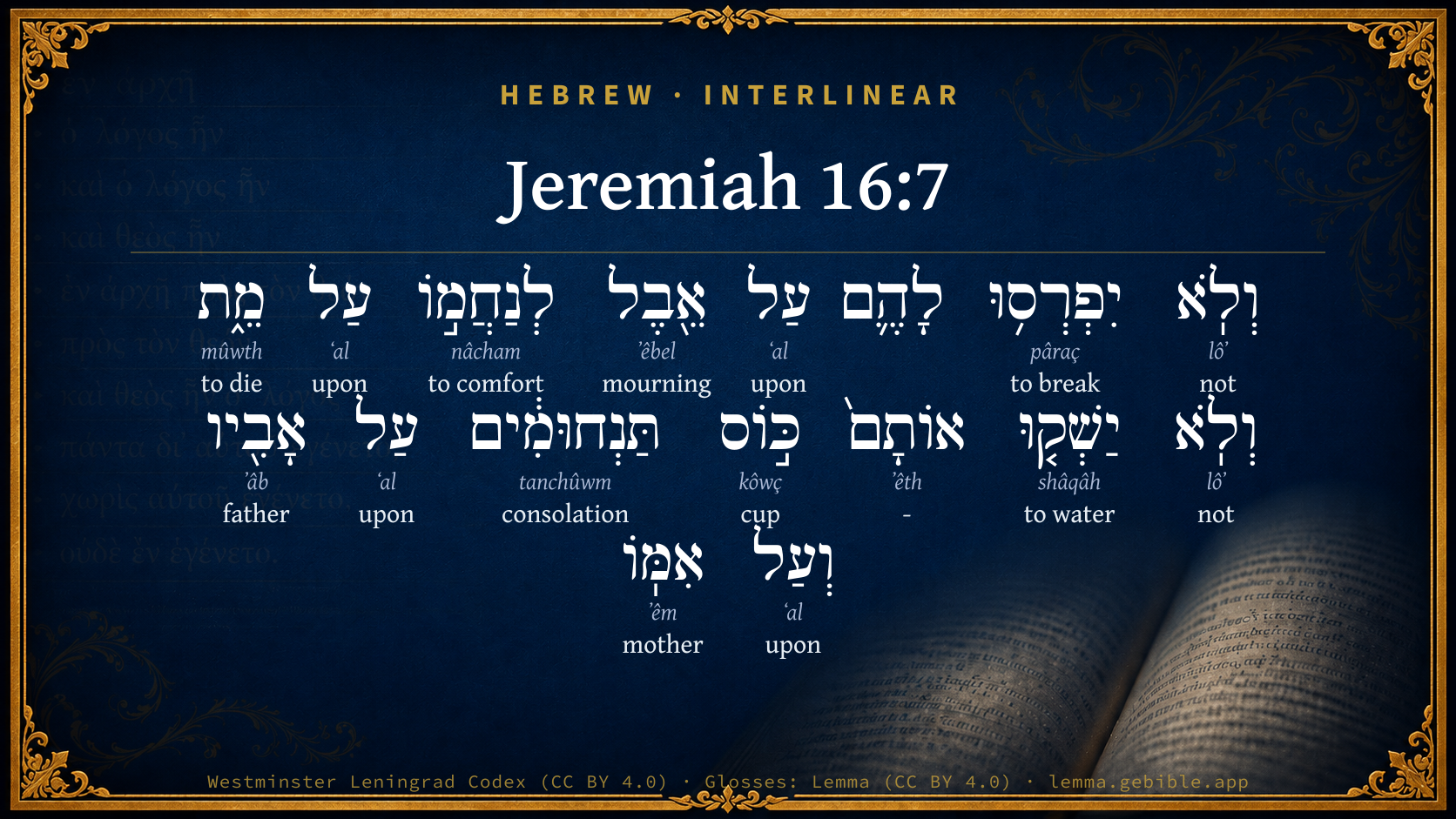
Hebrew (Westminster Leningrad Codex) Jeremiah 16:7 appears in the Hebrew Old Testament. The text above is from the Westminster Leningrad Codex. Each word links to its Strong’s number, a concise gloss, and parsing drawn from the Open Scriptures Hebrew Bible morphology. Click any word for its full Brown-Driver-Briggs (BDB) entry.
Download image
Cite this verse

Jeremiah 16:7 (World English Bible). Public Domain. Lemma interlinear Bible study tool, https://lemma.gebible.app/v/jeremiah/16/7.

Show BibTeX & RIS
BibTeX
RIS
English Translation
neither shall men break [bread] for them in mourning, to comfort them for the dead; neither shall men give them the cup of consolation to drink for their father or for their mother.
World English Bible · Public Domain
Download a study sheet

One document with this verse’s original text, its word-by-word gloss line, the meaning frame, cross-references with their text, attributed commentary, and full source and license credits — printable, and it pastes into notes with its structure intact.

This verse Autodidact and up

Study sheet (.html) Plain text (.txt)

A passage Seminary Student

Up to 50 verses in one chapter. A passage sheet keeps up to 6 commentary sources and 12 cross-references per verse, in the order this page ranks them, and says so on the sheet whenever that leaves anything out. Ask for a single verse and you get the Autodidact verse sheet above.

Everything on this page stays free to read, with no account — the sheet is a download of what is already on screen, not access to it.

Want to remove ads? Support Godless Engineer
Compare translations 3

The same verse in 3 English versions, stacked beneath the original-language interlinear above. Click any original word for its lexicon entry.

Each is an independent rendering of the whole verse — the interlinear is not word-aligned to these translations.

Highlighted words mark where these versions differ — a whole-verse word diff, not a word-by-word alignment.

  • World English Bible Public Domain
    neither shall men break [bread] for them in mourning, to comfort them for the dead; neither shall men give them the cup of consolation to drink for their father or for their mother.
  • King James Version Public Domain
    Neither shall men tear themselves for them in mourning, to comfort them for the dead; neither shall men give them the cup of consolation to drink for their father or for their mother.
  • unfoldingWord Literal Text CC BY-SA 4.0
    And not they shall break bread for them in mourning to comfort him for the one who is dead, and they shall not give them a cup of consolation to drink for his father or for his mother.

unfoldingWord Literal Text — © unfoldingWord, licensed CC BY-SA 4.0. Word-aligned USFM3 via Door43 (git.door43.org/unfoldingWord/en_ult).

Versions to compare (up to 4)

3 of 4 selected

Show all 18 translations

Every available English version of this verse, each an independent rendering of the whole verse.

  • World English Bible Public Domain
    neither shall men break [bread] for them in mourning, to comfort them for the dead; neither shall men give them the cup of consolation to drink for their father or for their mother.
  • Berean Standard Bible Public Domain
    No food will be offered to comfort those who mourn the dead; not even a cup of consolation will be given for the loss of a father or mother.
  • Majority Standard Bible Public Domain
    No food will be offered to comfort those who mourn the dead; not even a cup of consolation will be given for the loss of a father or mother.
  • King James Version Public Domain
    Neither shall men tear themselves for them in mourning, to comfort them for the dead; neither shall men give them the cup of consolation to drink for their father or for their mother.
  • American Standard Version (1901) Public Domain
    neither shall men break `bread' for them in mourning, to comfort them for the dead; neither shall men give them the cup of consolation to drink for their father or for their mother.
  • Revised Version (1885) Public Domain
    neither shall men break bread for them in mourning, to comfort them for the dead; neither shall men give them the cup of consolation to drink for their father or for their mother.
  • Geneva Bible (1599) Public Domain
    They shall not stretch out the hands for the in the mourning to comfort them for the dead, neither shall they giue them the cup of consolation to drinke for their father or for their mother.
  • Douay-Rheims (1899) Public Domain
    And they shall not break bread among them to him that mourneth, to comfort him for the dead: neither shall they give them to drink of the cup, to comfort them for their father and mother.
  • Young's Literal Translation Public Domain
    Nor do they deal out to them for mourning, To comfort him concerning the dead, Nor cause them to drink a cup of consolations For his father and for his mother.
  • Literal Standard Version CC BY-SA 4.0
    Nor do they deal out to them for mourning, || To comfort him concerning the dead, || Nor cause them to drink a cup of consolations || For his father and for his mother.
  • Unlocked Literal Bible CC BY-SA 4.0
    No one must share any food in mourning to comfort them because of the deaths, and none must give a comforting cup to his father or his mother in order to comfort them.
  • unfoldingWord Literal Text CC BY-SA 4.0
    And not they shall break bread for them in mourning to comfort him for the one who is dead, and they shall not give them a cup of consolation to drink for his father or for his mother.
  • Darby Bible Public Domain
    Nor shall they break [bread] for them in mourning, to comfort them for the dead; neither shall they give them the cup of consolations to drink for their father or for their mother.
  • World Messianic Bible Public Domain
    Men won’t break bread for them in mourning, to comfort them for the dead. Men won’t give them the cup of consolation to drink for their father or for their mother.
  • Webster's Bible Public Domain
    Neither shall men tear themselves for them in mourning, to comfort them for the dead; neither shall men give them the cup of consolation to drink for their father or for their mother.
  • Free Bible Version CC BY-SA 4.0
    No funeral receptions will be held to comfort those who mourn—not even a comforting drink is to be offered at the loss of a father or mother.
  • Bible in Basic English Public Domain
    No one will make a feast for them in sorrow, to give them comfort for the dead, or put to their lips the cup of comfort on account of their father or their mother.
  • JPS Tanakh (1917) Public Domain
    neither shall men break bread for them in mourning, to comfort them for the dead; neither shall men give them the cup of consolation to drink for their father or for their mother.

Literal Standard Version (2020), Covenant Press — licensed CC BY-SA 4.0. Text via the HelloAO Bible API (eBible.org). Unlocked Literal Bible (unfoldingWord) — licensed CC BY-SA 4.0. Text via the HelloAO Bible API (eBible.org). unfoldingWord Literal Text — © unfoldingWord, licensed CC BY-SA 4.0. Word-aligned USFM3 via Door43 (git.door43.org/unfoldingWord/en_ult). Free Bible Version, Dr. Jonathan Gallagher — licensed CC BY-SA 4.0. Text via the HelloAO Bible API (eBible.org).

Word by word

More ways to search: Search by grammar → Find every occurrence → Compare this word →

Practice this passage: Drill this verse → Learn its vocabulary →

תַּנְחוּמִ֔ים
tanchûwm
H8575
“consolations”
Noun, Common, Both, Plural, Absolute
Part of Speech
Noun
Type
Common
Gender
Both
Number
Plural
State
Absolute
Full BDB Definition

Origin: from H5162

TWOT: 1344d

consolation(s)
  1. וְלֹֽא lôʼ H3808 “and · not” Conjunction + Particle, Negative
  2. יִפְרְס֥וּ pâraç H6536 “to break” Verb, Qal, Imperfect, 3rd Person, Masculine, Plural
  3. עַל ʻal H5921 “upon” Preposition
  4. אֵ֖בֶל ʼêbel H60 “mourning” Noun, Common, Masculine, Singular, Absolute
  5. לְנַחֲמ֣וֹ nâcham H5162 “to comfort · him” Preposition + Verb, Piel, Infinitive Construct + Suffix, Personal, 3rd Person, Masculine, Singular
  6. עַל ʻal H5921 “upon” Preposition
  7. מֵ֑ת mûwth H4191 “dying” Verb, Qal, Participle Active, Masculine, Singular, Absolute
  8. וְלֹֽא lôʼ H3808 “and · not” Conjunction + Particle, Negative
  9. יַשְׁק֤וּ shâqâh H8248 “to water” Verb, Hiphil, Imperfect, 3rd Person, Masculine, Plural
  10. אוֹתָם֙ ʼêth H853 “- · them” Particle, Direct Object + Suffix, Personal, 3rd Person, Masculine, Plural
  11. כּ֣וֹס kôwç H3563 “cup of” Noun, Common, Feminine, Singular, Construct
  12. עַל ʻal H5921 “upon” Preposition
  13. אָבִ֖יו ʼâb H1 “father · his” Noun, Common, Masculine, Singular, Construct + Suffix, Personal, 3rd Person, Masculine, Singular
  14. וְעַל ʻal H5921 “and · upon” Conjunction + Preposition
  15. אִמּֽוֹ ʼêm H517 “mother · his” Noun, Common, Feminine, Singular, Construct + Suffix, Personal, 3rd Person, Masculine, Singular

About this verse

These counts appear in no published source. They are computed here, from the morphology-tagged text and Lemma’s own curated glosses. What Lemma adds →

17
words
12
distinct lemmas
Prophets
section

Notable vocabulary

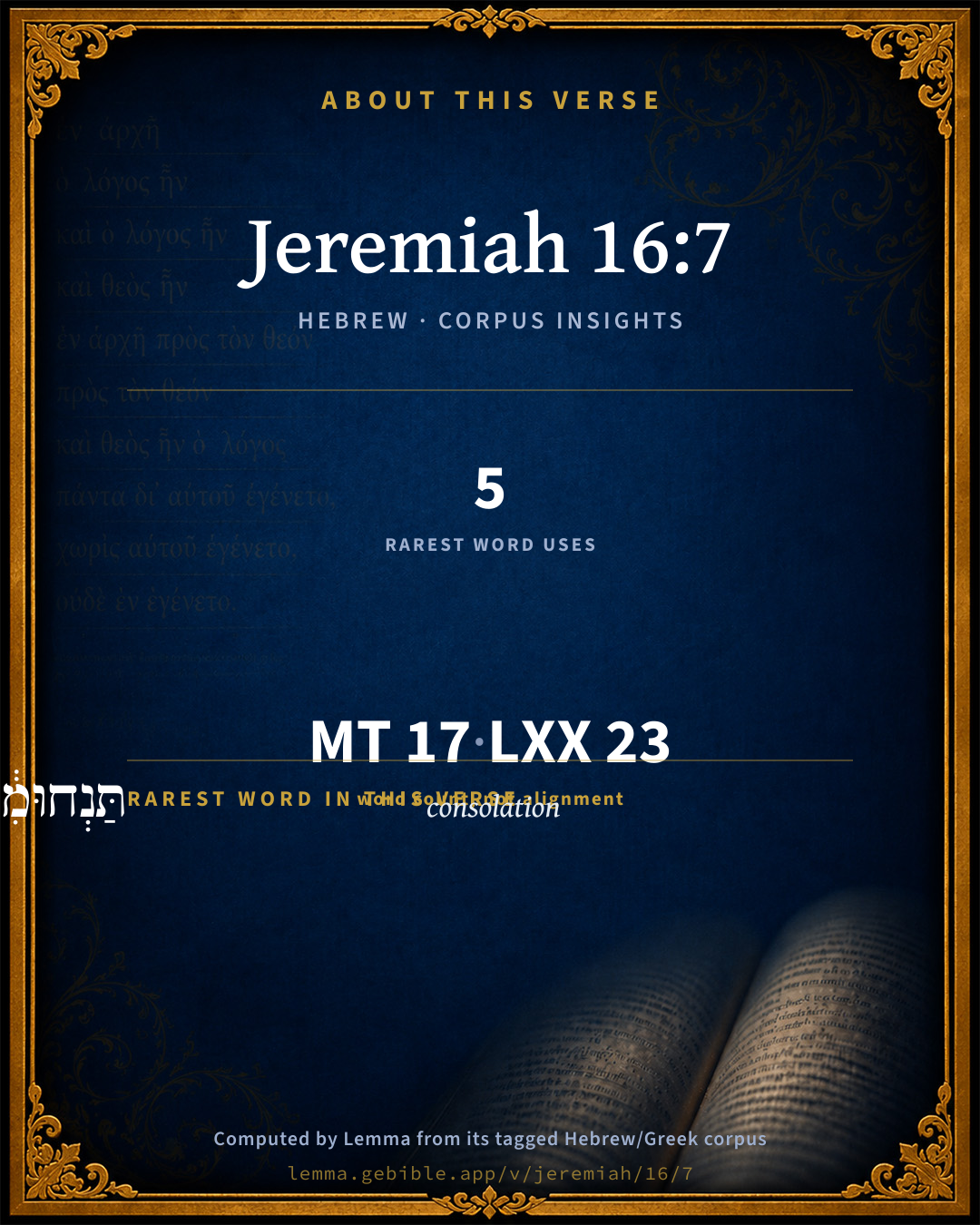
The rarest word here is תַּנְחוּמִ֔ים consolation H8575 — appearing just 5 times in the whole Hebrew Bible.

Shared distinctive vocabulary

תַּנְחוּמִ֔ים consolation H8575 occurs in 5 verses of the Hebrew Bible. Also found in:

Grammatical profile

  • 4 verbs
  • 5 nouns
  • 5 prepositions
  • 3 particles

Verb forms

  • יִפְרְס֥וּ Qal · Imperfect
  • לְנַחֲמ֣וֹ Piel · Infinitive Construct
  • מֵ֑ת Qal · Participle Active
  • יַשְׁק֤וּ Hiphil · Imperfect

Repetition

Words recur within this verse — often emphatic in Hebrew:

  • עַל upon H5921 ×4
  • וְלֹֽא not H3808 ×2

Hebrew & Septuagint length

In the original languages it is 17 Hebrew tokens and 23 Greek tokens — but the two are counted differently (Hebrew bundles its prefixes and suffixes into one token; the Greek is in lemma form), so that isn’t a like-for-like length.

Cross-references

5

Topical passages linked to Jeremiah 16:7 in the Treasury of Scripture Knowledge — connected by theme and wording, ordered by reader-vote popularity; previews shown in the World English Bible.

  • Ezekiel 24:17 Sigh, but not aloud, make no mourning for the dead; bind your headdress on you, and put your shoes on your feet, and don't cover your lips, and don't eat men's bread.
  • Hosea 9:4 They won't pour out wine offerings to Yahweh, Neither will they be pleasing to him. Their sacrifices will be to them like the bread of mourners; All who eat of it will be polluted; For their bread will be for their appetite. It will not come into the house of Yahweh.
  • Deuteronomy 26:14 I have not eaten of it in my mourning, neither have I put away of it, being unclean, nor given of it for the dead: I have listened to the voice of Yahweh my God; I have done according to all that you have commanded me.
  • Job 42:11 Then came there to him all his brothers, and all his sisters, and all those who had been of his acquaintance before, and ate bread with him in his house. They comforted him, and consoled him concerning all the evil that Yahweh had brought on him. Everyone also gave him a piece of money, and everyone a ring of gold.
  • Proverbs 31:6–7 Give strong drink to him who is ready to perish; And wine to the bitter in soul:

Cross-references courtesy of OpenBible.info (CC BY 4.0).

Hebrew and Greek witnesses Masoretic Hebrew ↔ Greek Septuagint

The same verse in the two great witnesses to the Old Testament, shown verse-for-verse.

These are two independent witnesses, not word-aligned to each other, and the Septuagint is shown in lemma (dictionary) form.

Hebrew Jeremiah 16:7 Masoretic · Westminster Leningrad Codex

וְלֹֽא יִפְרְס֥וּ לָהֶ֛ם עַל אֵ֖בֶל לְנַחֲמ֣וֹ עַל מֵ֑ת וְלֹֽא יַשְׁק֤וּ אוֹתָם֙ כּ֣וֹס תַּנְחוּמִ֔ים עַל אָבִ֖יו וְעַל אִמּֽוֹ

neither shall men break [bread] for them in mourning, to comfort them for the dead; neither shall men give them the cup of consolation to drink for their father or for their mother.

World English Bible · Public Domain

Greek LXX Structure differs

In the Septuagint, Jeremiah is about an eighth shorter than the Hebrew and arranges its material differently — the Oracles Against the Nations (Hebrew chapters 46–51) appear in the middle of the Greek book, after 25:13. Because the chapter and verse boundaries do not line up, a verse-for-verse comparison with the Hebrew is not shown.

A verse-for-verse comparison isn’t shown here because the chapters and verses don’t line up. Switch to the LXX edition with the MT / LXX toggle above to read the Greek directly.

On this verse, Joseph Benson's Commentary discusses the Septuagint’s reading. Read the note in Commentary ↓

Hebrew: Westminster Leningrad Codex (CC BY 4.0). Greek: Septuagint (public domain); English from a public-domain English Septuagint. How the Septuagint differs from the Hebrew →

Targum (Aramaic paraphrase)

1

The Targum is the ancient Jewish Aramaic paraphrase of the Hebrew Scriptures — an interpretive translation, not the Hebrew text itself. Onkelos (literal) and Pseudo-Jonathan (expansive) render the Torah, and Jonathan the Prophets. Coverage is partial: where no permissively-licensed English translation exists for a verse, only the Aramaic is shown. This is verse-level text, not a word-by-word alignment to the Hebrew.

  1. Targum Jonathan Prophets (Joshua–Malachi)
    וְלָא יִפְרְסוּן לְהוֹן עַל אֶבְלָא לְנֶחָמוּתְהוֹן עַל מִיתָא וְלָא יַשְׁקוּן יַתְהוֹן כָּס תַּנְחוּמִין גְבַר עַל אֲבוּהִי וְעַל אִמֵיהּ:

    (no public-domain English translation for this verse)

    Targum Jonathan — Aramaic: “Mikraot Gedolot” (public domain). English: “Sefaria Community Translation” (CC0 1.0 (public-domain dedication)); “London "Chaldee Paraphrase," 1871” (public domain). Text via Sefaria.

Commentary

Notes on Jeremiah 16:7 from classic Christian and Jewish commentators (each source and its license shown beneath its notes). The classic Christian expositions comment on the surrounding passage and are grouped to its opening verse, so a note may address several verses; the Jewish commentaries on the Tanakh (Rashi and others) are per-verse, so they appear only where the commentator wrote on this verse.

Lemma curates 59 commentaries, every one of them public domain or Creative Commons licensed, each selected and text-cleaned for this edition rather than reprinted as found. About our sources →

Trapp's Complete Commentary

John Trapp

Jer 16:7 Neither shall [men] tear [themselves] for them in mourning, to comfort them for the dead; neither shall [men] give them the cup of consolation to drink for their father or for their mother.

Ver. 7. Neither shall men tear themselves for them.] Or, Neither shall they deal them bread in mourning to comfort any for the dead. Compare Eze 24:17. Of feasting at funerals mention is made by Herodotus, Cicero, Lucian, Pliny, Clement, and Chrysostom. See Jer 16:5.

Neither shall men give them the cup of consolation,] i.e., The consolatory cup, usually given at funerals to the disconsolate friends of the deceased. See on Pro 31:6-7.

John Trapp, A Commentary or Exposition upon All the Books of the Old and New Testament (1647–1656) — public domain. Text from a community e-Sword module.

Joseph Benson's Commentary

Jer 16:7. Neither shall men tear themselves for them — According to this translation the phrase alludes to another expression of immoderate grief, which consisted in tearing their flesh with their nails. But according to the marginal reading, the sense is, Neither shall men break bread for them; alluding to the mourning-feast, mentioned Jer 16:5. So the LXX., ου μη κλασθη αρτος εν πενθει αυτων εις παρακλησιν επι τεθνηκοτι, “bread shall by no means be broken in their mourning, for consolation concerning the dead.” So also the Vulgate. As to the custom alluded to, Jerome informs us, in his commentary on this place, that “it was usual to carry provisions to mourners, and to make an entertainment, which sort of feasts the Greeks call περιδειπνα, and the Latins parentalia.” The origin of which custom undoubtedly was, that the friends of the mourner, who came to comfort him, (which they often did in great numbers, as we learn from Joh 11:19,) easily concluding, that a person so far swallowed up of grief, as even to forget his own bread could hardly attend to the entertainment of so many guests, each sent in his proportion of meat and drink, in hopes to prevail upon the mourner, by their example and persuasions, to partake of such refreshment as might tend to recruit both his bodily strength and his spirits. To this custom Tobit is thought to refer when, among other exhortations to his son, he directs him to pour out his bread on the burial of the just. See Blaney. It must be observed, that among the Hebrews all things eaten were called bread. Neither shall men give them the cup of consolation for their father, &c. — They were also wont, on these occasions, to send wine, or some other cheering liquor to drink, that they might forget their sorrows. This is called here the cup of consolation. Sir John Chardin, in one of his MSS. tells us, that “the oriental Christians still make banquets of the same kind, by a custom derived from the Jews; and that the provisions spoken of in this verse were such as were wont to be sent to the house of the deceased, where healths were also drunk to the survivers of the family.” God here tells the Jews by his prophet, that the time should come when so many should die, and so fast, and the rest should be so much upon the brink of the grave, that they should have neither leisure nor heart for using these ceremonies.

Joseph Benson's Commentary on the Old and New Testaments (1811–1818) — public domain. Text from a community e-Sword module.

Geneva Bible (1599)

Geneva Bible translators

For in these great extremities all consolation and comfort shall be in vain.

Geneva Bible (1599) marginal notes — public domain. Text via Bolls.life.

Jamieson, Fausset & Brown

Robert Jamieson, A. R. Fausset & David Brown

tear themselves--rather, "break bread," namely, that eaten at the funeral-feast (Deu 26:14; Job 42:11; Eze 24:17; Hos 9:4). "Bread" is to be supplied, as in Lam 4:4; compare "take" (food) (Gen 42:33).

give . . . cup of consolation . . . for . . . father--It was the Oriental custom for friends to send viands and wine (the "cup of consolation") to console relatives in mourning-feasts, for example, to children upon the death of a "father" or "mother."

Jamieson, Fausset & Brown — Commentary Critical and Explanatory on the Whole Bible (1871) — public domain (CC PDM 1.0). Text via the HelloAO Bible API.

John Calvin's Commentaries

With regard to the seventh verse, we may learn from it what I have already referred to, — that the Jews made funeral feasts, that children and widows might receive some relief to their sorrow; for the Prophet calls it the cup of consolations, when friends kindly attended; they had also some ridiculous gesticulations; for no doubt laughter was often excited by mourners among the Jews. But we see that men vied with one another in lamenting for the dead; for it was deemed a shame not to shew grief at the death of their friends. When tears did not flow, when the nearest relations did not howl for the dead, they thought them inhuman; hence it was, that there was much dissimulation in their mourning; and it was foolishly regarded an alleviation to extend the cup of consolation. But as I have said before, the Prophet here did not point out what was right, but borrowed his words from what was commonly practiced. It follows —

John Calvin's Commentaries (1540-1563) — public domain. Text from the Calvin Translation Society English edition (1840s-50s) via the Christian Classics Ethereal Library (ccel.org). Calvin's coverage is partial (roughly two-thirds of the Bible); uncommented books and verses are honest gaps, never fabricated. The 19th-century editor's footnotes and remarks are omitted so the notes are faithfully Calvin's own voice.

Ellicott's Commentary for English Readers

(7) Neither shall men tear themselves.—The marginal reading, “Neither shall men break bread for them,” as in Isa_58:7; Lam_4:4, gives the true meaning. We are entering upon another region of funeral customs, reminding us of some of the practices connected with the “wakes” of old English life. After the first burst of sorrow and of fasting, as the sign of sorrow (2Sa_1:12; 2Sa_3:35; 2Sa_12:16-17), friends came to the mourner to comfort him. A feast was prepared for them, consisting of “the bread of mourners” (Hos_9:4; Eze_24:17) and the “cup of consolation,” as for those of a heavy heart (Pro_31:6). It is probable that some reference to this practice was implied in our Lord’s solemn benediction of the bread and of the cup at the Last Supper. As His body had been “anointed for the burial” (Mat_26:12), so, in giving the symbols of His death, He was, as it were, keeping with His disciples His own funeral feast. The thought of the dead lying unburied, or buried without honour, is contemplated in all its horrors.

A Bible Commentary for English Readers, edited by Charles John Ellicott (1878–1897) — public domain. Text from a community e-Sword module.

The Cambridge Bible for Schools and Colleges

gen. ed. J. J. S. Perowne

7. break bread for them] The same verb as in Isa_58:7 (“deal”). There the word for bread (leḥem) stands in MT., and a very slight change here would convert “for them” (Heb. lahem) into the same word. If on the other hand we keep lahem, leḥem must have dropped out after it. The reference is to the custom for mourners to fast (cp. 2Sa_3:35), whereupon their sympathetic friends brought them bread and wine to console them.

the cup of consolation] on the principle stated Pro_31:6.

The Cambridge Bible for Schools and Colleges (gen. ed. J. J. S. Perowne; Cambridge University Press, 1878–1918) — public domain. Text from a community e-Sword module.

John Gill's Exposition

Thou shall not also go into the house of feasting,.... Which it was lawful to do, and which the prophet doubtless had done at other times; but now a time of calamity coming on, it was not proper he should; and the rather he was to abstain from such places, and from pleasant conversation with his friends, to assure them that such a time was coming, and this his conduct was a sign of it; for which reason he is forbid to attend any entertainment of his friends, on account of marriage, or any other circumstance of life, for which feasts were used:

to sit with them to eat and to drink: which not only expresses the position at table, but continuance there; for at feasts men not only eat and drink for necessity, or just to satisfy nature, but for pleasure, and unto and with cheerfulness; which may lawfully be done, provided that temperance and sobriety be preserved; but the prophet is not allowed to do that now, which at other times he might do, and did; and that on purpose that his friends might take notice of it, and inquire the reason of it, the distress that was coming upon them, as the words following show.

John Gill's Exposition of the Whole Bible (1746–1763) — public domain (CC PDM 1.0). Text via the HelloAO Bible API.

Albert Barnes' Notes on the Bible

Tear themselves - Better as in the margin; “break broad for them.” It was customary upon the death of a relative to fast, and for the friends and neighbors after a decent delay to come and comfort the mourner, and urge food upon him 2Sa 12:17; food was also distributed at funerals to the mourners, and to the poor.

Cup of consolation - Marginal reference note.

Albert Barnes' Notes on the Bible (1834–1885) — public domain. Text from a community e-Sword/MySword module.

Haydock's Catholic Bible Commentary

Cup. Most exquisite things were sent on such occasions. (Buxtorf, Syn. xxxv.) (Proverbs xxxi. 6., Tobias iv. 18., and John xi. 19.)

George Leo Haydock (1774–1849), Haydock's Catholic Family Bible and Commentary, 1859 edition — public domain. Excludes Psalms (Douay-Rheims chapter numbering differs from Protestant) and Deuterocanonical books (Catholic canon only).

Matthew Poole's English Annotations

Neither shall men tear themselves for them in mourning to comfort them for the dead: if we allow our translation here of the word כּ֣וֹס with the word supplied, themselves, it will be hard to give a tolerable sense of these words, for then tearing is the same with the cutting themselves mentioned in the former verse, which though it might be as a passionate expression of the person’s sorrow that did it, yet how it should comfort the friends of the deceased will be very hard to conceive. But the truth is, the word hath but two significations, and we have here given it what doth worst suit this text. It signifies to divide, and to tear, or rend. Both in kal the first conjugation, and in pihel the third conjugation, it is used to signify dividing: in the former, Isa 58:7, where we interpret it deal; to deal, that is, divide thy bread to the hungry; which is the only text (excepting this) where it is used in this conjugation. In the ether conjugation it is so used in many texts, Lev 11:4,5 &c.; Deu 14:7; so certainly it ought to have been translated here, Neither shall men deal out bread for them in mourning, to comfort them for the dead, and seemeth to hint to us a custom in use amongst them, when they had any friend that had lost his or her relations, to send them some meat or victuals, (for amongst the Hebrews all things that they ate were called bread,) and then to go and dine or sup with them, to have opportunity to speak comfortably to them. This doubtless is the sense of the words, and so it is plain enough, and this is confirmed by the next phrase.

Neither shall men give them the cup of consolation to drink for their father or for their mother; neither shall men drink the cup of consolation for their father, &c.; as in such cases they were wont to have something to eat, so they were also wont to send bottles of wine, or other cheering liquor, to drink, that they might forget their sorrows; this is called the cup of consolation, from the end for which the sending and drinking of it was intended. God tells them that the time should come that so many should die, and so fast, and the rest should be so much upon the brink of the grave, that they should have no leisure for or heart to these ceremonies.

Matthew Poole's English Annotations on the Holy Bible (1683–1685) — public domain. Text from a community e-Sword/MySword module.

Whedon's Commentary on the Bible

Daniel D. Whedon

7. Neither… tear themselves — Better, as the margin translates, break bread, fitly joined here with the cup of consolation. The allusion is to a custom of going to the home of a bereaved family to comfort them and to urge them to take necessary sustenance. See 2Sa_3:35; 2Sa_12:16, etc.

Daniel D. Whedon (gen. ed.), Commentary on the Old and New Testaments (1874–1909) — public domain. Text from a community e-Sword module.

The Pulpit Commentary

Tear themselves for them. The verb is used in Isa_58:7 of breaking bread (the accusative is there expressed), and there is no doubt that this is the meaning here. The only question is whether lahem, for them, should not rather be lekhem, bread (this was read by the Septuagint, Peshito, Vulgate, Targnm). St. Jerome sees here an allusion to the funeral feasts (comp. the parentalia), and surely he is right. The Jews had a conception of the nature of the life of the other world only less distinct than that of their Egyptian neighbors. The funeral feast was not merely for the living, but for the dead. Indeed, it was primarily intended for the spiritual nourish-merit of those who had gone before to the unseen world (comp. Bonwick, "Egyptian Belief and Modern Thought," p. 48). Chardin, the old traveler, asserts that "the Oriental Christians still make banquets of this kind by a custom derived from the Jews." The cup of consolation . It would seem as if the funeral feasts had dwindled among the Jews into little more than a refection for the benefit of the mourners.

The Pulpit Commentary (1880–1919), ed. H.D.M. Spence-Jones & Joseph S. Exell — public domain. Text from a community e-Sword module.

John Wesley's Explanatory Notes

Deal bread - It was a custom among them, when they had any friend, that had lost his relations, to send them some meat (for among the Hebrew all things they ate were called bread) and then to go and sup with them, and speak comfortably to them. The cup - They were also wont to send wine, that they might forget their sorrows; this is called, The cup of consolation.

John Wesley, Explanatory Notes Upon the Whole Bible (1754–1765) — public domain. Text via the GEBible commentary corpus.

Keil & Delitzsch

C. F. Keil & F. Delitzsch

פּרס, as in Isa 58:7, for פּרשׂ, Lam 4:4, break, sc. the bread (cf. Isa. l.c.) for mourning, and to give to drink the cup of comfort, does not refer to the meals which were held in the house of mourning upon occasion of a death after the interment, for this custom cannot be proved of the Israelites in Old Testament times, and is not strictly demanded by the words of the verse. To break bread to any one does not mean to hold a feast with him, but to bestow a gift of bread upon him; cf. Isa 58:7. Correspondingly, to give to drink, does not here mean to drink to one's health at a feast, but only to present with wine to drink. The words refer to the custom of sending bread and wine for refreshment into the house of the surviving relatives of one dead, to comfort them in their sorrow; cf. Sa2 3:35; Sa2 12:16., and the remarks on Eze 24:17. The singular suffixes on לנחמו, אביו, and אמּו, alongside of the plurals להם and אותם, are to be taken distributively of every one who is to be comforted upon occasion of a death in his house; and להם is not to be changed, as by J. D. Mich. and Hitz., into לחם.

Keil & Delitzsch — Biblical Commentary on the Old Testament (1861–1891) — public domain (CC PDM 1.0). Text via the HelloAO Bible API. (Old Testament only.)

unfoldingWord translationNotes

Door43 World Missions Community

No one must share any food in mourning to comfort them because of the deaths ... none must give a comforting cup to his father or his mother

These two clauses have a similar meaning. God said basically the same thing twice for emphasis. It was customary to take food or wine to people whose relative had died. Yahweh has removed all comfort from the people because of their sin. (See: Parallelism)

none must give a comforting cup

Here the word "cup" represents the drink that the cup holds. AT: "none must give a comforting drink" (See: Metonymy)

a banquet house

"a house where people are feasting"

Yahweh of hosts ... says this

Jeremiah often uses these words to introduce an important message from Yahweh. See how you translated this in Jeremiah 6:6.

See

"Look" or "Listen" or "Pay attention to what I am about to tell you"

before your eyes

Here the word "your" is plural and refers to the people of Israel. The idiom means that Yahweh will do this where they can see. AT: "in front of you" or "where you can see" (See: Forms of You and Idiom)

in your days

This idiom means during their lifetime. AT: "during your lifetime" (See: Idiom)

the sound of joy and the sound of gladness, the sound of the groom and the sound of the bride

See how you translated this in Jeremiah 7:34.

translationWords

comfort

banquet

Yahweh of hosts

God

Israel

joy

voice

bride

unfoldingWord translationNotes — © Distant Shores Media and the Door43 World Missions Community, licensed CC BY-SA 4.0. Source: git.door43.org/Door43/en_tn.

Rashi

Rabbi Shlomo Yitzchaki (Rashi)

And they shall not break [bread] for them an expression of breaking. Comp. (Dan. 5:25) “Mene Mene Tekel Upharsin, (divided).” This alludes to the practice of giving a meal to the mourners in the city square and they break for them the bread upon reciting the blessing of ‘hamotzi.’ (I Sam. 9: 13) “For he will bless the sacrifices,” Jonathan renders: He will break (פָרִיס) bread.

neither will they give them to drink etc This is the reason for what I said, “Neither go to lament.”

Rashi on the Tanakh — English translations: “The Judaica Press complete Tanach with Rashi, translated by A. J. Rosenberg” (CC BY 4.0); “Pentateuch with Rashi's commentary by M. Rosenbaum and A.M. Silbermann, 1929-1934” (public domain); “The Metsudah Tanach series, Lakewood, N.J” (CC BY 4.0); and “The Book of Joshua, Metsudah Publications, 1997” (CC BY 4.0). Text via Sefaria.

Lesson kit

Teaching starters — assembled from the data on this page, not authored interpretation. Every prompt links to the verse data it draws on. Edit before teaching.

Jeremiah, in the Prophets, opens this verse with 17 words (12 distinct Hebrew lemmas). Its most distinctive word is tanchûwm (“consolation”). A historical commentator’s framing appears above. Read the whole chapter for the surrounding context.

Discussion questions

  1. What does “consolation” (tanchûwm) contribute to the verse as a whole?
  2. How does Job 15:11, which shares the word «consolation», read alongside this verse?
  3. What does the repetition of “upon” (4× in this one verse) do in this verse?
  4. These translations render this verse differently. What is at stake in choosing one wording over another?
  5. «יִפְרְס֥וּ» is a Qal Imperfect verb. How does that grammatical form shape the action described?
  6. Compare how Trapp's Complete Commentary and Joseph Benson's Commentary read this verse. Where do they agree or differ?

Things to notice

Reading settings

Reading text

Shown beneath each verse's original-language words.

Old Testament
Old Testament edition

Read the OT as the Masoretic Hebrew (MT) or the Greek Septuagint (LXX).

English shown for the Greek Septuagint (in the Hebrew ↔ Greek comparison).

Comparing translations? Open the Compare panel on any verse page to stack up to four side by side.