
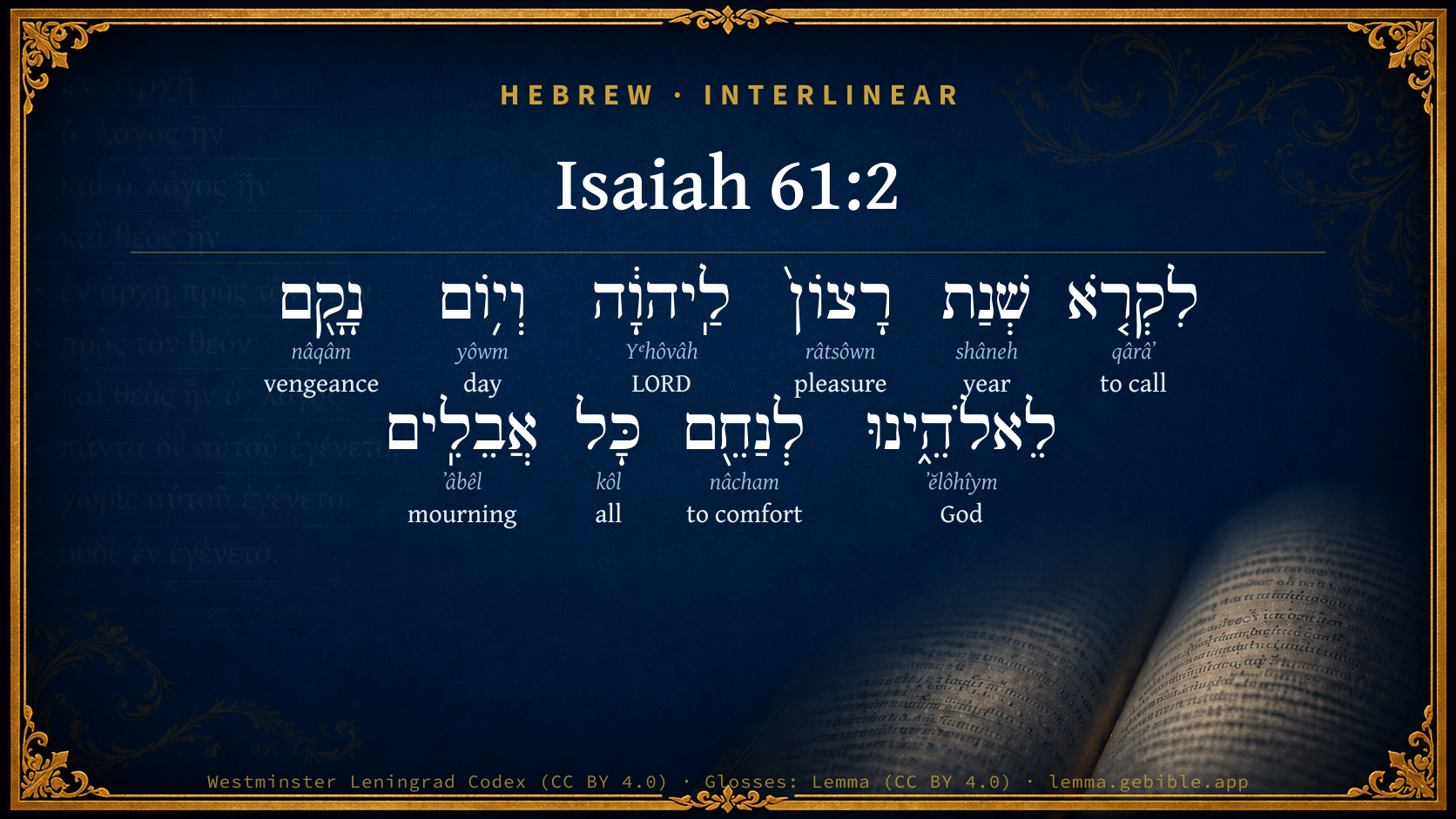
Isaiah 61:2

Hebrew (Westminster Leningrad Codex) Isaiah 61:2 appears in the Hebrew Old Testament. The text above is from the Westminster Leningrad Codex. Each word links to its Strong’s number, a concise gloss, and parsing drawn from the Open Scriptures Hebrew Bible morphology. Click any word for its full Brown-Driver-Briggs (BDB) entry.
Download image
Cite this verse

Isaiah 61:2 (World English Bible). Public Domain. Lemma interlinear Bible study tool, https://lemma.gebible.app/v/isaiah/61/2.

Show BibTeX & RIS
BibTeX
RIS
English Translation
to proclaim the year of Yahweh's favor, and the day of vengeance of our God; to comfort all who mourn;
World English Bible · Public Domain
Download a study sheet

One document with this verse’s original text, its word-by-word gloss line, the meaning frame, cross-references with their text, attributed commentary, and full source and license credits — printable, and it pastes into notes with its structure intact.

This verse Autodidact and up

Study sheet (.html) Plain text (.txt)

A passage Seminary Student

Up to 50 verses in one chapter. A passage sheet keeps up to 6 commentary sources and 12 cross-references per verse, in the order this page ranks them, and says so on the sheet whenever that leaves anything out. Ask for a single verse and you get the Autodidact verse sheet above.

Everything on this page stays free to read, with no account — the sheet is a download of what is already on screen, not access to it.

Want to remove ads? Support Godless Engineer
Compare translations 3

The same verse in 3 English versions, stacked beneath the original-language interlinear above. Click any original word for its lexicon entry.

Each is an independent rendering of the whole verse — the interlinear is not word-aligned to these translations.

Highlighted words mark where these versions differ — a whole-verse word diff, not a word-by-word alignment.

  • World English Bible Public Domain
    to proclaim the year of Yahweh's favor, and the day of vengeance of our God; to comfort all who mourn;
  • King James Version Public Domain
    To proclaim the acceptable year of the LORD, and the day of vengeance of our God; to comfort all that mourn;
  • unfoldingWord Literal Text CC BY-SA 4.0
    to call out the year of favor of Yahweh, and the day of vengeance of our God, to comfort all mourners,

unfoldingWord Literal Text — © unfoldingWord, licensed CC BY-SA 4.0. Word-aligned USFM3 via Door43 (git.door43.org/unfoldingWord/en_ult).

Versions to compare (up to 4)

3 of 4 selected

Show all 18 translations

Every available English version of this verse, each an independent rendering of the whole verse.

  • World English Bible Public Domain
    to proclaim the year of Yahweh's favor, and the day of vengeance of our God; to comfort all who mourn;
  • Berean Standard Bible Public Domain
    to proclaim the year of the LORD’s favor and the day of our God’s vengeance, to comfort all who mourn,
  • Majority Standard Bible Public Domain
    to proclaim the year of the LORD’s favor and the day of our God’s vengeance, to comfort all who mourn,
  • King James Version Public Domain
    To proclaim the acceptable year of the LORD, and the day of vengeance of our God; to comfort all that mourn;
  • American Standard Version (1901) Public Domain
    to proclaim the year of Jehovah's favor, and the day of vengeance of our God; to comfort all that mourn;
  • Revised Version (1885) Public Domain
    to proclaim the acceptable year of the LORD, and the day of vengeance of our God; to comfort all that mourn;
  • Geneva Bible (1599) Public Domain
    To preache the acceptable yeere of the Lord, and the day of vengeance of our God, to comfort all that mourne,
  • Douay-Rheims (1899) Public Domain
    To proclaim the acceptable year of the Lord, and the day of vengeance of our God: to comfort all that mourn:
  • Young's Literal Translation Public Domain
    To proclaim the year of the good pleasure of Jehovah, And the day of vengeance of our God, To comfort all mourners.
  • Literal Standard Version CC BY-SA 4.0
    To proclaim the year of the favor of YHWH, || And the day of vengeance of our God, || To comfort all mourners.
  • Unlocked Literal Bible CC BY-SA 4.0
    He has sent me to proclaim the year of Yahweh's favor, the day of vengeance of our God, and to comfort all who mourn.
  • unfoldingWord Literal Text CC BY-SA 4.0
    to call out the year of favor of Yahweh, and the day of vengeance of our God, to comfort all mourners,
  • Darby Bible Public Domain
    to proclaim the acceptable year of Jehovah, and the day of vengeance of our God; to comfort all that mourn;
  • World Messianic Bible Public Domain
    to proclaim the year of the LORD’s favor and the day of vengeance of our God, to comfort all who mourn,
  • Webster's Bible Public Domain
    To proclaim the acceptable year of the LORD, and the day of vengeance of our God; to comfort all that mourn;
  • Free Bible Version CC BY-SA 4.0
    to declare the year of the Lord's grace and the day of our God's punishment, to comfort those who mourn.
  • Bible in Basic English Public Domain
    To give knowledge that the year of the Lord's good pleasure has come, and the day of punishment from our God; to give comfort to all who are sad;
  • JPS Tanakh (1917) Public Domain
    To proclaim the year of the LORD'S good pleasure, and the day of vengeance of our God; to comfort all that mourn;

Literal Standard Version (2020), Covenant Press — licensed CC BY-SA 4.0. Text via the HelloAO Bible API (eBible.org). Unlocked Literal Bible (unfoldingWord) — licensed CC BY-SA 4.0. Text via the HelloAO Bible API (eBible.org). unfoldingWord Literal Text — © unfoldingWord, licensed CC BY-SA 4.0. Word-aligned USFM3 via Door43 (git.door43.org/unfoldingWord/en_ult). Free Bible Version, Dr. Jonathan Gallagher — licensed CC BY-SA 4.0. Text via the HelloAO Bible API (eBible.org).

Word by word

More ways to search: Search by grammar → Find every occurrence → Compare this word →

Practice this passage: Drill this verse → Learn its vocabulary →

אֲבֵלִֽים
ʼâbêl
H57
“mourning”
Adjective, Adjective, Masculine, Plural, Absolute
Part of Speech
Adjective
Type
Adjective
Gender
Masculine
Number
Plural
State
Absolute
Full BDB Definition

Origin: from H56

TWOT: 6b

mourning - for the dead - because of calamity - of rites of mourning - mourner (substantive) - for the dead - for calamity
  1. לִקְרֹ֤א qârâʼ H7121 “to call” Preposition + Verb, Qal, Infinitive Construct
  2. שְׁנַת shâneh H8141 “year of” Noun, Common, Feminine, Singular, Construct
  3. רָצוֹן֙ râtsôwn H7522 “pleasure” Noun, Common, Masculine, Singular, Absolute
  4. לַֽיהוָ֔ה Yᵉhôvâh H3068 “to/for · LORD” Preposition + Noun, Proper
  5. וְי֥וֹם yôwm H3117 “and · day of” Conjunction + Noun, Common, Masculine, Singular, Construct
  6. נָקָ֖ם nâqâm H5359 “vengeance” Noun, Common, Masculine, Singular, Absolute
  7. לֵאלֹהֵ֑ינוּ ʼĕlôhîym H430 “to/for · God(s) · our” Preposition + Noun, Common, Masculine, Plural, Construct + Suffix, Personal, 1st Person, Common, Plural
  8. לְנַחֵ֖ם nâcham H5162 “to comfort” Preposition + Verb, Piel, Infinitive Construct
  9. כָּל kôl H3605 “all of” Noun, Common, Masculine, Singular, Construct

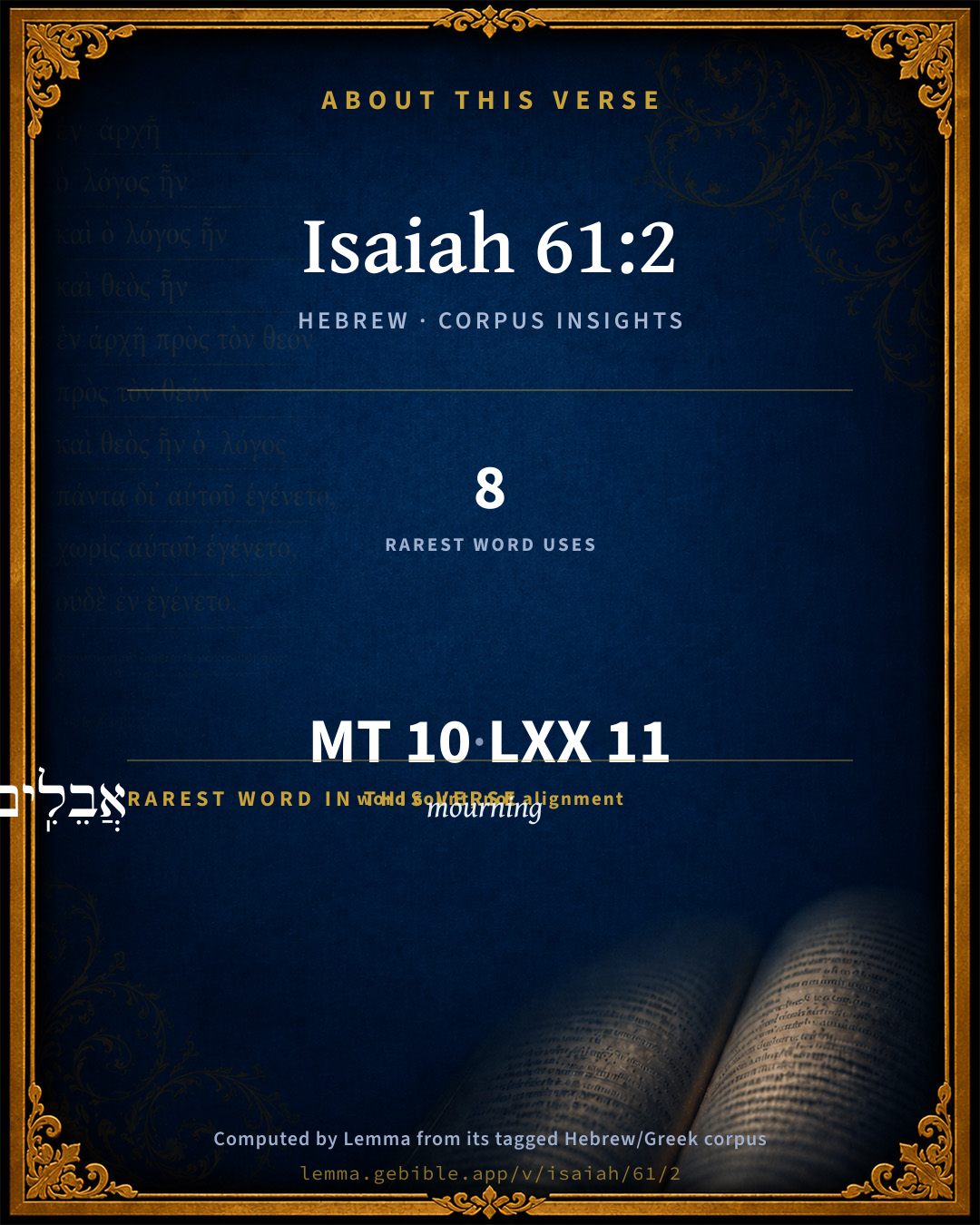
About this verse

These counts appear in no published source. They are computed here, from the morphology-tagged text and Lemma’s own curated glosses. What Lemma adds →

10
words
10
distinct lemmas
Prophets
section

Notable vocabulary

The rarest word here is אֲבֵלִֽים mourning H57 — appearing just 8 times in the whole Hebrew Bible.

Shared distinctive vocabulary

אֲבֵלִֽים mourning H57 occurs in 8 verses of the Hebrew Bible. Also found in:

Grammatical profile

  • 2 verbs
  • 7 nouns
  • 1 adjective

Verb forms

  • לִקְרֹ֤א Qal · Infinitive Construct
  • לְנַחֵ֖ם Piel · Infinitive Construct

Hebrew & Septuagint length

In English translation the verse runs 20 words from the Hebrew and 18 from the Septuagint (LXX English) — closely comparable.

A rough comparison of the two English renderings, which tokenize alike — not a word-level alignment.

Word counts can differ between the Hebrew and the Greek without any difference in meaning — e.g. the Hebrew direct-object marker אֵת has no separate Greek word, and Greek often adds the article ὁ.

In the original languages it is 10 Hebrew tokens and 11 Greek tokens — but the two are counted differently (Hebrew bundles its prefixes and suffixes into one token; the Greek is in lemma form), so that isn’t a like-for-like length.

Cross-references

25

Topical passages linked to Isaiah 61:2 in the Treasury of Scripture Knowledge — connected by theme and wording, ordered by reader-vote popularity; previews shown in the World English Bible.

  • Matthew 5:4 Blessed are those who mourn, For they shall be comforted.
  • Isaiah 34:8 For Yahweh has a day of vengeance, a year of recompense for the cause of Zion.
  • Isaiah 57:18 I have seen his ways, and will heal him: I will lead him also, and restore comforts to him and to his mourners.
  • Luke 4:19 And to proclaim the acceptable year of the Lord."
  • 2 Thessalonians 2:16–17 Now our Lord Jesus Christ himself, and God our Father, who loved us and gave us eternal comfort and good hope through grace,
  • Isaiah 25:8 He has swallowed up death forever; and the Lord Yahweh will wipe away tears from off all faces; and the reproach of his people will he take away from off all the earth: for Yahweh has spoken it.
  • Jeremiah 31:13 Then shall the virgin rejoice in the dance, and the young men and the old together; for I will turn their mourning into joy, and will comfort them, and make them rejoice from their sorrow.
  • John 16:20–22 Most assuredly I tell you, that you will weep and lament, but the world will rejoice. You will be sorrowful, but your sorrow will be turned into joy.
  • 1 Thessalonians 2:16 forbidding us to speak to the Gentiles that they may be saved; to fill up their sins always. But wrath has come on them to the uttermost.
  • Isaiah 35:4 Tell those who are of a fearful heart, Be strong, don't be afraid: behold, your God will come [with] vengeance, [with] the recompense of God; he will come and save you.
  • Isaiah 49:8 Thus says Yahweh, In an acceptable time have I answered you, and in a day of salvation have I helped you; and I will preserve you, and give you for a covenant of the people, to raise up the land, to make them inherit the desolate heritage:
  • Isaiah 63:1–6 Who is this who comes from Edom, with dyed garments from Bozrah? this who is glorious in his clothing, marching in the greatness of his strength? I who speak in righteousness, mighty to save.
  • Isaiah 66:10–12 Rejoice you with Jerusalem, and be glad for her, all you who love her: rejoice for joy with her, all you who mourn over her;
  • Isaiah 66:14 You shall see [it], and your heart shall rejoice, and your bones shall flourish like the tender grass: and the hand of Yahweh shall be known toward his servants; and he will have indignation against his enemies.
  • Malachi 4:1–3 "For, behold, the day comes, it burns as a furnace; and all the proud, and all who work wickedness, will be stubble; and the day that comes will burn them up," says Yahweh of Hosts, "that it shall leave them neither root nor branch.
  • Luke 7:44–50 Turning to the woman, he said to Simon, "Do you see this woman? I entered into your house, and you gave me no water for my feet, but she has wet my feet with her tears, and wiped them with the hair of her head.
  • Luke 21:22–24 For these are days of vengeance, that all things which are written may be fulfilled.
  • 2 Corinthians 1:4–5 who comforts us in all our affliction, that we may be able to comfort those who are in any affliction, through the comfort with which we ourselves are comforted by God.
  • Jeremiah 46:10 For that day is [a day] of the Lord, Yahweh of Hosts, a day of vengeance, that he may avenge him of his adversaries: and the sword shall devour and be satiate, and shall drink its fill of their blood; for the Lord, Yahweh of hosts, has a sacrifice in the north country by the river Euphrates.
  • Luke 6:21 Blessed are you who hunger now, For you will be filled. Blessed are you who weep now, For you will laugh.
  • 2 Thessalonians 1:7–9 and to give relief to you that are afflicted with us, when the Lord Jesus is revealed from heaven with his mighty angels in flaming fire,
  • Leviticus 25:9–13 Then you shall sound the loud trumpet on the tenth day of the seventh month. On the Day of Atonement you shall sound the trumpet throughout all your land.
  • Isaiah 59:17–18 He put on righteousness as a breastplate, and a helmet of salvation on his head; and he put on garments of vengeance for clothing, and was clad with zeal as a mantle.
  • 2 Corinthians 6:2 for he says, "At an acceptable time I listened to you, In a day of salvation I helped you." Behold, now is the acceptable time. Behold, now is the day of salvation.
  • Psalms 110:5–6 The Lord is at your right hand. He will crush kings in the day of his wrath.

Cross-references courtesy of OpenBible.info (CC BY 4.0).

Hebrew and Greek witnesses Masoretic Hebrew ↔ Greek Septuagint

The same verse in the two great witnesses to the Old Testament, shown verse-for-verse.

These are two independent witnesses, not word-aligned to each other, and the Septuagint is shown in lemma (dictionary) form.

Hebrew Isaiah 61:2 Masoretic · Westminster Leningrad Codex

לִקְרֹ֤א שְׁנַת רָצוֹן֙ לַֽיהוָ֔ה וְי֥וֹם נָקָ֖ם לֵאלֹהֵ֑ינוּ לְנַחֵ֖ם כָּל אֲבֵלִֽים

to proclaim the year of Yahweh's favor, and the day of vengeance of our God; to comfort all who mourn;

World English Bible · Public Domain

Greek LXX Isaiah 61:2 Septuagint · lemma form

καλέω ἐνιαυτός κύριος δεκτός καί ἡμέρα ἀνταπόδοσις παρακαλέω πᾶς ὁ πενθέω

to declare the acceptable year of the Lord, and the day of recompence; to comfort all that mourn;

LXX2012 (modern English Septuagint) · Public Domain

Hebrew: Westminster Leningrad Codex (CC BY 4.0). Greek: Septuagint (public domain); English from LXX2012 (modern English Septuagint) (Public Domain). How the Septuagint differs from the Hebrew →

Targum (Aramaic paraphrase)

1

The Targum is the ancient Jewish Aramaic paraphrase of the Hebrew Scriptures — an interpretive translation, not the Hebrew text itself. Onkelos (literal) and Pseudo-Jonathan (expansive) render the Torah, and Jonathan the Prophets. Coverage is partial: where no permissively-licensed English translation exists for a verse, only the Aramaic is shown. This is verse-level text, not a word-by-word alignment to the Hebrew.

  1. Targum Jonathan Prophets (Joshua–Malachi)
    לְמִקְרֵי שְׁנַת רַעֲוָא קֳדָם יְיָ וְיוֹם פּוּרְעֲנוּתָא קֳדָם אֱלָהָנָא לְנַחָמָא כָּל אֲבֵלַיָא:

    To proclaim the acceptable year of the Lord, and the day of vengeance of our God; to comfort all that mourn.

    Targum Jonathan — Aramaic: “Mikraot Gedolot” (public domain). English: “Sefaria Community Translation” (CC0 1.0 (public-domain dedication)); “London "Chaldee Paraphrase," 1871” (public domain). Text via Sefaria.

Commentary

Notes on Isaiah 61:2 from classic Christian and Jewish commentators (each source and its license shown beneath its notes). The classic Christian expositions comment on the surrounding passage and are grouped to its opening verse, so a note may address several verses; the Jewish commentaries on the Tanakh (Rashi and others) are per-verse, so they appear only where the commentator wrote on this verse.

Lemma curates 59 commentaries, every one of them public domain or Creative Commons licensed, each selected and text-cleaned for this edition rather than reprinted as found. About our sources →

Trapp's Complete Commentary

John Trapp

Isa 61:2 To proclaim the acceptable year of the LORD, and the day of vengeance of our God; to comfort all that mourn;

Ver. 2. To proclaim the acceptable year of the Lord.] The new and true jubilee, or year of releasement, called here in the Hebrew the year of good will, like as the elect are called the men of God’s good will. {Luk 2:14} This year is now, {2Co 6:2} and the present now must be embraced and improved, since God is but a while with men in the opportunities of grace; which opportunities are headlong, and, once past, irrecoverable.

And the day of vengeance of our God.] Tribulation to them that trouble his people. {2Th 1:6-7} Gog and Magog shall down in that day; all humans be hanged up at that royal feast, at the last day especially. {Luk 19:27}

To comfort all that mourn.] This Christ did both by word and deed, and this must all his ministers do: "Comfort the feebleminded"; {1Th 5:14} not burdening men’s consciences with human traditions and merit of works. Popery is a doctrine of desperation.

John Trapp, A Commentary or Exposition upon All the Books of the Old and New Testament (1647–1656) — public domain. Text from a community e-Sword module.

The Biblical Illustrator

Joseph S. Exell

Isa_61:2

To proclaim the acceptable year of the Lord

The year of Jubilee

It may be profitable to trace out the analogies between the year of jubilee which rejoiced the hearts of Israel, and that more comprehensive era of which it was broadly typical, and which was to bring gladness to all peoples unto the end of the dispensation, when the loving ministry of God is finished.

1. The Jewish jubilee commenced at the close of the day of atonement. Is not this a very true type of the way in which spiritual blessings are exclusively introduced to mankind? There can be no jubilee for us, a race of lost and guilty rebels taken in arms, traitors convicted of treason, unless an all-prevalent atonement had previously purchased our pardon.

2. There was rest from exhausting labour. By a providential arrangement similar to that which secured a double supply of manna on the sixth day, the land had unusual fertility in the sixth year, so that in the seventh, which was the ordinary, and in the fiftieth, which was the special sabbatical year, there was a suspension of the common duties of husbandry. Both the land and labourers had rest, and yet the supply did not fail, for there was plenty in every barn, and there was gladness in every heart. And, in a spiritual sense, is not rest for the weary just what our spirits so fervently require--just what the Gospel has been itself inspired to provide

3. The next blessing pertaining to the year of jubilee was the restoration of alienated property. When a man, through misfortune or extravagance, had contracted liabilities that were beyond his means, and had sold his possessions to discharge them, if he were not himself able to redeem them, and if none of his kindred were at once wealthy and willing, these possessions remained as the property of the creditor until the year of jubilee, and then it was provided by the law that they should return to him who had parted from them for a season. We, the whole race of us, had a bright inheritance once--Gods favour, Gods fellowship, Gods image, all were ours by birth--but, alas! we alienated it by sin. We are not ourselves able to redeem it. But, through infinite compassion, this our inheritance has not been suffered to pass out of the family. Christ our kinsman, our elder brother, has paid down the price, and has rescued this our heritage from the fangs of the harpies who would fain have usurped it for their own. We had sold our birthright as a common thing, but it has been redeemed, and it is offered to us without a price by a love that is surely without parallel. The acceptable year did dawn upon the world indeed when it witnessed the birth of the Messiah, and that sun, like that of Gideon, stood still at His bidding, and hasted not to go down until now.

4. Another blessing which is mentioned in the history is the restoration of freedom. It seems to have been a custom among the Hebrews, as among other Eastern nations, for a debtor who had become hopelessly involved to sell himself to his creditors, in order that by his personal service he might discharge the debt that he was otherwise unable to pay. Of course, it was provided that for the amelioration of his condition, and for its termination in the year of jubilee, the man was not to be a slave, but a hired servant and a soldier, and he was to remain until the year of jubilee, and then he and his children should all go out and return unto their possession. All sinners are in bondage, bound with the chain of their sins, led captive by the devil at his will. How I delight to proclaim it in your hearing, The year of jubilee is come. If the Son make you free, ye shall be free indeed. (W. M. Punshon.)

No light without a shadow

There is a tremendous alternative before men--acceptation or vengeance. When we speak of vengeance in this connection, and as a Divine act, it must be understood not in a malignant and revengeful sense, but in a judicial. It must be regarded as an act of eternal justice. We propose to interrogate Nature and ask her what she has to tell us of this alternative. We would greatly prefer to present Christ as the light of the world, but we know of no light without a shadow. Observe, however, the terms in which the light and the shadow are expressed in the prophets language. It is the year of acceptation, and only the day of vengeance. This is a very natural description. The light always attracts us most: we scarcely think of the shadow. The idea of hell is in accordance with the laws of nature, and cannot be eliminated from thought.

I. ANTITHESES BELONG TO THE FUNDAMENTAL NATURE OF THINGS; HENCE, ARE TO BE FOUND EVEN IN FINALITIES. All positive things involve a corresponding negative; and are comprehensible only by contrast with their negative. If you paint a picture all white, you have nothing but a white washed canvas and no picture; it is only by contrast between lights and shadows that you can give it expression and form. What is there in the world that has not its corresponding negative? If there is light there is also darkness; if there is height there is also depth; if there is joy there is also sorrow; if there is perfection there is also deformity; if there is beauty there is also ugliness; if there is upward there is also downward; if there is heat there is also cold; if there is good tilers is also bad; if there is reward there is also punishment; if there is heaven there is also hell.

II. ALTERNATIVES ARE NECESSARY TO MORAL BEINGS. A moral being is one who has power of choice; and there can be no choice except as between alternatives. Our whole life is a choosing between alternatives. It would then, indeed, be singular if this choice was only possible in matters of secondary importance, but eliminated from matters of the highest importance. If there is no alternative over against heaven, then heaven is not a matter of choice; if not matter of choice, then it must be arbitrarily conferred, and, there being no alternative, it must of necessity be conferred arbitrarily upon good and bad alike.

III. THE LAW OF CONSEQUENCES REVEALS A HELL. Who can compute the consequences of an act? It may be but momentary, yet consequences of the most momentous character are entailed upon the world.

IV. THE LAW OF GROWTH REVEALS A HELL. Growth is of two kinds: by assimilation of things without, and by development from within: the first, scientific people call by involution; the second, by evolution. Sin grows, and grows by this double process. It assimilates with itself the elements of evil around it. This is the law of its existence, which forecloses any prospect of remedy from within. Moreover, sin grows by evolution. Sin propagates, and it propagates nothing but itself. Hence it cannot become extinct. It must propagate itself in the soul for ever unless some external power shall eliminate it. It cannot outgrow itself. The soul, therefore, which is identified with sin, must partake of this eternal process. That there is an external remedy we will confess: but we can readily perceive that the growing processes of sin must more and more repel this remedy. The history of a sinning soul, then, unfolds an ever-diminishing hope of reclamation.

V. THE EVIDENT TENDENCY OF CHARACTER TO ASSUME STABILITY IS INDICATIVE OF A HELL. This final stability is what we call second nature--the outcome and ultimate form of the plastic powers of the soul. Hence the welfare of the creature demands a limited probation. Mans happiness demands that he should be able to work towards an assured future: but the laws which facilitate stability in goodness must also facilitate stability in evil. Hence it will be seen why it is that the ambassadors of God are for ever proclaiming: Now is the day of salvation, and warning you to seek the Lord while He may be found. Hence it is we are telling you that the fittest time for giving yourselves to God is in your youth.

VI. CONCLUSION. Nature has told us there is a hell. Thus nature is a school-master to bring us to Christ. (Southern Pulpit.)

Proclamation of acceptance and vengeance

Notice well the expression, to proclaim, because a proclamation is the message of a king, and where the word of a king is there is power. The Lord Jesus Christ came into the world to announce the will of the King of kings. Nor let it be forgotten that a proclamation must be treated with profound respect, not merely by receiving attention to its contents, but by gaining obedience to its demands. There are three points in the proclamation worthy of our best attention.

I. JESUS PROCLAIMS THE ACCEPTABLE YEAR OF THE LORD. There can be very little question that this relates to the jubilee year. The reason for all the jubilee blessings was found in the Lord.

II. THE DAY OF VENGEANCE OF OUR GOD.

1. Whenever there is a day of mercy to those who believe, it is always a day of responsibility to those who reject it, and if they continue in that state it is a day of increased wrath to unbelievers.

2. Another meaning of the text comes out in the fact that there is appointed a day of vengeance for all the enemies of Christ, and this will happen in that bright future day for which we are looking.

3. However, I consider that the chief meaning of the text lies in this--that the day of vengeance of our God was that day when He made all the trangressions of His people to meet upon the head of our great Surety.

Look at the instructive type by which this truth was taught to Israel of old. The year of jubilee began with the day of atonement.

4. The day of vengeance, then, is intimately connected with the year of acceptance; and mark, they must be so connected experimentally in the heart of all Gods people by the teaching of the Holy Ghost, for whenever Christ comes to make us live, the law comes first to kill us.

III. THE COMFORT FOR MOURNERS DERIVABLE FROM BOTH THESE THINGS. To comfort all that mourn. Oh, ye mourners, what joy is here, joy because this is the year of acceptance, and in the year of acceptance, or jubilee, men were set free and their lands were restored without money. No man ever paid a penny of redemption money on the jubilee morning: every man was free simply because jubilee was proclaimed: no merit was demanded, no demur was offered, no delay allowed, no dispute permitted. Jubilee came, and the bondman was free. And now, to-day, whosoever believeth in Jesus is saved, pardoned, freed, without money, without merit, without preparation, simply because believeth. An equal joy-note rings out from the other sentence concerning the day of vengeance. I f the day of vengeance took place when our Lord died, then it is over. (C. H.Spurgeon.)

Preaching Gods judgment on sin

A member of the congregation, at the close of a sermon that lasted for an hour, and had been preached amid a stillness most painful, nothing heard but the tones of the preacher, and during the pauses the ticking of the clock--a sermon on the sad and awful issues of a sinful life, and the glory and the joy of a life lived in Christ--and, if Dr. Dale intends to preach like that I shall not come and hear him, for I cannot stand it; it goes through me. I spoke to Dr. Dale afterwards about the stillness and said it was simply awful. Ah! yes, he said; but it was more awful to me; it is hard to preach like that, but it must be done. (Gee. Barber, in Dr. Dales Life.)

To comfort all that mourn

Tears dried

Some seek to comfort by telling us that sorrow is wrong. They say that we should be brave and not allow our feelings to become so deep. It is true there may be excessive grief, and so grief may become sinful. But to say that we must not sorrow is to try to induce us to outrage our nature and to deprive us of one of the most effectual means whereby God educates and purifies. Christ is not come to deliver us from suffering, but to enable us to derive good from the suffering. How does Christ comfort all that mourn?

I. BY HIMSELF BECOMING THE SUFFERER FOR US, TO TAKE AWAY SIN. Christ bore the curse of it for us, and in doing this He removed the root of our mourning.

II. BY HIS SYMPATHY. He feels with us and for us, and by oneness with us in sorrow gives us comfort. Sympathy means suffering along with another. Job spoke of it when he said, Did I not weep for him that was in trouble? was not my soul grieved for the poor?

III. By showing us THE ORIGIN AND PURPOSE OF SUFFERING. Nowhere except in Gods revelation in Christ do we learn how and why affliction and sorrow come upon us. Our Lord Jesus Christ explains all. And His explanation goes down to the very root of the matter. Suffering is necessary in order that we enter into the fulness of Gods love in the gift of His Son. He who has received Christ as his Saviour is instructed, sanctified, made more meet for the Masters use, becomes more heavenly minded, by means of all the affliction through which his Heavenly Father causes him to pass. To suffer in Christ is to live more deeply. Love and sorrow are the two conditions of a profound life.

IV. BY ASSURING THOSE WHO BELIEVE THAT THEY SHALL BE EVERLASTINGLY WITH HIM TO BEHOLD HIS GLORY. We learn--

1. That the comfort Christ imparts is effectual. It is not limited or partial. See how fully this is set forth in the passage with which the text is connected. What variety of imagery is used to picture to us the fulness and perfection of the remedy Christ brings for human guilt and misery. The healing He effects is for our whole nature, for heart, mind and conscience. He completely redeems and blesses.

2. The comfort Christ gives is enduring. It is no momentary or temporary assuaging of grief. It will never fail, it will increase in its influence and power.

3. The comfort Christ bestows is offered to all and is adapted to all. To comfort all that mourn. All ye that labour, etc. Whatever burden, whatever sorrow, there is in Him comfort for all. (G. W.Humphreys, B. A.)

The Biblical Illustrator, edited by Joseph S. Exell (c. 1880s–1900s) — public domain. Text from a community e-Sword module.

Joseph Benson's Commentary

Isa 61:2-3. And the day of vengeance of our God — Namely, on those who reject or neglect these gracious offers of mercy and salvation: they shall not only be left in their captivity, as they deserve to be, but shall be dealt with as enemies. We have the gospel summed up, Mar 16:16, where that part of it, he that believeth shall be saved, proclaims the acceptable year of the Lord to those that will accept it; but the other part, he that believeth not shall be damned, proclaims the day of vengeance of our God; that vengeance that he will take on those that obey not the gospel of our Lord Jesus Christ, 2Th 1:8; see also Heb 10:27-30; Mat 24:21; Rev 18:1. The clause seems to have an especial reference to the time in which God punished the unbelieving and disobedient Jews by the destruction of Jerusalem, and the unparalleled calamities that came upon their nation. We find Christ, in several of his discourses, threatening them with the judgments of God for their rejecting him. And he calls the destruction of Jerusalem the days of vengeance, Luk 21:22, the very expression made use of here. To comfort all that mourn — Either on account of their sins, or their sufferings, or the desolations and miseries of the spiritual Zion, his church; and who, mourning, seek to him, and not to the world, for comfort. He not only provides comfort for them, and proclaims it, but he applies and bestows it by giving them the Comforter. There is enough in him to comfort all that mourn, whatever their afflictions or sorrows may be; but this comfort is sure to them that mourn in Zion, that is, that sorrow after a godly sort, and apply by faith and prayer to God in Christ for relief and consolation. To appoint unto them beauty — Or rather, ornament, (as the Hebrew פארmore properly signifies,) for ashes. Bishop Lowth renders the clause, To give them a beautiful crown instead of ashes; the oil of gladness instead of sorrow; observing, “In times of mourning the Jews put on sackcloth, or coarse and sordid raiment; and spread dust and ashes on their heads: on the contrary, splendid clothing, and ointment poured on the head, were the signs of joy.” The oil of joy — Which makes the face to shine, instead of that mourning which disfigures the countenance, and makes it unlovely. This oil of joy the saints have from that oil of gladness with which Christ himself was anointed above his fellows. The garments of praise — Such beautiful garments as were worn on thanksgiving days, instead of the spirit of heaviness. Hebrew, כהה, contraction, dimness, or obscurity; “open joys,” says Henry, “for secret mournings. Zion’s mourners keep the spirit of heaviness to themselves, and weep in secret; but the joy, with which they are recompensed, they are clothed with, as with a garment, in the eyes of others.” Observe, reader, where God gives the oil of joy, he gives the garment of praise. Those comforts which come from God dispose the heart to, and enlarge the heart in, thanksgivings to God. That they might be called trees of righteousness — That they might be righteous persons, deeply rooted by faith in the ground of gospel truth, solid and firm in sincerity, fortitude, and patience; ornaments to God’s vineyard, and bringing forth fruit suitable to the soil wherein they are planted. The planting of the Lord — Planted by that holy Lord who, being himself holy and righteous, would plant none but such: see on Isa 60:21. That he might be glorified — Namely, by the fruit they bear; for herein is our heavenly Father glorified, that we bring forth much fruit.

Joseph Benson's Commentary on the Old and New Testaments (1811–1818) — public domain. Text from a community e-Sword module.

Scofield Reference Notes

C. I. Scofield

acceptable year of the Lord

Observe that Jesus suspended the reading of this passage in the synagogue at Nazareth Luk 4:16-21 at the comma in the middle of Isa 61:2. The first advent, therefore, opened the day of grace, "the acceptable year of Jehovah," but does not fulfil the day of vengeance. That will be taken up when Messiah returns 2Th 1:7-10 Cf.; Isa 34:8; Isa 35:4-10. The last verse, taken with the 4th, gives the historic connection: the vengeance precedes the regathering of Israel, and synchronizes with the day of the Lord.; Isa 2:10-22; Rev 19:11-21; Isa 63:1-6.

The Scofield Reference Bible (1917 edition), notes by C. I. Scofield — public domain. Text from a community e-Sword module.

Tyndale Open Study Notes

Tyndale Open Resources

61:2 The time of the Lord’s favor is the day of God’s salvation (see 49:8). • the day of God’s anger: God now turns his wrath against the enemies of his people. It will be a day of righteous vengeance (see 34:8; 63:3-4).

Tyndale Open Study Notes — © Tyndale Open Resources, licensed CC BY-SA 4.0. Text via the HelloAO Bible API.

Geneva Bible (1599)

Geneva Bible translators

The time when it pleased God to show his good favor to man, which S. Paul calleth the fullness of time, Gal. 4:4.

For when God delivereth his Church, he punisheth his enemies.

Geneva Bible (1599) marginal notes — public domain. Text via Bolls.life.

Jamieson, Fausset & Brown

Robert Jamieson, A. R. Fausset & David Brown

acceptable year--the year of jubilee on which "liberty was proclaimed to the captives" (Isa 61:1 Co2 6:2).

day of vengeance--The "acceptable time of grace" is a "year"; the time of "vengeance" but "a day" (so Isa 34:8; Isa 63:4; Mal 4:1). Jesus (Luk 4:20-21) "closed the book" before this clause; for the interval from His first to His second coming is "the acceptable year"; the day of vengeance" will not be till He comes again (Th2 1:7-9).

our God--The saints call Him "our God"; for He cometh to "avenge" them (Rev 6:10; Rev 19:2).

all that mourn--The "all" seems to include the spiritual Israelite mourners, as well as the literal, who are in Isa 61:3 called "them that mourn in Zion," and to whom Isa 57:18 refers.

Jamieson, Fausset & Brown — Commentary Critical and Explanatory on the Whole Bible (1871) — public domain (CC PDM 1.0). Text via the HelloAO Bible API.

Ellicott's Commentary for English Readers

(2) To proclaim the acceptable year . . .—The Year of Jubilee is still, perhaps, in the prophet’s thoughts; but the chief point of the promise is the contrast between the “year” of favour and the single “day” of vengeance, reminding us of the like contrast in Exo_20:5-6.

A Bible Commentary for English Readers, edited by Charles John Ellicott (1878–1897) — public domain. Text from a community e-Sword module.

The Cambridge Bible for Schools and Colleges

gen. ed. J. J. S. Perowne

2. the acceptable year of the Lord] Rather, a year of Jehovah’s favour (ch. Isa_49:8); and so in the next line, a day of our God’s vengeance (cf. Isa_63:4, ch. Isa_34:8). vengeance] i.e. on the oppressors of Israel, perhaps also on the sinful members of the nation (Isa_59:16 ff.).

to comfort all that mourn] Cf. ch. Isa_57:18. The clause belongs properly to the next verse.

The Cambridge Bible for Schools and Colleges (gen. ed. J. J. S. Perowne; Cambridge University Press, 1878–1918) — public domain. Text from a community e-Sword module.

John Gill's Exposition

To proclaim the acceptable year of the Lord,.... Not an exact year, but time in general; for such are wrong, who from hence conclude that Christ's public ministry lasted but a year, since it is certain, by the passovers he kept, that it must be at least three or four years; the whole time of Christ on earth was an acceptable and desirable time, what many great personages desired to see, and did not: this time may take in the whole Gospel dispensation, which was ushered in by Christ: the allusion, as before observed, is to the year of jubilee, when there was a proclamation of liberty; of release of debts; of restoration of inheritances, and of cessation from work; all which must make it an acceptable year: and this proclamation was made on the day of atonement; and Jarchi interprets the phrase here of a "year of reconciliation"; or "the year of atonement to the Lord", as it maybe rendered (s); this was made by the sacrifice of Christ, and is proclaimed in the Gospel, and makes a most considerable part of it. It may be rendered, "the year of the good will of the Lord" (t); and such was the time of Christ's coming on earth, to save men, and make peace and reconciliation for them, Luk 2:14 and was an "acceptable time" indeed; acceptable to the Lord himself; as were the incarnation of Christ, his obedience and righteousness, his sufferings and death, his sacrifice and satisfaction; since hereby the perfections of God were glorified, his purposes fulfilled, his covenant confirmed, and his people saved: acceptable to men; as were the birth of Christ; the things done by him; peace made, pardon procured, righteousness brought in, and salvation wrought out; all which must be acceptable to such who are lost, and know it, and are sensible that nothing of their own can save them; see Ti1 1:15.

the day of vengeance of our God; when vengeance was taken on sin, in the person of Christ; when he destroyed the works of the devil, the devil himself, and spoiled principalities and powers; when he abolished death, and was the plague and destruction of that and the grave; when he brought wrath to the uttermost on the Jews for the rejection of him, who would not have him to reign over them; and who will take vengeance on antichrist at his spiritual coming, and upon all the wicked at the day of judgment. Kimchi understands this of the day when God shall take vengeance on Gog and Magog.

To comfort all that mourn: that are under afflictions, and mourn for them; and under a sense of sin, and mourn for that; who mourn for their own sins, indwelling sin, and their many actual transgressions; and for the sins of others, of profane persons, and especially professors of religion; these Christ comforts by his Spirit, by his word and ministers, by his promises, by his ordinances, and by the discoveries, of pardoning grace and mercy,

(s) "annum placabilem Jehovae", Vatablus; "annum placabilem Domino", V. L. (t) Heb. "annum benevolentiae, seu bneplaciti Jehovae", Piscator, Tigurine version; "annum complacentiae", Vitinga.

John Gill's Exposition of the Whole Bible (1746–1763) — public domain (CC PDM 1.0). Text via the HelloAO Bible API.

Albert Barnes' Notes on the Bible

To proclaim the acceptable year of the Lord - (see the notes at Isa 49:8). There is probably an allusion here to the year of Jubilee, when the trumpet was blown, and liberty was proclaimed throughout all the land (so Lev 25:9-10). In like manner the Messiah would come to proclaim universal liberty - liberty to all the world from the degrading servitude of sin. The time of his coming would be a time when Yahweh would be pleased to proclaim through him universal emancipation from this ignoble bondage, and to restore to all the privilege of being the freedmen of the Lord.

And the day of vengeance of our God - (See the notes at Isa 34:8). This is language adapted to the deliverance from Babylon. The rescue of his people would be attended with vengeance on their enemies. This was not quoted by the Saviour in his discourse at Nazareth, or if quoted, the fact is not recorded by Luke (see Luk 4:19). The text which the Saviour took then as the foundation of his discourse Luk 4:21, seems to have ended with the clause before this, It is not to be inferred, however, that he did not consider the subsequent expressions as referring to himself, but it was not necessary to his purpose to quote them. Regarded as applicable to the Redeemer and his preaching, this doubtless refers to the fact that his coming would be attended with vengeance on his foes. It is a great truth, manifest everywhere, that God’s coming forth at any time to deliver his people is attended with vengeance on his enemies. So it was in the destruction of Idumea - regarded as the general representative of all the foes of God (see the notes at Isa. 34; Isa 35:1-10); so it was in the deliverance from Egypt - involving the destruction of Pharaoh and his host; so in the destruction of Babylon and the deliverance of the captives there. So in like manner it was in the destruction of Jerusalem; and so it will be at the end of the world Matt. 25:31-46; 2Th 1:7-10.

To comfort all that mourn - The expression, ‘all that mourn,’ may refer either to those who mourn over the loss of earthly friends and possessions, or to those who mourn over sin. In either case the gospel has afforded abundant sources of consolation (see the notes at Isa 25:8).

Albert Barnes' Notes on the Bible (1834–1885) — public domain. Text from a community e-Sword/MySword module.

Haydock's Catholic Bible Commentary

Year of Jubilee, (Jeremias xxv. 11.) when the Jews should be delivered, as a figure of Christ’s redemption. --- Vengeance, when the Chaldeans, &c., should perish, (Calmet) and all obstinate sinners, at the day of judgment. (Haydock)

George Leo Haydock (1774–1849), Haydock's Catholic Family Bible and Commentary, 1859 edition — public domain. Excludes Psalms (Douay-Rheims chapter numbering differs from Protestant) and Deuterocanonical books (Catholic canon only).

Matthew Poole's English Annotations

To proclaim; to declare, as it respects the Jews, that their liberty is at hand.

The acceptable year, viz. the happy age of God’s grace, either which will be grateful and welcome news to them, or acceptable to God, a time wherein it pleaseth him to favour them; but this must be understood of a further extent than to Babylon, and rather unto mankind in Jesus Christ, Gal 4:4; Tit 3:4, called a time of God’s good-will in that angelical song, Luk 2:14, on the account of those good tidings which the angel brought, Isa 61:10,11; called so possibly from the arbitrariness and good pleasure of God, having no respect to any satisfaction from man.

Year; not precisely, as if Christ preached but one year, the mistake of some ancients, mentioned and refuted by Irenaeus, lib. 2. ch. 38; but for time indefinitely, and may include the whole time of preaching the gospel; see Rom 10:15; which I take to be the meaning of that now, 2Co 6:2, and probably hath a pertinent allusion to the year of jubilee, which was a general release proclaimed by sound of trumpet, which relates also here to the word proclaiming, Lev 25:10.

The day of vengeance, viz. on Babylon, it being necessary, that where God will deliver his people, he should take vengeance on their enemies; but mystically and principally on the enemies of his church, and the spiritual ones chiefly, viz. Satan, sin, and death.

That mourn; either by reason of their sufferings, or of their sins, Mat 11:28; or the miseries of Zion. See Poole "Isa 57:18".

Matthew Poole's English Annotations on the Holy Bible (1683–1685) — public domain. Text from a community e-Sword/MySword module.

The Pulpit Commentary

To proclaim the acceptable year of the Lord. An "acceptable year," or "year of acceptance," is a space of time during which God would be pleased to accept such as repented and turned to him. It is, of course, not intended to limit the space to a "year." The space is rather the term of our sojourn here below. The day of vengeance. The "day" of vengeance is contrasted with the "year" of acceptance, to indicate God"s long-suffering and patience towards sinners. (comp. Isa_34:8; and see also Exo_20:5, Exo_20:6) To comfort all that mourn; i.e. all who "sorrow after a godly sort" (2Co_7:11) all who mourn their transgressions and shortcomings, their "sins, negligences, and ignorances," with a hearty desire to be rid of them, and to serve God truly in the future.

The year of acceptance and the day of vengeance.

Very striking is the frequency with which this, and other prophets, set together the two sides of Messiah"s work. Deliverance of those who trust him goes together with judgment on those who reject him. In a most impressive way the Old Testament canon closes with this dual aspect of Divine dealings, "For, behold, the day cometh, that shall burn as an oven; and all the proud, yea, and all that do wickedly, shall be stubble But unto you that fear my Name shall the Sun of Righteousness arise with healing in his wings". (Mal_4:1, Mal_4:2) And the New Testament opens with the prophetic exclamation of Simeon, as he held the infant Saviour in his arms, "This Child is set for the fall and rising again of many in Israel." Some make a distinction between the long year of acceptance and the short day of vengeance. No doubt the first reference of the text is to the Divine indignation against those faithless or selfish Jews who would not respond to the Lord"s call to return to their ancient land. So it may stand for the Divine indignation against those who are "condemned already, because they have not believed in the Name of the only begotten Son of God." This subject is so frequently and variously treated, that we here confine ourselves to two points.

I ACCEPTANCE FOLLOWS FORGIVENESS. Messiah proclaims acceptance because he brings forgiveness. It is of the utmost importance that there should be no uncertain sound as to the necessity for "forgiveness." Vague sentiments prevail concerning the Divine acceptance; and there is a notion that all we can need is a sort of educating into goodness. Man, every man, needs to be forgiven. No man can be accepted until he is forgiven. This may lead to a full consideration of that work of Messiah which bears on the ensuring of forgiveness. It is a mediatorial work, which has relations of propitiation towards God and relations of conviction towards man. The acceptance time is proclaimed to guilty rebels who lay down their arms and ask for mercy.

II REJECTION FOLLOWS THE HARDNESS THAT WILL NOT SEEK FORGIVENESS. That is the "day of vengeance of our God." If put into a word, that word may be this they are left to their fate. If put into a figure, it may be this they are outside the lighted halls, in the "outer darkness." If fashioned in human images, the offended king must put to death those who rebelliously refuse to touch his offered golden sceptre. There is a mystery of profound and awful meaning in the expression, "the wrath of the Lamb. R.T.

The Pulpit Commentary (1880–1919), ed. H.D.M. Spence-Jones & Joseph S. Exell — public domain. Text from a community e-Sword module.

John Wesley's Explanatory Notes

Vengeance - It being necessary, that where God will deliver his people, he should take vengeance on their enemies; principally on the enemies of his church, and the spiritual ones chiefly, Satan, sin, and death.

John Wesley, Explanatory Notes Upon the Whole Bible (1754–1765) — public domain. Text via the GEBible commentary corpus.

J. A. Alexander on Isaiah

Joseph Addison Alexander

“To proclaim a year of favor for Jehovah and a day of vengeance for our God, to comfort all mourners.” Clement of Alexandria inferred from the use of the word ‘year’ in this verse that our Lord’s public ministry was only one year in duration, a conclusion wholly irreconcilable with the gospel history. The expression is a poetical equivalent to ‘day’, suggested by the previous allusion to the year of jubilee. The same two words occur as parallels in Isa 34:8; Isa 63:4, while in Isa 49:8 we have the general expression ‘time of favor’. For the meaning of the last words of the verse, see above, on Isa 49:13 and Isa 57:18. They may either be descriptive of sufferers, as the persons needing consolation, or of penitents, as those who shall alone receive it.

Joseph Addison Alexander, The Prophecies of Isaiah (1846–1847; New York: Scribner, 1870–1878) — public domain. Text from a community e-Sword module.

unfoldingWord translationNotes

Door43 World Missions Community

General Information:

Isaiah continues speaking.

the year of Yahweh's favor, the day of vengeance

Both of these phrases refer to the same span of time. "Year" and "day" are both specific examples that represent the greater whole. (See: Metonymy and Parallelism)

year of Yahweh's favor

"time when Yahweh will act kindly toward his people"

translationWords

send

preach

Yahweh

favor

avenge

God

comfort

unfoldingWord translationNotes — © Distant Shores Media and the Door43 World Missions Community, licensed CC BY-SA 4.0. Source: git.door43.org/Door43/en_tn.

Rashi

Rabbi Shlomo Yitzchaki (Rashi)

a year of acceptance A year of appeasement and good will.

Rashi on the Tanakh — English translations: “The Judaica Press complete Tanach with Rashi, translated by A. J. Rosenberg” (CC BY 4.0); “Pentateuch with Rashi's commentary by M. Rosenbaum and A.M. Silbermann, 1929-1934” (public domain); “The Metsudah Tanach series, Lakewood, N.J” (CC BY 4.0); and “The Book of Joshua, Metsudah Publications, 1997” (CC BY 4.0). Text via Sefaria.

Ibn Ezra

Rabbi Abraham ibn Ezra

The acceptable year. The year of redemption.

All that mourn for Zion, as is said in the next verse.

Ibn Ezra on the Tanakh — English translations: “Sefaria Community Translation” (CC0 1.0 (public-domain dedication)); “Yalkut, Sifsei Chachomim Chumash, Metsudah Publications, 2009” (CC BY 4.0); and “Commentary of Ibn Ezra on Isaiah - trans. by M. Friedlander, 1873” (public domain). Text via Sefaria.

Lesson kit

Teaching starters — assembled from the data on this page, not authored interpretation. Every prompt links to the verse data it draws on. Edit before teaching.

Isaiah, in the Prophets, opens this verse with 10 words (10 distinct Hebrew lemmas). Its most distinctive word is ʼâbêl (“mourning”). A historical commentator’s framing appears above. Read the whole chapter for the surrounding context.

Discussion questions

  1. What does “mourning” (ʼâbêl) contribute to the verse as a whole?
  2. Genesis 37:35 shares the word «mourning» with this verse. How do the two illuminate each other?
  3. These translations render this verse differently. What is at stake in choosing one wording over another?
  4. The verb «לִקְרֹ֤א» is Qal Infinitive Construct. How does its form color the action?
  5. Reading how Trapp's Complete Commentary and The Biblical Illustrator read this verse, where do the two commentators agree and where do they part?

Things to notice

Reading settings

Reading text

Shown beneath each verse's original-language words.

Old Testament
Old Testament edition

Read the OT as the Masoretic Hebrew (MT) or the Greek Septuagint (LXX).

English shown for the Greek Septuagint (in the Hebrew ↔ Greek comparison).

Comparing translations? Open the Compare panel on any verse page to stack up to four side by side.