
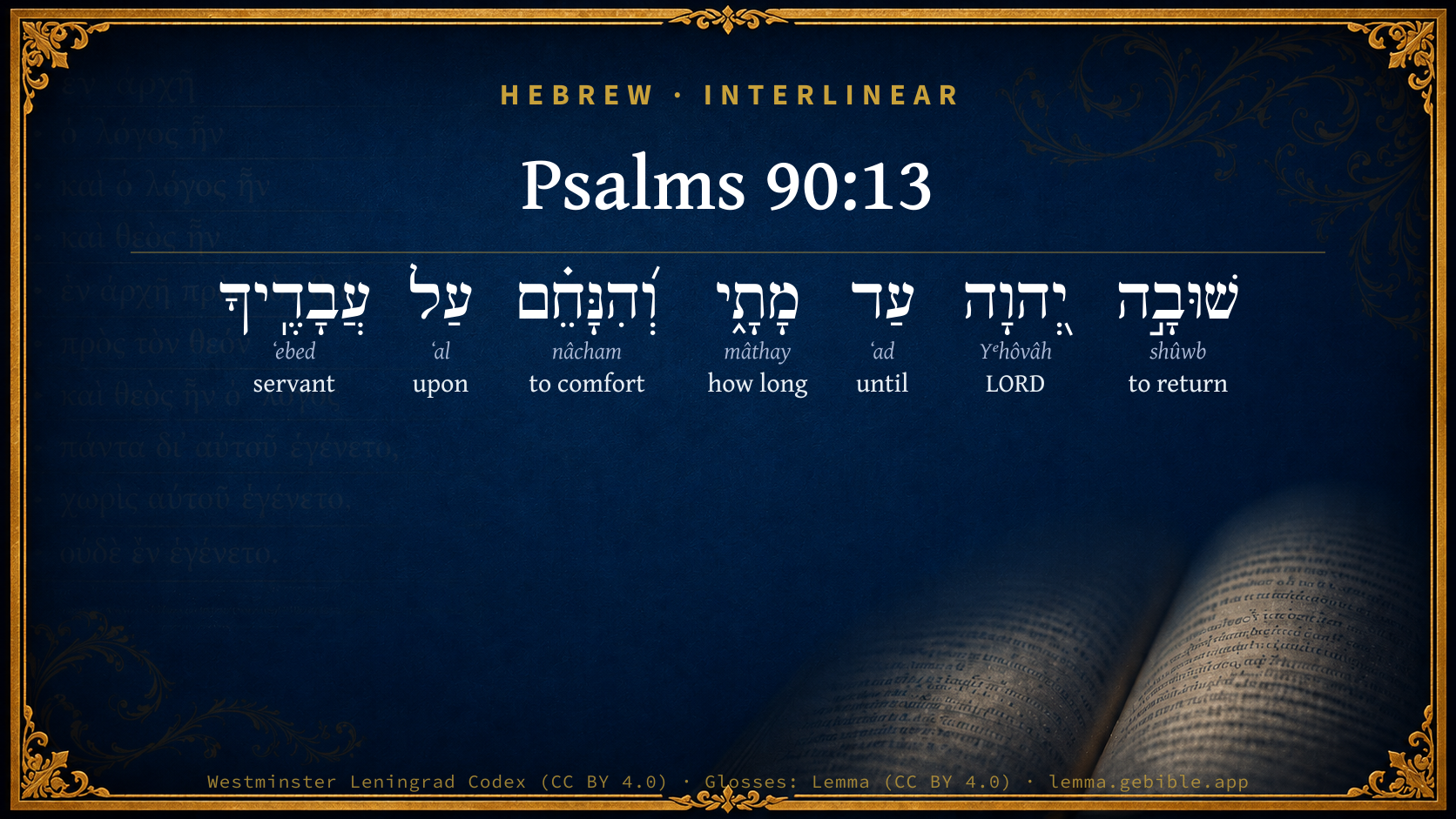
Psalms 90:13

Hebrew (Westminster Leningrad Codex) Psalms 90:13 appears in the Hebrew Old Testament. The text above is from the Westminster Leningrad Codex. Each word links to its Strong’s number, a concise gloss, and parsing drawn from the Open Scriptures Hebrew Bible morphology. Click any word for its full Brown-Driver-Briggs (BDB) entry.
Download image
Cite this verse

Psalms 90:13 (World English Bible). Public Domain. Lemma interlinear Bible study tool, https://lemma.gebible.app/v/psalms/90/13.

Show BibTeX & RIS
BibTeX
RIS
English Translation
Relent, Yahweh! How long? Have compassion on your servants!
World English Bible · Public Domain
Download a study sheet

One document with this verse’s original text, its word-by-word gloss line, the meaning frame, cross-references with their text, attributed commentary, and full source and license credits — printable, and it pastes into notes with its structure intact.

This verse Autodidact and up

Study sheet (.html) Plain text (.txt)

A passage Seminary Student

Up to 50 verses in one chapter. A passage sheet keeps up to 6 commentary sources and 12 cross-references per verse, in the order this page ranks them, and says so on the sheet whenever that leaves anything out. Ask for a single verse and you get the Autodidact verse sheet above.

Everything on this page stays free to read, with no account — the sheet is a download of what is already on screen, not access to it.

Want to remove ads? Support Godless Engineer
Compare translations 3

The same verse in 3 English versions, stacked beneath the original-language interlinear above. Click any original word for its lexicon entry.

Each is an independent rendering of the whole verse — the interlinear is not word-aligned to these translations.

Highlighted words mark where these versions differ — a whole-verse word diff, not a word-by-word alignment.

  • World English Bible Public Domain
    Relent, Yahweh! How long? Have compassion on your servants!
  • King James Version Public Domain
    Return, O LORD, how long? and let it repent thee concerning thy servants.
  • unfoldingWord Literal Text CC BY-SA 4.0
    Return, Yahweh! Until when? Have compassion on your servants.

unfoldingWord Literal Text — © unfoldingWord, licensed CC BY-SA 4.0. Word-aligned USFM3 via Door43 (git.door43.org/unfoldingWord/en_ult).

Versions to compare (up to 4)

3 of 4 selected

Show all 18 translations

Every available English version of this verse, each an independent rendering of the whole verse.

  • World English Bible Public Domain
    Relent, Yahweh! How long? Have compassion on your servants!
  • Berean Standard Bible Public Domain
    Return, O LORD! How long will it be? Have compassion on Your servants.
  • Majority Standard Bible Public Domain
    Return, O LORD! How long will it be? Have compassion on Your servants.
  • King James Version Public Domain
    Return, O LORD, how long? and let it repent thee concerning thy servants.
  • American Standard Version (1901) Public Domain
    Return, O Jehovah; how long? And let it repent thee concerning thy servants.
  • Revised Version (1885) Public Domain
    Return, O LORD; how long? and let it repent thee concerning thy servants.
  • Geneva Bible (1599) Public Domain
    Returne (O Lord, howe long?) and be pacified toward thy seruants.
  • Douay-Rheims (1899) Public Domain
    Return, O Lord, how long? and be entreated in favour of thy servants.
  • Young's Literal Translation Public Domain
    Turn back, O Jehovah, till when? And repent concerning Thy servants.
  • Literal Standard Version CC BY-SA 4.0
    Turn back, O YHWH, until when? And regret concerning Your servants.
  • Unlocked Literal Bible CC BY-SA 4.0
    Turn back, Yahweh! How long will it be? Have pity on your servants.
  • unfoldingWord Literal Text CC BY-SA 4.0
    Return, Yahweh! Until when? Have compassion on your servants.
  • Darby Bible Public Domain
    Return, Jehovah: how long? and let it repent thee concerning thy servants.
  • World Messianic Bible Public Domain
    Relent, LORD! How long? Have compassion on your servants!
  • Webster's Bible Public Domain
    Return, O LORD, how long? and repent thou concerning thy servants.
  • Free Bible Version CC BY-SA 4.0
    Lord, how long will it be before you come back to us and have pity on us your servants?
  • Bible in Basic English Public Domain
    Come back, O Lord; how long? let your purpose for your servants be changed.
  • JPS Tanakh (1917) Public Domain
    Return, O LORD; how long? And let it repent Thee concerning Thy servants.

Literal Standard Version (2020), Covenant Press — licensed CC BY-SA 4.0. Text via the HelloAO Bible API (eBible.org). Unlocked Literal Bible (unfoldingWord) — licensed CC BY-SA 4.0. Text via the HelloAO Bible API (eBible.org). unfoldingWord Literal Text — © unfoldingWord, licensed CC BY-SA 4.0. Word-aligned USFM3 via Door43 (git.door43.org/unfoldingWord/en_ult). Free Bible Version, Dr. Jonathan Gallagher — licensed CC BY-SA 4.0. Text via the HelloAO Bible API (eBible.org).

Word by word

More ways to search: Search by grammar → Find every occurrence → Compare this word →

Practice this passage: Drill this verse → Learn its vocabulary →

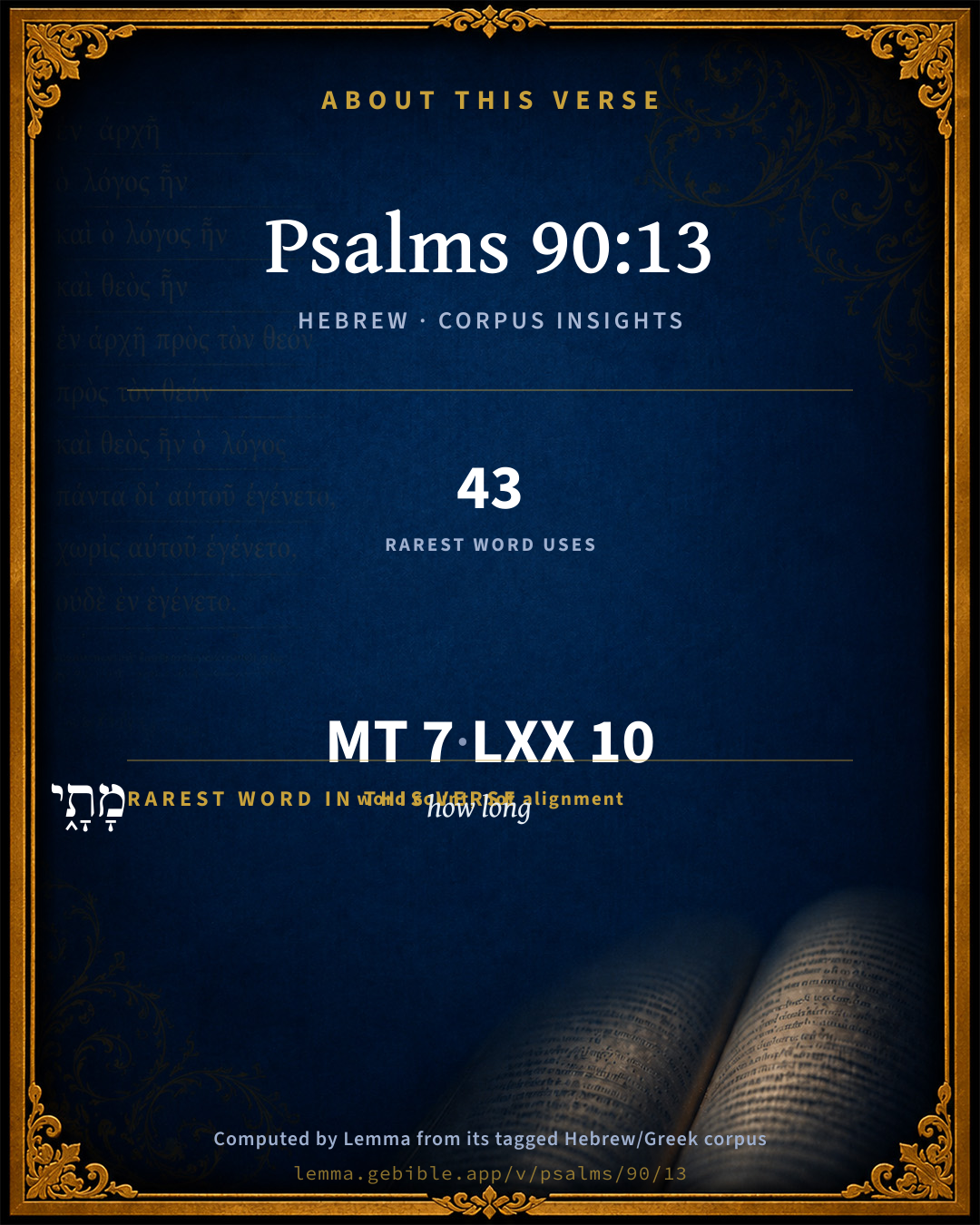
About this verse

These counts appear in no published source. They are computed here, from the morphology-tagged text and Lemma’s own curated glosses. What Lemma adds →

7
words
7
distinct lemmas
Wisdom
section

Shared distinctive vocabulary

מָתָ֑י how long H4970 occurs in 40 verses of the Hebrew Bible. Also found in:

Grammatical profile

  • 2 verbs
  • 2 nouns
  • 2 prepositions
  • 1 particle

Verb forms

  • שׁוּבָ֣ה Qal · Imperative
  • וְ֝הִנָּחֵ֗ם Niphal · Imperative

Hebrew & Septuagint length

In English translation the verse runs 9 words from the Hebrew and 11 from the Septuagint (LXX English) — closely comparable.

A rough comparison of the two English renderings, which tokenize alike — not a word-level alignment.

Word counts can differ between the Hebrew and the Greek without any difference in meaning — e.g. the Hebrew direct-object marker אֵת has no separate Greek word, and Greek often adds the article ὁ.

In the original languages it is 7 Hebrew tokens and 10 Greek tokens — but the two are counted differently (Hebrew bundles its prefixes and suffixes into one token; the Greek is in lemma form), so that isn’t a like-for-like length.

Cross-references

16

Topical passages linked to Psalms 90:13 in the Treasury of Scripture Knowledge — connected by theme and wording, ordered by reader-vote popularity; previews shown in the World English Bible.

  • Deuteronomy 32:36 For Yahweh will judge his people, Repent himself for his servants; When he sees that [their] power is gone, There is none [remaining], shut up or left at large.
  • Psalms 106:45 He remembered for them his covenant, And repented according to the multitude of his loving kindnesses.
  • Psalms 135:14 For Yahweh will judge his people, And have compassion on his servants.
  • Psalms 80:14 Turn again, we beg you, God of hosts. Look down from heaven, and see, and visit this vine,
  • Psalms 89:46 How long, Yahweh? Will you hide yourself forever? Will your wrath burn like fire?
  • Hosea 11:8 "How can I give you up, Ephraim? How can I hand you over, Israel? How can I make you like Admah? How can I make you like Zeboiim? My heart is turned within me, My compassion is aroused.
  • Joel 2:13–14 Tear your heart, and not your garments, And turn to Yahweh, your God; For he is gracious and merciful, Slow to anger, and abundant in loving kindness, And relents from sending calamity.
  • Amos 7:3 Yahweh relented concerning this. "It shall not be," says Yahweh.
  • Amos 7:6 Yahweh relented concerning this. "This also shall not be," says the Lord Yahweh.
  • Jonah 3:9 Who knows whether God will not turn and repent, and turn away from his fierce anger, so that we might not perish?"
  • Exodus 32:12 Why should the Egyptians speak, saying, 'He brought them forth for evil, to kill them in the mountains, and to consume them from the surface of the earth?' Turn from your fierce wrath, and repent of this evil against your people.
  • Exodus 32:14 Yahweh repented of the evil which he said he would do to his people.
  • Psalms 6:3–4 My soul is also in great anguish. But you, Yahweh--how long?
  • Psalms 74:10 How long, God, shall the adversary reproach? Shall the enemy blaspheme your name forever?
  • Jeremiah 12:15 It shall happen, after that I have plucked them up, I will return and have compassion on them; and I will bring them again, every man to his heritage, and every man to his land.
  • Zechariah 1:16 Therefore thus says Yahweh: "I have returned to Jerusalem with mercy. My house shall be built in it," says Yahweh of Hosts, "and a line shall be stretched forth over Jerusalem."'

Cross-references courtesy of OpenBible.info (CC BY 4.0).

Hebrew and Greek witnesses Masoretic Hebrew ↔ Greek Septuagint

The same verse in the two great witnesses to the Old Testament, shown verse-for-verse.

You’re reading Greek Psalm 89 (Hebrew Psalm 90). The Septuagint counts the superscription, so verse numbers can differ from the Hebrew — chapter-level alignment, not verse-by-verse. Numbering follows Rahlfs.

These are two independent witnesses, not word-aligned to each other, and the Septuagint is shown in lemma (dictionary) form.

Hebrew Psalms 90:13 Masoretic · Westminster Leningrad Codex

שׁוּבָ֣ה יְ֭הוָה עַד מָתָ֑י וְ֝הִנָּחֵ֗ם עַל עֲבָדֶֽיךָ

Relent, Yahweh! How long? Have compassion on your servants!

World English Bible · Public Domain

Greek LXX Greek Psalm 89:13 Septuagint · lemma form

ἐπιστρέφω κύριος ἕως πότε καί παρακαλέω ἐπί ὁ δοῦλος σύ

Return, O Lord, how long? and be entreated concerning your servants.

LXX2012 (modern English Septuagint) · Public Domain

Hebrew: Westminster Leningrad Codex (CC BY 4.0). Greek: Septuagint (public domain); English from LXX2012 (modern English Septuagint) (Public Domain). How the Septuagint differs from the Hebrew →

Commentary

Notes on Psalms 90:13 from classic Christian and Jewish commentators (each source and its license shown beneath its notes). The classic Christian expositions comment on the surrounding passage and are grouped to its opening verse, so a note may address several verses; the Jewish commentaries on the Tanakh (Rashi and others) are per-verse, so they appear only where the commentator wrote on this verse.

Lemma curates 59 commentaries, every one of them public domain or Creative Commons licensed, each selected and text-cleaned for this edition rather than reprinted as found. About our sources →

Trapp's Complete Commentary

John Trapp

Psa 90:13 Return, O LORD, how long? and let it repent thee concerning thy servants.

Ver. 13. Let it repent thee] Or, comfort thou thy servants.

John Trapp, A Commentary or Exposition upon All the Books of the Old and New Testament (1647–1656) — public domain. Text from a community e-Sword module.

The Biblical Illustrator

Joseph S. Exell

Psa_90:13

Return, O Lord, how long?

and let it repent Thee concerning Thy servants.

Gods return to the soul or nation

I. God doth sometimes desert and depart from His people for a time. Not in regard of their union, but in regard of communion and manifestation. Though nothing is hid from the heat of this sun, yet our souls may be hid from the light of this sun: God doth sometimes depart from His own people. There are some graces that do not open nor show themselves but in the sunshining day of Gods presence--thankfulness, joy, assurance. But there are other graces, that are best seen when God withdraws, and when God is absent--faith in God, and love to God especially.

II. The people of God are very sensible of His displeasure. They look upon it as a very tedious thing; and most afflictions. O Lord, how long? Without the presence of God they have no enjoyment, their enjoyments are as no enjoyments: the presence of God with them is the top of all their enjoyments. If the sun be down, it is not all the torches and candles lighted up that will give you a day; and if God be gone, it is not all your creature comforts will give you joy.

III. In the time of those departures their great desire is that God would return. What is the presence of God but the most desirable thing in the world? (Act_3:19). Gods presence is the saints pleasure. God never returns empty-handed to His people. When He hath stricken them, He will let out more love unto them than ever before.

IV. When the Lord doth return unto His people, He doth then repent Him concerning His servants.

1. God doth not repent by the changing of His affection, but by the changing of His dispensation.

2. God will more easily repent of His judgments than of His mercies.

3. How it may appear that when God returns unto His people, that then He will repent Him concerning His servants. Why that appears by the thing itself. If a man say he will go from such a town and never return again, and then do return, he doth repent him concerning the thing, by his return; and so concerning God (Jer_18:7-8).

4. But then, how shall we know in case God be absent, or God be departed, to know that God will return again? You may know it by your relations. If you be in covenant with God, God will return again to you though now He be absent; Though He afflict you with rods, His lovingkindness will He not take away, nor suffer his faithfulness to fail.

V. What shall we do that God may return again?

1. Be sure of this, that you keep your door open, the door of your hearts open for Christs return. When the master is abroad, the servant sits up to keep the door open for his coming in.

2. Be sure of this, that now in the time of Christs absence you neglect no duty, though very unsavoury to you. The more unsavoury the duty now is unto you through the absence of Christ, the more acceptable unto Christ.

3. Be sure that you go and stand there where Christ used to be. (W. Bridge, M.A.)

The Biblical Illustrator, edited by Joseph S. Exell (c. 1880s–1900s) — public domain. Text from a community e-Sword module.

Joseph Benson's Commentary

Psa 90:13-17. Return, O Lord — To us in mercy. How long? — Understand, wilt thou be angry? Or, will it be ere thou return to us? Let it repent thee, &c. — Of thy severe proceedings against us. O satisfy us early with thy mercy — That is, speedily, or seasonably, before we be utterly consumed. Make us glad, &c. — Our afflictions have been sharp and long, let not our prosperity be small and short. Let thy work appear to thy servants — Declare to all the world, that thou hast not quite forsaken us thy servants, but wilt still work wonders for us; and thy glory unto their children — Do more glorious and magnificent things for our children. Let that great and glorious work of giving thy people a complete deliverance, which thou didst long since design and promise, be at last accomplished and manifested in the sight of the world. And let the beauty of the Lord be upon us — His favourable countenance, gracious influence, and glorious presence. And establish the work of our hands upon us — Or, in us. Do not only work for us, but in us; enlighten our minds, and renew our hearts by thy Holy Spirit, that we may turn, and constantly cleave to thee, and not revolt and draw back from thee, as we have frequently done, to our own shame and undoing.

Joseph Benson's Commentary on the Old and New Testaments (1811–1818) — public domain. Text from a community e-Sword module.

Keil & Delitzsch

C. F. Keil & F. Delitzsch

The prayer for a salutary knowledge, or discernment, of the appointment of divine wrath is now followed by the prayer for the return of favour, and the wish that God would carry out His work of salvation and bless Israel's undertakings to that end. We here recognise the well-known language of prayer of Moses in Exo 32:12, according to which שׁוּבה is not intended as a prayer for God's return to Israel, but for the turning away of His anger; and the sigh עד־מתי that is blended with its asks how long this being angry, which threatens to blot Israel out, is still to last. והנּהם is explained according to this same parallel passage: May God feel remorse or sorrow (which in this case coincide) concerning His servants, i.e., concerning the affliction appointed to them. The naming of the church by עבדיך (as in Deu 9:27, cf. Exo 32:13 of the patriarchs) reminds one of Deu 32:36 : concerning His servants He shall feel compassion (Hithpa. instead of the Niphal). The prayer for the turning of wrath is followed in Psa 90:14 by the prayer for the turning towards them of favour. In בּבּקר there lies the thought that it has been night hitherto in Israel. "Morning" is therefore the beginning of a new season of favour. In שׂבּענוּ (to which הסדּך is a second accusative of the object) is implied the thought that Israel whilst under wrath has been hungering after favour; cf. the adjective שׂבע in the same tropical signification in Deu 33:23. The supplicatory imperatives are followed by two moods expressive of intention: then will we, or: in order that we may rejoice and be glad; for futures like these set forth the intention of attaining something as a result or aim of what has been expressed just before: Ew. 325, a. בּכל־ימינוּ is not governed by the verbs of rejoicing (Psa 118:24), in which case it would have been בּחיּינוּ, but is an adverbial definition of time (Psa 145:2; Psa 35:8): within the term of life allotted to us. We see from Psa 90:15 that the season of affliction has already lasted for a long time. The duration of the forty years of wrath, which in the midst of their course seemed to them as an eternity, is made the measure of the reviving again that is earnestly sought. The plural ימות instead of ימי is common only to our Psalm and Deu 32:7; it is not known elsewhere to Biblical Hebrew. And the poetical שׁנות instead of שׁני, which also occurs elsewhere, appears for the first time in Deu 32:7. The meaning of ענּיתנוּ, in which ימות hcihw is specialized after the manner of a genitive, is explained from Deu 8:2., according to which the forty years' wandering in the wilderness was designed to humble (ענּות) and to prove Israel through suffering. At the close of these forty years Israel stands on the threshold of the Promise Land. To Israel all final hopes were closely united with the taking possession of this land. We learn from Gen. 49 that it is the horizon of Jacob's prophetic benediction. This Psalm too, in Psa 90:16-17, terminates in the prayer for the attainment of this goal. The psalmist has begun in Psa 90:1 his adoration with the majestic divine name אדני; in Psa 90:13 he began his prayer with the gracious divine name יהוה; and now, where he mentions God for the third time, he gives to Him the twofold name, so full of faith, אדני אלהינוּ. אל used once alternates with the thrice repeated על: salvation is not Israel's own work, but the work of Jahve; it therefore comes from above, it comes and meets Israel. It is worthy of remark that the noun פּעל occurs only in Deuteronomy in the whole Tra, and that here also of the gracious rule of Jahve, Psa 32:4, cf. Psa 33:11. The church calls the work of the Lord מעשׂה ידינוּ in so far as He executes it through them. This expression מעשׂה ידים as a designation of human undertakings runs through the whole of the Book of Deuteronomy: Deu 2:7; Deu 4:28; Deu 11:7; Deu 14:29; Deu 16:15; Deu 24:19; Deu 27:15; Deu 28:12; Deu 30:9. In the work of the Lord the bright side of His glory unveils itself, hence it is called הדר; this too is a word not alien at least to the language of Deuteronomy, Deu 33:17. Therein is made manifest נעם ה, His graciousness and condescension - an expression which David has borrowed from Moses in Psa 27:4. יראה and יהי are optatives. כּוננה is an urgent request, imperat. obsecrantis as the old expositors say. With Waw the same thought is expressed over again (cf. Isa 55:1, וּלכוּ, yea come) - a simple, childlike anadiplosis which vividly reminds us of the Book of Deuteronomy, which revolves in thoughts that are ever the same, and by that very means speaks deeply to the heart. Thus the Deuteronomic impression of this Psalm accompanies us from beginning to end, from מעון to מעשׂה ידים. Nor will it now be merely accidental that the fondness for comparisons, which is a peculiarity of the Book of Deuteronomy (Deu 1:31, Deu 1:44; Deu 8:5; Deu 28:29, Deu 28:49, cf. Deu 28:13, Deu 28:44; Deu 29:17-18), is found again in this Psalm.

Keil & Delitzsch — Biblical Commentary on the Old Testament (1861–1891) — public domain (CC PDM 1.0). Text via the HelloAO Bible API. (Old Testament only.)

J. A. Alexander on Psalms

Joseph Addison Alexander

13. (Psa 90:13) Return, Jehovah! How long (wilt thou forsake us)?—And repent as to thy servants. To the prayer that the people may understand the causes of God's wrath is now added a prayer for its removal. The loss of God's favour is, as usual, represented as his absence. The aposiopesis in the question (how long?) is like that in Psa 6:3; Psa 13:1. This clause being parenthetical, what follows is connected by the copulative particle with the imperative at the beginning. The meaning of the last clause is, so change thy dealing with thy servants as if thou hadst repented of afflicting them. The same bold form of speech is used by Moses elsewhere. See Exo 32:12, Deu 32:36, and compare the imitations in Jdg 2:18, Jer 15:6, Joe 2:13, Jon 4:2, Psa 135:14.

Joseph Addison Alexander, The Psalms Translated and Explained (1850) — public domain. Text from a community e-Sword module.

Tyndale Open Study Notes

Tyndale Open Resources

90:13-17 The psalmist prays for the Lord’s favor and restoration.

90:13 The phrase your servants refers to the community of those loyal to the Lord.

Tyndale Open Study Notes — © Tyndale Open Resources, licensed CC BY-SA 4.0. Text via the HelloAO Bible API.

Geneva Bible (1599)

Geneva Bible translators

Meaning, wilt thou be angry?

Or, take comfort in thy servants.

Geneva Bible (1599) marginal notes — public domain. Text via Bolls.life.

Adam Clarke's Commentary

Verse 13. Return, O Lord, how long?] Wilt thou continue angry with us for ever?

Let it repent thee] הנחם hinnachem, be comforted, rejoice over them to do them good. Be glorified rather in our salvation than in our destruction.

Adam Clarke's Commentary on the Bible (1810–1826) — public domain. Text from a community e-Sword/MySword module.

John Calvin's Commentaries

13. Return, O Jehovah! how long? After having spoken in the language of complaint, Moses adds a prayer, That God, who had not ceased for a long time severely to punish his people, would at length be inclined to deal gently with them. Although God daily gave them in many ways some taste of his love, yet their banishment from the land of promise was a very grievous affliction; for it admonished them that they were unworthy of that blessed inheritance which he had appointed for his children. They could not fail often to remember that dreadful oath which he had thundered out against them,

“Surely they shall not see the land which I sware unto their fathers, neither shall any of them that provoked me see it: But as for you, your carcases, they shall fall in this wilderness,” (Numbers 14:23, 32.)

Moses, no doubt, combines that sore bondage which they had suffered in Egypt with their wanderings in the wilderness; and therefore he justly bewails their protracted languishing in the words how long? As God is said to turn his back upon us, or to depart to a distance from us, when he withdraws the tokens of his favor, so by his return we are to understand the manifestation of his grace. The word נחם, nacham, which we have translated be pacified, signifies to repent, and may therefore not improperly be explained thus: Let it repent thee concerning thy servants. According to the not unfrequent and well known phraseology of Scripture, God is said to repent, when putting away men’s sorrow, and affording new ground of gladness, he appears as it were to be changed. Those, however, seem to come nearer the mind of the Psalmist who translate, Comfort thyself over thy servants; for God, in cherishing us tenderly, takes no less pleasure in us than does a father in his own children. Now that is nothing else than to be pacified or propitious, as we have translated it, to make the meaning the more obvious.

John Calvin's Commentaries (1540-1563) — public domain. Text from the Calvin Translation Society English edition (1840s-50s) via the Christian Classics Ethereal Library (ccel.org). Calvin's coverage is partial (roughly two-thirds of the Bible); uncommented books and verses are honest gaps, never fabricated. The 19th-century editor's footnotes and remarks are omitted so the notes are faithfully Calvin's own voice.

Ellicott's Commentary for English Readers

(13) Return.—Better, turn, either from anger (Exo_32:12), or merely as in Psa_6:4, “turn to thy servant.”

Plainly we have here the experience of some particular epoch, and a prayer for Israel. From his meditation on the shortness of human existence the poet does not pass to a prayer for a prolonged life for himself, like Hezekiah, but for some intervention in relief of the suffering community of which he forms. part.

How long?—See Note, Psa_74:9.

Let it repent thee.—Better, have pity on. (See Deu_32:36.)

A Bible Commentary for English Readers, edited by Charles John Ellicott (1878–1897) — public domain. Text from a community e-Sword module.

The Cambridge Bible for Schools and Colleges

gen. ed. J. J. S. Perowne

13. A combined reminiscence of Exo_32:12 and Deu_32:36. Cp. too Psa_6:3-4. Return is the most obvious rendering; but the passage in Ex. suggests that the meaning may be, Turn from thy wrath; how long wilt thou be angry? Cp. Psa_80:4. God’s change of attitude is spoken of in Scripture after the manner of men as repenting or relenting; not of course that He can regret His course of action, or be subject to mutability of purpose.

13–17. Prayer for such a restoration of God’s favour to His people as will gladden the members of it through the brief span of life. Perhaps the connexion with the preceding verses is the hope that Israel’s resipiscence may prepare the way for Jehovah’s return.

The Cambridge Bible for Schools and Colleges (gen. ed. J. J. S. Perowne; Cambridge University Press, 1878–1918) — public domain. Text from a community e-Sword module.

John Gill's Exposition

Return, O Lord,.... Either from the fierceness of thine anger, according to Aben Ezra and Jarchi; of which complaint is made, Psa 90:7, or unto us, from whom he had departed; for though God is everywhere, as to his being and immensity, yet, as to his gracious presence, he is not; and where that is, he sometimes withdraws it; and when he visits again with it, be may be said to return; and when he returns, he visits with it, and which is here prayed for; and designs a manifestation of himself, of his love and grace, and particularly his pardoning mercy; see Psa 80:14.

how long? this is a short abrupt way of speaking, in which something is understood, which the affection of the speaker would not admit him to deliver; and may be supplied, either thus,

how long wilt thou be angry? God is sometimes angry with his people, which, when they are sensible of, gives them a pain and uneasiness they are not able to bear; and though it endures but for a moment, yet they think it a long time; see Psa 30:5. Arama interprets it,

"how long ere the time of the Messiah shall come?''

or "how long wilt thou hide thyself?" when he does this, they are troubled; and though it is but for a small moment he forsakes them, yet they count it long, and as if it was for ever; see Psa 13:1, or "how long wilt thou afflict us?" as the Targum; afflictions come from the Lord, and sometimes continue long; at least they are thought so by the afflicted, who are ready to fear God has forgotten them and their afflictions, Psa 44:23, or "how long wilt thou defer help?" the Lord helps, and that right early, at the most seasonable time, and when difficulties, are the greatest; but it sometimes seems long first; see Psa 6:3,

and let it repent thee concerning thy servants; men are all so, of right, by creation, and through the benefits of Providence; and many, in fact, being made willing servants by the grace of God; and this carries in it an argument for the petition: repentance does not properly belong to God; it is denied of him, Num 23:19, yet it is sometimes ascribed to him, both with respect to the good he has done, or promised, and with respect to the evil he has brought on men, or threatened to bring; see Gen 6:6, and in the latter sense it is to be understood here; and intends not any change of mind or will in God, which cannot be; but a change of his dispensations, with respect to desertion, affliction, and the like; which the Targum expresses thus,

"and turn from the evil thou hast said thou wilt do to thy servants:''

if this respects the Israelites in the wilderness, and their exclusion from Canaan, God never repented of what he threatened; he swore they should not enter it, and they did not, only their children, excepting two persons: some render the words, "comfort thy servants" (f); with thy presence, the discoveries of thy love, especially pardoning grace, and by removing afflictions, or supporting under them.

(f) "consolare", Pagninus, Montanus, Vatablus.

John Gill's Exposition of the Whole Bible (1746–1763) — public domain (CC PDM 1.0). Text via the HelloAO Bible API.

Albert Barnes' Notes on the Bible

Return, O Lord - Come back to thy people; show mercy by sparing them. It would seem probable from this that the psalm was composed in a time of pestilence, or raging sickness, which threatened to sweep all the people away - a supposition by no means improbable, as such times occurred in the days of Moses, and in the rebellions of the people when he was leading them to the promised land.

How long? - How long shall this continue? How long shall thy wrath rage? How long shall the people still fall under thy hand? This question is often asked in the Psalms. Psa 4:2; Psa 6:3; Psa 13:1-2; Psa 35:17; Psa 79:5, et al.

And let it repent thee - That is, Withdraw thy judgments, and be merciful, as if thou didst repent. God cannot literally “repent,” in the sense that he is sorry for what he has done, but he may act “as if” he repented; that is, he may withdraw his judgments; he may arrest what has been begun; he may show mercy where it seemed that he would only show wrath.

Concerning thy servants - In respect to thy people. Deal with them in mercy and not in wrath.

Albert Barnes' Notes on the Bible (1834–1885) — public domain. Text from a community e-Sword/MySword module.

Matthew Poole's English Annotations

Return, O Lord, to us in mercy; for thou seemest to have forsaken us and cast us off.

How long; understand, wilt thou be angry; or, will it be ere thou return to us?

Concerning thy servants; i.e. of thy severe proceedings against us, and change thy course and carriage to us.

Matthew Poole's English Annotations on the Holy Bible (1683–1685) — public domain. Text from a community e-Sword/MySword module.

The Treasury of David

Charles H. Spurgeon

Ver. 13. Return, O LORD, how long? Come in mercy, to us again. Do not leave us to perish. Suffer not our lives to be both brief and bitter. Thou hast said to us, "Return, ye children of men", and now we humbly cry to thee, "Return, thou preserver of men." Thy presence alone can reconcile us to this transient existence; turn thou unto us. As sin drives God from us, so repentance cries to the Lord to return to us. When men are under chastisement they are allowed to expostulate, and ask "how long?" Our faith in these times is not too great boldness with God, but too much backwardness in pleading with him.

And let it repent thee concerning thy servants. Thus Moses acknowledges the Israelites to be God's servants still. They had rebelled, but they had not utterly forsaken the Lord; they owned their obligations to obey his will, and pleaded them as a reason for pity. Will not a man spare his own servants? Though God smote Israel, yet they were his people, and he had never disowned them, therefore is he entreated to deal favourably with them. If they might not see the promised land, yet he is begged to cheer them on the road with his mercy, and to turn his frown into a smile. The prayer is like others which came from the meek lawgiver when he boldly pleaded with God for the nation; it is Moses like. He here speaks with the Lord as a man speaketh with his friend.

Ver. 13. Let it repent thee. According to the not infrequent and well known phraseology of Scripture, God is said to repent, when putting away men's sorrow, and affording new ground of gladness, he appears as it were to be changed. —John Calvin.

Ver. 13. In what manner the Lord may be said to repent.

Psalms 90:14*

Charles H. Spurgeon's The Treasury of David (1869–1885) — public domain. Psalms only. Text from a community e-Sword/MySword module.

Whedon's Commentary on the Bible

Daniel D. Whedon

13. Return, O Lord—These terrible judgments are viewed as the result of the divine withdrawal. God is supposed to withdraw when he punishes, and to return when he renews his mercy. The previous verse is a prayer that they might return to God; this that he would return to them.

How long— That is, how long wilt thou afflict us?

Let it repent thee—Have compassion. The word denotes a change of treatment, which, with men, would imply a change of feeling, or repentance, but as applied to God it is anthropopathic.

Daniel D. Whedon (gen. ed.), Commentary on the Old and New Testaments (1874–1909) — public domain. Text from a community e-Sword module.

The Pulpit Commentary

Return, O Lord, how long? rather, turn, O Lord; i.e. "turn from thy anger how long will it be ere thou turnest?" And let it repent thee concerning thy servants. God "is not a man, that he should repent"; (Num_23:19) and yet from time to time "it repents him concerning his servants". (Deu_32:36 Psa_135:14) He relents, that is, from his fierce anger, allows himself to be appeased, and has compassion upon those who have provoked him.

The Pulpit Commentary (1880–1919), ed. H.D.M. Spence-Jones & Joseph S. Exell — public domain. Text from a community e-Sword module.

John Wesley's Explanatory Notes

Return - To us in mercy. How long - Will it be before thou return to us? Repent thee - Of thy severe proceedings against us.

John Wesley, Explanatory Notes Upon the Whole Bible (1754–1765) — public domain. Text via the GEBible commentary corpus.

Scofield Reference Notes

C. I. Scofield

repent

(See Scofield "Zec 8:14").

The Scofield Reference Bible (1917 edition), notes by C. I. Scofield — public domain. Text from a community e-Sword module.

Rashi

Rabbi Shlomo Yitzchaki (Rashi)

Return, O Lord from Your burning wrath.

And repent Think well about Your servants.

Rashi on the Tanakh — English translations: “The Judaica Press complete Tanach with Rashi, translated by A. J. Rosenberg” (CC BY 4.0); “Pentateuch with Rashi's commentary by M. Rosenbaum and A.M. Silbermann, 1929-1934” (public domain); “The Metsudah Tanach series, Lakewood, N.J” (CC BY 4.0); and “The Book of Joshua, Metsudah Publications, 1997” (CC BY 4.0). Text via Sefaria.

Lesson kit

Teaching starters — assembled from the data on this page, not authored interpretation. Every prompt links to the verse data it draws on. Edit before teaching.

Psalms, in the Wisdom, opens this verse with 7 words (7 distinct Hebrew lemmas). Its most distinctive word is mâthay (“how long”). A historical commentator’s framing appears above. Read the whole chapter for the surrounding context.

Discussion questions

  1. How does “how long” (mâthay) shape what this verse is saying?
  2. How does Genesis 30:30, which shares the word «how long», read alongside this verse?
  3. These translations render this verse differently. What is at stake in choosing one wording over another?
  4. «שׁוּבָ֣ה» is a Qal Imperative verb. How does that grammatical form shape the action described?
  5. Compare how Trapp's Complete Commentary and The Biblical Illustrator read this verse. Where do they agree or differ?

Things to notice

Reading settings

Reading text

Shown beneath each verse's original-language words.

Old Testament
Old Testament edition

Read the OT as the Masoretic Hebrew (MT) or the Greek Septuagint (LXX).

English shown for the Greek Septuagint (in the Hebrew ↔ Greek comparison).

Comparing translations? Open the Compare panel on any verse page to stack up to four side by side.