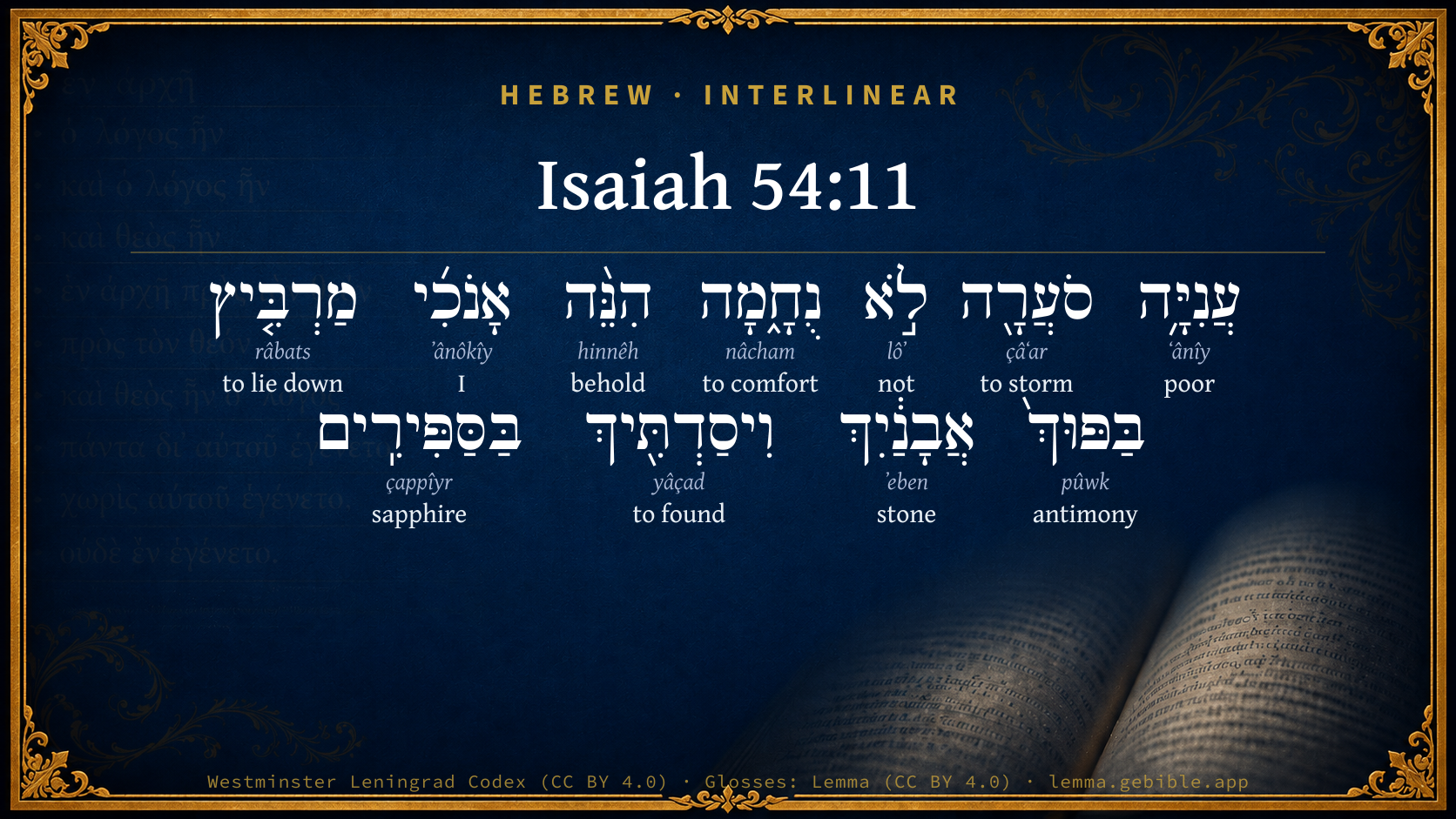
Isaiah 54:11

Hebrew (Westminster Leningrad Codex) Isaiah 54:11 appears in the Hebrew Old Testament. The text above is from the Westminster Leningrad Codex. Each word links to its Strong’s number, a concise gloss, and parsing drawn from the Open Scriptures Hebrew Bible morphology. Click any word for its full Brown-Driver-Briggs (BDB) entry.
Download image
Cite this verse

Isaiah 54:11 (World English Bible). Public Domain. Lemma interlinear Bible study tool, https://lemma.gebible.app/v/isaiah/54/11.

Show BibTeX & RIS
BibTeX
RIS
English Translation
you afflicted, tossed with tempest, and not comforted, behold, I will set your stones in beautiful colors, and lay your foundations with sapphires.
World English Bible · Public Domain
Download a study sheet

One document with this verse’s original text, its word-by-word gloss line, the meaning frame, cross-references with their text, attributed commentary, and full source and license credits — printable, and it pastes into notes with its structure intact.

This verse Autodidact and up

Study sheet (.html) Plain text (.txt)

A passage Seminary Student

Up to 50 verses in one chapter. A passage sheet keeps up to 6 commentary sources and 12 cross-references per verse, in the order this page ranks them, and says so on the sheet whenever that leaves anything out. Ask for a single verse and you get the Autodidact verse sheet above.

Everything on this page stays free to read, with no account — the sheet is a download of what is already on screen, not access to it.

Want to remove ads? Support Godless Engineer
Compare translations 3

The same verse in 3 English versions, stacked beneath the original-language interlinear above. Click any original word for its lexicon entry.

Each is an independent rendering of the whole verse — the interlinear is not word-aligned to these translations.

Highlighted words mark where these versions differ — a whole-verse word diff, not a word-by-word alignment.

  • World English Bible Public Domain
    you afflicted, tossed with tempest, and not comforted, behold, I will set your stones in beautiful colors, and lay your foundations with sapphires.
  • King James Version Public Domain
    O thou afflicted, tossed with tempest, and not comforted, behold, I will lay thy stones with fair colours, and lay thy foundations with sapphires.
  • unfoldingWord Literal Text CC BY-SA 4.0
    “Poor, tempested, not comforted, behold, I am setting your stones in antimony, and I will found you with sapphires.

unfoldingWord Literal Text — © unfoldingWord, licensed CC BY-SA 4.0. Word-aligned USFM3 via Door43 (git.door43.org/unfoldingWord/en_ult).

Versions to compare (up to 4)

3 of 4 selected

Show all 18 translations

Every available English version of this verse, each an independent rendering of the whole verse.

  • World English Bible Public Domain
    you afflicted, tossed with tempest, and not comforted, behold, I will set your stones in beautiful colors, and lay your foundations with sapphires.
  • Berean Standard Bible Public Domain
    “O afflicted city, lashed by storms, without solace, surely I will set your stones in antimony and lay your foundations with sapphires.
  • Majority Standard Bible Public Domain
    “O afflicted city, lashed by storms, without solace, surely I will set your stones in antimony and lay your foundations with sapphires.
  • King James Version Public Domain
    O thou afflicted, tossed with tempest, and not comforted, behold, I will lay thy stones with fair colours, and lay thy foundations with sapphires.
  • American Standard Version (1901) Public Domain
    O thou afflicted, tossed with tempest, and not comforted, behold, I will set thy stones in fair colors, and lay thy foundations with sapphires.
  • Revised Version (1885) Public Domain
    O thou afflicted, tossed with tempest, and not comforted, behold, I will set thy stones in fair colours, and lay thy foundations with sapphires.
  • Geneva Bible (1599) Public Domain
    O thou afflicted and tossed with tempest, that hast no comfort, beholde, I wil lay thy stones with the carbuncle, and lay thy foundation with saphirs,
  • Douay-Rheims (1899) Public Domain
    O poor little one, tossed with tempest, without all comfort, behold I will lay thy stones in order, and will lay thy foundations with sapphires,
  • Young's Literal Translation Public Domain
    O afflicted, storm-tossed, not comforted, Lo, I am laying with cement thy stones, And have founded thee with sapphires,
  • Literal Standard Version CC BY-SA 4.0
    “O afflicted, storm-tossed, not comforted, || Behold, I am laying your stones with cement, || And have founded you with sapphires,
  • Unlocked Literal Bible CC BY-SA 4.0
    Afflicted one, storm-driven and uncomforted one, look, I will set your pavement in turquoise, and lay your foundations with sapphires.
  • unfoldingWord Literal Text CC BY-SA 4.0
    “Poor, tempested, not comforted, behold, I am setting your stones in antimony, and I will found you with sapphires.
  • Darby Bible Public Domain
    [Thou] afflicted, tossed with tempest, not comforted! Behold, I will set thy stones in antimony, and lay thy foundations with sapphires;
  • World Messianic Bible Public Domain
    “You afflicted, tossed with storms, and not comforted, behold, I will set your stones in beautiful colors, and lay your foundations with sapphires.
  • Webster's Bible Public Domain
    Oh thou afflicted, tossed with tempest, and not comforted, behold, I will lay thy stones with fair colors, and lay thy foundations with sapphires.
  • Free Bible Version CC BY-SA 4.0
    My poor storm-damaged city that can't be comforted! Look, I'm going to reset your stones in cement made of antimony, I will use sapphires to lay your foundations.
  • Bible in Basic English Public Domain
    O troubled one, storm-crushed, uncomforted! see, your stones will be framed in fair colours, and your bases will be sapphires.
  • JPS Tanakh (1917) Public Domain
    O thou afflicted, tossed with tempest, and not comforted, behold, I will set thy stones in fair colours, and lay thy foundations with sapphires.

Literal Standard Version (2020), Covenant Press — licensed CC BY-SA 4.0. Text via the HelloAO Bible API (eBible.org). Unlocked Literal Bible (unfoldingWord) — licensed CC BY-SA 4.0. Text via the HelloAO Bible API (eBible.org). unfoldingWord Literal Text — © unfoldingWord, licensed CC BY-SA 4.0. Word-aligned USFM3 via Door43 (git.door43.org/unfoldingWord/en_ult). Free Bible Version, Dr. Jonathan Gallagher — licensed CC BY-SA 4.0. Text via the HelloAO Bible API (eBible.org).

Word by word

More ways to search: Search by grammar → Find every occurrence → Compare this word →

Practice this passage: Drill this verse → Learn its vocabulary →

בַּפּוּךְ֙
pûwk
H6320
“in/at the · antimony”
Preposition, Determined + Noun, Common, Masculine, Singular, Absolute
Part of Speech
Preposition + Noun
Type
Common
Gender
Masculine
Number
Singular
State
Absolute
Full BDB Definition

Origin: from an unused root meaning to paint

TWOT: 1742

antimony, stibium, black paint - eye cosmetic
  1. עֲנִיָּ֥ה ʻânîy H6041 “poor” Adjective, Adjective, Feminine, Singular, Absolute
  2. סֹעֲרָ֖ה çâʻar H5590 “to storm” Verb, Pual, Perfect, 3rd Person, Feminine, Singular
  3. לֹ֣א lôʼ H3808 “not” Particle, Negative
  4. נֻחָ֑מָה nâcham H5162 “to comfort” Verb, Pual, Perfect, 3rd Person, Feminine, Singular
  5. הִנֵּ֨ה hinnêh H2009 “behold” Particle, Demonstrative
  6. אָנֹכִ֜י ʼânôkîy H595 “I” Pronoun, Personal, 1st Person, Common, Singular
  7. מַרְבִּ֤יץ râbats H7257 “lying down” Verb, Hiphil, Participle Active, Masculine, Singular, Absolute
  8. אֲבָנַ֔יִךְ ʼeben H68 “stones · your” Noun, Common, Feminine, Plural, Construct + Suffix, Personal, 2nd Person, Feminine, Singular
  9. וִיסַדְתִּ֖יךְ yâçad H3245 “and · to found · you” Conjunction + Verb, Qal, Sequential Perfect, 1st Person, Common, Singular + Suffix, Personal, 2nd Person, Feminine, Singular
  10. בַּסַּפִּירִֽים çappîyr H5601 “in/at the · sapphires” Preposition, Determined + Noun, Common, Masculine, Plural, Absolute

About this verse

These counts appear in no published source. They are computed here, from the morphology-tagged text and Lemma’s own curated glosses. What Lemma adds →

11
words
11
distinct lemmas
Prophets
section

Notable vocabulary

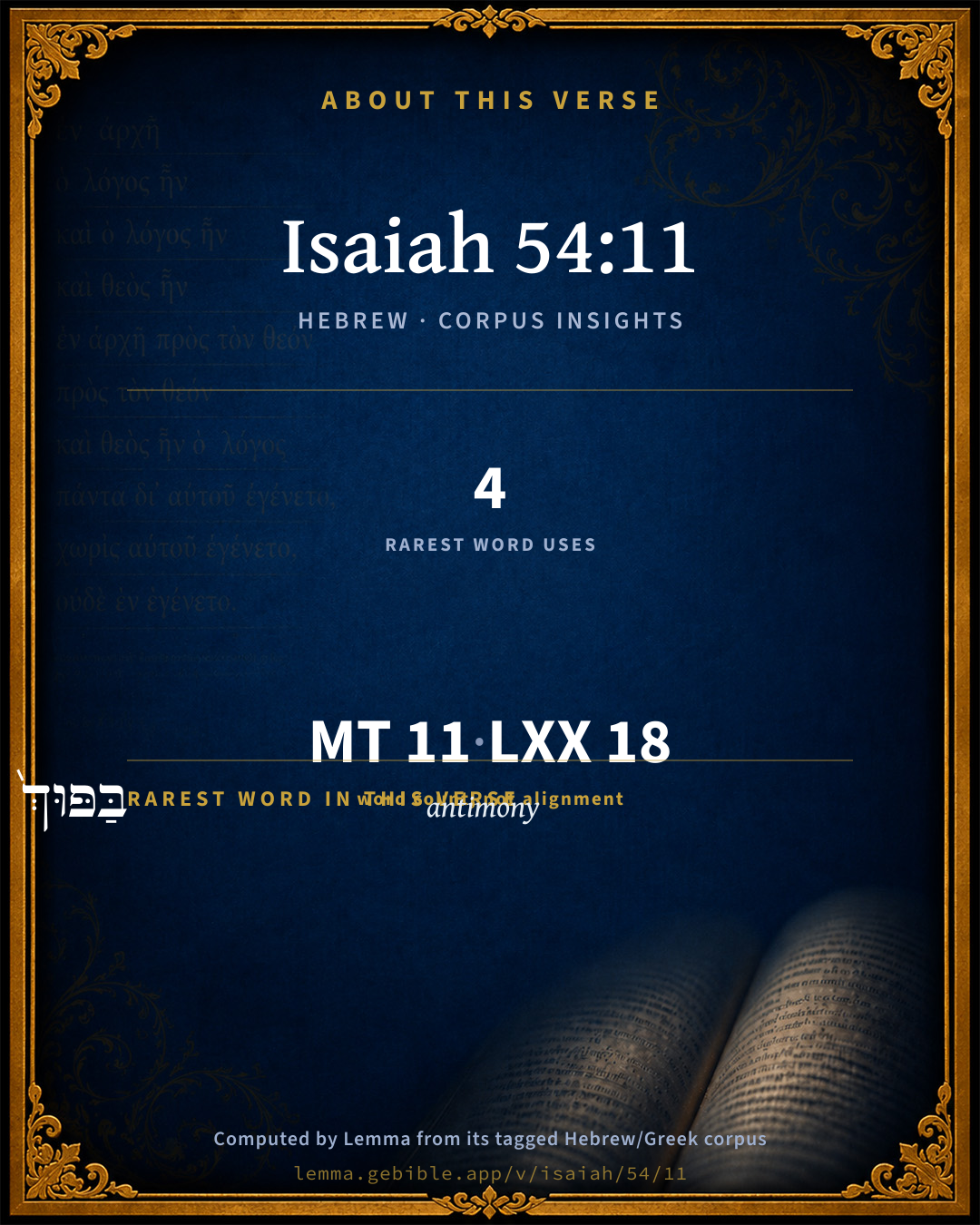
The rarest word here is בַּפּוּךְ֙ antimony H6320 — appearing just 4 times in the whole Hebrew Bible.

Shared distinctive vocabulary

בַּפּוּךְ֙ antimony H6320 occurs in 4 verses of the Hebrew Bible. Also found in:

Grammatical profile

  • 4 verbs
  • 3 nouns
  • 1 adjective
  • 1 pronoun
  • 2 particles

Verb forms

  • סֹעֲרָ֖ה Pual · Perfect
  • נֻחָ֑מָה Pual · Perfect
  • מַרְבִּ֤יץ Hiphil · Participle Active
  • וִיסַדְתִּ֖יךְ Qal · Sequential Perfect

Hebrew & Septuagint length

In English translation the verse runs 23 words from the Hebrew and 21 from the Septuagint (LXX English) — closely comparable.

A rough comparison of the two English renderings, which tokenize alike — not a word-level alignment.

Word counts can differ between the Hebrew and the Greek without any difference in meaning — e.g. the Hebrew direct-object marker אֵת has no separate Greek word, and Greek often adds the article ὁ.

In the original languages it is 11 Hebrew tokens and 18 Greek tokens — but the two are counted differently (Hebrew bundles its prefixes and suffixes into one token; the Greek is in lemma form), so that isn’t a like-for-like length.

Cross-references

37

Topical passages linked to Isaiah 54:11 in the Treasury of Scripture Knowledge — connected by theme and wording, ordered by reader-vote popularity; previews shown in the World English Bible.

  • 1 Peter 2:4–6 coming to him, a living stone, rejected indeed by men, but chosen by God, precious.
  • Jeremiah 30:17 For I will restore health to you, and I will heal you of your wounds, says Yahweh; because they have called you an outcast, [saying], It is Zion, whom no man seeks after.
  • Acts 14:22 confirming the souls of the disciples, exhorting them to continue in the faith, and that through many afflictions we must enter into the Kingdom of God.
  • Isaiah 54:6 For Yahweh has called you as a wife forsaken and grieved in spirit, even a wife of youth, when she is cast off, says your God.
  • 1 Chronicles 29:2 Now I have prepared with all my might for the house of my God the gold for the [things of] gold, and the silver for the [things of] silver, and the brass for the [things of] brass, the iron for the [things of] iron, and wood for the [things of] wood; onyx stones, and [stones] to be set, stones for inlaid work, and of various colors, and all manner of precious stones, and marble stones in abundance.
  • Psalms 34:19 Many are the afflictions of the righteous, But Yahweh delivers him out of them all.
  • Exodus 2:23 It happened in the course of those many days, that the king of Egypt died, and the children of Israel sighed because of the bondage, and they cried, and their cry came up to God because of the bondage.
  • Revelation 21:18–21 The construction of its wall was jasper. The city was pure gold, like pure glass.
  • Isaiah 14:32 What then shall one answer the messengers of the nation? That Yahweh has founded Zion, and in her shall the afflicted of his people take refuge.
  • Isaiah 28:16 therefore thus says the Lord Yahweh, Behold, I lay in Zion for a foundation a stone, a tried stone, a precious corner -[stone] of sure foundation: he who believes shall not be in haste.
  • Isaiah 49:14 But Zion said, Yahweh has forsaken me, and the Lord has forgotten me.
  • Isaiah 51:21 Therefore hear now this, you afflicted, and drunken, but now with wine:
  • Lamentations 1:1–2 How does the city sit solitary, that was full of people! She has become as a widow, who was great among the nations! She who was a princess among the provinces is become tributary!
  • Ezekiel 10:1 Then I looked, and see, in the expanse that was over the head of the cherubim there appeared above them as it were a sapphire stone, as the appearance of the likeness of a throne.
  • Revelation 12:13–17 When the dragon saw that he was thrown down to the earth, he persecuted the woman who gave birth to the male child.
  • Exodus 3:2 The angel of Yahweh appeared to him in a flame of fire out of the midst of a bush. He looked, and behold, the bush burned with fire, and the bush was not consumed.
  • Exodus 3:7 Yahweh said, "I have surely seen the affliction of my people who are in Egypt, and have heard their cry because of their taskmasters, for I know their sorrows.
  • Exodus 24:10 They saw the God of Israel. Under his feet was like a paved work of sapphire stone, like the skies for clearness.
  • Exodus 28:17–20 You shall set in it settings of stones, four rows of stones: a row of ruby, topaz, and beryl shall be the first row;
  • Exodus 39:10–14 They set in it four rows of stones. A row of ruby, topaz, and beryl was the first row;
  • Deuteronomy 31:17 Then my anger shall be kindled against them in that day, and I will forsake them, and I will hide my face from them, and they shall be devoured, and many evils and troubles shall come on them; so that they will say in that day, Haven't these evils come on us because our God is not among us?
  • 1 Kings 5:17 The king commanded, and they hewed out great stones, costly stones, to lay the foundation of the house with worked stone.
  • Psalms 129:1–3 Many times they have afflicted me from my youth up. Let Israel now say,
  • Song of Solomon 5:14 His hands are like rings of gold set with beryl. His body is like ivory work overlaid with sapphires.
  • Isaiah 51:17–19 Awake, awake, stand up, Jerusalem, that have drunk at the hand of Yahweh the cup of his wrath; you have drunken the bowl of the cup of staggering, and drained it.
  • Isaiah 51:23–52:5 and I will put it into the hand of those who afflict you, who have said to your soul, Bow down, that we may go over; and you have laid your back as the ground, and as the street, to those who go over.
  • Isaiah 60:15 Whereas you have been forsaken and hated, so that no man passed through you, I will make you an eternal excellency, a joy of many generations.
  • Lamentations 1:16–17 For these things I weep; my eye, my eye runs down with water; Because the comforter who should refresh my soul is far from me: My children are desolate, because the enemy has prevailed.
  • Lamentations 1:21 They have heard that I sigh; there is none to comfort me; All my enemies have heard of my trouble; they are glad that you have done it: You will bring the day that you have proclaimed, and they shall be like me.
  • Ezekiel 1:26 Above the expanse that was over their heads was the likeness of a throne, as the appearance of a sapphire stone; and on the likeness of the throne was a likeness as the appearance of a man on it above.
  • Ezekiel 40:1–42 In the five and twentieth year of our captivity, in the beginning of the year, in the tenth [day] of the month, in the fourteenth year after that the city was struck, in the same day, the hand of Yahweh was on me, and he brought me there.
  • Matthew 8:24 Behold, a great tempest arose in the sea, so much that the boat was covered with the waves, but he was asleep.
  • John 16:20–22 Most assuredly I tell you, that you will weep and lament, but the world will rejoice. You will be sorrowful, but your sorrow will be turned into joy.
  • John 16:33 I have told you these things, that in me you may have peace. In the world you have oppression; but cheer up! I have overcome the world."
  • Acts 27:18–20 As we labored exceedingly with the storm, the next day they began to throw things overboard.
  • Ephesians 2:20 being built on the foundation of the apostles and prophets, Christ Jesus himself being the chief cornerstone;
  • Revelation 11:3–10 I will give power to my two witnesses, and they will prophesy one thousand two hundred sixty days, clothed in sackcloth."

Cross-references courtesy of OpenBible.info (CC BY 4.0).

Hebrew and Greek witnesses Masoretic Hebrew ↔ Greek Septuagint

The same verse in the two great witnesses to the Old Testament, shown verse-for-verse.

These are two independent witnesses, not word-aligned to each other, and the Septuagint is shown in lemma (dictionary) form.

Hebrew Isaiah 54:11 Masoretic · Westminster Leningrad Codex

עֲנִיָּ֥ה סֹעֲרָ֖ה לֹ֣א נֻחָ֑מָה הִנֵּ֨ה אָנֹכִ֜י מַרְבִּ֤יץ בַּפּוּךְ֙ אֲבָנַ֔יִךְ וִיסַדְתִּ֖יךְ בַּסַּפִּירִֽים

you afflicted, tossed with tempest, and not comforted, behold, I will set your stones in beautiful colors, and lay your foundations with sapphires.

World English Bible · Public Domain

Greek LXX Isaiah 54:11 Septuagint · lemma form

ταπεινός καί ἀκατάστατος οὐ παρακαλέω ἰδού ἐγώ ἑτοιμάζω σύ ἄνθραξ ὁ λίθος σύ καί ὁ θεμέλιον σύ σάπφειρος

Afflicted and outcast you have not been comforted: behold, I will prepare carbuncle for your stones, and sapphire for your foundations;

LXX2012 (modern English Septuagint) · Public Domain

On this verse, Joseph Benson's Commentary discusses the Septuagint’s reading. Read the note in Commentary ↓

Hebrew: Westminster Leningrad Codex (CC BY 4.0). Greek: Septuagint (public domain); English from LXX2012 (modern English Septuagint) (Public Domain). How the Septuagint differs from the Hebrew →

Targum (Aramaic paraphrase)

1

The Targum is the ancient Jewish Aramaic paraphrase of the Hebrew Scriptures — an interpretive translation, not the Hebrew text itself. Onkelos (literal) and Pseudo-Jonathan (expansive) render the Torah, and Jonathan the Prophets. Coverage is partial: where no permissively-licensed English translation exists for a verse, only the Aramaic is shown. This is verse-level text, not a word-by-word alignment to the Hebrew.

  1. Targum Jonathan Prophets (Joshua–Malachi)
    חֲשִׁיבָתָא מְקַבְּלָא עוּלְבַּן קַרְתָּא דְאָמְרִין עֲלָה עַמְמַיָא לָא תִתְנְחֵם הָא אֲנָא כָּבֵשׁ בִצְדִידָא אַבְנֵי רִצְפָּתִיךְ וַאֲשַׁכְלְלִינִיךְ בְּאַבְנִין טָבִין:

    O distressed city that receiveth affliction, concerning her the nations say, She shall not be comforted: behold, I lay the stones of thy pavement with mosaic, and thy foundations with costly stones.

    Targum Jonathan — Aramaic: “Mikraot Gedolot” (public domain). English: “Sefaria Community Translation” (CC0 1.0 (public-domain dedication)); “London "Chaldee Paraphrase," 1871” (public domain). Text via Sefaria.

Commentary

Notes on Isaiah 54:11 from classic Christian and Jewish commentators (each source and its license shown beneath its notes). The classic Christian expositions comment on the surrounding passage and are grouped to its opening verse, so a note may address several verses; the Jewish commentaries on the Tanakh (Rashi and others) are per-verse, so they appear only where the commentator wrote on this verse.

Lemma curates 59 commentaries, every one of them public domain or Creative Commons licensed, each selected and text-cleaned for this edition rather than reprinted as found. About our sources →

Matthew Henry's Commentary

Very precious promises are here made to the church in her low condition, that God would not only continue his love to his people under their troubles as before, but that he would restore them to their former prosperity, nay, that he would raise them to greater prosperity than any they had yet enjoyed. In the foregoing chapter we had the humiliation and exaltation of Christ; here we have the humiliation and exaltation of the church; for, if we suffer with him, we shall reign with him. Observe,

I. The distressed state the church is here reduced to by the providence of God (Isa 54:11): "O thou afflicted, poor, and indigent society, that art tossed with tempests, like a ship driven from her anchors by a storm and hurried into the ocean, where she is ready to be swallowed up by the waves, and in this condition not comforted by any compassionate friend that will sympathize with thee, or suggest to thee any encouraging considerations (Ecc 4:1), not comforted by any allay to thy trouble, or prospect of deliverance out of it." This was the condition of the Jews in Babylon, and afterwards, for a time, under Antiochus. It is often the condition of Christian churches and of particular believers; without are fightings, within are fears; they are like the disciples in a storm, ready to perish; and where is their faith?

II. The glorious state the church is here advanced to by the promise of God. God takes notice of the afflicted distressed state of his church, and comforts her, when she is most disconsolate and has no other comforter. Let the people of God, when they are afflicted and tossed, think they hear God speaking comfortably to them by these words, taking notice of their griefs and fears, what afflictions they are under, what distresses they are in, and what comforts their case calls for. When they bemoan themselves, God bemoans them, and speaks to them with pity: O thou afflicted, tossed with tempests, and not comforted; for in all their afflictions he is afflicted. But this is not all; he engages to raise her up out of her affliction, and encourages her with the assurance of the great things he would do for her, both for her prosperity and for the securing of that prosperity to her.

1. Whereas now she lay in disgrace, God promises that which would be her beauty and honour, which would make her easy to herself and amiable in the eyes of others.

(1.) This is here promised by a similitude taken from a city, and it is an apt similitude, for the church is the city of the living God, the heavenly Jerusalem. Whereas now Jerusalem lay in ruins, a heap of rubbish, it shall be not only rebuilt, but beautified, and appear more splendid than ever; the stones shall be laid not only firm, but fine, laid with fair colours; they shall be glistering stones, Ch1 29:2. The foundations shall be laid or garnished with sapphires, the most precious of the precious stones here mentioned; for Christ (the church's foundation), and the foundation of the apostles and prophets, are precious above any thing else. The windows of this house, city, or temple, shall be made of agates, the gates of carbuncles, and all the borders (the walls that enclose the courts, or the boundaries by which her limits are marked, the mere-stones) shall be of pleasant stones, Isa 54:12. Never was this literally true; but it intimates, [1.] That, God having graciously undertaken to build his church, we may expect that to be done for it, that to be wrought in it, which is very great and uncommon. [2.] That the glory of the New Testament church shall far exceed that of the Jewish church, not in external pomp and splendour, but in those gifts and graces of the Spirit which are infinitely more valuable, that wisdom which is more precious than rubies (Pro 3:15), than the precious onyx and the sapphire, and which the topaz of Ethiopia cannot equal, Job 28:16, Job 28:19. [3.] That the wealth of this world, and those things of it that are accounted most precious, shall be despised by all the true living members of the church, as having no value, no glory, in comparison with that which far excels. That which the children of this world lay up among their treasures, and too often in their hearts, the children of God make pavements of, and put under their feet, the fittest place of it.

(2.) It is here promised in the particular instances of those things that shall be the beauty and honour of the church, which are knowledge, holiness, and love, the very image of God, in which man was created, renewed, and restored. And these are the sapphires and carbuncles, the precious and pleasant stones, with which the gospel temple shall be enriched and beautified, and these wrought by the power and efficacy of those doctrines which the apostle compares to gold or silver, and precious stones, that are to be built upon the foundation, Co1 3:12. Then the church is all glorious, [1.] When it is full of the knowledge of God, and that is promised here (Isa 54:13): All thy children shall be taught of the Lord. The church's children, being born of God, shall be taught of God; being his children by adoption, he will take care of their education. It was promised (Isa 54:1) that the church's children should be many; but lest we should think that being many, as sometimes it happens in numerous families, they will be neglected, and not have instruction given them so carefully as if they were but few, God here takes that work into his own hand: They shall all be taught of the Lord; and none teaches like him. First, It is a promise of the means of instruction and those means authorized by a divine institution: They shall all be taught of God, that is, they shall be taught by those whom God shall appoint and whose labours shall be under his direction and blessing. He will ordain the methods of instruction, and by his word and ordinances will diffuse a much greater light than the Old Testament church had. Care shall be taken for the teaching of the church's children, that knowledge may be transmitted from generation to generation, and that all may be enriched with it, from the least even to the greatest. Secondly, It is a promise of the Spirit of illumination. Our Saviour quotes it with application to gospel grace, and makes it to have its accomplishment in all those that were brought to believe in him (Joh 6:45): It is written in the prophets, They shall be all taught of God, whence he infers that those, and those only, come to him by faith that have heard and learned of the Father, that are taught by him as the truth is in Jesus, Eph 4:21. There shall be a plentiful effusion of the Spirit of grace upon Christians, to teach them all things, Joh 14:26. [2.] When the members of it live in love and unity among themselves: Great shall be the peace of thy children. Peace may be taken here for all good. As where no knowledge of God is no good can be expected, so those that are taught of God to know him are in a fair way to prosper for both worlds. Great peace have those that know and love God's law, Psa 119:165. But it is often put for love and unity; and so we may take it. All that are taught of God are taught to love one another (Th1 4:9) and that will keep peace among the church's children and prevent their falling out by the way. [3.] When holiness reigns; for that above any thing is the beauty of the church (Isa 54:14): In righteousness shall thou be established. The reformation of manners, the restoration of purity, the due administration of public justice, and the prevailing of honesty and fair dealing among men, are the strength and stability of any church or state. The kingdom of God, set up by the gospel of Christ, is not meat and drink, but this righteousness and peace, holiness and love.

2. Whereas now she lay in danger, God promises that which would be her protection and security.

(1.) God engages here that though, in the day of her distress, without were fightings and within were fears, now she shall be safe from both. [1.] There shall be no fears within (Isa 54:14): "Thou shalt be far from oppression. Those that have oppressed thee shall be removed, those that would oppress thee shall be restrained, and therefore thou shalt not fear, but mayest look upon it as a thing at a great distance, that thou art now in no danger of. Thou shalt be far from terror, not only from evil, but from the fear of evil, for it shall not come near thee so as to do thee any hurt or to put thee in any fright." Note, Those are far from terror that are far from oppression; for it is as great a terror as can fall on a people to have the rod of government turned into the serpent of oppression, because against this there is no fence, nor is there any flight from it. [2.] There shall be no fightings without. Though attempts should be made upon them to insult them, to invade their country, or besiege their towns, they should all be in vain, and none of them succeed, Isa 54:15. It is granted, "They shall surely gather together against thee; thou must expect it." The confederate force of hell and earth will be renewing their assaults. As long as there is a devil in hell, and a persecutor out of it, God's people must expect frequent alarms; but, First, God will not own them, will not give them either commission or countenance; they gather together, hand joins in hand, but it is not by me. God gave them no such order as he did to Sennacherib, to take the spoil, and to take the prey, Isa 10:6. And therefore, Secondly, Their attempt will end in their own ruin: "Whosoever shall gather together against thee, be they ever so many and ever so mighty, they shall not only be baffled, but they shall fall for thy sake, or they shall fall before thee, which shall be the just punishment of their enmity to thee." God will make them to fall for the sake of the love he bears to his church and the care he has of it, in answer to the prayers made by his people, and in pursuance of the promises made to them. "They shall fall, that thou mayest stand," Psa 27:2.

(2.) That we may with the greatest assurance depend upon God for the safety of his church, we have here, [1.] The power of God over the church's enemies asserted, Isa 54:16. The truth is they have no power but what is given them from above, and he that gave them their power can limit and restrain them. Hitherto they shall go, and no further. First, They cannot carry on their design without arms and weapons of war; and the smith that makes those weapons is God's creature, and he gave him his skill to work in iron and brass (Exo 31:3, Exo 31:4) and particularly to make proper instruments for warlike purposes. It is melancholy to think, as if men did not die fast enough of themselves, how ingenious and industrious they are to make instruments of death and to find out ways and means to kill one another. The smith blows the coals in the fire, to make his iron malleable, to soften it first, that it may be hardened into steel, and so he may bring forth an instrument proper for the work of those that seek to destroy. It is the iron age that is the age of war. But God has created the smith, and therefore can tie his hands, so that the project of the enemy shall miscarry (as many a project has done) for want of arms and ammunition. Or the smith that forges the weapons is perhaps put here for the council of war that forms the design, blows the coals of contention, and brings forth the plan of the war; these can do no more than God will let them. Secondly, They cannot carry it on without men, they must have soldiers, and it is God that created the waster to destroy. Military men value themselves upon their great offices and splendid titles, and even the common soldiers call themselves gentlemen; but God calls them wasters made to destroy, for wasting and destruction are their business. They think their own ingenuity, labour, and experience, made them soldiers; but it was God that created them, and gave them strength and spirit for that hazardous employment; and therefore he not only can restrain them, but will serve his own purposes and designs by them. [2.] The promise of God concerning the church's safety solemnly laid down, as the heritage of the servants of the Lord (Isa 54:17), as that which they may depend upon and be confident of, that God will protect them from their adversaries both in camps and courts. First, From their field-adversaries, that think to destroy them by force and violence, and dint of sword: "No weapon that is formed against thee (though ever so artfully formed by the smith that blows the coals, Isa 54:16, though ever so skilfully managed by the waster that seeks to destroy) shall prosper; it shall not prove strong enough to do any harm to the people of God; it shall miss its mark, shall fall out of the hand or perhaps recoil in the face of him that uses it against thee." It is the happiness of the church that no weapons formed against it shall prosper long, and therefore the folly of its enemies will at length be made manifest to all, for they are but preparing instruments of ruin for themselves. Secondly, From their law-adversaries, that think to run them down under colour of right and justice. When the weapons of war do not prosper there are tongues that rise in judgment. Both are included in the gates of hell, that seek to destroy the church; for they had their courts of justice, as well as their magazines and military stores, in their gates. The tongues that rise in judgment against the church are as such as either demand a dominion over it, as if God's children were their lawful captives, pretending an authority to oppress their consciences, or they are such as misrepresent them, and falsely accuse them, and by slanders and calumnies endeavour to make them odious to the people and obnoxious to the government. This the enemies of the Jews did, to incense the kings of Persia against them, Ezr 4:12; Est 3:8. "But these insulting threatening tongues thou shalt condemn; thou shalt have wherewith to answer their insolent demands, and to put to silence their malicious reflections. Thou shalt do it by well-doing (Pe1 2:15), by doing that which will make thee manifest in the consciences even of thy adversaries, that thou art not what thou art represented to be. Thou shalt condemn them, that is, God shall condemn them for thee. He shall bring forth thy righteousness as the light, Psa 37:6. Thou shalt condemn them as Noah condemned the old world that reproached him, by building the ark, and so saving his house, in contempt of their contempts." The day is coming when God will reckon with the wicked men for all their hard speeches which they have spoken against him, Jde 1:15.

The last words refer not only to this promise, but to all that go before: This is the heritage of the servants of the Lord. God's servants are his sons, for he has provided an inheritance for them, rich, sure, and indefeasible. God's promises are their heritage for ever (Psa 119:111); and their righteousness is of me, saith the Lord. God will clear up the righteousness of their cause before men. It is with him, for he knows it; it is with him, for he will plead it. Or their reward for their righteousness, and for all that which they have suffered unrighteously, is of God, that God who judges in the earth, and with whom verily there is a reward for the righteous. Or their righteousness itself, all that in them which is good and right, is of God, who works it in them; it is of Christ who is made righteousness to them. In those for whom God designs a heritage hereafter he will work righteousness now.

Matthew Henry's Commentary on the Whole Bible (1708–1710) — public domain (CC PDM 1.0). Text via the HelloAO Bible API.

Trapp's Complete Commentary

John Trapp

Isa 54:11 O thou afflicted, tossed with tempest, [and] not comforted, behold, I will lay thy stones with fair colours, and lay thy foundations with sapphires.

Ver. 11. O thou afflicted, tossed with tempest, and not comforted.] This is the Church’s style and state in this present life: Ecclesia est haeres crucis, The church’s cross clings, saith Luther. None out of hell have suffered more than saints.

Behold, I will lay thy stones with fair colours.] So that thou shalt be a city of pearl, having for thy foundation the Lord Christ, {1Co 3:11} for thy windows, the holy prophets, apostles, and other faithful preachers, by whose ministry thou shalt receive the light of true knowledge, {Dan 12:3} and for thy walls and gates the divine protection. See Rev 21:11-21. All this is to be understood as the spiritual excellence of the Church, which is begun in this life, and to be perfected in the life to come.

And lay thy foundations with sapphires.] Compare Exo 24:10, where Moses and the eiders are said to have "seen the God of Israel; and there was under his feet as it were a paved work of a sapphire stone, and as it were the body of heaven in its clearness." To show that God had now changed their condition, their bricks made in their bondage to sapphire, their lying and sooting among the pots into the wings of a dove covered with silver, and her feathers of pure gold. {as Psa 68:13}

John Trapp, A Commentary or Exposition upon All the Books of the Old and New Testament (1647–1656) — public domain. Text from a community e-Sword module.

The Biblical Illustrator

Joseph S. Exell

Isa_54:11-17

O thou afflicted

The city of God

The reference is still to Jerusalem.

In the former paragraph, she was addressed as a barren wife; here as destined to arise from her encumbering ruins, and become the joy of the whole earth. Of course, the primary reference is to that actual rebuilding which took place under the direction of Nehemiah. But there is a further and more spiritual meaning. These words must refer to that city of God which is ever arising amid the ruins of all other structures. Watched by the ever-attentive eye of the great Architect, wrought by unseen hands, tested by the constant application of the line of truth and the plummet of righteousness, and emerging slowly from heaps of rubbish into strength and beauty. A description is given of the pricelessness of the structure, the privileges of the inhabitants, and the safety which is assured by the Word of God; and let us not hesitate to appropriate this blessed vision. It is put clearly within our reach by the assurance with which the chapter closes, that this is the heritage of all the servants of the Lord. (F. B. Meyer, B. A.)

Gods promise to the afflicted Church

I. THE LOW AND AFFLICTED STATE OF THE CHURCH.

1. She is deeply distressed; and the language of Divine compassion towards her is, Oh thou afflicted! Piety exempts from future wrath, but not from present trouble. Saints have their afflictions in common with others.

2. The Church of God is also described as being tossed with tempests, like a ship driven from her anchors, carried to and fro by the boisterous waves, and ready every moment to be swallowed up. A storm at sea also well represents the terrors of an awakened conscience, and the agonies of a mind in deep distress; when awful providences are joined with inward darkness, so that one trouble excites and sharpens another.

3. The Church is afflicted, and not comforted. Sometimes light arises out of darkness, and God comforts His people in all their tribulations: but here every species of relief is withheld.

II. THE COMPASSION OF GOD TOWARDS HIS AFFLICTED PEOPLE, AND THE PROMISE MADE FOR THEIR RELIEF. Behold, I will lay thy stones with fair colours, etc. This is as if the Lord had said, I will turn thy sorrow into joy, thy tears into triumphs.

1. The Church is here represented as a building, whether as a common dwelling or a temple is immaterial. The materials are various. Some are placed in a more conspicuous situation than others; but all are useful and necessary, in different degrees. The various parts of the edifice require to be united, in order to form an entire structure; a confused heap of materials, scattered and unconnected, afford no idea of a building. A temple is designed for worship, and a house for habitation; the Church of God is designed for both.

2. The several parts of this building are next described; the stones that are to be laid, and also the foundations. None but spiritual materials, none but living stones are fit to make a part of this building. The foundation of this building is Christ Jesus. All true believers are united to Him, and rest their eternal all upon Him, as a building rests upon its foundation.

3. We have a promise of future felicity, and glory to the Church. I will lay thy stones with fair colours, and thy foundations with sapphires. These expressions may imply--

(1) The Churchs worth and excellency.

(2) Its comeliness and beauty.

(3) Its firmness and stability. The precious stones and the sapphires, with which this building is to be erected, are durable as well as beautiful, and expressive of the perpetuity of the Gospel Church.

(4) Its future glory. The Church shall indeed be raised to a greater degree of glory in this world; but she shall be transcendently and eternally glorious in the world to come. The future glory of the Church, as predicted by the prophet, is similar to that of the New Jerusalem, which the apostle saw descending from God out of heaven. Let then the afflicted Church, and individual believers, bless God for such a promise! Let them exercise faith and patience, and wait its full accomplishment. (B. Beddome, M. A.)

The city of God

I. THE PRICELESSNESS OF THE STRUCTURE. What an enumeration of precious stones! Let us consider what jewels are. A jewel is a bit of ordinary earth which has passed through an extraordinary experience. Then there is a special fitness in this address to the afflicted people of God.

I. Foundations of sapphire. Underneath our live, underpinning the history of the world of men, the one ultimate fact for us all is the love of God. They are stable. They are fair.

2. Windows of agates. Agates are varieties of quartz, and bear evidently in their texture the mark of fire. Indeed, they are always found in the igneous rocks, from which they drop out when such rocks decompose under the action of water and air. The agate is partially transparent; not opaque, as flint; not transparent, as rock-crystal--it admits light, tempering it as it passes. God makes windows of agates; He takes our sorrows and makes them windows through which we may gaze into the unseen. In sorrow we see the unsatisfying nature of the world, and the reality of the unseen; we learn to appreciate the tenderness and delicacy of human love; we have insight into the meaning of Gods providences; we behold the value and truth of Scripture.

3. Gates of carbuncles. There is a good deal of uncertainty as to the precise stone indicated by the Hebrew word rendered carbuncle. It seems better, therefore, to take the suggestion of the duplicate vision in the Apocalypse, and to think of gates of pearl. The pearl is said to result from the infliction of a wound in the oyster, which leads it to throw out the precious fluid that congeals into a pearl. If so, every pearl on the neck of beauty is the lasting memento of a stab of pain. At any rate, each pearl commemorates the hazard of human life in the divers descent into the ocean depths. It is true of life; all our outgoings into wider ministry, nobler life, greater responsibility of blessedness, are due to the precious action of sorrow, self-sacrifice, and pain. There is no gate into the life, which is life indeed, which has not cost us dear.

II. THE PRIVILEGES OF THE CHILDREN OF THE CITY.

1. They shall be all taught of God. It is a deep and helpful thought that God has opened a school in this dark world, and has Himself undertaken to act as Schoolmaster. It is the Father who teaches. He knows our frame, etc. To be taught of God is to be led by His own hand into a perfect knowledge of the mysteries of redemption.

2. Great shall be the peace of thy children. We have first peace with God, through faith in the blood and righteousness of Christ; then the peace of God, which here is called great, and elsewhere that passeth understanding. Some parts of the ocean laugh the sounding-line to scorn. You may let out 1,000, 2,000, even 6,000 fathoms, and still the plumb falls clear. So it is when Gods peace, driven from all the world, comes to fold its wings of rest in the heart. It is better than joy, which falters and fluctuates; better than the ecstacy which may have its reactions. And these two rest on each other. The more you know God, the more peace you have; because you find Him more worthy of your trust.

III. THEIR SAFETY. The waster fulfils a useful function: the knife that cuts away the dead wood; the fire that eats out the alloy; the winnowing fan that rids the wheat of the chaff; the east wind tearing through the forest; the frost crumbling up the soil; the vast army of animals that devour and destroy. I have created the waster to destroy. This is the strong Hebrew way of saying that God permits, and overrules, and brings out good by means of the evil that had seemed destructive of all good. (F. B.Meyer, B. A.)

Zions foundations, windows, gates, and borders

I. THE STATE, CHARACTER, AND CONDITION OF THE SUFFERING CHURCH OF GOD. O thou afflicted, tossed with tempest, and not comforted. Every one of these expressions is pregnant with heavenly meaning.

1. O thou afflicted. Affliction is one of the marks that God stamps upon His people.

2. Tossed with tempest. Some are tossed with a tempest of doubts and fears; others with a tempest of lusts and corruptions; others with a tempest of rebellion and fretfulness; others with a storm of guilt and despondency; others with gloomy forebodings and dismal apprehensions. Thus are they driven from their course, their sun and stars all obscured; no clear evidences, no bright manifestations; darkness above and a raging sea beneath; breakers ahead, and no harbour in sight.

3. But the Lord adds another word, not comforted--that is, not comforted by, not capable of comfort from, man. This I look upon as a very decisive mark of a work of grace upon the soul. God has received the Churchs comfort in His own hands; from His lips alone can consolation be spoken into her soul.

II. THE BLESSED CLUSTER OF GOSPEL PROMISES THAT GOD MAKES TO HIS SUFFERING CHURCH. Behold, He says, as though He would draw her special attention to the work that He was about to perform. I will lay thy stones with fair colours. The Lord here seems to take the figure of a building; or rather of a temple, for His people are compared to a temple.

His work upon their soul He compares to the work of an architect, or a builder who lays stone upon stone until he puts on the top-stone with shoutings of grace, grace, unto it.

1. The first promise that He makes relative to this building of mercy is--I will lay her stones with fair colours. This seems to be general description of the work of God in rearing up the spiritual building before Ha fair colouring. But in the words, I will lay thy stones with fair colours, there seems to be a reference also to the cement in which the stones are laid, as well as to the stones themselves. What is this cement? Is it not blood and love?

2. But the Lord goes on to particularize His work. He speaks of her foundations, her windows, her gates, and borders, and He tells us how they are all severally formed and made. Beginning at the beginning, He describes the material and laying of her foundations--I will lay thy foundations with sapphires. Before we can stand firmly in to things of God, we must have a good foundation, something solid for our faith, our hope, our love, our all to rest upon. But what is a sapphire? A precious stone, the distinguishing feature of which is its peculiar clear and beautiful colour--a heavenly blue. I would not press the figure too closely, but may it not fitly represent from its nature and colour a special gift from heaven? What a mercy for you if your faith has such a sapphire for its foundation; when you do not rest upon the bare letter of Gods word, but upon the testimony of God laid into your soul.

3. But the Lord also adds--and I will make thy windows of agates. What is a window for? Chiefly to admit light and air, and also to give us a prospect of the scenery without. But the windows are of agate. Glass in those days was not used for windows; it was known for various other purposes; for it has been lately found in Nineveh, as well as in the tombs of Egypt; but its use for windows is of comparatively modern date. But why are they made of agate? Though not as clear as glass, it is what is called semi-transparent, that is, sufficiently transparent to admit a considerable amount of light. The sun shining through a window of agate might lose a portion of its brightness, but not much of its light. Upon Zion in her time-state the Sun of Righteousness does not shine in all his brightness. The windows of agate whilst she is in the flesh temper his rays. Her prospects, too, are not fully bright and clear. We have not those clear views which the saints have in glory where they see Jesus face to face.

4. But the Lord speaks also of Zions gates. These gates are to give admission to the temple which He is rearing for His own habitation. But of what material are the gates? These, too, like the foundations and windows, are of precious stones. And thy gates of carbuncles. Now we must not be too fanciful in our interpretation of Gods word; yet, doubtless, the Spirit of God chose these jewels with some peculiar meaning. The carbuncle is of a blood-red colour. And why should the Lord have chosen that Zions gates should be of this peculiar colour? May we not believe that there is some mystic allusion here to the blood of the Lamb? But what are gates for? Entrance and exit. Zion has her gates of exit and entrance. She has her gates of access to God, entrance into the presence of the Most High. And who has opened the door, or rather who has not only opened it, and made it, but Himself is it? I am the door, saith Jesus; and was not the door opened through His rent flesh? (Heb_10:19-20). But gates not only give admission but exit. Not only do prayers, supplications and tears, rise up with acceptance through the gates of carbuncle, and thus enter into the ears of the Lord of Sabaoth, but promises also, tokens, testimonies and visits come down. And as every prayer, to be a prayer, is breathed through the gate of carbuncle, through the blood of the Lamb, so every answer, that is an answer, comes down through the same consecrated channel.

5. But the Lord also speaks of Zions borders. He tells us He will make all her borders of pleasant stones. There shall be nothing common about her. No architect pays the same attention to the courts and outbuildings that he pays to the mansion itself. If the mansion be of stone these may be of brick. Not so with God, Zions Divine Architect. Zions very borders, courts, outbuildings, are all of the same material with the mansion itself. Thus Gods providential dealings, which often form the outward setting of His inward mercies, are of pleasant stones. But for whom are these mercies? The meritorious? the diligent? the industrious? We read not so. O thou afflicted, etc. What 1 are all these mercies for such as they? They are the only persons who will prize them, or glorify God for them. (J. C. Philpot.)

Behold, I will lay thy stones with fair colours

The decorations of Nature

Natures temple is not a hueless, monotonous structure like the pyramids of Egypt. It is richly decorated. It is overlaid with chaste and beautiful ornamentation. Every stone is painted with fair colours, accurately toned, and in perfect keeping. Not a rock that peers above the surface of the earth but is clothed with the rainbow tints of moss and lichen, and wreathed with the graceful tenderness of fern and wild-flower. Every mountain is clothed with the variegated verdure of forest and pasture, blending gradually upwards into the sober grey of crag, and the silvery whiteness of snow, and the quiet blue of the cloud-flecked sky. And when the living hues of plants are absent, there is compensation in the rich colours of the rocks, or in the bright reflections of the heavens. The brilliant crimson of Sinais granite and sandstone cliffs makes up for their naked sterility; and if the mountain ranges of northern Europe are destitute of the emerald verdure of the Alps, they are covered instead with purple light as with a robe, and gather out of the sky at sunrise and twilight hues softer than the plumage of a dove, and more radiant than the petals of rose and violet. Even works of human art are decorated by nature with a picturesque glory of colour and light, in harmony with her own landscapes. The castle or the abbey, left untenanted, falls into ruin; but Nature--whose profound peace succeeds all strife of man, and whose passive permanency mocks his fast-perishing creeds--steps in to claim her reversion; and wherever her soft finger touches, there new beauties spring up and shame the artists proudest triumphs. (H. Macmillan, LL. D.)

The adornments of grace

As Nature deals with the materials of her framework, so the Divine Artificer deals with the living materials of His spiritual temple. Every stone that is fit to be built into the walls of His holy habitation is richly sculptured and decorated. He leaves none in the meanness and vileness of their natural state. He digs them out of the fearful pit and the miry clay that they may be chiselled and polished, so as to be ornaments of the structure in which they stand. He makes the Sun of righteousness to shine upon the dark vapour-cloud of their nature, and thus paints it with the rainbow hues of grace. Black in themselves, He makes them comely in the reflected light of His love. From the moment that the favour of God is restored to them, they are wakened to a new existence and a better principle. (H. Macmillan, LL. D.)

Stones with fair colours

I. WHAT ARE THE FAIR COLOURS WITH WHICH THE CHRISTIAN CHARACTER IS ADORNED?

1. Humility is one of the most conspicuous of them. It is the soft purple hue of the lowly violet, hid among its leaves, and known only by its fragrance; of the fruit when it is ripest; of the hills when most saturated with sunset light, and most like Heaven. It is the ornament which, in the sight of God, is of great price; it is the secret of true refinement and distinction in the eyes of men; it is the glory of the inner man renewed in sanctified self-denial and self-forgetfulness. By nothing is the genuine believer distinguished from the mere formalist and hypocrite more than by his humility.

2. Patience. It is the tender green of the grass, which, through summers heat and winters frost, remains unchanged, which may be trampled under foot and injured in every way, and yet retains its vitality unimpaired.

3. Benevolence. It is the quiet blue of the sky, which shines upon the just and the unjust, which sends down rain and dew upon the evil and the good. This is the virtue which counteracts the natural selfishness of the heart, and takes us out of ourselves. It is by the uniform and enlarged exercise of it that the disciples of the Lord are distinguished from the people of the world, who are ever intent only upon their own interests and pleasures. It is by their benevolence that they are assimilated to the Universal Giver, whose tender mercies are over all His works, and are never exhausted--to the compassionate Saviour, who though He was rich yet for our sakes became poor, that we through His poverty might become rich, and whose meat and drink on earth was to go about continually doing good--to the holy angels, whose happiness is increased by seeing sinners repenting on earth, and by being sent forth to minister to the heirs of salvation.

4. Zeal. It is the ruby hue of the blood which circulates through the veins, and animates the whole body with life and vigour. It is the crimson heat which energizes or melts everything it, and pervades all with its own glow. It stimulates to the performance of every duty, infuses life into every experience, fervour into all devotion, spirit into all work, and overcomes difficulty as fire overcomes every resisting object.

5. Moderation or temperance. It is the golden mean between two extremes--the safe though narrow path between opposite evils that come veryclose to each other. It is the souls centre of gravity.

6. All these and other graces are summed up in charity. As every lovely hue is light, so every lovely grace is love. This is the rainbow which gathers up and harmonizes all other qualities, and bends its Divine beauty over the whole life of the Christian. It is the genus of which all the Christian virtues are the species. Patience is the attitude of love, zeal is the energy of love, humility is the upset of love, benevolence is the acting of love.

II. WHAT ARE THE PROPERTIES OF THESE FAIR COLOURS?

1. They should be harmonious. They should be developed proportionally, so that each, instead of detracting from, may add lustre to the other. Though the graces are possessed by the believer in various degrees of perfection, yet in every person some one or other is predominant, becomes so conspicuous as to colour the rest, and give the whole character its prevailing hue. The New Jerusalem above will be a glorious city, because there shall be gathered together, in varied but harmonious splendour, the brightness of the diamond, the ruddy flame of the topaz,, the deep green of the emerald, the shining gold of the jasper, the milk-white filminess of the onyx, the heavenly blue of the sapphire, the lovely violet of the amethyst, the burning changes of the opal, and the soft beauty of the pearl!

2. The fair colours with which God lays the stones of His spiritual temple are not superficial. There is no plating, or enamelling, or veneering. Grace works from within outwards, renews the heart, and thus transforms the life.

III. HOW ARE THESE FAIR COLOURS PRODUCED? God is their author. It is He who says, I will lay thy stones with fair colours. They are not the spontaneous products of our own corrupt nature, nor even the forced growths of our own careful cultivation. The beauties of holiness are no mere fancy-sketch, no original picture. They are a copy of the Great Master. (H. Macmillan, LL. D.)

The co-operation of providence and grace

The work of the Spirit is aided by Gods providential dealings without. It is to the afflicted, tempest-tossed, and not comforted, that God says, Behold, I will lay thy stones with fair colours. I have seen a literal fulfilment of these words in Nature. It is a remarkable circumstance that the most brilliant colours of plants are to be seen on the highest mountains, in spots that are most exposed to the wildest weather. The brightest lichens and mosses, the loveliest gems of wild flowers, abound far up on the bleak storm-scalped peak. One of the richest displays of organic colouring I have ever beheld was near the summit of Mont Chenelettaz, a hill about 10,000 feet high, immediately above the great St. Bernard Hospice. The whole face of an extensive rock was covered with a most vivid yellow lichen, which shone in the sunshine like the golden battlement of an enchanted castle. There, in that lofty region, amid the most frowning desolation, exposed to the fiercest tempests of the sky, this lichen exhibited a glory of colour such as it never shows in the sheltered valley. I have two specimens of the same lichen before me, one from the great St. Bernard, and the other from the wall of a Scottish castle deeply embosomed among sycamore trees; and the difference in point of form and colouring between them is most striking. The specimen nurtured amid the wild storms of the mountain-peak is of a lovely primrose hue, and is smooth in texture and complete in outline; while the specimen nurtured amid the soft airs and the delicate showers of the lowland valley is of a dim rusty hue, and is scurfy in texture and broken in outline. And is it not so with the Christian who is afflicted, tempest-tossed, and not comforted? Till the storms and vicissitudes of Gods providence beat upon him again and again, his character appears marred and clouded by selfish and worldly influences. But trials clear away the obscurity, perfect the outlines of his disposition, and give brightness and beauty to his piety. (H. Macmillan, LL. D.)

The world unfavourable to beauty of Christian character

But though the trials of life are well fitted to bring out the fair colours of the Christian character, there is a sense in which the world may be said to be unfavourable to them. Its climate is not like the glowing air and the clear sunny sky of Egypt or Italy, which embalm architectural remains in imperishable beauty, and present the temples erected ages ago as sharply-defined in their sculpture, and as fresh and undimmed in their colouring as if built only yesterday. Iris like our own misty climate. It is difficult to preserve the beauty of holiness in a world lying in wickedness, to keep the garments unspotted from the flesh. The fair colours of grace require to be constantly renewed, polished, brightened. But as Christians, another Will than your own has begun to work in you both to will and to do of His good pleasure. And your holiness will surely spread in spite of every opposition over your whole nature and life, transforming you in the renewing of your mind, preserving you from the pollutions of the world, and preparing you for being presented faultless before the presence of His glory with exceeding joy. (H. Macmillan, LL. D.)

The beautifying power of Divine grace

These fair colours of grace are within reach of all. In nature there is hardly a stone that is not capable of crystallizing into something purer and brighter than its normal state. Coal, by a slightly different arrangement of its particles, is capable of becoming the radiant diamond. The slag cast out from the furnace as useless waste, forms into globular masses of radiating crystals. From tar and pitch the loveliest colours are now manufactured. The very mud on the road, trampled under foot as the type of all impurity, can be changed by chemical art into metals and gems of surpassing beauty. And so the most unpromising materials, from the most worthless moral rubbish that men east out and despise, may be converted by the Divine alchemy into the gold of the sanctuary, and made jewels fit for the mediatorial crown of the Redeemer. (H. Macmillan, LL. D.)

Fair colours:

Antimony was the costly black mineral powder with which the Eastern women painted their eyelids to throw up the lustre of their eyes. The dark cement in which the gems of the walls, gates, battlements, and even the foundations of the City were to be set, and which was to enhance their brilliance, was to be composed of this costly pigment. (S. Cox, D. D.)

And lay thy foundations with sapphires

Foundations of sapphires

By the sea-shore we find samples of many of the rocks which form the crust of the earth. The commonest specimen among them has something to commend it either in colour or in form. It is assuredly not of worthless and unsightly materials that the hidden parts of the earth are constructed. Unlike mans work, which is carefully elaborated only where the eye is intended to see it, Gods work is the same throughout. Not only is beauty lavished upon the superstructure--upon the grass, and the flowers, and the trees, that are to meet the gaze--but the very foundations are composed of onyx stones and stones to be set, glistering stones and of divers colours, and all manner of precious stones, and marble stones in abundance. A similar principle appears throughout the spiritual creation, of which the scheme of nature is only the visible picture. In the moral works of God as well as in the natural, beauty is combined with utility--grace with strength. He lays the foundations of the general Christian Church, and of the individual Christian character, with sapphires. Those hidden principles and motives upon which the grand superstructure of faith and charity is guilt, are not only strong and steadfast, but beautiful. (H. Macmillan, LL. D.)

The sapphire

The sapphire is one of the brightest and most valuable of those mysterious unfading flowers of the inner earth which we call jewels. Born of darkness, stranger to the light, it yet holds in its core of focussed rays the blue of heaven. Gentians, violets, forget-me-nots, calm lakes and summer skies, glacier-depths and living springs, have their passing and perishing loveliness enshrined and concentrated in its heart of rock. There is one variety, of a singularly soft pure azure, which has the power of retaining its lovely memory of heaven, even by candlelight, when an ordinary sapphire looks black. It is sometimes found in masses of considerable size, and may therefore appropriately be spoken of in connection with foundations. It formed the pavement, like the body of heaven in its clearness, under the feet of the God of Israel, as seen by the elders in Exodus; and the throne of glory which appeared to Ezekiel in vision resembled a sapphire stone. It was the fifth precious stone in the breastplate of the Jewish high-priest, and had the name of Simeon engraved upon it; and the second foundation of the New Jerusalem is a sapphire. The minute account in Exodus and Revelation, of this and other jewels that adorned the sacerdotal apparel and the walls of the heavenly city, indicates the symbolic reverence attached to their use by the Jews. And this belief in their mystic qualities passed from India and Persia to Greece and Rome, and after playing a considerable part in the Gnostic systems of Alexandria, became finally transferred to the Christian Church, as we find Bishop Marboeuf of Rennes, in the eleventh century, versifying their talismanic influences in his curious Lapidarium. Even St. Jerome praises the sapphire for its use in conciliating to its wearer the favour of princes, quelling his enemies, dispersing sorceries, setting free the captive, and even assuaging the wrath of God himself. (H. Macmillan, LL. D.)

Blue

Blue is an exceedingly lovely colour. It is quiet and subdued, attracting without dazzling the eye, suggestive of peace and repose. It is the most universally distributed of all hues. It forms the pleasing background of nature, on which the more brilliant colours of tree and flower and field come forth to arrest our attention, not only by their own beauty, but also by the force of contrast. We see it in the boundless expanse of the sky which bends over and idealizes our dull cold earth, and forms, with its varied changes, a part of the landscape, not the mere empty space that surrounds it. We see it in the distant hills, that assume on the horizon the azure colour of the sky, from sympathy of beauty and peace. We see it in the far-stretching ocean that covers three-fourths of the surface of the globe; in the lake, the river, and the stream, the mirrors which reflect and spiritualize the changeable beauty of earth and heaven. We see it in the blue-bell that rings out the pensive requiem of natures mutability on quiet autumn eves; and in the human eye, the most wonderful of Gods works, which reflects the world without and the world within--which is at once useful as an organ of vision, and beautiful as a spiritual and expressive window of the soul And as in the temple of nature, from the viewless air to the ethereal lustre of childhoods innocent eye, the hue of the sapphire predominates, so in the tabernacle and temple of old it was pre-eminent, being always mentioned in connection with gold in the enumeration of the sacred furniture. As the gold was emblematic of the glory and majesty of God, so the blue combined with it, in the sacred appointments of the tabernacle, might be aptly employed to represent His love and grace. Such an interpretation would be in strict accordance with the symbolism of nearly all nations, among whom blue has always been associated with ideas of love. (H. Macmillan, LL. D.)

Sapphire foundations

We may therefore understand the sapphire foundations of the Christian life which God lays, to be, in general terms, the love of God in Christ; His general love in providence, and His particular and surpassing love in redemption. It is on this beautiful and serene background that all the great manifestations of grace given to mankind are displayed. The temple of Solomon was built on the rocky foundation of Mount Moriah, a place consecrated to the work of redemption, from the time when Abraham offered there the ram which the Lord had provided, instead of his son Isaac, and the destroying angel sheathed there, by the threshing-floor of Araunah, the sword of judgment, on account of Davids sacrifice. And so the spiritual temple is also built upon the work of redemption as its sapphire foundation. What beautiful emblems of Christs love are the two grandest objects of nature--sapphire sea and sapphire sky! The boundless extent of heavens blue field cannot be measured even by the astronomer, so the length and breadth, and height and depth of the love of Christ surpass all knowledge. Or, to take the sea as the comparison, the sea touches the shore along one narrow line, and all the beauty and fertility of that shore are owing to its life-giving dews and rains;, but it stretches away from the shore, beyond the horizon, into regions which mans eye has never seen, and the further it recedes, the deeper and the bluer its waters become. And so the love of Christ touches us along the whole line of our life, imparts all the beauty and fruitfulness to that life, but it stretches away from the point of contact into the unsearchable riches of Christ, the measureless fulness of the Godhead--that ocean of inconceivable, incommunicable love which no plummet can sound, or eye of angel or saint ever scan. The Hebrew word sappir, translated sapphire in our version, is derived from the same root as the words that signify a book, writing, or engraving; and according to the Talmud, the two tables of stone, on which the Law was written on Sinai, were formed of sapphires. Blessed be God, it is not on the sapphire foundations of the Law that we are now to build our trust. The obedience that can rest on these foundations must be perfect in every jot and tittle, and perpetual, without cessation or suspense, without question or doubt, from the beginning to the end of life. But such an obedience we cannot rear. Christs finished work is now our sapphire foundation. (H. Macmillan, LL. D.)

I will lay thy foundations with sapphires:

The structure of our faith is four-square, like that of the temple of old. The chief corner-stone which binds the whole together is the redemption-love of Christ; but connected with it as a foundation for the believers stability and hope, is--

1. The covenant of grace, embracing every blessing from the first moment of incipient peace in the soul to the consummation of that peace in heaven, extending in its administration to the most minute particulars, making ample provision for every evil that can possibly happen to us, and securing calmness in the prospect and in the hour of death.

2. The revealed truth of God is another sapphire foundation connected with the precious corner-stone.

3. The experience of the believer is yet another sapphire foundation. The objective revelation of the Gospel has been followed by the subjective operation of the Spirit. The outward teaching of inspiration has become an inward Divine illumination. The doctrine has become a living power whose strength has been tried and proved; the Divine announcement has passed into the form of a human experience; the creed is no mere formula of speech, no mystic incantation, but corresponds with needs of his soul, which he has probed to the bottom in the hour of difficulty. In short, Christ proclaimed by Old Testament types and prophecies, revealed in the Gospels, preached in the Apostolic Acts and Epistles, has become Christ formed in the soul the hope of glory. The sapphire is one of the most precious jewels; ranking next to the diamond in value. It is precious for its own beauty and rarity, and precious on account of the labour revolved in obtaining it. And who can estimate the preciousness of the sapphire foundations of our faith, the work of redemption which cost the humiliation, suffering, and death of the Son of God to accomplish; and the experience of the truth in the soul wrought out through much sorrow, through doubts, and fears, and terrible struggles? The sapphire is also one of the purest of the precious stones. The ancient meteoric stone called the Kaaba, built into the sacred mosque at Mecca, and still pressed with devotion by the lips of every pilgrim, may be taken to represent in its blackness and earthliness, the Mohammedan religion. But the foundation of Christianity is a pure transparent sapphire. It has no flaws, no dross, no earthy ingredients. These foundations are steadfast and enduring. They are not composed of perishable materials--not even of rocks that weather and crumble away--but of sapphires, next to the diamond the hardest of the precious stones. Jewels, as a class, are the most lasting of all earthly objects--the most beautiful as well as the most imperishable form in which matter appears. They are therefore expressive types of stability and permanence. The sapphire foundations of the Christian life are everlasting. (H. Macmillan, LL. D.)

The Biblical Illustrator, edited by Joseph S. Exell (c. 1880s–1900s) — public domain. Text from a community e-Sword module.

Joseph Benson's Commentary

Isa 54:11-12. O thou afflicted, &c. — O thou, my church, which hast been in a most afflicted and comfortless condition; behold, I will lay thy stones with fair colours, &c. — I will make thee exceedingly beautiful and pure, stable and glorious. For, as Bishop Lowth justly observes, “these seem to be general images to express beauty, magnificence, purity, strength, and solidity, agreeably to the ideas of the eastern nations; and to have never been intended to be strictly scrutinized, or minutely and particularly explained, as if they had each of them some precise moral or spiritual meaning. Tobit, in his prophecy of the final restoration of Israel, (Tob 13:16-17,) describes the New Jerusalem in the same oriental manner. ‘For Jerusalem shall be built up with sapphires, and emeralds, and precious stones; thy walls, and towers, and battlements, with pure gold; and the streets of Jerusalem shall be paved with beryl, and carbuncle, and stones of Ophir.’” It must be well observed, however, that it is not any external pomp or worldly glory that is intended to be set forth in these verses, as is evident from many parts of Scripture, which assure us that Christ’s kingdom is of another nature, and that the outward condition of God’s church is, and, for the most part, will be, mean and afflicted in this world: but it is of a spiritual beauty and glory that these things are spoken, consisting in a plentiful effusion of excellent gifts, graces, and comforts upon the church, which, however, will be followed with eternal glory in heaven. We have a similar description of the church’s glory Rev 21:11, &c. I will make thy windows of agates — Hebrew, כדכד, “lapis pretiosus quasi scintillans dictus,” says Buxtorf; a precious stone, so called from its sparkling. One kind of these stones, according to Pliny, was transparent like glass. But some render the word crystal; and the LXX., and some others of the ancients, translate it jasper. The truth is, the proper signification of the Hebrew names of precious stones is not perfectly known to the Jews themselves. It may suffice us to know that this was some very clear, transparent, and probably sparkling precious stone. And all thy borders — The utmost parts or walls, of pleasant stones. The church is here evidently compared to a building, whose foundation, pavement, gates, and windows are all named.

Joseph Benson's Commentary on the Old and New Testaments (1811–1818) — public domain. Text from a community e-Sword module.

The Preacher's Complete Homiletical Commentary

Joseph S. Exell (gen. ed.)

THE CHURCH, Isa_54:11-12.

I. The distressed condition of the Church. Without. Within. II. The promised glory of the Church. Completed. Adorned. Perfected with grace. III. The perpetuation of the Church. Her children instructed—blessed with abundant peace. IV. The inviolable security of the Church. Established. Protected from oppression, fear, terror.—Dr. Lyth.

THE AFFLICTED AND BEAUTIFIED CHURCH

Isa_54:11-12. O thou afflicted, tossed with tempest, &c.

These verses, which doubtless had a reference to the future glory of Israel, are in a spiritual sense true of God’s people in all time. In them God sees His people as they often are, and as they will be when His purposes concerning them shall have been accomplished. We find in them—

I. GOD’S PEOPLE DESCRIBED. “O thou afflicted.” How often this has been true of the Church; of the individual believer (Psa_34:19). “Tossed with tempest.” How often have heresies and dissensions shaken the Church to its foundations! “And not comforted:” all ordinary sources of comfort having proved vain; the true source of comfort not having been sought. How often it is our own fault that we are comfortless! Herein we are apprised—

1. Of God’s knowledge. How important is this, that God knows our sins and our sorrows! (Joh_10:14).

2. God’s sympathy. The tone is sympathetic; the speaker is touched with a feeling of our infirmities.

3. God’s affection. This is not a taunt, nor a complaint, nor a rebuke. Love speaks here: true love, deep love, Divine love. Mere friendship leaves us when our dark days come; but love calls us by our name in the darkness as in the light.

II. GOD’S PROMISE DECLARED. We may leave all fanciful speculation and content ourselves with seeing here the contrast between the present and future condition,

(1) of Israel;

(2) of the Church.

This is a picture of a beautiful city; its pavements fair, its foundations firm, its windows—or rather its battlements—all radiant, its gates like a burning coal, its borders—its whole circuit—full of glory. We may note—

1. That God promises what is needful. Stones, foundations, battlements; no city is complete without these. It is that which we most need that God offers to bestow upon us.

2. God promises that which is valuable. Zion is to be rebuilt, not merely with “stones,” but with “precious stones.” God acts like Himself in blessing His people. He gives the best of the best.

3. What God promises He undertakes to carry out (Jos_21:45; Jos_23:14; 1Ki_8:56). “Hitherto hath the Lord helped us.” Who will “taste and see that the Lord is gracious?”—Walter J. Mayers.

I. A desolate condition described. Apply it—

1. To the history of the Church at large. Like a vessel in a storm, but always saved from shipwreck.

2. To the experience of individual Christians. It may be with—

1. Outward calamities.

2. Mental griefs.

3. Fore-boding fears. But God beholds with a complacent eye. He is no indifferent observer. All the relations He sustains breathe consolation (Isa_54:5). Make sure of the friendship of Him who is the pilot of the vessel, and then commit your interests to His guidance; otherwise when storms come you will have no anchor, and when death comes no hope.

II. The gracious promise given. Not only taken off the tossing wave, but promised a city rising from ruins. A promise of the final restoration of the Church, begun on earth, perfected in heaven.

1. The skill of the architect. God claims the work as His own (Eph_1:19).

2. The strength of the foundation. Combining beauty and durability.

3. The beauty of the super-structure. What beauty like the beauty of holiness.

4. The happiness and security of the worshippers.—Samuel Thodey.

GOD’S PUPILS

Isa_54:13. All thy children shall be taught of the Lord.

Teaching and learning are the universal and everlasting occupations of all mankind. It is well to learn of wise men; it is better still to learn of the all-wise God. A precious promise is this given to Israel, and through Israel to mankind.

I. THE SCHOOL. What, where, is God’s school? The largest and truest answer is—

1. The world, which to those who apprehend it aright, is not altogether a workshop or a play-ground, but a school, in which the highest lessons are taught and may be acquired.

2. The Church, which is a higher form of the school, where the teaching is, as it were, more advanced.

II. THE SCHOLARS. All who will learn may learn.

It is the education of mankind which is proceeding in this school; and there are those who do not know it, who little think it, who are the pupils of the giver of light and wisdom.

III. THE TEACHER. Upon this, in-deed, all depends. The Lord under-takes to be our teacher. This office He fulfils by His servants inspired to convey His mind and will, but, above all, by His Son, the Great Teacher, “the Light of the world.”

IV. THE LESSONS. They are mainly—

1. God’s truth concerning His own character and relationship to men.

2. God’s will, which is the same as our duty, the summons addressed to our faith and obedience.

V. THE DISCIPLINE. Knowledge alone is no blessing. In all education the moral result, the influence upon character is of supreme concern. God’s discipline is unspeakably precious. Just it is; and yet, gentle too.

VI. THE PURPOSE EFFECTED BY DIVINE TEACHING AND TRAINING.

1. Knowledge. When of the right sort a priceless boon.

2. Character. The ultimate result of the highest teaching.

3. Usefulness. God teaches us, that, through us, He may teach our fellowmen.

4. Eternal life. Life is eternal learning, and heaven is the approach of the soul to Him from whose fulness it drinks in unfailing and everlasting supplies.

Application. There is needed, in-order to learn, a lowly and teachable disposition. The cry of the heart should be, “Teach me Thy way, O God!”—Homiletical Library, vol. ii., p. 76.

I. The relation which believers sustain to the Church—thy children. II. The advantages they enjoy in the Church. 1. Divine instruction.

2. Great peace: “the peace of God”—profound, strengthening, satisfying, enduring, &c.

Isa_54:14. I. The foundation of the Church—righteousness. II. The security of it. III. The comfort of it. Oppression, and terror, and fear excluded. IV. The permanency of it.

Isa_54:15. I. The last combination of the Church’s enemies. II. Its unauthorised character. III. Utter abortiveness. IV. The blessed assurance.

Isa_54:16-17. I. All agencies and forces are the creation of God. II. He licenses, employs, controls them as He pleases. III. Hence no weapon or power can prosper against the Church which He has redeemed.—J. Lyth, D.D.

The Preacher's Complete Homiletical Commentary (gen. ed. Joseph S. Exell; Funk & Wagnalls, c. 1892) — public domain (pre-1929). A full-Bible homiletical/sermon-outline anthology covering 65 of 66 books (2 John is absent from the source module). Text from a community e-Sword module.

Tyndale Open Study Notes

Tyndale Open Resources

54:11-17 This is a vision of the renewed Jerusalem as a city under God’s protection, a place of peace and righteousness (see 59:21–60:22). This section forms the background of John’s vision of the new Jerusalem (Rev 21:10-21).

54:11 The Lord himself would rebuild the city (see Heb 11:10). • Lapis lazuli is a semi-precious stone.

Tyndale Open Study Notes — © Tyndale Open Resources, licensed CC BY-SA 4.0. Text via the HelloAO Bible API.

Geneva Bible (1599)

Geneva Bible translators

Hereby he declareth the excellent estate of the Church under Christ.

Geneva Bible (1599) marginal notes — public domain. Text via Bolls.life.

Jamieson, Fausset & Brown

Robert Jamieson, A. R. Fausset & David Brown

not comforted--by anyone; none gave her help or comfort.

lay . . . with fair colours--rather, "lay . . . in cement of vermilion" [LOWTH]. The Hebrew for "fair colors" means stibium, the paint with which Eastern women painted their eyelids and eyelashes (Kg2 9:30). The very cement shall be of the most beautiful color (Rev 21:18-21).

Jamieson, Fausset & Brown — Commentary Critical and Explanatory on the Whole Bible (1871) — public domain (CC PDM 1.0). Text via the HelloAO Bible API.

Adam Clarke's Commentary

Verse 11. Behold, I will lay thy stones - "Behold, I lay thy stones"] These seem to be general images to express beauty, magnificence, purity, strength, and solidity, agreeably to the ideas of the eastern nations; and to have never been intended to be strictly scrutinized, or minutely and particularly explained, as if they had each of them some precise, moral, or spiritual meaning. Tobit, in his prophecy of the final restoration of Israel, describes the New Jerusalem in the same oriental manner: "For Jerusalem shall be built up with sapphires, and emeralds, and precious stones; thy walls, and towers, and battlements, with pure gold. And the streets of Jerusalem shall be paved with beryl, and carbuncle, and stones of ophir." Tob. 13:16, 17. Compare also Re 21:18-21.

Adam Clarke's Commentary on the Bible (1810–1826) — public domain. Text from a community e-Sword/MySword module.

Ellicott's Commentary for English Readers

(11) I will lay thy stones with fair colours.—The first germ of the idealising symbolism of the new Jerusalem. The language of Tob_13:16-17, shows the impression which it made on the Jews of the captivity. It takes its highest form, excluding all thoughts of a literal fulfilment, in Rev_21:19-21. The Hebrew word for “fair colours” indicates the kohl, the black powder of antimony, or manganese, used by women in the East on eyelids and eyebrows, so as to enhance the brilliancy of the eyes. (2Ki_9:30, 1Ch_29:2, Jer_4:30.) Here, apparently, it is used in the same way as the setting of the sapphires and other gems. For “windows” read pinnacles.

Sapphires . . .—As with the choice of the twelve gems for the High Priest’s breast-plate, it is probable that each stone, over and above its visible beauty, had a symbolical significance. Sapphire, e.g., represented the azure of the firmament, as the “sapphire throne” of the Eternal (Exo_24:10, Eze_1:26; Eze_10:1), and the rubies (not “agates”) and carbuncles may, in like manner, have answered to the fiery glow of the Divine love and the Divine wrath.

A Bible Commentary for English Readers, edited by Charles John Ellicott (1878–1897) — public domain. Text from a community e-Sword module.

The Cambridge Bible for Schools and Colleges

gen. ed. J. J. S. Perowne

11, 12. The outward splendour of the new Jerusalem described in highly figurative language; comp. Tob_13:16-17; Rev_21:18-21.

I will lay thy stones with fair colours] lit. in antimony (R.V. marg.). Antimony (pûkh) was used by Oriental females as an eye-powder to blacken the edges of the eyelids and enhance the lustre of the eyes (2Ki_9:30; Jer_4:30; comp. the name of Job’s third daughter, Keren-hap-pukh, ‘horn of eye-powder,’ Job_42:14. see further Lane, Manners and Customs, &c. ed. 1890, pp. 29 ff.). In the figure the antimony would represent the costly mortar used to set off the brilliancy of the still more costly stones. The ἄνθρακα of the LXX. seems to stand for נפך (instead of פוך), a kind of precious stone; see Exo_28:18 &c. In 1Ch_29:2, where we read of “stones of pûkh” (R.V. “stones for inlaid work”) prepared for the Temple, the idea must be different; but whether that passage has any connexion with the present image is doubtful.

I will lay thy foundations (lit. “I will found thee”) with sapphires] Exo_24:10; Eze_1:26.

The Cambridge Bible for Schools and Colleges (gen. ed. J. J. S. Perowne; Cambridge University Press, 1878–1918) — public domain. Text from a community e-Sword module.

John Gill's Exposition

O thou afflicted, tossed with tempests, and not comforted,.... Or, "O thou poor" (s) church; for the first Christian churches chiefly consisted of poor persons, not many mighty and noble being called; and which were greatly "afflicted" with false teachers, who broached errors and heresies, and made schisms among them; and "tossed with tempests" like a ship at sea; or "stormed" (t) with the rage and fury of violent persecutors, such as the Roman emperors were; and not "comforted", having none to administer any external comfort or relief to them; none of the kings or princes of the earth, or any civil magistrate to protect and defend them; what comfort they had was internal and spiritual; what they had from Christ and his Spirit, and by the word and ordinances; or rather this may describe the state of the church under Papal tyranny and persecution, which brings it nearer to the times of peace and prosperity after promised:

behold, I will lay thy stones with fair colours; or, "with paint" (u); such as women used to paint their faces or eyes with, Kg2 9:30. The Targum is,

"behold, I will lay with paint the stones of thy pavement;''

and the words seem plainly to design the stones of a pavement, and perhaps by an hypallage or transposition may be rendered,

I will lay thy pavement with glistering stones; so the word is translated Ch1 29:2 or, "with stones of paint" (w); which are of the colour of the "stibium", or paint before mentioned, and which was of a black colour; and Aben Ezra says the word here signifies a precious stone of a black colour; perhaps black marble is meant, a stone fit for pavements; but, be these stones what they will, they design in the spiritual sense the materials of a Gospel church, those "lively stones" which

are built up a spiritual house, and which are beautified with the gifts and graces of the Spirit of God; and may also denote that the lowest and meanest of the Lord's people, pointed out by stones of the pavement, should be thus adorned:

and lay thy foundations with sapphires; a precious stone of a white colour, according to R. Saadiah Gaon; but, according to Aben Ezra, of a red colour; though the sapphire is usually said to be of a sky colour, shining with specks of gold. The Targum renders it, "with precious stones"; and so the foundation of the wall of the New Jerusalem is said to be garnished with all manner of precious stones, Rev 21:19, this may respect Christ, the sure foundation God has laid in Zion, the foundation of the apostles and prophets; the one and only foundation of the church of Christ, and all true believers, who is more precious than sapphires, or all the most precious stones; he always has been the foundation of his church in all ages; but the meaning is, that he shall now appear most clearly and manifestly to be the foundation, and to be a firm, rich, and glorious one; see Exo 24:10.

(s) V. L. Munster, Pagninus; "O paupercula", Tigurine version; "inops", Cocceius. (t) "tempestate obruta"; Munster, Vatablus, Forerius. (u) "in fuco", Tigurine version; "in stibio", Sanctius. (w) "Stibinis lapidibus", Forerius.

John Gill's Exposition of the Whole Bible (1746–1763) — public domain (CC PDM 1.0). Text via the HelloAO Bible API.

Albert Barnes' Notes on the Bible

O thou afflicted - In the previous verses, Yahweh had merely promised protection, and had in general terms assured them of his favor. Here he shows that they should not only be defended, but that his church would rise with great beauty, and be ornamented like a most splendid palace or temple. This is to be regarded as addressed primarily to the exiles in Babylon near to the close of their seventy years’ captivity. But nothing forbids us to apply it to the church in all similar circumstances when persecuted, and when she is like a ship rolling on the heaving billows of the ocean.

Tossed with tempest - Lowth, ‘Beaten with the storm.’ The idea is that of a ship that is driven by the tempest; or any object that is tossed about with a whirlwind (סערה so‛ărâh). See Jon 1:11-13; Hos 13:3; Heb 3:14. The figure is especially striking in an Oriental country. Tempests and whirlwinds there, are much more violent than they are with us, and nothing there can stand before them (see Harmer’s Obs. vol. i. p. 92ff Ed. Loud. 1808).

And not comforted - They were far away from all the comforts which they had enjoyed in their own land, and they were apparently forsaken by God.

Behold, I will lay thy stones - It is not uncommon in the Scriptures to compare the prosperity of the church to a splendid temple or palace. In the book of Tobit (Tobit 13:16, 17) a description of Jerusalem occurs, which has all the appearance of having been copied from this, or at least shows that the writer had this passage in his eye. ‘For Jerusalem shall be built up with sapphires, and emeralds, and precious stones; thy walls, and battlements, and towers, of pure gold. And the streets of Jerusalem shall be paved with beryl, and carbuncle, and stones of Ophir.’ And in the book of Revelation Rev 21:18-21, a similar description occurs of the New Jerusalem. Possibly John had his eye upon this passage in Isaiah, though he has greatly amplified the description. The passage here undoubtedly contains a figurative description of the future prosperity and glory of the church of God. Lowth remarks on it, justly, ‘These seem to be general images to express beauty, magnificence, purity, strength, and solidity, agreeably to the ideas of eastern nations; and to have never been intended to be strictly scrutinized or minutely and particularly explained, as if they had each of them some precise moral and spiritual meaning.’ The phrase ‘I will lay thy stones,’ refers to the work of masonry in laying down the foundation of a building, or the stones of which a building is composed, in mortar or cement. Literally, ‘I cause to lie down.’ The word here used (רבץ râbâts) is usually appropriated to an animal that crouches or lies down.

With fair colors - This translation by no means conveys the idea of the original. The sense is not that the stones would have fair colors, but that the cement which would be used would be that which was commonly employed to make the most valued colors. The edifice which would be reared would be as costly and magnificent as if the very cement of the stones consisted of the most precious coloring matter; the purest vermilion. The word rendered here ‘fair colors’ (פוך pûk) denotes properly, seaweed, from which an alkaline paint was prepared; then paint itself, dye, fucus, and also that with which the Hebrew women tinged their eyelashes (stibium). This is composed of the powder of lead ore, and was drawn with a small wooden bodkin through the eyelids, and tinged the hair and the edges of the eyelids with a dark sooty color, and was esteemed to be a graceful ornament. This practice is of great antiquity.

It was practiced by Jezebel (see 2Ki 9:30, where the same word is used as here); it was practiced among the Greeks and Romans (Xen. Cyr. i. 11); and it is still practiced in Africa (see Shaw’s Travels, pp. 294, 295). The word used here is rendered ‘paint,’ or ‘painted’ 2Ki 9:30; Jer 22:14; and ‘glistening stones’ 1Ch 29:2. It does not occur elsewhere. In the passage in Chronicles it may mean the carbuncle, as it is rendered here by the Septuagint, (ἄνθρακα anthraka); but it here denotes, doubtless, the valued paint or dye which was used as an ornament. The description here is that the very stones should be laid in cement of this description, and is of course equivalent to saying that it would be in the most costly and magnificent manner. It may be added, however, that it would not be the mere fact that the stibium would constitute the cement that the prophet seems to refer to, but probably he also means to intimate that this would contribute greatly to the beauty of the city. The cement in which bricks or stones is laid in a building is partly visible, and the beauty of the structure would be augmented by having that which was regarded as constituting the highest ornament used for cement.

And thy foundations with sapphires - The sapphire is a well-known gem distinguished for its beauty and splendor. In hardness it is inferior to the diamond only. Its colors are blue, red, violet, green, white, or limpid.

Albert Barnes' Notes on the Bible (1834–1885) — public domain. Text from a community e-Sword/MySword module.

Haydock's Catholic Bible Commentary

Sapphires. Hebrew, "antimony," a mineral shining like silver, 4 Kings ix. 30.

George Leo Haydock (1774–1849), Haydock's Catholic Family Bible and Commentary, 1859 edition — public domain. Excludes Psalms (Douay-Rheims chapter numbering differs from Protestant) and Deuterocanonical books (Catholic canon only).

Matthew Poole's English Annotations

O thou afflicted, tossed with tempests, and not comforted; O thou my poor church, \vho hast frequently been, and wilt again and again be, in a most afflicted and comfortless condition for a time, be not discouraged thereby.

I will lay thy stones with fair colours, and lay thy foundations with sapphires; I will make thee exceeding beautiful and glorious. Which yet is not to be understood of outward pomp and worldly glory, as is evident from many places of Scripture, which assure us that Christ’s kingdom is of another nature, and that the external condition of God’s church is, and for the most part will be, mean and calamitous in this world; but of a spiritual beauty and glory, consisting in the plentiful effusion of excellent gifts, and graces, and comforts; although these shall be followed with eternal glory in heaven. See the like description of the church’s glory, Rev 21:11, &c.

Matthew Poole's English Annotations on the Holy Bible (1683–1685) — public domain. Text from a community e-Sword/MySword module.

Whedon's Commentary on the Bible

Daniel D. Whedon

11, 12. Hitherto the Church, or Zion, has been a lone female, afflicted, or insulted; tossed with tempest, unprotected, jostled about, furious storms driving in upon her; but now, instead of ruined walls and torn-up pavements, a blessed spiritual vision is the medium in which she is to be seen. The stones of Zion shall be laid in solid gems of variegated colours, and of a strength and quality most precious and most enduring. The Hebrew mind revelled in figures of this kind to exhibit the future Church in her splendour, permanence, and power. Both in the apocryphal book of Tobit, (chap. Isa_13:16-17,) and especially in Rev_21:18-27, the whole resources of rhetoric in this line of figures, descriptive of the glories of Zion or the New Jerusalem, seem worked to exhaustion. Beauty, preciousness, solidity, are characteristics after which the whole heart and understanding are put upon the strain to describe.

Thy windows — Here so called because light is transmitted through them. The lexicons give other definitions, such as battlements, pinnacles, and the like; implying, however, some relation to the sun, as if the material they were made of was transparent, and so admitted the light.

Sapphires — Gems translucently blue, and in foundations beautifully offsetting the azure of the sky.

Agates, the same as rubies; and carbuncles, the same as glittering gems.

Daniel D. Whedon (gen. ed.), Commentary on the Old and New Testaments (1874–1909) — public domain. Text from a community e-Sword module.

The Pulpit Commentary

Vers. 11-17. THE GLORY OF THE NEW JERUSALEM, AND THE HAPPINESS OF ITS INHABITANTS. Hitherto Israel has been addressed; now the direct object of address is Jerusalem. The eye of the prophet passes, however, with a glance, from the actual present to the far-distant future, and sees the Zion of God in her heavenly setting, all bedecked with precious stones, as she was seen by the exile of Patmos more than seven centuries later. (Rev_21:16-21) After briefly describing the heavenly city, he passes to her inhabitants, and promises them peace, protection, and righteousness.

O thou afflicted. (comp. Isa_49:14-17) Jerusalem is seen as she was during the Captivity by God"s hand, vexed with all his storms, and not yet comforted. (Comp. Isa_64:10, Isa_64:11) Then a fresh vision obliterates the mournful sight. I will lay thy stones with fair colours; literally, I will lay thy stones in antimony; i.e. I will give them a setting and adornment like that which beautiful women were in the habit of giving to their eyes when they wished to attract admiration. (see 2Ki_9:30) Puk, or antimony, was used to stain both the upper and the under eyelid, in order to increase the apparent lustre of the eye, and so impart to it greater beauty. The passage is not to be understood as implying that coloured marbles were ever really set in antimony. And lay thy foundations with sapphires; or, make thy foundations of sapphires. In Revelation the first foundation is "jasper," the second "sapphire". (Rev_21:19) Sapphire was the foundation on which the throne of God appeared to be set, when it was seen by Moses, Aaron, and the seventy elders. (Exo_24:10) The throne itself had the appearance of sapphire, as seen by Ezekiel. (Eze_1:26 Eze_10:1) Sapphire is the hue of heaven.

The Pulpit Commentary (1880–1919), ed. H.D.M. Spence-Jones & Joseph S. Exell — public domain. Text from a community e-Sword module.

John Wesley's Explanatory Notes

O thou - Who hast been, in a most afflicted and comfortless condition. With sapphires - I will make thee exceeding beautiful and glorious, by a plentiful effusion of excellent gifts, and graces.

John Wesley, Explanatory Notes Upon the Whole Bible (1754–1765) — public domain. Text via the GEBible commentary corpus.

Keil & Delitzsch

C. F. Keil & F. Delitzsch

"O thou afflicted, tossed with tempest, not comforted, behold, I lay thy stones in stibium, and lay thy foundations with sapphires; and make thy minarets of ruby, and thy gates into carbuncles, and all thy boundary into jewels." At the present time the church, of which Jerusalem is the metropolis, is sunk in misery, driven with tempest like chaff of the threshing-floor (Hos 13:3), without comfort; because till now it has waited in vain for any act of consolation on the part of God, and has been scorned rather than comforted by man (סערה is a part. kal, not pual; and נחמה 3rd pers. praet. like נעזבה, Isa 62:12, and רחמה, Hos 1:6; Hos 2:3). But this will be altered; Jerusalem will rise again from the dust, like a glorious building of God. Jerome makes the following apt remark on Isa 54:11: "in stibio, i.e., in the likeness of an elegant woman, who paints her eyes with stibium; referring to the beauty of the city." Pūkh is eye-black (kohl, cf., kâchal, Eze 23:40), i.e., a sooty compound, the chief component of which was powdered antimony, or else manganese or lead, and with which oriental women coloured their eyebrows, and more particularly the eyelids both above and below the eyes, that the beauty of the latter might be all the more conspicuous (Kg2 9:30). The classic φῦκος, fucus, has a meaning foreign to the Hebrew word, viz., that of rouge for the cheeks. If, then, stibium (antimony), or any blackening collyrium generally, served the purpose of mortar in the rebuilding of Jerusalem, the stones of its walls (not its foundation-stones, אדניך, which is the reading adopted by Ewald, but, on the contrary, the visible stones of its towering walls) would look like the eyes of a woman shining forth from the black framework of their painted lids, i.e., they would stand out in splendour from their dark ground. The Beth in bassappı̄rı̄m indicates the means employed. Sapphires serve as foundation-stones, for the foundation of Jerusalem stands as immoveably firm as the covenant of God. The sapphire blue is the colour of the heaven, of revelation, and of the covenant. The shemâshōth, however, i.e., the minarets which stand out like rays of the sun, and also the gates, have a red appearance. Red is the colour of blood, and hence of life and of imperishableness; also the colour of fire and of lightning, and hence of wrath and victory. Jehovah makes the minarets of "ruby." The Sept. and Jerome adopt the rendering iaspidem (a jasper); at any rate, כּדכד (which is the proper way of writing the word: Ewald, 48, c)

(Note: The first כ is dagessatum, the second raphatum: see Norzi. The word forms one of the eighteen which have a dagesh after a word ending with a vowel sound (בלא מבטל בתר יה וא דגשין): see Masora Magna on Dan 5:11, and Heidenheim's הטעמים משפטי, 41a. The object is to secure greater euphony, as in ככרכמישׁ (הלא), Isa 10:9, which is one of the eighteen words.)

is a red sparkling jewel (from kidkēd; cf., kı̄dōd, scintilla). The arches of the gates He forms of אקדּח אבני, stones of fiery splendour (from qâdach, to burn: hence qaddachath, πυρετός), that is to say, or carbuncle stones (from carbunculus, a small red-hot coal), like ruby, garnet, etc. Jerome has adopted the false rendering lapides sculptos, after Symm. λίθοι γλυφῆς (from קדח = קדד, findere?). The accusative of the predicate כדכד is interchanged with עקדח לבני, and then with לאבני־חפץ, to denote the materia ex qua. The whole territory (precinct) of Jerusalem is turned by Jehovah into precious stones, that is to say, it appears to be paved with such stones, just as in Tobit 13:17 the streets are said to be "paved with beryl, and carbuncle, and stones of Ophir," i.e., to be covered with a mosaic formed of precious stones. It is upon the passage before us that Tobit 13:16, 17, and Rev 21:18-21, are founded. The motley colours of the precious stones, with which the new Jerusalem is adorned, are something more than a mere childish fancy. Whence, then, do the precious stones derive their charm? The ultimate ground of this charm is the fact, that in universal nature everything presses to the light, and that in the mineral world the jewels represent the highest stage of this ascending process. It is the self-unfolding process of the divine glory itself, which is reflected typologically in the several gradations of the manifold play of colours and the transparency of the precious stones. For this reason, the high priest wore a breastplate with twelve precious stones, upon which were the names of the twelve tribes of Israel; and for this same reason, the author of the Apocalypse carries out into detail in chapter 21 the picture of the new Jerusalem, which is here sketched by the prophet of the Old Testament (without distinguishing time from eternity), adding crystals and pearls to the precious stones which he there mentions one by one. How can all this be explained, except on the ground that even the mineral world reflects the glory of those eternal lights from which God is called the "Father of lights," or except on the assumption that the saints in light will one day be able to translate these stony types into the words of God, out of which they have their being?

Keil & Delitzsch — Biblical Commentary on the Old Testament (1861–1891) — public domain (CC PDM 1.0). Text via the HelloAO Bible API. (Old Testament only.)

J. A. Alexander on Isaiah

Joseph Addison Alexander

“Wretched, storm-tossed, comfortless! Behold I am laying (or about to lay) thy stones in antimony, and I will found thee upon sapphires.” The past afflictions of God’s people are contrasted with the glory which awaits them, and which is here represented by the image of a city built of precious stones, and cemented with the substance used by oriental women in the staining of their eyelids (2Ki 9:30; Jer 4:30). This eye-paint, made of stibium or antimony, may be joined with sapphires as a costly substance, commonly applied to a more delicate use; or there may be allusion to the likeness between stones thus set and painted eyes. The stones meant are not corner or foundation-stones, but all those used in building. There is something singular, though not perhaps significant, in the application to these stones of a Hebrew verb elsewhere used only in reference to animals.

Joseph Addison Alexander, The Prophecies of Isaiah (1846–1847; New York: Scribner, 1870–1878) — public domain. Text from a community e-Sword module.

Kretzmann's Popular Commentary

Paul E. Kretzmann

The Lord’s Promise of Perfect Security for the Church

v. 11. O thou afflicted, one full of misery and sorrow, tossed with tempest, like the chaff from the threshing-floor, and not comforted, still lying in desolation, behold, I will lay thy stones with fair colors, building up the city walls and houses in such a way as to lay the stones in colored mortar to enhance the beautiful effect, and lay thy foundations with sapphires, as a plinth for the whole city.

v. 12. And I will make thy windows of agates, the parapets of houses and walls of jewels, and thy gates of carbuncles, stones which are both beautiful and terrifying, and all thy borders, the walls proper, of pleasant stones, of such whose beauty makes them desirable. It is a fine description of the manner in which the Lord builds His Church on earth. Cf Eph 2:19-22.

v. 13. And all thy children, the inhabitants of the Lord’s city, shall be taught of the Lord, His disciples knowing Him by faith; and great shall be the peace of thy children, namely, the peace which passes all understanding, which comes to the believers by virtue of the fact that the enmity between God and man has been removed by the atoning work of the Messiah.

v. 14. In righteousness shalt thou be established, clothed with salvation, firmly grounded in the righteousness imputed by faith; thou shalt be far from oppression, fearing no danger and misfortune, for thou shalt not fear, literally, "Far be it from thee to fear"; and from terror, for it shall not come near thee, nothing would be able to bring further desolation.

v. 15. Behold, they shall surely gather together, but not by Me, that is, if some of the enemies, in spite of all, should attempt to harm Zion, it would be against the Lord’s counsel and will; whosoever shall gather together against thee shall fall for thy sake, being overcome and induced to join the party of the Lord.

v. 16. Behold, I have created the smith that bloweth the coals in the fire and that bringeth forth an instrument for his work, drawing it out of the fire as his labor requires; and I have created the waster to destroy. The physical strength for the making of weapons of war comes from the Lord, but at the same time He has reserved to Himself the power to destroy these same weapons.

v. 17. No weapon that is formed against thee shall prosper, none being able to attack the Church with lasting success; and every tongue that shall rise against thee in judgment thou shalt condemn, the Church remaining victorious also against the efforts of all science falsely so called to disprove the truth of the Gospel. This is the heritage of the servants of the Lord, namely, that they can conquer all the enemies, and their righteousness is of Me, saith the Lord, He alone being the Source of their salvation. This promise is Jehovah’s powerful Amen at the end of this chapter, a source of comfort to the believers of all times.

Paul E. Kretzmann, Popular Commentary of the Bible (1921–1924) — public domain. Text from a community e-Sword module.

unfoldingWord translationNotes

Door43 World Missions Community

General Information:

Yahweh continues speaking to the people of Jerusalem.

Afflicted one

Here Yahweh speaks to the city of Jerusalem as if it were listening to him. Here Jerusalem represents the people who live there. AT: "You afflicted people of Jerusalem" (See: Apostrophe and Metonymy)

storm-driven

Yahweh speaks of the people as if they were blown around and damaged by the winds and storms. This means the people were hurt and without stability. (See: Metaphor)

uncomforted one

"without comfort"

I will set your pavement in turquoise ... wall of beautiful stone

Yahweh describes in ideal terms how he will restore Jerusalem and cause it to be beautiful again. Although the language may be exaggerated, you should translate this just as Yahweh described it.

turquoise ... sapphires ... rubies

These are precious gemstones. Turquoise is light blue-to-green, sapphires are typically dark blue, and rubies are red-to-pink. (See: Translate Unknowns)

translationWords

afflicted

found

gate

stone

unfoldingWord translationNotes — © Distant Shores Media and the Door43 World Missions Community, licensed CC BY-SA 4.0. Source: git.door43.org/Door43/en_tn.

Rashi

Rabbi Shlomo Yitzchaki (Rashi)

tempestuous one whose heart storms with many troubles.

I will set with carbuncle I pave your floor with carbuncle stones.

Rashi on the Tanakh — English translations: “The Judaica Press complete Tanach with Rashi, translated by A. J. Rosenberg” (CC BY 4.0); “Pentateuch with Rashi's commentary by M. Rosenbaum and A.M. Silbermann, 1929-1934” (public domain); “The Metsudah Tanach series, Lakewood, N.J” (CC BY 4.0); and “The Book of Joshua, Metsudah Publications, 1997” (CC BY 4.0). Text via Sefaria.

Ibn Ezra

Rabbi Abraham ibn Ezra

סוערה Tempestuous; comp. סוער (Jon. 1:11); or Tossed with tempest. Jerusalem is meant.

פוך A precious stone of black colour. Some think that it is the same as נפך, an emerald (Ex. 28:18).

Thy stones, which will be required for the building.

ספירים Sapphires. Precious stones of red colour, as I have explained (Lam. 4:7)

Ibn Ezra on the Tanakh — English translations: “Sefaria Community Translation” (CC0 1.0 (public-domain dedication)); “Yalkut, Sifsei Chachomim Chumash, Metsudah Publications, 2009” (CC BY 4.0); and “Commentary of Ibn Ezra on Isaiah - trans. by M. Friedlander, 1873” (public domain). Text via Sefaria.

Lesson kit

Teaching starters — assembled from the data on this page, not authored interpretation. Every prompt links to the verse data it draws on. Edit before teaching.

Isaiah, in the Prophets, opens this verse with 11 words (11 distinct Hebrew lemmas). Its most distinctive word is pûwk (“antimony”). A historical commentator’s framing appears above. Read the whole chapter for the surrounding context.

Discussion questions

  1. The word pûwk carries the sense “antimony.” How does it shape the verse?
  2. 2 Kings 9:30 shares the word «antimony» with this verse. How do the two illuminate each other?
  3. These translations render this verse differently; the difference is in the English rendering, not the original. What questions does that raise?
  4. The verb «סֹעֲרָ֖ה» is Pual Perfect. How does its form color the action?
  5. Reading how Matthew Henry's Commentary and Trapp's Complete Commentary read this verse, where do the two commentators agree and where do they part?

Things to notice

Reading settings

Reading text

Shown beneath each verse's original-language words.

Old Testament
Old Testament edition

Read the OT as the Masoretic Hebrew (MT) or the Greek Septuagint (LXX).

English shown for the Greek Septuagint (in the Hebrew ↔ Greek comparison).

Comparing translations? Open the Compare panel on any verse page to stack up to four side by side.