
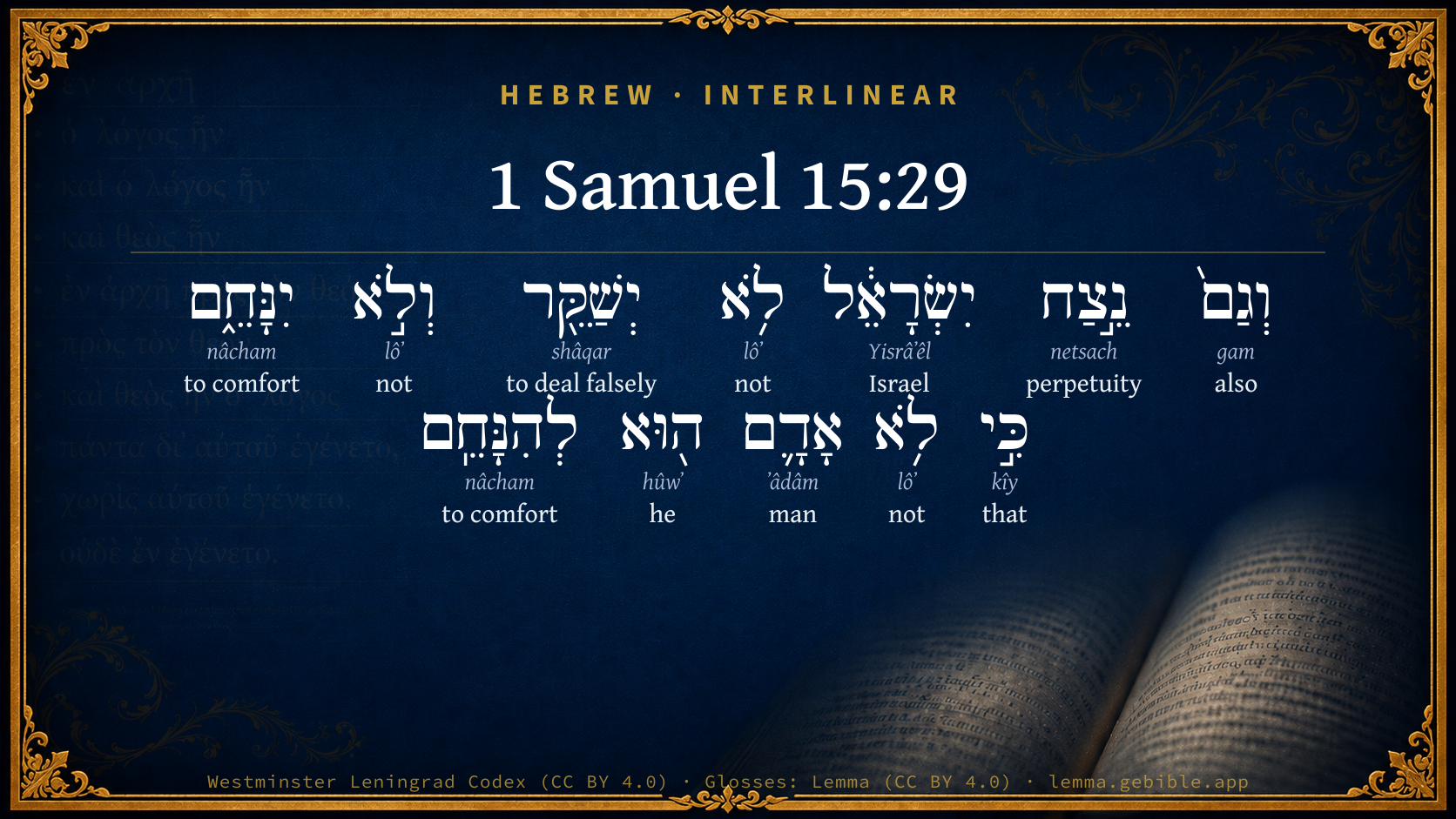
1 Samuel 15:29

Hebrew (Westminster Leningrad Codex) 1 Samuel 15:29 appears in the Hebrew Old Testament. The text above is from the Westminster Leningrad Codex. Each word links to its Strong’s number, a concise gloss, and parsing drawn from the Open Scriptures Hebrew Bible morphology. Click any word for its full Brown-Driver-Briggs (BDB) entry.
Download image
Cite this verse

1 Samuel 15:29 (World English Bible). Public Domain. Lemma interlinear Bible study tool, https://lemma.gebible.app/v/1-samuel/15/29.

Show BibTeX & RIS
BibTeX
RIS
English Translation
Also the Strength of Israel will not lie nor repent; for he is not a man, that he should repent.
World English Bible · Public Domain
Highlights
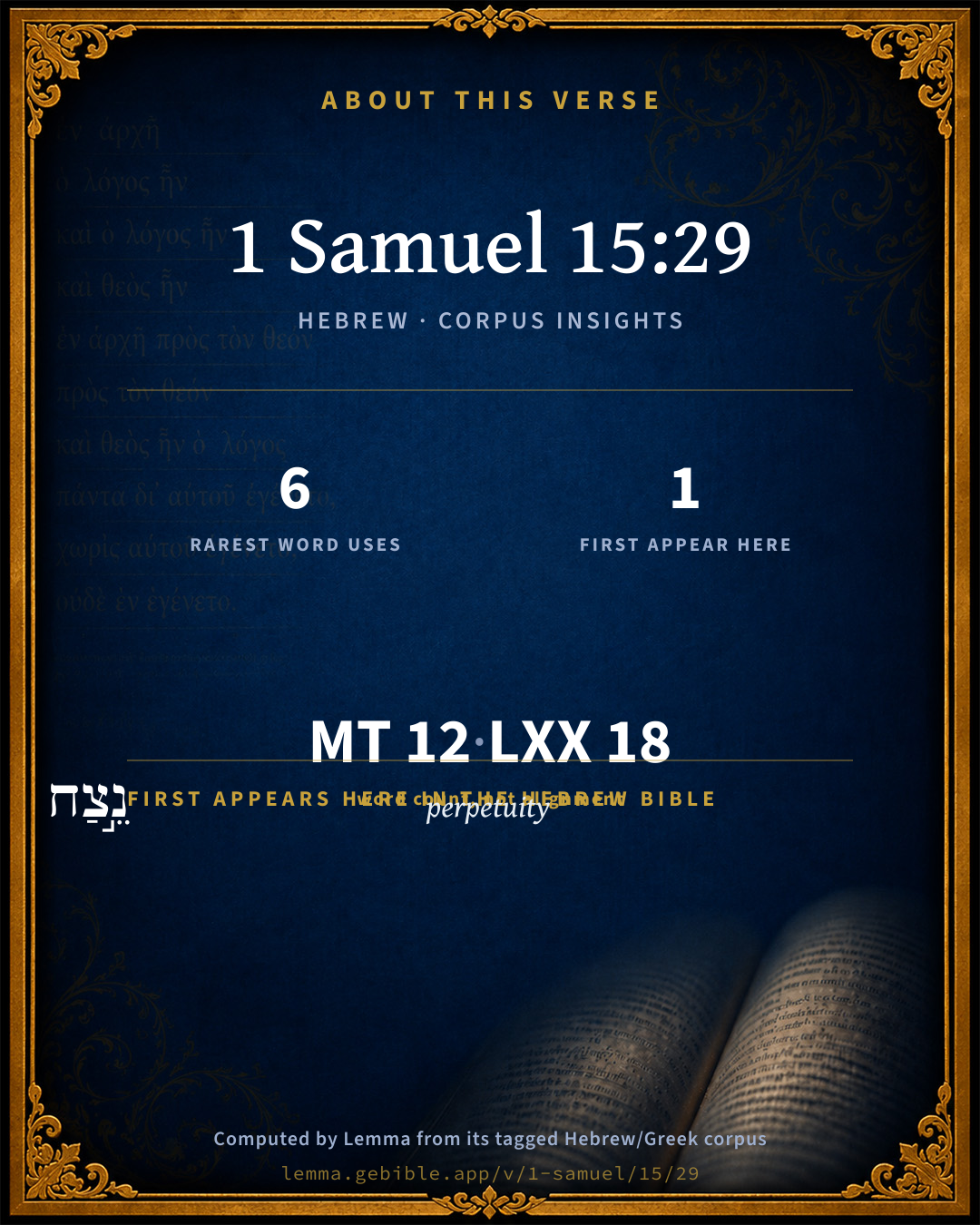
  • 1 first appearance in the Hebrew Bible
Full analysis ↓
Download a study sheet

One document with this verse’s original text, its word-by-word gloss line, the meaning frame, cross-references with their text, attributed commentary, and full source and license credits — printable, and it pastes into notes with its structure intact.

This verse Autodidact and up

Study sheet (.html) Plain text (.txt)

A passage Seminary Student

Up to 50 verses in one chapter. A passage sheet keeps up to 6 commentary sources and 12 cross-references per verse, in the order this page ranks them, and says so on the sheet whenever that leaves anything out. Ask for a single verse and you get the Autodidact verse sheet above.

Everything on this page stays free to read, with no account — the sheet is a download of what is already on screen, not access to it.

Want to remove ads? Support Godless Engineer
Compare translations 3

The same verse in 3 English versions, stacked beneath the original-language interlinear above. Click any original word for its lexicon entry.

Each is an independent rendering of the whole verse — the interlinear is not word-aligned to these translations.

Highlighted words mark where these versions differ — a whole-verse word diff, not a word-by-word alignment.

  • World English Bible Public Domain
    Also the Strength of Israel will not lie nor repent; for he is not a man, that he should repent.
  • King James Version Public Domain
    And also the Strength of Israel will not lie nor repent: for he is not a man, that he should repent.
  • unfoldingWord Literal Text CC BY-SA 4.0
    For indeed the Glory of Israel does not lie and does not change his mind. For he not a man, to change his mind.”

unfoldingWord Literal Text — © unfoldingWord, licensed CC BY-SA 4.0. Word-aligned USFM3 via Door43 (git.door43.org/unfoldingWord/en_ult).

Versions to compare (up to 4)

3 of 4 selected

Show all 18 translations

Every available English version of this verse, each an independent rendering of the whole verse.

  • World English Bible Public Domain
    Also the Strength of Israel will not lie nor repent; for he is not a man, that he should repent.
  • Berean Standard Bible Public Domain
    Moreover, the Glory of Israel does not lie or change His mind, for He is not a man, that He should change His mind.”
  • Majority Standard Bible Public Domain
    Moreover, the Glory of Israel does not lie or change His mind, for He is not a man, that He should change His mind.”
  • King James Version Public Domain
    And also the Strength of Israel will not lie nor repent: for he is not a man, that he should repent.
  • American Standard Version (1901) Public Domain
    And also the Strength of Israel will not lie nor repent; for he is not a man, that he should repent.
  • Revised Version (1885) Public Domain
    And also the Strength of Israel will not lie nor repent: for he is not a man. that he should repent.
  • Geneva Bible (1599) Public Domain
    For in deede the strength of Israel will not lye nor repent: for hee is not a man that hee should repent.
  • Douay-Rheims (1899) Public Domain
    But the triumpher in Israel will riot spare, and will not be moved to repentance: for he is not a mail that he should repent.
  • Young's Literal Translation Public Domain
    and also, the Pre-eminence of Israel doth not lie nor repent, for He `is' not a man to be penitent.'
  • Literal Standard Version CC BY-SA 4.0
    and also, the Preeminence of Israel does not lie nor relent, for He [is] not a man that He should relent.”
  • Unlocked Literal Bible CC BY-SA 4.0
    Also, the Strength of Israel will not lie nor change his mind; for he is not a man, that he should change his mind.”
  • unfoldingWord Literal Text CC BY-SA 4.0
    For indeed the Glory of Israel does not lie and does not change his mind. For he not a man, to change his mind.”
  • Darby Bible Public Domain
    And also the Hope of Israel will not lie nor repent; for he is not a man, that he should repent.
  • World Messianic Bible Public Domain
    Also the Strength of Israel will not lie nor repent; for he is not a man, that he should repent.”
  • Webster's Bible Public Domain
    And also the Strength of Israel will not lie nor repent: for he is not a man, that he should repent.
  • Free Bible Version CC BY-SA 4.0
    In addition, the Glory of Israel does not lie or change his mind, for he is not a human being who changes his mind!”
  • Bible in Basic English Public Domain
    And further, the Glory of Israel will not say what is false, and his purpose may not be changed: for he is not a man, whose purpose may be changed.
  • JPS Tanakh (1917) Public Domain
    And also the Glory of Israel will not lie nor repent; for He is not a man, that He should repent.'

Literal Standard Version (2020), Covenant Press — licensed CC BY-SA 4.0. Text via the HelloAO Bible API (eBible.org). Unlocked Literal Bible (unfoldingWord) — licensed CC BY-SA 4.0. Text via the HelloAO Bible API (eBible.org). unfoldingWord Literal Text — © unfoldingWord, licensed CC BY-SA 4.0. Word-aligned USFM3 via Door43 (git.door43.org/unfoldingWord/en_ult). Free Bible Version, Dr. Jonathan Gallagher — licensed CC BY-SA 4.0. Text via the HelloAO Bible API (eBible.org).

Word by word

More ways to search: Search by grammar → Find every occurrence → Compare this word →

Practice this passage: Drill this verse → Learn its vocabulary →

יְשַׁקֵּ֖ר
shâqar
H8266
“to deal falsely”
Verb, Piel, Imperfect, 3rd Person, Masculine, Singular
Part of Speech
Verb
Stem
Piel
Form
Imperfect
Person
3rd Person
Gender
Masculine
Number
Singular
Full BDB Definition

Origin: a primitive root

TWOT: 2461

to do or deal falsely, be false, trick, cheat - (Piel) to deal falsely - (Qal) to deal falsely
  1. וְגַם֙ gam H1571 “and · also” Conjunction + Particle, Accusative
  2. נֵ֣צַח netsach H5331 “perpetuity of” Noun, Common, Masculine, Singular, Construct
  3. יִשְׂרָאֵ֔ל Yisrâʼêl H3478 “Israel” Noun, Proper
  4. לֹ֥א lôʼ H3808 “not” Particle, Negative
  5. וְלֹ֣א lôʼ H3808 “and · not” Conjunction + Particle, Negative
  6. יִנָּחֵ֑ם nâcham H5162 “to comfort” Verb, Niphal, Imperfect, 3rd Person, Masculine, Singular
  7. כִּ֣י kîy H3588 “that” Conjunction
  8. לֹ֥א lôʼ H3808 “not” Particle, Negative
  9. אָדָ֛ם ʼâdâm H120 “man” Noun, Common, Masculine, Singular, Absolute
  10. ה֖וּא hûwʼ H1931 “he” Pronoun, Personal, 3rd Person, Masculine, Singular
  11. לְהִנָּחֵֽם nâcham H5162 “to comfort” Preposition + Verb, Niphal, Infinitive Construct

About this verse

These counts appear in no published source. They are computed here, from the morphology-tagged text and Lemma’s own curated glosses. What Lemma adds →

12
words
9
distinct lemmas
Historical
section

Notable vocabulary

The rarest word here is יְשַׁקֵּ֖ר to deal falsely H8266 — appearing just 6 times in the whole Hebrew Bible.

First appearance in Scripture

This word makes its first canonical appearance in the Hebrew Bible here:

  • נֵ֣צַח perpetuity H5331

Shared distinctive vocabulary

יְשַׁקֵּ֖ר to deal falsely H8266 occurs in 6 verses of the Hebrew Bible. Also found in:

Grammatical profile

  • 3 verbs
  • 3 nouns
  • 1 pronoun
  • 1 conjunction
  • 4 particles

Verb forms

  • יְשַׁקֵּ֖ר Piel · Imperfect
  • יִנָּחֵ֑ם Niphal · Imperfect
  • לְהִנָּחֵֽם Niphal · Infinitive Construct

Repetition

Words recur within this verse — often emphatic in Hebrew:

  • יִנָּחֵ֑ם to comfort H5162 ×2
  • לֹ֥א not H3808 ×3

Hebrew & Septuagint length

In English translation the verse runs 20 words from the Hebrew and 23 from the Septuagint (LXX English) — closely comparable.

A rough comparison of the two English renderings, which tokenize alike — not a word-level alignment.

Word counts can differ between the Hebrew and the Greek without any difference in meaning — e.g. the Hebrew direct-object marker אֵת has no separate Greek word, and Greek often adds the article ὁ.

In the original languages it is 12 Hebrew tokens and 18 Greek tokens — but the two are counted differently (Hebrew bundles its prefixes and suffixes into one token; the Greek is in lemma form), so that isn’t a like-for-like length.

Cross-references

15

Topical passages linked to 1 Samuel 15:29 in the Treasury of Scripture Knowledge — connected by theme and wording, ordered by reader-vote popularity; previews shown in the World English Bible.

  • Numbers 23:19 God is not a man, that he should lie, Neither the son of man, that he should repent: Has he said, and will he not do it? Or has he spoken, and will he not make it good?
  • Ezekiel 24:14 I, Yahweh, have spoken it: it shall happen, and I will do it: I will not go back, neither will I spare, neither will I repent; according to your ways, and according to your doings, shall they judge you, says the Lord Yahweh.
  • Titus 1:2 in hope of eternal life, which God, who can't lie, promised before eternal times;
  • 2 Timothy 2:13 If we are faithless, He remains faithful. He can't deny himself.
  • Hebrews 6:18 that by two immutable things, in which it is impossible for God to lie, we may have a strong encouragement, who have fled for refuge to take hold of the hope set before us.
  • Psalms 95:11 Therefore I swore in my wrath, "They won't enter into my rest."
  • Joel 3:16 Yahweh will roar from Zion, And thunder from Jerusalem; And the heavens and the earth will shake; But Yahweh will be a refuge to his people, And a stronghold to the children of Israel.
  • Isaiah 45:24 Only in Yahweh, it is said of me, is righteousness and strength; even to him shall men come; and all those who were incensed against him shall be disappointed.
  • 2 Corinthians 12:9 He has said to me, "My grace is sufficient for you, for my power is made perfect in weakness." Most gladly therefore I will rather glory in my weaknesses, that the power of Christ may rest on me.
  • Psalms 68:35 You are awesome, God, in your sanctuaries. The God of Israel gives strength and power to his people. Praise be to God!
  • Deuteronomy 33:27 The eternal God is [your] dwelling-place, Underneath are the everlasting arms. He thrust out the enemy from before you, Said, Destroy.
  • 1 Chronicles 29:11 Yours, Yahweh, is the greatness, the power, the glory, the victory, and the majesty: for all that is in the heavens and in the earth is yours. Yours is the kingdom, Yahweh, and you are exalted as head above all.
  • Psalms 29:11 Yahweh will give strength to his people. Yahweh will bless his people with peace.
  • Philippians 4:13 I can do all things through Christ, who strengthens me.
  • Numbers 14:28–29 Tell them, As I live, says Yahweh, surely as you have spoken in my ears, so will I do to you:

Cross-references courtesy of OpenBible.info (CC BY 4.0).

Hebrew and Greek witnesses Masoretic Hebrew ↔ Greek Septuagint

The same verse in the two great witnesses to the Old Testament, shown verse-for-verse.

These are two independent witnesses, not word-aligned to each other, and the Septuagint is shown in lemma (dictionary) form.

Hebrew 1 Samuel 15:29 Masoretic · Westminster Leningrad Codex

וְגַם֙ נֵ֣צַח יִשְׂרָאֵ֔ל לֹ֥א יְשַׁקֵּ֖ר וְלֹ֣א יִנָּחֵ֑ם כִּ֣י לֹ֥א אָדָ֛ם ה֖וּא לְהִנָּחֵֽם

Also the Strength of Israel will not lie nor repent; for he is not a man, that he should repent.

World English Bible · Public Domain

Greek LXX 1 Samuel 15:29 Septuagint · lemma form

καί διααἱρέω ἰσραήλ εἰς δύο καί οὐ ἀποστρέφω οὐδέ μετανοέω ὅτι οὐ ὡς ἄνθρωπος εἰμί ὁ μετανοέω αὐτός

And Israel shall be divided to two: and God will not turn nor repent, for he is not as a man to repent.

LXX2012 (modern English Septuagint) · Public Domain

On this verse, Haydock's Catholic Bible Commentary discusses the Septuagint’s reading. Read the note in Commentary ↓

Hebrew: Westminster Leningrad Codex (CC BY 4.0). Greek: Septuagint (public domain); English from LXX2012 (modern English Septuagint) (Public Domain). How the Septuagint differs from the Hebrew →

Targum (Aramaic paraphrase)

1

The Targum is the ancient Jewish Aramaic paraphrase of the Hebrew Scriptures — an interpretive translation, not the Hebrew text itself. Onkelos (literal) and Pseudo-Jonathan (expansive) render the Torah, and Jonathan the Prophets. Coverage is partial: where no permissively-licensed English translation exists for a verse, only the Aramaic is shown. This is verse-level text, not a word-by-word alignment to the Hebrew.

  1. Targum Jonathan Prophets (Joshua–Malachi)
    וְאִם תֵּימַר אֲתוּב מֵחוֹבִי וְיִשְׁתְּבֵיק לִי בְּדִיל דְאַעְבִּיד מַלְכוּ אֲנָא וּבְנַי עַל יִשְׂרָאֵל לְעָלָם כְּבַר גָזוּר עֲלָךְ מִן קֳדָם מָרֵי נִצְחָנֵיה דְיִשְׂרָאֵל דְלֵית קֳדָמוֹהִי שְׁקַר וְלָא תָאִיב מִמָה דַאֲמַר אֲרֵי לָא כִּבְנֵי אֱנָשָׁא הוּא דְאָמְרִין וּמְכַדְבִין גָזְרִין וְלָא מְקַיְמִין:

    (no public-domain English translation for this verse)

    Targum Jonathan — Aramaic: “Mikraot Gedolot” (public domain). English: “Sefaria Community Translation” (CC0 1.0 (public-domain dedication)); “London "Chaldee Paraphrase," 1871” (public domain). Text via Sefaria.

Commentary

Notes on 1 Samuel 15:29 from classic Christian and Jewish commentators (each source and its license shown beneath its notes). The classic Christian expositions comment on the surrounding passage and are grouped to its opening verse, so a note may address several verses; the Jewish commentaries on the Tanakh (Rashi and others) are per-verse, so they appear only where the commentator wrote on this verse.

Lemma curates 59 commentaries, every one of them public domain or Creative Commons licensed, each selected and text-cleaned for this edition rather than reprinted as found. About our sources →

Trapp's Complete Commentary

John Trapp

1Sa 15:29 And also the Strength of Israel will not lie nor repent: for he [is] not a man, that he should repent.

Ver. 29. And also the Strength (or Eternity) of Israel will not lie nor repent.] This was most fearful, and showed that the sentence passed upon Saul was irrevocable. Do not think, saith a reverend man, {a} this is a case that seldom comes; it is done every day, upon some or other.

{a} Dr Preston.

John Trapp, A Commentary or Exposition upon All the Books of the Old and New Testament (1647–1656) — public domain. Text from a community e-Sword module.

Tyndale Open Study Notes

Tyndale Open Resources

15:29 nor will he change his mind: Samuel spoke prophetically of God’s commitment to make David king and to preserve his dynasty. God had rejected Saul, but he would never reject David (see 2 Sam 7:8-17).

Tyndale Open Study Notes — © Tyndale Open Resources, licensed CC BY-SA 4.0. Text via the HelloAO Bible API.

Geneva Bible (1599)

Geneva Bible translators

Meaning, God, who maintaineth and prefereth his.

Geneva Bible (1599) marginal notes — public domain. Text via Bolls.life.

Jamieson, Fausset & Brown

Robert Jamieson, A. R. Fausset & David Brown

the Strength of Israel will not lie--Hebrew, "He that gives a victory to Israel," a further rebuke of his pride in rearing the Carmel trophy, and an intimation that no loss would be sustained in Israel by his rejection.

Jamieson, Fausset & Brown — Commentary Critical and Explanatory on the Whole Bible (1871) — public domain (CC PDM 1.0). Text via the HelloAO Bible API.

Adam Clarke's Commentary

Verse 29. The Strength of Israel will not lie ] What God has purposed he will bring to pass, for he has all power in the heavens and in the earth; and he will not repent - change his purpose - concerning thee.

We may say it was some extenuation of Saul's fault that the people insisted on preserving the best of the prey; for who could resist the demands of a victorious mob? But his crime was in consenting; had he not, the crime would have been theirs alone.

Adam Clarke's Commentary on the Bible (1810–1826) — public domain. Text from a community e-Sword/MySword module.

Ellicott's Commentary for English Readers

(29) The Strength of Israel will not lie.—This title of the Eternal, here rendered “the Strength of Israel,” would be better rendered the Changeless One of Israel. The Hebrew word is first found in this passage. In later Hebrew, as in 1Ch_29:2, it is rendered “glory,” from the Aramaean usage of speech (Keil). Some, less accurately, would translate it here “The Victory,” or “the Triumph of Israel,” will not lie, &c. In the eleventh verse of this chapter we read of the Eternal saying, “It repenteth me that I have set up Saul to be king,” while here we find how “the Changeless One (or Strength) of Israel will . . . not repent.” The truth is that with God there is no change. Now He approves of men and their works and days, and promises them rich blessings; now He condemns and punishes the ways and actions of the same men; hence He is said “to repent:” but the change springs alone from a change in the men themselves, not in God. Speaking in human language the Lord is said “to repent” because there was what appeared to be a change in the Eternal counsels.

“One instrument,” well says Dean Payne Smith, “may be laid aside, and another chosen (as was the case of Saul), because God ordains that the instruments by which He works shall be beings endowed with free will.” So God in the case of King Saul—in human language—was said to repent of His choice because, owing to Saul’s deliberate choice of evil, the Divine purposes could not in his case be carried out. Predictions and promises in the Scriptures are never absolute, but are always conditional. Still, God is ever the “Changeless One of Israel.” “The counsel of the Lord stands for ever” (Psa_33:11). “I am Jehovah; I change not” (Mal_3:6).

A Bible Commentary for English Readers, edited by Charles John Ellicott (1878–1897) — public domain. Text from a community e-Sword module.

The Cambridge Bible for Schools and Colleges

gen. ed. J. J. S. Perowne

29. the Strength of Israel] This word, which occurs here only as a title of God, combines the ideas of stability, permanence, constancy: the Strength or Confidence of Israel does not change as men do.

will not lie nor repent] The words closely resemble Num_23:19. There is a verbal contradiction between this utterance and 1Sa_15:11, which is usually explained by saying that in 1Sa_15:11 the historian uses language according to the manner of men (ἀνθρωποπαθῶς), while here the prophet speaks as befits the nature of God (θεοπρεπῶς). This is only a partial solution. It is precisely because God is unchangeable, that in His dealing with men He must seem to change His action as they change their conduct. This is one aspect of the great problem which runs through all religion, how human free-will can coexist with the Divine Sovereignty. Scripture is content to state both sides of the question, and leave conscience rather than reason to reconcile them.

The Cambridge Bible for Schools and Colleges (gen. ed. J. J. S. Perowne; Cambridge University Press, 1878–1918) — public domain. Text from a community e-Sword module.

John Gill's Exposition

And also the Strength of Israel will not lie nor repent,.... Neither of the evil which he had threatened to Saul in taking away the kingdom from him; nor of the good which he had promised to David in giving it to him; nor of his purpose and promise to Israel to protect and defend them, save and deliver them from the Philistines, and continue them a nation and kingdom: and for the confirmation of all this, this title or character of the Lord is given, "the Strength of Israel"; hence he cannot lie, which is the effect of weakness; nor repent or change his mind, as men do, when something unforeseen arises, which hinders the execution of their first design, and which through weakness they cannot surmount: and hence God would support Israel as a nation, and strengthen them against their enemies, and work deliverance and salvation for them: or "the victory of Israel" (q); the author of Israel's victories, and to whom they are to be ascribed, and who is able to give them more, and would; and as he did especially by David, to whom the kingdom is promised: or "the eternity of Israel" (r); that gives firmness, permanency, and duration to them; all which is true of Israel in a spiritual sense; he gives them spiritual strength, victory over their enemies, sin, Satan, and the world, permanent duration, everlasting salvation, immortality, and eternal life:

for he is not a man, that he should repent; men are weak and feeble, and cannot perform what they purpose or promise, and therefore repent; but God, the Strength of Israel, is able to perform whatever he has purposed or promised, and therefore repents not; men are changeable in their minds, and repent of their first thoughts and designs; but God is unchangeable, and never alters his counsels, breaks his covenant, reverses his blessings, repents of his gifts, nor changes his affections to his Israel. Abarbinel says this may be understood of Saul, and so be given as a reason why God would not repent of the evil he had threatened him with, because he was a man that repented not of his sin; but the first sense is best, and agrees with and is confirmed by Num 23:19.

(q) "victoria Israel", Montanus, Vatablus, Piscator; "victor Israelis", Tigurine version. (r) "Aeternitas Israelis", Junius & Tremellius.

John Gill's Exposition of the Whole Bible (1746–1763) — public domain (CC PDM 1.0). Text via the HelloAO Bible API.

Albert Barnes' Notes on the Bible

The strength of Israel - A phrase which occurs only here. The word means, perpetuity, truth, glory, victory, and trust, or confidence.

Albert Barnes' Notes on the Bible (1834–1885) — public domain. Text from a community e-Sword/MySword module.

Haydock's Catholic Bible Commentary

Triumpher. Some suppose that he speaks ironically of Saul. A prince, like you, will not repent. (Calmet) --- But it more probably refers to God, who would not fail to execute his threats against the king. (Haydock) --- Hebrew, "the victor in Israel will not lie, he will not repent." Septuagint, "and Israel shall be split in two, and the holy one of Israel shall not turn nor repent." Saul’s rejection became now inevitable. (Calmet)

George Leo Haydock (1774–1849), Haydock's Catholic Family Bible and Commentary, 1859 edition — public domain. Excludes Psalms (Douay-Rheims chapter numbering differs from Protestant) and Deuterocanonical books (Catholic canon only).

Matthew Poole's English Annotations

He calls God

the Strength of Israel; partly, to show the reason why God neither will nor can lie; because lying is a weakness, and proceeds from the sense of a man’s weakness, because he cannot many times accomplish his design without lying and dissimulation; which therefore many princes have used for this very reason. But, saith he, God needs no such artifices; he can do whatsoever he pleaseth by his absolute power, and hath no need to use lies to accomplish his will. Partly, to show that Israel should be no loser by Saul’s loss, as he might vainly imagine, because he had saved them from their enemies on every side, 1Sa 14:47. For not Saul, but God, was the Strength and Protector of Israel, and he would continue to save them when Saul was lost and gone. And partly, to assure Saul that God would execute this threatening, because he wanted not strength to do it, and none could hinder him in it.

Nor repent, i.e. nor change his counsel; which also is an effect of weakness and imperfection, either of wisdom or power.

Matthew Poole's English Annotations on the Holy Bible (1683–1685) — public domain. Text from a community e-Sword/MySword module.

Whedon's Commentary on the Bible

Daniel D. Whedon

29. Strength of Israel — Jehovah, thus called not only because of his omnipotence, but also because of his constancy and truth — the glorious object of Israel’s confidence.

Will not lie nor repent — Compare 1Sa_15:11 and note there. Jehovah has feelings of love and anger: love for the righteous and anger towards the wicked. If the righteous man turn from his righteousness, or the wicked from his wickedness, towards him correspondingly Jehovah’s feelings change. This is often called repentance in God. But beyond this the divine Nature is not subject to change. In man, however, repentance implies sinfulness and fallibility, and involves a moral and religious change, so that it is never after the manner of man that God repents.

Daniel D. Whedon (gen. ed.), Commentary on the Old and New Testaments (1874–1909) — public domain. Text from a community e-Sword module.

The Pulpit Commentary

The Strength better, as in the margin, the Victory or Triumphof Israel. He who is Israel"s Victory, or He in whom Israel has victory, will not repent. In ver. 11 God was said to repent, because there was what appeared to be a change in the Divine counsels. "God gave Israel a king in his anger, and took him away in his wrath". (Hos_13:11) But such modes of speaking are in condescension to human weakness. Absolutely with God there is no change. He is the Eternal Present, with whom all things that were, and are, and shall be are one. But even looked at from below, as this finite creature man looks at his Maker"s acts, there is no change in the Divine counsels, because, amidst all the vicissitudes of human events, God"s will moves calmly forward without let or hindrance. No lower or secondary motives influence him, no rival power thwarts him. One instrument may be laid aside, and another chosen, because God ordains that the instruments by which he works shall be beings endowed with free will. Saul was the very counterpart of the Jewish people highly endowed with noble qualities, but headstrong, self-willed, disobedient. Nevertheless, he laid the foundation for the throne of David, who in so many points was the ideal of the theocratic king; and Israel in like manner prepared the way for the coming of the true Messianic King, and gave mankind the one Catholic, i.e. universal, religion. "He who is Israel"s Victory does not repent.

Ver. 29. (GILGAL.)

The unchangeable One of Israel.

And also the Strength of Israel will not lie nor repent: For he is not a man, that he should repent

The word rendered Strength in the A.V (netsach, here used for the first time) has a varied signification (splendour, victory, truth, confidence, perpetuity, etc.), but is used in this place in the sense of steadfastness, constancy, and unchangeableness. Jehovah, the prophet says, is the Immutability, or unchangeable One, of Israel. He is not like man, inconstant, unreliable, changeable. He is not such a one as Saul imagined him to be; does not vacillate in his thoughts, feelings, or purposes; but acts on immutable principles, and performs the word which he has spoken; and hence the sentence of rejection cannot be reversed. His unchangeableness is often declared in the Scriptures. It is implied in the name of Jehovah. It was dwelt upon by Moses, (Deu_32:4, Deu_32:18, Deu_32:31) perceived by Balsam, (Num_23:19) and asserted by Hannah in her song of praise. (1Sa_2:2) And although it is often disbelieved or misinterpreted, it is a source of strength and consolation to all by whom it is properly understood and realised. Observe that it

I ACCORDS WITH APPARENT CHANGEABLENESS in

1. The creation of the world and the varied operations of his hand. It is not stoical indifference (without affection) nor absolute quiescence (without activity). He is the living God, and freely exercises his boundless power in producing infinite changes. "Over all things, animate and inanimate, flows the silent and resistless tide of change." But whilst he is "in all, above all, and through all," he is separate and distinct from all; and the creation of the world and all the mutations of matter and force are only expressions of his eternal and unchangeable thought. The physical universe is the garment in which the Invisible clothes himself and manifests himself to our apprehension. (Psa_102:25-27 Psa_104:2)

2. The revelations of his character and the successive dispensations of hisgrace. These are not contrary to one another. They are simply the clearer and more perfect manifestations of him who is always "the same;" adapted to the need and capacity of men. God deals with them as a parent with his children, affording them instruction as they are able to bear it.

3. The relations in which he stands to men, and his diversified dealings with them. They sometimes appear the opposite of each other. At one time he approves of individuals and nations, and promises them manifold blessings, whereas at another he condemns and punishes them. Hence he is said to repent. But the change arises from a change in men themselves. The Glory of Israel always shines with undimmed lustre; but they shut their eyes and turn their backs upon the light, so that to them it becomes darkness. And it is his unchangeable holiness that necessitates this result; for if he were "altogether such a one as themselves," they might expect (like Saul) to enjoy his favour whilst they continued in sin. "With the pure thou wilt show thyself pure; and with the froward thou wilt show thyself froward". (Psa_18:26)

II DENOTES REAL UNCHANGEABLENESS in

1. The perfections of his character. Change is an element of imperfection, and no such element can exist in the absolutely perfect One. With him "there is no variableness, neither shadow caused by turning". (Jam_1:17) "In him there is no darkness at all". (1Jn_1:5) And it is "impossible for God to lie". (Heb_6:18)

2. The principles of his government: wisdom, truth, equity, goodness, etc. In these things he delights, and from them he never departs. They stand like rocks amidst a sea of perpetual change. They are more immutable than the laws of nature, being the foundation on which those laws rest, and inseparable from the Divine character. "The word of our God" (in which they are expressed) "shall stand forever". (Isa_40:8 Isa_51:6) "Till heaven and earth pass," etc.. (Mat_5:18)

3. The purposes of his heart, formed in perfect knowledge of all that will take place, and effected in harmony with the principles before mentioned. Some of these purposes are hidden. (Deu_29:29) Others are revealed, and include the general conditions of peace and happiness, and the results of their observance or neglect (promises and threatenings), also particular events, occurring either independently of the free action of men, or in connection with it, whether in the way of opposition or cooperation, as, e.g. , the setting up of a theocratic kingdom, the advent and death of the Messiah, (Act_4:27, Act_4:28) and his universal reign. "The counsel of the Lord standeth forever" (Psa_33:10, Psa_33:11; Pro_19:21; Isa_46:10; Jer_4:28) "I am Jehovah, I change not; therefore ye sons of Jacob are not consumed". (Mal_3:6) "When we find predictions in Scripture not executed, we must consider them not as absolute, but conditional, or, as the civil law calls it, an interlocutory sentence. God declared what would follow by natural causes, or by the demerit of man, not what he would absolutely do himself. And though in many of these predictions the condition is not expressed, it is understood" (Jer_18:7, Jer_18:8; Eze_33:13, Eze_33:14; Jon_3:4 Jon_4:2)

III INCITES TO HUMAN CONSTANCY in

1. Faith. He never disappoints the trust that is reposed in him. His covenant with his people is firm and sure; "for the mountains shall depart, and the hills be removed," etc.. (Isa_54:10) "All the promises of God in him are yea, and in him Amen". (2Co_1:20) What an incentive is thus afforded to each believer, and the whole Church, to "abide in him"! "Whose faith follow, etc. Jesus Christ (is) the same yesterday, and today, and forever; (therefore) be not carried about (like a ship driven by varying winds) with divers and strange doctrines; for it is a good thing that the heart be established with grace". (Heb_13:7-9)

2. Love. Only the unchangeable One can be a true, satisfying, and enduring rest of the affections; for all earthly objects change and pass away, and must leave the immortal spirit desolate. His unchanging love should keep our love to him and to each other burning with a steady flame (Joh_13:1, Joh_13:34; Jud_1:21)

3. Righteousness.

(1) Which consists in conformity to the constant obedience of Christ to the righteous and unalterable will of the Father.

(2) Which is faithfully assured of enduring blessedness. (Rev_22:14) "He that doeth the will of God abideth forever". (1Jn_2:17)

(3) But without which there will be an irrevocable loss of the most glorious crown and kingdom. The persistently rebellious dash themselves to pieces against the unchangeable holiness and justice of God. D.

The Pulpit Commentary (1880–1919), ed. H.D.M. Spence-Jones & Joseph S. Exell — public domain. Text from a community e-Sword module.

John Wesley's Explanatory Notes

Strength of Israel - So he calls God here, to shew the reason why God neither will nor can lie; because lying proceeds from the sense of a man's weakness, who cannot many times accomplish his design without lying and dissimulation; therefore many princes have used it for this very reason. But God needs no such artifices; he can do whatsoever he pleaseth by his absolute power. Repent - That is, nor change his counsel; which also is an effect of weakness and imperfection, either of wisdom or power. So that this word is not here used in the sense it commonly is when applied to God, as in Jer. xi, 1-23, and elsewhere.

John Wesley, Explanatory Notes Upon the Whole Bible (1754–1765) — public domain. Text via the GEBible commentary corpus.

Rashi

Rabbi Shlomo Yitzchaki (Rashi)

But, the Eternal One of Yisroel neither lies. And if you will say, 'I will repent of my sin before Him,' it will no longer avail to take the kingship from the one to whom it was given, for the Holy One, Blessed is He, Who is the Eternal One of Yisroel, will not lie by not giving the good to whom He said to give it.

Rashi on the Tanakh — English translations: “The Judaica Press complete Tanach with Rashi, translated by A. J. Rosenberg” (CC BY 4.0); “Pentateuch with Rashi's commentary by M. Rosenbaum and A.M. Silbermann, 1929-1934” (public domain); “The Metsudah Tanach series, Lakewood, N.J” (CC BY 4.0); and “The Book of Joshua, Metsudah Publications, 1997” (CC BY 4.0). Text via Sefaria.

Lesson kit

Teaching starters — assembled from the data on this page, not authored interpretation. Every prompt links to the verse data it draws on. Edit before teaching.

1 Samuel, in the Historical, opens this verse with 12 words (9 distinct Hebrew lemmas). Its most distinctive word is shâqar (“to deal falsely”). A historical commentator’s framing appears above. Read the whole chapter for the surrounding context.

Discussion questions

  1. The word shâqar carries the sense “to deal falsely.” How does it shape the verse?
  2. This is the first place “perpetuity” appears in Scripture (first appears here). What does its debut here establish?
  3. How does Genesis 21:23, which shares the word «to deal falsely», read alongside this verse?
  4. What does the repetition of “to comfort” (2× in this one verse) do in this verse?
  5. These translations render this verse differently. What is at stake in choosing one wording over another?
  6. «יְשַׁקֵּ֖ר» is a Piel Imperfect verb. How does that grammatical form shape the action described?
  7. Compare how Trapp's Complete Commentary and Tyndale Open Study Notes read this verse. Where do they agree or differ?

Things to notice

Reading settings

Reading text

Shown beneath each verse's original-language words.

Old Testament
Old Testament edition

Read the OT as the Masoretic Hebrew (MT) or the Greek Septuagint (LXX).

English shown for the Greek Septuagint (in the Hebrew ↔ Greek comparison).

Comparing translations? Open the Compare panel on any verse page to stack up to four side by side.