

Jeremiah 26:13

Hebrew (Westminster Leningrad Codex) Jeremiah 26:13 appears in the Hebrew Old Testament. The text above is from the Westminster Leningrad Codex. Each word links to its Strong’s number, a concise gloss, and parsing drawn from the Open Scriptures Hebrew Bible morphology. Click any word for its full Brown-Driver-Briggs (BDB) entry.
Download image
Cite this verse

Jeremiah 26:13 (World English Bible). Public Domain. Lemma interlinear Bible study tool, https://lemma.gebible.app/v/jeremiah/26/13.

Show BibTeX & RIS
BibTeX
RIS
English Translation
Now therefore amend your ways and your doings, and obey the voice of Yahweh your God; and Yahweh will repent him of the evil that he has pronounced against you.
World English Bible · Public Domain
Download a study sheet

One document with this verse’s original text, its word-by-word gloss line, the meaning frame, cross-references with their text, attributed commentary, and full source and license credits — printable, and it pastes into notes with its structure intact.

This verse Autodidact and up

Study sheet (.html) Plain text (.txt)

A passage Seminary Student

Up to 50 verses in one chapter. A passage sheet keeps up to 6 commentary sources and 12 cross-references per verse, in the order this page ranks them, and says so on the sheet whenever that leaves anything out. Ask for a single verse and you get the Autodidact verse sheet above.

Everything on this page stays free to read, with no account — the sheet is a download of what is already on screen, not access to it.

Want to remove ads? Support Godless Engineer
Compare translations 3

The same verse in 3 English versions, stacked beneath the original-language interlinear above. Click any original word for its lexicon entry.

Each is an independent rendering of the whole verse — the interlinear is not word-aligned to these translations.

Highlighted words mark where these versions differ — a whole-verse word diff, not a word-by-word alignment.

  • World English Bible Public Domain
    Now therefore amend your ways and your doings, and obey the voice of Yahweh your God; and Yahweh will repent him of the evil that he has pronounced against you.
  • King James Version Public Domain
    Therefore now amend your ways and your doings, and obey the voice of the LORD your God; and the LORD will repent him of the evil that he hath pronounced against you.
  • unfoldingWord Literal Text CC BY-SA 4.0
    And now, make good your ways and your deeds, and listen to the voice of Yahweh your God, and Yahweh will relent concerning the disaster that he has spoken against you.

unfoldingWord Literal Text — © unfoldingWord, licensed CC BY-SA 4.0. Word-aligned USFM3 via Door43 (git.door43.org/unfoldingWord/en_ult).

Versions to compare (up to 4)

3 of 4 selected

Show all 18 translations

Every available English version of this verse, each an independent rendering of the whole verse.

  • World English Bible Public Domain
    Now therefore amend your ways and your doings, and obey the voice of Yahweh your God; and Yahweh will repent him of the evil that he has pronounced against you.
  • Berean Standard Bible Public Domain
    So now, correct your ways and deeds, and obey the voice of the LORD your God, so that He might relent of the disaster He has pronounced against you.
  • Majority Standard Bible Public Domain
    So now, correct your ways and deeds, and obey the voice of the LORD your God, so that He might relent of the disaster He has pronounced against you.
  • King James Version Public Domain
    Therefore now amend your ways and your doings, and obey the voice of the LORD your God; and the LORD will repent him of the evil that he hath pronounced against you.
  • American Standard Version (1901) Public Domain
    Now therefore amend your ways and your doings, and obey the voice of Jehovah your God; and Jehovah will repent him of the evil that he hath pronounced against you.
  • Revised Version (1885) Public Domain
    Therefore now amend your ways and your doings, and obey the voice of the LORD your God; and the LORD will repent him of the evil that he hath pronounced against you.
  • Geneva Bible (1599) Public Domain
    Therefore nowe amende your wayes and your workes, and heare the voyce of the Lord your God, that the Lord may repent him of the plague, that he hath pronounced against you.
  • Douay-Rheims (1899) Public Domain
    Now therefore amend your ways, and your doings, and hearken to the voice of the Lord your God: and the Lord will repent of the evil that he hath spoken against you.
  • Young's Literal Translation Public Domain
    And now, amend your ways, and your doings, and hearken to the voice of Jehovah your God, and Jehovah doth repent concerning the evil that He hath spoken against you.
  • Literal Standard Version CC BY-SA 4.0
    And now, amend your ways, and your doings, and listen to the voice of your God YHWH, and YHWH relents concerning the evil that He has spoken against you.
  • Unlocked Literal Bible CC BY-SA 4.0
    So now, improve your ways and your practices, and listen to the voice of Yahweh your God so that he will relent concerning the disaster that he has proclaimed against you.
  • unfoldingWord Literal Text CC BY-SA 4.0
    And now, make good your ways and your deeds, and listen to the voice of Yahweh your God, and Yahweh will relent concerning the disaster that he has spoken against you.
  • Darby Bible Public Domain
    And now, amend your ways and your doings, and hearken to the voice of Jehovah your God; and Jehovah will repent him of the evil that he hath pronounced against you.
  • World Messianic Bible Public Domain
    Now therefore amend your ways and your doings, and obey the LORD your God’s voice; then the LORD will relent from the evil that he has pronounced against you.
  • Webster's Bible Public Domain
    Therefore now amend your ways and your doings, and obey the voice of the LORD your God; and the LORD will repent of the evil that he hath pronounced against you.
  • Free Bible Version CC BY-SA 4.0
    So change your ways and do what's right, and do what Lord your God tells you, so that he won't have to carry out the disaster he has announced he will bring down on you.
  • Bible in Basic English Public Domain
    So now, make a change for the better in your ways and your doings, and give ear to the voice of the Lord your God; then the Lord will let himself be turned from the decision he has made against you for evil.
  • JPS Tanakh (1917) Public Domain
    Therefore now amend your ways and your doings, and hearken to the voice of the LORD your God; and the LORD will repent Him of the evil that He hath pronounced against you.

Literal Standard Version (2020), Covenant Press — licensed CC BY-SA 4.0. Text via the HelloAO Bible API (eBible.org). Unlocked Literal Bible (unfoldingWord) — licensed CC BY-SA 4.0. Text via the HelloAO Bible API (eBible.org). unfoldingWord Literal Text — © unfoldingWord, licensed CC BY-SA 4.0. Word-aligned USFM3 via Door43 (git.door43.org/unfoldingWord/en_ult). Free Bible Version, Dr. Jonathan Gallagher — licensed CC BY-SA 4.0. Text via the HelloAO Bible API (eBible.org).

Word by word

More ways to search: Search by grammar → Find every occurrence → Compare this word →

Practice this passage: Drill this verse → Learn its vocabulary →

וּמַ֣עַלְלֵיכֶ֔ם
maʻălâl
H4611
“and · deeds · your”
Conjunction + Noun, Common, Masculine, Plural, Construct + Suffix, Personal, 2nd Person, Masculine, Plural
Part of Speech
Conjunction + Noun
Type
Common
Gender
Masculine
Number
Plural
State
Construct
Full BDB Definition

Origin: from H5953

TWOT: 1627e

deed, practice - practice (usually bad) - deeds - acts
  1. וְעַתָּ֗ה ʻattâh H6258 “and · now” Conjunction + Adverb
  2. הֵיטִ֤יבוּ yâṭab H3190 “be good” Verb, Hiphil, Imperative, 2nd Person, Masculine, Plural
  3. דַרְכֵיכֶם֙ derek H1870 “ways · your” Noun, Common, Both, Plural, Construct + Suffix, Personal, 2nd Person, Masculine, Plural
  4. וְשִׁמְע֕וּ shâmaʻ H8085 “and · hear” Conjunction + Verb, Qal, Imperative, 2nd Person, Masculine, Plural
  5. בְּק֖וֹל qôwl H6963 “in/at · voice of” Preposition + Noun, Common, Masculine, Singular, Construct
  6. יְהוָ֣ה Yᵉhôvâh H3068 “LORD” Noun, Proper
  7. אֱלֹהֵיכֶ֑ם ʼĕlôhîym H430 “God(s) · your” Noun, Common, Masculine, Plural, Construct + Suffix, Personal, 2nd Person, Masculine, Plural
  8. וְיִנָּחֵ֣ם nâcham H5162 “and · to comfort” Conjunction + Verb, Niphal, Imperfect, 3rd Person, Masculine, Singular
  9. יְהוָ֔ה Yᵉhôvâh H3068 “LORD” Noun, Proper
  10. אֶל ʼêl H413 “to” Preposition
  11. הָ֣רָעָ֔ה raʻ H7451 “the · evil” Particle, Definite Article + Noun, Common, Feminine, Singular, Absolute
  12. אֲשֶׁ֥ר ʼăsher H834 “which” Particle, Relative
  13. דִּבֶּ֖ר dâbar H1696 “to speak” Verb, Piel, Perfect, 3rd Person, Masculine, Singular
  14. עֲלֵיכֶֽם ʻal H5921 “upon · you” Preposition + Suffix, Personal, 2nd Person, Masculine, Plural

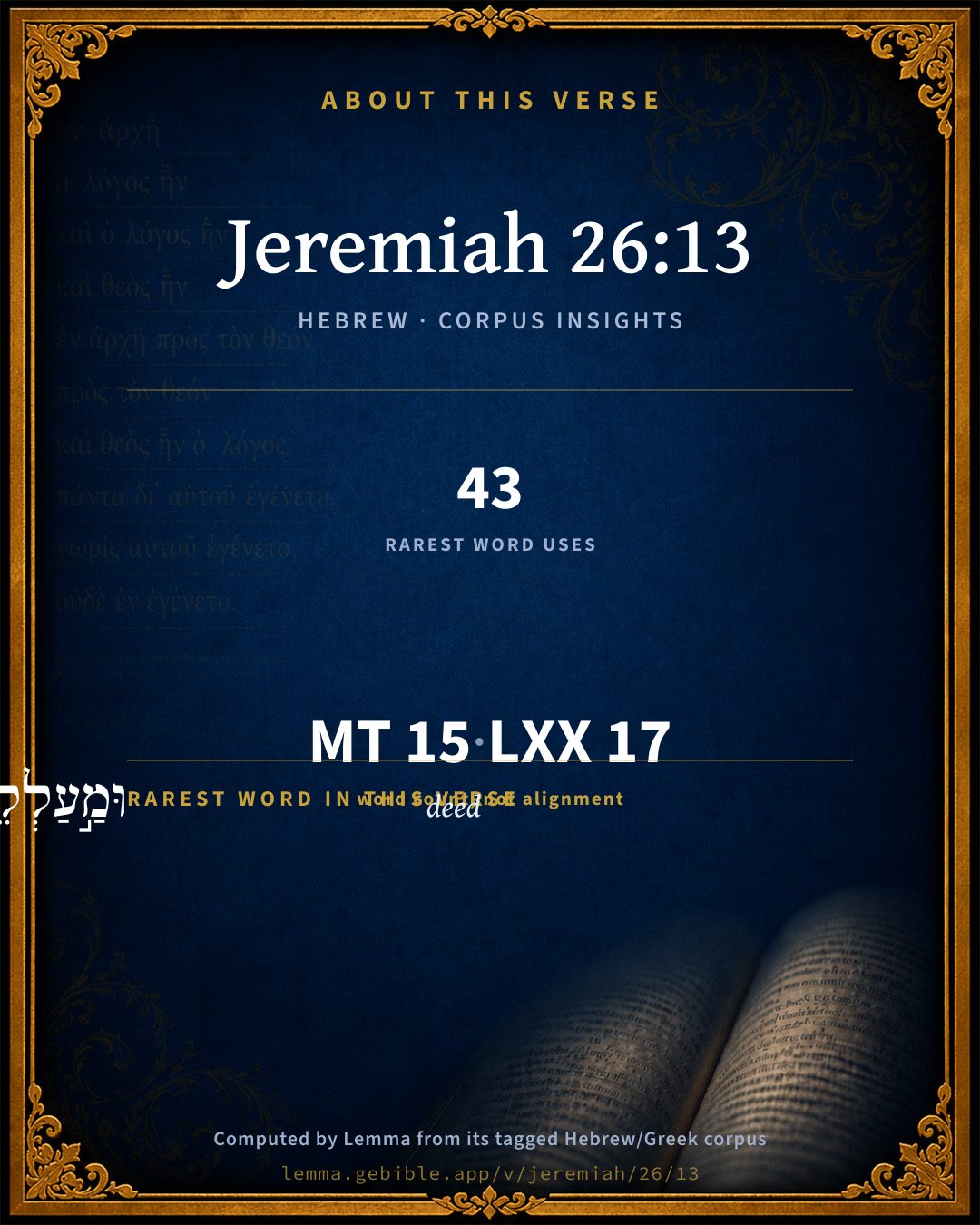
About this verse

These counts appear in no published source. They are computed here, from the morphology-tagged text and Lemma’s own curated glosses. What Lemma adds →

15
words
14
distinct lemmas
Prophets
section

Shared distinctive vocabulary

וּמַ֣עַלְלֵיכֶ֔ם deed H4611 occurs in 41 verses of the Hebrew Bible. Also found in:

Grammatical profile

  • 4 verbs
  • 7 nouns
  • 2 prepositions
  • 1 adverb
  • 1 particle

Verb forms

  • הֵיטִ֤יבוּ Hiphil · Imperative
  • וְשִׁמְע֕וּ Qal · Imperative
  • וְיִנָּחֵ֣ם Niphal · Imperfect
  • דִּבֶּ֖ר Piel · Perfect

Repetition

A word recurs within this verse — often emphatic in Hebrew:

  • יְהוָ֣ה LORD H3068 ×2

Hebrew & Septuagint length

In the original languages it is 15 Hebrew tokens and 17 Greek tokens — but the two are counted differently (Hebrew bundles its prefixes and suffixes into one token; the Greek is in lemma form), so that isn’t a like-for-like length.

Cross-references

19

Topical passages linked to Jeremiah 26:13 in the Treasury of Scripture Knowledge — connected by theme and wording, ordered by reader-vote popularity; previews shown in the World English Bible.

  • Isaiah 1:19 If you are willing and obedient, You shall eat the good of the land;
  • Jonah 3:9 Who knows whether God will not turn and repent, and turn away from his fierce anger, so that we might not perish?"
  • Jonah 4:2 He prayed to Yahweh, and said, "Please, Yahweh, wasn't this what I said when I was still in my own country? Therefore I hurried to flee to Tarshish, for I knew that you are a gracious God, and merciful, slow to anger, and abundant in loving kindness, and you repent of the evil.
  • Isaiah 55:7 let the wicked forsake his way, and the unrighteous man his thoughts; and let him return to Yahweh, and he will have mercy on him; and to our God, for he will abundantly pardon.
  • Jeremiah 7:3–7 Thus says Yahweh of Hosts, the God of Israel, Amend your ways and your doings, and I will cause you to dwell in this place.
  • Jeremiah 18:8 if that nation, concerning which I have spoken, turn from their evil, I will repent of the evil that I thought to do to them.
  • Jeremiah 26:3 It may be they will listen, and turn every man from his evil way; that I may repent me of the evil which I purpose to do to them because of the evil of their doings.
  • Jeremiah 26:19 Did Hezekiah king of Judah and all Judah put him to death? Didn't he fear Yahweh, and entreat the favor of Yahweh, and Yahweh repented him of the evil which he had pronounced against them? Thus should we commit great evil against our own souls.
  • Jeremiah 35:15 I have sent also to you all my servants the prophets, rising up early and sending them, saying, Return you now every man from his evil way, and amend your doings, and don't go after other gods to serve them, and you shall dwell in the land which I have given to you and to your fathers: but you have not inclined your ear, nor listened to me.
  • Jeremiah 36:3 It may be that the house of Judah will hear all the evil which I purpose to do to them; that they may return every man from his evil way; that I may forgive their iniquity and their sin.
  • Jeremiah 38:20 But Jeremiah said, They shall not deliver you. Obey, I beg you, the voice of Yahweh, in that which I speak to you: so it shall be well with you, and your soul shall live.
  • Hosea 14:1–4 Israel, return to Yahweh your God; For you have fallen because of your sin.
  • Joel 2:14 Who knows? He may turn and relent, And leave a blessing behind him, Even a meal offering and a drink offering to Yahweh, your God.
  • Hebrews 5:9 Having been made perfect, he became to all of those who obey him the author of eternal salvation,
  • Exodus 32:14 Yahweh repented of the evil which he said he would do to his people.
  • Deuteronomy 32:36 For Yahweh will judge his people, Repent himself for his servants; When he sees that [their] power is gone, There is none [remaining], shut up or left at large.
  • Judges 2:18 When Yahweh raised them up judges, then Yahweh was with the judge, and saved them out of the hand of their enemies all the days of the judge: for it repented Yahweh because of their groaning by reason of those who oppressed them and vexed them.
  • Jeremiah 42:10 If you will still abide in this land, then will I build you, and not pull you down, and I will plant you, and not pluck you up; for I repent me of the evil that I have done to you.
  • Ezekiel 33:11 Tell them, As I live, says the Lord Yahweh, I have no pleasure in the death of the wicked; but that the wicked turn from his way and live: turn you, turn you from your evil ways; for why will you die, house of Israel?

Cross-references courtesy of OpenBible.info (CC BY 4.0).

Hebrew and Greek witnesses Masoretic Hebrew ↔ Greek Septuagint

The same verse in the two great witnesses to the Old Testament, shown verse-for-verse.

These are two independent witnesses, not word-aligned to each other, and the Septuagint is shown in lemma (dictionary) form.

Hebrew Jeremiah 26:13 Masoretic · Westminster Leningrad Codex

וְעַתָּ֗ה הֵיטִ֤יבוּ דַרְכֵיכֶם֙ וּמַ֣עַלְלֵיכֶ֔ם וְשִׁמְע֕וּ בְּק֖וֹל יְהוָ֣ה אֱלֹהֵיכֶ֑ם וְיִנָּחֵ֣ם יְהוָ֔ה אֶל הָ֣רָעָ֔ה אֲשֶׁ֥ר דִּבֶּ֖ר עֲלֵיכֶֽם

Now therefore amend your ways and your doings, and obey the voice of Yahweh your God; and Yahweh will repent him of the evil that he has pronounced against you.

World English Bible · Public Domain

Greek LXX Structure differs

In the Septuagint, Jeremiah is about an eighth shorter than the Hebrew and arranges its material differently — the Oracles Against the Nations (Hebrew chapters 46–51) appear in the middle of the Greek book, after 25:13. Because the chapter and verse boundaries do not line up, a verse-for-verse comparison with the Hebrew is not shown.

A verse-for-verse comparison isn’t shown here because the chapters and verses don’t line up. Switch to the LXX edition with the MT / LXX toggle above to read the Greek directly.

Hebrew: Westminster Leningrad Codex (CC BY 4.0). Greek: Septuagint (public domain); English from a public-domain English Septuagint. How the Septuagint differs from the Hebrew →

Targum (Aramaic paraphrase)

1

The Targum is the ancient Jewish Aramaic paraphrase of the Hebrew Scriptures — an interpretive translation, not the Hebrew text itself. Onkelos (literal) and Pseudo-Jonathan (expansive) render the Torah, and Jonathan the Prophets. Coverage is partial: where no permissively-licensed English translation exists for a verse, only the Aramaic is shown. This is verse-level text, not a word-by-word alignment to the Hebrew.

  1. Targum Jonathan Prophets (Joshua–Malachi)
    וּכְעַן אַתְקִינוּ אוֹרְחַתְכוֹן וְעוֹבָדֵיכוֹן וְקַבִּילוּ לְמֵימְרָא דַייָ אֱלָהָכוֹן וִיתוּב יְיָ מִן בִּישְׁתָּא דְמַלֵיל עֲלֵיכוֹן:

    (no public-domain English translation for this verse)

    Targum Jonathan — Aramaic: “Mikraot Gedolot” (public domain). English: “Sefaria Community Translation” (CC0 1.0 (public-domain dedication)); “London "Chaldee Paraphrase," 1871” (public domain). Text via Sefaria.

Commentary

Notes on Jeremiah 26:13 from classic Christian and Jewish commentators (each source and its license shown beneath its notes). The classic Christian expositions comment on the surrounding passage and are grouped to its opening verse, so a note may address several verses; the Jewish commentaries on the Tanakh (Rashi and others) are per-verse, so they appear only where the commentator wrote on this verse.

Lemma curates 59 commentaries, every one of them public domain or Creative Commons licensed, each selected and text-cleaned for this edition rather than reprinted as found. About our sources →

Trapp's Complete Commentary

John Trapp

Jer 26:13 Therefore now amend your ways and your doings, and obey the voice of the LORD your God; and the LORD will repent him of the evil that he hath pronounced against you.

Ver. 13. Amend your ways.] Fall out with your faults, and not with your friends. See Jer 7:3.

And the Lord will repent him of the evil.] This he often inculcateth. Ideo minatur Deus ut non puniat. Therefore God will threaten so as not to punish. See Jer 18:8.

John Trapp, A Commentary or Exposition upon All the Books of the Old and New Testament (1647–1656) — public domain. Text from a community e-Sword module.

Joseph Benson's Commentary

Jer 26:13-16. Amend your ways, and the Lord will repent, &c. — It appears here again that God’s determination to give up Jerusalem to destruction was conditional: see note on Jer 18:7-10. If the people had repented of their sins, and reformed their conduct, their ruin would have been prevented, and they would have enjoyed a continuance of peace and prosperity. As for me, behold I am in your hand — I have neither any power, nor can make any interest to oppose you; do with me as seemeth good in your sight — I am content even to lose my life, if God be pleased to permit you to take it. But know ye for certain, &c. — Be fully assured; if you put me to death — Who, as you well know, am not guilty of any crime; ye shall surely bring innocent blood upon yourselves, and upon this city, &c. — You may think that by killing the prophet you will defeat the accomplishment of the prophecy, but you will find yourselves wretchedly deceived: such an act will at once greatly add to your guilt, and aggravate your ruin. Their own consciences could not but tell them that if Jeremiah was (as certainly he was) sent of God to bring them this message, it was at their utmost peril if they treated him for it as a malefactor. For of a truth the Lord hath sent me unto you, &c. — Such is Jeremiah’s justification of himself. He reduces all to this, that God had sent him; and his adversaries were able to make no reply. “If God hath sent me, you can have nothing to say against me.” It is upon this that he is declared innocent in the following verse, This man is not worthy to die — Which was the sentence pronounced by the princes and all the people: for the people, who before were forward to condemn him, now, upon hearing his apology, were as forward to acquit him.

Joseph Benson's Commentary on the Old and New Testaments (1811–1818) — public domain. Text from a community e-Sword module.

Jamieson, Fausset & Brown

Robert Jamieson, A. R. Fausset & David Brown

(Jer 26:3, Jer 26:19).

Jamieson, Fausset & Brown — Commentary Critical and Explanatory on the Whole Bible (1871) — public domain (CC PDM 1.0). Text via the HelloAO Bible API.

Adam Clarke's Commentary

Verse 13. Therefore now amend your ways] If ye wish to escape the judgment which I have predicted, turn to God, and iniquity shall not be your ruin.

Adam Clarke's Commentary on the Bible (1810–1826) — public domain. Text from a community e-Sword/MySword module.

John Calvin's Commentaries

He not only confirms here what he had taught, but also reproves the hardness and obstinate wickedness of the priests and prophets; for though he addressed the princes and the people, he yet no doubt designed to touch more sharply those ungodly men who set themselves up against God; and at the same time his discourse referred to them all, when he said, “How have I sinned? I have endeavored to promote your safety, must I therefore die?” We hence see that the Prophet not only confirmed what he had said, but also accused his adversaries of ingratitude; for nothing could have been more kind, and ought to have been more acceptable, than to be called to repent, that they might receive mercy from God: “What was the object of my doctrine? even that ye might repent; and what does repentance bring? even salvation; for God is ready to forgive you. Now ye cannot bear to hear, that God would be merciful to you. What madness is this?” We now then see the design of the Prophet.

And this passage deserves to be noticed; for God will render to all the ungodly their own reward; not only because they harden themselves against every instruction, but also because they are manifest and, as it were, sworn enemies to their own salvation, inasmuch as they refuse the necessary remedy, and do not allow themselves to be restored to the right way, that they may be forgiven. Very weighty, then, is what he now says, that no fault could be found in his doctrine, except that it proved galling to the wicked, but that they could yet obtain peace, provided they sought reconciliation with God.

He adds, Hear ye the voice of Jehovah, in order to shew that he required nothing new from the people, that he imposed on them no hard yoke, but only called them to the duty of obeying the Law; and he adds to this, your God, in order to take away from them every excuse, lest they should object and say that what Jeremiah alleged was unknown to them. Here, then, he triumphantly declares that he had taught them nothing that was alien to the Law, and that the Jews were inexcusable who professed Jehovah to be their God, and yet hearkened not to his voice, which ought to have been familiar to them.

John Calvin's Commentaries (1540-1563) — public domain. Text from the Calvin Translation Society English edition (1840s-50s) via the Christian Classics Ethereal Library (ccel.org). Calvin's coverage is partial (roughly two-thirds of the Bible); uncommented books and verses are honest gaps, never fabricated. The 19th-century editor's footnotes and remarks are omitted so the notes are faithfully Calvin's own voice.

Ellicott's Commentary for English Readers

(13) Therefore now amend your ways . . .—The prophet’s apologia consists in repeating the substance of his message. He had not denounced an irreversible doom. He had held out the assurance of pardon on repentance. He had threatened only to bring about repentance. The whole history reminds us of the accusation brought against One greater than Jeremiah. He had foretold a destruction of the Second Temple as complete as that of Shiloh (Luk_19:44). He, too, was accused of having said that He would destroy the Temple (Mat_26:61). And He, foreseeing that the people would not repent, had pronounced, though not publicly, a sentence on the Temple which succeeded that against which Jeremiah had prophesied, which was irrevocable (Mat_24:2; Mar_13:2; Luk_19:44).

A Bible Commentary for English Readers, edited by Charles John Ellicott (1878–1897) — public domain. Text from a community e-Sword module.

The Cambridge Bible for Schools and Colleges

gen. ed. J. J. S. Perowne

13. your ways and your doings] See on Jer_7:3.

The Cambridge Bible for Schools and Colleges (gen. ed. J. J. S. Perowne; Cambridge University Press, 1878–1918) — public domain. Text from a community e-Sword module.

John Gill's Exposition

Therefore now amend your ways and your doings,.... Make them good; leave your evil ways, and walk in good ways; forsake your evil works, and do good works:

and obey the voice of the Lord your God; and that because he is your God, as well as what his word directs to is good, and for your good:

and the Lord will repent him of the evil that he hath pronounced against you; will do as men do when they repent, change their method of acting, and manner of behaviour; so the Lord is said to repent or turn, when he changes the method and conduct of his providence towards men, though he never changes his mind or counsel.

John Gill's Exposition of the Whole Bible (1746–1763) — public domain (CC PDM 1.0). Text via the HelloAO Bible API.

Matthew Poole's English Annotations

It is not I that have pronounced evil against you, but the Lord, who made both you and me: you rage against me, who am but God’s instrument, by whom he lets you know his mind and will; it were more advisable for you to reform your wicked lives and practices; and that by a full obedience to what the Lord hath commanded you in his law, and by me speaketh to you. If you will do this, the Lord will change the course of his providence, and do that which in men is called a repenting, and not bring those evil things upon you which he, by me his servant, hath pronounced against you.

Matthew Poole's English Annotations on the Holy Bible (1683–1685) — public domain. Text from a community e-Sword/MySword module.

Whedon's Commentary on the Bible

Daniel D. Whedon

13-15. Amend your ways — Even now he has for them a message of love and hope. He speaks as a man eager for one thing — the good of the commonwealth.

I am in your hands — His individual life was but a trifle, and they could do with him according to their pleasure. His only protest is against being esteemed a false prophet, for to reject him would be to reject his message.

Daniel D. Whedon (gen. ed.), Commentary on the Old and New Testaments (1874–1909) — public domain. Text from a community e-Sword module.

Scofield Reference Notes

C. I. Scofield

repent

(See Scofield "Zec 8:14").

The Scofield Reference Bible (1917 edition), notes by C. I. Scofield — public domain. Text from a community e-Sword module.

unfoldingWord translationNotes

Door43 World Missions Community

your ways ... your practices

These two phrases mean almost the same thing. AT: "the things you do" (See: Doublet)

listen to the voice of Yahweh

The voice is a synecdoche for the person, and the same word can be translated "listen" or "obey." AT: "obey Yahweh" (See: Synecdoche)

Do to me what is good and right in your eyes

The words "good" and "right" mean the same thing. The eye is a metonym for the person's thoughts. AT: "Do to me whatever you think is the right thing to do" (See: Doublet and Idiom)

you are bringing innocent blood on yourselves and on this city and its inhabitants

Blood is a metonym for violent death, and to bring blood on someone is to make them guilty of violent death. AT: "you are making yourselves and this city and its inhabitants guilty of the violent death of an innocent person" (See: Metonymy)

this city and its inhabitants

These are two ways of speaking of the same people, perhaps first as a group and then as individuals. The city is a metonym for the people in the city. AT: "all the people in the city and every one of the people who live here" (See: Doublet)

for your ears

The ear is a metonym for what the ear hears. AT: "for you to hear" (See: Metonymy)

translationWords

voice

God

preach

hand

good

know

innocent

blood

unfoldingWord translationNotes — © Distant Shores Media and the Door43 World Missions Community, licensed CC BY-SA 4.0. Source: git.door43.org/Door43/en_tn.

Lesson kit

Teaching starters — assembled from the data on this page, not authored interpretation. Every prompt links to the verse data it draws on. Edit before teaching.

Jeremiah, in the Prophets, opens this verse with 15 words (14 distinct Hebrew lemmas). Its most distinctive word is maʻălâl (“deed”). A historical commentator’s framing appears above. Read the whole chapter for the surrounding context.

Discussion questions

  1. The word maʻălâl carries the sense “deed.” How does it shape the verse?
  2. How does Deuteronomy 28:20, which shares the word «deed», read alongside this verse?
  3. What does the repetition of “LORD” (2× in this one verse) do in this verse?
  4. The translations on this page render this verse differently — a whole-verse word diff, not a word-by-word alignment. What might account for the different wordings?
  5. «הֵיטִ֤יבוּ» is a Hiphil Imperative verb. How does that grammatical form shape the action described?
  6. Compare how Trapp's Complete Commentary and Joseph Benson's Commentary read this verse. Where do they agree or differ?

Things to notice

Reading settings

Reading text

Shown beneath each verse's original-language words.

Old Testament
Old Testament edition

Read the OT as the Masoretic Hebrew (MT) or the Greek Septuagint (LXX).

English shown for the Greek Septuagint (in the Hebrew ↔ Greek comparison).

Comparing translations? Open the Compare panel on any verse page to stack up to four side by side.