Ezekiel 16:54

Hebrew (Westminster Leningrad Codex) Ezekiel 16:54 appears in the Hebrew Old Testament. The text above is from the Westminster Leningrad Codex. Each word links to its Strong’s number, a concise gloss, and parsing drawn from the Open Scriptures Hebrew Bible morphology. Click any word for its full Brown-Driver-Briggs (BDB) entry.
Download image
Cite this verse

Ezekiel 16:54 (World English Bible). Public Domain. Lemma interlinear Bible study tool, https://lemma.gebible.app/v/ezekiel/16/54.

Show BibTeX & RIS
BibTeX
RIS
English Translation
that you may bear your own shame, and may be ashamed because of all that you have done, in that you are a comfort to them.
World English Bible · Public Domain
Download a study sheet

One document with this verse’s original text, its word-by-word gloss line, the meaning frame, cross-references with their text, attributed commentary, and full source and license credits — printable, and it pastes into notes with its structure intact.

This verse Autodidact and up

Study sheet (.html) Plain text (.txt)

A passage Seminary Student

Up to 50 verses in one chapter. A passage sheet keeps up to 6 commentary sources and 12 cross-references per verse, in the order this page ranks them, and says so on the sheet whenever that leaves anything out. Ask for a single verse and you get the Autodidact verse sheet above.

Everything on this page stays free to read, with no account — the sheet is a download of what is already on screen, not access to it.

Want to remove ads? Support Godless Engineer
Compare translations 3

The same verse in 3 English versions, stacked beneath the original-language interlinear above. Click any original word for its lexicon entry.

Each is an independent rendering of the whole verse — the interlinear is not word-aligned to these translations.

Highlighted words mark where these versions differ — a whole-verse word diff, not a word-by-word alignment.

  • World English Bible Public Domain
    that you may bear your own shame, and may be ashamed because of all that you have done, in that you are a comfort to them.
  • King James Version Public Domain
    That thou mayest bear thine own shame, and mayest be confounded in all that thou hast done, in that thou art a comfort unto them.
  • unfoldingWord Literal Text CC BY-SA 4.0
    On account of these things you will show your shame; you will be humiliated because of everything that you have done, and in this way you will be a comfort to them.

unfoldingWord Literal Text — © unfoldingWord, licensed CC BY-SA 4.0. Word-aligned USFM3 via Door43 (git.door43.org/unfoldingWord/en_ult).

Versions to compare (up to 4)

3 of 4 selected

Show all 18 translations

Every available English version of this verse, each an independent rendering of the whole verse.

  • World English Bible Public Domain
    that you may bear your own shame, and may be ashamed because of all that you have done, in that you are a comfort to them.
  • Berean Standard Bible Public Domain
    So you will bear your disgrace and be ashamed of all you did to comfort them.
  • Majority Standard Bible Public Domain
    So you will bear your disgrace and be ashamed of all you did to comfort them.
  • King James Version Public Domain
    That thou mayest bear thine own shame, and mayest be confounded in all that thou hast done, in that thou art a comfort unto them.
  • American Standard Version (1901) Public Domain
    that thou mayest bear thine own shame, and mayest be ashamed because of all that thou hast done, in that thou art a comfort unto them.
  • Revised Version (1885) Public Domain
    that thou mayest bear thine own shame, and mayest be ashamed because of all that thou hast done, in that thou art a comfort unto them.
  • Geneva Bible (1599) Public Domain
    That thou mayest beare thine owne shame, and mayest bee confounded in all that thou hast done, in that thou hast comforted them.
  • Douay-Rheims (1899) Public Domain
    That thou mayest bear thy shame, and mayest be confounded in all that thou hast done, comforting them.
  • Young's Literal Translation Public Domain
    So that thou dost bear thy shame, And hast been ashamed of all that thou hast done, In thy comforting them.
  • Literal Standard Version CC BY-SA 4.0
    So that you bear your shame, || And have been ashamed of all that you have done, || In your comforting them.
  • Unlocked Literal Bible CC BY-SA 4.0
    On account of these things you will show your shame; you will be humiliated because of everything that you have done, and in this way you will be a comfort to them.
  • unfoldingWord Literal Text CC BY-SA 4.0
    On account of these things you will show your shame; you will be humiliated because of everything that you have done, and in this way you will be a comfort to them.
  • Darby Bible Public Domain
    that thou mayest bear thy confusion, and mayest be confounded for all that thou hast done, in that thou comfortest them.
  • World Messianic Bible Public Domain
    that you may bear your own shame, and may be ashamed because of all that you have done, in that you are a comfort to them.
  • Webster's Bible Public Domain
    That thou mayest bear thy own shame, and mayest be confounded in all that thou hast done, in that thou art a comfort to them.
  • Free Bible Version CC BY-SA 4.0
    In this way you will have to put up with your disgrace and be ashamed of all the bad things you did that made them feel better about themselves.
  • Bible in Basic English Public Domain
    So that you will be shamed and made low because of all you have done, when I have mercy on you.
  • JPS Tanakh (1917) Public Domain
    that thou mayest bear thine own shame, and mayest be ashamed because of all that thou hast done, in that thou art a comfort unto them.

Literal Standard Version (2020), Covenant Press — licensed CC BY-SA 4.0. Text via the HelloAO Bible API (eBible.org). Unlocked Literal Bible (unfoldingWord) — licensed CC BY-SA 4.0. Text via the HelloAO Bible API (eBible.org). unfoldingWord Literal Text — © unfoldingWord, licensed CC BY-SA 4.0. Word-aligned USFM3 via Door43 (git.door43.org/unfoldingWord/en_ult). Free Bible Version, Dr. Jonathan Gallagher — licensed CC BY-SA 4.0. Text via the HelloAO Bible API (eBible.org).

Word by word

More ways to search: Search by grammar → Find every occurrence → Compare this word →

Practice this passage: Drill this verse → Learn its vocabulary →

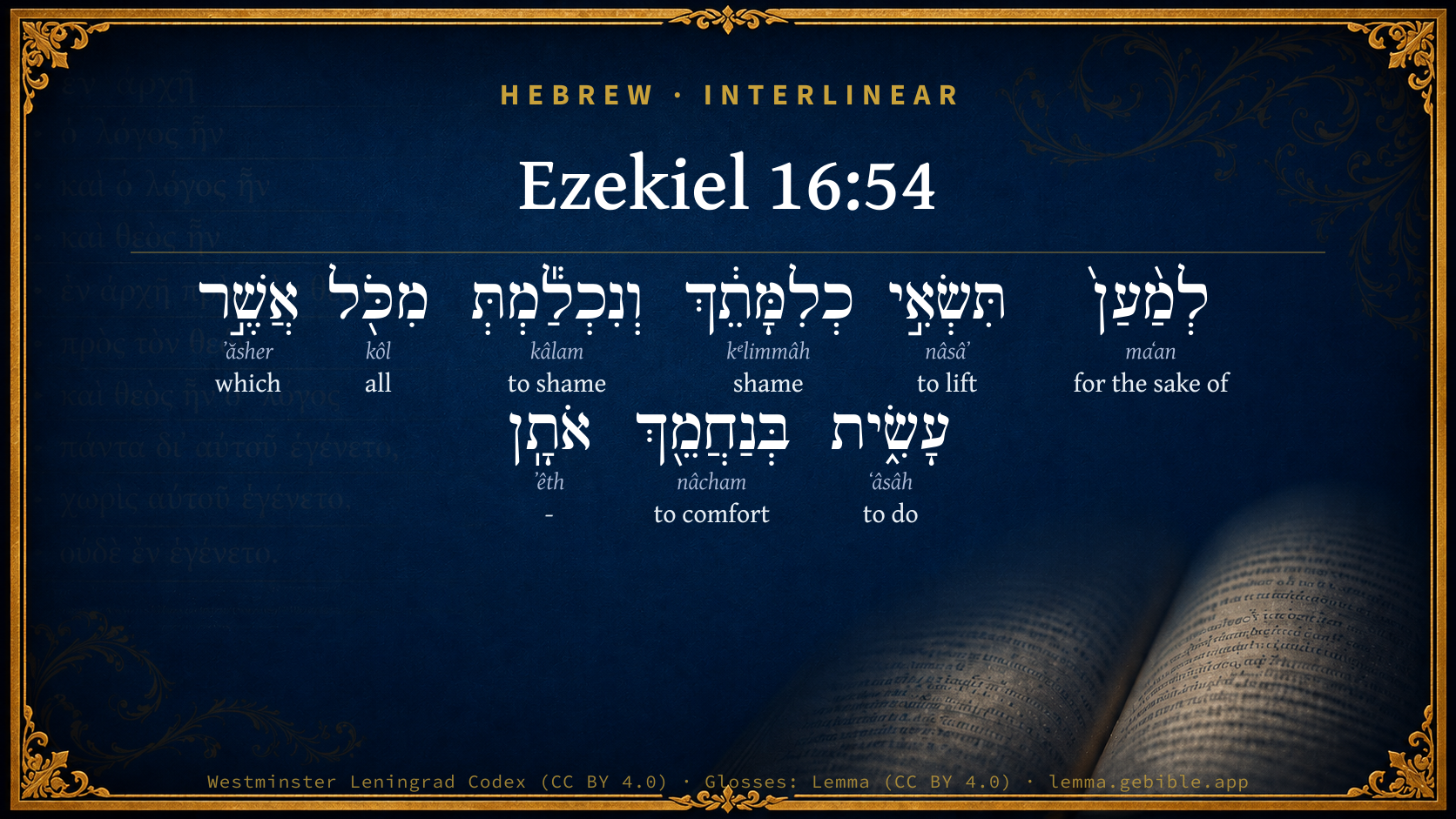
כְלִמָּתֵ֔ךְ
kᵉlimmâh
H3639
“shame · your”
Noun, Common, Feminine, Singular, Construct + Suffix, Personal, 2nd Person, Feminine, Singular
Part of Speech
Noun
Type
Common
Gender
Feminine
Number
Singular
State
Construct
Full BDB Definition

Origin: from H3637

TWOT: 987a

disgrace, reproach, shame, confusion, dishonour, insult, ignominy - insult, reproach - reproach, ignominy
  1. לְמַ֨עַן֙ maʻan H4616 “for the sake of” Preposition
  2. תִּשְׂאִ֣י nâsâʼ H5375 “to lift” Verb, Qal, Imperfect, 2nd Person, Feminine, Singular
  3. וְנִכְלַ֕מְתְּ kâlam H3637 “and · to shame” Conjunction + Verb, Niphal, Sequential Perfect, 2nd Person, Feminine, Singular
  4. מִכֹּ֖ל kôl H3605 “from · all” Preposition + Noun, Common, Masculine, Singular, Absolute
  5. אֲשֶׁ֣ר ʼăsher H834 “which” Particle, Relative
  6. עָשִׂ֑ית ʻâsâh H6213 “to do” Verb, Qal, Perfect, 2nd Person, Feminine, Singular
  7. בְּנַחֲמֵ֖ךְ nâcham H5162 “in/at · to comfort · you” Preposition + Verb, Piel, Infinitive Construct + Suffix, Personal, 2nd Person, Feminine, Singular
  8. אֹתָֽן ʼêth H853 “- · them” Particle, Direct Object + Suffix, Personal, 3rd Person, Feminine, Plural

About this verse

These counts appear in no published source. They are computed here, from the morphology-tagged text and Lemma’s own curated glosses. What Lemma adds →

9
words
9
distinct lemmas
Prophets
section

Shared distinctive vocabulary

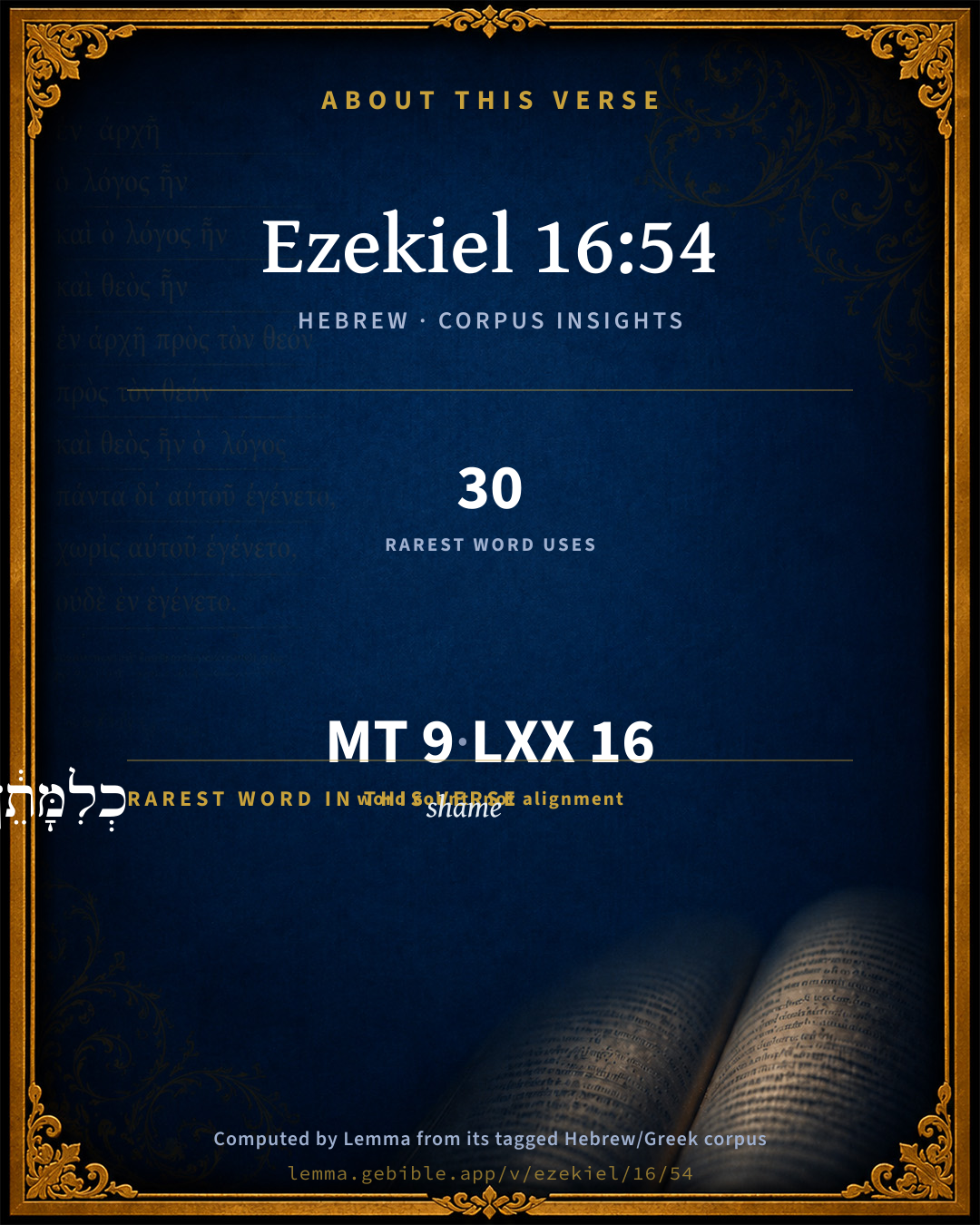
כְלִמָּתֵ֔ךְ shame H3639 occurs in 29 verses of the Hebrew Bible. Also found in:

Grammatical profile

  • 4 verbs
  • 2 nouns
  • 1 preposition
  • 2 particles

Verb forms

  • תִּשְׂאִ֣י Qal · Imperfect
  • וְנִכְלַ֕מְתְּ Niphal · Sequential Perfect
  • עָשִׂ֑ית Qal · Perfect
  • בְּנַחֲמֵ֖ךְ Piel · Infinitive Construct

Hebrew & Septuagint length

In English translation the verse runs 26 words from the Hebrew and 20 from the Septuagint (LXX English) — closely comparable.

A rough comparison of the two English renderings, which tokenize alike — not a word-level alignment.

Word counts can differ between the Hebrew and the Greek without any difference in meaning — e.g. the Hebrew direct-object marker אֵת has no separate Greek word, and Greek often adds the article ὁ.

In the original languages it is 9 Hebrew tokens and 16 Greek tokens — but the two are counted differently (Hebrew bundles its prefixes and suffixes into one token; the Greek is in lemma form), so that isn’t a like-for-like length.

Cross-references

5

Topical passages linked to Ezekiel 16:54 in the Treasury of Scripture Knowledge — connected by theme and wording, ordered by reader-vote popularity; previews shown in the World English Bible.

  • Ezekiel 14:22–23 Yet, behold, therein shall be left a remnant that shall be carried forth, both sons and daughters: behold, they shall come forth to you, and you shall see their way and their doings; and you shall be comforted concerning the evil that I have brought on Jerusalem, even concerning all that I have brought on it.
  • Jeremiah 2:26 As the thief is ashamed when he is found, so is the house of Israel ashamed; they, their kings, their princes, and their priests, and their prophets;
  • Ezekiel 16:52 You also, bear you your own shame, in that you have given judgment for your sisters; through your sins that you have committed more abominable than they, they are more righteous that you: yes, be also confounded, and bear your shame, in that you have justified your sisters.
  • Ezekiel 16:63 that you may remember, and be confounded, and never open your mouth any more, because of your shame, when I have forgiven you all that you have done, says the Lord Yahweh.
  • Ezekiel 36:31–32 Then shall you remember your evil ways, and your doings that were not good; and you shall loathe yourselves in your own sight for your iniquities and for your abominations.

Cross-references courtesy of OpenBible.info (CC BY 4.0).

Hebrew and Greek witnesses Masoretic Hebrew ↔ Greek Septuagint

The same verse in the two great witnesses to the Old Testament, shown verse-for-verse.

These are two independent witnesses, not word-aligned to each other, and the Septuagint is shown in lemma (dictionary) form.

Hebrew Ezekiel 16:54 Masoretic · Westminster Leningrad Codex

לְמַ֨עַן֙ תִּשְׂאִ֣י כְלִמָּתֵ֔ךְ וְנִכְלַ֕מְתְּ מִכֹּ֖ל אֲשֶׁ֣ר עָשִׂ֑ית בְּנַחֲמֵ֖ךְ אֹתָֽן

that you may bear your own shame, and may be ashamed because of all that you have done, in that you are a comfort to them.

World English Bible · Public Domain

Greek LXX Ezekiel 16:54 Septuagint · lemma form

ὅπως κομίζω ὁ βάσανος σύ καί ἀτιμόω ἐκ πᾶς ὅς ποιέω ἐν ὁ σύ παραὀργίζω ἐγώ

that you may bear your punishment, and be dishonored for all that you have done in provoking me to anger.

LXX2012 (modern English Septuagint) · Public Domain

Hebrew: Westminster Leningrad Codex (CC BY 4.0). Greek: Septuagint (public domain); English from LXX2012 (modern English Septuagint) (Public Domain). How the Septuagint differs from the Hebrew →

Targum (Aramaic paraphrase)

1

The Targum is the ancient Jewish Aramaic paraphrase of the Hebrew Scriptures — an interpretive translation, not the Hebrew text itself. Onkelos (literal) and Pseudo-Jonathan (expansive) render the Torah, and Jonathan the Prophets. Coverage is partial: where no permissively-licensed English translation exists for a verse, only the Aramaic is shown. This is verse-level text, not a word-by-word alignment to the Hebrew.

  1. Targum Jonathan Prophets (Joshua–Malachi)
    בְּדִיל דִתְקַבְּלִין אִתְכְּנָעוּתִיךְ וְתִתְכַּנְעִין מִכָּל דַעְבַדְתְּ בְּנַחֲמוֹתַיִךְ יַתְהֶן:

    (no public-domain English translation for this verse)

    Targum Jonathan — Aramaic: “Mikraot Gedolot” (public domain). English: “Sefaria Community Translation” (CC0 1.0 (public-domain dedication)); “London "Chaldee Paraphrase," 1871” (public domain). Text via Sefaria.

Commentary

Notes on Ezekiel 16:54 from classic Christian and Jewish commentators (each source and its license shown beneath its notes). The classic Christian expositions comment on the surrounding passage and are grouped to its opening verse, so a note may address several verses; the Jewish commentaries on the Tanakh (Rashi and others) are per-verse, so they appear only where the commentator wrote on this verse.

Lemma curates 59 commentaries, every one of them public domain or Creative Commons licensed, each selected and text-cleaned for this edition rather than reprinted as found. About our sources →

Trapp's Complete Commentary

John Trapp

Eze 16:54 That thou mayest bear thine own shame, and mayest be confounded in all that thou hast done, in that thou art a comfort unto them.

Ver. 54. In that thou art a comfort unto them.] Eze 14:22. Solamen miseris socios habuisse doloris; to have companions in misery is some kind of comfort.

John Trapp, A Commentary or Exposition upon All the Books of the Old and New Testament (1647–1656) — public domain. Text from a community e-Sword module.

Geneva Bible (1599)

Geneva Bible translators

In that thou hast showed thyself worse than they and yet thoughtest to escape punishment.

Geneva Bible (1599) marginal notes — public domain. Text via Bolls.life.

Jamieson, Fausset & Brown

Robert Jamieson, A. R. Fausset & David Brown

bear thine own shame--by being put on a level with those whom thou hast so much despised.

thou art a comfort unto them--since they see thee as miserable as themselves. It is a kind of melancholy "comfort" to those chastised to see others as sorely punished as themselves (Eze 14:22-23).

Jamieson, Fausset & Brown — Commentary Critical and Explanatory on the Whole Bible (1871) — public domain (CC PDM 1.0). Text via the HelloAO Bible API.

John Calvin's Commentaries

Hence we gather from the last verse, that God gave the Jews no hope of safety, but rather confirms their utter destruction, so that no future safety was to be hoped for. For he says, that you may bear thy reproach and become ashamed, namely, because they had sinned grievously, as I have said before, and had not repented of their wickedness. He adds, in consoling them. He speaks after the ordinary manner of men, since the miserable feel some consolation in seeing themselves perish among a great multitude. This then is the consolation of which the Prophet speaks, not that the sorrow of Sodom and Samaria was mitigated when they saw the Jews joined to themselves, but, as I have said, God adopts the common language of men. It follows —

John Calvin's Commentaries (1540-1563) — public domain. Text from the Calvin Translation Society English edition (1840s-50s) via the Christian Classics Ethereal Library (ccel.org). Calvin's coverage is partial (roughly two-thirds of the Bible); uncommented books and verses are honest gaps, never fabricated. The 19th-century editor's footnotes and remarks are omitted so the notes are faithfully Calvin's own voice.

Ellicott's Commentary for English Readers

(54) Art a comfort unto them.—Compare what was said of justifying them in Eze_16:51-52. The greater sin of Judah became a comfort by throwing their own evil into the shade.

A Bible Commentary for English Readers, edited by Charles John Ellicott (1878–1897) — public domain. Text from a community e-Sword module.

The Cambridge Bible for Schools and Colleges

gen. ed. J. J. S. Perowne

54. Read: “that thou mayest bear thy shame, and be ashamed because of all that thou hast done in comforting them.” Jerusalem “comforted” Samaria and Sodom in surpassing them in wickedness, and causing them to feel less their own guilt, as also in causing their restoration.

The Cambridge Bible for Schools and Colleges (gen. ed. J. J. S. Perowne; Cambridge University Press, 1878–1918) — public domain. Text from a community e-Sword module.

John Gill's Exposition

When thy sisters, Sodom, and her daughters, shall return to their former estate,.... The Jews, as Jerom says, are of opinion, that in the days of their vainly expected Messiah Sodom will be restored to its ancient state, and be as the garden of God, and as the land of Egypt; and Jarchi interprets the bringing again the captivity of Sodom, in Eze 16:53; by the Lord's healing the land of brimstone and salt, and placing inhabitants in it; and it is asserted by the Jews (f) that Sodom and Gomorrah shall be rebuilt in future times, in the times of the Messiah, according to the sense of this passage: but this is not to be understood in a literal sense, of the rebuilding of Sodom and cities adjacent, and of restoring them to their former fruitfulness and fertility, and of the inhabitants to their former prosperity, and much less to their former state of wickedness; but spiritually, of the conversion of Gentile sinners to their ancient and happy estate in Christ:

and Samaria and her daughters shall return to their former estate; to the knowledge of the Messiah, and the pure worship of God:

then thou and thy daughters shall return to your former estate; the conversion of Judah, and of Israel or the ten tribes, here meant by Samaria, is frequently prophesied of, as what will be at the same time, Jer 23:6.

(f) Shemot Rabba, sect. 15. fol. 101. 3.

John Gill's Exposition of the Whole Bible (1746–1763) — public domain (CC PDM 1.0). Text via the HelloAO Bible API.

Albert Barnes' Notes on the Bible

Thou art a comfort unto them - The degradation of Judah would be a kind of consolation to others. Compare Isa. 14.

Albert Barnes' Notes on the Bible (1834–1885) — public domain. Text from a community e-Sword/MySword module.

Haydock's Catholic Bible Commentary

Them. It affords some consolation to have partners in misery. (Calmet)

George Leo Haydock (1774–1849), Haydock's Catholic Family Bible and Commentary, 1859 edition — public domain. Excludes Psalms (Douay-Rheims chapter numbering differs from Protestant) and Deuterocanonical books (Catholic canon only).

Matthew Poole's English Annotations

Thou mayest; thou shalt, so the Hebrew, as well as mayest.

Shame; punishment for offences is ever reproachful, and some punishments are more so than others. Such shall the Jews’ punishments be.

Confounded; some offenders are hardened to an insensibleness of shame, but God will make these Jews to feel the smart, and blush under the shame of their punishments.

In all that thou hast done; for all the wickednesses from which the punishments of Sodom and Samaria should have deterred them, for imitating and outdoing them.

A comfort; encouraging sinners like those of Sodom and Samaria, and being fellow sufferers with them in as great, or greater, judgments.

Matthew Poole's English Annotations on the Holy Bible (1683–1685) — public domain. Text from a community e-Sword/MySword module.

Whedon's Commentary on the Bible

Daniel D. Whedon

54. Mayest be confounded in all — Literally, mayest be shamed for all. (See Eze_16:52.) Jerusalem will be ashamed since her superfluity of wickedness can comfort such people as the Sodomites and Samaritans with the idea that they are not very wicked, after all.

Daniel D. Whedon (gen. ed.), Commentary on the Old and New Testaments (1874–1909) — public domain. Text from a community e-Sword module.

The Pulpit Commentary

Even in that restoration, however, there should be a further clement of humiliation. Judah should be a comfort. (see Eze_14:22) to those who should see her placed lower than themselves, content, at last, to lake the lowest place, humbling herself that she might be (ver. 61) afterwards exalted.

The Pulpit Commentary (1880–1919), ed. H.D.M. Spence-Jones & Joseph S. Exell — public domain. Text from a community e-Sword module.

John Wesley's Explanatory Notes

A comfort - Encouraging sinners like those of Sodom and Samaria.

John Wesley, Explanatory Notes Upon the Whole Bible (1754–1765) — public domain. Text via the GEBible commentary corpus.

Rashi

Rabbi Shlomo Yitzchaki (Rashi)

in that you consoled them when you became more wicked than they, and you gave them an excuse [to neglect righteousness]. Another explanation: in that you consoled them When the evil comes upon you, they will be consoled, saying, We have not suffered alone.

Rashi on the Tanakh — English translations: “The Judaica Press complete Tanach with Rashi, translated by A. J. Rosenberg” (CC BY 4.0); “Pentateuch with Rashi's commentary by M. Rosenbaum and A.M. Silbermann, 1929-1934” (public domain); “The Metsudah Tanach series, Lakewood, N.J” (CC BY 4.0); and “The Book of Joshua, Metsudah Publications, 1997” (CC BY 4.0). Text via Sefaria.

Lesson kit

Teaching starters — assembled from the data on this page, not authored interpretation. Every prompt links to the verse data it draws on. Edit before teaching.

Ezekiel, in the Prophets, opens this verse with 9 words (9 distinct Hebrew lemmas). Its most distinctive word is kᵉlimmâh (“shame”). A historical commentator’s framing appears above. Read the whole chapter for the surrounding context.

Discussion questions

  1. The word kᵉlimmâh carries the sense “shame.” How does it shape the verse?
  2. How does Job 20:3, which shares the word «shame», read alongside this verse?
  3. The translations on this page render this verse differently — a whole-verse word diff, not a word-by-word alignment. What might account for the different wordings?
  4. «תִּשְׂאִ֣י» is a Qal Imperfect verb. How does that grammatical form shape the action described?
  5. Compare how Trapp's Complete Commentary and Geneva Bible (1599) read this verse. Where do they agree or differ?

Things to notice

Reading settings

Reading text

Shown beneath each verse's original-language words.

Old Testament
Old Testament edition

Read the OT as the Masoretic Hebrew (MT) or the Greek Septuagint (LXX).

English shown for the Greek Septuagint (in the Hebrew ↔ Greek comparison).

Comparing translations? Open the Compare panel on any verse page to stack up to four side by side.