Isaiah 49:13

Hebrew (Westminster Leningrad Codex) Isaiah 49:13 appears in the Hebrew Old Testament. The text above is from the Westminster Leningrad Codex. Each word links to its Strong’s number, a concise gloss, and parsing drawn from the Open Scriptures Hebrew Bible morphology. Click any word for its full Brown-Driver-Briggs (BDB) entry.
Download image
Cite this verse

Isaiah 49:13 (World English Bible). Public Domain. Lemma interlinear Bible study tool, https://lemma.gebible.app/v/isaiah/49/13.

Show BibTeX & RIS
BibTeX
RIS
English Translation
Sing, heavens; and be joyful, earth; and break forth into singing, mountains: for Yahweh has comforted his people, and will have compassion on his afflicted.
World English Bible · Public Domain
Download a study sheet

One document with this verse’s original text, its word-by-word gloss line, the meaning frame, cross-references with their text, attributed commentary, and full source and license credits — printable, and it pastes into notes with its structure intact.

This verse Autodidact and up

Study sheet (.html) Plain text (.txt)

A passage Seminary Student

Up to 50 verses in one chapter. A passage sheet keeps up to 6 commentary sources and 12 cross-references per verse, in the order this page ranks them, and says so on the sheet whenever that leaves anything out. Ask for a single verse and you get the Autodidact verse sheet above.

Everything on this page stays free to read, with no account — the sheet is a download of what is already on screen, not access to it.

Want to remove ads? Support Godless Engineer
Compare translations 3

The same verse in 3 English versions, stacked beneath the original-language interlinear above. Click any original word for its lexicon entry.

Each is an independent rendering of the whole verse — the interlinear is not word-aligned to these translations.

Highlighted words mark where these versions differ — a whole-verse word diff, not a word-by-word alignment.

  • World English Bible Public Domain
    Sing, heavens; and be joyful, earth; and break forth into singing, mountains: for Yahweh has comforted his people, and will have compassion on his afflicted.
  • King James Version Public Domain
    Sing, O heavens; and be joyful, O earth; and break forth into singing, O mountains: for the LORD hath comforted his people, and will have mercy upon his afflicted.
  • unfoldingWord Literal Text CC BY-SA 4.0
    Shout joyfully, heavens, and rejoice, earth, and break forth singing, mountains! For Yahweh will comfort his people, and he will have compassion on his afflicted. q1

unfoldingWord Literal Text — © unfoldingWord, licensed CC BY-SA 4.0. Word-aligned USFM3 via Door43 (git.door43.org/unfoldingWord/en_ult).

Versions to compare (up to 4)

3 of 4 selected

Show all 18 translations

Every available English version of this verse, each an independent rendering of the whole verse.

  • World English Bible Public Domain
    Sing, heavens; and be joyful, earth; and break forth into singing, mountains: for Yahweh has comforted his people, and will have compassion on his afflicted.
  • Berean Standard Bible Public Domain
    Shout for joy, O heavens; rejoice, O earth; break forth in song, O mountains! For the LORD has comforted His people, and He will have compassion on His afflicted ones.
  • Majority Standard Bible Public Domain
    Shout for joy, O heavens; rejoice, O earth; break forth in song, O mountains! For the LORD has comforted His people, and He will have compassion on His afflicted ones.
  • King James Version Public Domain
    Sing, O heavens; and be joyful, O earth; and break forth into singing, O mountains: for the LORD hath comforted his people, and will have mercy upon his afflicted.
  • American Standard Version (1901) Public Domain
    Sing, O heavens; and be joyful, O earth; and break forth into singing, O mountains: for Jehovah hath comforted his people, and will have compassion upon his afflicted.
  • Revised Version (1885) Public Domain
    Sing, O heavens; and be joyful, O earth; and break forth into singing, O mountains: for the LORD hath comforted his people, and will have compassion upon his afflicted.
  • Geneva Bible (1599) Public Domain
    Reioyce, O heauens: and bee ioyfull, O earth: brast foorth into praise, O mountaines: for God hath comforted his people, and will haue mercie vpon his afflicted.
  • Douay-Rheims (1899) Public Domain
    Give praise, O ye heavens, and rejoice, O earth, ye mountains, give praise with jubilation: because the Lord hath comforted his people, and will have mercy on his poor ones.
  • Young's Literal Translation Public Domain
    Sing, O heavens, and joy, O earth, And break forth, O mountains, with singing, For comforted hath Jehovah His people, And His afflicted ones He doth pity.
  • Literal Standard Version CC BY-SA 4.0
    Sing, O heavens, and rejoice, O earth, || And break forth, O mountains, with singing, || For YHWH has comforted His people, || And He pities His afflicted ones.
  • Unlocked Literal Bible CC BY-SA 4.0
    Sing, heavens, and be joyful, earth; break into singing, you mountains! For Yahweh comforts his people, and will have compassion on his afflicted.
  • unfoldingWord Literal Text CC BY-SA 4.0
    Shout joyfully, heavens, and rejoice, earth, and break forth singing, mountains! For Yahweh will comfort his people, and he will have compassion on his afflicted. q1
  • Darby Bible Public Domain
    Shout, ye heavens; and be joyful, thou earth; and break forth into singing, ye mountains: for Jehovah hath comforted his people, and will have mercy upon his afflicted ones.
  • World Messianic Bible Public Domain
    Sing, heavens, and be joyful, earth! Break out into singing, mountains! For the LORD has comforted his people, and will have compassion on his afflicted.
  • Webster's Bible Public Domain
    Sing, O heavens, and be joyful, O earth; and break forth into singing, O mountains: for the LORD hath comforted his people, and will have mercy upon his afflicted.
  • Free Bible Version CC BY-SA 4.0
    Heavens, shout for joy! Earth, celebrate! Mountains, sing out in happiness! The Lord has come to care for his people, and he will treat his suffering people kindly.
  • Bible in Basic English Public Domain
    Let your voice be loud in song, O heavens; and be glad, O earth; make sounds of joy, O mountains, for the Lord has given comfort to his people, and will have mercy on his crushed ones.
  • JPS Tanakh (1917) Public Domain
    Sing, O heavens, and be joyful, O earth, and break forth into singing, O mountains; for the LORD hath comforted His people, and hath compassion upon His afflicted.

Literal Standard Version (2020), Covenant Press — licensed CC BY-SA 4.0. Text via the HelloAO Bible API (eBible.org). Unlocked Literal Bible (unfoldingWord) — licensed CC BY-SA 4.0. Text via the HelloAO Bible API (eBible.org). unfoldingWord Literal Text — © unfoldingWord, licensed CC BY-SA 4.0. Word-aligned USFM3 via Door43 (git.door43.org/unfoldingWord/en_ult). Free Bible Version, Dr. Jonathan Gallagher — licensed CC BY-SA 4.0. Text via the HelloAO Bible API (eBible.org).

Word by word

More ways to search: Search by grammar → Find every occurrence → Compare this word →

Practice this passage: Drill this verse → Learn its vocabulary →

יפצחו
pâtsach
H6476
“to break forth”
Verb, Qal, Jussive, 3rd Person, Masculine, Plural
Part of Speech
Verb
Stem
Qal
Form
Jussive
Person
3rd Person
Gender
Masculine
Number
Plural
Full BDB Definition

Origin: a primitive root

TWOT: 1796

to cause to break or burst forth, break forth with, break out - (Qal) to break out, break forth with - (Piel) to break up
  1. רָנּ֤וּ rânan H7442 “shout” Verb, Qal, Imperative, 2nd Person, Masculine, Plural
  2. שָׁמַ֨יִם֙ shâmayim H8064 “heaven(s)” Noun, Common, Masculine, Plural, Absolute
  3. וְגִ֣ילִי gîyl H1523 “and · rejoice” Conjunction + Verb, Qal, Imperative, 2nd Person, Feminine, Singular
  4. אָ֔רֶץ ʼerets H776 “land” Noun, Common, Both, Singular, Absolute
  5. וּפִצְח֥וּ pâtsach H6476 “and · break forth” Conjunction + Verb, Qal, Imperative, 2nd Person, Masculine, Plural
  6. הָרִ֖ים har H2022 “mountains” Noun, Common, Masculine, Plural, Absolute
  7. רִנָּ֑ה rinnâh H7440 “cry” Noun, Common, Feminine, Singular, Absolute
  8. כִּֽי kîy H3588 “that” Conjunction
  9. נִחַ֤ם nâcham H5162 “to comfort” Verb, Piel, Perfect, 3rd Person, Masculine, Singular
  10. יְהוָה֙ Yᵉhôvâh H3068 “LORD” Noun, Proper
  11. עַמּ֔וֹ ʻam H5971 “people · his” Noun, Common, Masculine, Singular, Construct + Suffix, Personal, 3rd Person, Masculine, Singular
  12. וַעֲנִיָּ֖ו ʻânîy H6041 “and · poor · his” Conjunction + Adjective, Adjective, Masculine, Plural, Construct + Suffix, Personal, 3rd Person, Masculine, Singular
  13. יְרַחֵֽם râcham H7355 “to love” Verb, Piel, Imperfect, 3rd Person, Masculine, Singular

About this verse

These counts appear in no published source. They are computed here, from the morphology-tagged text and Lemma’s own curated glosses. What Lemma adds →

14
words
13
distinct lemmas
Prophets
section

Notable vocabulary

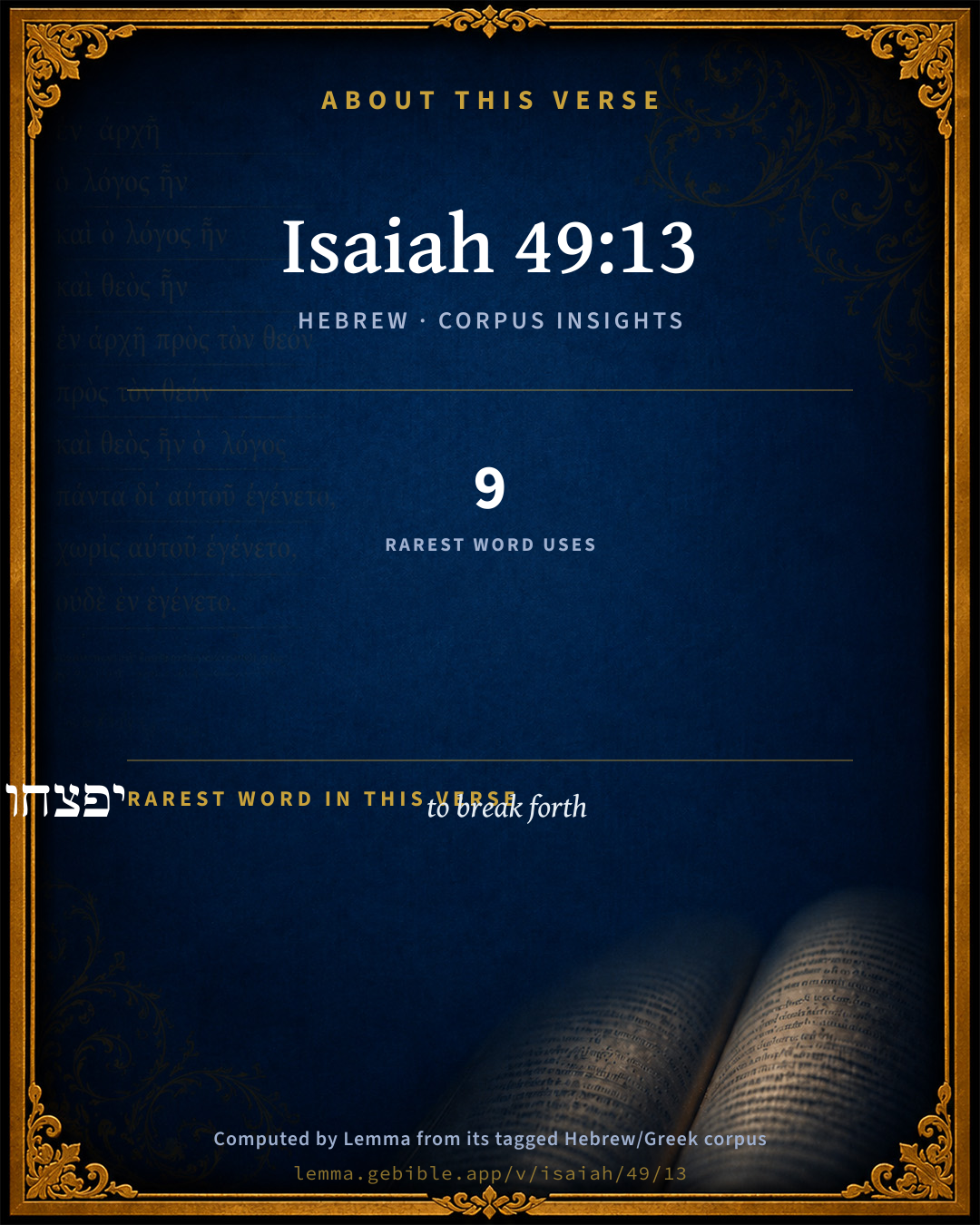
The rarest word here is יפצחו to break forth H6476 — appearing just 9 times in the whole Hebrew Bible.

Shared distinctive vocabulary

יפצחו to break forth H6476 occurs in 8 verses of the Hebrew Bible. Also found in:

Grammatical profile

  • 6 verbs
  • 6 nouns
  • 1 adjective
  • 1 conjunction

Verb forms

  • רָנּ֤וּ Qal · Imperative
  • וְגִ֣ילִי Qal · Imperative
  • יפצחו Qal · Jussive
  • וּפִצְח֥וּ Qal · Imperative
  • נִחַ֤ם Piel · Perfect
  • יְרַחֵֽם Piel · Imperfect

Repetition

A word recurs within this verse — often emphatic in Hebrew:

  • יפצחו to break forth H6476 ×2

Hebrew & Septuagint length

In English translation the verse runs 25 words from the Hebrew and 34 from the Septuagint (LXX English) — closely comparable.

A rough comparison of the two English renderings, which tokenize alike — not a word-level alignment.

Word counts can differ between the Hebrew and the Greek without any difference in meaning — e.g. the Hebrew direct-object marker אֵת has no separate Greek word, and Greek often adds the article ὁ.

Cross-references

17

Topical passages linked to Isaiah 49:13 in the Treasury of Scripture Knowledge — connected by theme and wording, ordered by reader-vote popularity; previews shown in the World English Bible.

  • Isaiah 44:23 Sing, you heavens, for Yahweh has done it; shout, you lower parts of the earth; break forth into singing, you mountains, O forest, and every tree therein: for Yahweh has redeemed Jacob, and will glorify himself in Israel.
  • Isaiah 51:3 For Yahweh has comforted Zion; he has comforted all her waste places, and has made her wilderness like Eden, and her desert like the garden of Yahweh; joy and gladness shall be found therein, thanksgiving, and the voice of melody.
  • Psalms 96:11–13 Let the heavens be glad, and let the earth rejoice. Let the sea roar, and it's fullness!
  • Isaiah 40:1–2 Comfort you, comfort you my people, says your God.
  • Isaiah 52:9 Break forth into joy, sing together, you waste places of Jerusalem; for Yahweh has comforted his people, he has redeemed Jerusalem.
  • Luke 2:13–14 Suddenly, there was with the angel a multitude of the heavenly host praising God, and saying,
  • Psalms 98:4–9 Make a joyful noise to Yahweh, all the earth! Burst out and sing for joy, yes, sing praises!
  • Isaiah 12:1 In that day you will say, "I will give thanks to you, Yahweh; for though you were angry with me, your anger has turned away and you comfort me.
  • Isaiah 42:10–11 Sing to Yahweh a new song, and his praise from the end of the earth; you who go down to the sea, and all that is therein, the isles, and the inhabitants of it.
  • Isaiah 55:12 For you shall go out with joy, and be led forth with peace: the mountains and the hills shall break forth before you into singing; and all the trees of the fields shall clap their hands.
  • Isaiah 66:13–14 As one whom his mother comforts, so will I comfort you; and you shall be comforted in Jerusalem.
  • 2 Thessalonians 2:16–17 Now our Lord Jesus Christ himself, and God our Father, who loved us and gave us eternal comfort and good hope through grace,
  • Isaiah 61:2–3 to proclaim the year of Yahweh's favor, and the day of vengeance of our God; to comfort all who mourn;
  • Jeremiah 31:13 Then shall the virgin rejoice in the dance, and the young men and the old together; for I will turn their mourning into joy, and will comfort them, and make them rejoice from their sorrow.
  • Luke 15:10 Even so, I tell you, there is joy in the presence of the angels of God over one sinner repenting."
  • 2 Corinthians 7:6 Nevertheless, he who comforts the lowly, God, comforted us by the coming of Titus;
  • Revelation 7:9–12 After these things I looked, and behold, a great multitude, which no man could number, out of every nation and of all tribes, peoples, and languages, standing before the throne and before the Lamb, dressed in white robes, with palm branches in their hands.

Cross-references courtesy of OpenBible.info (CC BY 4.0).

Hebrew and Greek witnesses Masoretic Hebrew ↔ Greek Septuagint

The same verse in the two great witnesses to the Old Testament, shown verse-for-verse.

These are two independent witnesses, not word-aligned to each other, and the Septuagint is shown in lemma (dictionary) form.

Hebrew Isaiah 49:13 Masoretic · Westminster Leningrad Codex

רָנּ֤וּ שָׁמַ֨יִם֙ וְגִ֣ילִי אָ֔רֶץ יפצחו וּפִצְח֥וּ הָרִ֖ים רִנָּ֑ה כִּֽי נִחַ֤ם יְהוָה֙ עַמּ֔וֹ וַעֲנִיָּ֖ו יְרַחֵֽם

Sing, heavens; and be joyful, earth; and break forth into singing, mountains: for Yahweh has comforted his people, and will have compassion on his afflicted.

World English Bible · Public Domain

Greek LXX Isaiah 49:13 Septuagint · lemma form

εὐφραίνω οὐρανός καί ἀγαλλιάομαι ὁ γῆ ῥήγνυμι ὁ ὄρος εὐφροσύνη καί ὁ βουνός δικαιοσύνη ὅτι ἐλεέω ὁ θεός ὁ λαός αὐτός καί ὁ ταπεινός ὁ λαός αὐτός παρακαλέω

Rejoice, you⌃ heavens; and let the earth be glad: let the mountains break forth with joy; for the Lard has had mercy on his people, and has comforted the lowly ones of his people.

LXX2012 (modern English Septuagint) · Public Domain

On this verse, Adam Clarke's Commentary discusses the Septuagint’s reading. Read the note in Commentary ↓

Hebrew: Westminster Leningrad Codex (CC BY 4.0). Greek: Septuagint (public domain); English from LXX2012 (modern English Septuagint) (Public Domain). How the Septuagint differs from the Hebrew →

Targum (Aramaic paraphrase)

1

The Targum is the ancient Jewish Aramaic paraphrase of the Hebrew Scriptures — an interpretive translation, not the Hebrew text itself. Onkelos (literal) and Pseudo-Jonathan (expansive) render the Torah, and Jonathan the Prophets. Coverage is partial: where no permissively-licensed English translation exists for a verse, only the Aramaic is shown. This is verse-level text, not a word-by-word alignment to the Hebrew.

  1. Targum Jonathan Prophets (Joshua–Malachi)
    שַׁבָּחוּ שְׁמַיָא וּבוּעִי אַרְעָא וְדוּצוּ טוּרַיָא תּוּשְׁבַּחְתָּא אֲרֵי עֲתִיד יְיָ לְנַחֲמָא עַמֵיהּ וְעַל עִנְוְתָנוֹהִי יְרַחֵם:

    Sing, O heavens; and be joyful, O earth; and be glad, O mountains, with praise, for the Lord will comfort His people, and will have mercy upon His afflicted.

    Targum Jonathan — Aramaic: “Mikraot Gedolot” (public domain). English: “Sefaria Community Translation” (CC0 1.0 (public-domain dedication)); “London "Chaldee Paraphrase," 1871” (public domain). Text via Sefaria.

Commentary

Notes on Isaiah 49:13 from classic Christian and Jewish commentators (each source and its license shown beneath its notes). The classic Christian expositions comment on the surrounding passage and are grouped to its opening verse, so a note may address several verses; the Jewish commentaries on the Tanakh (Rashi and others) are per-verse, so they appear only where the commentator wrote on this verse.

Lemma curates 59 commentaries, every one of them public domain or Creative Commons licensed, each selected and text-cleaned for this edition rather than reprinted as found. About our sources →

Matthew Henry's Commentary

The scope of these verses is to show that the return of the people of God out of their captivity, and the eternal redemption to be wrought out by Christ (of which that was a type), would be great occasions of joy to the church and great proofs of the tender care God has of the church.

I. Nothing can furnish us with better matter for songs of praise and thanksgiving, Isa 49:13. Let the whole creation join with us in songs of joy, for it shares with us in the benefits of the redemption, and all they can contribute to this sacred melody is little enough in return for such inestimable favours, Psa 96:11. Let there be joy in heaven, and let the angels of God celebrate the praises of the great Redeemer; let the earth and the mountains, particularly the great ones of the earth, be joyful, and break forth into singing, for the earnest expectation of the creature that waits for the glorious liberty of the children of God (Rom 8:19, Rom 8:21) shall now be abundantly answered. God's people are the blessings and ornaments of the world, and therefore let there be universal joy, for God has comforted his people that were in sorrow and he will have mercy upon the afflicted because of his compassion, upon his afflicted because of his covenant.

II. Nothing can furnish us with more convincing arguments to prove the most tender and affectionate concern God has for his church, and her interests and comforts.

1. The troubles of the church have given some occasion to question God's care and concern for it, Isa 49:14. Zion, in distress, said, The Lord has forsaken me, and looks after me no more; my Lord has forgotten me, and will look after me no more. See how deplorable the case of God's people may be sometimes, such that they may seem to be forsaken and forgotten of their God; and at such a time their temptations may be alarmingly violent. Infidels, in their presumption, say God has forsaken the earth (Eze 8:12), and has forgotten their sins, Psa 10:11. Weak believers, in their despondency, are ready to say, "God has forsaken his church and forgotten the sorrows of his people." But we have no more reason to question his promise and grace than we have to question his providence and justice. He is as sure a rewarder as he is a revenger. Away therefore with these distrusts and jealousies, which are the bane of friendship.

2. The triumphs of the church, after her troubles, will in due time put the matter out of question.

(1.) What God will do for Zion we are told, Isa 49:17. [1.] Her friends, who had deserted her, shall be gathered to her, and shall contribute their utmost to her assistance and comfort: Thy children shall make haste. Converts to the faith of Christ are the children of the church; they shall join themselves to her with great readiness and cheerfulness, and flock into the communion of saints, as doves to their windows. "Thy builders shall make haste" (so some read it), "who shall build up thy houses, thy walls, especially thy temple; they shall do it with expedition." Church work is usually slow work; but, when God's time shall come, it shall be done suddenly. [2.] Her enemies, who had threatened and assaulted her, shall be forced to withdraw from her: Thy destroyers, and those who made thee waste, who had made themselves masters of the country and ravaged it, shall go forth of thee. By Christ the prince of this world, the great destroyer, is cast out, is dispossessed, has his power broken and his attempts quite baffled.

(2.) Now by this it will appear that Zion's suggestions were altogether groundless, that God has not forsaken her, nor forgotten her, nor ever will. Be assured, [1.] That God has a tender affection for his church and people, Isa 49:15. In answer to Zion's fears, God speaks as one concerned for his own glory (he takes himself to be reflected upon if Zion say, The Lord has forsaken me, and he will clear himself), as one concerned also for his people's comfort; he would not have them droop, and be discouraged, and give way to any uneasy thoughts. "You think that I have forgotten you. Can a woman forget her sucking child?" First, It is not likely that she should. A woman, whose honour it is to be of the tender sex as well as the fair one, cannot but have compassion for a child, which, being both harmless and helpless, is a proper object of compassion. A mother, especially, cannot but be concerned for her own child; for it is her own, a piece of herself, and very lately one with her. A nursing mother, most of all, cannot but be tender of her sucking child; her own breasts will soon put her in mind of it if she should forget it. But, Secondly, It is possible that she may forget. A woman may perhaps be so unhappy as not to be able to remember her sucking child (she may be sick, and dying, and going to the land of forgetfulness), or she may be so unnatural as not to have compassion on the son of her womb, as those who, to conceal their shame, are the death of their children as soon as they are their life, Lam 4:10; Deu 28:57. But, says God, I will not forget thee. Note, God's compassions to his people infinitely exceed those of the tenderest parents towards their children. What are the affections of nature to those of the God of nature! [2.] That he has a constant care of his church and people (Isa 49:16): I have engraven thee upon the palms of my hands. This does not allude to the foolish art of palmistry, which imagines every man's fate to be engraved in the palms of his hands and to be legible in the lines there, but to the custom of those who tie a string upon their hands or fingers to put them in mind of things which they are afraid they shall forget, or to the wearing of signet or locket-rings in remembrance of some dear friend. His setting them thus as a seal upon his arm denotes his setting them as a seal upon his heart, and his being ever mindful of them and their interests, Sol 8:6. If we bind God's law as a sign upon our hand (Deu 6:8, Deu 6:11, Deu 6:18), he will engrave our interests as a sign on his hand, and will look upon that and remember the covenant. He adds, "Thy walls shall be continually before me; thy ruined walls, though no pleasing spectacle, shall be in my thoughts of compassion." Do Zions' friends favour her dust? Psa 102:14. So does her God. Or, "The plan and model of thy walls, that are to be rebuilt, is before me, and they shall certainly be built according to it." Or, "Thy walls (that is, thy safety) are my continual care; so are the watchmen on thy walls." Some apply his engraving his church on the palms of his hands to the wounds in Christ's hands when he was crucified; he will look on the marks of them, and remember those for whom he suffered and died.

Matthew Henry's Commentary on the Whole Bible (1708–1710) — public domain (CC PDM 1.0). Text via the HelloAO Bible API.

Trapp's Complete Commentary

John Trapp

Isa 49:13 Sing, O heavens; and be joyful, O earth; and break forth into singing, O mountains: for the LORD hath comforted his people, and will have mercy upon his afflicted.

Ver. 13. Sing, O heavens.] {a} The prophet having thus foretold the saints’ happiness in and by Christ, cannot hold, but breaketh forth into God’s praises, calling into concert all creatures which since the fall have lain bedridden, as it were, looking with outstretched neck for their full deliverance. {Rom 8:23}

For the Lord hath comforted his people.] This is just matter of general joy.

{a} Enthusiastico iubilo, &c. - Oecolamp.

John Trapp, A Commentary or Exposition upon All the Books of the Old and New Testament (1647–1656) — public domain. Text from a community e-Sword module.

The Preacher's Complete Homiletical Commentary

Joseph S. Exell (gen. ed.)

GOD’S CARE FOR HIS CHURCH

Isa_49:13-17. Sing, O heavens, &c.

I. Nothing can furnish us with better matter for songs of praise and thanksgiving than the tender care God has of the Church (Isa_49:13). Let the whole creation join with us in songs of joy, for it shares with us in the benefits of the redemption (Rom_8:19; Rom_8:21).

II. The care which God has for His Church is never to be doubted by us. True, the troubles of the Church have given some occasion to question His concern for it (Isa_49:14). The case of His people may sometimes be so deplorable that they seem to be forsaken and forgotten by Him; and at such a time their temptation may be alarmingly violent. Weak believers, in their despondency, are ready to say, “God has forsaken us,” &c. But we have no more reason to question His promise and grace, than we have to question His providence and justice. He is as sure a Rewarder as He is a Revenger. Away, therefore, with those distrusts and jealousies which are the bane of friendship. The triumphs of the Church, after her troubles, will in due time put the matter out of question (Isa_49:17).

III. Be assured that God has a tender affection for His Church and people (Isa_49:15). In answer to Zion’s fears, He speaks as one concerned for His own glory; He takes Himself to be reflected upon if Zion say, “The Lord hath forsaken me;” and He will clear Himself. As one concerned also for His people’s comfort, He would not have them droop and be discouraged, and give way to uneasy thoughts. You think that I have forgotten you; “can a woman forget her sucking child?”

1. It is not likely that she should. A woman, whose honour it is to be of the tender sex as well as the fair one, cannot but have compassion for a child, which, being both harmless and helpless, is a proper object of compassion. A mother, especially, cannot, but be concerned for her own child. for it is her own, a piece of herself, and very lately one with her. A nursing mother, most of all, cannot but be tender of her sucking child. But

2. it is possible she may forget. A woman may be so unhappy as not to be able to remember her sucking child; she may be sick, dying, and going to the land of forgetfulness; or she may be so unnatural as not to have compassion on it (Lam_4:10; Deu_28:57). But, says God, “I will not forget thee.” His compassions to His people infinitely exceed those of the tenderest parents toward their children (P. D. 1499).

IV. Be assured that God has a constant care of His Church and people (Isa_49:16-17). “I have graven thee upon the palms of my hands,” alludes to the custom of wearing signet or locket rings in remembrance of some dear friend. If we bind God’s law as a sign upon our hand (Deu_6:8-11), He will engrave our interests as a sign on His hand, and will look upon that and remember the covenant, “Thy walls shall continually be before Me;” “thy ruined walls, though no pleasing spectacle, shall be in my thoughts of compassion.” Or, “The plan and model of thy walls, that are to be rebuilt, is before Me, and they shall certainly be built according to it.”—Matthew Henry. Commentary: in loco.

A GLORIOUS IMPOSSIBILITY

Isa_49:14-15. But Zion said, The Lord hath forsaken me, &c.

I. The believer, like Zion of old, is sometimes led to form suspicions concerning the Lord’s goodness. Such suspicions are apt to arise—

1. In periods of deep spiritual temptation: times of dark and mysterious providences; days in which God’s people “walk in darkness and have no light.” Such times are apt to come upon us through neglect of prayer, through neglect of some known duty; and then, instead of blaming ourselves, we are apt to distrust God.

2. In times of deep temporal trial.

II. The love of God for His people renders all such suspicions utterly unreasonable. A mother’s love for her child is tender and strong; many mothers have contentedly laid down their lives for their children; but history is full of proofs that a mother’s love for her child may utterly pass away. But God’s love for His people will never fail. “Can a mother forget her sucking child, that she should not have compassion on the son of her womb? Yea, they may forget; yet will not I forget thee.” How tender, comprehensive, and touching is this figure! There is much to be considered in it: the tenderness of the tie, the helplessness of the child, the very posture of the child.

1. The tenderness of the tie. [1513] The tie between God’s children and Himself is infinitely closer than that between a child and its mother. True, the child derives its life from the mother, as the medium by which the Lord doth communicate it; but God is the life of His saints. They live and move and have their being in Him, and He lives in them.

[1513] The young of all creatures are lovely and attractive always: but let us survey the image here. Here is a child, a harmless object, a helpless object, an endeared object, and towards which any one may feel compassion and tenderness. But you will observe that the child here is the mother’s own—“the son of her womb;” lately a part of herself, and endeared by the anxieties of bearing it, and the pain and peril of bringing it forth. Nor is this all; for the mother is a nursing mother. Isaiah scorned to take an image of exquisite tenderness from those wretches who, when they have it in their power, devolve this pleasing and (ask all the physicians) this salutary duty upon others, upon strangers, and upon hirelings; no, it is a nursing mother, and the child is a “sucking child,” looking up with ineffable satisfaction to his benefactor, and with his little hands stroking the cheeks of her who feeds him.—Jay.

2. The helplessness of the child. The helplessness and dependence of the believer is still greater. In a few months it will be able to walk alone; in a few years we shall find it not only walking and running, but labouring independently of its mother. But look at the believer—at those most advanced in the life of God, most filled with heavenly wisdom; look at “Paul the aged.” He is as feeble, as dependent, as helpless in himself as at the first moment (1Co_15:10).

3. The posture of the child: that is more touching still. There are few sights more endearing, as every mother will acknowledge, than that of a child hanging on her bosom, deriving the support of its physical life from herself. It is one of the most touching pictures that can be presented to our eye. And yet, compared with that of a believer, it is as nothing. His is not an unconscious hanging upon the author and sustainer of His being; His is a conscious, glad dependence upon God for those supplies that come from His Father’s heart, and minister to His spiritual life—that life which is the commencement of life eternal. Who can compare the one with the other? It is a closer tie, a tenderer tie, a more dependent object, and a posture infinitely more endearing. No wonder God gives the strong assurance which our text contains.

III. God’s love for His people manifests itself in a constant remembrance of their condition and needs. “Yet will I not forget thee,” is only another way of saying, “I will always remember thee.”

1. He does not forget their persons (Isa_49:16).

2. Nor the work of grace that is in them. It is described as His poem: “we are His workmanship”—His poem (Eph_2:10). A man takes care of his book; but if he has his own poem, will he be likely to forget that?

3. Nor their trials (Isa_43:2).

4. Nor their returns to Him (Jer_31:18).

5. Nor their obedience (Isa_64:5; Heb_6:10).

6. Nor their needs in death (Psa_116:15). Blessed truth, it is full of unutterable sweetness.

The subject is full of instruction.

1. It should lead to self-examination. Are we of the number of those whom God knows, in the sense of reproving and acknowledging as His? If He does not thus know us, how can we expect Him to remember us?

2. A sight of the helpless child hanging upon its mother’s breast should show us our own dependency, and take away every thought of self-sufficiency.

3. The fickleness of the tenderest of human affections brings out more clearly into view the glory of God’s love for His people.

4. The constancy of the Divine love should make us ashamed of our despondency and distrust in times of trial.

5. If God never forgets us, we should never forget Him.—J. H. Evans, M.A., Thursday Penny Pulpit, vol. iv. pp. 305–316.

I. A MOURNFUL COMPLAINT (Isa_49:14). The wicked think too much of the goodness of God, in reference to themselves; they mistake the effects of His general bounty for evidences of His peculiar friendship (H. E. I. 3977–3980). The very reverse of this is the disposition of all subjects of Divine grace; they know that self-deception is tremendous, probable, common, and are therefore afraid of it; they often carry their solicitude beyond the point of duty; they apply to themselves what was intended for others, and sometimes think themselves forsaken of God.

1. This arises sometimes

(1.) from the weakness of their faith ([1516]. H. E. I. 2014–2017).

(2.) From ignorance; they have a knowledge of God, but it is very imperfect, and therefore they form mistaken apprehensions as to the manner in which He is likely to deal with them.

(3.) From a suspension of divine manifestation. The sun is always in the sky, but it is not always visible. God hides Himself from the house of Jacob; and if you are part of the house of Jacob, you will be affected thereby (Psa_30:7). When He does this, it is not in the mere exercise of Divine sovereignty, but either as a prevention of sin, or as correction for it (Isa_59:2; Hos_5:15; Job_15:11; H. E. I. 1644–1659).

(4.) From conflict with the troubles of life. It is forgotten that these are really proofs that God has not forsaken us (Pro_13:24; Heb_12:6; H. E. I. 189–196, 3692–3695).

(5.) Sometimes from God’s delay in the accomplishment of prayer. Distinguish between the acceptance and the answer of prayer; God always immediately hears, but does not always immediately answer the prayer of faith (2Pe_3:9; Lam_3:26; H. E. I. 3884–3899).

[1516] Our comfort must always be according to our faith. “In whom,” Bays Peter, “believing, ye rejoice with joy unspeakable and full of glory.” There is always consolation in God’s riches of glory by Christ Jesus; but these can only be perceived and apprehended by faith. There is always fruit enough upon the tree of life, but faith in the hand by which alone we gather it. There is water enough always in the wells of salvation, but by faith we must draw it.—Jay, H. E. I. 1252–1285.

2. Who can find language to express the wretchedness such a false conclusion causes? The misery produced by it in a child of God is due to three causes:—

(1.) He loves God, not perfectly, but supremely; and love can never be reconciled to the absence of its object.

(2.) He entirely relies upon Him, and therefore feels that if God has withdrawn from him, all must be darkness, dreariness, desolation, and death.

(3.) He has enjoyed Him already, and therefore nothing can satisfy him but God (H. E. I. 1018, 2378–2387).

II. A SATISFACTORY ANSWER (Isa_49:15). Notice,

1. The improbability of the fear. This is metaphorically expressed. The case supposed is not likely, but it is possible. But the tenderest feelings of nature are as nothing when compared with the kindness of God.

2. The certainty of the assurance. “Yet will not I forget thee.” With God there is no fickleness (Num_23:19).—H. E. I. 2324, P. D. 815.

3. The all-sufficiency of the truth established; that is, the perpetual regard of God for us. If His favour is set upon us, it secures everything else (Psa_84:11-12).

Concluding remarks.—

1. Distresses and discouragements are not incompatible with religion (H. E. I. 339–346, 2907).

2. See how concerned God is, not only for His people’s safety, but for their comfort also. Let His people fall in with this design (Psa_42:11).

4. Do not take the comfort belonging to a gracious state, unless you are the subjects of a gracious character.—W. Jay: “The British Pulpit,” vol. v. pp. 221–230.

We have here two assertions; Zion’s and God’s.

I. ZION’S ASSERTION. “The Lord hath forsaken me,” &c. Observe four things which may cause this complaint:—

1. The mysteriousness of Divine providence.

2. The long duration of Zion’s troubles.

3. Lack of success.

4. Zion’s own sinfulness and weakness.

II. GOD’S ASSERTION. “Can a woman forget her sucking child?” &c. “Yet will I never forget thee.” Why?

1. He is too nearly related to Zion.

2. He bestows too much thought upon Zion.

3. He has done too much on behalf of Zion.

4. He has given too many promises—great and precious—to Zion.

5. He expects too much from Zion.

6. He hath ordained that Zion shall for ever dwell in His immediate presence. “For ever with the Lord.” God, then, cannot forget His people.

Improvement.

1. Zion should at once withdraw her complaint.

2. As God will never forget Zion, Zion should never forget her God.

3. Zion should never despond in the presence of any untoward event which may overtake her.—W. Roberts, Penybontfawr, “Pregethau.”

1. God’s love is like a mother’s love. There is no love in this world like a mother’s love. It is free, unbought, unselfish (P. D. 2357). God’s love to a soul in Christ is stronger (Psa_103:13-14; Mal_3:17; Isa_66:13; H. E. I. 2322–2333; P. D. 1499). Be not cast down in affliction (H. E. I. 189–196). Deserted souls, God’s love cannot change unless His true nature change. Not till God cease to be holy, just, and true, will He cease to love the soul that hides under the wings of Jesus (H. E. I. 2324).

2. His love is full love. A mother’s love is the fullest love which we have on earth. She loves with all her heart. But there is no love full but that of God toward His Son; God loves Jesus fully—the whole heart of the Father is as it were continually poured down in love upon the Lord Jesus. But when a soul comes to Christ, the same love rests on that soul (Joh_17:26). True, a creature cannot receive the love of God as Jesus can; but it is the same love that shines on us and Him—full, satisfying, unbounded love. How can God forget what He fully loves? A creature’s love may fail; for what is a creature?—a clay vessel, a breath of wind that passeth away and cometh not again. But the Creator’s love cannot fail—it is full love toward an object infinitely worthy of His love—in which thou sharest.

3. It is an unchanging love. A mother’s love is, of all creature-love, the most unchangeable. But far more unchanging is the love of God to Christ, and to a soul in Christ: “I am the Lord; I change not.” The Father that loves has no variableness. Jesus who is loved, is the same yesterday, to-day, and for ever. How can that love change? It flowed before the world was; it will flow when the world has passed away. If you are in Christ, that love shines on you (Jer_31:3; Rom_8:38-39).—R. M. M‘Cheyne: Sketches of Sermons.

These words apply, first of all, to God’s ancient people, the Jews, but they are equally true of all believers.

I. There are times when believers are apt to think themselves forsaken.

1. In time of sore affliction. So it was with Naomi, Hezekiah, Job. It is a sad thing when the soul faints under the rebukes of God. They were intended to lead you deeper into Christ—into a fuller enjoyment of God (H. E. I. 66–70).

2. When they have fallen into sin. As long as a believer walks humbly with his God, his soul is at peace. But the moment that unbelief creeps in, he is led away into sin—like David he falls very low. A believer generally falls lower than the world; and now he falls into darkness. When Adam fell, he was afraid; and he hid himself from God among the trees of the garden, and he made a covering of leaves. When a believer falls, he also is afraid—he hides from God.

3. In time of desertion. Desertion is God withdrawing from the soul of a believer; so that His absence is felt. Sometimes it pleases God to withdraw from the soul, chiefly, I believe, to humble us in the dust; or to discover some corruption unmortified; or to lead us to hunger more after Him. Such was the state of David when he wrote Psalms 42 (Job_6:4; Job_29:1-2; H. E. I. 1644–1659).

II. God cannot forget a soul in Christ: “Can a woman,” &c.

TO THE PREACHER.

1. Comfort downcast believers. Your afflictions and desertions only prove that you are under the Father’s hand. There is no time when the patient is an object of such tender interest to the surgeon, as when he is under his knife; so, you may be sure, if you are suffering from the hand of God, His eye is all the more bent on you (Deu_33:27).

2. Invite poor sinners to come and taste of this love. It is a sweet thing to be loved. I suppose the most of you have tasted a mother’s love; but this is nothing to the love of your God.

Oh! it is sweet to pass from wrath to love—from death to life. That poor murderess would leap in her cell, when the news came that she was not to die the murderer’s death; but, ah! ten thousand times sweeter would it be to you, if God were, this day, to persuade you to embrace Christ freely offered in the gospel.—R. M. M‘Cheyne: Sermons and Lectures, pp. 99–105.

GRAVEN UPON JEHOVAH’S HANDS

Isa_49:16. Behold, I have graven thee upon the palms of My hands.

The prophets were more than half poets. The language here is highly figurative. It is a bold anthropomorphism. The words are used of Zion, the Church of God. That glorious building, complete in the Divine idea, is regarded as graven upon God’s hands. Each individual member of the spiritual Zion has his own place therein marked out by Jehovah. It is to the individual reference implied in the text that attention is invited.

I. Amid temptations to regard ourselves forgotten of the Lord, how consoling is the reflection that the life of the true believer in God is linked with the life of the Eternal! “Where there is no eye to see reality,” it has been said, “there is ever an eye-brow waiting to rise in scornful wonder at the name of it.” And again, “Where the substantial hand to grasp things worthy is wanting, there is always some thin shadow-hand to wave them off with mocking gestures.” But spiritual discernment embraces the fact, that man, and especially the Christ-like man, lives in God. The being of the godly is bound up with the being of God; they are specially dear to God, shall never be lost sight of by Him, have their life hid with Christ in God, and go forward to the fulness of life, to the pleasures, which, according to another use of the same figure, are said to be at God’s right hand for evermore. To speak after this manner is no doubt mysticism to the unspiritual. But the obscurity is in them. Not always is this momentous truth quite clear even to the spiritual; but it is peculiarly dark and unintelligible to those whose understanding has not been enlightened from above: for it is one of those things which “are spiritually discerned.”

II. Why it is often hard for even the believer in God to realise this union. Many reasons might be suggested. Consider one. The world is but a small part of the universe, and man’s life on earth bears but a small proportion to his God-given immortality. Hence the obscurity resting upon the purpose to which all things tend, and also upon the tendency itself as residing in the means to the end. Chance and accident seem to rule widely in this world. The goal is reached by much of seeming waste, sacrifice, and sorrow (H. E. I. 4033, 4034). As for the world, so for the individual, there is a divine idea, but it is a mosaic, beautiful as a whole, we may believe, yet tesselated with innumerable fragments. Why trouble ourselves unnecessarily, complaining till ourselves are hoarse, and others miserable?—why not just fall in to our little work patient, and believing that the Divine purpose is good, and will yet sparkle forth like a bright jewel from the short period of confusion? (H. E. I. 4047).

III. Consider some part of the proof that our union with God endures and is indissoluble.

1. The believer in God should find it easy to convince himself that there is much undeveloped power in the Church which shall yet be made manifest. And so with the individual. The feeling of undeveloped power within us, this feeling that there is life within us down below our present life, is identical with being graven on Jehovah’s hands. We do not know the possibility of our being, but we feel within us depths that no man knows, and which we ourselves, can appreciate with no distinctness.

2. Do not suppose, because you have been appointed a humble place in the world’s work, because your luxuries are few, and your hands never idle, and sickness like a lion ever crouching at the door of your house, that God has forgotten you, and not graven out your place on the palms of His hands. Poverty, weakness, suffering, shame, are not these just so many powers plying to bring up into play the deep, Divine life? (H. E. I. 91–98). In ways we cannot fathom, God is showing us that He remembers us, is present, ordaining for the best, in every circumstance of life. For the bringing of order out of seeming confusion, it is necessary to believe that He is present in the most trivial circumstances, and, as Christ says, numbers the very hairs of your head.—J. M. Simcock.

The text belongs primarily to the seed of Israel; next, to the whole Church as a body; and then to every individual member.

I. Consider our text verbally. Every single word deserves to be emphasised.

1. “Behold.” It is a word of wonder; intended to excite admiration. Wherever you see it hung out in Scripture, it is like an ancient sign-board, signifying that there are rich wares within, drawing attention to something particularly worthy of observation. Here, indeed, we have a theme for marvelling. Heaven and earth may well be astonished that God should grave upon His hands the names of sinners. Speak of the seven wonders of the world, why this is a wonder in the seventh heavens! No doubt a part of the wonder which is concentrated in the word “Behold,” is excited by the unbelieving lamentation of the preceding sentence. How the Divine mind seems to be amazed at this wicked unbelief of man! What can be more astounding than the unfounded doubts and fears of God’s favoured people? He seems to say, “How can I have forgotten thee, when I have graven,” &c. Here follows the great marvel, that God should be faithful to such a faithless people, and that when He is provoked with their doubting, He nevertheless abideth true. Behold! and be ashamed and confounded for all your cruel doubts of your indulgent Lord.

2. Behold, “I have,” &c. The Divine Artist, who has been pleased to engrave His people for a memorial, is none other than God Himself. Here we learn the lesson which Christ afterwards taught His disciples—“Ye have not chosen me, but I have chosen you.” No one can write upon the hand of God but God Himself. Neither our merits, prayers, repentance, nor faith, can write our names there, for these in their goodness extend not unto God so as to write upon His hands. Then, again, if the Lord hath done it, there is no mistake about it. If some human hand had cut the memorial, the hieroglyphs might be at fault; but since perfect wisdom has combined with perfect love to make a memorial of the saints, then no error by any possibility can have occurred; there can be no erasures, no crossing out of what God has written, no blotting out of what the Eternal hath decreed.

3. “Behold, I have graven thee.” Not, “I will,” nor yet, “I am doing it;” it is a thing of the past, and how far back in the past! Oh! the antiquity of this inscription! Do not these deep things comfort you? Does not eternal love delight you?

4. “Graven.” I have not merely printed thee, stamped thee on the surface, but I have permanently cut thee into my hand with marks which never can be removed. That word “graven” sets forth the perpetuity of the inscription.

5. “I have graven thee,” &c. “My Lord, dost thou mean me? Yes, even me, if I by faith cling to Thy cross.” “I have graven thee.” It does not say, “Thy name.” The name is there, but this is not all; “I have graven thee.” See the fulness of this! I have graven everything about thee, all that concerns thee; it is a full picture, as though the man himself were there.

6. We are engraven, where? Upon His hands, not upon the works of His hands. They shall perish; yea, they shall all wax old as doth a garment, but His hands shall endure for ever. Notice, it does not say, “I have graven thee upon the palm of one hand,” but “I have graven thee upon the palms of My hands.” There are two memorials. His saints shall never be forgotten, for the inscription is put there upon the palm of this hand, the right hand of blessing, and upon the palm of that hand, the left hand of justice.

Now let us proceed to the second part of the subject—

II. Consider the text as a whole. God’s remembrance of His people is—

1. Constant.

2. Practical. He will work and show Himself strong for His people; He brings His omnipotent hands to effect our redemption.

3. Eternal. You cannot suppose it possible that any person can erase what is written on God’s hand.

4. Tender.

5. Most surprising. Child of God, let your cheerful eyes and your joyful heart testify how great a wonder it is that you, once so far estranged from God, are this day written on the palms of His hands.

6. Most consolatory. There is no sorrow to which our text is not an antidote.

III. Be heedful of the duty which such a text suggests.

1. If you be partakers of this precious text, is it not your duty to leave your cares behind you to-day? Should not the fact that God always graciously and tenderly recollects you, compel you once for all to leave your burden with Him who careth for you?

2. If this text is not yours, how your mouths ought to water after it! Is there a soul here who says, “O that I had a part and lot in this matter!” Thou mayest have His pardoning love shed abroad in thy heart even now.—C. H. Spurgeon, Metropolitan Tabernacle Pulpit, No. 512.

The Preacher's Complete Homiletical Commentary (gen. ed. Joseph S. Exell; Funk & Wagnalls, c. 1892) — public domain (pre-1929). A full-Bible homiletical/sermon-outline anthology covering 65 of 66 books (2 John is absent from the source module). Text from a community e-Sword module.

Tyndale Open Study Notes

Tyndale Open Resources

49:13 This hymn of praise is in response to the salvation that the servant would make possible.

Tyndale Open Study Notes — © Tyndale Open Resources, licensed CC BY-SA 4.0. Text via the HelloAO Bible API.

Geneva Bible (1599)

Geneva Bible translators

Read Isa. 44:23.

Geneva Bible (1599) marginal notes — public domain. Text via Bolls.life.

Jamieson, Fausset & Brown

Robert Jamieson, A. R. Fausset & David Brown

So Rev 12:12. God will have mercy on the afflicted, because of His compassion; on His afflicted, because of His covenant.

Jamieson, Fausset & Brown — Commentary Critical and Explanatory on the Whole Bible (1871) — public domain (CC PDM 1.0). Text via the HelloAO Bible API.

Adam Clarke's Commentary

Verse 13. Break forth into singing, O mountains - "Ye mountains, burst forth into song"] Three ancient MSS. are without the י yod or the conjunction vau before the verb: and so the Septuagint, Syriac, and Vulgate.

Adam Clarke's Commentary on the Bible (1810–1826) — public domain. Text from a community e-Sword/MySword module.

Ellicott's Commentary for English Readers

(13) Sing, O heavens.—As in Isa_44:23, all nature is invited to join in the chorus of praise for the deliverance of Israel.

A Bible Commentary for English Readers, edited by Charles John Ellicott (1878–1897) — public domain. Text from a community e-Sword module.

The Cambridge Bible for Schools and Colleges

gen. ed. J. J. S. Perowne

13. The lyrical conclusion of the passage on the Servant, partly resembling ch. Isa_44:23.

his afflicted] See on Isa_41:17.

The Cambridge Bible for Schools and Colleges (gen. ed. J. J. S. Perowne; Cambridge University Press, 1878–1918) — public domain. Text from a community e-Sword module.

John Gill's Exposition

Sing, O heavens, and be joyful, O earth,.... Which may be understood of the heavens, and the earth by a personification, a figure usual in Scripture, to express the greatness of the benefit received, and to raise thankfulness and admiration in the hearts of God's people; see Psa 90:11 or by the heavens may be meant the angels in heaven, who, as they rejoice at the conversion of a single sinner, will much more rejoice at such numerous conversions among Jews and Gentiles, here prophesied of, Luk 15:10 and, by the "earth", the saints on earth, the excellent in it, who have a more immediate concern in, and must be affected with, the case here represented:

and break forth into singing, O mountains; such as are in high office either in the state, as Christian kings and princes, Isa 49:23 or in the church, as prophets and apostles, Rev 18:20. The reason of all this is,

for the Lord hath comforted his people; with the discoveries of his love and grace; by his gracious presence among them; by the coming of Christ unto them in a spiritual way; by sending his Spirit, and renewing the face of things, and reviving his work in the midst of them; by the pure and powerful preaching of the Gospel, and comfortable administration of Gospel ordinances; and by large additions of converts made unto them:

and will have mercy upon his afflicted, or "poor", or "meek" and "humble" ones, as the words (l) may be rendered: the Lord's people is a poor and afflicted people, poor in a temporal and spiritual sense; the church and interest of Christ is in a poor and low condition: the Lord's people are afflicted outwardly and inwardly, and so become meek, and are kept humble; these the Lord, in the latter day, will raise from a low and distressed condition to a more exalted and comfortable one; which will be an instance of his mercy and compassion, and be matter of joy unto them.

(l) "pauperum suorum", V. L. "pauperes suos", Forerius; "inopes suos", Vitringa; "humiles", Sept. "mansuetorum", Targum.

John Gill's Exposition of the Whole Bible (1746–1763) — public domain (CC PDM 1.0). Text via the HelloAO Bible API.

Albert Barnes' Notes on the Bible

Sing, O heavens - In view of the glorious truths stated in the previous verses, that kings should rise up, and princes worship; that the Messiah would be for a light to the Gentiles, and that the true religion would be extended to each of the four quarters of the globe. The idea in this verse is, that it was an occasion on which the heavens and the earth would have cause to exult together. It is common in Isaiah thus to interpose a song of praise on the announcement of any great and glorious truth, and to call on the heavens and the earth to rejoice together (see the notes at Isa 12:1-6; Isa 42:10-11; Isa 44:23).

Albert Barnes' Notes on the Bible (1834–1885) — public domain. Text from a community e-Sword/MySword module.

Matthew Poole's English Annotations

The Lord hath comforted his people; God hath now sent that long-desired consolation of Israel.

Matthew Poole's English Annotations on the Holy Bible (1683–1685) — public domain. Text from a community e-Sword/MySword module.

Whedon's Commentary on the Bible

Daniel D. Whedon

13. On this coming of disciples to Messiah from every quarter, the whole creation is poetically summoned to shout a paean of triumph. The subject of the song is, Comfort. The past and the future are joined in the promise, and those to be comforted are tenderly called his people. The blessings of the Messianic ages are summed up in the promise from first to last.

Daniel D. Whedon (gen. ed.), Commentary on the Old and New Testaments (1874–1909) — public domain. Text from a community e-Sword module.

The Pulpit Commentary

Vers. 13-26. ZION COMFORTED IN HER DESPONDENCY. While the future is thus glorious, both for the "Servant of the Lord" and for his people Israel, the present is gloom and misery. Zion not here the city, but the people of God desponds and says, "Jehovah has forsaken me, and my Lord hath forgotten me" (ver. 14). This burst of grief, though arising from weakness of faith, is forgiven by the compassion of God, and "afflicted" Israel is "comforted" and consoled through the remainder of the chapter (vers. 15-26).

Ver. 13. Sing, O heavens. (comp. Isa_44:23) Heaven and earth are called upon to rejoice and "break forth into singing

(1) because of the glory that awaits the Redeemer (vers. 5-12); and

(2) because of the gracious intentions of God with respect to Israel (vers. 16-26).

O mountains The majesty of mountains seems to have deeply impressed Isaiah. Throughout his writings they are continually introduced as the grandest of the works of God. (comp. Isa_2:2, 14 5:25 13:4 14:25 22:5 30:25 34:3 37:24 40:4, 9, 12 41:15 42:11, 15, etc.) He expects them to be especially ready to sympathize with man. Such a feeling would be natural to one accustomed to the hill-country of Palestine and the lofty heights of Hermon and Lebanon, but could scarcely have been developed in an exile of the time of Cyrus, born and brought up in the dead level of Babylonia. Hath comforted... will have mercy. Both verbs designate the same action, which is really future, but in God"s counsels is already accomplished. The perfect is thus, once more, that of prophetic certitude.

Vers. 13-16. The love of God for his Church.

The love of God for his Church is no doubt something mysterious, inscrutable, as are all the Divine attributes; but it is so pointedly set before us in many places, both of the Old and the New Testaments, that it must certainly be intended we should meditate upon it. We may with reverence consider it

(1) in its origin;

(2) in its action;

(3) in its results.

I IN ITS ORIGIN. God"s love for his Church would seem to originate in the fondness with which all intelligent beings regard the work of their own hands; that on which they have spent toil, time, labour, thought, care. God in creating the world had, primarily, his Church in view; he made all material things for the sake of man; and he made mankind with a view to his Church. He was moved to the creation of the world by a desire to have for all eternity a body of pure, good, happy, intelligent worshippers dwelling with him in heaven. He began by making man "in his own image", (Gen_1:27) with a moral nature, free-will, consciousness, personality, memory. He knew that, with these gifts, man would fall; but he determined from the first that out of fallen humanity he would raise up a certain number as many as would allow him save them, purify them, make them his "peculiar people", (Deu_14:2) his Church. In idea, we may say that God loved his Church before he had created it; for, knowing what it would be, he loved it by anticipation, recognizing in it the best, and so the dearest to him, of all his works. Such was his love for his Church in its origin. We have now to consider it

II IN ITS ACTION. As a means of obtaining that Church triumphant in heaven which he desired, God saw good to create a Church militant on earth, which should be its shadow and representative, and to make that Church the peculiar object of his care. For this Church he showed his love by unwearied, ceaseless watchfulness, by supernatural interpositions from time to time, by patient endurance of provocations, by occasional chastisements, by warnings, by providential guidance, by direct teaching from Sinai, by indirect instruction through a long series of inspired prophets and seers. Never forgetting, never forsaking Israel, he delivered them out of Egypt, led them through the wilderness, gave them Canaan, subdued the nations before them, saved them from the power of Assyria, brought them forth out of Babylon, sustained and supported them, until, in the fulness of time, he gave the strongest possible evidence of his love by sending forth his Son to die for his Church, and by his death to infuse into it fresh life, and transform it from a national into a world-wide society, from the Church of the Jews into the "holy Catholic Church the Church of all nations. And this Church he has built upon a rock; he has promised to be with it always; he has declared that the gates of hell shall not prevail against it. This Church he "nourisheth and cherisheth", (Eph_5:29) guiding it with his Spirit, sanctifying and cleansing it, (Eph_5:26) protecting it from its secret foes, delivering it from its avowed enemies. The Church of Christ for nearly nineteen hundred years has triumphed over all attempts to crush it and destroy it, not by its own strength, but through the love and care of the Almighty. The action of God"s love for his Church is thus, in the first place, to keep it in being; in the second, to purify and perfect it. It only remains to consider this precious love

III IN ITS RESULTS. The present results are:

1. That there is a witness for God in almost every land a witness which testifies unceasingly to the existence, power, and goodness of the Almighty; to the free offer of redemption through his Son, and to the free gift of sanctification through his Spirit.

2. There is a body which preaches holiness of life, even if it very imperfectly practises it.

3. There is a community which witnesses to the spirituality of man, to free-will, moral responsibility, the absolute and eternal difference of right from wrong, a future life, and judgment to come.

4. There is a body which hands on religion from age to age as a real living thing; a power seen in its fruits; a transforming, energizing power; not a philosophy, but a life. In the future the great result will be that which the Revelation of St. John indicates the eternal existence in heaven of a Church triumphant; "a multitude which no man can number," consisting "of all nations, and kindreds, and people, and tongues," who will "stand before the throne of God, and before the Lamb, clothed with white robes, and palms in their hands," praising him and ready to do his pleasure for. (Rev_7:9, Rev_7:10)

The Pulpit Commentary (1880–1919), ed. H.D.M. Spence-Jones & Joseph S. Exell — public domain. Text from a community e-Sword module.

Keil & Delitzsch

C. F. Keil & F. Delitzsch

In this return of the exiles from every quarter of the globe to their fatherland, and for this mighty work of God on behalf of His church, which has been scattered in all directions, the whole creation is to praise Him. "Sing, O heavens; and shout, O earth; and break out into singing, O mountains! for Jehovah hath comforted His people, and He hath compassion upon His afflicted ones." The phrase רנּה פּצח, like ורנּן פּצח (which occurs in Psa 98:4 as well as in Isaiah), is peculiarly Isaiah's (Isa 14:7, and several times in chapters 40-66). "The afflicted ones" (‛ăniyyı̄m) is the usual Old Testament name for the ecclesia militans. The future alternates with the perfect: the act of consolation takes place once for all, but the compassion lasts for ever. Here again the glorious liberty of the children of God appears as the focus from which the whole world is glorified. The joy of the Israel of God becomes the joy of heaven and earth. With the summons to this joy the first half of the prophecy closes; for the word תאמר, which follows, shows clearly enough that the prophecy has merely reached a resting-point here, since this word is unsuitable for commencing a fresh prophecy.

Keil & Delitzsch — Biblical Commentary on the Old Testament (1861–1891) — public domain (CC PDM 1.0). Text via the HelloAO Bible API. (Old Testament only.)

J. A. Alexander on Isaiah

Joseph Addison Alexander

“Shout, oh heavens, and rejoice, oh earth; let the mountains burst unto a shout; because Jehovah has comforted His people, and on His sufferers He will have mercy.” This is a very common method with Isaiah of foretelling any joyful change by summoning all nature to exult in it as already realized. See especially Isa 44:23. Jehovah’s consolation of His people is administered by deed as well as by word. (Compare Isa 51:3; Isa 51:12; Isa 52:9; Isa 66:13; Luk 2:25; Luk 2:38 ). The consolation here meant is the joyful assemblage of His people from all parts of the earth, predicted in the foregoing verse. The Hebrew word which is commonly translated in the English Bible ‘poor’, is here rendered more correctly ‘afflicted.’ The expression ‘His afflicted’ intimates at once their previous condition and their intimate relation to the Lord as their protector.

Joseph Addison Alexander, The Prophecies of Isaiah (1846–1847; New York: Scribner, 1870–1878) — public domain. Text from a community e-Sword module.

Rashi

Rabbi Shlomo Yitzchaki (Rashi)

for the Lord has consoled His people.

Rashi on the Tanakh — English translations: “The Judaica Press complete Tanach with Rashi, translated by A. J. Rosenberg” (CC BY 4.0); “Pentateuch with Rashi's commentary by M. Rosenbaum and A.M. Silbermann, 1929-1934” (public domain); “The Metsudah Tanach series, Lakewood, N.J” (CC BY 4.0); and “The Book of Joshua, Metsudah Publications, 1997” (CC BY 4.0). Text via Sefaria.

Ibn Ezra

Rabbi Abraham ibn Ezra

Sing, etc. This is a figurative expression; or the purity of the air is to be considered as the singing of the heavens, the productiveness of the fields and gardens as the singing of the earth, and the singing of the mountains can be explained in a similar way.

Ibn Ezra on the Tanakh — English translations: “Sefaria Community Translation” (CC0 1.0 (public-domain dedication)); “Yalkut, Sifsei Chachomim Chumash, Metsudah Publications, 2009” (CC BY 4.0); and “Commentary of Ibn Ezra on Isaiah - trans. by M. Friedlander, 1873” (public domain). Text via Sefaria.

Lesson kit

Teaching starters — assembled from the data on this page, not authored interpretation. Every prompt links to the verse data it draws on. Edit before teaching.

Isaiah, in the Prophets, opens this verse with 14 words (13 distinct Hebrew lemmas). Its most distinctive word is pâtsach (“to break forth”). A historical commentator’s framing appears above. Read the whole chapter for the surrounding context.

Discussion questions

  1. What does “to break forth” (pâtsach) contribute to the verse as a whole?
  2. Psalms 98:4 shares the word «to break forth» with this verse. How do the two illuminate each other?
  3. “to break forth” occurs 2× in this one verse. What is the effect of the repetition?
  4. These translations render this verse differently. What is at stake in choosing one wording over another?
  5. The verb «רָנּ֤וּ» is Qal Imperative. How does its form color the action?
  6. Reading how Matthew Henry's Commentary and Trapp's Complete Commentary read this verse, where do the two commentators agree and where do they part?

Things to notice

  • These translations choose different wording for 16 words in this verse.
  • “to break forth” occurs 2× in this single verse.
  • 13 distinct Hebrew lemmas span 14 words in this verse.

Reading settings

Reading text

Shown beneath each verse's original-language words.

Old Testament
Old Testament edition

Read the OT as the Masoretic Hebrew (MT) or the Greek Septuagint (LXX).

English shown for the Greek Septuagint (in the Hebrew ↔ Greek comparison).

Comparing translations? Open the Compare panel on any verse page to stack up to four side by side.