
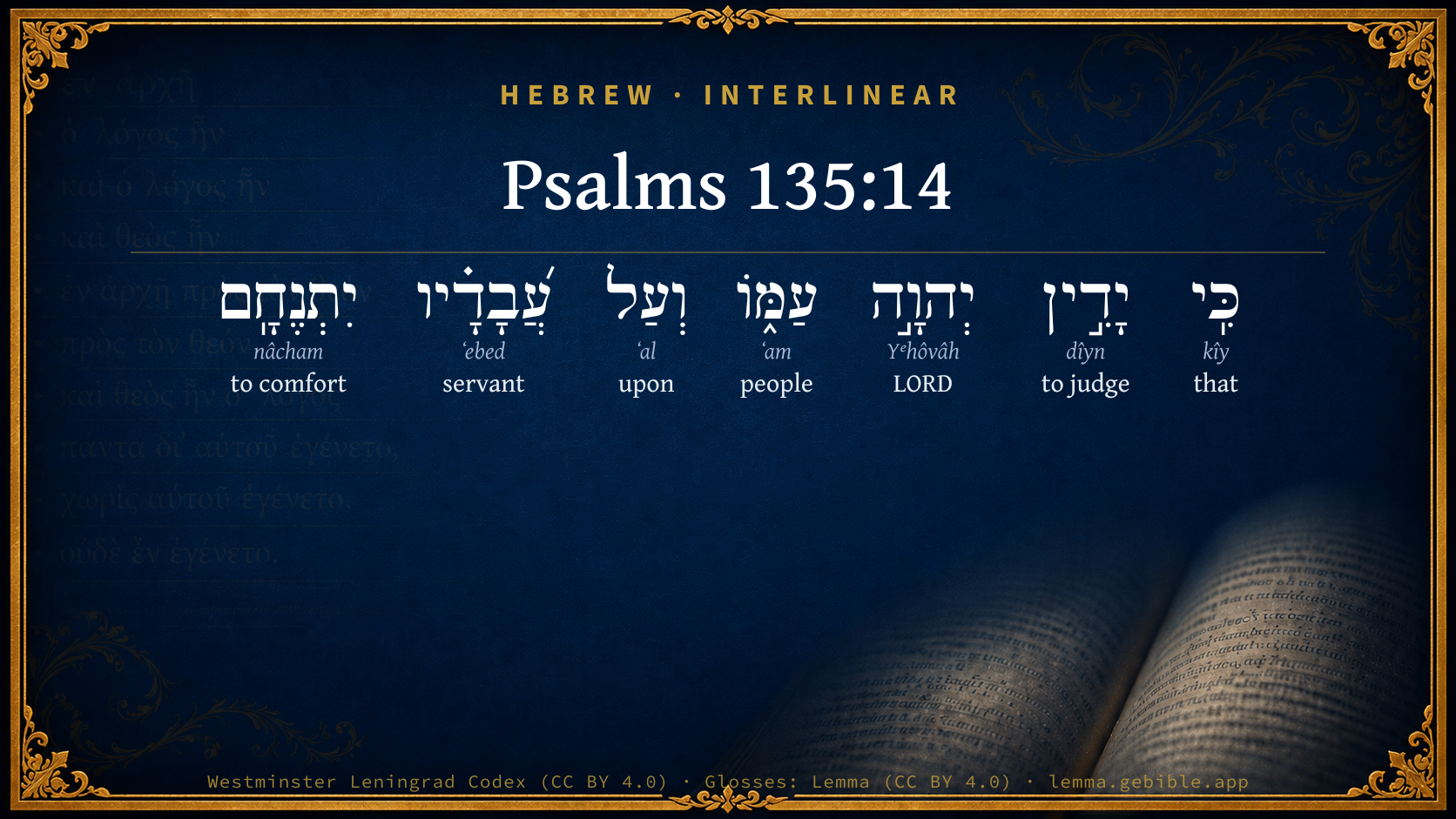
Psalms 135:14

Hebrew (Westminster Leningrad Codex) Psalms 135:14 appears in the Hebrew Old Testament. The text above is from the Westminster Leningrad Codex. Each word links to its Strong’s number, a concise gloss, and parsing drawn from the Open Scriptures Hebrew Bible morphology. Click any word for its full Brown-Driver-Briggs (BDB) entry.
Download image
Cite this verse

Psalms 135:14 (World English Bible). Public Domain. Lemma interlinear Bible study tool, https://lemma.gebible.app/v/psalms/135/14.

Show BibTeX & RIS
BibTeX
RIS
English Translation
For Yahweh will judge his people, And have compassion on his servants.
World English Bible · Public Domain
Download a study sheet

One document with this verse’s original text, its word-by-word gloss line, the meaning frame, cross-references with their text, attributed commentary, and full source and license credits — printable, and it pastes into notes with its structure intact.

This verse Autodidact and up

Study sheet (.html) Plain text (.txt)

A passage Seminary Student

Up to 50 verses in one chapter. A passage sheet keeps up to 6 commentary sources and 12 cross-references per verse, in the order this page ranks them, and says so on the sheet whenever that leaves anything out. Ask for a single verse and you get the Autodidact verse sheet above.

Everything on this page stays free to read, with no account — the sheet is a download of what is already on screen, not access to it.

Want to remove ads? Support Godless Engineer
Compare translations 3

The same verse in 3 English versions, stacked beneath the original-language interlinear above. Click any original word for its lexicon entry.

Each is an independent rendering of the whole verse — the interlinear is not word-aligned to these translations.

Highlighted words mark where these versions differ — a whole-verse word diff, not a word-by-word alignment.

  • World English Bible Public Domain
    For Yahweh will judge his people, And have compassion on his servants.
  • King James Version Public Domain
    For the LORD will judge his people, and he will repent himself concerning his servants.
  • unfoldingWord Literal Text CC BY-SA 4.0
    For Yahweh vindicates his people, and he has compassion on his servants.

unfoldingWord Literal Text — © unfoldingWord, licensed CC BY-SA 4.0. Word-aligned USFM3 via Door43 (git.door43.org/unfoldingWord/en_ult).

Versions to compare (up to 4)

3 of 4 selected

Show all 17 translations

Every available English version of this verse, each an independent rendering of the whole verse.

  • World English Bible Public Domain
    For Yahweh will judge his people, And have compassion on his servants.
  • Berean Standard Bible Public Domain
    For the LORD will vindicate His people and will have compassion on His servants.
  • Majority Standard Bible Public Domain
    For the LORD will vindicate His people and will have compassion on His servants.
  • King James Version Public Domain
    For the LORD will judge his people, and he will repent himself concerning his servants.
  • American Standard Version (1901) Public Domain
    For Jehovah will judge his people, And repent himself concerning his servants.
  • Revised Version (1885) Public Domain
    For the LORD shall judge his people, and repent himself concerning his servants.
  • Geneva Bible (1599) Public Domain
    For the Lord will iudge his people, and be pacified towardes his seruants.
  • Young's Literal Translation Public Domain
    For Jehovah doth judge His people, And for His servants comforteth Himself.
  • Literal Standard Version CC BY-SA 4.0
    For YHWH judges His people, || And comforts Himself for His servants.
  • Unlocked Literal Bible CC BY-SA 4.0
    For Yahweh defends his people and has compassion on his servants.
  • unfoldingWord Literal Text CC BY-SA 4.0
    For Yahweh vindicates his people, and he has compassion on his servants.
  • Darby Bible Public Domain
    For Jehovah will judge his people, and will repent in favour of his servants.
  • World Messianic Bible Public Domain
    For the LORD will judge his people and have compassion on his servants.
  • Webster's Bible Public Domain
    For the LORD will judge his people, and he will repent concerning his servants.
  • Free Bible Version CC BY-SA 4.0
    The Lord will vindicate his people; he will show compassion to those who follow him.
  • Bible in Basic English Public Domain
    For the Lord will be judge of his people's cause; his feelings will be changed to his servants.
  • JPS Tanakh (1917) Public Domain
    For the LORD will judge His people, and repent Himself for His servants.

Literal Standard Version (2020), Covenant Press — licensed CC BY-SA 4.0. Text via the HelloAO Bible API (eBible.org). Unlocked Literal Bible (unfoldingWord) — licensed CC BY-SA 4.0. Text via the HelloAO Bible API (eBible.org). unfoldingWord Literal Text — © unfoldingWord, licensed CC BY-SA 4.0. Word-aligned USFM3 via Door43 (git.door43.org/unfoldingWord/en_ult). Free Bible Version, Dr. Jonathan Gallagher — licensed CC BY-SA 4.0. Text via the HelloAO Bible API (eBible.org).

Word by word

More ways to search: Search by grammar → Find every occurrence → Compare this word →

Practice this passage: Drill this verse → Learn its vocabulary →

About this verse

These counts appear in no published source. They are computed here, from the morphology-tagged text and Lemma’s own curated glosses. What Lemma adds →

7
words
7
distinct lemmas
Wisdom
section

Notable vocabulary

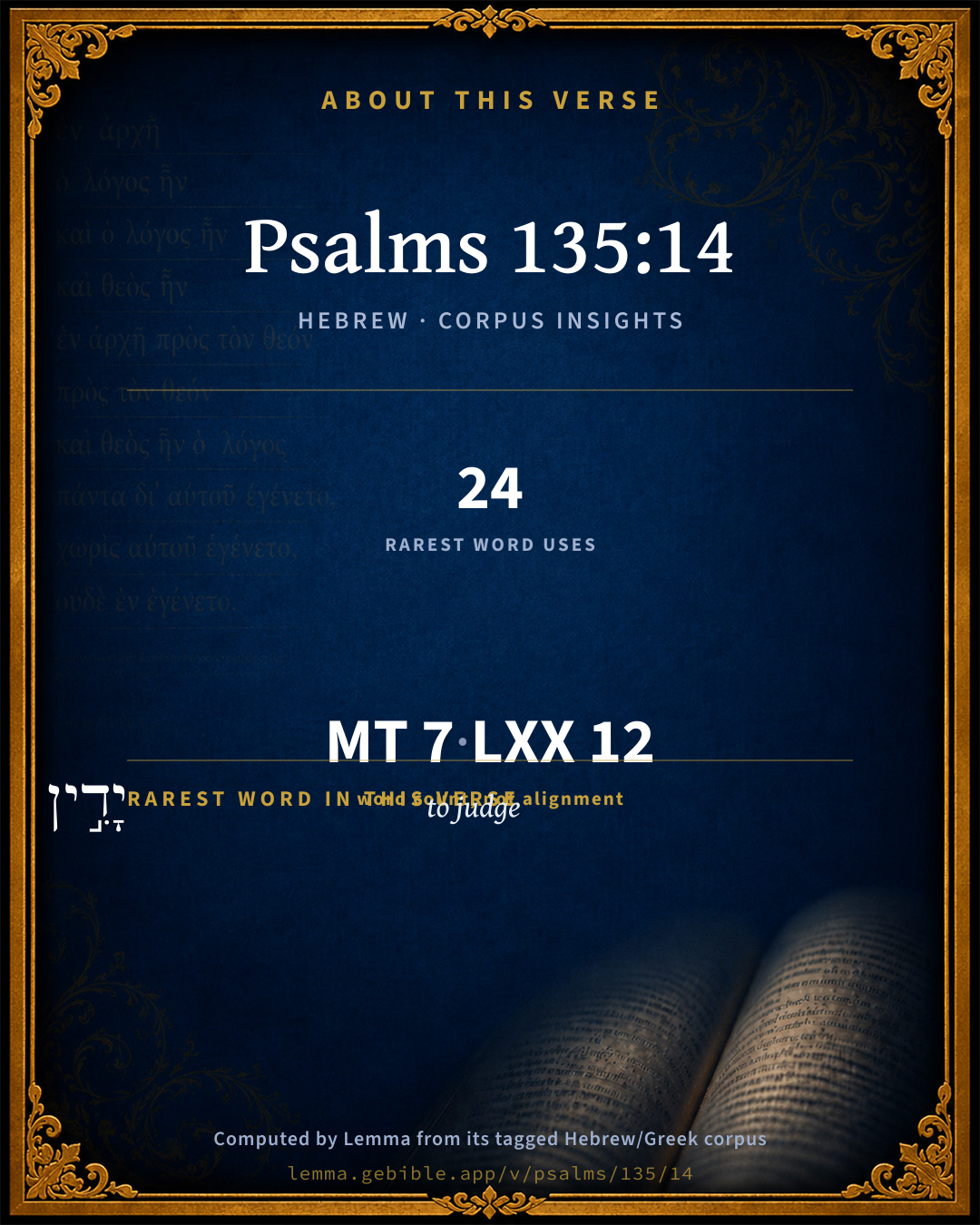
The rarest word here is יָדִ֣ין to judge H1777 — appearing just 24 times in the whole Hebrew Bible.

Shared distinctive vocabulary

יָדִ֣ין to judge H1777 occurs in 24 verses of the Hebrew Bible. Also found in:

Grammatical profile

  • 2 verbs
  • 3 nouns
  • 1 preposition
  • 1 conjunction

Verb forms

  • יָדִ֣ין Qal · Imperfect
  • יִתְנֶחָֽם Hithpael · Imperfect

Hebrew & Septuagint length

In English translation the verse runs 12 words from the Hebrew and 13 from the Septuagint (LXX English) — closely comparable.

A rough comparison of the two English renderings, which tokenize alike — not a word-level alignment.

Word counts can differ between the Hebrew and the Greek without any difference in meaning — e.g. the Hebrew direct-object marker אֵת has no separate Greek word, and Greek often adds the article ὁ.

In the original languages it is 7 Hebrew tokens and 12 Greek tokens — but the two are counted differently (Hebrew bundles its prefixes and suffixes into one token; the Greek is in lemma form), so that isn’t a like-for-like length.

Cross-references

11

Topical passages linked to Psalms 135:14 in the Treasury of Scripture Knowledge — connected by theme and wording, ordered by reader-vote popularity; previews shown in the World English Bible.

  • Deuteronomy 32:36 For Yahweh will judge his people, Repent himself for his servants; When he sees that [their] power is gone, There is none [remaining], shut up or left at large.
  • Psalms 7:8 Yahweh administers judgment to the peoples. Judge me, Yahweh, according to my righteousness, And to my integrity that is in me.
  • Psalms 50:4 He calls to the heavens above, To the earth, that he may judge his people:
  • Jonah 4:2 He prayed to Yahweh, and said, "Please, Yahweh, wasn't this what I said when I was still in my own country? Therefore I hurried to flee to Tarshish, for I knew that you are a gracious God, and merciful, slow to anger, and abundant in loving kindness, and you repent of the evil.
  • Judges 10:16 They put away the foreign gods from among them, and served Yahweh; and his soul was grieved for the misery of Israel.
  • 1 Chronicles 21:15 God sent an angel to Jerusalem to destroy it: and as he was about to destroy, Yahweh saw, and he repented him of the evil, and said to the destroying angel, It is enough; now stay your hand. The angel of Yahweh was standing by the threshing floor of Ornan the Jebusite.
  • Hosea 11:8–9 "How can I give you up, Ephraim? How can I hand you over, Israel? How can I make you like Admah? How can I make you like Zeboiim? My heart is turned within me, My compassion is aroused.
  • Amos 7:3 Yahweh relented concerning this. "It shall not be," says Yahweh.
  • Amos 7:6 Yahweh relented concerning this. "This also shall not be," says the Lord Yahweh.
  • Psalms 90:13 Relent, Yahweh! How long? Have compassion on your servants!
  • Psalms 96:13 Before Yahweh; for he comes, For he comes to judge the earth. He will judge the world with righteousness, The peoples with his truth.

Cross-references courtesy of OpenBible.info (CC BY 4.0).

Hebrew and Greek witnesses Masoretic Hebrew ↔ Greek Septuagint

The same verse in the two great witnesses to the Old Testament, shown verse-for-verse.

You’re reading Greek Psalm 134 (Hebrew Psalm 135). The Septuagint counts the superscription, so verse numbers can differ from the Hebrew — chapter-level alignment, not verse-by-verse. Numbering follows Rahlfs.

These are two independent witnesses, not word-aligned to each other, and the Septuagint is shown in lemma (dictionary) form.

Hebrew Psalms 135:14 Masoretic · Westminster Leningrad Codex

כִּֽי יָדִ֣ין יְהוָ֣ה עַמּ֑וֹ וְעַל עֲ֝בָדָ֗יו יִתְנֶחָֽם

For Yahweh will judge his people, And have compassion on his servants.

World English Bible · Public Domain

Greek LXX Greek Psalm 134:14 Septuagint · lemma form

ὅτι κρίνω κύριος ὁ λαός αὐτός καί ἐπί ὁ δοῦλος αὐτός παρακαλέω

For the Lord shall judge his people, and comfort himself concerning his servants.

LXX2012 (modern English Septuagint) · Public Domain

Hebrew: Westminster Leningrad Codex (CC BY 4.0). Greek: Septuagint (public domain); English from LXX2012 (modern English Septuagint) (Public Domain). How the Septuagint differs from the Hebrew →

Commentary

Notes on Psalms 135:14 from classic Christian and Jewish commentators (each source and its license shown beneath its notes). The classic Christian expositions comment on the surrounding passage and are grouped to its opening verse, so a note may address several verses; the Jewish commentaries on the Tanakh (Rashi and others) are per-verse, so they appear only where the commentator wrote on this verse.

Lemma curates 59 commentaries, every one of them public domain or Creative Commons licensed, each selected and text-cleaned for this edition rather than reprinted as found. About our sources →

Trapp's Complete Commentary

John Trapp

Psa 135:14 For the LORD will judge his people, and he will repent himself concerning his servants.

Ver. 14. For the Lord will judge his people] Iudicabit, id est vindicabit, he will preserve them, and provide for their welfare.

And he will repent himself] This is mutatio rei non Dei, effectus non affectus. Some render it, He will be propitious; others, He will take comfort in his servants. See Jdg 10:16.

John Trapp, A Commentary or Exposition upon All the Books of the Old and New Testament (1647–1656) — public domain. Text from a community e-Sword module.

J. A. Alexander on Psalms

Joseph Addison Alexander

14. (Psa 135:14) For Jehovah will judge his people, and for the sake of his servants will repent. He will fulfil the promise in Deut. xxxii. 36. He will judge (i.e. do justice to) his people. See above, on Ps. lxxii. 2. For the sense in which repentance is ascribed to God, see above, on Psa 90:13.

Joseph Addison Alexander, The Psalms Translated and Explained (1850) — public domain. Text from a community e-Sword module.

Geneva Bible (1599)

Geneva Bible translators

That is, govern and defend his people.

Geneva Bible (1599) marginal notes — public domain. Text via Bolls.life.

Adam Clarke's Commentary

Verse 14. The Lord will judge his people] He will do them justice against their enemies.

Adam Clarke's Commentary on the Bible (1810–1826) — public domain. Text from a community e-Sword/MySword module.

Ellicott's Commentary for English Readers

(14) From Deu_32:36.

Judge—i.e., see them righted.

A Bible Commentary for English Readers, edited by Charles John Ellicott (1878–1897) — public domain. Text from a community e-Sword module.

The Cambridge Bible for Schools and Colleges

gen. ed. J. J. S. Perowne

14. Taken verbatim from Deu_32:36; cp. Psa_90:13. In virtue of His relation to Israel He will do them justice, and not finally abandon them.

The Cambridge Bible for Schools and Colleges (gen. ed. J. J. S. Perowne; Cambridge University Press, 1878–1918) — public domain. Text from a community e-Sword module.

John Gill's Exposition

The idols of the Heathen are silver and gold,.... This, with what follows, is observed, to show that when God judges his people, and takes vengeance on their enemies, the idols they serve will not be able to protect them, and deliver them out of his hands; and also to prove what is before asserted, that our Jehovah is great above all gods, Psa 135:5; the matter of which they are made is at best gold and silver, which are the dust and metals of the earth, or what the prophet calls thick clay, Hab 2:6; and are the creatures of Jehovah, and at his dispose, who says, the silver and the gold are mine, Hag 2:8; and who is infinitely above them in value and worth; even the knowledge of him, and the words of his mouth, doctrines, and precepts, are better than gold and silver, Pro 3:14;

the work of men's hands; which they form out of gold and silver into such shapes and figures, and therefore can never have deity in them; and a most stupid thing it is to imagine that the Godhead is like to gold and silver, graven by art and man's device, Act 17:29; See Gill on Psa 115:4.

John Gill's Exposition of the Whole Bible (1746–1763) — public domain (CC PDM 1.0). Text via the HelloAO Bible API.

Albert Barnes' Notes on the Bible

For the Lord will judge his people - He will interpose in their behalf by his judgments, or by directing the course of events in their favor. This language is copied literally from Deu 32:36 : “For the Lord shall judge his people, and repent himself for his servants.” It is there a part of the song of Moses after the journey through the wilderness, after smiting the kings of the Amorites and of Bashan; and when, delivered from their enemies, the Israelites had come to the borders of the promised land, Deut. 31. The language was, therefore, especially appropriate to the design of this psalm.

And he will repent himself concerning his servants - In behalf of his people. That is, he will do as if he repented, or had changed his mind. He will stay his judgments. He will not suffer his people to be destroyed. He will not permit the judgments which seemed to threaten their entire ruin to be carried out to the full. They shall be arrested midway as if God had then changed his mind. Of course, all this is language accommodated to human weakness, and to the manner of speaking among people.

Albert Barnes' Notes on the Bible (1834–1885) — public domain. Text from a community e-Sword/MySword module.

Matthew Poole's English Annotations

Will judge his people; will in due time plead the cause of his people, or give judgment for them, as this phrase is used, Deu 32:36; Jer 5:28; 22:16.

He will repent himself concerning his servants; he will recall that severe sentence which for their sins he had passed upon them, and be reconciled to them.

Matthew Poole's English Annotations on the Holy Bible (1683–1685) — public domain. Text from a community e-Sword/MySword module.

The Treasury of David

Charles H. Spurgeon

Ver. 14. For the LORD will judge his people. He will exercise personal discipline over them, and not leave it to their foes to maltreat them at pleasure. When the correction is ended he will arise and avenge them of their oppressors, who for a while were used by him as his rod. He may seem to forget his people, but it is not so; he will undertake their cause and deliver them. The judges of Israel were also her deliverers, and such is the Lord of hosts: in this sense as ruling, preserving, and delivering his chosenJehovah will judge his people. And he will repent himself concerning his servants. When he has smitten them, and they lie low before him, he will pity them as a father pitieth his children, for he doth not afflict willingly. The Psalm speaks after the manner of men: the nearest description that words can give of the Lord's feeling towards his suffering servants is that he repents the evil which he inflicted upon them. He acts as if he had changed his mind and regretted smiting them. It goes to the heart of God to see his beloved ones oppressed by their enemies: though they deserve all they suffer, and more than all, yet the Lord cannot see them smart without a pang. It is remarkable that the nations by which God has afflicted Israel have all been destroyed as if the tender Father hated the instruments of his children's correction. The chosen nation is here called, first, "his people", and then "his servants:" as his people he judges them, as his servants he finds comfort in them, for so the word may be read. He is most tender to them when he sees their service; hence the Scripture saith, "I will spare them, as a man spareth his own son that serveth him." Should not the "servants" of God praise him? He plagued Pharaoh's servants; but as for his own he has mercy upon them, and returns to them in love after he has in the truest affection smitten them for their iniquities. "Praise him, O ye servants of the Lord."

Ver. 14. The LORD will judge his people. Others would like to do it, but must not. The world has seven judgment days in every week, but shall not be able to condemn the saints. He himself will judge. How will he judge them

1. Their persons, as to whether they are in or out of Christ.

2. Their principles, as to whether they are genuine or spurious.

3. Their prayers, as to whether they are availing or useless.

4. Their profession, as to whether it is true or false.

5. Their procedure, as to whether it is good or bad. W. J.

Ver. 14.

1. The position of believers his people.

2. The discipline of God's family.

3. The tenderness of the Lord to them.

4. The safety of believers: they are still the Lord's.

Psalms 135:15*

Charles H. Spurgeon's The Treasury of David (1869–1885) — public domain. Psalms only. Text from a community e-Sword/MySword module.

Whedon's Commentary on the Bible

Daniel D. Whedon

14. Repent himself concerning his servants—That is, will change his method of treating them, and turn away his judgments, and remember mercy, when they turn to him. The author here undoubtedly glances at the recent deliverance from Babylon.

Daniel D. Whedon (gen. ed.), Commentary on the Old and New Testaments (1874–1909) — public domain. Text from a community e-Sword module.

The Pulpit Commentary

For the Lord will judge his people; i.e. will right them whenever they are wronged. (see Exo_2:23-25 Exo_3:7-9 Exo_6:6 Psa_54:1-3) And he will repent himself concerning his servants. God "will not keep his anger for ever". (Psa_103:9) When he has sufficiently chastised his sinful servants, he will "repent," or "relent" (Kay, Cheyne), with respect to them, and receive them back into favor. The history contained in the Book of Judges strongly illustrates this statement. (Jud 3:6-11, 12-30 4:1-3, 13-16 6:1-16 10:6-18 11:4-33 13:1-5, etc.)

The Divine repentances.

The explanation is often made that the changes of Divine plans are responsive to changes in the circumstances of God"s people. It is seeing deeper into the heart of truth to see that the Divine repentances even answer to the changing moods of God"s people. His "repenting himself concerning his servants" is really his "having compassion on them;" and that is responding to their moods. The separate meanings of the word "repentance" have often been presented, and the very limited senses in which the term can be applied to God have been variously shown. It represents the Divine responsiveness, which is as perfect as any other Divine attribute. It greatly helps us to see clearly that the Divine repentance is a perfect thing, because repentance, though it may be a right thing in man, is closely associated with frailty and evil. Repentance involves change of plan; and this must be based on change of mind. But we have constantly to change our minds and change our plans, in order to meet new conditions; and we never dream of such changing being wrong. They are not made wrong by calling them "repentances." It is the association of sin with the change which brings in the element of regret which characterizes human repentance; but as there is no sin in God, there can be no regret; and we must eliminate these features from repentance when we apply the term to God.

I THE DIVINE REPENTANCE IS RELATIVE TO MAN. There is no such thing as change in God, as repentance in God relative to the world of things. This theological truth science does but express by the "invariability of natural law." There is no created thing that has independent action, so nothing can ever make new conditions for God to adjust himself to. Man alone can do this, because he can act independently.

II THE DIVINE REPENTANCE IS RELATIVE TO MAN"S CIRCUMSTANCES, There is a sense in which man is ever putting himself into fresh circumstances. What should we have to say of the helplessness of God, if he could not adjust himself to new conditions?

III THE DIVINE REPENTANCE IS RELATIVE TO MAN"S MOODS. For the Divine relations are spiritual; they mainly concern the man himself. And changing spiritual moods require wise and gracious adjustments on the part of God. R.T.

The Pulpit Commentary (1880–1919), ed. H.D.M. Spence-Jones & Joseph S. Exell — public domain. Text from a community e-Sword module.

John Wesley's Explanatory Notes

Judge - Will in due time plead the cause of his people. Repent - He will recall that severe sentence which for their sins he had passed upon them.

John Wesley, Explanatory Notes Upon the Whole Bible (1754–1765) — public domain. Text via the GEBible commentary corpus.

Scofield Reference Notes

C. I. Scofield

repent

(See Scofield "Zec 8:14").

The Scofield Reference Bible (1917 edition), notes by C. I. Scofield — public domain. Text from a community e-Sword module.

Rashi

Rabbi Shlomo Yitzchaki (Rashi)

For the Lord will judge His people He will judge their judgment from their enemies.

and relent He will have another thought.

Rashi on the Tanakh — English translations: “The Judaica Press complete Tanach with Rashi, translated by A. J. Rosenberg” (CC BY 4.0); “Pentateuch with Rashi's commentary by M. Rosenbaum and A.M. Silbermann, 1929-1934” (public domain); “The Metsudah Tanach series, Lakewood, N.J” (CC BY 4.0); and “The Book of Joshua, Metsudah Publications, 1997” (CC BY 4.0). Text via Sefaria.

Lesson kit

Teaching starters — assembled from the data on this page, not authored interpretation. Every prompt links to the verse data it draws on. Edit before teaching.

Psalms, in the Wisdom, opens this verse with 7 words (7 distinct Hebrew lemmas). Its most distinctive word is dîyn (“to judge”). A historical commentator’s framing appears above. Read the whole chapter for the surrounding context.

Discussion questions

  1. The word dîyn carries the sense “to judge.” How does it shape the verse?
  2. Genesis 6:3 shares the word «to judge» with this verse. How do the two illuminate each other?
  3. These translations render this verse differently. What is at stake in choosing one wording over another?
  4. The verb «יָדִ֣ין» is Qal Imperfect. How does its form color the action?
  5. Reading how Trapp's Complete Commentary and J. A. Alexander on Psalms read this verse, where do the two commentators agree and where do they part?

Things to notice

Reading settings

Reading text

Shown beneath each verse's original-language words.

Old Testament
Old Testament edition

Read the OT as the Masoretic Hebrew (MT) or the Greek Septuagint (LXX).

English shown for the Greek Septuagint (in the Hebrew ↔ Greek comparison).

Comparing translations? Open the Compare panel on any verse page to stack up to four side by side.