
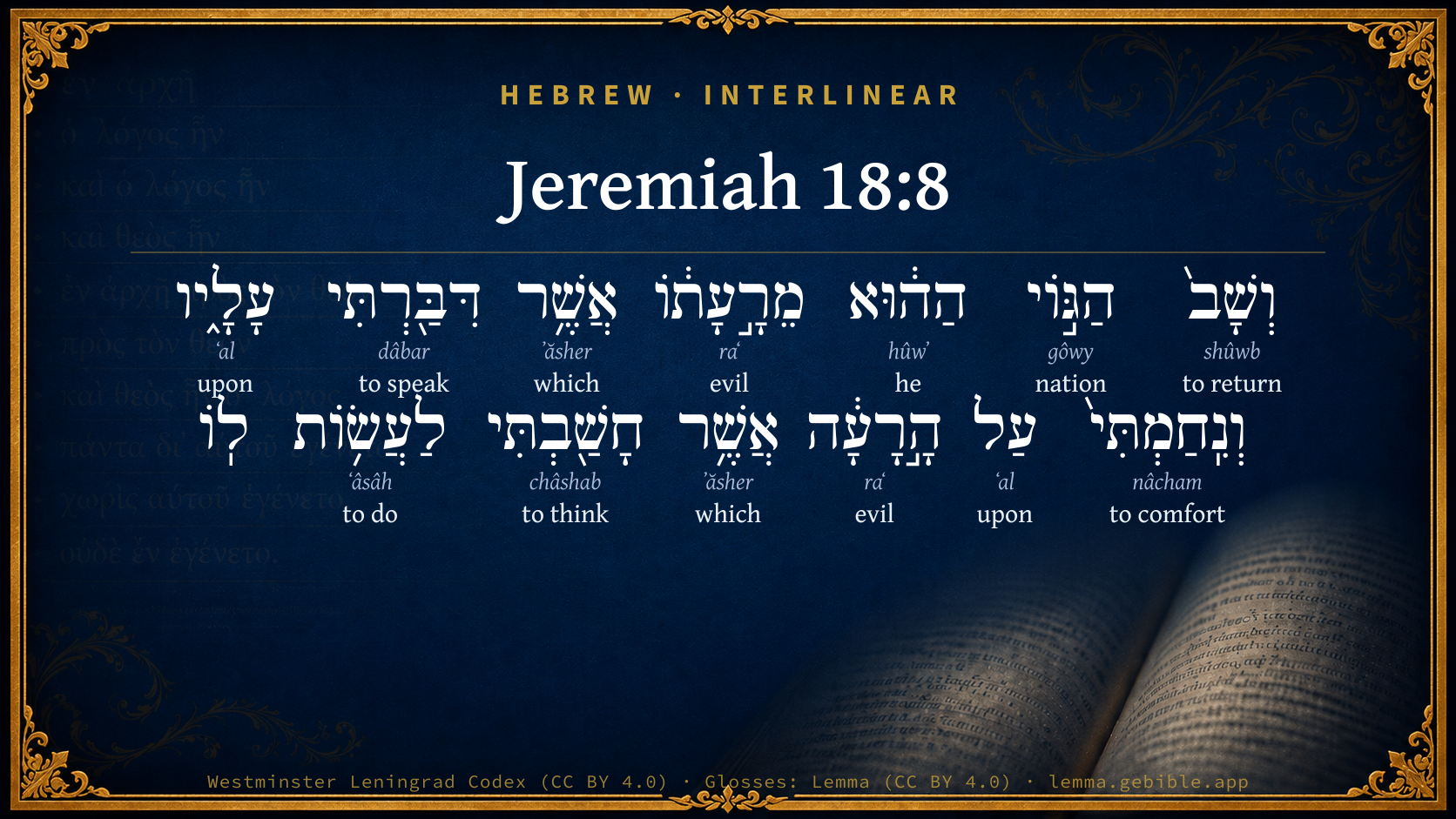
Jeremiah 18:8

Hebrew (Westminster Leningrad Codex) Jeremiah 18:8 appears in the Hebrew Old Testament. The text above is from the Westminster Leningrad Codex. Each word links to its Strong’s number, a concise gloss, and parsing drawn from the Open Scriptures Hebrew Bible morphology. Click any word for its full Brown-Driver-Briggs (BDB) entry.
Download image
Cite this verse

Jeremiah 18:8 (World English Bible). Public Domain. Lemma interlinear Bible study tool, https://lemma.gebible.app/v/jeremiah/18/8.

Show BibTeX & RIS
BibTeX
RIS
English Translation
if that nation, concerning which I have spoken, turn from their evil, I will repent of the evil that I thought to do to them.
World English Bible · Public Domain
Download a study sheet

One document with this verse’s original text, its word-by-word gloss line, the meaning frame, cross-references with their text, attributed commentary, and full source and license credits — printable, and it pastes into notes with its structure intact.

This verse Autodidact and up

Study sheet (.html) Plain text (.txt)

A passage Seminary Student

Up to 50 verses in one chapter. A passage sheet keeps up to 6 commentary sources and 12 cross-references per verse, in the order this page ranks them, and says so on the sheet whenever that leaves anything out. Ask for a single verse and you get the Autodidact verse sheet above.

Everything on this page stays free to read, with no account — the sheet is a download of what is already on screen, not access to it.

Want to remove ads? Support Godless Engineer
Compare translations 3

The same verse in 3 English versions, stacked beneath the original-language interlinear above. Click any original word for its lexicon entry.

Each is an independent rendering of the whole verse — the interlinear is not word-aligned to these translations.

Highlighted words mark where these versions differ — a whole-verse word diff, not a word-by-word alignment.

  • World English Bible Public Domain
    if that nation, concerning which I have spoken, turn from their evil, I will repent of the evil that I thought to do to them.
  • King James Version Public Domain
    If that nation, against whom I have pronounced, turn from their evil, I will repent of the evil that I thought to do unto them.
  • unfoldingWord Literal Text CC BY-SA 4.0
    and that nation turns from its evil, which I have spoken against it, then I will relent concerning the disaster that I planned to do to it.

unfoldingWord Literal Text — © unfoldingWord, licensed CC BY-SA 4.0. Word-aligned USFM3 via Door43 (git.door43.org/unfoldingWord/en_ult).

Versions to compare (up to 4)

3 of 4 selected

Show all 18 translations

Every available English version of this verse, each an independent rendering of the whole verse.

  • World English Bible Public Domain
    if that nation, concerning which I have spoken, turn from their evil, I will repent of the evil that I thought to do to them.
  • Berean Standard Bible Public Domain
    But if that nation I warned turns from its evil, then I will relent of the disaster I had planned to bring.
  • Majority Standard Bible Public Domain
    But if that nation I warned turns from its evil, then I will relent of the disaster I had planned to bring.
  • King James Version Public Domain
    If that nation, against whom I have pronounced, turn from their evil, I will repent of the evil that I thought to do unto them.
  • American Standard Version (1901) Public Domain
    if that nation, concerning which I have spoken, turn from their evil, I will repent of the evil that I thought to do unto them.
  • Revised Version (1885) Public Domain
    if that nation, concerning which I have spoken, turn from their evil, I will repent of the evil that I thought to do unto them.
  • Geneva Bible (1599) Public Domain
    But if this nation, against whom I haue pronounced, turne from their wickednesse, I will repent of the plague that I thought to bring vpon them.
  • Douay-Rheims (1899) Public Domain
    If that nation against which I have spoken, shall repent of their evil, I also will repent of the evil that I have thought to do to them.
  • Young's Literal Translation Public Domain
    And that nation hath turned from its evil, Because I have spoken against it, Then I have repented of the evil that I thought to do to it.
  • Literal Standard Version CC BY-SA 4.0
    And that nation has turned from its evil, || Because I have spoken against it, || Then I have relented of the calamity that I thought to do to it.
  • Unlocked Literal Bible CC BY-SA 4.0
    But if the nation about which I have made that proclamation turns from its evil, then I will relent from the disaster that I was planning to bring upon it.
  • unfoldingWord Literal Text CC BY-SA 4.0
    and that nation turns from its evil, which I have spoken against it, then I will relent concerning the disaster that I planned to do to it.
  • Darby Bible Public Domain
    if that nation, concerning which I have spoken, turn from their evil, then I will repent of the evil that I thought to do unto them.
  • World Messianic Bible Public Domain
    if that nation, concerning which I have spoken, turns from their evil, I will repent of the evil that I thought to do to them.
  • Webster's Bible Public Domain
    If that nation against which I have pronounced, shall turn from their evil, I will repent of the evil that I thought to do to them.
  • Free Bible Version CC BY-SA 4.0
    However, if that nation I warned gives up its evil ways, then I will change my mind regarding the disaster I was about to bring.
  • Bible in Basic English Public Domain
    If, in that very minute, that nation of which I was talking is turned away from its evil, my purpose of doing evil to them will be changed.
  • JPS Tanakh (1917) Public Domain
    but if that nation turn from their evil, because of which I have spoken against it, I repent of the evil that I thought to do unto it.

Literal Standard Version (2020), Covenant Press — licensed CC BY-SA 4.0. Text via the HelloAO Bible API (eBible.org). Unlocked Literal Bible (unfoldingWord) — licensed CC BY-SA 4.0. Text via the HelloAO Bible API (eBible.org). unfoldingWord Literal Text — © unfoldingWord, licensed CC BY-SA 4.0. Word-aligned USFM3 via Door43 (git.door43.org/unfoldingWord/en_ult). Free Bible Version, Dr. Jonathan Gallagher — licensed CC BY-SA 4.0. Text via the HelloAO Bible API (eBible.org).

Word by word

More ways to search: Search by grammar → Find every occurrence → Compare this word →

Practice this passage: Drill this verse → Learn its vocabulary →

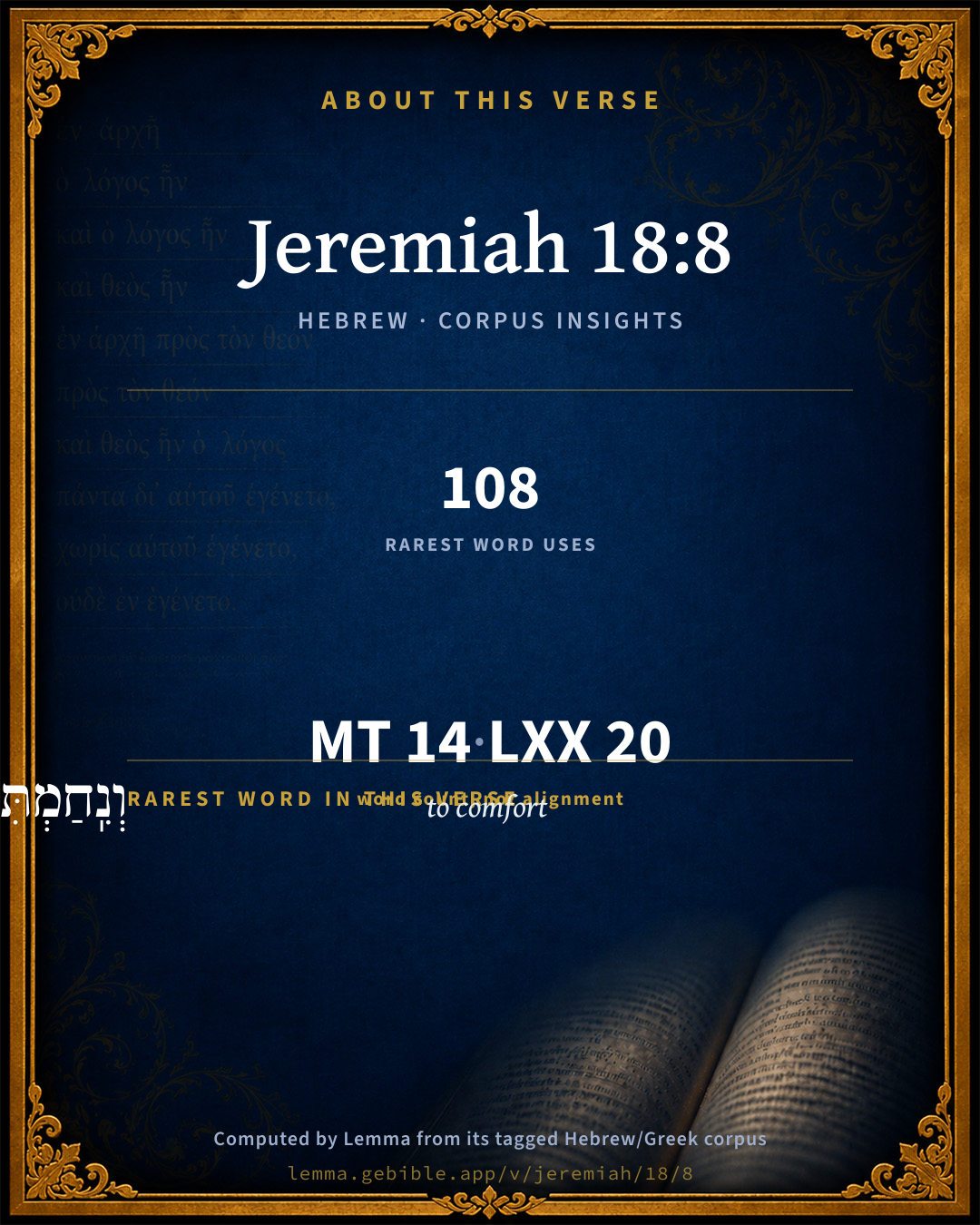
וְנִֽחַמְתִּי֙
nâcham
H5162
“and · to comfort”
Conjunction + Verb, Niphal, Sequential Perfect, 1st Person, Common, Singular
Part of Speech
Conjunction + Verb
Stem
Niphal
Form
Sequential Perfect
Person
1st Person
Gender
Common
Number
Singular
Full BDB Definition

Origin: a primitive root

TWOT: 1344

to be sorry, console oneself, repent, regret, comfort, be comforted - (Niphal) - to be sorry, be moved to pity, have compassion - to be sorry, rue, suffer grief, repent - to comfort oneself, be comforted - to comfort oneself, ease oneself - (Piel) to comfort, console - (Pual) to be comforted, be consoled - (Hithpael) - to be sorry, have compassion - to rue, repent of - to comfort oneself, be comforted - to ease oneself
  1. וְשָׁב֙ shûwb H7725 “and · to return” Conjunction + Verb, Qal, Sequential Perfect, 3rd Person, Masculine, Singular
  2. הַגּ֣וֹי gôwy H1471 “the · nation” Particle, Definite Article + Noun, Common, Masculine, Singular, Absolute
  3. הַה֔וּא hûwʼ H1931 “the · he” Particle, Definite Article + Pronoun, Personal, 3rd Person, Masculine, Singular
  4. מֵרָ֣עָת֔וֹ raʻ H7451 “from · evil · his” Preposition + Noun, Common, Feminine, Singular, Construct + Suffix, Personal, 3rd Person, Masculine, Singular
  5. אֲשֶׁ֥ר ʼăsher H834 “which” Particle, Relative
  6. דִּבַּ֖רְתִּי dâbar H1696 “to speak” Verb, Piel, Perfect, 1st Person, Common, Singular
  7. עָלָ֑יו ʻal H5921 “upon · him” Preposition + Suffix, Personal, 3rd Person, Masculine, Singular
  8. עַל ʻal H5921 “upon” Preposition
  9. הָ֣רָעָ֔ה raʻ H7451 “the · evil” Particle, Definite Article + Noun, Common, Feminine, Singular, Absolute
  10. אֲשֶׁ֥ר ʼăsher H834 “which” Particle, Relative
  11. חָשַׁ֖בְתִּי châshab H2803 “to think” Verb, Qal, Perfect, 1st Person, Common, Singular
  12. לַעֲשׂ֥וֹת ʻâsâh H6213 “to do” Preposition + Verb, Qal, Infinitive Construct

About this verse

These counts appear in no published source. They are computed here, from the morphology-tagged text and Lemma’s own curated glosses. What Lemma adds →

14
words
10
distinct lemmas
Prophets
section

Grammatical profile

  • 5 verbs
  • 3 nouns
  • 1 pronoun
  • 3 prepositions
  • 2 particles

Verb forms

  • וְשָׁב֙ Qal · Sequential Perfect
  • דִּבַּ֖רְתִּי Piel · Perfect
  • וְנִֽחַמְתִּי֙ Niphal · Sequential Perfect
  • חָשַׁ֖בְתִּי Qal · Perfect
  • לַעֲשׂ֥וֹת Qal · Infinitive Construct

Repetition

Words recur within this verse — often emphatic in Hebrew:

  • מֵרָ֣עָת֔וֹ evil H7451 ×2
  • עָלָ֑יו upon H5921 ×2
  • אֲשֶׁ֥ר which H834 ×2

Hebrew & Septuagint length

In the original languages it is 14 Hebrew tokens and 20 Greek tokens — but the two are counted differently (Hebrew bundles its prefixes and suffixes into one token; the Greek is in lemma form), so that isn’t a like-for-like length.

Cross-references

27

Topical passages linked to Jeremiah 18:8 in the Treasury of Scripture Knowledge — connected by theme and wording, ordered by reader-vote popularity; previews shown in the World English Bible.

  • Ezekiel 18:21 But if the wicked turn from all his sins that he has committed, and keep all my statutes, and do that which is lawful and right, he shall surely live, he shall not die.
  • Jeremiah 26:13 Now therefore amend your ways and your doings, and obey the voice of Yahweh your God; and Yahweh will repent him of the evil that he has pronounced against you.
  • Hosea 11:8 "How can I give you up, Ephraim? How can I hand you over, Israel? How can I make you like Admah? How can I make you like Zeboiim? My heart is turned within me, My compassion is aroused.
  • Jonah 3:9–10 Who knows whether God will not turn and repent, and turn away from his fierce anger, so that we might not perish?"
  • Jeremiah 26:3 It may be they will listen, and turn every man from his evil way; that I may repent me of the evil which I purpose to do to them because of the evil of their doings.
  • Judges 2:18 When Yahweh raised them up judges, then Yahweh was with the judge, and saved them out of the hand of their enemies all the days of the judge: for it repented Yahweh because of their groaning by reason of those who oppressed them and vexed them.
  • Joel 2:13–14 Tear your heart, and not your garments, And turn to Yahweh, your God; For he is gracious and merciful, Slow to anger, and abundant in loving kindness, And relents from sending calamity.
  • Amos 7:3–6 Yahweh relented concerning this. "It shall not be," says Yahweh.
  • Psalms 106:45 He remembered for them his covenant, And repented according to the multitude of his loving kindnesses.
  • Jeremiah 7:3–7 Thus says Yahweh of Hosts, the God of Israel, Amend your ways and your doings, and I will cause you to dwell in this place.
  • Exodus 32:12 Why should the Egyptians speak, saying, 'He brought them forth for evil, to kill them in the mountains, and to consume them from the surface of the earth?' Turn from your fierce wrath, and repent of this evil against your people.
  • Deuteronomy 32:36 For Yahweh will judge his people, Repent himself for his servants; When he sees that [their] power is gone, There is none [remaining], shut up or left at large.
  • Judges 10:15–16 The children of Israel said to Yahweh, We have sinned: do you to us whatever seems good to you; only deliver us, we pray you, this day.
  • 1 Kings 8:33–34 When your people Israel are struck down before the enemy, because they have sinned against you; if they turn again to you, and confess your name, and pray and make supplication to you in this house:
  • 2 Chronicles 12:6 Then the princes of Israel and the king humbled themselves; and they said, Yahweh is righteous.
  • Psalms 90:13 Relent, Yahweh! How long? Have compassion on your servants!
  • Psalms 135:14 For Yahweh will judge his people, And have compassion on his servants.
  • Isaiah 1:16–19 Wash yourselves, make yourself clean. Put away the evil of your doings from before my eyes; Cease to do evil.
  • Luke 13:3–5 I tell you, no, but, unless you repent, you will all perish in the same way.
  • Jeremiah 15:6 You have rejected me, says Yahweh, you are gone backward: therefore have I stretched out my hand against you, and destroyed you; I am weary with repenting.
  • Jeremiah 26:19 Did Hezekiah king of Judah and all Judah put him to death? Didn't he fear Yahweh, and entreat the favor of Yahweh, and Yahweh repented him of the evil which he had pronounced against them? Thus should we commit great evil against our own souls.
  • Jeremiah 36:3 It may be that the house of Judah will hear all the evil which I purpose to do to them; that they may return every man from his evil way; that I may forgive their iniquity and their sin.
  • Jeremiah 42:10 If you will still abide in this land, then will I build you, and not pull you down, and I will plant you, and not pluck you up; for I repent me of the evil that I have done to you.
  • Ezekiel 33:11 Tell them, As I live, says the Lord Yahweh, I have no pleasure in the death of the wicked; but that the wicked turn from his way and live: turn you, turn you from your evil ways; for why will you die, house of Israel?
  • Ezekiel 33:13 When I tell the righteous, that he shall surely live; if he trust to his righteousness, and commit iniquity, none of his righteous deeds shall be remembered; but in his iniquity that he has committed, therein shall he die.
  • Jonah 2:5–10 The waters surrounded me, Even to the soul. The deep was around me. The weeds were wrapped around my head.
  • Jonah 4:2 He prayed to Yahweh, and said, "Please, Yahweh, wasn't this what I said when I was still in my own country? Therefore I hurried to flee to Tarshish, for I knew that you are a gracious God, and merciful, slow to anger, and abundant in loving kindness, and you repent of the evil.

Cross-references courtesy of OpenBible.info (CC BY 4.0).

Hebrew and Greek witnesses Masoretic Hebrew ↔ Greek Septuagint

The same verse in the two great witnesses to the Old Testament, shown verse-for-verse.

These are two independent witnesses, not word-aligned to each other, and the Septuagint is shown in lemma (dictionary) form.

Hebrew Jeremiah 18:8 Masoretic · Westminster Leningrad Codex

וְשָׁב֙ הַגּ֣וֹי הַה֔וּא מֵרָ֣עָת֔וֹ אֲשֶׁ֥ר דִּבַּ֖רְתִּי עָלָ֑יו וְנִֽחַמְתִּי֙ עַל הָ֣רָעָ֔ה אֲשֶׁ֥ר חָשַׁ֖בְתִּי לַעֲשׂ֥וֹת לֽוֹ

if that nation, concerning which I have spoken, turn from their evil, I will repent of the evil that I thought to do to them.

World English Bible · Public Domain

Greek LXX Structure differs

In the Septuagint, Jeremiah is about an eighth shorter than the Hebrew and arranges its material differently — the Oracles Against the Nations (Hebrew chapters 46–51) appear in the middle of the Greek book, after 25:13. Because the chapter and verse boundaries do not line up, a verse-for-verse comparison with the Hebrew is not shown.

A verse-for-verse comparison isn’t shown here because the chapters and verses don’t line up. Switch to the LXX edition with the MT / LXX toggle above to read the Greek directly.

Hebrew: Westminster Leningrad Codex (CC BY 4.0). Greek: Septuagint (public domain); English from a public-domain English Septuagint. How the Septuagint differs from the Hebrew →

Targum (Aramaic paraphrase)

1

The Targum is the ancient Jewish Aramaic paraphrase of the Hebrew Scriptures — an interpretive translation, not the Hebrew text itself. Onkelos (literal) and Pseudo-Jonathan (expansive) render the Torah, and Jonathan the Prophets. Coverage is partial: where no permissively-licensed English translation exists for a verse, only the Aramaic is shown. This is verse-level text, not a word-by-word alignment to the Hebrew.

  1. Targum Jonathan Prophets (Joshua–Malachi)
    וִיתוּב עַמָא הַהוּא מִבִּישְׁתֵּיהּ דִגְזָרִית עֲלוֹהִי וְאֵיתוֹב מִן בִּישְׁתָּא דְחַשְׁבֵית לְמֶעְבַּד לֵיהּ:

    (no public-domain English translation for this verse)

    Targum Jonathan — Aramaic: “Mikraot Gedolot” (public domain). English: “Sefaria Community Translation” (CC0 1.0 (public-domain dedication)); “London "Chaldee Paraphrase," 1871” (public domain). Text via Sefaria.

Commentary

Notes on Jeremiah 18:8 from classic Christian and Jewish commentators (each source and its license shown beneath its notes). The classic Christian expositions comment on the surrounding passage and are grouped to its opening verse, so a note may address several verses; the Jewish commentaries on the Tanakh (Rashi and others) are per-verse, so they appear only where the commentator wrote on this verse.

Lemma curates 59 commentaries, every one of them public domain or Creative Commons licensed, each selected and text-cleaned for this edition rather than reprinted as found. About our sources →

Trapp's Complete Commentary

John Trapp

Jer 18:8 If that nation, against whom I have pronounced, turn from their evil, I will repent of the evil that I thought to do unto them.

Ver. 8. Turn from their evil.] If I may see such work among them, as at Nineveh God did. {Jon 3:10} He saw not their sackcloth and their ashes, but their repentance and works - those fruits of their faith.

I will repent of the evil.] Not by any change of my will, but by the willing of a change: mutatione Rei non Dei.

John Trapp, A Commentary or Exposition upon All the Books of the Old and New Testament (1647–1656) — public domain. Text from a community e-Sword module.

Geneva Bible (1599)

Geneva Bible translators

When the Scripture attributeth repentance unto God, it is not that he doeth contrary to that which he hath ordained in his secret counsel: but when he threateneth, it is a calling to repentance, and when he giveth man grace to repent, the threatening (which ever containeth a condition in it) taketh no place: and this the scripture calleth repentance in God, because it so appeareth to man’s judgment.

Geneva Bible (1599) marginal notes — public domain. Text via Bolls.life.

Jamieson, Fausset & Brown

Robert Jamieson, A. R. Fausset & David Brown

their evil--in antithesis to, "the evil that I thought to do."

repent--God herein adapts Himself to human conceptions. The change is not in God, but in the circumstances which regulate God's dealings: just as we say the land recedes from us when we sail forth, whereas it is we who recede from the land (Eze 18:21; Eze 33:11). God's unchangeable principle is to do the best that can be done under all circumstances; if then He did not take into account the moral change in His people (their prayers, &c.), He would not be acting according to His own unchanging principle (Jer 18:9-10). This is applied practically to the Jews' case (Jer 18:11; see Jer 26:3; Jon 3:10).

Jamieson, Fausset & Brown — Commentary Critical and Explanatory on the Whole Bible (1871) — public domain (CC PDM 1.0). Text via the HelloAO Bible API.

Adam Clarke's Commentary

Verse 8. See Clarke on Jer 18:7.

Adam Clarke's Commentary on the Bible (1810–1826) — public domain. Text from a community e-Sword/MySword module.

John Calvin's Commentaries

But the Prophet speaks first of punishment; Suddenly, he says, will I speak of a nation and of a kingdom, to pull down, to extirpate and to destroy; that is, even they who seem far from all danger shall find that they are exposed to my judgment. But if a nation, he says, turns from its wickedness, against whom I have spoken, then I will repent of the evil, etc. The Prophet no doubt intended to shut up the mouths of the Jews, who, as we have before seen, continually contended with God; for he could not convince them that the punishments were just which God inflicted on them for their sins. As then they were thus perverse in their wickedness, and hypocrisy also had hardened them the more, the Prophet says here in God’s name, “When I speak against a nation and threaten final ruin, if it repents, I shall be immediately reconciled to it; there is therefore no ground for the Jews to expostulate with me, as though I dealt with them too severely; for they shall find me reconcilable if they repent from the heart.” It follows then, that their obstinacy was the cause why God proceeded in his judgments, for the repentance of God means no other thing than what Scripture says elsewhere, that he is merciful, slow to wrath, and ready to forgive. (Numbers 14:18; Psalm 103:8.) He then here testifies, that nothing hindered the Jews from being in a better state but their own perverseness.

John Calvin's Commentaries (1540-1563) — public domain. Text from the Calvin Translation Society English edition (1840s-50s) via the Christian Classics Ethereal Library (ccel.org). Calvin's coverage is partial (roughly two-thirds of the Bible); uncommented books and verses are honest gaps, never fabricated. The 19th-century editor's footnotes and remarks are omitted so the notes are faithfully Calvin's own voice.

The Cambridge Bible for Schools and Colleges

gen. ed. J. J. S. Perowne

8. I will repent] speaking after the manner of men. The sense is, I will alter my treatment, for among men change of conduct implies change of purpose.

The Cambridge Bible for Schools and Colleges (gen. ed. J. J. S. Perowne; Cambridge University Press, 1878–1918) — public domain. Text from a community e-Sword module.

John Gill's Exposition

If it do evil in my sight,.... What is sinful, contrary to the law and will of God, openly and publicly, in a bold and daring manner:

that it obey not my voice: in my word, and by my prophets, but turn a deaf ear to them, and slight and despise all instructions, admonitions, and reproofs:

then I will repent of the good wherewith I said I would benefit them; or, "do them good" (t); that is, withhold it from them, and not bestow it on them; but, on the contrary, correct or punish them according to their deserts. Thus, though God is a sovereign God, yet, in the dispensations of his providence towards kingdoms and nations, he deals with them in such a merciful and equitable manner, that there is no just reason to complain of him; and yet he maintains and keeps up his power and authority, such as the potter exercises over the clay.

(t) "ad benefaciendum ei", Montanus; "ut benefacerem ei", Valablus, Pagninus; "benefacturum ei", Junius & Tremellius, Piscator.

John Gill's Exposition of the Whole Bible (1746–1763) — public domain (CC PDM 1.0). Text via the HelloAO Bible API.

Albert Barnes' Notes on the Bible

I will repent of the evil ... I will repent of the good - All God’s dealings with mankind are here declared to be conditional. God changeth not, all depends upon man’s conduct.

Albert Barnes' Notes on the Bible (1834–1885) — public domain. Text from a community e-Sword/MySword module.

Haydock's Catholic Bible Commentary

Shall repent, having free-will, though prevented by grace. (St. Jerome)

George Leo Haydock (1774–1849), Haydock's Catholic Family Bible and Commentary, 1859 edition — public domain. Excludes Psalms (Douay-Rheims chapter numbering differs from Protestant) and Deuterocanonical books (Catholic canon only).

Matthew Poole's English Annotations

If that nation, against whom I have pronounced, turn from their evil; if that nation leaveth off those sinful courses which I have by my prophets threatened with judgments;

I will repent of the evil that I thought to do unto them; I will also turn from the methods of my severe providence which I had resolved in case of their impenitency to proceed in against them. There is a difference betwixt repentance in man, and repentance as it is attributed to God; repentance in man must be, not only a change in action, but a change of heart; repentance as attributed to God never signifieth a change of heart, or purpose, or counsels, but only a change in action, all alteration of the course of his providence. Hence God in Scripture is said to repent, as in this text, and Jon 3:10. And it is also said of him, that he is not as man, that he should lie or repent, Num 23:19; 1Sa 15:29. God never changeth his counsels or purposes, though he often varieth his actions of providence, according to the behaviours of his creatures.

Matthew Poole's English Annotations on the Holy Bible (1683–1685) — public domain. Text from a community e-Sword/MySword module.

Whedon's Commentary on the Bible

Daniel D. Whedon

8. Repent — The strongest type of anthropopathic language applied to God, just as we ascribe the qualities of animate beings to inanimate; as “The sun rises;” “The shore recedes.”

Daniel D. Whedon (gen. ed.), Commentary on the Old and New Testaments (1874–1909) — public domain. Text from a community e-Sword module.

The Pulpit Commentary

Vers. 8-12. A never-to-be-forgotten principle of interpretation.

These verses plainly teach that all God"s threatenings, even the most terrible, and all God"s promises, even the most blessed, are conditional on the continuance of the moral character to which they were addressed. Now, this is

I A CORDIAL AGAINST DESPAIR. When the convicted sinner as the men of Nineveh hear the awful denunciations of God"s judgment, all hope seems to be forbidden. The Ninevites, to encourage themselves in a forlorn hope, could only say, "Who can tell whether God will be gracious?" But this and the like Scriptures, confirmed by so many facts of experience, forbid all such despair.

II A CHECK TO PRESUMPTION. How many prate concerning final perseverance who are not persevering at all except in sin and worldliness? But they need to be reminded of this sure condition, one which the great adversary of souls is ever striving to make us forget.

III AN EXPLANATION OF THE STERN WORDS OF SCRIPTURE. When one would give the alarm of fire he does not whisper the word. So when God would warn sinners he does not soften his words, but in most vivid manner sets before men the awful doom of the ungodly. Thus would God, by his terrors, scare men if naught else will do to "flee from the wrath to come," so that "he may repent of the evil he thought to do unto them." Such words are not the utterance of absolute decrees against any soul to whom they are addressed, but loving warnings to such soul to turn to God and live.

IV A REASON FOR ITS WORDS OF WARNING. These are found in varied form, addressed to disciples of Christ, to those to whom the most glorious promise had been made. See the sermon on the mount; how full of warnings! Therefore this conditionalness of God"s words speaks:

1. To the believer, and bids him" Be not high-minded, but fear." "If God spared not the natural branches, take heed lest he also spare not thee

2. To the ungodly. See the sure end of thy way; how awful! But see, too, God"s earnest desire that thou shouldest forsake that way. C.

The Pulpit Commentary (1880–1919), ed. H.D.M. Spence-Jones & Joseph S. Exell — public domain. Text from a community e-Sword module.

Scofield Reference Notes

C. I. Scofield

repent

(See Scofield "Zec 8:14").

The Scofield Reference Bible (1917 edition), notes by C. I. Scofield — public domain. Text from a community e-Sword module.

Rashi

Rabbi Shlomo Yitzchaki (Rashi)

of its evil for which I spoke concerning it Of its sins for which I spoke concerning it. to uproot and to demolish (depayser [?] in French).

I will repent And I will think another thought.

Rashi on the Tanakh — English translations: “The Judaica Press complete Tanach with Rashi, translated by A. J. Rosenberg” (CC BY 4.0); “Pentateuch with Rashi's commentary by M. Rosenbaum and A.M. Silbermann, 1929-1934” (public domain); “The Metsudah Tanach series, Lakewood, N.J” (CC BY 4.0); and “The Book of Joshua, Metsudah Publications, 1997” (CC BY 4.0). Text via Sefaria.

Lesson kit

Teaching starters — assembled from the data on this page, not authored interpretation. Every prompt links to the verse data it draws on. Edit before teaching.

Jeremiah, in the Prophets, opens this verse with 14 words (10 distinct Hebrew lemmas). Its most distinctive word is nâcham (“to comfort”). A historical commentator’s framing appears above. Read the whole chapter for the surrounding context.

Discussion questions

  1. The word nâcham carries the sense “to comfort.” How does it shape the verse?
  2. Ezekiel 18:21 shares this passage’s theme. How do the two illuminate each other?
  3. “evil” occurs 2× in this one verse. What is the effect of the repetition?
  4. These translations render this verse differently; the difference is in the English rendering, not the original. What questions does that raise?
  5. The verb «וְשָׁב֙» is Qal Sequential Perfect. How does its form color the action?
  6. Reading how Trapp's Complete Commentary and Geneva Bible (1599) read this verse, where do the two commentators agree and where do they part?

Things to notice

Reading settings

Reading text

Shown beneath each verse's original-language words.

Old Testament
Old Testament edition

Read the OT as the Masoretic Hebrew (MT) or the Greek Septuagint (LXX).

English shown for the Greek Septuagint (in the Hebrew ↔ Greek comparison).

Comparing translations? Open the Compare panel on any verse page to stack up to four side by side.